Showing posts sorted by relevance for query strategic assessment. Sort by date Show all posts

Sunday, January 25, 2009

Random Notes on Strategic Assessment and Strategy Development


One major reason why projects fail is poor intelligence gathering. If the intelligence gathering process is wrong, then the gathered intelligence is incorrect. Therefore, the strategic assessment of the intelligence could be invalid. Now that the strategic assessment is invalid, what makes he or she think that their plan of action is going to be correct!?

In this global economy, do you have the inclination to waste time and resources?

#

Our Compass AE strategic assessment module is superior to the basic SWOT analysis
in terms of presenting a grand picture with strategic specifics and connecting the tactical specifics to the grand picture. Our process of assessing the competition is more than understanding their strengths and their weaknesses of the opposition and the possible opportunities and the threats of the grand situation. It is about understanding their strategic intent.

In our up and coming book, we will briefly touch on the differences
between our Compass AE's strategic assessment module and the SWOT process.


#

In future posts, we will explain how to integrate Colonel's Boyd OODA approach with our Compass AE methodology.

#

From our observations, some professionals do not have the tangible experience to defining or identifying a "tangible"grand picture. They would rather operate from the ground up. ... While not knowing what lies the road ahead, they are making new changes every 2-5 days. Time and resources are being wasted again.

Observe what they do and hear what they say. They always talk about objectives. Rarely do they know the actual approach. Sometimes they have a tendency to use general strategy principles in specific situations and
use specific strategy principles in general situations. In most cases, they have no awareness of what is the grand situation and how to connect their plan to it. Most of the time, they rarely deliver promptly, precisively and properly.

In a chaotic global economy, delivering your projects on time, on budget and on target is the key to success. With our Compass process, you can do it.


#

Building the Grand Picture

Once we has assessed the grand picture, we begin to build the Tangible Vision. The first step is to focus on understanding the end in mind. With our Compass AE process, the implementers focus on the end in mind by delineating the goal and then the operational objectives.

Side note: The Tangible Vision is a strategic overview model that enable you to focus on “the end in mind”. It is the bridge between the strategic assessment process and the operational planning stage of the project.

#

If the gathered intelligence and the strategic assessment process are correct, then the strategic assessment of the intelligence is valid. If the strategic assessment is valid, the project team's plan of action (based on the strategic assessment) is going to be correct.

Following are the steps to Compass AE process:
1. Perform proper intelligence gathering;
2. Validate the data;
3. Assess strategically
4. Validate the assessment of the data;
5. Build and Connect with the Tangible Vision; and
6. Lead with the Tangible Vision.

When a team properly defines the tactical objectives, the grand goal and the connections between it (the Tangible Vision), one can define the tactical requirements and the steps to completing the project

Don’t be a grand architect who focus on abstract dreams. Be a pragmatic architect-implementer who understands tangibility of the grand picture and how the operations connect to your goal.

With our Compass AE methodology, your project team will always hit their target, on time and on budget. :)


Collaboration360 Consultants
(C360). Copyright:2009 © All rights reserved
Copying, posting and reproduction in any form (without prior consent) is an infringement of copyright.

Tuesday, July 8, 2008

Our "Strategic Assessment" Chart

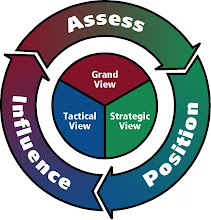
Following is our strategic assessment chart that we have developed and implemented for competitive analysis:


This chart is based on our understanding of Sun Tzu's The Art of War (90%) and other strategy classics (10%).

Our strategic assessment process will work with any industry.
In a later entry, we will explain the concept behind the chart.

In the next few months, a business magazine will be publishing our article titled "Strategic Assessment: Insights from the Art of War."

More to come.

Sunday, August 24, 2008

C360's Compass View of Strategy (2)

To succeed in one’s venture, one’s intelligence gathering process must be correct.

If the gathered intelligence and the implementation of the strategic assessment process are correct, then the strategic assessment of the intelligence is valid.

If the strategic assessment is valid, the project team's plan of action (based on the strategic assessment) will be correct.

The C360 View:
When the Compass team properly gathers
intelligence, they assess themselves, the competition and their grand settings. Then, they collaboratively build the Tangible Vision.

By using the Tangible Vision, the team properly defines the grand goal, the tactical objectives, and the connections between the objectives and the goal. Then they delineate the tactical requirements of each objective.


When the Compass team leads with their Tangible Vision, they perform the following:
  • minimize the costs;
  • mitigate the risks;
  • accelerate the delivery;
  • maximize the opportunities;
  • ensure the quality
At the end, success is the absolute.

Does your process enable your team to do the above?

If you are interested in knowing more about our Compass AE process, please contact us at service (att)collaboration360(dott)com.

Copyright: 2008 © Collaboration360 Consultants (C360 Consultants).
Copying, posting and reproduction in any form (without prior consent) is an infringement of copyright

Sunday, September 21, 2008

A Great Example of Strategic Assessment


Following is an article on how proper "strategic assessment" is done:

#

Who will win the Obama vs. Obama election?
Willie Brown Sunday, July 20, 2008


... Don't underestimate the right wing and the Libertarian types' ability to make it interesting - because they will.

And Steve Schmidt - the guy who's running John McCain's campaign - is like Karl Rove's son.

Schmidt is probably one of the best targeter of voters in the country. He really knows how to connect one-on-one with voters.

He doesn't just do polling like other consultants - he uses commercial market studies.

He reduces voting to who shops at Wal-Mart, Target and Costco and how to talk to them. He doesn't give a damn about Wilkes Bashford or Nordstrom shoppers.

He checks out what kind of cars voters are driving, where voters shop, what kind of things they buy, what programs they watch on TV, what they do on weekends.

Then he does the assessment and tailors the campaign's message to convince you that his candidate has your deepest interest at heart.

He was part of my team on the Indian gaming stuff and he ran Arnold Schwarzenegger's re-election campaign as well.

I can't figure out yet how he's going to market McCain, but I can tell you that just like Rove, we won't know how he did it until the election is over.


http://sfgate.com/cgi-bin/article.cgi?f=/c/a/2008/07/20/BAD511PR2F.DTL

This article appeared on page B - 1 of the San Francisco Chronicle


1. Gather information (competitive intelligence) properly
2. Assess the intelligence data properly and punctuality.
3. Build a strategic plan (Tangible Vision) based on the assessed data.
4.
Develop an operational plan based on the strategic plan.

Does it sound simple?

Any questions on our Strategic Assessment process, you can contact us at service [aatt] collaboration360 [ddott] com. More information on us can be found here.

Thanks!

M.E. Hom
Chief Architect of Collaboration360.com

Copyright: 2008 © Collaboration360 Consultants (C360 Consultants).
Copying, posting and reproduction in any form (without prior consent) is an infringement of copyright

Sunday, November 30, 2008

The Art of Strategic Assessment


When assessing our competitors, our clients and the grand settings, we ask many questions based on the principles of Sun Zi's Art of War and the rest of the Chinese eight strategy classics.

Following are some of the questions based on the ground level situations:
  • Who is on offense and who is on defense?
  • Who is taking the offensive initiative and who is responding properly?
  • Who is taking the unorthodox approach and who is taking the orthodox approach?
  • Who is in the state of vacuous and the state of substantial?
  • Who is reckless and who is weightless?
  • Who is profiting and who is being harmed?
  • Who is fighting under the state of security and who is fighting under the state of danger?
  • Who is willing to fight to the death and who is fighting to seek life?
  • Who is hungry and who is stated?
  • Who is fatigued and who is at ease?
  • Who is close to victory and who is close to total defeat?
  • Who is advancing and who is retreating at this moment?
  • Who is displaying the state of provocation and who is displaying the state of compulsion?
  • Who is implementing their plans from remote and who is implement from the ground zero?
  • Who is utilizing the "soft methods" and who is utilizing playing "hard methods"?
  • Who is displaying the image of "slowness" and who is displaying the image of "quickness"?
  • Who is displaying the image of "order" and who is displaying the image of "disorder"?
  • Who is displaying the emotion of anger and who is displaying the emotion of spirit?
  • Who is displaying the action of retreating and who is displaying the action of pursuing?
  • What is reality and what is illusion?
Is this how you assess yourself and your opposition?

With the strategic assessment module of our Compass AE process, one starts with a top down view and analyze their grand settings in terms of the following:
  • strategic position;
  • strategic advantage;
  • weaknesses and strengths;
  • competitive terrains;
  • competitive situations;
  • nine contingencies;
  • the planning of the strategic campaign;
  • the deployment of the implementing team;
  • the engaging of the team;
  • the use of intelligence;
  • the intent of the campaign; and
  • the strategic influence.
The strategic assessment module of our Compass AE process is more detailed than your usual SWOT process.

If you are interested in learning more about our Compass AE process, please e-mail us at service[aatt]collaboration360[dott]com
.

Copyright: 2008 © Collaboration360 Consultants (C360 Consultants).
Copying, posting and reproduction in any form
(without prior consent) is an infringement of copyright

Monday, May 26, 2008

Our View of Sunzi 's Strategic Approach

How we viewed the structure of Sun Zi's (Sun Tzu) strategic system:


#


Our Compass AE process of strategic assessment is based on the use of Sunzi (Sun Tzu) strategy principles.


#


#


/// note: The mindmaps listed above, were used in our
recent "Southern New Hampshire University" presentation.

#

By using our strategic assessment process, you are able to out-do your competition in terms of faster execution, minimize costs, mitigate risks, etc.

If you are interested in the specifics in using our strategic assessment process, please e-mail us at contactus(aatt)collaboration360(ddott)com. Otherwise you will have to wait for our white paper on Strategic Assessments sometime in 2009.

Sunday, May 3, 2009

The Dao of Strategic Assessment (16): Strategic Assessment's Golden Rule


In our future book, we will emphasize on some of the significant assessment points. ...

#
April 29, 2009
Poppies a Target in Fight Against Taliban
By DEXTER FILKINS

ZANGABAD, Afghanistan American commanders are planning to cut off the Taliban’s main source of money, the country’s multimillion-dollar opium crop, by pouring thousands of troops into the three provinces that bankroll much of the group’s operations.

The plan to send 20,000 Marines and soldiers into Helmand, Kandahar and Zabul Provinces this summer promises weeks and perhaps months of heavy fighting, since American officers expect the Taliban to vigorously defend what makes up the economic engine for the insurgency. The additional troops, the centerpiece of President Obama’s effort to reverse the course of the seven-year war, will roughly double the number already in southern Afghanistan. The troops already fighting there are universally seen as overwhelmed. In many cases, the Americans will be pushing into areas where few or no troops have been before.

Through extortion and taxation, the Taliban are believed to reap as much as $300 million a year from Afghanistan’s opium trade, which now makes up 90 percent of the world’s total. That is enough, the Americans say, to sustain all of the Taliban’s military operations in southern Afghanistan for an entire year.

Opium is their financial engine, said Brig. Gen. John Nicholson, the deputy commander of NATO forces in southern Afghanistan. That is why we think he will fight for these areas.

/// By assessing the economic and logistics points of the Taliban, the U.S. Military realized what was their primary source of their strength.

... Among the ways the Taliban are believed to make money from the opium trade is by charging farmers for protection; if the Americans and British attack, the Taliban will be expected to make good on their side of that bargain.

Indeed, Taliban fighters have begun to fight any efforts by the Americans or the British to move into areas where poppy grows and opium is produced.

... To offer an alternative to poppy farming, the American military is setting aside $250 million for agriculture projects like irrigation improvements and wheat cultivation. General Nicholson said that a $200 million plan for infrastructure improvements, much of it for roads to help get crops to market, was also being prepared. The vision, General Nicholson said, is to try to restore the agricultural economy that flourished in Afghanistan in the 1970s. That, more than military force, will defeat the Taliban, he said.

There is a significant portion of the enemy that we believe we can peel off with incentives, the general said. We can hire away many of these young men.

Even if the Americans are able to cut production, shortages could drive up prices and not make a significant dent in the Taliban’s profits.


/// One of the key objectives of the U.S. military is to diminish the momentum of the Taliban's.

To instill chaos into the heart of the opposition, the first step is knowing the mind and the structure of the opposition.

After the Taliban was strategically assessed, the
U.S. military discovered the fuel behind their engine and focused their efforts toward dismantling it.

While politics steer the Taliban cooking pot, the financing of the opium is what fuels the cooking pot.
Eliminate the fuel of Taliban. The idealogy of the Taliban will decline immediately.

This "Remove the Firewood from Under the Cooking Pot" stratagem can be found in the 36 Stratagems essay.

In our soon to be published book on strategic assessment, we will cover more on this point.


The foray into Zangabad suggested the difficulties that lie ahead. The terrain is a guerrilla’s dream. In addition to acres of shoulder-high poppy plants, rows and rows of hard-packed mud walls, used to stand up grape vines, offer ideal places for ambushes and defense.

But the trickiest thing will be winning over the Afghans themselves. The Taliban are entrenched in the villages and river valleys of southern Afghanistan. The locals, caught between the foes, seem, at best, to be waiting to see who prevails. ...

Copyright 2009 The New York Times Company
http://www.nytimes.com/2009/04/29/world/asia/29afghan.html

When attacking a strong force it is difficult to attack it directly as it stands. In these cases, one attacks the corners. In large scale battles, after careful inspection of the enemy's forces, one can gain advantage by attacking the corners of exposed strategic points. When one has eliminated the strength of the corners, the strength of the whole will also be diminished.
---
Miyamoto Musashi

Sunday, March 23, 2008

Strategic Assessment : Step 1 to Building the Tangible Vision (Addendum)


The key to building a good Tangible Vision is knowing your opposition, your settings and yourself via proper strategic assessment protocols.

Gathering the information is one thing. Knowing how to assess the information is another.


###

As Sun Tzu Says, Know Your Enemy - Competition
Posted: Feb. 21, 2008

Editor’s note: “The Angel Connection” is a regular feature in WRAL Local Tech Wire. LTW asked consultant Bill Warner to share advice for entrepreneurs seeking angel investors and/or venture capital investment. He is chairman of the Triangle Accredited Capital Forum, an angel investor network with over 100 members throughout the Southeast.

RESEARCH TRIANGLE PARK – Sun Tzu expresses it in many ways with respect to preparing for war, when he writes “know your enemy.”

Preparing to compete in business is similar in a lot of ways. One of the similarities is the need to know your competition in detail. As in war, you don’t want to enter the battlefield with the wrong weapons, deploying inappropriate tactics, with too few people, or engaging on the wrong terrain.

Have answers
When you are selling to a premier customer or presenting to a possible investor, you need to be prepared to answer such questions as:

• What makes your product or service better?
• Why should I buy from you?
• How are you differentiated?
• How successful are they?
• What are you doing to exploit their weaknesses?
• What strengths do they have, and how are you responding?
• What are they going to do to beat you?
• How much does your competitor charge?
• Is your service better?
• Are they public or private?
• Who funds them?
• Who is their lead investor?
• What financial position do they have?
• What is their pricing strategy?
• What is their marketing strategy?
• How is their sales force deployed?

Not being able to answer basic questions about your competition, will reduce your chances of winning a sale or getting funding. Worse yet, you will not be able to form a clear strategy to beat them.

What you need to know
An assessment of each of your competitors needs to be created. The research can come from all sorts of sources like: Websites, SEC filings, media articles, consultant briefings, marketing material, their customers and former employees. Of course, make sure you are not gathering anything that is proprietary. Basically the content of the assessment should be:

• Company description including demographics and size
• Summary of key management
• Financials, with an analysis of strengths and weaknesses
• Description of how they are capitalized
• Product line description with an assessment of their strengths and weaknesses
• Description of their marketing and sales strategy
• Positioning analysis and what makes them different
• Determination of what threats they represent to your strategy
• Description of what opportunities you have to beat them

Some people call this a SWOT analysis (strengths, weaknesses, opportunities and threats). It is, plus more. This basic information is what is needed to formulate a plan to win against them and to effectively answer the tough questions you are going to have to answer.

Organize this information in a way that allows you to quickly identify what strategy you are going to need to beat them all.

About the author: Bill Warner is the managing partner of Paladin and Associates, a business consulting firm in the Research Triangle Park area of central North Carolina, and is the chairman of the Triangle Accredited Capital Forum, an angel investor network with over one hundred members throughout the southeast.

Copyright 2008 by WRAL.com. All rights reserved.

http://www.wral.com/business/local_tech_wire/venture/story/2466993/

# # #

Wednesday, July 23, 2008

Implementing the C360's Strategic Assessment Process


We are currently talking to a high-tech media personality to implement our Strategic Assessment process as the format for a "new" high-tech market research report. Both sides are still playing with the idea.

Our strategic assessment process is designed to be implemented to all competitive arenas.

More to come

Sunday, November 9, 2008

A Benefit from Strategic Assessment


Before building your plan, it is important to assess the grand picture. The Strategic Assessment module of the Compass AE process gives you this capability to see the direct and the indirect connections from the starting point to the finishing point. This feature enables one to think outside the box.

The more specifics you know about your grand picture, the better the operational plan becomes. ...
The better your operational plan is, the "quality of your decision-making" rises.

The question is ... do you know how to assess the grand picture?

When using our "Strategic Assessment" module, the implementers will not be deceived by hype and/or misconstrued events for opportunities. They will not develop a plan that underestimates the cost of the implemented strategy and miscalculates the risks and consequences of their project.

Does your project process do that?

If you are interested in our Compass AE process, e-mail us at service(aatt)collaboration360(dott)com.

Copyright: 2008 © Collaboration360 Consultants (C360 Consultants).
Copying, posting and reproduction in any form (without prior consent) is an infringement of copyright

Saturday, November 1, 2008

Strategic Assessment: The Book


As we progress toward the completion of our "Strategic Assessment" book, we are deciding whether to add a chapter on how to combine our Strategic Assessment process with Game Theory .

Sunday, October 25, 2009

The Way of Strategy (#24): Knowing the Grand Settings (2)


"Know the challenge, know yourself; your success will never be threatened. Know your settings, know the external changes, your success will always be absolute." - Art of War

Whenever one enters into a new competitive setting, knowing the rules and the dimensions of the terrain are the first few steps. Understand the strategic leverage of your team. Determining their strengths and weaknesses. Then matching the attributes to the terrain. Those are the first few steps of a good Compass strategy. ...


We recently were talking to an associate who used some parts of our process in his projects. He explained the following business situation.

"We have a mechanical engineer consultant who just has designed the physical box that our module unit will go into. It will be attached to the dashboard that I'm responsible for. He doesn't have an actual dashboard, but he has all the mechanical drawings from the daskboard designer. ... The management presumed that the mechanical engineer did not need any more information. He sent me a prototype. We tried to install it and the device did not meet our requirements. ... As you constantly mentioned to us, that people usually performs well, are given a tangible representation of what is required of them. ... ( Sidebar: Defining the end in mind is the most difficult challenge in defining the strategy. Proper strategic assessment and planning areis the other most difficult things to do.) ... *I* think what we should have done was to send him an actual dashboard and let him see for himself (not photos) on how it actually works. ... Management is beginning to come around to see the wisdom of assessing the compass of their situation before doing anything else. ..."

Strategic Assessment is about understanding the compass of one's grand settings. It is not about assumption or guessing. Depending on the quality of the data and the experience of the Compass strategist, he/she can predict the outcome.

Our preferred approach is to operate with tangible data from every strategic stakeholders. ...

Assumptions usually have a tendency of wasting time and money. One cannot tell someone to design a three-dimensional object with two dimensional data.

One cannot advise inexperienced outcome-driven management (who has no grand picture or any strategic experience on proper logistics and protocol), on the proper strategic management approach until they understand that quality takes time. Poor quality specifics (requirements to process) usually create extended time line and higher operating costs.

"There is no time to do it right. There is always time to fix it. ..."

When project managers or strategists do not properly build a grand picture that focuses on the agreed "end in mind.", time, effort and money are wasted. It is a lesson that most inexperienced outcome-driven management will never understand.

Conclusively, strategic experience results.

Thursday, May 22, 2008

Thank you, Dr. Fellman!


Many thanks to Dr. Fellman of Southern New Hampshire University for the opportunity to do a presentation on "Applying Sun Tzu's (Sunzi's) principles to the Global Economy" for his Multinational Business Strategy class.

We touched on the importance of strategic assessment. Like most people, everyone wants the golden template of strategy. They want a tool that enables teams to finish their project with minimal efforts and maximum results. Sorry! That does not exist yet.

Strategy is the key. The rule of general strategy is "process precedes technology". The professionals know the meaning behind that rule. They
know that technology is not the answer. It is usually a solution with limitations.

#

Effective strategy development starts with the act of intelligence gathering and assessing the data properly. Once the assessment stage is completed, the strategists build the big picture and then the tactical plan...

From my experience, m
ost people do not want to take time to gather intelligence and assess data.
They want to feel their objective by ad-libbing. Realistically, the improvisers usually wasted their time and their resources by feeling their way around, when they should have taken time to develop a process and comply with it. At the end, they fail more than they succeed.

Someone in the class asked me the question "If you were Starbucks, entering a new market in the Middle East, how would you use Sun Tzu's principles?"

My response was, "In order to use the Sun Tzu's strategic principles properly, one starts with the fundamental step of Sun Tzu's Art of War- "Strategic Assessment" (Chapter One). Assess and recognize the disposition of everyone in that area, then their strategic advantage of the major players and their weaknesses and strengths. ... Once that is established, recognize the competitive situations and conditions for that terrain. Know which of the nine variables that are in play for each competitor, etc. ... When this stage is completed, one can build a grand plan based on the trademarked Sun Tzu's principles. ...

Properly assessing one's grand settings is the key to building a detailed big picture (the Tangible Vision)!?.

Dr. Fellman! Thanks again for the opportunity for allowing us (Collaboration360) to share our knowledge of Chinese Strategies with you and your class.

#

His response was:

"The Chinese students said that on the Mainland, they don't study Sun Tzu, so they found it very interesting and also very new. They were deeply impressed by your level of knowledge and I was very grateful to have you as a guest lecturer. ... " --- Dr. Phil Fellman

# # #

Wednesday, February 11, 2009

Creating Order within a State of Disorder


In unpredictable times, it is important to be flexible. With the objective of creating predictability within one's settings, one focuses on being efficient in the reduction of chaos.

The first step is assessing the grand settings. The assessment stage must contain everything in terms of details regarding to the competitive position of each competitor, their strategic advantage, the weakness and strength, etc. The succeeding step of the assessment process is connecting the strategic positioning to the following: the cycles, the opportunities, the terrains, the situations, and the contingencies.

The next stage is developing a Tangible Vision (a strategic overview) with a few PACE guidelines that based on the strategic assessment. The Tangible Vision provides a top down view of the grand picture.

Detail wise, the Tangible Vision must also contain the prioritization of strategic value points and what one is willing to trade off.
If the specifics of the Tangible Vision do not have anything regarding to "mission", "commitment", "consequences"; "impact"; "reliability"; and "tangibility". I would bet against it.

During the extreme state of unpredictability, one might decide to sacrifice one strategic value point in order to complete their goal. No strategy is perfect. At the end, it is all about doing things for the greater good.

In future posts, we will touch on how our Compass AE methodology diminishes the points that are stated from "The Strategy Paradox."

More to come.

Collaboration360 Consultants (C360). Copyright:2009 © All rights reserved
Copying, posting and reproduction in any form (without prior consent) is an infringement of copyright.

###

Timothy Geithner no superhero
KATHLEEN PENDER

Wednesday, February 11, 2009

The Senate overlooked Timothy Geithner's tax mistakes and confirmed him as Treasury secretary because he was the superhero who could rescue the financial system.

Turns out Geithner is a mere mortal. He has no magic bullets or secret decoder ring. And that explains why the stock market fell off a cliff as Geithner delivered his "Financial Stability Plan" on Tuesday.

By day's end, the Dow Jones industrial average had fallen 381.99 points, or 4.6 percent, to 7,888.88.

"I think the market is reacting to a growing sense that the problems are larger than the ability of our elected officials to deal with them," says Karl Mills, president of Oakland investment firm Jurika, Mills & Keifer.

Geithner laid out several new or expanded plans for relieving banks of their toxic assets and jump-starting lending. But all were short on specifics.

"People were expecting him to come up with something substantive. It was more of a progress report and a statement of the obvious," Mills says.

Geithner warned that his strategy will "require a substantial and sustained commitment of public resources" and will "involve risk and take time."

Kudos to Geithner for his honesty, but that is not what investors wanted to hear.

"The bottom line is, there is no easy solution," Mills says. "It's not like there's a death star you can load up with bad loans, shoot into space and 30 years later it will fall back to Earth."

Although Geithner is taking the blame for Tuesday's market tumble, President Obama did him no favors when he warned, in his televised news conference Monday night, that failure to pass a stimulus bill "could turn a crisis into a catastrophe."

"Those kind of comments set up (the idea) that this guy (Geithner) ought to have a good plan," says Steve Brown, president Pacific Coast Bankers' Bank in San Francisco. "Geithner came in and said I have a plan, but we're still working out the details, it's going to take a long time and cost a lot of money. That obviously doesn't give anyone the warm and fuzzies."

Adam Lerrick, an economics professor at Carnegie Mellon University, says Geithner failed to answer five questions, at least to Wall Street's satisfaction: "What is he trying to do? How is he going to do it? Why is it going to work? How much is it going to cost? Where is he going to get the money?"

Lerrick notes that Geithner's predecessor Henry Paulson didn't answer those questions, either.

Experts were especially disappointed at the lack of detail in Geithner's plan to help banks "cleanse their balance sheets" of "legacy assets" by creating a "public-private investment fund."

This fund would use public and private capital to buy toxic assets from banks. Private investors would set the price paid, thereby minimizing the cost and risk to taxpayers.

The problem is, if the fund buys these assets at a price private investors are willing to pay "it will bankrupt the sellers. If they pay more, they really jam it to the taxpayers," says Allan Meltzer, a professor of political economy at Carnegie Mellon.

The previous administration had the same problem with the $700 billion Troubled Asset Relief Plan. Originally, TARP was going to buy toxic assets from banks, but finding the right price was a big problem. If Treasury paid too much, it put taxpayers at risk. If it paid too little, it could erode bank capital.

Eventually, that's one reason Paulson decided to use the first part of TARP capital to buy preferred stock in banks. That helped shore up bank capital, but the toxic assets remain in banks.

Geithner's plan simply proves that "the problems are large, they are complicated and there is no easy answer," Mills says." If there was, somebody would have come up with it."

http://sfgate.com/cgi-bin/article.cgi?f=/c/a/2009/02/11/BU1F15RN08.DTL

This article appeared on page C - 1 of the San Francisco Chronicle


Does Geithner's speech have anything regarding to "mission", "commitment", impact"; "reliability"; "consequences"; and "tangibility"?

Some people think his speech was high on philosophy and low on tangible specifics. In times of unpredictability, it is strategically better to keep the specifics a secret.


Mr. Geithner has a challenging job of fixing the economy. We at Collaboration360 wish Mr. Geithner and his team the best of all luck.

Sunday, August 30, 2009

The Dao of Strategic Assessment (37): Assessing the Grand Picture

To properly compete in the global economy, the successful strategist and his/her project team usually know what are their objectives. They assess their grand settings in order to determine what are their possibility of success. The assessment also acts as a compass for the strategist (and the team) to decide what circumstances work for them. The next step is the development of a grand strategic overview that is consisted of a goal, a set of strategic guidelines based on our PACE format, a listing of PACE-specific objectives.

Our process of delineating the goal is based on our interpretation of Sunzi (Sun Tzu) concepts and principles where we focus on the importance of the competitive position.


Once certain situations appears, the strategist and his/her team uses the strategic overview as a guide to connect the dots and reap rewards.

Our Compass AE process allows the strategic team to connect the dots by establishing a strategic overview that focuses on priorities, approaches and circumstances. It also depict the technical connections from the initial milestone to the concluding milestone.

If you are interested in knowing more about this, please
contact us at service[aatt]collaboration360[ddott].com.

Wednesday, March 11, 2009

The Dao of Strategic Assessment (6): After the Assessment


Most larger opposition usually have bigger budgets and a large strategic network. No matter how large the opposition is, they can be beaten. The question is do you have the time, the resources and the patience to compete against them?

Once the assessment of each competitor is completed (
strengths, weaknesses, opportunities, threats, etc. ) what is your next step?

We recommend the building of a strategic overview that defines your priorities, your approaches and the "possible" circumstances. It helps to know your tangible timeline, the amount of available resources, your
strengths, your weaknesses, the opportunities and the threats of your opposition, etc.

With the right process and plan, the priority objective of the consummate strategist is to find the gaps inside the competition's strategy and the grand settings while completing the target.

The "idea" approach is to focus on indirect confrontation. It does take some time of planning and preparation. From our experience, the benefits are fantastic.

#

The following material on the various strategic approaches is from http://marketingplaybook.com

1: Drag Race Play: Pick a competitor and try to beat it in head-on competition.

dragrace.jpg

With the Drag Race Play approach, one picks one competitor to compare himself to and then
you put all you have into beating them across the finish line.

2: Stealth Play: Stay under the radar.

Sneak behind the competition's back and then focus on gaining on the competition incrementally. 90 percent of startups begin in this stealth mode.
stealth.jpg
This play is almost the opposite of the Drag Race. When you are running the stealth mode, you are trying to avoid getting squashed by the competition. Generally you focus on a specific niche where you can build your strength unnoticed. You often add-on, peacefully coexist and even draft behind the would-be biggest competitor(s), avoiding drag races completely. Until you have what it takes to move onto another more open and larger play.


3: Platform Play: Develop an alliance with people who you trust.
Allow them to succeed w/ you.
platform.jpg
The Platform Play enables you to rise above the competition, or even co-opt them. You win by becoming a Platform from which everyone can win too. By making it easy and profitable for others to ally with you and painful for them to let you loose, you will win.

4. The Best of Both Play

bestofboth.jpg
You offer the other party a choice of "near the best" to the low end.

5. The High-Low Play

This play is basically the opposite of the Best of Both Play. Here, instead of offering a combination that collapses the extremes of a category, you emphasize the importance of choice. You offer both extremes, no compromises and a migration path between them. A composite macro choice that can be both a large-margin choice for those who can afford it and a low-end object that does a lot for most people.

highlow.jpg
In this situation, you present the other party a choice of two (to three) options and they have to make a choice.

http://seattletimes.nwsource.com/html/businesstechnology/2002000080_btinterface09.html

Wednesday, September 9, 2009

The Way of Strategy (10): A Tangible Strategy!


Building and implementing a strategy under a chaotic setting is solitary, poor, nasty, brutish and rarely ever short enough.

- paraphrased from Thomas Hobbes


It is always a challenge to build a strategy that can be adjusted to the parameters of an uncertain setting, with the specific guidelines focused on being efficient.

Our Compass rule for operating under tentative settings is to maintain a few guidelines that enables one to be flexible while focusing on building a predictable and efficient setting by
using metrics and detailed analysis processes.

In competition, a good strategy is built on the theory of establishing order while creating disorder within their competitor settings. It begins by assessing the grand situation and then the different micro situations that comes with it.

Our strategic assessment process begins by identifying the variables that are in play. Then determine a list of general and specific tangible measures that comes with it. The next step is evaluate the tangible risks for each variable.

The quantity of quality information and the professional experience of the strategist usually determines the quality of strategic assessment and planning.

Through the assessment process, one can develop standards that can be used for maintaining performance and quality.
"A strategy without tangible measures is a strategy that borders in the realm of illusions."

#

Welcoming the New, Improving the Old
By SARA BECKMAN

FOR decades, companies from Cisco Systems to Staples to Bank of America have worked to embed the basic techniques of Six Sigma, the business approach that relies on measurement and analysis to make operations as efficient as possible.

More recently, in the last 5 to 10 years, they have been told they must master a new set of skills known as “design thinking.” Aiming to help companies innovate, design thinking starts with an intense focus on understanding real problems customers face in their day-to-day lives — often using techniques derived from ethnographers — and then entertains a range of possible solutions.

To many, the two skill sets don’t fit together well, and Chuck Jones, vice president for global consumer design at Whirlpool, explains why that may be so. Design thinkers, he says, are like quantum physicists, able to consider a world in which anything — like traveling at the speed of light — is theoretically possible. But a majority of people, including the Six Sigma advocates in most corporations, think more like Newtonian physicists — focused on measurement along three well-defined dimensions.

Six Sigma, a kit of analytical tools first developed in the 1980s at Motorola, has been embraced by many businesses — big and small. Joy Ulickey, a quality consultant in San Francisco, applied them in 2008 to help a midsize Sonoma winery figure out why it was having so many failed fermentations.

Through a detailed analysis of possible factors affecting fermentation, like yeast type, temperature and the rate of cycling wine through the tanks, Ms. Ulickey identified the primary problem as temperature control. Then she suggested several “countermeasures,” including hiring workers to monitor temperature or investing in newer fermentation tanks. Her work allowed the winery to save hundreds of thousands of dollars a year and improve its wine.

On a much larger scale, it is unimaginable that Intel could produce a single one of its highly complex semiconductor chips or that Procter & Gamble could deliver laundry detergent of consistent quality globally without these types of analytical techniques.

Design thinking can be equally effective, but in different ways. While in business school, Jeff Denby and Jason Kibbey concocted an online underwear company called Pact, applying design thinking to understand prospective customers and to rethink how underwear is developed and sold. They visited underwear stores and asked friends and family to send pictures of the underwear in their dresser drawers, or, for those brave enough, shots of themselves posing in their favorite boxers or panties.

They tested different approaches to marketing, including subscription programs, and different ways of developing stylish products. For example, they considered letting up-and-coming designers compete to create designs showcasing particular causes.

Today, their company, based in Berkeley, Calif., sells organic cotton underwear created by the designer Yves Béhar. The designs use graphics that highlight the work of groups like 826 National, which helps young writers, and a portion of revenue is contributed to those causes.

To survive, many businesses will have to figure out how to incorporate both approaches. Design thinking offers tools for exploring new markets and opportunities; Six Sigma skills can be applied to improve existing products. Companies that adhere strictly to one or the other risk failure. “The practices that make for success at one time can trap firms and contribute to their downfall at a later time,” says Bob Cole, a quality expert and professor emeritus at the Haas School of Business at the University of California, Berkeley.

Professor Cole uses the history of the Japanese DRAM industry to illustrate his point:

In the early 1990s, Japanese DRAM producers doggedly pursued quality improvement, investing in engineering and equipment to develop products of higher and higher quality. The market, however, was shifting from mainframes to personal computers, a shift that South Korean producers observed.

Samsung, for example, released a 128-megabyte DRAM in 2000 that was a perfect fit for vendors of low-priced PCs, and it leveraged that design into other products. By gathering valuable knowledge on emerging user needs, Samsung was able to rapidly respond to a changing market, while Japanese producers slowly left the DRAM field.

According to Michael Barry, a consulting assistant professor at the Hasso Plattner Institute of Design at Stanford and a partner at the design firm Point Forward, the Six Sigma process starts with an assumption about what is good — like higher-quality DRAM chips. Design thinking, meanwhile, inquires as to what is good — as lower-cost, higher-speed DRAM chips were for PCs and other products.

THE different world views, however, can be brought together.

At Whirlpool, Mr. Jones first proved the value of design with the introduction of the Duet washer and dryer. Duet’s novel, easy-to-use, energy-efficient design made Whirlpool a player in the front-loader market. After that success, he invited Whirlpool’s Six Sigma experts to help him improve design processes. They developed various new metrics — for how customers evaluate product quality, for example — that allowed designers and Six Sigma types to understand each other better.

Progressive Insurance has also turned design and Six Sigma techniques into reasonably comfortable bedfellows. In the early 1990s, it started emphasizing showing up at an accident scene and handling situations in real time, according to a 2004 article by Michael Hammer in The Harvard Business Review. That move reflected a designer’s way of thinking about customer needs, but the company was able to execute the idea through its ability to measure, analyze and improve its processes.

Both worlds — the quantum one where designers push boundaries to surprise and delight, and the Newtonian one where workers meet deadlines and margins — are meaningful. The most successful companies will learn to build bridges between them and leverage them both.

Sara Beckman is faculty director of the Management of Technology Program at the Haas School of Business at the University of California, Berkeley.

http://www.nytimes.com/2009/09/06/business/06proto.html?em