Showing posts with label Compass AE. Show all posts

Sunday, April 5, 2009

The Dao of Strategic Assessment (10): Assess, Never Assume

Never assume. Always assess first.

While assessing the goal, always check the grand settings. Understand the direction of the momentum, the scope, the time line, the metrics and the risks.

Our Compass AE process is based on defining the outcome first. Once it is delineated, one understands the direction of the project. Then it becomes easier for the project strategist to establish the operational specifics of the project.

We will touch on the topic of top-down thinking in later posts.


When You Assume
Andy Clark

April 1, 2009

The plan looks good on paper. Competent professionals are executing it. But unexpected delays and costs still crop up. It could be the one area of project management where your years of experience can actually hurt you: assumptions. So how do you weed them out of your plan? Here are some unassuming ideas.

It happened to me again last week in the initiation phase of an Archiving Implementation project. We completed a successful proof of concept and were moving ahead with the implementation, which required a refreshed database. I had asked the database administrators (DBAs) how long it would take to build the refresh and they answered “4 hours.” I assumed this was a full estimate of the time required for the refresh, based on my experience working with DBAs on similar activities. What I didn’t realize is that changes in storage technology had changed our refresh procedures and this was now a System Administrator operation as much as a DBA operation. Consequently the estimate did not include either the System Administrator work or the coordination work.


I hadn’t waited until the last minute to get started, so this false assumption didn’t cause a delay in the project’s critical path, but it did cost some of my time and caused work to be done on a quasi-emergency basis rather than as a planned activity.


Every time I turn around, I run into an assumption. I’ve seen system tests delayed because lab configuration wasn’t complete; rollouts delayed because user documentation wasn’t in a usable format; and meetings delayed because key participants were on vacation.

Many times I’ve seen a plan that looks good on paper, executed by qualified professionals, get hammered with delays caused by assumptions. It’s easy to do, and it’s the one area of project management where your own experience can actually betray you. You evaluate and estimate an activity based on previous experiences, but don’t realize that there have been changes in the business environment that render these estimates invalid.

How do you avoid falling victim to assumptions? Here are some techniques that can help:
· Review your requirements and deliverables
· Question estimates
· Know the project team
· Consider stakeholders
· Pay attention to risk management
· Don’t be afraid to ask the obvious question
· Document (!!)

Carefully reviewing a project’s requirements and deliverables can identify many assumptions as you build the WBS, schedule and the other planning documents.


For example if a project requires status reports, who will draft them? How will the information be gathered and distributed, and in what format? Where will they be retained? Is there any special content that the sponsor or other stakeholders are looking for? Is there a specific time they want to see them and what time period do they want covered? Is there a part of the project they (or you) are particularly interested in tracking? Are there any accessibility or language considerations? Many of these questions have simple answers that will be right 99 percent of the time. However, notice how many questions come up for building status reports, and this is usually a very straightforward deliverable. By the time you finish walking through a moderately complex project there will be hundreds of these questions and your chances of missing one of those “99 percent certainty” questions is quite high.

You should always examine any estimates closely, even those you make yourself.How confident is the estimator? What resources is he or she depending on? Which of these resources do you not have firm control over? How much coordination and communications are required for the task? How recently has the estimator done this type of work? Generating an estimate that states, “We’ll need a developer to spend 16 hours developing a login page” is not enough. It is crucial to identify all of the resources and coordination required for each task. Otherwise there is a good chance that something will come up — for example, the coder will not have access to your directory services system for user authentication and you’ll lose a week waiting for that to happen.


Now you are ready to take a close look at the project team. Are there tasks that require a specific skill-set that is not on your team? For example, does your project require DBAs, or some other specialty, for several key tasks? If so, you should look to add or reserve someone with the right skills on at least a part time basis. In a similar vein, you also need to be careful when project staff has other commitments. When you have project members on multiple projects you need to be sure you know where your project falls “in the stack.” When your project members also support operational systems this can take them completely off your project at any time. Be prepared.


Always consider the stakeholders. Some project managers fall into the trap of paying so much attention to the project team’s requirements, that they ignore the stakeholders requirements. Many projects depend heavily on stakeholders for training, testing and documentation activities. Virtually all projects depend on stakeholders to verify and accept deliverables. Give careful thought to what stakeholders will need to perform their duties. If you are relying on stakeholders for testing or verification, they will likely need help in defining test plans and test cases. Consider what type of training, access and reports your stakeholders will need. Investing time in helping your stakeholders be effective participants is time well spent.


You may have noticed that the type of work you do in identifying assumptions bears a strong resemblance to Risk Identification. The two efforts really do work hand in hand. Any assumption is a risk, so doing due diligence in risk management will help you identify assumptions and vice versa. In addition, you should be alert for new assumptions when you are working your way through Risk Analysis and especially Risk Response Planning. If your contingency plan for losing your database server is to move your database to another server, then you are assuming that both servers will not be simultaneously offline for an extended period of time. Hopefully, these two servers are not on two virtual machines located on the same physical server.


Good project managers ask questions even when the answer seems obvious. Questions, even seemingly easy questions, make people think. When you ask the system engineer whether a 50-teraflop graphics processor can handle the forms processing video, he may realize that, while processor power is not a problem, memory and storage could be. The obvious question often is not as obvious as you think, and sometimes it leads others to spot problems that you might overlook. These types of questions will help you get the best from your team.

Finally, make sure that your assumptions are documented in appropriate places — the Project Charter, Risk Management Plan and Project Requirements Document, for starters. This needs to be done for all of the usual political reasons, but it also helps identify new assumptions. Writing documents and asking questions are the best ways to nudge team members into identifying new risks.

These best practices can help, but in all probability you will not identify all assumptions. It’s easy to overlook the possibility that a team member will be sick at a crucial point, a virus will infect your workstation, or that your sponsor will be transferred to a different position. In fact, it’s probably not worthwhile to try to find everything, but you need to do what you can.

In the case of my archiving project, the problem with the refresh did not delay the project because the refresh was not started at the end of its slack period. Slack time is a gift on a busy project. Typically that gift is spent working on other activities, but whenever possible, start tasks as early as possible, lest you discover that your project has a new critical path.

These concepts, like much of project management, are mostly common sense. However, if you believe that common sense is the same as common practice, then you are making a really bad assumption.


Andy Clark is a Lead for the Virginia Community College System, one of the largest integrated higher education systems in the world. In this capacity, he routinely leads projects with dozens of engaged stakeholders. His 25 years of project management experience encompasses projects of all sizes in both the public and private sector.

Copyright © 2009 projects@work All rights reserved.
The URL for this article is:
http://www.projectsatwork.com/article.cfm?ID=248406


http://www.projectsatwork.com/content/Articles/248406.cfm

Sunday, January 25, 2009

Random Notes on Strategic Assessment and Strategy Development


One major reason why projects fail is poor intelligence gathering. If the intelligence gathering process is wrong, then the gathered intelligence is incorrect. Therefore, the strategic assessment of the intelligence could be invalid. Now that the strategic assessment is invalid, what makes he or she think that their plan of action is going to be correct!?

In this global economy, do you have the inclination to waste time and resources?

#

Our Compass AE strategic assessment module is superior to the basic SWOT analysis
in terms of presenting a grand picture with strategic specifics and connecting the tactical specifics to the grand picture. Our process of assessing the competition is more than understanding their strengths and their weaknesses of the opposition and the possible opportunities and the threats of the grand situation. It is about understanding their strategic intent.

In our up and coming book, we will briefly touch on the differences
between our Compass AE's strategic assessment module and the SWOT process.


#

In future posts, we will explain how to integrate Colonel's Boyd OODA approach with our Compass AE methodology.

#

From our observations, some professionals do not have the tangible experience to defining or identifying a "tangible"grand picture. They would rather operate from the ground up. ... While not knowing what lies the road ahead, they are making new changes every 2-5 days. Time and resources are being wasted again.

Observe what they do and hear what they say. They always talk about objectives. Rarely do they know the actual approach. Sometimes they have a tendency to use general strategy principles in specific situations and
use specific strategy principles in general situations. In most cases, they have no awareness of what is the grand situation and how to connect their plan to it. Most of the time, they rarely deliver promptly, precisively and properly.

In a chaotic global economy, delivering your projects on time, on budget and on target is the key to success. With our Compass process, you can do it.


#

Building the Grand Picture

Once we has assessed the grand picture, we begin to build the Tangible Vision. The first step is to focus on understanding the end in mind. With our Compass AE process, the implementers focus on the end in mind by delineating the goal and then the operational objectives.

Side note: The Tangible Vision is a strategic overview model that enable you to focus on “the end in mind”. It is the bridge between the strategic assessment process and the operational planning stage of the project.

#

If the gathered intelligence and the strategic assessment process are correct, then the strategic assessment of the intelligence is valid. If the strategic assessment is valid, the project team's plan of action (based on the strategic assessment) is going to be correct.

Following are the steps to Compass AE process:
1. Perform proper intelligence gathering;
2. Validate the data;
3. Assess strategically
4. Validate the assessment of the data;
5. Build and Connect with the Tangible Vision; and
6. Lead with the Tangible Vision.

When a team properly defines the tactical objectives, the grand goal and the connections between it (the Tangible Vision), one can define the tactical requirements and the steps to completing the project

Don’t be a grand architect who focus on abstract dreams. Be a pragmatic architect-implementer who understands tangibility of the grand picture and how the operations connect to your goal.

With our Compass AE methodology, your project team will always hit their target, on time and on budget. :)


Collaboration360 Consultants
(C360). Copyright:2009 © All rights reserved
Copying, posting and reproduction in any form (without prior consent) is an infringement of copyright.

Monday, January 19, 2009

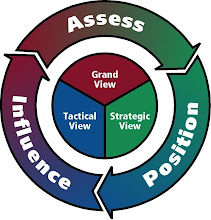
Assess, Position and Implement


Currently our global economy is overwhelmed with random chaos. Some people look at divine inspiration as an alternative.

The key to adjusting to this state of random chaos is to have a process that allows one to stay on the tangible course while minding the grand picture.


Our solution is based on these three steps:
  • Assessing the grand picture;
  • Positioning by planning and preparing a master plan with detailed specifics; and
  • Implementing by utilizing the strategic overview as a standard in completing your goal.
Assess the grand picture means understanding the grand settings through proper information gathering steps. Then, evaluating the information with a proper set of strategic assessment protocols.

If one does not know their grand settings, there is no way he or she will be able to anticipate what is ahead.

--- More to come.

If you want to know about how to build a good plan, please contact us at service[@t]collaboration360[doott].com

Replace @t with "@" and doott with "." .

Collaboration360 Consultants (C360). Copyright:2006-2009 © All rights reserved
Copying, posting and reproduction in any form (without prior consent) is an infringement of copyright.

#
Faith and Finances
Rob Baedeker, Special to SF Gate
Monday, January 19, 2009

Try a Google search for "lost faith" and you'll get plenty of stories about crises of religious belief. But these days you're also likely to see headlines like this one about lost faith in Wall Street and the economy in general.

The road to the free-market promised land may indeed have been paved with a confidence bordering on religious conviction. But now that financial markets have faltered, are believers turning to old-fashioned religious faith for solace and direction?

When I spoke with Bay Area clergy to see if they'd noticed an increase in the number of congregants coming to them for guidance due to financial distress, most echoed Kalid Siddiqi, the imam for Friday prayer at the Masjid Darussalam in San Francisco. "All kinds of people have approached me for counseling," Saddiqi told me. "I have been in this country 24 years, and I have never seen this kind of uneasiness, financially and economically, among the community."

Others, like Diane Rizzetto, abbess and teacher at the Bay Zen Center in Oakland, said that while the numbers of community members seeking her counsel for money-related issues haven't changed substantially, "There is definitely a sense of uncertainty. There's a tension sort of in the air."


... Across faiths, these clergy see this kind of material assistance as rooted in deeper spiritual convictions.

Friedman explained Judaism's response to people in need. The first, she said, is to mobilize people who have resources to support others. "A mitzvah is a commandment and a good deed all wrapped up in one, and there are two sides: one is giving, but receiving is also a mitzvah."

Friedman and others relayed the embarrassment that many in their congregations have felt about asking for help. "There's so much shame around not only asking for help but even people who can't ask for help," she said. There's shame in being poor, in losing your job or home and not being able to provide for your family. I try to help people to see that by coming to ask for help, or allowing themselves to open up and say, 'I need something,' they're enabling other people to give to them, and they're doing a mitzvah -- enabling other people to be holy and act in holy ways."

Siddiqi, a professor of Islamic Studies and Arabic language at several Bay Area colleges and institutions, cited one of the five pillars of Islam, zakah (the directive for the rich to share their wealth with the poor), but he added a caveat about receiving.

"Asking for help if you have all the doors closed is OK," he said. "But asking for help when you are able to do something for yourself is not a very good idea. It is a great honor to work -- it is dishonoring yourself when go and ask for help while you are able to do something."

His advice to those with money worries often includes updating their professional skills or perhaps widening their job search -- and changing their expectations.


... Saddiqi said economic calamity can also be understood, in Islam, as a test from God. He quoted passages from the Koran about Allah testing humans with "fear and hunger, or some loss in goods or lives" and how he will reward "glad tidings to those who patiently persevere."

But Howell had a different take. "Sometimes people think that they're supposed to suffer and that's something that God wants or that's demanded of their faith. That's not what I believe in. I think sometimes we put ourselves in situations where we make ourselves miserable because we have such a small idea of where we can go and what we can be."

In difficult times like these, Rizzetto reminds people that "uncertainty is what lies at the basis of Buddhist thinking." Economic upheaval is "also a very dramatic reminder of our basic human condition of clinging to things É of our wanting things to be permanent, and that's the basis of our suffering. Because they just aren't permanent: as much as we want it, the universe just doesn't run that way."

"But something really good can come of it," she added. "We just don't know. We have a choice: we can look at it as doom and gloom and this is terrible and the end of the world, or if we remember that change brings with it many different possibilities."

Here again the theme of opportunity-in-crisis carried across religious lines.

"It's not always about money or having a great job," said Glabach. "It's also that maybe in situations of crisis, new things can become better or maybe a lot of things can become restructured or redefined."

"This has been an opportunity," Rabbi Friedman said, "to really appreciate the things in life that money doesn't buy, the things that are really enduring, and for all of us to pull back financially and realize that so many of us have not only been living beyond means and our needs, but confusing needs with wants."

After hearing some perspectives from the faithful, I was curious how the God-less were dealing with -- and making sense of -- the recession, so I called David Fitzgerald, action coordinator for the San Francisco Atheists.

"We've had lots of people in our community who have been impacted," he said, explaining the case of a member who recently lost his home.

Aside from the lack of belief in a higher power, Fitzgerald's description of the atheists' response to its members' needs sounded much like the community efforts of the faithful I spoke with. "We say, 'Hands that help are better than hands that pray,'" he explained. "When things like this happen, we come together and we know there's not going to be anybody in the sky looking out for us. If we don't do it, no one else will. That gives us a lot of impetus to take direct action and help people out, and give them support É I have a lot of respect for [religious] charities that do go out there and do the work, but like we say, 'Nothing fails like prayer.' It's literally the least you can do."

Prayer was indeed part of the prescription of many of the faithful I spoke with. But some, like the Zen Center's Rizzetto, had different methods of assuaging their adherents' anxiety.

"There are little specific practices that sometimes I'll give someone," she said. "One is to carry a notebook around and make a list of 10 things a day that they're thankful for. I'm talking about things that are not general, just little things like being able to smell coffee. Not even to have the cup of coffee but just to smell coffee. It helps turn the mind toward the abundance. There is a great abundance, but the mind will turn toward that which isn't. Sometimes we need to put a gentle hand on the shoulder say turn, look in that direction."

Surveying how different faiths make sense of financial disaster, it's tempting to generalize about how all religions are the same, in the end -- that the minister, the imam, the Buddhist and the rabbi are all telling similar stories, albeit with different terms.

It's a comforting notion, but not completely true, I think. What I was reminded of over the course of even these brief conversations is the sometimes radically different ways that religions contextualize catastrophe: for one faith, the recession is a dramatization of uncertainty; for another it's the confirmation of God's certain plan. For one man, the stock market crash is a test from God; for another it's a reminder that there is no God.

If there is a point these religious thinkers have in common, though, it may be optimism. All of them, even the atheist, talked about opportunities revealed by the economic crisis. And universally, they spoke about mobilizing their communities to help others in need.

It's hard to tell which one -- optimism or the exercise of charity -- is the cause and which is the effect. Either way, it's nice to hear.

Do you have a person or topic you'd like to see covered in Money Tales? Let us know. E-mail Rob at rbaedeker@sfgate.com
#

Sunday, January 4, 2009

Position with the Plan ( Building the Tangible Vision)


Regardless of having passion in one's endeavor, one must have a plan.

There are good plans and bad plans.

The challenge is building a plan that
enables you to do the following:
1. Focus on your objective while mind the Tangible Vision;
2. Avoid negative circumstances, while focusing on positive situations;
3. Maximize opportunities;
4. Adjust strategically;
5. Shape the Tangible Vision; and
6. Lead with strategic leadership .

When you can do that with your plan, you can make better decisions. You will stay on course and complete your goal regardless of the circumstances.

Does your current plan do that?


What is the Tangible Vision?
The Tangible Vision is a goal, a plan that you work with. It also emphasizes a clearly-defined vision or mission statement that you believe in.

The first step is establishing your desired "end-in-mind" with specific details. The ideal outcome must have the value points and a tangible model that you can relate to. It also encompasses the contra-position of the desired outcome.

The next step is building the specific guidelines for each milestone. Those guidelines are based on the priorities, the approach and various circumstances for that phase.

The final step is outlining the operational steps that match the specific guidelines for each milestone.


The guidelines stated in the Tangible Vision become the strategic standard for the implementer to make decisions with. They know the positives and the negatives based on anticipated situations.

The Tangible Vision also guides the implementer on when and how to adapt the changes, what are the contingencies, etc.

In a future post, we will talk more about the basics of the Tangible Vision.

If you want to know about how to build a good plan, please contact us at service[@t]collaboration360[doott].com

Replace @t with "@" and doott with "." .


Collaboration360 Consultants (C360). Copyright:2006-2009 © All rights reserved
Copying, posting and reproduction in any form (without prior consent) is an infringement of copyright.

Friday, December 19, 2008

A Thank You Note


Last month we did a presentation on applying Sunzi's The Art of War in business. We also demonstrated the basic framework of our process.

Following are comments from Dr Fellman, the Professor of International Strategy from University of Southern New Hampshire


"M.E. Hom has taken the ancient strategic writings of Sun Tzu (Sunzi) and incorporated them into a modern international project management methodology of unusually sophistication, flexibility and practicality. He combines the best elements of competitive intelligence, strategic planning and contemporary business theory into a process which can be practically applied by managers around the world.

Mr. Hom has been a frequent and well-appreciated guest lecturer in our MBA and MS courses and I give his process my highest recommendation. ..."

- Dr. Phil Fellman, Professor of International Business, University of Southern New Hampshire


His comment on one of our previous presentations
The Chinese students said that on the Mainland, they don't study Sun Tzu, so they found it very interesting and also very new. They were deeply impressed by your level of knowledge and I was very grateful to have you as a guest lecturer. -Dr. Phil Fellman

Tuesday, November 25, 2008

Using Statistics to Assess the Grand Situation


Secure data on your opposition.

Assess the data.

Discover the habits and tendencies of yourself, the other competitors and the grand settings.

Understand the strengths, the weaknesses, the opportunities and the threats of each competitor is not enough.

With the "strategic assessment" module of our Compass AE process, you will understand the opposition's strategic position from the different views of the grand settings.

The more you learn about yourself, your competitors and your grand settings from the different views, the better your chance of understanding yourself, your opponent and the grand settings.

With our Compass AE process are your guide, you will find the critical path of least resistance.

Copyright: 2008 © Collaboration360 Consultants (C360 Consultants).
Copying, posting and reproduction in any form (without prior consent) is an infringement of copyright


# # #
November 23, 2008

Titans' Against-the-Grain Defense

By JUDY BATTISTA NASHVILLE

It was not long after Jim Schwartz began an unpaid internship with the old Cleveland Browns, driving scouts and players to the airport, and buying cigarettes for the coaches, that he bumped up against football's poured-in-concrete conventional wisdom.


Schwartz, now the defensive coordinator for the Tennessee Titans, had an economics degree from Georgetown University, an abiding fascination with statistics and a preference for watching game film over television. That made him a kindred spirit with his first N.F.L. boss, Bill Belichick. But when Schwartz told Belichick his findings from an early N.F.L. research project almost 15 years ago, Belichick said he did not believe him.


"Fumbles are a random occurrence," Schwartz said he told Belichick. "Being able to get interceptions or not throw interceptions has a high correlation with good teams. But over the course of a year, good teams don't fumble any more or less than bad teams. Bill didn't agree. He said, 'No, good teams don't fumble the ball.' But actually, they fumble just as often as bad teams."

With the Titans, Schwartz once encouraged the former offensive coordinator Norm Chow to run more on third-and-short because his research indicated that it was more effective than passing.
Unorthodox thinking like that has earned Schwartz, 42, a reputation as one of the N.F.L.'s leading practitioners of statistical analysis "Moneyball" for the shoulder-pad set using them in coaching the defense for the league's only unbeaten team.

In Schwartz's eighth season as the coordinator, the Titans' defense is ranked sixth entering Sunday's game here against the Jets (7-3). The ranking is based on yards surrendered.
"Who cares who is leading in yardage?" Schwartz said, pointing out that allowing a 12-yard run raises the total but is meaningless on a third-and-20 play. No statistic matters more to coaches than fewest points allowed, and by that measure, no team comes close to the Titans (10-0). They are giving up 13.1 points a game, 1.4 points fewer than the second-ranked Pittsburgh Steelers. But Schwartz, perhaps more aware than most of how numbers can be manipulated, did not embrace that figure without explanation.

The Titans gave up their most points of the season, 21, to Indianapolis. But the Colts scored 7 points with little time remaining, when the Titans were leading by 17. Against Kansas City, the Titans allowed 10 late points after the starters were pulled in a 34-10 victory. So the Titans average fewer than 13.1 meaningful points allowed. With an offense that relies on the run, not downfield passing, the Titans are built to win close (read playoff) games. That leaves the defense with little margin for error. The Titans are defined by multitalented players who are effective in different styles. The Titans used eight-man fronts to stop Jacksonville's running game in the season opener, then played a cover-2 defense to thwart Cincinnati's passing the next week.

With a line featuring Albert Haynesworth, perhaps the league's best defensive player, the Titans generate pressure on quarterbacks with minimal blitzing. (An addendum to Schwartz's fumble analysis: good teams sack the quarterback, and forcing a quarterback to fumble is a lot easier than taking the ball from a running back or a wide receiver.) Players credit the defensive coaches for their ability to correct mistakes quickly the Chicago Bears converted three consecutive third-down attempts on their opening drive against the Titans, but none the rest of the game and for the detailed preparation that dovetails with what linebacker Keith Bulluck called Schwartz's "little hobbies." Kyle Vanden Bosch said: "Especially from a defensive lineman standpoint, we don't usually pay attention to formations and down and distance. He has that broken down for us. We know what to expect out of certain formations, and what plays they can run. It's unusual for a defensive line. But we have a quiz in front of the whole defense on Friday, and he expects everybody to know that." Belichick regards Schwartz as one of the smartest coaches he has been around, and in recent years, Schwartz has become a candidate for several head coaching jobs. He is almost certain to be a front-runner as positions open this year. But being known as a "stats guy" is not necessarily a compliment, because statistics do not hold the romantic place in football that they do in baseball.

Although every coach uses plenty of data the Titans' Jeff Fisher tracks how long his team takes to break the huddle football is unlikely to bestow statistics-driven celebrity on anyone the way the baseball book "Moneyball" did on Billy Beane, the general manager of the Oakland Athletics.

Schwartz has met with the developers of a computer program to analyze difficult play-calling decisions, and he has watched film with Aaron Schatz, an author of "Pro Football Prospectus," who uses unusual statistics to analyze the game. But at the same time, Schwartz shuns the impression that creates, stressing that statistics are just another tool in game preparation.

"Sometimes, that's an easy thing for people in the media to use against you," Schwartz said. " 'Oh, yeah, he can't adjust; he's just a stats guy. They don't really understand the game.' That's why sometimes, the whole stats thing is a dirty word.

"If you ask me, Would you rather have a great fly-by-the-seat-of-your-pants guy on Sunday, a guy who can dial up plays and he'd be the best in league, or a guy who is best in the league from Monday to Saturday preparing, I respect the guy who prepares. You're not always going to be rolling 7, 7, 7 and be hot every week. But if you prepare well during the week, you'll be consistent from week to week."

Numbers have long threaded through Schwartz's thinking. His father was a police officer, and when they watch television together and see a news report about a murder, his father will mention what percentage of women are murdered by their husbands. When Schwartz was growing up in Baltimore, the Dallas Cowboys were the best team in football. They used a computer analysis of prospects as part of their forward-thinking draft preparation.

"They used that not to press a button and have the computer say, 'This is your draft pick,' " Schwartz said. "It was more to guide them — these are important traits to look for. That's the way we use it."

The 16-game season provides a small sample, a shortcoming of football statistics. So Schwartz breaks down each drive as if it were its own game. Twelve drives, say, multiplied by 16 games is a much bigger sample.

/// Micro-assessing the grand situation.

Yet Schwartz rejects one Beane quirk revealed in "Moneyball" — that he does not like to watch games because he cannot stand how random events may influence the outcome. Schwartz, a former college linebacker, calls the defensive signals from the sideline rather than the press box, so he can look at his players and gauge their physical feedback. The Titans' attacking style — what Vanden Bosch called "forcing the issue" — seems to run counter to the by-the-numbers image that makes Schwartz uncomfortable.

"This guy is a football coach who motivates players," Schatz said, "and he also happens to have a very open mind and interest in statistics. But he's not like me on the sidelines."

Still, with Tennessee on the way to the playoffs, the Titans' pounding defense — and the mind that directs it — figure to get plenty of attention. Schwartz cringes when he thinks others perceive him as a numbers geek, an odd concern for an avid amateur chess player who uses Bobby Fischer and Garry Kasparov analogies.

"People talk about the chess match between coaches and coordinators," Schwartz said. "Anybody who plays chess knows your rook never falls down, your rook never stops one spot short. There's human nature to football that will never make it into a game of numbers."

Copyright 2008 The New York Times Company
http://www.nytimes.com/2008/11/23/sports/football/23titans.html?

Sunday, September 28, 2008

Process Precedes Technology (3)


Technology connects a team together regardless of the distance.

Can the team make strategic decisions as a team regardless of the distance, the technology, the number of the people and the project culture? With our Compass AE process, they know what are the important decisions and they are ensured that they will make right decision every time.


Does your strategic project process enables your team to do that?

If you have any questions about Compass AE process, you can contact us at service [aatt] collaboration360 [dott] com

Tuesday, August 26, 2008

C360's Compass View of Strategy (3)


Not all processes are alike.

Compass AE is a strategic process that gives the implementers a high level, top to bottom overview of the priorities, approaches and circumstances for any Tangible Vision-driven projects.

Does your company have a process like that?

Sunday, August 24, 2008

C360's Compass View of Strategy (2)

To succeed in ones venture, ones intelligence gathering process must be correct.

If the gathered intelligence and the implementation of the strategic assessment process are correct, then the strategic assessment of the intelligence is valid.

If the strategic assessment is valid, the project team's plan of action (based on the strategic assessment) will be correct.

The C360 View:
When the Compass team properly gathers
intelligence, they assess themselves, the competition and their grand settings. Then, they collaboratively build the Tangible Vision.

By using the Tangible Vision, the team properly defines the grand goal, the tactical objectives, and the connections between the objectives and the goal. Then they delineate the tactical requirements of each objective.


When the Compass team leads with their Tangible Vision, they perform the following:
  • minimize the costs;
  • mitigate the risks;
  • accelerate the delivery;
  • maximize the opportunities;
  • ensure the quality
At the end, success is the absolute.

Does your process enable your team to do the above?

If you are interested in knowing more about our Compass AE process, please contact us at service (att)collaboration360(dott)com.

Copyright: 2008 © Collaboration360 Consultants (C360 Consultants).
Copying, posting and reproduction in any form (without prior consent) is an infringement of copyright

Saturday, August 16, 2008

Learning Lessons of Strategy from the Recent Russian Blitz


The following article is something that most businesses can learn from the "Russian Blitz".


#
August 17, 2008
Military Analysis

Russian Blitz Melded Old-School Onslaught With Modern Military Tactics

WASHINGTON — Russia’s victorious military blitz into the former Soviet republic of Georgia brought something old and something new — but none of it was impromptu, despite appearances that a long-frozen conflict had suddenly turned hot.

The Russian military borrowed a page from classic Soviet-era doctrine: Moscow’s commanders sent an absolutely overwhelming force into Georgia. It was never going to be an even fight, and the outcome was predictable, if not preordained.

/// In any "real" competition, there is no such thing as even parity.

At the same time, the Russian military picked up what is new from the latest in military thinking, including American military writings about the art of war, replete with the hard-learned lessons of Iraq and Afghanistan.

So along with the old-school onslaught of infantry, armor and artillery, Russia mounted joint air and naval operations, appeared to launch simultaneous cyberattacks on Georgian government Web sites and had its best English speakers at the ready to make Moscow’s case in television appearances.

If the rapidly unfolding events caught much of the world off guard, that kind of coordination of the old and the new did not look accidental to military professionals.

“They seem to have harnessed all their instruments of national power — military, diplomatic, information — in a very disciplined way,” said one Pentagon official, who like others interviewed for this article disclosed details of the operation under ground rules that called for anonymity. “It appears this was well thought out and planned in advance, and suggests a level of coordination in the Russian government between the military and the other civilian agencies and departments that we are striving for today.

In fact, Pentagon and military officials say Russia held a major ground exercise in July just north of Georgia’s border, called Caucasus 2008, that played out a chain of events like the one carried out over recent days.

“This exercise was exactly what they executed in Georgia just a few weeks later,” said Dale Herspring, an expert on Russian military affairs at Kansas State University. “This exercise was a complete dress rehearsal.”

/// In some project culture, "amateur professionals" rarely spent enough time preparing and rehearsing their implementation.

1st rule of preparation is ...The amount of time it takes to deploy one's plan is inversely proportional to the amount of time that is spent planning your plan

Compass AE process requires the project implementers to review and rehearse their recently-built Tangible Vision process before connecting to it. ///

Russian commentators have countered that more than 1,000 American military personnel were in Georgia for an exercise last month. But that exercise focused on counterinsurgency operations to prepare a Georgian brigade for duty in Iraq, a different mission than the seizing of territory or denying an aggressor a new stake on the land.

Even as the Russian military succeeded at its most obvious objectives — taking control of South Ossetia and Abkhazia, humiliating the Georgian government and crippling the republic’s army and police units — serious shortcomings on the Russian side were revealed during the brief fighting, Pentagon and military officials said.

To the surprise of American military officers, an impaired Georgian air-defense system was able to down at least six Russian jets. The Sukhoi-25, an aging ground attack plane, appeared to be the most vulnerable.

Georgia never has fielded an integrated, nationwide air defense system, and those ground-to-air weapons that survived early Russian shelling operated without any central control — and some without battle-command radars, as they were destroyed by Russian strikes.

That they bloodied the Russian air wing was taken as a clear sign of poor Russian aircraft maintenance, poor Russian piloting skills — or, most likely, years of insufficient funds for adequate flight training.

Russian-language media and unofficial national security Web sites in Moscow, which since the days of the disastrous Soviet foray into Afghanistan have developed a skeptical independent streak, also noted other shortcomings.

A Russian general in command of the 58th Army was wounded in the leg when he led a column of 30 armored vehicles toward the capital of South Ossetia, apparently without sufficient intelligence from scouts on the ground or surveillance aircraft overhead to know a Georgian ambush was awaiting.

The Russians also suffered losses as they came through the Roki Tunnel, which connects South Ossetia to the neighboring region of North Ossetia in Russia proper. Russian national security analysts said there was no air cover to protect Moscow’s forces in their first minutes on Georgian soil outside the safety of the mountain tunnel.

Despite these failings, the Russian military was able to coordinate infantry advances with movement of airborne troops, simultaneously with the deployment of armor and artillery. To be sure, they only had to travel short distances, but Russia was able to inject 9,000 to 10,000 troops, 150 tanks and 700 other armored vehicles onto Georgian territory in the first weekend of fighting, officials said.

Russian warships moved off the coast of Georgia, and Russian special operations forces infiltrated into Georgia through Abkhazia, according to Pentagon and military officials.

“This was not the Russian Army from the humiliation of Afghanistan, and it’s not the Russian military that had to flatten Chechnya to save it,” said one Pentagon official knowledgeable of how the fighting unfolded. Another said: “The Russian military is back. They are to be contended with.”

Despite a recent increase in Russian long-range bomber flights along old, cold war routes near United States airspace, the offensive into Georgia gave little indication of a renewed capacity or renewed interest in global projection of power by the Russians.

But Moscow’s military is wholly capable of pressing the Kremlin’s designs on hegemony over the formerly Communist states along the border that Russian leaders call “the near abroad.”

Russia prepared the battlefield in the months leading up to the outbreak of fighting.

In April, Russia reinforced its peacekeeping force in Abkhazia with advanced artillery, and in May it sent construction troops to fix a railroad line linking that area with Russia.

Georgia’s overmatched army of about 30,000 was able to field four combat brigades of about 3,300 soldiers each.

At the start of the fighting, the Georgian Army’s First Brigade was in Iraq, and subsequently was airlifted home aboard American aircraft — but without their war-fighting gear. The Fourth Brigade was in training for the next rotation to Iraq. The Second and Third Brigades were in western Georgia, closer to Abkhazia than to South Ossetia, where the fighting started.

The American military training for the Georgian troops has been described as involving counterterrorism for domestic security and counterinsurgency for the Iraq mission, with little emphasis on taking ground, holding ground or defending against invasion.

The influx of American training and American support might have left the Georgians feeling that their far smaller military could stand up to Russia in asserting sovereignty over South Ossetia and Abkhazia.

But Georgian command and control withered quickly under the Russian attack, and army and police units were operating on their own, often at cross purposes or overlapping missions.

/// Opposing operational responsibilities create internal conflicts. It also wastes time and resources.

With our Compass AE process, the implementers always know their objectives and how it connects to other team's objectives . A collaboratively-built Tangible Vision increases efficiency while eliminating redundancy. ///

Although the Georgian units had been taught that speed of operations brings a mass all its own to the battlefield, and that improving accuracy in firepower brings a mass all its own, the lesson of the conflict is that, in some cases, mass has a mass all its own.

Russia easily smothered the smaller Georgian force.

http://www.nytimes.com/2008/08/17/world/europe/17military.html

#


C360's View on Achieving World Class Standards of Performance
Professionals of this caliber are able to coordinate and implement multiple processes in parallel order. Without a macro process to coordinate multiple processes, people are reduced to doing one thing at a time. This level of performance does not work when competing against competition with great resources.

With our Compass AE process, any project team can achieve this level of performance. They build a strategic overview (Tangible Vision) that allows their implementers to view the "multiple process" in any geometric order. By understanding how everything is connected strategically, the team knows what to do in advance in certain circumstances.


C360's View of the Importance of Momentum:
"When torrential water tosses boulders, it is because of momentum; ... When the strike of a hawk breaks the body of its prey, it is because of timing. ... Thus the momentum of one skilled in war is overwhelming, and his attack precisely regulated. His potential is that of a fully drawn crossbow; his timing, the release of the trigger. ... " Art of War, 5

A Compass team that builds and connects with the Tangible Vision, is prepositioned to move with momentum.

If you are interested in knowing more about our Compass AE process, please contact us at service (att)collaboration360(dott)com.

Copyright: 2008 © Collaboration360 Consultants (C360).
Comments made by Collaboration360 blogger is copyrighted.
Copying, posting and reproduction in any form (without prior consent) is an infringement of copyright.

The C360's Compass View of Strategy (1)

Many professionals are not properly trained in identifying or defining a grand picture that is tangible. They would rather build things from the ground up. Improvising and making new changes without any strategic guidelines every 2-5 days. No idea of outcome. No direction. No connections. No anticipation. Regardless of the outcome, time and resources are wasted.

With our Compass AE process, the project implementers build a Tangible Vision by focusing on "the end in mind" first. The first step is delineating the specifics of the direction from a top down direction. Then they continue by optimizing the delineated tactical specifics from bottom up. The tactical details matches the specifics of each tactical milestone

If you are interested in knowing more about the Compass AE, please contact us at service(aa tt)collaboration360(ddott)com.

Copyright: 2008 © Collaboration360 Consultants (C360).
Copying, posting and reproduction in any form (without prior consent) is an infringement of copyright.

Thursday, June 19, 2008

The Essence of the Tangible Vision


"Skate to where the puck is going, Not to where it has been." --- Wayne Gretzky


Whether it is a sporting event or managing a project, my focus is on the current moment while determining what will happen next. It is a skill that people can master. Whether they want to do it is a different story.

Regardless of the competitive arena, the professionals focus on their objectives while minding the big picture. They usually follow where the momentum of trends is heading to. Depending on the skill level and the resources of the strategist, he goes with it or intercepts it. Sometimes, he reverses it. This skill level is what distinguish the professionals from the masses of amateurs.

(fyi- The
Chinese strategic classics emphasizes this point with clarity.)

#

A well-written Tangible Vision focuses on where the goal is going to take the implementers to. It delineates the direction,
the values, the risk and rewards, etc. If the specifics of the goal are right, the foundation for delineating the operational side is established.

The more tangible the specifics of the goal are, the more predictable the operation will be coming. Do you know what those specifics are?

The Tangible Vision is more than an endpoint. It is a strategic overview. The team collaboratively uses it to decide on strategic matters and long term objectives.


Building the Tangible Vision
The client and I would usually establish the ideal outcome, the
direction and the connections from outcome to milestones. The next step is building the specifics for each milestone. The final step is building the operational steps that matches the operating specifics for each milestone.

The guidelines stated in the Tangible Vision become the strategic standard for the team to make decisions with. They know the positives and the negatives based on anticipated situations. The Tangible Vision also guides the team on when and how to adapt the changes, who is the consensus, etc.

After estimating the advantages in accord with what you have heard, put it into effect with strategic power supplemented by field tactics that respond to external factors. As for strategic power, it is controlling the tactical imbalance of power in accord with the gains to be realized. --- The Art of War, 1

Connecting with The Tangible Vision
The team connects with their Tangible Vision when they understand the connections between each milestones from start to finish.

Leading with The Tangible Vision
Once a team properly built and connected with their Tangible Vision, they lead with it. With their Tangible Vision, the team members focuses on their own objectives while minding the big picture.

They also do the following:
  1. Understand the critical path;
  2. Avoid the negatives, focus on positives;
  3. Anticipate opportunities;
  4. Adjust strategically;
  5. Shape the Tangible Vision; and
  6. Lead by strategic collaboration
#

If your strategic process does not enable your team to do the above, it is time for you to review your approach.


Those who know the big picture and the fundamentals that leads to the big picture, are ahead of the game.

#

By using our Compass AE process, you and your project team are able to out-do your competition in terms of faster execution, minimize costs, mitigate risks, etc. We will touch on these important points later.

If you are interested in knowing more about Compass AE, please contact us at contactus(aatt)collaboration360(ddott)com.


Sunday, June 15, 2008

C360 View on Virtual Teams and Collaboration


Tactics and technology are good for limited tactical situations. The question is ... how does a virtual team (Geographically Dispersed Team (GDT) collaborate anywhere as a team regardless of the technology, the distance and the project culture?

#

Tactical Tips for Virtual Teams

Andrew Makar, PMP

May 27, 2008

Less than five years ago, the typical system implementation required the project team to be onsite at the client’s location. With the increased use of outsourcing, Software As A Service (SAAS) and the improvement in collaboration technologies like Cisco’s WebEx conferencing and Microsoft Sharepoint, system implementations can be supported with virtual teams. A virtual team is composed of geographically dispersed team members who primarily interact and collaborate with the collaboration software and telecommunications technology.

Performing tasks offsite provides companies with the flexibility to leverage remote resources without incurring travel expenses. However, according to the December 2007 Black Enterprise magazine, “virtual teams also provide challenges including miscommunication, breaches in security, and lack of worker productivity.” The challenges with virtual teams need to be balanced with their benefits.

/// When a Compass team builds a Tangible Vision, they decide on the specific wording of the goals and objectives. Mutual agreement of specific terms prevents miscommunication.

In 2007, I had the opportunity to manage three virtual software implementations including a compensation planning tool, an incident management system and a new suite of HR applications. The first two projects were comprised entirely of virtual teams, while the third implementation consisted of a hybrid approach of onsite and virtual resources.

During these implementations, the interactions with the project teams for the compensation and incident management systems were conducted through teleconferences and Web conferencing. The larger HR project consisted of onsite and remote teams. I only met the infrastructure manager responsible architecture once, but had consistent contact with him every day during the eight-month system implementation. These experiences yielded several tactical tips to remember when working with virtual teams:

Tactical Tip No. 1: Define the management processes and project guidelines upfront.
The project control and execution processes used to manage virtual teams are no different than with onsite teams. The execution of issue management, schedule management or change management may be supported with project portfolio management software or collaboration solutions. Effective projects, both virtual and onsite, ensure the project management expectations are communicated early and project teams understand how to follow the processes.
In the HR systems implementation, the PMO conducted project orientation sessions with each vendor so they understood the project expectations, status reporting procedures, meeting cadence and project norms.

/// With the Tangible Vision, the Compass team knows the specific priorities, the specific approaches and the circumstances for each milestone.

Tactical Tip No. 2: Establish and communicate the project’s meeting cadence.
Even though status reports, issue tracking and generating project metrics are viewed as mundane administrative procedures, they are critical to managing and controlling virtual projects. A meeting cadence needs to be communicated to each virtual team so they understand the process to review status on a weekly basis. Managing projects with virtual teams runs a risk that key team members may not attend status meetings or communicate as frequently. Just like an onsite project, if key team members are not attending or communicating, follow the appropriate escalation path to include the reluctant team members.

/// With the Tangible Vision, the Compass team knows when to meet and how to communicate.

The HR implementation had multiple vendors located throughout the
Europe, North America, South America and Asia. The project had multiple work streams and a common project calendar was implemented to communicate key meetings to effectively control the project and communicate status. Project teams leveraged a calendar built in Microsoft Sharepoint to keep informed of schedule and meeting changes.

Establishing these procedures upfront ensured the project team reported status by close of business on Friday and submitted a weekly status report to the PMO on Monday. Status calls were held virtually with team members representing the various countries and business units. Regardless of the presence of virtual or onsite teams, projects need to communicate the meeting cadence to ensure smooth execution.


Tactical Tip No. 3: Leverage Web-based conferencing to avoid dial-in dysfunction.
If project teams are collaborating virtually, leverage Web conferencing tools as much as possible to avoid confusion. Even if the presentation is distributed before the meeting, it helps to see the slides presented with a Webex, GoToMeeting or similar Web conferencing solution.
In the compensation implementation, every requirement session, configuration, system testing and project status leveraged a Web conference solution. The business customer liked this approach since they were able to see the solution evolve weekly, despite having the development and project management staff located in California and Florida. Without effective collaboration technologies, dial-in dysfunction can set in as virtual team members lose track of the meeting and they focus on something else until they are called back into the conference call.


Tactical Tip No. 4: Initiate in-person and manage virtually.
The global nature of projects today requires project teams to collaborate over phone, e-mail and the Internet. Before starting a project with virtual teams, project managers should encourage a project kickoff with representatives from each team attending in person. By initiating the project with representation in the room, the project team members will meet the key people who will be delivering the project over phone lines over the next few months or years. Depending on the scope and complexity of the project, additional in-person meetings may be required.

Don’t underestimate the power of looking someone in the eye and establishing that bond of trust.

Large IT implementations often involve implementing a solution in multiple countries. Visiting each country and meeting with the team members affected by the new solution will help with communication barriers and put a face on the project team that is often heard through conference calls. Once the project is initiated with in-person contact, it becomes easier to manage virtually. However, when in doubt, fly on out.

/// When a new Compass team builds their Tangible Vision, they get the opportunity to learn about each other. Trust must be established with each other before they can connect to the Tangible Vision as a team

Andrew Makar is an IT program manager who is focused on effectively translating project management theory into actual practice. Additional articles and musings on project management technique can be found on his website at http://www.amakar.com.
Copyright © 2008 gantthead.com All rights reserved. http://www.gantthead.com/article.cfm?ID=241690

///

Definition of Collaboration
1. the act or process of collaborating.
2. a product resulting from collaboration: This dictionary is a collaboration of many minds.

As a noun, collaboration means that it is an "act of working jointly; "they worked either in collaboration or independently"

As a "intransitive verb", it means "... To work together, especially in a joint intellectual effort. ..."

Our C360 view on Collaboration

Collaboration is about cooperative teamwork toward the completion of the goal. It is not about technology that enables the sharing of resources and data.

Everyone wants the silver bullet or the golden ring that enables a team to collaborate. But most people are not willing to work for it or pay for it.

Collaboration is a team interaction. How does one get a group of people to collaborate as a team? The answer is a strategic process first, not technology. Technology is not the answer. It is a tool with limitations.

The future is having a project team using a strategic process that enables them to collaborate anywhere as a team regardless of the distance, the technology and the project culture.


#

Collabortion Is Still a Singular, Personal Experience By David Strom http://www.baselinemag.com/c/a/Messaging-and-Collaboration/Collabortion-Is-Still-a-Singular-Personal-Experience/

###

By using our Compass AE process, you and your project team are able to out-do your competition in terms of faster execution, minimize costs, mitigate risks, etc. We will touch on these important points later.

If you are interested in the specifics in using Compass AE, please contact us at contactus(aatt)collaboration360(ddott)com.