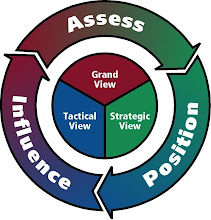
Showing posts with label Applications of the Tangible Vision. Show all posts

Wednesday, April 29, 2009

Connecting with the Tangible Vision


Starting a fight does not focus a team. It merely distracts the team from connecting and leading with their Tangible Vision. A fight does not create any momentum for the underdog who is behind the eightball.

fyi- A Tangible Vision is a strategic overview that emphasizes the specifics in terms of dates, metrics and risks. When a team connects with their Tangible Vision, they understand that completing the goal is everything. Concurrently, there is trust and accountability.

Lets Go Red Wings. Lets Go. ...

#
Ducks oust top-seeded Sharks 4-1 in Game 6
By GREG BEACHAM, AP Sports Writer
(04-27) 23:58 PDT Anaheim, Calif. (AP) --

Right when the opening puck dropped, Ryan Getzlaf and Joe Thornton dropped gloves. The star centers' simmering dislike erupted into a brawl dominated by Thornton, who pummeled Getzlaf with at least two flush blows to the face.

Getzlaf took it and smiled, knowing he still could win the only important fight.

/// In desperate times, desperate teams deploy desperate measures.
Win a fight. Then, lose a game is not the way to go.
The San Jose Sharks is a team with no idea of their priorities. ///

And that's exactly what happened in the waning minutes of Game 6. Getzlaf scored the knockout goal as the eighth-seeded Anaheim Ducks ousted the not-so-mighty San Jose Sharks from the postseason with a 4-1 victory Monday night.

Teemu Selanne and Francois Beauchemin put Anaheim ahead with their first playoff goals on fortunate deflections 83 seconds apart in the second period, and the Ducks coolly finished off the Presidents' Trophy winners in an upset that could resonate for years in this juicy in-state rivalry.

"I think if you ask anyone, we're not an eight seed," defenseman Ryan Whitney said. "Everyone in here knows that, and I think now everyone in hockey pretty much sees it, too."

Jonas Hiller made 36 saves to finish his phenomenal playoff series debut for the Ducks, who won a fight-filled clincher to complete a remarkable playoff upset two years after winning the franchise's only Stanley Cup.

The clubs' final meeting was a slugfest with 60 total penalty minutes and a long series of brawls between Anaheim's goals and Hiller's saves. It all started with the stunning fight between Getzlaf and Thornton, who traded shoves and harsh words two days earlier in San Jose.

"Joe kind of came in and said, 'Do you want to go tonight?'" Getzlaf said. "I had every intention of asking him, so it was a situation that carried over from last game. We kind of knew what we were doing. ... (In Game 5) I didn't want give them any spark. Tonight, I felt, was the opportunity to redeem myself."

Corey Perry also scored as Anaheim advanced to face second-seeded Detroit, which swept Columbus out of the first round. The defending Stanley Cup champions are favorites to defend their title — but few gave the Ducks much chance against the Sharks, either.

With a dynamic offensive effort that negated all the Sharks' physical bluster, Anaheim became the third team to beat the NHL's top regular-season club in the first round since 2000, and just the fifth since 1968. The Ducks are the eighth No. 8 seed to win a playoff series since 1994, largely dominating the league's first all-California postseason series in 40 years.

Evgeni Nabokov made 28 saves and Milan Michalek scored the game's first goal for the Sharks, who completed the biggest playoff collapse in a franchise history full of them. San Jose led the NHL with franchise records for points (117) and wins (53) during the regular season, but the club has been past the second round of the postseason just once, in 2004.

The Ducks were outshot in every game, but Hiller, the Swiss goalie, allowed just 10 goals and posted two shutouts.

"Did we get what we deserved? We could have played better, obviously, in some games," said Sharks rookie coach Todd McLellan, an assistant in Detroit last year. "It took us a while once our character was challenged, and we responded. The lesson has to be learned that we can't give games away."

San Jose has won four Pacific Division titles in the past seven seasons, but has never made it beyond the 2004 Western Conference finals.

Selanne broke a tie during a power play, slipping the puck in front of the net where it apparently glanced off Christian Ehrhoff's stick. A few moments later, Beauchemin launched a shot from the blue line that appeared to ricochet off Dan Boyle's stick and past Nabokov.

"To a man, they were better," Boyle said in the Sharks' somnolent dressing room. "Their goalie was better than ours. Their defense was better, and their forwards were better. We had a great regular season and a disappointing playoff, and for that, you have to give them credit."

The loss might be the final game in the 20-year career of Jeremy Roenick, who postponed retirement to make two more runs at his first Stanley Cup. Rob Blake, the 39-year-old defenseman, also could be gone, as could 43-year-old Claude Lemieux, who made a comeback after a 5 1/2-year NHL absence, but played just once against Anaheim.

Notes:@ Anaheim improved to 9-0 in franchise history when playing at home with a chance to close out a postseason series. ... Two scraps near the second intermission briefly put four Sharks and three Ducks in the penalty boxes. ... San Jose dropped to 2-13 in the sixth games of playoff series.

http://sfgate.com/cgi-bin/article.cgi?f=/n/a/2009/04/27/sports/s221243D34.DTL

Tuesday, April 28, 2009

The Dao of Strategic Assessment (15): Assess Never Assume


When assessing the grand picture, one must know the grand settings of their terrain and the grand specifications of each competitor.


#
The New York Times April 26, 2009
Does H.P. Need a Dose of Anarchy?
By ASHLEE VANCE
Palo Alto, Calif.

IT all seems obvious when viewed through hindsight’s pristine lens: Hewlett-Packard didn’t need a reinvention. It just needed some fierce fiscal discipline to transform itself from a bumbling, lost soul into a well-oiled profit machine.

At its core, H.P.’s turnaround works against the natural order of things in Silicon Valley, where people talk about technology first and finances a distant second. The frenetic hunt for the next big thing has helped a select few endure decades of busts and booms, and they have always left it to the bean counters to obsess about the bottom line.

So it took a true outsider, in Mark V. Hurd, to engineer H.P.’s resurrection and to create the world’s largest technology company. Mr. Hurd, hired four years ago in the wake of Carleton S. Fiorina’s tumultuous departure as chief executive, forced a steady, boring diet of performance benchmarks, heavy-handed cost-cutting and data-mining down H.P.’s corporate throat.

Silicon Valley is not known for creating lean organizations, and he’s as good as we have ever seen, said Michael S. Malone, a historian who wrote Bill and Dave, a book about the company’s renowned co-founders, William Hewlett and David Packard. He’s taught a lesson in what big-time corporate management looks like.


But with the most brutal cuts behind it, H.P. faces a fresh set of challenges as the second stage of Mr. Hurd’s tenure begins. Most pressing is widespread concern that Mr. Hurd has built an inflexible, solipsistic giant so obsessed with schematics and data-driven fiscal machinations that it has lost the ability to deliver that prized and perennial Silicon Valley trick: to surprise and astound.

Although H.P. is trying to expand its presence in businesses like personal computers and printers, some critics argue that those markets have little left to give. The company could also use more imaginative thinking to bolster its developing line of software products and services.
In short, what may be missing in the formidable intellectual and strategic artillery that Mr. Hurd brings to bear at H.P. is creative inspiration. Or, as Mr. Malone puts it, I am not sure Mark has built an H.P. that can go through the natural changes that accompany the technology industry as the company has in the past. If you posit this idea to any of the company’s top executives, they’ll dismiss it. H.P. has plenty of room to grow, they say in printers, computers, software or services and has a firm grasp of the technology industry’s nature and undulations. If you don’t believe such talk, that’s fine, they say just look at the numbers for any convincing.

When you hear me talk, I have four quadrants in my head simultaneously, Mr. Hurd says, outlining a mental tableau that encompasses H.P.’s operations (Quadrant 1), products (Quadrant 2), business and technology trends (Quadrant 3) and competitors (Quadrant 4). Visions of metrics dance in his mind, and he speaks of them with a passion and devotion that has clearly filtered through the ranks and H.P.’s results. While that approach also offers a contained, orderly way for Mr. Hurd to tackle his challenges, it isn’t necessarily a recipe for the kind of fertile brainstorming that leads to creative breakthroughs in the tech world.


/// As you view the lower left quadrant, do you assess the competitive position of your opposition?


Steven P. Jobs, the co-founder and chief of Apple, has never discussed quadrants when speaking about products like the iPod and the iPhone, and has dismissed the value of using focus groups to inform design projects. Sometimes consumers need to be shown what they want, Mr. Jobs has said.

MR. HURD, 52, often strums a tabletop like a pianist as he delves into business minutiae, his enthusiasm measured by the steady clack-clacking of his gold wedding band. He also enjoys riffling through a flip chart, tracing and disgorging a panoply of figures with the ease of a symphony conductor. Indeed, his flip chart is so precious to him that it accompanies him on the road. He always has that giant white pad and his magic markers, says Jeffrey Katzenberg, the chief executive of DreamWorks Animation, who says he sometimes has trouble parsing Mr. Hurd’s scrawls.

///
A Great Strategic Mind +
A thought-out grand process + Simple tools = Strategic Success
///

But for a numbers guy like Mr. Hurd, H.P. is a fantasy land, and the path for navigating it couldn’t be clearer.
He shows a remarkable familiarity with the balance sheet and amazing depth with numbers, says Matt Lavallee, the director of technology for the MLS Property Information Network, a real estate service, who talked with Mr. Hurd during a recent customer event. He’s the most impressive executive I have ever met.

Thanks to mega-acquisitions and strong growth, H.P. has emerged as the largest buyer of many components that go into computing systems. It buys about one-fifth of Intel’s chips used in PCs and servers, surpassing all rivals. And its purchasing power should increase as the innards of PCs, servers, storage systems and networking gear overlap more and more every year. H.P. has used its heft as a weapon, playing suppliers off one another, especially during lean times like now, to keep costs as low as possible. Ever to the point, Mr. Hurd says that if you don’t have scale, and you don’t have leverage, you won’t be able to give the customer what the customer wants. In recent years, the company has demonstrated an ability to balance chasing growth with its internal cuts. Although industry pundits had derided the PC business as a lost cause, H.P. has expanded its computer division sales by $15.6 billion over the last four years, hitting $42.3 billion in total sales last year.

During a similar period, computer sales at Dell rose to $35.8 billion, from $35.2 billion.
Just as astonishing, H.P. declared in February that it could shoot past Wall Street’s earnings targets for the full year at a time when its sales may come in about $18 billion lower than expected because of frozen consumer and corporate spending. Mr. Hurd attributes this performance to having banged out agreements with suppliers during better days and the company’s ability to turn far-flung corporate dials to fine-tune operations when customers suddenly stop buying.

His own intensity adds to the corporate mojo. Athletic and tightly focused, he comes from a relatively privileged background. His father attended Yale, and his mother, the daughter of a Park Avenue doctor, was introduced to society at a dinner at the Waldorf-Astoria. Growing up in New York and then Miami, he attended college preparatory schools and went to Baylor University in Waco, Tex., on a tennis scholarship.
He had long hair, wore tennis shorts and was a religious devotee of the courts," says Max Sandlin, a former congressman from Texas, who was president of Mr. Hurd’s fraternity.

At the time, most of us would have thought Mark more likely to be the next Jimmy Connors than the C.E.O. of H.P.
After Baylor, Mr. Hurd joined NCR, a quiet maker of cash-register equipment and automated teller machines, based in Dayton, Ohio. While not a self-made man in the classic sense, he is by all accounts a self-made business mind who manufactured his own luck and turned himself into a star at NCR, and over the course of 25 years excelled in a number of jobs, including running NCR’s flashiest division, a database unit called Teradata. Mr. Hurd flourished at Teradata, creating a fast-growing business within NCR that caught executives’ attention and ultimately led to his promotion as chief of the entire company.

More important, he evolved during those years into a manager both feared and admired for his command of numbers.
Mark provided a level of stability and leadership that inspired people, says Jim Murphy, who spent more than a decade at Teradata in sales.

He is the kind of guy you were willing to follow despite the pressure that comes with his constant drive to focus on metrics.


/// If the goal and the objectives have specific (and achievable) metrics, therefore, it is tangible.

That drive played out on the basketball and tennis courts, as well, where Mr. Hurd made it clear that he was always out to win. He is a vicious athlete and competitor, Mr. Murphy says. He would get pretty hot-headed and jaw with people. At H.P., Mr. Hurd’s reputation for having a quick mind and a quick temper has only grown. It’s common for executives to recount stories about his noticing a lowered forecast in a presentation, slamming his briefing materials down and, with an ever-present salty tongue, ordering that the situation be fixed before their next meeting.

For his part, Mr. Hurd is not about to give up his blunt style. I go all over the place, he says. I do like the ability to go around the company at different levels to find the people that have the actual answers to the question.
MR. HURD’S zeal has had a controversial reception at one of his company’s most admired divisions, H.P. Labs. Historically, the unit has been the most freewheeling part of the company, charged with creating new businesses out of thin air. Over the years, the products coming out of the labs have revitalized the company’s business during lulls.

Since Mr. Hurd arrived, H.P. Labs has whittled down the number of projects it tackles at any given time to 30, from about 150.

/// The 80/20 rule is in play. Focus 80% effort on the top 20%
of the listed objectives that generate tangible revenue.

Prith Banerjee, the director of H.P. Labs, has dismissed the castoffs as interesting science projects and championed the survivors as big bets with the most commercial potential.
Yet the often idiosyncratic researchers now find themselves writing up business plans and dealing directly with customers rather than funneling their ideas out to people more experienced in such matters.

For example, Carl Taussig, who runs H.P.’s Information Surfaces Lab, a part of H.P. Labs, has teamed with the Army, Arizona State University, DuPont Teijin Films and E Ink to produce flexible display technology that might be used like electronic paper or to create cheaper screens in mobile devices. H.P. Labs has a bigger burden now in creating a path toward commercialization, Mr. Taussig said. It’s more work, and it’s different work. But H.P.’s businesslike approach to research and curtailed money for the labs have former employees concerned about the company’s future.

I think they are seriously underspending on research and development, says Charles H. House, who worked at H.P. for 29 years, overseeing the creation of 12 product lines. It seems to me that betting on new areas is a struggle for them.
Shane Robison, the company’s chief strategy and technology officer, argues that few companies can match the breadth of its research, in areas as varied as printing systems and data mining. Some of the most impressive work has been in nanotechnology and optics, where engineers do nothing less than manipulate light to move data around computers at ground-breaking speeds. This is fundamental, breakthrough stuff, Mr. Robison says. He later added, It’s just goofy to get into a debate about whether you’re spending enough money.

A believer in long-term planning, Mr. Hurd says the company still has plenty to show the world. You would not want to short H.P. on its ability to innovate, he says.
Its biggest bets surround the plain-vanilla business of providing technology infrastructure to clients. H.P. believes that customers want to buy as much of those products and services from one company as possible a move that is, yes, data-driven.

H.P. expects the amount of information produced by companies to keep rising along with their desire to analyze that data. More data means more servers, storage and networking gear and, for as long as companies print paper records of their computing results plenty of purchases of H.P.’s expensive printer ink. At the heart of the company’s infrastructure play is Electronic Data Systems, the technology services company it acquired last year that manages customers’ data center operations. H.P. is laying off tens of thousands of employees as it tries to revivify the company and make it an integral part of its offerings to corporate customers.

But critics, most notably I.B.M., castigate H.P. as more or less the dull grunt of the tech world that has doubled down on humdrum, low-profit businesses.

If years of price wars for parts and infrastructure services ensue, H.P. will face serious pressure on the cost structure it has worked so hard to achieve.
There are still lots of opportunities for H.P. to cut costs out, but at some point its ability to do that at the rate of the last few years certainly diminishes, said A. M. Sacconaghi, a technology analyst at Sanford C. Bernstein & Company.

Because Mr. Hurd has so ably rationalized the company’s cost structure, he now has to prove that he can foster a culture capable of building a second wave of growth which zeroes back in on the creativity question.

In that regard, the future looks murky. Current and former employees complain that Mr. Hurd has put so much pressure on the organization that the willingness to take risks has faded. Quarterly business unit reviews with Mr. Hurd are known to be intense and probing and to inspire plenty of worry. Adding to this is a fear that morale has declined because of benefits cuts and a pay-for-performance rewards structure that creates deep fissures between the haves and the have-nots.

/// With our Compass AE process, a project team of implementers gain the strategic skills to see the technical connections within their big picture. They also get an overview that enables them to understand the balance of being efficient and being innovative.

Mr. Hurd faced similar criticisms at NCR.
I am not here trying to tell you it’s perfect, he says, adding that workers complain about bureaucracy and the process-driven practices creeping into their jobs. I think at the end of the day all these things come with a price.

/// To some people, a process has a tendency of slowing down innovation and growth. With the Compass AE process, the implementers gain the ability to increase their strategic valuation while minimizing values and mitigating risks.

Mr. Hurd, however, contends that internal surveys provide a more accurate view of the company than scattered anecdotes and reveal a satisfied work force. The company’s strong, consistent financial performance has restored its luster as a Silicon Valley icon and imbued employees with pride, he says. There is a tremendous attraction for the people to the scale, the opportunity, the entrepreneurship, he says. For us, it is a big deal to attract talent that can flourish in an environment like this and take advantage of our scale without it becoming an issue for them.

A COMPANY of 321,000 people can move only so nimbly, and H.P. has fallen behind in some of the most promising parts of the market. It arrived late with a line of netbooks, the low-cost, compact laptops that have taken the world by storm, opening doors for its rival Acer.

/// Sometimes, long term strategic thinkers will misunderstand the "
short-term" behavior of the masses.

And, over the last few years, a wide variety of online services has captured the attention of consumers and businesses, but H.P. has struggled to make its name synonymous with so-called cloud computing.


Despite talking so much about data and the powers of information analysis, the company trails rivals like I.B.M. and Oracle when it comes to building the most sophisticated business software. Another glaring weakness resides on the gadget front, where the company concedes an innovation lapse and continues to sell a relatively unpopular smartphone. (H.P. promises that better phones are in the pipeline.) With its software gurus, its newfound penchant for design and its deep ties to retailers, H.P. might have been expected to disrupt the cellphone market with new devices or even to concoct an electronic book reader that would complement its printer business.

Instead, it’s Apple and Amazon that built vibrant new businesses around such products.
In spite of the fact that there are things we could always do a better job on, innovating and so forth, I don’t think we have ever felt stronger about our portfolio of products and services and our opportunity to serve the market, Mr. Hurd says. I don’t think we think we’re confused about what the market wants.

To H.P.’s credit, it read the PC market just right in recent years, capitalizing on a surge in laptops and retail sales. It revamped the look of its products, developed a distinctive ad campaign and began to assert more independence.


For example, the company built a fanciful laptop in tandem with the fashion designer Vivienne Tam; it looks as much like a purse as a computer. And H.P.’s most daring move may have come with its TouchSmart software that lets people manipulate items on their computer screens with their fingers, while also adding a distinct look and feel to the company’s gear.

On the printing side, the company feels poised to capitalize on another megatrend: a shift to digital presses for industrial jobs like making magazines and labels. Every percentage point of additional share in this market translates into immense profits for H.P., which pours research and development dollars into proprietary ink. Mr. Hurd points again and again to the company’s scale and diversity as its major advantages.

Companies like I.B.M. and Dell have also emerged as the largest buyers of components during different eras, says Intel’s chief executive, Paul S. Otellini. Typically, the companies have started to struggle just as their buying heft approaches that of H.P., when gains prove tougher to come by and unexpected, nimble competitors emerge. That said, the tech industry has never encountered a giant the size of H.P. I do think Mark has carved out a unique opportunity that comes from selling everything from servers to phones, Mr. Otellini says.

In the end, Mr. Hurd says he’s not worried about his image as a numbers mercenary and refuses to fret about how others view his approach as H.P. tries to innovate its way toward growth. When I was at Teradata, I got called a growth guy. And then when I became C.E.O. of the whole company, I got called a cost-cutter, Mr. Hurd says. Then, I came to H.P. and became an operations guy. To be very blunt, I am not really that concerned with what labels get associated with somebody. I know we have a whole bunch of things to get done.

Copyright 2009 The New York Times Company

http://www.nytimes.com/2009/04/26/technology/companies/26hp.html?_r=1&hpw

Sunday, January 25, 2009

Random Notes on Strategic Assessment and Strategy Development


One major reason why projects fail is poor intelligence gathering. If the intelligence gathering process is wrong, then the gathered intelligence is incorrect. Therefore, the strategic assessment of the intelligence could be invalid. Now that the strategic assessment is invalid, what makes he or she think that their plan of action is going to be correct!?

In this global economy, do you have the inclination to waste time and resources?

#

Our Compass AE strategic assessment module is superior to the basic SWOT analysis
in terms of presenting a grand picture with strategic specifics and connecting the tactical specifics to the grand picture. Our process of assessing the competition is more than understanding their strengths and their weaknesses of the opposition and the possible opportunities and the threats of the grand situation. It is about understanding their strategic intent.

In our up and coming book, we will briefly touch on the differences
between our Compass AE's strategic assessment module and the SWOT process.


#

In future posts, we will explain how to integrate Colonel's Boyd OODA approach with our Compass AE methodology.

#

From our observations, some professionals do not have the tangible experience to defining or identifying a "tangible"grand picture. They would rather operate from the ground up. ... While not knowing what lies the road ahead, they are making new changes every 2-5 days. Time and resources are being wasted again.

Observe what they do and hear what they say. They always talk about objectives. Rarely do they know the actual approach. Sometimes they have a tendency to use general strategy principles in specific situations and
use specific strategy principles in general situations. In most cases, they have no awareness of what is the grand situation and how to connect their plan to it. Most of the time, they rarely deliver promptly, precisively and properly.

In a chaotic global economy, delivering your projects on time, on budget and on target is the key to success. With our Compass process, you can do it.


#

Building the Grand Picture

Once we has assessed the grand picture, we begin to build the Tangible Vision. The first step is to focus on understanding the end in mind. With our Compass AE process, the implementers focus on the end in mind by delineating the goal and then the operational objectives.

Side note: The Tangible Vision is a strategic overview model that enable you to focus on “the end in mind”. It is the bridge between the strategic assessment process and the operational planning stage of the project.

#

If the gathered intelligence and the strategic assessment process are correct, then the strategic assessment of the intelligence is valid. If the strategic assessment is valid, the project team's plan of action (based on the strategic assessment) is going to be correct.

Following are the steps to Compass AE process:
1. Perform proper intelligence gathering;
2. Validate the data;
3. Assess strategically
4. Validate the assessment of the data;
5. Build and Connect with the Tangible Vision; and
6. Lead with the Tangible Vision.

When a team properly defines the tactical objectives, the grand goal and the connections between it (the Tangible Vision), one can define the tactical requirements and the steps to completing the project

Don’t be a grand architect who focus on abstract dreams. Be a pragmatic architect-implementer who understands tangibility of the grand picture and how the operations connect to your goal.

With our Compass AE methodology, your project team will always hit their target, on time and on budget. :)


Collaboration360 Consultants
(C360). Copyright:2009 © All rights reserved
Copying, posting and reproduction in any form (without prior consent) is an infringement of copyright.

Monday, June 2, 2008

C360 View on Why Good Strategies Fail (Part 1)


Strategy fails for many reasons. A lack of leadership. ... Bad strategy. ... Poor execution. ... Sometimes it is two out of those three reasons.

# # #

Three Reasons Why Good Strategies Fail: Execution, Execution...

Published: August 10, 2005 in Knowledge@Wharton

From Vivendi to Webvan, the shortcomings of a bad strategy are usually painfully obvious -- at least in retrospect. But good strategies fail too, and when that happens, it's often harder to pinpoint the reasons. Yet despite the obvious importance of good planning and execution, relatively few management thinkers have focused on what kinds of processes and leadership are best for turning a strategy into results.


/// Chinese strategic classics emphasized that individual team leadership is overrated. Mission definition (and presentation) is what counts. This view is found in chapter 1 and 2 of Jiang Tai Gong's Six Strategies essay.

As a result, says Wharton management professor Lawrence G. Hrebiniak, MBA-trained managers know a lot about how to decide a plan and very little about how to carry it out. " Making Strategy Work: Leading Effective Execution and Change (Wharton School Publishing). "Even though they are good managers, over time they really have to learn through the school of hard knocks, through experience, which means they make a lot of mistakes."

This lack of expertise in execution can have serious consequences. In a recent survey of senior executives at 197 companies conducted by management consulting firm Marakon Associates and the Economist Intelligence Unit, respondents said their firms achieved only 63% of the expected results of their strategic plans. Michael Mankins, a managing partner in Marakon's San Francisco office, says he believes much of that gap between expectation and performance is a failure to execute the company's strategy effectively.

But can better execution be taught? "I think you can at least make people aware of the key variables," says Hrebiniak. "You can develop a model.... If people know what the key variables are, they know what to look for and what questions to ask."


/// *** Our C360 research told us that most uncompleted goals were rarely tangible. Without detailed specifics, the chances of a project being completed "on time, on budget and on target" are rare.


The Pitfalls of Poor Synchronization

While execution can go wrong for a variety of reasons, one of the most basic may be allowing the focus of the strategy to shift over time. The attempt by Hewlett-Packard, after it acquired Compaq, to compete with Dell in PCs through scale is a classic example of goal-shifting -- competing on price one week, service the next, while trying to sell through often conflicting, high-cost channels. The result: CEO Carly Fiorina lost her job and HP still must resolve some key strategic issues.

/// *** The specific connections from the initial milestone to the final milestone is one of the many keys to a successful Tangible Vision. This "top view connection" characteristic of the Tangible Vision enables the team to adjust strategically while maintaining the focus toward the goal.

The first step is to define the challenge. Ultimately, argues Richard Steele, a partner in Marakon's New York office, the challenge of execution is mostly a matter of synchronization -- getting the right product to the right customer at the right time. Synchronization is hard for a variety of reasons, including the fact that "any large company these days sells multiple products to multiple customers in multiple geographies. In order to pursue the scale benefits of size -- those benefits of scale through consolidation -- you now have more and more complexity across the matrix." For example, Steele says, a regional manufacturing initiative in Europe may involve reconfiguring 15 different supply chains and understanding the markets of 15 different countries. "It's really tough to do."

///*** The building of the Tangible Vision starts with the understanding of the outcome.

Another classic example of mis-synchronization: United Air Lines' TED, which attempted to set up a competitive subsidiary to compete against upstarts such as Southwest. This was a good idea as far as it went, but United tried to compete using its same old cost structure -- the main reason it was losing markets to the low-cost airlines in the first place.

/// The Compass AE process emphasizes that each stage of the tangible vision must be connected from top down, start to finish.

At other times, plans fail simply because they don't get communicated to all the people involved. "I've done consulting where a major strategic thrust has been developed, and a month or two later I go down four or five levels and ask people how they're doing. They haven't even heard of the program," Hrebiniak says.

/// The Compass stakeholders who build and connect with their Tangible Vision, are accountable to communicate the detailed specifics of their milestone to the expediters.

Strategies also flop because individuals resist the change. For example, headquarters might want more standardization in a product, but a local marketing executive disagrees with the idea. "He might say, 'I need more nuts in my chocolate bar' or 'I need a different pack size,'" Steele says. "You can only get the cost benefit and you can only consolidate if everybody agrees that we are actually going to execute the strategy."

/// Compass AE emphasizes that each stage of the tangible vision must have standards relating to dates and metrics. It contains a criteria that enables them to adjust strategically.

Many times, there can be sound reasons for resistance. Sometimes a strategy might make sense at the highest level, but its full impact on the whole organization has not been fully considered, according to Steele. For example, imagine that the general strategy calls for promoting one brand throughout the company while taking resources away from another brand. That might make sense in one market, yet be completely counterproductive elsewhere. Faced with the choice to promote a product that's considered an advantaged brand in one market but lags in his own, a country manager is likely to try to fight or circumvent the strategy. "Human nature will say, 'I'm not going to synchronize with you. I'm not going to spend the money where you want me to spend it. And I'm going to fight it,'" Steele says. "And that's what he does."

/// The Compass AE process emphasizes that each stage of the tangible vision is connected from start to finish.

Cultural factors can also hinder execution. Companies sometimes try to apply a tried-and-true strategy without realizing that they are operating in markets that require a different approach. Even such a world-beater at execution as Wal-Mart, for instance, has sometimes made some missteps because of culture. One example: When Wal-Mart first moved in to Brazil, it tried to lay down terms with suppliers in the same way it does in the U.S., where it carries huge weight in the market. Suppliers simply refused to play, and the company was forced to reevaluate its strategy.

/// The Compass AE process emphasizes the collaborative building of the goals and the objectives. This point enables the team to learn something about each other.

Internal cultural factors may also present problems. Steele points out that marketers typically move from brand to brand over two-year cycles. At the same time, operations executives advance at a slower, steadier five-year pace, which gives each of them very different perspectives both about the organization's past and its future. Employee incentives may create friction as well. "We hope for A but reward B. We say, 'Do this under the strategy,' but the incentives have been around for 25 years and they reward something else totally," Hrebiniak says.

/// Will comment on this point of "time-lining" later.

Yet the biggest factor of all may be executive inattention. Once a plan is decided upon, there is often surprisingly little follow-through to ensure that it is executed, the experts at Wharton and Marakon note.

One culprit: "Less than 15% of companies routinely track how they perform over how they thought they were going to perform," says Mankins. Instead, only the first year's goals are measured -- and executives often set first-year goals deliberately low in order to meet a threshold for a bonus. He argues that this lack of introspection makes it easier for companies to ignore failed plans. And ignoring failure makes it that much harder to identify execution bottlenecks and take corrective action.

According to Mike Perigo, a partner in Marakon's San Francisco office, frequent communication is essential if plans are to be executed well. "We have found that very effective companies have regular dialogues between the leadership team and unit managers," he says.

People versus Process

What should be done? Mankins says that there are two schools of thought about the best way to improve execution.

One school emphasizes people: Just put the right people in place and the right things will get done. However, within the people school, there are also divisions. Some experts insist that the right people are hired, not made. "The idea is you get A players, you pay them a lot of money, and you pay them for the performance they generate -- irrespective of what may be happening in some other business or region," Mankins says. Others within the people camp think that the key is to improve executive performance through training, and improve the average employee's performance through the creation of a culture of accountability. For example, W. James McNerney, Jr., the chairman and CEO of 3M, argues that by improving the average performance of every individual by 15%, irrespective of what his or her role is, a company can achieve and sustain consistently superior performance.

/// Some ppl believes that having the right people in place is the key to winning. It does not always means that they will collaborate as a team . A collaborative team usually succeeds over a uncompetitive team.

In professional sports, having a team of superstars doesn't always mean a championship team.

A second school emphasizes process rather than people, Mankins says. Larry Bossidy, the CEO of Honeywell and co-author of Execution: The Discipline of Getting Things Done, is one of the leading proponents of this school. Hrebiniak is also a firm advocate of better processes. "If you have bad people, sure, you're not going to do anything well. But how many organizations go out and hire bad people? They all hire good people. So something else must get in the way," he argues. Mankins, however, believes both propositions have merit. "I don't believe those two schools of thought are competing. I think they're just two sides of the same coin," he says.

/// Process works when there is a set of standards that everyone collaboratively connects to it

Marakon's research suggests that companies that have delivered the best results to shareholders combine both approaches. Looking at stock performance going back to 1990, Mankins says, they found that the majority of companies in the top quartile of performance combine attention to process with attention to executive development. Cisco, 3M, and GE are all companies that have emphasized both. Bossidy's Honeywell, on the other hand, has focused principally on process -- and has achieved only average performance.

/// Compass AE process emphasizes that each stage of the tangible vision is connected from start to finish.

Five Keys to Getting the Job Done

Whatever perspective is ultimately seen as the most helpful, there seem to be some tangible things companies can do to improve the chances of success. Experts at Wharton and Marakon agree that, like everything else in business management, improving execution is an ongoing process. However, they say there are steps any company can take that should provide some incremental gains. For example:

Develop a model for execution.

Strategic yardsticks are plentiful. Michael Porter's theory of comparative advantage, for instance, gives strategists a way to conceptualize market leadership goals. In the evaluation of narrower plans, William Sharpe's capital asset pricing model, or more recent schema such as real options theory, can play a similar role. But when it comes to managing change, there are few such guidelines.

Hrebiniak, who offers such guidelines in his book, notes that it's important for managers to "have a model [identifying] the critical variables that define -- at least for the manager -- the things they have to worry about when they put together an implementation plan. Without that, managers will say something like, 'We just hand the ball off to someone and let them run with it,' and that's the execution plan. That isn't going to go anywhere."

/// Will comment on this point of identifying the critical variables later.

Choose the right metrics.

While sales and market share are always going to be the dominant metrics of business, Mankins says that more and more of the best companies are choosing metrics that help them evaluate not only their financial performance, but whether a plan is succeeding. For example, when a large cable company realized that the speed at which it penetrated a new market correlated directly with the number of service representatives it had in the field, executives began tracking the progress of how quickly representatives were being added in particular territories.

/// Each Tangible Vision includes detailed metrics at each milestone.

But Hrebiniak warns that it's important to choose metrics in a package so that they can change if market conditions change. For example, sales of cars might be a good metric for a car manufacturer, but if interest rates rise, sales will likely suffer. A good set of metrics takes that into account.

What should business units that don't touch customers use as a metric? Hrebiniak says he is often told by lawyers, human resource officers or information officers that the success of what they do can't be measured in numbers. His advice: Ask internal clients what would change for them if your department were good or bad -- or didn't exist? Sometimes questions like that can lead to good ideas for performance metrics.

/// To build and connect with the Tangible Vision, qualified stakeholders must be involved.

Don't forget the plan.

As noted above, plans are often simply agreed to and then forgotten. One way advocated by Mankins to keep the plan on center stage is to separate executive meetings about operations from those focused on strategy. While Hrebiniak holds that strategy only succeeds when it is integrated into operations, Mankins and his colleagues argue that day-to-day concerns often so overwhelm the executive team that such an agenda management process is the only way to keep executive attention focused on the organization's progress.

/// Will comment on the topic of connecting the Tangible Vision to a plan later.

Assess performance frequently.

Performance monitoring is still an annual affair at most companies. However, according to Mankins, plan assessments at many of the leading companies happen at much more frequent intervals than they did in the past. "The reason why Wal-Mart is so good at execution is it knows daily if what it is doing in each of its stores gets results or not," Mankins says. For example, when Wal-Mart learned this year that its Christmas sales strategy hadn't worked just eight days after the close of the season, it was able to mitigate the damage in a way it wouldn't have if results had been slower in coming. By shortening the performance monitoring cycle -- from quarter-by-quarter to month-by-month or week-by-week -- top management can get more "real-time" feedback on the quality of execution down the line.

/// Will comment on this point of "performance monitoring" later.

Communicate.

Hrebiniak says that companies often go wrong by creating a cultural distinction between the executives who design a strategy and people lower down in the corporate hierarchy who carry it out. Asking ongoing questions about the status of a plan is a good way to ensure that it will continue to be a priority.

Meetings between the executive team and unit managers should be regular and ongoing, advises Perigo. It's that kind of "direct, demonstrated leadership," he says, that convinces an organization that commitment to a plan is real and that there will be consequences if the plan is not followed through. "It's a signal of commitment from the top that there's an expectation of commitment from below."

/// Will comment on this point later.

http://knowledge.wharton.upenn.edu/article.cfm?articleid=1252


By using our strategic collaboration process, you will be able to out-do your competition in terms of faster execution, minimize costs, mitigate risks, etc.

If you are interested in learning more about our Compass AE process, please e-mail us at contactus(aatt)collaboration360(ddott)com.

Tuesday, April 8, 2008

The Importance of a Good Strategic Process


To thrive in the global economy, it is important to gain a strategic position.

Collaboration360 believes in the rule of "process precedes technology".

Our idea of team efficiency begins with a project team building, connecting and leading with a strategic overview (Tangible Vision) that enables them to see how the initial objective connects with other objectives, that leads to the overall grand goal. Our process also enables the team in how to manage themselves in various situations.

With a properly-built strategic overview, the team gets a 360 degrees view of the entire project. They know the general priorities, the approaches and the circumstances.

This overview allows the team to perform the following: see the critical path, focus on their strengths while avoiding their weaknesses, adjust strategically
while staying focused on the tangible path, etc.

From a technical view, our Compass AE process focuses the implementers on the goal and objectives. It prevents the team from getting a data overload and unspecific focus.

Our process gives the team a structural focus from top down. During implementation, the implementers are able to be efficient during predictable times and flexible during unpredictable times.

This standard of preparation works if the team has the proper professional experience and a good grand process that encompasses everything from initial preparation to building the strategic overview. and then building marketing development plans, product development plans around it, marketing implementation plans, etc.


q: Does your company utilizes any strategic project management process like this?

If you are interested in knowing more about Compass AE , please contact us at Service[aatt]collaboration360 [ddott]com. We will be more than happy to tell you more about Compass AE and how it can help your company.

Saturday, February 16, 2008

A Company That Grinds, Will Falter


Yahoo's problem is similar to that of many Silicon Valley companies. They have a difficult time determining what are their key priorities. Concurrently, they do not know how to rank what ideas matches the goal of their company.

We believed that these companies lacked the strategic overview from top to bottom.

Without a strategic overview, these companies are grinding step by step, never knowing what is the road ahead. T
hey never realized the Compass of their Tangible Vision.

With our Compass AE process as a decision-making tool, the decision makers determines what are their key priorities by studying their planned outcome, their priority ranking of value points and other strategic specifics of their Tangible Vision.

By gaining an strategic overview, Compass AE enables the decision makers to position themselves ahead of the competition.

Does your strategic process enables you to position ahead or does it place you into a situation of grinding behind your competition?


# # #

February 8, 2008
Is It Too Late for Yahoo?
By MIGUEL HELFT and BRAD STONE

SAN FRANCISCO One of the first questions that Jerry Yang and his top lieutenants pondered after he became chief executive of Yahoo last summer was whether the company could remain independent. They quickly answered yes.

But Mr. Yang, who founded Yahoo along with David Filo in 1995, had a harder time coming up with convincing answers for many of the more complex questions facing the company. How exactly would an independent Yahoo sharpen its focus, shed marginal projects and become a stronger competitor to Google, the runaway leader in online search and advertising?

Mr. Yang, a cerebral, highly analytic executive who, by all accounts, cares deeply about the company he helped build and its workers, appears to have run out of time to answer those questions. A $44.6 billion bid from Microsoft is once again forcing Mr. Yang and his board to consider the viability of Yahoo as an independent company.

This time, Mr. Yang, 39, faces enormous pressure as he decides whether to try to rescue the company from the clutches of Microsoft, or accept the bid and watch Yahoo become part of Microsoft’s arsenal in its no-holds-barred brawl with Google.

Some analysts and several current and former Yahoo executives are, meanwhile, wondering whether things would be different had Mr. Yang been quicker at making some of the tough choices that Yahoo faced.

He came on board, announced a 100-day strategic review and promised there would be no sacred cows, said Mark Mahaney, an analyst with Citigroup. One hundred days went by, and no cows were slaughtered.

It took until last week, more than six months into Mr. Yang’s tenure, for him to announce that Yahoo would cut 1,000 employees. At the same time, however, Mr. Yang warned investors that he had decided to make larger-than-expected investments in the business. The announcement sent the company’s shares down to their lowest level in more than three years, precipitating Microsoft’s bid.

Why couldn’t those things be hashed out in the first 100 days? Mr. Mahaney asked.

Yahoo declined to make Mr. Yang available for an interview. But other Yahoo executives strongly defended his short tenure, saying Mr. Yang had quickly set priorities and laid out a precise strategy for making Yahoo more competitive.

We have moved quickly and aggressively to implement our strategy, said Hilary Schneider, an executive vice president in charge of Yahoo’s network of advertisers and publishers.

By most measures, Mr. Yang is one of the most successful entrepreneurs in Silicon Valley history. He helped build Yahoo from an early directory of Web sites into a sprawling Internet giant that offers services from online dating to e-mail that are used by nearly 500 million people around the globe. His wealth is estimated to top $2 billion.

Early on, as Yahoo’s business grew, Mr. Yang and Mr. Filo recognized that they did not have the experience to run the company. They called themselves Chief Yahoos and hired others to fill the chief executive post: Tim Koogle and then Terry S. Semel. Mr. Filo worked as an architect of Yahoo’s computer systems. Mr. Yang played the role of strategic adviser and represented Yahoo in front of investors and business partners.

Last June, Yahoo investors became increasingly disenchanted with Mr. Semel, as Yahoo struggled to compete with Google in the online search business and faced growing threats from successful social networks like MySpace and Facebook.

Mr. Semel resigned and Mr. Yang was unexpectedly thrust into the chief executive job. He inherited a long list of problems, including a demoralized work force and a company that had grown bureaucratic and cluttered with too many projects.

At the time, Mr. Yang said his years as a Yahoo strategist had prepared him well for the job. And he dismissed speculation that his tenure would be short-lived.

But many Yahoo executives, as well as some of Mr. Yang’s friends, say he accepted the job only reluctantly, out of a sense of responsibility and care for his company.

Mr. Yang himself, at times, suggested that some of the burdens of his new role weighed heavily on him. Speaking to Yahoo advertisers at a conference in October, he described the chief executive job as lonely.

As a founder everybody loves you, he said. When you become C.E.O., you can tell somewhat the behaviors change. He later added: You have to make tough calls.

Mr. Yang is generally well liked by Yahoo’s workers, and his appointment helped improve employee morale. He took steps to restore aspects of the company’s start-up culture, for example, by being more open about the challenges facing it. He held some meetings with executives in the middle of the cafeteria.

Mr. Yang and Yahoo’s president, Susan L. Decker, also moved quickly to hash out a strategy. The two thought that Yahoo’s business plan was basically sound but that the company needed to be better managed and had to get out of some businesses that were not vital to its future. They reorganized to make business units more accountable, and they made some acquisitions to build Yahoo’s advertising and e-mail technology.

They have moved faster than they have in the past and focused on increasing the value they provide to the advertiser, said David W. Kenny, chief executive of Digitas, an interactive marketing agency that is part of the Publicis Groupe.

Mr. Yang and Ms. Decker also began meeting regularly with an expanding group of top executives in the offices of Stone Yamashita Partners, a consulting firm in San Francisco. According to executives who attended those meetings, Mr. Yang and Ms. Decker were quick to outline Yahoo’s top priorities: becoming a starting point for consumers on the Web, developing technology and relationships to sell ads on Yahoo and other Web sites, and opening up Yahoo to outside programmers and publishers.

But to achieve those, Yahoo also had to cut some things. In particular, it had to prune its sprawling Internet portal so that employees could be reassigned to crucial projects.

You can’t place your chips on every spot and every color and every number, said Dan Finnigan, an executive vice president who ran Yahoo’s HotJobs site and left last year. Businesses like travel, shopping, music and even HotJobs were all great products, but none were going to make a huge difference in the fight with Google unless we used them to drive the main search business.

Many other executives agreed that Yahoo had to focus on fewer things. To stress the point, Mr. Yang invited Steven P. Jobs, Apple’s chief executive, to give a pep talk to some 300 Yahoo vice presidents. Mr. Jobs told them that years earlier many Apple insiders wanted the company to compete with Palm’s personal digital assistants. Mr. Jobs said he decided against it, and noted that had Apple gone after Palm, it might not have been able to develop the iPod.

But cutting was not easy for Mr. Yang, who choked up in front of employees years ago when Yahoo made its first significant layoffs after the dot-com crash. When a group of executives presented options, he stalled.

Instead of saying yes or no, there were no decisions, said a person who attended many of the meetings. These decisions are agonizing for him. It’s his caring about the people and the company that make him both great for this job and difficult for the job.

One top executive countered that Mr. Yang had already shuttered some projects and turned Yahoo into a more efficient company, without jeopardizing profitable businesses.

Some analysts said the only move that could have averted Microsoft’s bid was for Yahoo to outsource its search advertising business to Google something the company is now considering.

Jordan Rohan, an analyst with RBC Capital Markets, noted that this decision would have required Mr. Yang to admit defeat in a critical area. It would also have required a sense of urgency that Jerry has not necessarily shown, he said.

On Wall Street, patience was running thin. Yahoo shares kept declining, from a high of more than $34 in October to about $24 at the end of the year and a low of $18.58 last week.

We are still trying to do too many things, and fund them in a way that we need to in order to win, said a senior executive who has grown disillusioned with Mr. Yang. With the stock at $24 or $25, we’d be having a very different conversation now. But there were decisions made that were naïve that have left us in a position where we can’t control our destiny.

Copyright 2008 The New York Times Company

http://www.nytimes.com/2008/02/08/technology/08yahoo.html
# # #

Friday, February 8, 2008

Competing in the Global Economy (Using Compass AE to Create Innovation)


"Genius is one percent inspiration and ninety-nine percent perspiration." --- Thomas Alva Edison

"If Edison had a needle to find in a haystack, he would proceed at once with the diligence of the bee to examine straw after straw until he found the object of his search. I was a sorry witness of such doings, knowing that a little theory and calculation would have saved him ninety per cent of his labour." --- Nikola Tesla, New York Times, October 19, 1931

With the Compass AE process, the project team understands the big picture. They understand the connections between the incremental chain of objectives to the goal . Instead of grinding, the team is strategically positioned to complete their goal.

A Compass team that build, connect and lead with a Tangible Vision is a team with positional advantage. We have a specific template that enables product development teams to stay focused on their objectives while minding the big picture.

When a Compass team achieves the gold standard of innovation, they have a good chance of becoming a successful trendsetter.


If you are interested in learning more about Compass AE, please e-mail us at contactus [tat]collaboration360[dott] com. [ Replace [tat] with "@" and [dot] with "." ]

###

Copyright:2008 © Collaboration360 Consultants (C360).
Copying, posting and reproduction in any form (without prior consent) is an infringement of copyright.

###

February 3, 2008
Unboxed
Eureka! It Really Takes Years of Hard Work

WE’VE all heard the tales of the apple falling on Newton’s head and Archimedes leaping naked from his bath shrieking “Eureka!” Many of us have even heard that eBay was created by a guy who realized that he could help his fiancée sell Pez dispensers online.

The fact that all three of these epiphany stories are pure fiction stops us short. As humans, we want to believe that creativity and innovation come in flashes of pure brilliance, with great thunderclaps and echoing ahas. Innovators and other creative types, we believe, stand apart from the crowd, wielding secrets and magical talents beyond the rest of us.

Balderdash. Epiphany has little to do with either creativity or innovation. Instead, innovation is a slow process of accretion, building small insight upon interesting fact upon tried-and-true process. Just as an oyster wraps layer upon layer of nacre atop an offending piece of sand, ultimately yielding a pearl, innovation percolates within hard work over time.

“The most useful way to think of epiphany is as an occasional bonus of working on tough problems,” explains Scott Berkun in his 2007 book, “The Myths of Innovation.” “Most innovations come without epiphanies, and when powerful moments do happen, little knowledge is granted for how to find the next one. To focus on the magic moments is to miss the point. The goal isn’t the magic moment: it’s the end result of a useful innovation.”

Everything results from accretion, Mr. Berkun says: “I didn’t invent the English language. I have to use a language that someone else created in order to talk to you. So the process by which something is created is always incremental. It always involves using stuff that other people have made.”

The innovator Jim Marggraff, creator of an interactive world globe called the Odyssey Atlasphere, the LeapPad reading platform for children and LeapFrog’s Fly talking pen, explains that each creation built on the work that went into making the previous one. That same process of accretion holds true for the Pulse Smartpen, introduced last week by his new company, Livescribe; he hopes that the product, which records audio while it tracks what the pen writes, will bring back computing to its pen-and-paper roots.

“The aha moments grow out of hours of thought and study,” he says. “If you look at my innovations, there’s a common theme. I take something familiar, intuitive and ubiquitous and recast it in a manner that will redefine its use to drive profound change.”

The Atlasphere grew from his dismay that one in seven American adults could not find the United States on an unmarked world map, and that one in four couldn’t find the Pacific Ocean. He sees geographic illiteracy as a big obstacle to world peace, so he packed his interactive globe with games and tens of thousands of geographic and cultural facts, all available at the touch of a stylus.

The “near touch” technology that went into the Atlasphere might have other educational benefits, Mr. Marggraff realized. A self-described “student of learning and learning systems,” he had been puzzling over how to help his 4-year-old son understand reading.

“I was pointing to the words on the page and trying to explain what a word was, but I’d watch him and realize that he didn’t have any idea what I was talking about,” he says. “This black-ink thing here is called a letter — I realized this was all very abstract.”

Mr. Marggraff likes to go to bed with one or more problems on his mind. “Typically, I’ll fall asleep chewing on it and then I’ll wake up at 4 in the morning with some sort of solution,” he says.

That’s a common theme in innovation, according to Mihaly Csikszentmihalyi, a psychologist at the Claremont Graduate University in California. “Cognitive accounts of what happens during incubation assume that some kind of information processing keeps going on even when we are not aware of it, even while we are asleep,” he writes in “Creativity: Flow and the Psychology of Discovery and Invention.”

This time, Mr. Marggraff awoke at 4 in the morning determined to “flatten out” the globe so he could use the Atlasphere’s near-touch technology on a single page and, ultimately, within a specially designed book to help children learn how to read. Though some would call this an epiphany, it took years of trial and error to make the LeapPad a reality.

“There’s an aha moment followed by a ton of work to figure out what it is that’s actually going to work,” agrees Douglas K. van Duyne, co-founder of Naviscent, a Web usability consulting firm. “It goes back to that old saw that invention is 1 percent inspiration and 99 percent perspiration. The idea of epiphany is a dreamer’s paradise where people want to believe that things are easier than they are. It takes a huge amount of determination and effort to follow through.”

Businesses want to believe that a brilliant mind or a brilliant idea can make or break their innovation efforts, Mr. Berkun says. The myth of epiphany has a long history because it’s appealing to believe that there is a short, simple reason that things happen. The myth has staying power because there is a tiny core of truth within it.

“But as soon as you dig into what happened five minutes before that magic moment, or a day, or a week, or a month,” he says, “you realize that there is a much more complicated story in the background."

THAT more complicated story most often begins and ends with a determined, hard-working and open-minded person trying, and failing, to find a solution to a given problem.

“Successful entrepreneurs do not wait until ‘the Muse kisses them’ and gives them a ‘bright idea’: they go to work," Peter F. Drucker says in “Innovation and Entrepreneurship.” “Altogether they do not look for the ‘biggie,’ the innovation that will ‘revolutionize the industry,’ create a ‘billion-dollar business’ or ‘make one rich overnight.’ Those entrepreneurs who start out with the idea that they’ll make it big — and in a hurry — can be guaranteed failure.”

It’s not that these magical moments of epiphany don’t happen. In small ways, they happen all the time. But they’re not nearly as important as what the innovator did before — or ultimately does after — the magic light bulb goes on. As the French scientist Louis Pasteur once said, “Chance favors the prepared mind.”

Janet Rae-Dupree writes about science and emerging technology in Silicon Valley.

Copyright 2008 The New York Times Company

http://www.nytimes.com/2008/02/03/business/03unbox.html