Showing posts with label Sun Tzu. Show all posts

Monday, July 6, 2009

Another View of Sunzi (Sun Tzu)


We found this item in our archives

# # #

Sun Tzu, Hamlet, and Bruce Lee
by Paul McGuire filed under Product Reviews
You have probably already read Super System by Doyle Brunson-the book poker players like to call "The Bible." I'm sure you've also read the followup titled Super System 2, along with the Theory of Poker by David Sklansky and anything written by Dan Harrington.

I always recommend those books to novice players but I also give them a few non-poker titles, because there are many valuable lessons that poker players can learn by reading them.

Here are three books that you might like...


1. Art of War by Sun Tzu was written in the 6th century B.C., yet some of Sun Tzu's military strategies and tactics are stilled employed to this day by both the military and astute businessmen. Sun Tzu stressed the role of positioning in strategy, which is affected by both the environment and the subjective opinions of the combatants involved. His philosophy was that proper strategy required quick responses to ever changing conditions. Sun Tzu said, "All warfare is based on deception." That is one his most valuable pieces of wisdom, which I think about every time I sit down at the tables. If Sun Tzu played online poker, my guess is that he would crush the game.

Through an assortment of relevant strategic experience and a good sense of conscious awareness, one can respond effectively to the ever-changing conditions.

The writer might know some of the generalities. However, we disbelieve if he understood the intent behind the application of the strategic principles of the AoW.
The key to the AoW's approach is to neutralize the opposition (or finish one's mission with maximum efficiency.

Another words, secure a total win by the following criteria:

(a) in the shortest possible time;
(b) with the least amount of resources;
(c) with minimum damage to the settings


Overall, the writer's view of the Art of War is quite general.


2. The Warrior Within: Philosophies of Bruce Lee
by John Little, is a book that I have written about in a previous column. The Warrior Within is one of the more influential books that I have read in the last couple of years, because it helped me to focus on knowing myself and exploring my limitations. Most people view Bruce Lee as just a kung fu actor and overlook his attempt to apply Eastern philosophy to Western living, which is chronicled in the book. Throughout his life, Lee formulated a complex personal philosophy that celebrated the virtues of knowledge and complete mastery of one's self. His most influential sections deal with the ability to defeat adversity by adapting to circumstances, which is something that every poker player has to apply to their game.

As a kung fu instructor, Lee didn't specifically teach his style of fighting; rather he encouraged his students to find themselves.
Lee is who he is because he was not copying anyone else. He evolved into his own person. He was never fond of styles, because he felt that they prohibited true expression. It was important to learn technique but not as important as learning about yourself.


3. Hamlet by William Shakespeare is one of his most celebrated plays. I have a morbid fascination with Hamlet and have spent many late nights pondering the actions of the indecisive 30-year old Danish prince and what lessons could be learned from his mistakes. Hamlet is the most compelling character in all of literature. This is a guy wrought with emotional conflict and guilt due to his inaction. He knows that his Uncle Claudius killed his father and yet he's slow to avenge his murder. The conflicted Hamlet accidentally killed Polonius, the father of his girlfriend

Ophelia, who in turn committed suicide by drowning herself which triggered the series of events climaxing with one of the most brutal endings in the history of storytelling.

The story of Hamlet had existed for many years before Shakespeare penned it four hundred years ago. He was the first to adapt the legend of Hamlet and he turned it into one of his most famous pieces of work. The themes that Shakespeare touched on four centuries ago still hold today in an extremely dissonant world.
Inaction and slow decision making are personality flaws that best describe Hamlet. He was doomed from the start and if you carry around those two traits in your emotional baggage, then you're doomed as well.

http://www.pokerplayernewspaper.com/viewarticle.php?id=2405

Wednesday, March 18, 2009

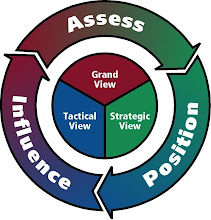
The Dao of Strategic Assessment (9): Assess, Position and Implement


In terms of strategic project over-viewing, Gates assessed the grand picture, understood the rule of "economic laws never change, while technology changes", and made the wise decision on focusing on the "75% solution" approach instead choosing the "gold plated" solution.

Due to the urgency of their current needs and the constant change of technology, it was more efficient for the Dept of Defense to focus on a series of pragmatic solutions.

Good strategic planning and decision making depends greatly on one's assessment of themselves, their opposition and what is the possible reaction from the opposition. Then building a plan upon that evaluation.

Against a "poorly resourced" opposition, one has more latitude in their decision-making. He can afford some loss of time and resources.

When competing against an
unknown opposition with greater resources, there is always uncertainty in their reaction. Regardless of their resources, there is always an weakness lurking somewhere in their armor. The underdog must properly assess the opposition in order to detect that "Achilles heel."

When leading with Sunzi’s strategic principles, one focuses on defeating the opposition in the least amount of time, with the minimum cost and the smallest damage to the grand settings.

The approach sounds conceptually simple.

The question is: does the company have the experienced professionals that are required to complete this objective? ... It is always a challenge to complete an objective on time, on budget and on target.


Strategic Disposition
After completing the assessment, the next stage is developing one's strategic disposition through solid planning and the understanding of each competitor's strategic disposition.

When developing the game plan, one determines whether to be flexible or efficient in their strategic approach.

Chinese strategy classics emphasize the importance of focusing on flexibility and being efficient in an unpredictable setting. While completing short term goals and objectives, one builds momentum for a forthcoming predictable setting.

When implementing in a predictable setting, focus on becoming efficient while minding the grand settings.

By using our Compass AE process, you are able to do the following:
  • Focus on the current objective while minding the Tangible Vision (the big picture);
  • Avoid negative circumstances while focusing on positive circumstances;
  • Maximize opportunities;
  • Adjust strategically;
  • Shape the Tangible Vision; and
  • Lead with strategic leadership .
By following your strategic dispositions, you can make better decisions. You will stay on course and complete your goal regardless of the circumstances.

Does your current plan do that?

What is the Tangible Vision?
The Tangible Vision is a goal, a plan that you work with. It also emphasizes a clearly-defined vision or mission statement that you believe in.

The first step is establishing your desired "end-in-mind" with specific details. The ideal outcome must have the value points and a tangible model that you can relate to. It also encompasses the contra-position of the desired outcome.

The next step is building the specific guidelines for each milestone. Those guidelines are based on the priorities, the approach and various circumstances for that phase.

The final step is outlining the operational steps that match the specific guidelines for each milestone.


The guidelines stated in the Tangible Vision become the strategic standard for the implementer to make decisions with. They know the positives and the negatives based on anticipated situations.

The Tangible Vision also guides the implementer on when and how to adapt the changes, what are the contingencies, etc.

In a future post, we will talk more about the basics of the Tangible Vision.

If you are interested in knowing more about our Compass AE process, please contact us at service[aatt] collaboration360[ddott]com

Copyright: 2009 Collaboration360 Consultants (C360).
Copying, posting and reproduction in any form (without prior consent) is an infringement of copyright.

#

March 17, 2009
Drones Are Weapons of Choice in Fighting Qaeda
By CHRISTOPHER DREW

A missile fired by an American drone killed at least four people late Sunday at the house of a militant commander in northwest Pakistan, the latest use of what intelligence officials have called their most effective weapon against Al Qaeda. And Pentagon officials say the remotely piloted planes, which can beam back live video for up to 22 hours, have done more than any other weapons system to track down insurgents and save American lives in Iraq and Afghanistan.

The planes have become one of the military’s favorite weapons despite many shortcomings resulting from the rush to get them into the field. An explosion in demand for the drones is contributing to new thinking inside the Pentagon about how to develop and deploy new weapons systems.

Air Force officials acknowledge that more than a third of their unmanned Predator spy planes which are 27 feet long, powered by a high-performance snowmobile engine, and cost $4.5 million apiece have crashed, mostly in Iraq and Afghanistan. Pilots, who fly them from trailers halfway around the world using joysticks and computer screens, say some of the controls are clunky.

For example, the missile-firing button sits dangerously close to the switch that shuts off the plane’s engines. Pilots are also in such short supply that the service recently put out a call for retirees to help. But military leaders say they can easily live with all that.

Since the height of the cold war, the military has tended to chase the boldest and most technologically advanced solution to every threat, leading to long delays and cost overruns that result in rarely used fighter jets that cost $143 million apiece, and plans for a $3 billion destroyer that the Navy says it can no longer afford.

Now the Pentagon appears to be warming up to Voltaire’s saying, The perfect is the enemy of the good.

/// Perfection is the state of mind. Being good is not enough. Focus on becoming excellent is the key.

In speeches, Defense Secretary Robert M. Gates has urged his weapons buyers to rush out 75 percent solutions over a period of months rather than waiting for gold-plated solutions. And as the Obama administration prepares its first budget, officials say they plan to free up more money for simpler systems like drones that can pay dividends now, especially as fighting intensifies in Afghanistan and Pakistan.

/// At this level, it is all about choosing a set of simple solutions that can provide immediate wins. Against the weak opposition, simplicity is acceptable. At some point of time, the superior competitor will compete against a greater opposition with the similar technology with advanced features.

A rare behind-the-scenes look at the use of the Predator shows both the difficulties and the rewards in pushing out weapons more quickly. I’ll be really candid, said Col. Eric Mathewson, who directs the Air Force’s task force on unmanned aerial systems. We’re on the ragged edge. He said the service has been scrambling to train more pilots, who fly the drones via satellite links from the western United States, to keep up with a near-tripling of daily missions in the last two years. Field commanders in Iraq and Afghanistan, where the Air Force is in charge of the Predators, say their ability to linger over an area for hours, streaming instant video warnings of insurgent activity, has been crucial to reducing threats from roadside bombs and identifying terrorist compounds. The C.I.A. is in charge of drone flights in Pakistan, where more than three dozen missiles strikes have been launched against Al Qaeda and Taliban leaders in recent months.

Considered a novelty a few years ago, the Air Force’s fleet has grown to 195 Predators and 28 Reapers, a new and more heavily armed cousin of the Predator. Both models are made by General Atomics, a contractor based in San Diego. Including drones that the Army has used to counter roadside bombs and tiny hand-launched models that can help soldiers to peer past the next hill or building, the total number of military drones has soared to 5,500, from 167 in 2001. The urgent need for more drones has meant bypassing usual procedures. Some of the 70 Predator crashes, for example, stemmed from decisions to deploy the planes before they had completed testing and to hold off replacing control stations to avoid interrupting the supply of intelligence. The context was to do just the absolute minimum needed to sustain the fight now, and accept the risks, while making fixes as you go along, Colonel Mathewson said. It is easier, of course, for the military to take more risks with unmanned planes.

Complaints about civilian casualties, particularly from strikes in Pakistan, have stirred some concerns among human rights advocates. Military officials say the ability of drones to observe targets for lengthy periods makes strikes more accurate. They also said they do not fire if they think civilians are nearby. The Predators were still undergoing basic testing when they were rushed into use in Bosnia and Kosovo in the 1990s and then hastily armed with missiles after the September 2001 terrorist attacks. But it was only after the military turned to new counterinsurgency techniques in early 2007, that demand for drones became almost insatiable.

Since then, Air Force Lt. Gen. Gary North, the air-component commander for the combined forces in Iraq and Afghanistan, said the service has gone to amazing lengths to increase their use. The Predators and Reapers are now flying 34 surveillance patrols each day in Iraq and Afghanistan, up from 12 in 2006. They are also transmitting 16,000 hours of video each month, some of it directly to troops on the ground.

The strains of these growing demands were evident on a recent visit to Davis-Monthan Air Force Base in Tucson, Ariz., one of four bases where Air National Guard units have been ordered to full-time duty to help alleviate crew shortages. The Guard members, along with Air Force crews at a base in the Nevada desert, are 7,000 to 8,000 miles away from the planes they are flying. Most of the crews sit at 1990s-style computer banks filled with screens, inside dimly lit trailers. Many fly missions in both Iraq and Afghanistan on the same day.

On a recent day, at 1:15 p.m. in Tucson 1:15 the next morning in Afghanistan a pilot and sensor operator were staring at gray-toned video from the Predator’s infrared camera, which can make even the darkest night scene surprisingly clear. The crew was scanning a road, looking for but not finding signs of anyone planting improvised explosive devices or lying in wait for a convoy.

As the Predator circled at 16,000 feet, the dark band of a river and craggy hills came into view, along with ribbons of farmland. We spend 70 to 80 percent of our time doing this, just scanning roads, said the pilot, Matthew Morrison.

At other times, the crews monitor insurgent compounds and watch over troops in battle. When you’re on the radio with a guy on the ground, and he is out of breath and you can hear the weapons fire in the background, you are every bit as engaged as if you were actually there, Major Morrison said. When Predators spot possible targets, officers monitoring video at command centers in Iraq and Afghanistan decide whether to order an attack.

Col. Gregg A. Davies, commander of the group that flies Predators for the Arizona Guard, said fighter planes with bigger bombs are often sent in to make the strikes. In all, the Air Force says, Predators and Reapers shot missiles on 244 of the 10,949 missions in Iraq and Afghanistan in 2007 and 2008. Air Force officials said a few crew members have had a difficult time watching the strikes. And some pilots said it can be hard to transition from being a computer-screen warrior to dinner at home or their children’s soccer games.

Another problem has been that few pilots wanted to give up flying fighter jets to operate drones. Given the shortages, the Air Force has temporarily blocked transfers out of the program. It also has begun training officers as drone pilots who have had little or no experience flying conventional planes.

Colonel Mathewson, director of the Air Force’s task force on unmanned aerial systems, said that while upgrades have been made to control stations, the service plans to eventually shift to simpler and more intuitive ground systems that could allow one remote pilot to control several drones.

Now, pilots say, it takes up to 17 steps including entering data into pull-down windows to fire a missile. And even though 13 of the 70 Predator crashes have occurred over the last 18 months, officials said the accident rate has fallen as flying hours have shot up. All told, 55 have been lost because of equipment failure, operator errors or weather. Four were shot down in Bosnia, Kosovo and Iraq; 11 were lost in combat situations, like running out of fuel while protecting troops under fire.

Given the demand for video intelligence, the Air Force is equipping 50 manned turbo-prop planes with similar cameras. And it is developing new camera systems for Reapers that could vastly expand the intelligence each plane can collect. P. W. Singer, a defense analyst at the Brookings Institution, said the Predators have already had an incredible effect, though the remote control raised obvious questions about whether the military could become more cavalier about using force.

Still, he said, these systems today are very much Model T Fords. These things will only get more advanced.

Copyright 2009 The New York Times Company
http://www.nytimes.com/2009/03/17/business/17uav.html

Sunday, February 1, 2009

Applying SunZi Principles in a Competitive Arena


A drafted post that was lost in the archives.

When a visiting team enters the home territory of their opposition, they must remember the following: "... In dispersive ground the opposition must unify the determination of the army. ... Ground equally accessible to both the enemy and me is communicating. ... Do not attack an enemy who occupies key ground; in communicating ground do not allow your formations to become separated. ... In difficult ground, press on; in encircled ground, devise stratagems; in death (desperate) ground, fight. ... " --- Sun Zi AoW, Chapter 11 Nine Grounds


Notes:
Dispersive ground
is a competing situation where a competitor attempts to challenge you before your preparation is completed .

Key ground is a competing situation where one secures great advantage by having the expediency of utilizing the resources at hand.

Communicating ground
is a competing situation where you and your competitor(s) are able to advance and retreat easily. The challenge is to secure the space of one's terrain with maximum efficiency, speed and the least amount of resources, without exposing one's weakness.

Difficult ground is a competing situation where you or your competitor encounter major barriers. The challenging part of this situation is deciding whether to advance or retreat.

Serious ground
is a competing situation where you or your competitor have gain significant ground in the terrain of their competing arena. The two challenging points of this situation is: (1) the risk of running out of resources and provisions; and (2) determining how to secure more resources as one progress along .

Encircled ground
is a competitive situation where you or your competitor are almost out of resources. The recommended protocol is to study the strategic positioning of the "encircling" player, pinpoint weaknesses and devise stratagems to avoid the state of desperation.

Death ground is a competitive situation where the encircled competitor is at a desperate situation. In order to gain new momentum and life, he or she focuses on fast wins through direct confrontation. Any delayed strategic action would guarantee the end of their endeavor.

#

Following are the steps that we recommend to the advantageous competitor:
  • Force the Dispersive circumstance into the heart of the opposition by commanding the Key ground and controlling the Communicating ground;
  • Move intensively fast; and
  • Secure the Serious ground while understanding that the grand settings behind the goal must not be destroyed.
This is the essence of Sunzi strategic concepts.

# # #

NFL says Patriots claim of extra crowd noise unsubstantiated
ESPN.com news services

Updated: November 5, 2007, 3:21 PM ET


The NFL says no artificial crowd noise was pumped into the RCA Dome on Sunday during the New England-Indianapolis game, despite claims otherwise by Patriots team president Jonathan Kraft.

"CBS has informed us that the unusual audio moment heard by fans during the Patriots-Colts telecast was the result of tape feedback in the CBS production truck and was isolated to the CBS broadcast," NFL spokesman Greg Aiello said Monday. "It was in no way related to any sound within the stadium and could not be heard in the stadium." Yahoo! Sports reported earlier that the NFL was looking into charges Kraft made after Sunday's 24-20 New England win. Kraft told NFL vice president of security Milt Ahlerich -- the same man involved in confiscating the Patriots' videotape made in a Week 2 game against the New York Jets that cost Belichick $500,000, the Patriots $250,000 and a first-round draft pick -- that he felt there was extra noise in the stadium. Aiello said, according to Yahoo!: "We're aware of it and we're looking into it. It may just be the TV feed from CBS, but we're checking it out." Monday, he said that was indeed the case. Kraft is the latest in a line of people who have accused the Colts of enhancing crowd noise in their domed stadium. It has never been proven.
http://sports.espn.go.com/nfl/news/story?id=3095903

###

q: How do you stop the opposition from utilizing this advantage?
a: From another Chinese strategy classic, "one uses 'Yin' (soft) methods to counter the opponent's 'Yang' (hard) methods."

q: What soft method could the Patriots have used to shut down the channeled loud noise?
De-accelerate the pace of the game by implementing a "long and tedious no-huddle run first" attack. The slower the game gets, the more bored the crowd becomes. Once one gets two long consecutive scoring drives and if the opposition fails in their scoring. Most likely, the crowd will no longer be involved in the game.


Water (soft methods) can isolate an enemy but cannot destroy his supplies or equipment (team unity or fan support). ... Those who use fire (hard methods) to assist their attacks are intelligent; those who use inundations (a combination of soft and hard methods) are powerful.
- Sun Tzu's The Art of War: Chapter 12 Attack by Fire (Use of Influence)


More examples on the maneuvering of Yin and Yang tactics will be covered in our Strategic Assessment book.

# # #

Collaboration360 Consultants (C360 Consultants). Copyright:2009 © All rights reserved
Copying, posting and reproduction in any form (without prior consent) is an infringement of copyright.

Friday, December 19, 2008

A Thank You Note


Last month we did a presentation on applying Sunzi's The Art of War in business. We also demonstrated the basic framework of our process.

Following are comments from Dr Fellman, the Professor of International Strategy from University of Southern New Hampshire


"M.E. Hom has taken the ancient strategic writings of Sun Tzu (Sunzi) and incorporated them into a modern international project management methodology of unusually sophistication, flexibility and practicality. He combines the best elements of competitive intelligence, strategic planning and contemporary business theory into a process which can be practically applied by managers around the world.

Mr. Hom has been a frequent and well-appreciated guest lecturer in our MBA and MS courses and I give his process my highest recommendation. ..."

- Dr. Phil Fellman, Professor of International Business, University of Southern New Hampshire


His comment on one of our previous presentations
The Chinese students said that on the Mainland, they don't study Sun Tzu, so they found it very interesting and also very new. They were deeply impressed by your level of knowledge and I was very grateful to have you as a guest lecturer. -Dr. Phil Fellman

Monday, October 27, 2008

Preparation Precedes Performance


If you are prepared properly, you can create opportunities within the sphere of your opposition..


"... When the army has penetrated deep into hostile territory, leaving far behind many enemy cities and towns, it is in serious ground. ... In serious ground I would ensure a continuous flow of provisions. ... Take advantage of the enemy's unpreparedness; travel by unexpected routes and strike him where he has taken no precautions. ... Speed is the essence of war. Take advantage of the enemy's unpreparedness; travel by unexpected routes and strike him where he has taken no precautions. ..." --- Sunzi Art of War Chapter 11


October 26, 2008
So Spread Out, So Hard to Catch
By THAYER EVANS

TULSA, Okla. When Rice Coach David Bailiff prepared for Tulsa’s fast-paced no-huddle, spread offense, he noticed that the videotapes had recorded some of the action in midplay.

He wondered if the missing tape was a bit of gamesmanship. That was until his team lost, 63-28. Not only could Rice not keep up with Tulsa on the field, but the Owls’ video staff also could not keep up with recording the Golden Hurricane’s offense.

You think they’re starting their camera late, Bailiff said in a telephone interview, but then you realize that’s just how fast they’re going.

All season, opponents have been playing catch-up to No. 22 Tulsa (7-0, 4-0 Conference USA) and its offense, which entered the weekend ranked first in total offense (624.7 yards a game) and scoring (56.6) in the Football Bowl Subdivision.

In his first season as a starter, the fifth-year senior quarterback David Johnson has blossomed into a stealth Heisman Trophy contender and thrown for 2,397 yards. He led the nation in touchdown passes (31) and passing efficiency (212.8).

Under the energetic second-year coach Todd Graham, Tulsa could be on the verge of crashing the Bowl Championship Series, despite having the smallest enrollment of any top-division member (4,165). Entering Sunday’s home game against Central Florida, Tulsa is ranked No. 19 in the B.C.S. standings and is halfway to its goal of posting a 14-0 record and winning the Orange Bowl for the first time since 1945.

I’m going to have to study his offense and see what new wrinkles that we can put in, said Michigan Coach Rich Rodriguez, a spread-offense guru, for whom Graham used to work as a defensive assistant at West Virginia.

Of Tulsa’s remaining regular-season opponents, only Houston entered Saturday with a winning record. Tulsa’s toughest challenge could be at Arkansas on Nov. 1.

But that is only if the Razorbacks can figure out how to slow the Golden Hurricane offense, which tries to snap the ball in the first 10 seconds of the 40-second play clock. Tulsa has outscored their opponents by an average of 56.6 to 27.1 this season.

It just feels like the opposing teams have no chance, the senior wide receiver Brennan Marion said.


The up-tempo offense
, which Central Arkansas Coach Clint Conque called smoke and mirrors after losing to Tulsa last month, causes alignment mistakes and fatigue among defenses. The hectic offense has been known to leave opposing players gasping for breath. Tulsa has outscored opponents by 302-118 after the first quarter.

They have the fastest-paced offense I’ve ever seen, said Bailiff, a 27-year coaching veteran.

Tulsa’s dynamism can be traced to Graham, who was hired in 2007 after he coached Rice to its first bowl in 45 years in his lone season there. Before that, he was the Golden Hurricane’s defensive coordinator for three seasons under Steve Kragthorpe, who left for Louisville in 2007.

A plastic orange with 14-0 written on it and a Bible turned to Psalms sat on a desk in Graham’s office, and The Art of War was in a bookcase.

Graham, the son of a single mother with an eighth-grade education who raised five children, arrives for work at 6 a.m. daily, and sleeps twice a week in his office on a blue air mattress that his wife bought. He makes his secretaries answer the telephone, University of Tulsa, home of the champions.

His players often tease him for his telling them to do a handspring out of bed in the morning to ensure a positive attitude.

I’m fired up to be doing this, said Graham, 43, who has six children. Can you believe I get paid to do this? It’s a great job. I don’t want to be around the fellowship of the miserable. I am jacked that I get to work.

But even though Graham had recruited many of Tulsa’s players during his first stint with the team, they seemed unsure about his boundless enthusiasm when he returned.

In his first team meeting after being introduced as that coach, Graham stated that his goals for last season were a 14-0 record and an Orange Bowl victory. His words were met with awkward silence.

We were like: ‘This guy is crazy,’ the senior offensive tackle Rodrick Thomas said. ‘He’s rambling. He’s way too ecstatic and needs to calm down.’

With the innovative Gus Malzahn as a co-offensive coordinator, Tulsa led the nation in total offense at 543.9 yards a game last season. It also became the first team with a 5,000-yard passer, three 1,000-yard receivers and a 1,000-yard running back in N.C.A.A. history.

But instead of playing in the Orange Bowl, the Golden Hurricane whipped Bowling Green, 63-7, in the GMAC Bowl to finish 10-4.

Undeterred, Graham announced in a team meeting in January that his goals for this season were again a 14-0 record and an Orange Bowl victory. This time, his players nodded in agreement. As a reminder, the trophies from the university’s 1945 Orange Bowl and 2005 Conference USA championship were placed on the field during every off-season workout.

We bought in this year, Thomas said.

As chaotic as Tulsa’s offense looks, there is logic to it. Malzahn is required to design a game plan within Graham’s parameters, which are based on his 22 years of coaching defense.

If I just let him do whatever he wanted to, he’d throw the ball every play, Graham said of Malzahn, who had previously been Arkansas’s offensive coordinator.

Graham, who is sure to be mentioned for prominent coaching jobs after this season, requires establishing the run to set up play-action passing. Ideally, he wants an equal mix of passing and rushing plays.

Graham also mandates multiple formations with simplicity in plays, sets with multiple tight ends, the option and even the triple option out of the shotgun, as well as misdirection in rushing and passing. He also demands five plays a quarter to throw the ball deep outside the hash marks and continual changes in the spacing in formations.

We basically run on offense everything I hate to defend, Graham said. We’re going to be in the left lane, man. We ain’t in the right lane. We’re in the left lane, hammered down.

Even Johnson occasionally seems to marvel at the offense.

There’s a lot of stuff that I’ve never seen before, said Johnson, whose only major scholarship offer was from Tulsa. I don’t even how it’s going to work sometimes, but then it does. It’s just crazy.

Despite the lack of national attention relative to their ranking, Johnson and his teammates hardly seem to mind. He just seems glad that Tulsa is finally getting respect locally.

At a recent home game, Johnson recalled not seeing fans in the stands wearing Oklahoma and Oklahoma State apparel for the first time in his career.

As we keep winning, our sphere of influence is getting bigger, he said.

Trying to catch them, either on tape or on the field, is the challenge.

Copyright 2008 The New York Times Company

http://www.nytimes.com/2008/10/26/sports/ncaafootball/26tulsa.html

#


If you want your project team to maneuver like this, contact us at service[aatt]collaboration360[dott]com. We believe we can help you

Wednesday, October 15, 2008

New Application for the C360 Strategic Assessment Process


Was working with a potential client. We showed him how to use our strategic assessment process for intelligence gathering.

While the grand process is the same but the operational process is quite different.

If you are interested in this topic, contact us at service(aatt)collaboration360(ddoottt)com

Sunday, October 12, 2008

An Endorsement for Our Strategic Assessment Process from Roger Ames


"a very contemporary, very intelligent application of Sunzi."
-- Dr. Roger T. Ames, author of Sun Tzu: The Art of Warfare and
Sun Pin: The Art of Warfare

Roger T. Ames is a Professor of Philosophy and the Director of the Center for Chinese Studies at the University of Hawaii. He is the editor of the journal Philosophy East & West.


Copyright: 2008 © Collaboration360 Consultants (C360 Consultants).
Copying, posting and reproduction in any form
(without prior consent) is an infringement of copyright

Friday, August 29, 2008

C360's Freebie: Strategic Assessment Template for IT Project Development


We are currently working on a specialized strategic assessment template for IT project development. When it is finished, we are offering it to any interested parties.

If you are interested in securing a digital copy, please contact us at service [aatt] collaboration360 [dott] com.

Copyright: 2008 © Collaboration360 Consultants (C360).
Copying, posting and reproduction in any form (without prior consent) is an infringement of copyright.

Wednesday, August 20, 2008

An Endorsement from Mark McNeilly, a Sun Tzu Expert


"Michael Hom's strategic assessment approach provides an insightful and logical way to understand and take advantage of one's market position relative to competitors and the marketplace, all built on the writings of one of history's great strategists, Sun Tzu."
--- Mark McNeilly, Author of Sun Tzu and the Art of Business,
Sun Tzu and the Art of Modern Warfare and George Washington and the Art of Business.


Copyright: 2008 © Collaboration360 Consultants (C360).
Copying, posting and reproduction in any form (without prior consent) is an infringement of copyright.

Friday, August 8, 2008

Latest Status on Our Strategic Assessments Process paper.


Will announce the publishing of our Strategic Assessment article later this month. For those who are interested in securing a copy of this article, please contact us. We will send you a PDF version of it.

Saturday, July 26, 2008

Strategic Assessment: The Book


After a few weeks of contemplation, we at the Collaboration360 decided to write a book on how to apply our Strategical Assessment process to the global marketplace.

As mentioned before, our process is based on the principles from the Art of War and the rest of the eight Chinese strategy classics.

We have already done the table of contents. Have not figured out the book title. It will have
detailed examples for different competing arena.

It will be a long and slow process. But we will get it done.

More to come