skip to main |
skip to sidebar
 We understand the essentials of strategy through experience and execution. With our process, you will be able to do the following:
- Minimizing costs;
- Mitigating risks;
- Accelerating delivery;
- Maximizing opportunities;
- Ensuring quality.
Beside devising marketing strategies for startups, we also specializes in strategic project management.#
The following set of concepts is from Bob Lewis, one of my favorite IT project writers.The KJR Manifesto's 13 concepts whose principal virtue is that they work: - There are no best practices, only practices that fit best.
- To optimize the whole you must sub-optimize the parts.
- Bad metrics are worse than no metrics.
- Relationships precede process.
- Relationships outlive transactions.
- Don't confuse documentation with reality.
- Before you can be strategic you have to be competent.
- Big solutions that work start as small solutions that work.
- Customers are external. Internal customers aren't.
- Don't run IT as a business, run it in a business like way.
- There are no IT projects.
- Digest with intestines, think with brain.
- Every employee is irreplaceable.
http://issurvivor.com/shop/article_KJR/Keep-the-Joint-Running%3A-A-Manifesto-for-21st-Century-Information-Technology.html
All of his project management books and materials are great. We recommended it.

 When your project team implements their plan, do they know how tangible is it?
If their plan is not tangible, the team will disbelieve it. In most cases, they will not complete it to the best of their ability!? ... What do you think the chances of that project ever becoming a success? ... What is the probability of their project being completed on time, on budget and on target?  Before a team defines their project plan, they must know what are their goals and objectives. This planned outcome enables a team to know what their grand goal is. Many project plans fails because of the misunderstanding of the specifics behind the goaIs.
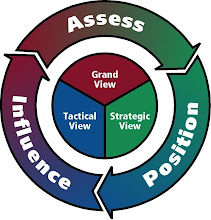
The Compass team establishes the Tangible Vision ("the big picture") by defining their goals and objectives in terms of their needs, their time line, their effort. their viability, their value, and the sustainability of the goal. The next step is the transformation of those project specifics in simple guidelines.
Once the Compass team has built and connected with their Tangible Vision, they will have strategic overview of their goals, their objectives and the approach to completing it. (More data on building the Tangible Vision later.)
Does your team know how to do it?
If you are interested in learning more about our Compass AE process, please contact us through contactus[tatt]collaboration[dott]com. Replace [tatt] with "@" and [dott] with ".". We will send you a white paper on our Compass AE methodology.
 1 "Within three years, about two-thirds of U.S. professionals will be mobile workers. ..." - International Data Corporation 2002. /// It is only a matter of time that most project teams will be operating from a virtual office. The question is ... how will these teams stay connected as a team? In terms of communications, tools connect them. Does it connects the team as a collaborative team?2 "... In a recent survey of 124 financial executives, only 21% said they encouraged value-creating behaviors. ..."- Deloitte Dbriefs Webcast, Driving Enterprise Value, October 14, 2004/// When building a Tangible Vision, the project team is encouraged to define the specific values. 3 "50% of all projects fail and a staggering 31.1% of projects will be canceled before they ever get completed. ..." - The Standish Group/// This outcome happens when the teams lack a team collaborative process to connect with.4 "Only 59% of all projects reach the market. In Europe only a meager 45% get shipped. ..." - Embedded Systems 07/2006. /// From the Standish group report, 30% of all projects was completed on time, on-budget and on target5. "The average cost of a Fortune 500 project range between $6-10 million before it goes over budget and over schedule. ..."- Baseline Magazine6. "1 out of every 4 projects never get out of the starting line. ..." - Meta group/// One in four implemented projects failed due to poor planning and an unwillingness to modify existing business practice.7. "60% of all requirements for most projects are re-written. ..."- Construx/// More than 60% of software projects in the U.S. failed, and poor requirements is one of the top 5 reasons.8 "More than 50% of the project failures are due to reasons outside of the project. ..."
- Anonymous /// The project implementors are so focused on daily tasks and activities, that they lose track of their strategic matters and long range goals.
 Proper Preparation Propels Profits
 Current trend of project management:* 60% of all requirements for most projects are re-written. (Borland Intl, Construx.com);
Result:* 1 out of every 4 projects never leave the starting line (Meta group);* 30% of all projects are completed on time, on-budget and on target (Chaos Report);"Only 59% of our projects reach the market. In Europe only a meager 45% get shipped. ..." Jack Ganssle, Embedded.com (07.10.2006)# # #Our Analysis:
When a team collaboratively does not understand what is their big picture, they will not collaborate. No collaboration = No project success. It is psychological difficult to force a team to collaborate when they are not connect with it.
Our Compass AE process enables a project team to collaboratively use the Tangible Vision to view the "top to bottom" connections between the goal, the objectives and the requirements. ...
When they connect with it, the process of collaboration begins.
@ the end, the Compass team completes their Tangible Vision on time, on budget and on target.