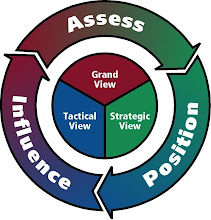
When assessing the grand picture, one must know the grand settings of their terrain and the grand specifications of each competitor.
#
The New York Times April 26, 2009
Does H.P. Need a Dose of Anarchy?
By ASHLEE VANCE Palo Alto, Calif.
IT all seems obvious when viewed through hindsight’s pristine lens: Hewlett-Packard didn’t need a reinvention. It just needed some fierce fiscal discipline to transform itself from a bumbling, lost soul into a well-oiled profit machine.
At its core, H.P.’s turnaround works against the natural order of things in Silicon Valley, where people talk about technology first and finances a distant second. The frenetic hunt for the next big thing has helped a select few endure decades of busts and booms, and they have always left it to the bean counters to obsess about the bottom line.
So it took a true outsider, in Mark V. Hurd, to engineer H.P.’s resurrection and to create the world’s largest technology company. Mr. Hurd, hired four years ago in the wake of Carleton S. Fiorina’s tumultuous departure as chief executive, forced a steady, boring diet of performance benchmarks, heavy-handed cost-cutting and data-mining down H.P.’s corporate throat.
Silicon Valley is not known for creating lean organizations, and he’s as good as we have ever seen, said Michael S. Malone, a historian who wrote Bill and Dave, a book about the company’s renowned co-founders, William Hewlett and David Packard. He’s taught a lesson in what big-time corporate management looks like.
But with the most brutal cuts behind it, H.P. faces a fresh set of challenges as the second stage of Mr. Hurd’s tenure begins. Most pressing is widespread concern that Mr. Hurd has built an inflexible, solipsistic giant so obsessed with schematics and data-driven fiscal machinations that it has lost the ability to deliver that prized and perennial Silicon Valley trick: to surprise and astound.
Although H.P. is trying to expand its presence in businesses like personal computers and printers, some critics argue that those markets have little left to give. The company could also use more imaginative thinking to bolster its developing line of software products and services. In short, what may be missing in the formidable intellectual and strategic artillery that Mr. Hurd brings to bear at H.P. is creative inspiration. Or, as Mr. Malone puts it, I am not sure Mark has built an H.P. that can go through the natural changes that accompany the technology industry as the company has in the past. If you posit this idea to any of the company’s top executives, they’ll dismiss it. H.P. has plenty of room to grow, they say in printers, computers, software or services and has a firm grasp of the technology industry’s nature and undulations. If you don’t believe such talk, that’s fine, they say just look at the numbers for any convincing.
When you hear me talk, I have four quadrants in my head simultaneously, Mr. Hurd says, outlining a mental tableau that encompasses H.P.’s operations (Quadrant 1), products (Quadrant 2), business and technology trends (Quadrant 3) and competitors (Quadrant 4). Visions of metrics dance in his mind, and he speaks of them with a passion and devotion that has clearly filtered through the ranks and H.P.’s results. While that approach also offers a contained, orderly way for Mr. Hurd to tackle his challenges, it isn’t necessarily a recipe for the kind of fertile brainstorming that leads to creative breakthroughs in the tech world.

/// As you view the lower left quadrant, do you assess the competitive position of your opposition?
Steven P. Jobs, the co-founder and chief of Apple, has never discussed quadrants when speaking about products like the iPod and the iPhone, and has dismissed the value of using focus groups to inform design projects. Sometimes consumers need to be shown what they want, Mr. Jobs has said.
MR. HURD, 52, often strums a tabletop like a pianist as he delves into business minutiae, his enthusiasm measured by the steady clack-clacking of his gold wedding band. He also enjoys riffling through a flip chart, tracing and disgorging a panoply of figures with the ease of a symphony conductor. Indeed, his flip chart is so precious to him that it accompanies him on the road. He always has that giant white pad and his magic markers, says Jeffrey Katzenberg, the chief executive of DreamWorks Animation, who says he sometimes has trouble parsing Mr. Hurd’s scrawls.
///
A Great Strategic Mind + A thought-out grand process + Simple tools = Strategic Success
///
But for a numbers guy like Mr. Hurd, H.P. is a fantasy land, and the path for navigating it couldn’t be clearer. He shows a remarkable familiarity with the balance sheet and amazing depth with numbers, says Matt Lavallee, the director of technology for the MLS Property Information Network, a real estate service, who talked with Mr. Hurd during a recent customer event. He’s the most impressive executive I have ever met.
Thanks to mega-acquisitions and strong growth, H.P. has emerged as the largest buyer of many components that go into computing systems. It buys about one-fifth of Intel’s chips used in PCs and servers, surpassing all rivals. And its purchasing power should increase as the innards of PCs, servers, storage systems and networking gear overlap more and more every year. H.P. has used its heft as a weapon, playing suppliers off one another, especially during lean times like now, to keep costs as low as possible. Ever to the point, Mr. Hurd says that if you don’t have scale, and you don’t have leverage, you won’t be able to give the customer what the customer wants. In recent years, the company has demonstrated an ability to balance chasing growth with its internal cuts. Although industry pundits had derided the PC business as a lost cause, H.P. has expanded its computer division sales by $15.6 billion over the last four years, hitting $42.3 billion in total sales last year.
During a similar period, computer sales at Dell rose to $35.8 billion, from $35.2 billion. Just as astonishing, H.P. declared in February that it could shoot past Wall Street’s earnings targets for the full year at a time when its sales may come in about $18 billion lower than expected because of frozen consumer and corporate spending. Mr. Hurd attributes this performance to having banged out agreements with suppliers during better days and the company’s ability to turn far-flung corporate dials to fine-tune operations when customers suddenly stop buying.
His own intensity adds to the corporate mojo. Athletic and tightly focused, he comes from a relatively privileged background. His father attended Yale, and his mother, the daughter of a Park Avenue doctor, was introduced to society at a dinner at the Waldorf-Astoria. Growing up in New York and then Miami, he attended college preparatory schools and went to Baylor University in Waco, Tex., on a tennis scholarship. He had long hair, wore tennis shorts and was a religious devotee of the courts," says Max Sandlin, a former congressman from Texas, who was president of Mr. Hurd’s fraternity.
At the time, most of us would have thought Mark more likely to be the next Jimmy Connors than the C.E.O. of H.P. After Baylor, Mr. Hurd joined NCR, a quiet maker of cash-register equipment and automated teller machines, based in Dayton, Ohio. While not a self-made man in the classic sense, he is by all accounts a self-made business mind who manufactured his own luck and turned himself into a star at NCR, and over the course of 25 years excelled in a number of jobs, including running NCR’s flashiest division, a database unit called Teradata. Mr. Hurd flourished at Teradata, creating a fast-growing business within NCR that caught executives’ attention and ultimately led to his promotion as chief of the entire company.
More important, he evolved during those years into a manager both feared and admired for his command of numbers. Mark provided a level of stability and leadership that inspired people, says Jim Murphy, who spent more than a decade at Teradata in sales.
He is the kind of guy you were willing to follow despite the pressure that comes with his constant drive to focus on metrics.
/// If the goal and the objectives have specific (and achievable) metrics, therefore, it is tangible.
That drive played out on the basketball and tennis courts, as well, where Mr. Hurd made it clear that he was always out to win. He is a vicious athlete and competitor, Mr. Murphy says. He would get pretty hot-headed and jaw with people. At H.P., Mr. Hurd’s reputation for having a quick mind and a quick temper has only grown. It’s common for executives to recount stories about his noticing a lowered forecast in a presentation, slamming his briefing materials down and, with an ever-present salty tongue, ordering that the situation be fixed before their next meeting.
For his part, Mr. Hurd is not about to give up his blunt style. I go all over the place, he says. I do like the ability to go around the company at different levels to find the people that have the actual answers to the question. MR. HURD’S zeal has had a controversial reception at one of his company’s most admired divisions, H.P. Labs. Historically, the unit has been the most freewheeling part of the company, charged with creating new businesses out of thin air. Over the years, the products coming out of the labs have revitalized the company’s business during lulls.
Since Mr. Hurd arrived, H.P. Labs has whittled down the number of projects it tackles at any given time to 30, from about 150.
/// The 80/20 rule is in play. Focus 80% effort on the top 20% of the listed objectives that generate tangible revenue.
Prith Banerjee, the director of H.P. Labs, has dismissed the castoffs as interesting science projects and championed the survivors as big bets with the most commercial potential. Yet the often idiosyncratic researchers now find themselves writing up business plans and dealing directly with customers rather than funneling their ideas out to people more experienced in such matters.
For example, Carl Taussig, who runs H.P.’s Information Surfaces Lab, a part of H.P. Labs, has teamed with the Army, Arizona State University, DuPont Teijin Films and E Ink to produce flexible display technology that might be used like electronic paper or to create cheaper screens in mobile devices. H.P. Labs has a bigger burden now in creating a path toward commercialization, Mr. Taussig said. It’s more work, and it’s different work. But H.P.’s businesslike approach to research and curtailed money for the labs have former employees concerned about the company’s future.
I think they are seriously underspending on research and development, says Charles H. House, who worked at H.P. for 29 years, overseeing the creation of 12 product lines. It seems to me that betting on new areas is a struggle for them. Shane Robison, the company’s chief strategy and technology officer, argues that few companies can match the breadth of its research, in areas as varied as printing systems and data mining. Some of the most impressive work has been in nanotechnology and optics, where engineers do nothing less than manipulate light to move data around computers at ground-breaking speeds. This is fundamental, breakthrough stuff, Mr. Robison says. He later added, It’s just goofy to get into a debate about whether you’re spending enough money.
A believer in long-term planning, Mr. Hurd says the company still has plenty to show the world. You would not want to short H.P. on its ability to innovate, he says. Its biggest bets surround the plain-vanilla business of providing technology infrastructure to clients. H.P. believes that customers want to buy as much of those products and services from one company as possible a move that is, yes, data-driven.
H.P. expects the amount of information produced by companies to keep rising along with their desire to analyze that data. More data means more servers, storage and networking gear and, for as long as companies print paper records of their computing results plenty of purchases of H.P.’s expensive printer ink. At the heart of the company’s infrastructure play is Electronic Data Systems, the technology services company it acquired last year that manages customers’ data center operations. H.P. is laying off tens of thousands of employees as it tries to revivify the company and make it an integral part of its offerings to corporate customers.
But critics, most notably I.B.M., castigate H.P. as more or less the dull grunt of the tech world that has doubled down on humdrum, low-profit businesses.
If years of price wars for parts and infrastructure services ensue, H.P. will face serious pressure on the cost structure it has worked so hard to achieve. There are still lots of opportunities for H.P. to cut costs out, but at some point its ability to do that at the rate of the last few years certainly diminishes, said A. M. Sacconaghi, a technology analyst at Sanford C. Bernstein & Company.
Because Mr. Hurd has so ably rationalized the company’s cost structure, he now has to prove that he can foster a culture capable of building a second wave of growth which zeroes back in on the creativity question.
In that regard, the future looks murky. Current and former employees complain that Mr. Hurd has put so much pressure on the organization that the willingness to take risks has faded. Quarterly business unit reviews with Mr. Hurd are known to be intense and probing and to inspire plenty of worry. Adding to this is a fear that morale has declined because of benefits cuts and a pay-for-performance rewards structure that creates deep fissures between the haves and the have-nots.
/// With our Compass AE process, a project team of implementers gain the strategic skills to see the technical connections within their big picture. They also get an overview that enables them to understand the balance of being efficient and being innovative.
Mr. Hurd faced similar criticisms at NCR. I am not here trying to tell you it’s perfect, he says, adding that workers complain about bureaucracy and the process-driven practices creeping into their jobs. I think at the end of the day all these things come with a price.
/// To some people, a process has a tendency of slowing down innovation and growth. With the Compass AE process, the implementers gain the ability to increase their strategic valuation while minimizing values and mitigating risks.
Mr. Hurd, however, contends that internal surveys provide a more accurate view of the company than scattered anecdotes and reveal a satisfied work force. The company’s strong, consistent financial performance has restored its luster as a Silicon Valley icon and imbued employees with pride, he says. There is a tremendous attraction for the people to the scale, the opportunity, the entrepreneurship, he says. For us, it is a big deal to attract talent that can flourish in an environment like this and take advantage of our scale without it becoming an issue for them.
A COMPANY of 321,000 people can move only so nimbly, and H.P. has fallen behind in some of the most promising parts of the market. It arrived late with a line of netbooks, the low-cost, compact laptops that have taken the world by storm, opening doors for its rival Acer.
/// Sometimes, long term strategic thinkers will misunderstand the "short-term" behavior of the masses.
And, over the last few years, a wide variety of online services has captured the attention of consumers and businesses, but H.P. has struggled to make its name synonymous with so-called cloud computing.
Despite talking so much about data and the powers of information analysis, the company trails rivals like I.B.M. and Oracle when it comes to building the most sophisticated business software. Another glaring weakness resides on the gadget front, where the company concedes an innovation lapse and continues to sell a relatively unpopular smartphone. (H.P. promises that better phones are in the pipeline.) With its software gurus, its newfound penchant for design and its deep ties to retailers, H.P. might have been expected to disrupt the cellphone market with new devices or even to concoct an electronic book reader that would complement its printer business.
Instead, it’s Apple and Amazon that built vibrant new businesses around such products. In spite of the fact that there are things we could always do a better job on, innovating and so forth, I don’t think we have ever felt stronger about our portfolio of products and services and our opportunity to serve the market, Mr. Hurd says. I don’t think we think we’re confused about what the market wants.
To H.P.’s credit, it read the PC market just right in recent years, capitalizing on a surge in laptops and retail sales. It revamped the look of its products, developed a distinctive ad campaign and began to assert more independence.
For example, the company built a fanciful laptop in tandem with the fashion designer Vivienne Tam; it looks as much like a purse as a computer. And H.P.’s most daring move may have come with its TouchSmart software that lets people manipulate items on their computer screens with their fingers, while also adding a distinct look and feel to the company’s gear.
On the printing side, the company feels poised to capitalize on another megatrend: a shift to digital presses for industrial jobs like making magazines and labels. Every percentage point of additional share in this market translates into immense profits for H.P., which pours research and development dollars into proprietary ink. Mr. Hurd points again and again to the company’s scale and diversity as its major advantages.
Companies like I.B.M. and Dell have also emerged as the largest buyers of components during different eras, says Intel’s chief executive, Paul S. Otellini. Typically, the companies have started to struggle just as their buying heft approaches that of H.P., when gains prove tougher to come by and unexpected, nimble competitors emerge. That said, the tech industry has never encountered a giant the size of H.P. I do think Mark has carved out a unique opportunity that comes from selling everything from servers to phones, Mr. Otellini says.
In the end, Mr. Hurd says he’s not worried about his image as a numbers mercenary and refuses to fret about how others view his approach as H.P. tries to innovate its way toward growth. When I was at Teradata, I got called a growth guy. And then when I became C.E.O. of the whole company, I got called a cost-cutter, Mr. Hurd says. Then, I came to H.P. and became an operations guy. To be very blunt, I am not really that concerned with what labels get associated with somebody. I know we have a whole bunch of things to get done.
Copyright 2009 The New York Times Company
http://www.nytimes.com/2009/04/26/technology/companies/26hp.html?_r=1&hpw


+Going+from+Point+A+to+Z.gif)