Showing posts with label JiangTaiGong. Show all posts

Tuesday, June 24, 2008

Compass AE as an Collaborative Enabler


The great enabler

By Rod Newing

Published: June 29 2007 17:38 | Last updated: June 29 2007 17:38

No single technology can accommodate the complex processes and cultural ramifications of collaborative interactions. Successful collaboration results from using the right balance of face-to-face meetings and technology. Furthermore the technology, or combination of technologies, must be appropriate to each kind of interaction.

/// Conceptually, collaboration results from proper teamwork first.

But trying to work together remotely goes against our natural human instincts. "We are optimally evolved to talk at a range of about 5 feet in groups of no more than 90 people," says Ceri Roderick, a partner in Pearn Kandola, an occupational psychologist practice. "We respond to a rich stream of information and judge nuances, such as pronunciation or slight facial expressions." This enables us to assess people's motives, trustworthiness and reliability.

Take all that away and the bald words on the page can be over-interpreted or misunderstood. "As organisations become larger, more global and more dispersed," Mr Roderick warns, "we stretch the parameters and make life difficult for ourselves." The objective of technology is to replicate that rich stream of information when the communication is particularly important – for example, when building relationships and trust, solving problems or reviewing progress. This means operating in real-time and combining as many forms of communication as possible, such as images, voice and text. This process is called "unified communications" and it is made possible by the latest internet-based technologies. These combine to give much more information to provide more context to the exchange.

"Successful collaboration starts with the people," says Graham Oakes, a technology consultant. "They need to establish contact with each other and agree lines of communication, which is a lot easier to do face to face."

Mr Roderick recommends that people working in virtual teams should make time to meet occasionally. This allows them to understand more about the personal and cultural context of other individuals, which helps when they subsequently telephone or e-mail each other.

/// The team starts by building the Tangible Vision as a team. When they builds their Tangible Vision, they begin to learn something about their counterpart. ... For example, how does he/she think? How does he/she expresses their ideas? etc.

The need to get the balance right is shown by "Congested Lives", a research study of over 1,200 UK businesses employees carried out by YouGov for Polycom, a collaborative communications vendor. This showed that unnecessary face-to-face meetings cost businesses £17bn each year and 82 per cent of respondents who had travelled to meetings in the last year believed many of them were unnecessary.

If people want to build trust and relationships without the time and cost of travel, then video conferencing is the most effective tool. "The purpose of many video conferences is not necessarily to get things done but to build trust and contacts in the relationship," says Jeffrey Mann, vice-president of research at Gartner, the technology analyst. "Video and web conferencing are really relationship building, and not necessarily information passing or for agenda point processing, because people want to know who they are dealing with."

Growth in video conferencing has been forecast for many years, but so far it has failed to materialise. Professor Peter Cochrane, a futurologist and founder of ConceptLabs, puts its failure to date down to poor video and sound quality, no eye contact, no gaze awareness, no body language, small people images and no depth of field.

"Most of this can now be fixed," he says, "notably by Cisco Telepresence, which uses life-size high definition screens, audio straight out of the speaker's mouth from the right direction, eye contact and all in good quality. Hollywood discovered the value of emotions, for which good audio and video are the essential."

Asynchronous communication, where people interact over a period of time, is also a valuable tool. "If you are dealing with someone in another part of the world in another language, it gives them more time to think and react," says Mr Mann. "It is a real disadvantage if they have to think in real-time."

But there is a danger of sharing too much information. Microsoft's Enterprise IQ Survey 2007, in partnership with Henley Management College, found that an average workgroup of 25 people shares information 1,500 times a week and intensive information users share over 5,000 times a week. Even then, 22 per cent of documents are considered to be out of date.

"People are drowning in data and feel overwhelmed by information," says Jean-Anne Stewart, director of corporate programmes at Henley Management College. "There are issues of reliability and accuracy, which may be contributing to calling meetings to gather and share information."

/// When a Compass team leads with their Tangible Vision, they focus on the standards that are listed in their Tangible Vision. The Tangible Vision gives the Compass team a strategic overview of direction, connections and anticipation.

Although a wide range of corporate technologies exists to overcome some of the cultural issues surrounding collaborative working, a new range of consumer-based technologies is beginning to establish itself in the enterprise. Often referred to collectively as "Web 2.0", the technologies include social networks, wikis and blogs.

"The teenagers of today are using technology to communicate and collaborate like never before but the business world is struggling to figure out how to use them," says Neil Sutton, general manager for information technology services at BT.

When today's teenagers start their careers in the commercial world, it will have an impact on the way we communicate. They will prefer different ways of communicating, and this will affect collaboration within, and between businesses – but the business world is not ready for it."

Stewart Mader, wiki evangelist at Atlassian, a software systems company, points out that the generation now entering the workforce are experts in social media and are already collaborating with each other. One of the reasons for the success of Web 2.0 tools is that they blur the line between pure business productivity and the building of an emotional connection, a sense of ownership and involvement, which allows people to interact directly with other people to build their knowledge.

"They approach knowledge as the product of that organic, non-linear human connection and collaboration," he says. "Imagine unleashing that potential in the professional world."

People's individual web profiles are the foundation of social networks, allowing them to connect to each other and to information. These profiles add the necessary "context" to the collaboration.

IBM has been using the same approach for eight years with its 475,000 "Blue Pages" employee and partner profiles. These include an individual's experience, skills, projects they have worked on, their patents and publications, the content they have created, the activities they are involved in and the communities in which they participate.

"They are accessed 6m times a day to find more about the people you know and to find the people you don't know," says Jeff Schick, worldwide vice-president for social software at the company. "You really get a better understanding of who the individual is, what they do and what they know."

The CIX electronic conferencing system has been using the personal information of its users to make connections since before the internet became pervasive. "They are essential for building a mental picture of your remote colleagues," says Graham Davies, the company's managing director. "It helps us to predict how a person will interpret and react to our ideas and suggestions, in the same way their facial emotions and body language would in a face-to-face situation."

Clearly, technology can help to address a number of cultural problems associated with collaboration – but not if they are used exclusively. As Prof Cochrane concludes: "Collaboration still works best if it is supported by human contact that cements trust and familiarity on a regular basis."

Copyright The Financial Times Limited 2008

http://www.ft.com/cms/s/2/a68a825e-265d-11dc-8e18-000b5df10621.html

#

When the Compass team collaboratively builds and connects with their Tangible Vision, they become familiarized with the priorities and the approaches to completing their goal and the circumstances that can occur. ... They know their role and responsibilities in certain situations while learning something about each other. ... The members of the team collaboratively trust each other and know that everyone is accountable. The team is always decisive in their actions as a team and continually trusts their Tangible Vision.

#

"One who excels at warfare will await events in the situation without making any movements. When he sees he can be victorious he will arise; if he see he cannot be victorious he will desist. Thus it is said he doesn’t have any fear, he doesn’t vacillate. Of many harms that can beset any army, vacillations is the greatest. Of disasters that can befall an army, none surpasses doubt.”
– Six Secret Teachings, 26


By connecting with their Tangible Vision, a Compass team always know what are their priorities and the approaches regardless of the circumstances. There is no doubt in the mind of the Compass Implementors.

If you are interested in knowing more about how Compass AE works, please contact us at service [at] collaboration360 [dot] com. We have a white paper ready for your reading.


Copyright © 2008 Collaboration360 Consultants (and Collaboration360.com) All rights reserved. Copying, posting and reproduction in any form (without prior consent) is an infringement of copyright

#

Saturday, January 26, 2008

The Strategist as a Fisherman (3)


The Way of the Ultra Strategist:
He
creates the opportunities that lures their targets in, via transforming ordinary events into something extraordinary.

What is the Approach of the Ultra Strategist?
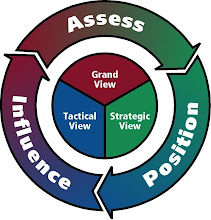
The strategist views the big picture. He builds his plan by assessing ideas, positioning events and choosing the best people to complete the goal. The key is the use of the Tangible Vision as his compass.

Do you have a strategic process that enables your team to perform the above?


###

Fishing, Nation and Attracting Talents-Six Teachings

(Tai Gong Six Teachings-Civil Teaching Chapter 1)

King Wen said:" I would like to hear about these greater principles."

Tai Gong said:" When the source is deep, water flows endlessly. When the water flows endlessly, fish spawn there. This is nature. When the roots of the trees are deep, the tree is tall. When the tree is tall, fruits are produced. This is nature. When men of true worth have views in common, they will come together. When they are drawn together, accomplishments can be achieved. This is nature. Speech and response are merely adornment of inner emotions. Speaking about the truth is the best. What I am about to say is all the truth without adornment, will you find it abhorrent?"

King Wen said:" Only a man of true benevolence can accept corrections and remonstrance. What makes you think I will be? Please continue."

Tai Gong continued:" When the fishing line is thin and the bait is glittering, only small fish will bite. When the line is thicker and bait is fragrant, medium sized fish will bite. When the line is thick and the bait is generous, large fish will bite. When the fish take the bait, they will be caught on the line. When men take salary, they will submit to their ruler. When you catch with bait, the fish can be killed. When you give remuneration, men can be made to exhaust their capabilities for you. If you regard families, as the basic foundation of state, the state is yours. If you use the state as your base to conquer the kingdom, you can conquer the kingdom."

###

Thursday, January 10, 2008

Competing in the Global Economy: A Grand Vision with No Tangibility


Intel exiting from the "One Laptop Per Child" (OLPC) project should not be a surprise. Bad events happen to those who possess a grand vision that lacks tangibility and detailed specifics. Am sure they developed a plan that didn't take account of negative circumstances.

"One Laptop Per Child" people did not plan that there will be competition with grander resources. who will surpass them within a short time period.

Negroponte should have known that his technological edge was minimal at best. The competition should be able to duplicate and improve on their design within a short timeline.

/// Sidebar: Defining and preparing for negative circumstances is considered to be a turnoff for some people. As one Silicon Valley person told me,"... Don't talk negative. It is bad vibe for the team. ... Got to be positive. " ///

Seen this storyline with many global startups who are "social cause-driven" with no concept of the bigger picture, winded up as road kills.


###

Nonprofit slips in race for cheap laptop for world's poor kids
Problems at One Laptop Per Child show how social entrepreneurs can blaze trails but miss the payoff.
By Ben Arnoldy | Staff writer of The Christian Science Monitor
Oakland, Calif.

The vision was grand: Develop a cheap laptop and get it into the hands of 150 million school children in the developing world.

Making the computer turned out to be the easy part. On Wednesday at the Consumer Electronics Show in Las Vegas, Nicholas Negroponte, founder of One Laptop Per Child, showed off the $200 XO. The innovative computer sports a bright screen readable in sunshine and a highly efficient battery that can be recharged by cranking it.

But One Laptop has run into controversy – a corporate partner and the group's chief technology officer pulled out in recent weeks – which has experts noting perils for the broader social entrepreneur movement.

Social entrepreneurs, who aim to solve social problems using business-world principles, have tackled everything from expanding rural credit to marketing indigenous crafts in recent years. But experts say the problems at One Laptop point to a challenge for these emerging entrepreneurs. They often excel at trailblazing new markets among the world's poor but struggle to achieve large-scale sales and distribution.

"In many respects, these social entrepreneurs are pathfinders, they are like the research and development for bigger players that have otherwise ignored the bottom of the pyramid market," says James Koch, a professor at Santa Clara University in California.

For example, One Laptop's XO has proven the concept of cheap laptops. Companies like Lenovo and Intel, sensing the market potential, are now working on their own models. This isn't necessarily bad for One Laptop's ultimate goal.

"Part of our model of success is to have competition, to have other people in this space," says Walter Bender, president of software and content at One Laptop. "We don't need to be the monopoly or biggest player in the market."

/// What we have here is an intangible view of a global economy. MY question is: If you are not going to be big, what are you going to be?

The world is filled with predators waiting for smart but naive people to make the grand mistake.
Dragons create opportunities. Tigers find opportunities. Wolves wait for opportunities. In a life and death struggle, a hungry wolfpack usually prevails over a smaller prey.


But the competitors' products aren't helping One Laptop's efforts to secure big orders. So far, it has orders for 500,000 laptops, with more than 100,000 already en route to places such as Afghanistan and Haiti. But it's far behind its goal to sell 150 million units by the end of 2008.

One reason for the shortfall, One Laptop alleges, is that a former partner – Intel – was disparaging the XO as it developed its own ultra-cheap laptop, the Classmate.

"Their sales people were saying, 'Because we're on the board, we have inside info and we know that everything is broken and it doesn't work,' " says Mr. Bender.

Intel has told a different story, saying that Mr. Negroponte was unreasonably demanding that the company stop marketing the Classmate in regions targeted by One Laptop. Intel didn't respond to an interview request.

/// Inviting current competition to join your group was not a smart idea.

"Do not loan sharp weapons to other men. If you loan sharp weapons to other men, you will be hurt by them and will not live out your allotted span of years." --- Jiang Tai Gong Six Secret Teachings (Sawyer X'lation) ///


Partnerships with multinational corporations can be double-edged swords for nonprofit startups. On the one hand, they're one of the quickest ways for startups to ramp up delivery of a product. On the other hand, nonprofits and corporations have different bottom lines, which means that such partnerships need to develop slowly and carefully,
says Nora Silver, director of the Center for Nonprofit and Public Leadership at the University of California, Berkeley.

A successful partnership between clothing-manufacturer Timberland and CityYear, a nationwide volunteer corps, took years to forge. The Intel partnership, however, seemed hasty and didn't integrate the sales force into the effort, Dr. Silver says.

"Did these folks have a clear contract?" she asks. "You have to be very clear about such basic agreements."

One Laptop was acting as if they had a contract with exclusivity and noncompete clauses, she adds. Bender says there was only a nondisparage agreement.

The difficulty of scaling up a business isn't limited to social entrepreneurs. For-profit startups struggle with it, too. But entrepreneurs have a bigger challenge when they target poor people, especially those who are uneducated and live in remote areas.

Traditional marketing campaigns on TV and billboards may miss these customers entirely. And putting the product on shelves may not be enough. The entrepreneurs may have to find ways to advance small loans to would-be buyers. They may have to find indigenous nonprofit groups that could open markets that a corporation would never devote the time or have the credibility to crack.

One Laptop decided to target ministries of education to get bulk orders for schools. Working with those agencies, even in the developed world, requires a lot of effort and patience, notes John Quelch, a professor at the Harvard Business School.

"One of the knocks against [One Laptop] could be that they focused very much at achieving a price point for the product, but didn't necessarily focus as much on developing a solution for the ministry of education for country X," says Dr. Quelch, adding that this can be a common pitfall.

/// Our Compass AE process focuses on the team collaboratively defining clear specifications from goal to objectives. If the specifics do not connect from milestone to milestone, the Tangible Vision does not work. ///

"Initially, we had three or four people doing that around the globe, which is a stretch," says Bender. One Laptop is now working closely with Brightstar, the world's largest cellphone distributor, to help with global logistics.

from the January 11, 2008 edition - http://www.csmonitor.com/2008/0111/p03s04-stct.html


/// When building a Tangible Vision, it is important to focus on creating strategic positioning from top to bottom.

In the case of OLPC,
their product does not offer any long term tangible "strategic positioning" leverage. The building of their marketing plan should have been focused on creating "strategic positioning".

Remember, Strategic Positioning = Strategic Advantage. ///

Saturday, January 5, 2008

The Strategist as a Fisherman (2)


Most fishermen knows that there are no big fishes in little ponds or small guppies in oceans of sharks and whales?

Before choosing "The Gold Standard" option for their Tangible Vision, one assesses their grand settings and themselves.


--- More to come. ---