Showing posts with label The Dao of Strategic Assessment (S4). Show all posts

Wednesday, August 26, 2009

The Dao of Strategic Assessment (36): The Importance of Proper Strategic Assessment

The purpose of strategic assessment is to understand the strategic valuation of one's current and future position. Regardless of the data, the emotional state can sometimes alter one's normal decision-making process.

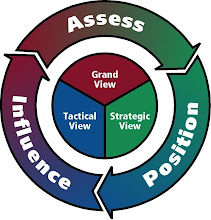
C360 assesses the grand picture by focusing on the fundamentals, the technicalities, the various cycles and the global effect.

The front runners are those who succeed by complying with the seasonal cycle of the global marketplace . They have the strategic skill to know the entrance point and the exit point many degrees before the termination of the cycle.

"Even in the good times, you need to be conservative, totally focused and not expand beyond your means. The good times can never last forever. Things come in cycles always." --- The Unknown Strategist

One succeeds by consciously assessing the grand picture- knowing what is currently happening and what is the next occurrence, then implementing one's Tangible Vision before the cycle is over.

If you need another view on your assessment of your grand picture, contact us at service[aatt]collaboration360[ddott].com. ...


________________________________
August 21, 2009
Rise of the Super-Rich Hits a Sobering Wall
By DAVID LEONHARDT and GERALDINE FABRIKANT

The rich have been getting richer for so long that the trend has come to seem almost permanent.

They began to pull away from everyone else in the 1970s. By 2006, income was more concentrated at the top than it had been since the late 1920s. The recent news about resurgent Wall Street pay has seemed to suggest that not even the Great Recession could reverse the rise in income inequality.

But economists say — and data is beginning to show — that a significant change may in fact be under way. The rich, as a group, are no longer getting richer. Over the last two years, they have become poorer. And many may not return to their old levels of wealth and income anytime soon.

For every investment banker whose pay has recovered to its prerecession levels, there are several who have lost their jobs — as well as many wealthy investors who have lost millions. As a result, economists and other analysts say, a 30-year period in which the super-rich became both wealthier and more numerous may now be ending.

The relative struggles of the rich may elicit little sympathy from less well-off families who are dealing with the effects of the worst recession in a generation. But the change does raise several broader economic questions. Among them is whether harder times for the rich will ultimately benefit the middle class and the poor, given that the huge recent increase in top incomes coincided with slow income growth for almost every other group. In blunter terms, the question is whether the better metaphor for the economy is a rising tide that can lift all boats — or a zero-sum game.

Just how much poorer the rich will become remains unclear. It will be determined by, among other things, whether the stock market continues its recent rally and what new laws Congress passes in the wake of the financial crisis. At the very least, though, the rich seem unlikely to return to the trajectory they were on.

Last year, the number of Americans with a net worth of at least $30 million dropped 24 percent, according to CapGemini and Merrill Lynch Wealth Management. Monthly income from stock dividends, which is concentrated among the affluent, has fallen more than 20 percent since last summer, the biggest such decline since the government began keeping records in 1959.

Bill Gates, Warren E. Buffett, the heirs to the Wal-Mart Stores fortune and the founders of Google each lost billions last year, according to Forbes magazine. In one stark example, John McAfee, an entrepreneur who founded the antivirus software company that bears his name, is now worth about $4 million, from a peak of more than $100 million. Mr. McAfee will soon auction off his last big property because he needs cash to pay his bills after having been caught off guard by the simultaneous crash in real estate and stocks.

“I had no clue,” he said, “that there would be this tandem collapse.”

Some of the clearest signs of the reversal of fortunes can be found in data on spending by the wealthy. An index that tracks the price of art, the Mei Moses index, has dropped 32 percent in the last six months. The New York Yankees failed to sell many of the most expensive tickets in their new stadium and had to drop the price. In one ZIP code in Vail, Colo., only five homes sold for more than $2 million in the first half of this year, down from 34 in the first half of 2007, according to MDA Dataquick. In Bronxville, an affluent New York suburb, the decline was to two, from 17, according to Coldwell Banker Residential Brokerage.

“We had a period of roughly 50 years, from 1929 to 1979, when the income distribution tended to flatten,” said Neal Soss, the chief economist at Credit Suisse. “Since the early ’80s, incomes have tended to get less equal. And I think we’ve entered a phase now where society will move to a more equal distribution.”

No More ’50s and ’60s

Few economists expect the country to return to the relatively flat income distribution of the 1950s and 1960s. Indeed, they say that inequality is likely to remain significantly greater than it was for most of the 20th century. The Obama administration has not proposed completely rewriting the rules for Wall Street or raising the top income-tax rate to anywhere near 70 percent, its level as recently as 1980. Market forces that have increased inequality, like globalization, are also not going away.

But economists say that the rich will probably not recover their losses immediately, as they did in the wake of the dot-com crash earlier this decade. That quick recovery came courtesy of a new bubble in stocks, which in 2007 were more expensive by some measures than they had been at any other point save the bull markets of the 1920s or 1990s. This time, analysts say, Wall Street seems unlikely to return soon to the extreme levels of borrowing that made such a bubble possible.

Any major shift in the financial status of the rich could have big implications. A drop in their income and wealth would complicate life for elite universities, museums and other institutions that received lavish donations in recent decades. Governments — federal and state — could struggle, too, because they rely heavily on the taxes paid by the affluent.

Perhaps the broadest question is what a hit to the wealthy would mean for the middle class and the poor. The best-known data on the rich comes from an analysis of Internal Revenue Service returns by Thomas Piketty and Emmanuel Saez, two economists. Their work shows that in the late 1970s, the cutoff to qualify for the highest-earning one ten-thousandth of households was roughly $2 million, in inflation-adjusted, pretax terms. By 2007, it had jumped to $11.5 million.

The gains for the merely affluent were also big, if not quite huge. The cutoff to be in the top 1 percent doubled since the late 1970s, to roughly $400,000.

By contrast, pay at the median — which was about $50,000 in 2007 — rose less than 20 percent, Census data shows. Near the bottom of the income distribution, the increase was about 12 percent.

Some economists say they believe that the contrasting trends are unrelated. If anything, these economists say, any problems the wealthy have will trickle down, in the form of less charitable giving and less consumer spending. Over the last century, the worst years for the rich were the early 1930s, the heart of the Great Depression.

Other economists say the recent explosion of incomes at the top did hurt everyone else, by concentrating economic and political power among a relatively small group.

“I think incredibly high incomes can have a pernicious effect on the polity and the economy,” said Lawrence Katz, a Harvard economist. Much of the growth of high-end incomes stemmed from market forces, like technological innovation, Mr. Katz said. But a significant amount also stemmed from the wealthy’s newfound ability to win favorable government contracts, low tax rates and weak financial regulation, he added.

The I.R.S. has not yet released its data for 2008 or 2009. But Mr. Saez, a professor at the University of California, Berkeley, said he believed that the rich had become poorer. Asked to speculate where the cutoff for the top one ten-thousandth of households was now, he said from $6 million to $8 million.

For the number to return to $11 million quickly, he said, would probably require a large financial bubble.

Making More Money

The United States economy experienced two such bubbles in recent years — one in stocks, the other in real estate — and both helped the rich become richer. Mr. McAfee, whose tattoos and tinted hair suggest an independent streak, is an extreme but telling example. For two decades, at almost every step of his career, he figured out a way to make more money.

In the late 1980s, he founded McAfee Associates, the antivirus software company. It gave away its software, unlike its rivals, but charged fees to those who wanted any kind of technical support. That decision helped make it a huge success. The company went public in 1992, in the early years of one of biggest stock market booms in history. But Mr. McAfee is, by his own description, an atypical businessman — easily bored and given to serial obsessions. As a young man, he traveled through Mexico, India and Nepal and, more recently, he wrote a book called, “Into the Heart of Truth: The Spirit of Relational Yoga.” Two years after McAfee Associates went public, he was bored again. So he sold his remaining stake, bringing his gains to about $100 million. In the coming years, he started new projects and made more investments. Almost inevitably, they paid off.

“History told me that you just keep working, and it is easy to make more money,” he said, sitting in the kitchen of his adobe-style house in the southwest corner of New Mexico. With low tax rates, he added, the rich could keep much of what they made.

One of the starkest patterns in the data on inequality is the extent to which the incomes of the very rich are tied to the stock market. They have risen most rapidly during the biggest bull markets: in the 1920s and the 20 years starting in 1987.
“We are coming from an abnormal period where a tremendous amount of wealth was created largely by selling assets back and forth,” said Mohamed A. El-Erian, chief executive of Pimco, one of the country’s largest bond traders, and the former manager of Harvard’s endowment.

/// Almost everyone knows the general strategic rules. However, a few knows the exception to those rules. Do you?

Some of this wealth was based on real economic gains, like those from the computer revolution. But much of it was not, Mr. El-Erian said. “You had wealth creation that could not be tied to the underlying economy,” he added, “and the benefits were very skewed: they went to the assets of the rich. It was financial engineering.”

But if the rich have done well in bubbles, they have taken enormous hits to their wealth during busts. A recent study by two Northwestern University economists found that the incomes of the affluent tend to fall more, in percentage terms, in recessions than the incomes of the middle class. The incomes of the very affluent — the top one ten-thousandth — fall the most.

Over the last several years, Mr. McAfee began to put a large chunk of his fortune into real estate, often in remote locations. He bought the house in New Mexico as a playground for himself and fellow aerotrekkers, people who fly unlicensed, open-cockpit planes. On a 157-acre spread, he built a general store, a 35-seat movie theater and a cafe, and he bought vintage cars for his visitors to use.

He continued to invest in financial markets, sometimes borrowing money to increase the potential returns. He typically chose his investments based on suggestions from his financial advisers. One of their recommendations was to put millions of dollars into bonds tied to Lehman Brothers.

For a while, Mr. McAfee’s good run, like that of many of the American wealthy, seemed to continue. In the wake of the dot-com crash, stocks started rising again, while house prices just continued to rise. Outside’s Go magazine and National Geographic Adventure ran articles on his New Mexico property, leading to him to believe that “this was the hottest property on the planet,” he said.

But then things began to change.

In 2007, Mr. McAfee sold a 10,000-square-foot home in Colorado with a view of Pike’s Peak. He had spent $25 million to buy the property and build the house. He received $5.7 million for it. When Lehman collapsed last fall, its bonds became virtually worthless. Mr. McAfee’s stock investments cost him millions more.

One day, he realized, as he said, “Whoa, my cash is gone.”

His remaining net worth of about $4 million makes him vastly wealthier than most Americans, of course. But he has nonetheless found himself needing cash and desperately trying to reduce his monthly expenses.

He has sold a 10-passenger Cessna jet and now flies coach. This week his oceanfront estate in Hawaii sold for $1.5 million, with only a handful of bidders at the auction. He plans to spend much of his time in Belize, in part because of more favorable taxes there.

Next week, his New Mexico property will be the subject of a no-floor auction, meaning that Mr. McAfee has promised to accept the top bid, no matter how low it is.

“I am trying to face up to the reality here that the auction may bring next to nothing,” he said.

In the past, when his stock investments did poorly, he sold real estate and replenished his cash. This time, that has not been an option.

Stock Market Mystery

The possibility that the stock market will quickly recover from its collapse, as it did earlier this decade, is perhaps the biggest uncertainty about the financial condition of the wealthy. Since March, the Standard & Poor’s 500-stock index has risen 49 percent.

Yet Wall Street still has a long way to go before reaching its previous peaks. The S.& P. 500 remains 35 percent below its 2007 high. Aggregate compensation for the financial sector fell 14 percent from 2007 to 2008, according to the Securities Industry and Financial Markets Association — far less than profits or revenue fell, but a decline nonetheless.

“The difference this time,” predicted Byron R. Wein, a former chief investment strategist at Morgan Stanley, who started working on Wall Street in 1965, “is that the high-water mark that people reached in 2007 is not going to be exceeded for a very long time.”

Without a financial bubble, there will simply be less money available for Wall Street to pay itself or for corporate chief executives to pay themselves. Some companies — like Goldman Sachs and JPMorgan Chase, which face less competition now and have been helped by the government’s attempts to prop up credit markets — will still hand out enormous paychecks. Over all, though, there will be fewer such checks, analysts say. Roger Freeman, an analyst at Barclays Capital, said he thought that overall Wall Street compensation would, at most, increase moderately over the next couple of years.

Beyond the stock market, government policy may have the biggest effect on top incomes. Mr. Katz, the Harvard economist, argues that without policy changes, top incomes may indeed approach their old highs in the coming years. Historically, government policy, like the New Deal, has had more lasting effects on the rich than financial busts, he said.

One looming policy issue today is what steps Congress and the administration will take to re-regulate financial markets. A second issue is taxes.

In the three decades after World War II, when the incomes of the rich grew more slowly than those of the middle class, the top marginal rate ranged from 70 to 91 percent. Mr. Piketty, one of the economists who analyzed the I.R.S. data, argues that these high rates did not affect merely post-tax income. They also helped hold down the pretax incomes of the wealthy, he says, by giving them less incentive to make many millions of dollars.

Since 1980, tax rates on the affluent have fallen more than rates on any other group; this year, the top marginal rate is 35 percent. President Obama has proposed raising it to 39 percent and has said he would consider a surtax on families making more than $1 million a year, which could push the top rate above 40 percent.

What any policy changes will mean for the nonwealthy remains unclear. There have certainly been periods when the rich, the middle class and the poor all have done well (like the late 1990s), as well as periods when all have done poorly (like the last year). For much of the 1950s, ’60s and ’70s, both the middle class and the wealthy received raises that outpaced inflation.

Yet there is also a reason to think that the incomes of the wealthy could potentially have a bigger impact on others than in the past: as a share of the economy, they are vastly larger than they once were.

In 2007, the top one ten-thousandth of households took home 6 percent of the nation’s income, up from 0.9 percent in 1977. It was the highest such level since at least 1913, the first year for which the I.R.S. has data.

The top 1 percent of earners took home 23.5 percent of income, up from 9 percent three decades earlier.

http://www.nytimes.com/2009/08/21/business/economy/21inequality.html

Sunday, August 23, 2009

The Dao of Strategic Assessment (35): The Return of Yahoo !?


Making presumptions and using technology as a general solution does not always work for everyone. In business as in life, even parity does not exist.

Compared to Google, Yahoo has limited resources. In order to compete effectively, they had to manage their time and energy effectively. They assessed what the general client base wanted and positioned themselves with a plan based on their assessment.


Having paid heed to the advantages of my plans, the general must create situations (strategic advantage) which will contribute to their accomplishment. By 'situations' I mean that he should act expediently in accordance with what is advantageous and so control the balance. - Art of War 1 (Griffith Translation)

Google has a general philosophy of "Technology is everything and the users make the individual choice of what they want to use." Overall, Google has the resources to overwhelm any competitor and feel no urgency to change. They will stay with their belief of a general technology-driven solution that enables the users to make their choice.


Currently web statistics show that Yahoo is ahead of Google in the arena of financial information. Whether they can beat Google on the long run is debatable.

It is a contest where one's killer app can be duplicated in less than nine months.

Following are three questions for the readers:
  • Do you assess before you plan?
  • What is your approach for assessing?
  • Based on your assessment, how do you define your goal?
We will touch on these three questions at a later post.

#
August 23, 2009
Digital Domain
Where Yahoo Leaves Google in the Dust
By RANDALL STROSS

GOOGLE has an outsize image as the deft master of information. Its superior technology seems to pitilessly grind up its rivals. But Google’s domination in search has proved hard for it to match in some information domains. When serving financial news and information, for example, Yahoo draws 17.5 times the traffic of Google, according to comScore Media Metrix.

Yahoo Finance, which has occupied the top spot in the category for 19 consecutive months, drew 21.7 million unique United States visitors in July; Google Finance drew only 1.2 million unique visitors, placing it 17th in comScore’s rankings for the category, one slot above a site called FreePressRelease.com.

Yahoo understands that information about money — a user’s own money — presents some tricky psychological issues. James Pitaro, vice president of Yahoo’s audience group, said, “In our research with users, we found that the more information that was displayed on the page, the greater the anxiety.”

He said Yahoo deliberately adopted what he calls “the Apple model — simplicity in design; a clean, simple look, not overburdening our users with too much information on the page.”

Google seems to pay no heed to such psychology. Google Finance, which was introduced in 2006 and shed its “beta” label earlier this year, hews to its original strategy: offer the best data and charts. And when that doesn’t work, offer still more data and charts.

Yahoo Finance is organized into sections: investing; news and opinion; personal finance; customized portfolio tracking; and “Tech Ticker,” short video features that have supplied an average of 450,000 streams a day in recent months, Yahoo says. When you click on a link to a news story accompanied by a Tech Ticker video, it starts automatically and seems intended to insert a warm human presence on the page. The video player is on one side of the page and is stationary; the visitor scrolls down on the other side to read news articles.

“It’s made for multitasking,” Mr. Pitaro said.

About 5 percent of the finance site’s information is original, he said, though his group is looking at ways to increase that to about 10 percent, matching the proportion on Yahoo Sports.

Mr. Pitaro credited Yahoo’s home page with sending traffic to Yahoo Finance.

“We have a great relationship with the front-page team to identify topics we should cover,” he said. An example of a “featured” story found last week on Yahoo’s front page: “Where Rich Singles Live,” accompanied by a picture of an attractive young woman smiling at the camera while pulling papers out of a briefcase. A click whisked the interested reader to Yahoo Finance.

Google does not use the mostly empty home page of the mothership to let visitors know that it has a finance site — some may not even know it exists. (To reach it, a user must click on the word “more” at the top of the home page.) But Google’s finance site offers something rather basic that Yahoo doesn’t: free real-time price quotations obtained directly from the New York Stock Exchange and Nasdaq.

Over at Yahoo, the price quotations come from the BATS Exchange, an electronic equity exchange. A Yahoo spokeswoman said that in terms of accuracy and speed, its data “are very close to that from the larger exchanges, and for the average investor, the differences would hardly be noticeable.” (In my side-by-side comparison, the BATS quote on Yahoo for “YHOO” usually lagged Nasdaq’s on Google by a minute.)

If Yahoo customers would like the quotations directly from the two largest United States exchanges, they must pay Yahoo $10.95 or $13.95 a month for the privilege of getting the same data that Google offers free.

Among all visitors to Yahoo Finance who are referred by another site, 47.8 percent came from another Yahoo property, according to comScore’s data for July. Only 28.8 percent of Google Finance visitors came from another Google property. (As for MSN Money, which holds third place, 72.7 percent came from other Microsoft sites.)

Compare the total United States traffic on all Google sites with the total on all of Yahoo’s and you’ll see that Google edged past Yahoo last year to take the overall lead. Since then, Google has stayed on top, though with only a slim advantage, according to comScore. So finance is an important category that allows Yahoo to remain neck-and-neck with Google over all.

Yahoo Finance is not just coasting, either: it enjoyed 12 percent growth in traffic from July 2008 to July 2009, while Google Finance’s traffic grew by only 3 percent.

GOOGLE has not adopted the features that Yahoo uses to create a more appealing look and feel for a finance site. While Google also provides news and portfolio tracking, it doesn’t have its own videos or columnists.

Invited to show off features that differentiated Google’s site from Yahoo’s, Ayan Mandal, a Google product manager, pointed to new charting tools, called “Technicals. Added this summer, they allow users to analyze stock prices over time with 12 technical formulas.

It seems unlikely, however, that Google’s new tools — whose metrics include one called the Fast Stochastic Oscillator — will do as much for building traffic as a fluffy news story or a short video featuring talking heads. Yahoo understands that a free finance site prospers by drawing less from the world of mathematics and more from the world of entertainment, informing just enough to satisfy users without setting off an anxiety attack.

Randall Stross is an author based in Silicon Valley and a professor of business at San Jose State University. E-mail: stross@nytimes.com.

http://www.nytimes.com/2009/08/23/business/23digi.html?hpw

Saturday, August 8, 2009

The Dao of Strategic Assessment (34): A View from a Saturday Morning Quarterback


We are so globally connected that a cyber disruption can only slow down the momentum of a web-based commerce.

Are you strategically prepared to manage your business when your computerized information systems or one of your primary web communication tools is inoperable?

Assess your settings in terms of your operations. Ask yourself the following questions, "What will my operating costs be if this device is down? ...
What is my backup? ... What is the impact regarding to my relationships to my customers"

Conclusively. spend some time with your IT professional and review your contingency plans. One should never be overly depended on one specific technology.


#

August 8, 2009
Professor Main Target of Assault on Twitter
By JENNA WORTHAM and ANDREW E. KRAMER

The cyberattacks Thursday and Friday on Twitter and other popular Web services disrupted the lives of hundreds of millions of Internet users, but the principal target appeared to be one man: a 34-year-old economics professor from the republic of Georgia.

During the assault — the latest eruption in a yearlong skirmish between nationalistic hackers in Russia and Georgia — unidentified attackers sent millions of spam e-mail messages and bombarded Twitter, Facebook and other services with junk messages. The blitz was an attempt to block the professor’s Web pages, where he was revisiting the events leading up to the brief territorial war between Russia and Georgia that began a year ago.

The attacks were “the equivalent of bombing a TV station because you don’t like one of the newscasters,” Mikko Hyppönen, chief research officer of the Internet security firm F-Secure, said in a blog post. “The amount of collateral damage is huge. Millions of users of Twitter, LiveJournal and Facebook have been experiencing problems because of this attack.”

The blogger, a refugee from the Abkhazia region, a territory on the Black Sea disputed between Russia and Georgia, writes under the name Cyxymu, but identified himself only by the name Giorgi in a telephone interview. Giorgi, who said he taught at Sukhumi State University, first noticed Thursday afternoon that LiveJournal, a popular blogging platform, was not working for him. “I decided to go to Facebook,” he said. “And Facebook didn’t work. Then I went to Twitter, and Twitter didn’t work. ‘How strange,’ I thought, ‘What a coincidence they all don’t work at once.’ ”

Security experts say that it is nearly impossible to determine who exactly is behind the attack, which disrupted access to Twitter, Facebook, LiveJournal and some Google sites on Thursday and continued to affect many Twitter users into Friday evening.

But Beth Jones, an analyst with the Internet security firm Sophos, said the assault occurred in two stages.

Early Thursday, the attackers sent out a wave of spam under the name Cyxymu, which is a Latin transliteration of the Cyrillic name of the capital of Abkhazia, Sukhumi. This technique, a “joe job,” is intended to discredit a Web user by making him appear to be the source of a large amount of junk e-mail. “These hackers wanted to make him look responsible for millions of spam e-mails,” said Ms. Jones.

The messages contained links to Giorgi’s accounts on several social networks and Web sites, including Twitter.

The next leg of the attack, Ms. Jones said, was a distributed denial of service, or D.D.O.S., attack aimed at knocking Giorgi off the Web. The hackers used a botnet, a network of thousands of malware-infected personal computers, to direct huge amounts of junk traffic to Cyxymu’s pages on Twitter, LiveJournal, YouTube and Facebook in an attempt to disable them, Ms. Jones said.

The junk messages overwhelmed the services, slowing them, and in the case of Twitter and LiveJournal, shutting them down entirely for a time.

Giorgi said his pages were providing a place for refugees from Abkhazia to exchange memories of their home. The Twitter page had a sepia photograph of a palm-lined city street. “It was nostalgia,” he said.

This week, he began posting day-by-day accounts of the run-up to the conflict that drew partly on posts from his readers inside of Abkhazia, who he said had been describing how the Russian army staged its forces in the region in early August 2008.

“I feel a bit ashamed for the people who lost service because my blog was blocked,” said Giorgi.

The hundreds of millions of Internet users affected were simply “collateral damage,” said Ms. Jones.

The attacks and their aftermath show just how vital Web tools and services are becoming to political discourse — and how vulnerable they are to disruption.

“They aren’t set up to play the role of a global communications network, but very quickly they’ve come to represent that,” said John Palfrey, a law professor and co-director of Harvard University’s Berkman Center for Internet and Society.

The attacks that felled Twitter shed light on the fragility of the popular microblogging service, especially compared to its competitor Facebook, which quickly recovered from the pummeling, said Stefan Tanase, a researcher at Kaspersky Lab, an Internet security firm. Twitter, a small San Francisco company, has been struggling to improve its security even as it tries to manage hypergrowth in the number of users and messages it handles.

But, Mr. Tanase said, “Twitter is definitely a company that is learning fast and reacting fast.”

The outage frustrated many Twitter users. Some migrated over to better-functioning social networks like Facebook and FriendFeed to send messages and follow conversations, said Jeremiah Owyang, an analyst at Forrester Research and a prolific tweeter.

“If Twitter goes down or shuts down permanently, the conversation just shifts somewhere else,” he said.

For others, solving the problem wasn’t quite as simple.

Soren Macbeth, founder and chief executive of StockTwits, a service that lets investors trade news and information about companies, said his service, which is built on Twitter’s infrastructure, was offline Thursday and still hadn’t fully recovered Friday.

“Having the service be intermittent is almost worse than having it be totally down,” he said. “It makes it seem more like our issue, a problem with our service.”

Mr. Macbeth said the service, which receives as many as 10,000 postings a day, had been at Twitter’s mercy since its inception. “It’s very challenging to run a business on top of Twitter,” he said. The difficulties of working with Twitter had already prompted StockTwits to begin developing a stand-alone platform, which the company plans to introduce on Sept. 1.

But for most businesses, Twitter is merely a supplemental marketing tool.

Ben Van Leeuwen, who runs trucks that serve scoops of ice cream to customers around New York City, said he didn’t even notice the service was down. “Sales were the same yesterday as they were the day before,” he said.

Aaron Magness, who heads up new business development and marketing at Zappos.com, an online shoe retailer with a sizable following on Twitter, said in an e-mail message that the outage didn’t affect the company.

“Twitter is one of many communication tools we utilize,” he said. “Luckily, we love talking to our customers and Twitter going down doesn’t impact our phones."

http://www.nytimes.com/2009/08/08/technology/internet/08twitter.html
http://bits.blogs.nytimes.com/2009/08/07/twitter-apps-blocked-as-attacks-continue-friday/?hpw

Thursday, August 6, 2009

The Dao of Strategic Assessment (33): Assessing the Client Profile


We live in an information society where the attention span of the masses is about five minutes or less. They want immediate feedback and then they go on. (Most of the time, this group do not want to focus on the grand picture. They live for the now moment with no regard for the future. That is another post.) ...

Twitter is the web medium for those attention-challenged,
obsessively-compulsive individuals who need immediate information feedback.

Currently, customer-based businesses and celebrities utilize Twitter as their immediate connection to their many followers. To maintain their loyalty, one must recognize their supporter's profile by properly assessing their needs and wants.


Building the Psychological Profile
The first step of assessing the data is to gather the right data set. It must be based on the targeted social-economic group. The next step is identifying their
behavior by determining their most common habits and inclinations under the criteria of delineated economic changes and the technical specifics of the market terrain. He/she then compares the data to other sources in order to have the most authentic data set. (As a safeguard, we usually implement another round of intelligence gathering from the ground level).

Proper strategic assessment of intelligence gives the reader a better under-standing of the followers in terms of predictability and direction

Connecting the follower's profile to the projected outcome enables the readers to understand how their fans connect to the greater picture.

Conclusively, our approach gives the client an objective outlook of their competitive positioning in their marketplace.


Cardinal Rule: The amount of quality intelligence is inversely proportional to the amount of knowledge one knows their marketplace.


#

Martha Stewart: Twitter is Better than Facebook

Yesterday, Bill Gates admitted that he has abandoned Facebook because he had too many friend requests and could not tell who he knew and who he didn’t. Now we have another well-known public figure who isn’t very fond of Facebook: Martha Stewart

The master of home décor, in an interview with The Daily Beast, talks up Twitter and describes Facebook as “dippy.” Unlike Gates though, she extensively discusses why Twitter has a special place in her heart.

Here’s a little of what she to the Beast:
“I just love it so much more than Facebook … First of all, you don’t have to spend any time on it, and, second of all, you reach a lot more people. And I don’t have to ‘befriend’ and do all that other dippy stuff that they do on Facebook.”

Martha continues to praise Twitter, even calling it “the Wal-Mart of the Internet” (that’s an interesting analogy…). She also stated that the Facebook v. Twitter debate doesn’t matter all that much, specifically because, “they’re all going to be owned by the same company eventually.” The Beast even got a quote from Brandee Barker, Facebook’s Director of Communications, on the subject of Martha Stewart and Facebook:

“I think Martha has built a tremendous fan base and she obviously knows how to use many different ways to communicate with them … I’m a big fan of Martha Stewart and her brand—and I hope she finds more ways to use Facebook.”


Really though, what else could Brandee say that didn’t bash Martha or Twitter?

Are Stewart’s words indicative of anything?
While it’s humorous that she calls Twitter the Wal-Mart of the Internet (and that she thinks they’ll both be owned by the same company someday), she does bring up some interesting points about how people, especially celebrities, utilize Facebook and Twitter differently. She uses it to get answers to her questions fast, to host giveaways, and even to purposely rattle the cages and to make some buzz, when she asked if Bruno (the movie) was about decorating.

Can Facebook really accomplish these things, especially for a celebrity with a massive following?
While it’s true that there’s a competition brewing between Facebook and Twitter, we seem to forget that they’re different products that have different purposes.

Facebook is about intimate connections and sharing multimedia with a group of friends. Twitter is about broadcasting and spreading your message to the entire world. With that in mind, which platform do you think celebrities require more? There’s a rational set of reasons that explain why celebrities have been cheerleaders for the microblogging startup.

Source: http://mashable.com #

Monday, August 3, 2009

The Dao of Strategic Assessment (32): Assess and Decide


Before a game-changing move is implemented, the chief decision-maker(s) must decide whether the intended outcome is greater than the secondary after-effects. Conclusively, the decision-maker must also determine whether he or she is willing to live with the consequences from such disruption.

Whenever you are making a high level decision, can you see the impact of your decision?
Can you see how strategically positioned you and your company will be, after the implementation of your decision?

Do you have a strategic process that allows you to see the strategic positioning outcome of your decision?


If not, contact us at service[aatt]collaboration360[ddott]com.

Our Compass AE process will give you the strategic insights that enables you to maximize your profits, minimize your costs and mitigate your risks


#

Halted ’03 Iraq Plan Illustrates U.S. Fear of Cyberwar Risk
By JOHN MARKOFF and THOM SHANKER

It would have been the most far-reaching case of computer sabotage in history. In 2003, the Pentagon and American intelligence agencies made plans for a cyberattack to freeze billions of dollars in the bank accounts of Saddam Hussein and cripple his government’s financial system before the United States invaded Iraq. He would have no money for war supplies. No money to pay troops.

“We knew we could pull it off — we had the tools,” said one senior official who worked at the Pentagon when the highly classified plan was developed.

But the attack never got the green light. Bush administration officials worried that the effects would not be limited to Iraq but would instead create worldwide financial havoc, spreading across the Middle East to Europe and perhaps to the United States.

Fears of such collateral damage are at the heart of the debate as the Obama administration and its Pentagon leadership struggle to develop rules and tactics for carrying out attacks in cyberspace.

While the Bush administration seriously studied computer-network attacks, the Obama administration is the first to elevate cybersecurity — both defending American computer networks and attacking those of adversaries — to the level of a White House director, whose appointment is expected in coming weeks.

But senior White House officials remain so concerned about the risks of unintended harm to civilians and damage to civilian infrastructure in an attack on computer networks that they decline any official comment on the topic. And senior Defense Department officials and military officers directly involved in planning for the Pentagon’s new “cybercommand” acknowledge that the risk of collateral damage is one of their chief concerns.

“We are deeply concerned about the second- and third-order effects of certain types of computer network operations, as well as about laws of war that require attacks be proportional to the threat,” said one senior officer.

This officer, who like others spoke on the condition of anonymity because of the classified nature of the work, also acknowledged that these concerns had restrained the military from carrying out a number of proposed missions. “In some ways, we are self-deterred today because we really haven’t answered that yet in the world of cyber,” the officer said.

In interviews over recent weeks, a number of current and retired White House officials, Pentagon civilians and military officers disclosed details of classified missions — some only considered and some put into action — that illustrate why this issue is so difficult.

Although the digital attack on Iraq’s financial system was not carried out, the American military and its partners in the intelligence agencies did receive approval to cripple Iraq’s military and government communications systems in the early hours of the war in 2003. And that attack did produce collateral damage.

Besides blowing up cellphone towers and communications grids, the offensive included electronic jamming and digital attacks against Iraq’s telephone networks. American officials also contacted international communications companies that provided satellite phone and cellphone coverage to Iraq to alert them to possible jamming and to ask their assistance in turning off certain channels.

Officials now acknowledge that the communications offensive temporarily disrupted telephone service in countries around Iraq that shared its cellphone and satellite telephone systems. That limited damage was deemed acceptable by the Bush administration.

Another such event took place in the late 1990s, according to a former military researcher. The American military attacked a Serbian telecommunications network and accidentally affected the Intelsat satellite communications system, whose service was hampered for several days.

These missions, which remain highly classified, are being scrutinized today as the Obama administration and the Pentagon move into new arenas of cyberoperations. Few details have been reported previously; mention of the proposal for a digital offensive against Iraq’s financial and banking systems appeared with little notice on Newsmax.com, a news Web site, in 2003.

The government concerns evoke those at the dawn of the nuclear era, when questions of military effectiveness, legality and morality were raised about radiation spreading to civilians far beyond any zone of combat.

“If you don’t know the consequences of a counterstrike against innocent third parties, it makes it very difficult to authorize one,” said James Lewis, a cyberwarfare specialist at the Center for Strategic and International Studies in Washington.

But some military strategists argue that these uncertainties have led to excess caution on the part of Pentagon planners.

“Policy makers are tremendously sensitive to collateral damage by virtual weapons, but not nearly sensitive enough to damage by kinetic” — conventional — “weapons,” said John Arquilla, an expert in military strategy at the Naval Postgraduate School in Monterey, Calif. “The cyberwarriors are held back by extremely restrictive rules of engagement.”

Despite analogies that have been drawn between biological weapons and cyberweapons, Mr. Arquilla argues that “cyberweapons are disruptive and not destructive.”

That view is challenged by some legal and technical experts.

“It’s virtually certain that there will be unintended consequences,” said Herbert Lin, a senior scientist at the National Research Council and author of a recent report on offensive cyberwarfare. “If you don’t know what a computer you attack is doing, you could do something bad.”

Mark Seiden, a Silicon Valley computer security specialist who was a co-author of the National Research Council report, said, “The chances are very high that you will inevitably hit civilian targets — the worst-case scenario is taking out a hospital which is sharing a network with some other agency.”

And while such attacks are unlikely to leave smoking craters, electronic attacks on communications networks and data centers could have broader, life-threatening consequences where power grids and critical infrastructure like water treatment plants are increasingly controlled by computer networks.

Over the centuries, rules governing combat have been drawn together in customary practice as well as official legal documents, like the Geneva Conventions and the United Nations Charter. These laws govern when it is legitimate to go to war, and set rules for how any conflict may be waged.

Two traditional military limits now are being applied to cyberwar: proportionality, which is a rule that, in layman’s terms, argues that if you slap me, I cannot blow up your house; and collateral damage, which requires militaries to limit civilian deaths and injuries.

“Cyberwar is problematic from the point of view of the laws of war,” said Jack L. Goldsmith, a professor at Harvard Law School. “The U.N. Charter basically says that a nation cannot use force against the territorial integrity or political independence of any other nation. But what kinds of cyberattacks count as force is a hard question, because force is not clearly defined.”

Copyright 2009 The New York Times Company

http://www.nytimes.com/2009/08/02/us/politics/02cyber.html

Saturday, August 1, 2009

The Dao of Strategic Assessment (31): Assess and Predict


Based on some micro economic trends that we have noticed and some interesting insights from a few private experts, C360 believed that the influx of the Chinese investors will play a quiet but important role in resurrecting the economic state of California.

The Chinese investors currently have the influence of the Five Strategic Constructs. They will use it to their advantage

We will cover more on this topic in another post.


#
Facetime July 30, 2009, 5:00PM EST
Is China Leading a Global Recovery?

By Maria Bartiromo
Increasingly, many companies see China as their ticket to surviving—and even thriving—in a post-recession world because of its insatiable appetite for goods as it moves toward a consumer-driven economy.

That theme keeps cropping up in recent conversations with CEOs and financial executives. Among the voices extolling the strength of China are Alcoa (AA) CEO Klaus Kleinfeld, Freeport-McMoRan (FCX) CEO Richard Adkerson, CEO Donald Tang of Hong Kong-based investment bank Citic Securities, and Joe Meuse, president of financial consulting firm Belmont Partners.


As BusinessWeek went to press on July 29, such enthusiasm was tempered by a sell-off on the Shanghai market. Concern was widespread because, as The Wall Street Journal online reported: "...hopes of a world-wide economic recovery increasingly center on continued growth in the developing world, and China in particular."

Correction or no correction, China's growing global economic importance was underscored as a high-level delegation from Beijing began discussions in Washington on July 27. "We're actually in the same big boat that has been hit by a fierce wind and huge waves,"

Dai Bingguo, one of the Chinese dignitaries, was quoted as saying. But a wag might call the two days of meetings massage therapy for America's biggest creditor, and a lot of people are starting to believe America and China are in two very different boats.


MARIA BARTIROMO

Where are we right now in this global slowdown? Do things feel better?

KLAUS KLEINFELD/ALCOA

Oh, yes, absolutely better than, let's say, last December. Our industry was in a free fall, with a 60% price decline in five months. Now we see that China has come back and is starting to grow nicely again, pulling Asia with it. We even see signs of an uptick in the U.S.


Is China going to lead the global economy out of this slump?
I wouldn't think so. But [China is] a very strong force. Everybody in our industry thought that because China has such huge capacity, when the market came down it would flood the world with cheap metal. It didn't happen.

The Chinese actually curtailed more than 30% of their capacity. So they acted responsibly. And their stimulus program is clearly working. I'm very impressed with what the Chinese are doing.


When do you think China will make the transition from an export-led to a consumer-led economy?
I think they are on the way now. The Chinese government is actively stimulating consumer activity. I mean, this year China will be the country that manufactures more cars than the U.S., more than anybody else on this planet.

MARIA BARTIROMO
You said in a phone conversation we had earlier that Beijing is transferring some $10 billion worth of state-owned stock to the social security fund. What's the significance of that?

DONALD TANG/CITIC

I think it represents the beginning of a wealth transfer from the government to its people. China's savings rate has been very high because its safety net is not as robust as that of many other countries such as the U.S. This is designed to boost the confidence of urban residents so they can start to spend and stimulate domestic consumption. It's a very important point as the country moves from an export-led economy to a consumer economy.
China seems to be shaking off the slump more swiftly than the U.S. Do you see that happening?

Two months ago, I walked into a breakfast meeting at the Ritz-Carlton in Beijing, and there was nobody else in the room.

On July 27, I walked in without a reservation and there was no room for me. So there are anecdotal signs that the economy is picking up.


Was China smarter than the U.S. about stimulating its economy?
Policymakers have really tried to take advantage of the crisis to transform the economy from an export economy led by the coastal region to [one led by] domestic consumption by, for example, giving consumers vouchers to buy electronic goods and reducing taxes to put money in their pockets.

MARIA BARTIROMO
In terms of growth, what are your most promising markets?


RICHARD ADKERSON/FREEPORT
China has been the support for the copper market during 2009, both through its infrastructure spending and the performance of its economy. China's stimulus plan is actually going better than expected, and we are seeing demand come back.

What will be the driving force in a global recovery?
It's China.

MARIA BARTIROMO

You were in China two weeks ago. What is happening on the ground?

JOSEPH MEUSE/BELMONT PARTNERS

I'm telling you they're already past the recession. That economy is humming. I see at least 9% GDP growth.


Are the Chinese amazed that we're still stuck in recession?

That's right. They're holding all the cards and will continue to do so. There is a feeling here that China is still stuck in some kind of Third World mentality. It's not. It's a superpower. Maria Bartiromo is the anchor of CNBC's Closing Bell.

http://www.businessweek.com/magazine/content/09_32/b4142011635792.htm