Traveling costs are going up.
  Video conferencing is on the rise
 Your virtual team of project implementers are located at
different remotes. How do you get them to collaborate as a team?
 If some teams cannot collaborate in close quarters,
what are the chances that they will collaborate
efficiently well at remote locales?
efficiently well at remote locales?

How do you get them to collaborate as a team?
While technology connects people,
a good strategic team collaborative process is
the key to a project success.
Do you have a process that can get people to
collaborate as a team?
a good strategic team collaborative process is
the key to a project success.
Do you have a process that can get people to
collaborate as a team?
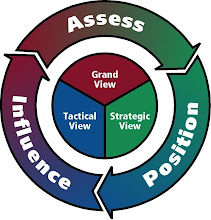
Our Compass AE methodology is a team collaborative approach that.emphasizes on advanced planning. It enables the project team to use our Tangible Vision component to plan their goal and strategic overview. They are always collaboratively prepared for all situations. The team understands what are the specific priorities, the particular approaches and the different circumstances that could occur.
A properly-built team collaborative process enables the project implementors to effectively utilize their technology in specific situations. Without a process, technology is only effective in limited situations.
Our Compass AE process also allows them to collaborate regardless of the distance, the technology and the project culture.
In future entries, the beneficial values of Compass AE will be explained.
If you are interested in knowing more about Compass AE as a strategic collaborative tool. please e-mail us at Service[aatt]collaboration360[ddott]com
###
Pleased to meet you, virtually
13.03.2008 - Videoconferencing is coming into view for more and more businesses as prices fall and quality improves. Recently, 240 employees of the Revenue Commissioners from 11 regional offices attended a seminar on VAT. In the past, this would have involved a mass exodus of staff to a central location such as Dublin, an administrative hassle trying to accommodate the numbers in one room and thousands of man-hours lost as workers made the journey.
Upon finishing the recent seminar, however, employees were back at their desks in minutes. Videoconferencing technology enabled the workers to link in from the meeting rooms in their offices and partake in the information seminar with minimum disruption to productivity.
Last year, the Revenue Commissioners embarked on a six-figure rollout of videoconferencing. So far, 25 offices in major towns around the country have had a room kitted out with a video screen, audio equipment and network connection, with five more offices due to come on stream shortly.
On top of that, about 115 senior managers have been supplied with desktop webcams to enable live, one-on-one video meetings. The upgrade of the videoconferencing technology is providing tangible benefits for Revenue, says Paul McDonald, business operations manager, Revenue.
"The new system can link up to 12 sites at the moment to deliver seminars and we will be extending this in the future. Previously, we could only link two sites at a time.
"If necessary, we can cram dozens of people in the videoconferencing room. If you're using it for something like a training session all staff members don't need to be visible to the trainer on the other end. They can hear what's being said and get their chance to ask questions."
Cutting costs is not the chief driver for Revenue, says McDonald. "There are benefits vis-à-vis savings in travel costs and at some stage we'd be looking to reduce carbon emissions, but better communication is the main driver."
/// *** Better communication creates efficiency
A lot of Revenue's work is based on legislation so any changes to the law and the knock-on effects for the tax system have to be communicated to all staff at the same time to avoid regional discrepancies. Videoconferencing smooths the passage of this information through to those at the coalface.
For Icon Clinical Research, improving productivity and keeping on top of vital relationships are the benefits of videoconferencing. "One of our drivers for using videoconferencing technology is to ensure we maintain necessary relations with staff, peers and customers without travelling all the time to do so," says Joe Daly, IT director, EU and rest of world, Icon Clinical Research.
/// Think of the time and money that can be saved from not traveling all of the time. Time is money.
The biopharma multinational has offices in 40 countries, many of which utilise dispersed workforces. All the main offices use videoconferencing to keep in contact with each other and also to help manage remote workforces.
It's a development jetlag-weary executives of the 5,500-strong multinational are very glad of.
"We're a global company and we do have quite high travel costs, particularly for client visits and general meetings," explains Daly. Videoconferencing has reduced the number of trips executives make, freeing up time and curbing expenses.
 When traveling, the anxiety of waiting for the uncertainty can be overwhelming.
This stress causes the traveling professionals to be unproductive.
The question is ... do you want your people to perform and produce
below their norm?
Cutting down on trans-Atlantic crossings was also a key driver in NTR Group's adoption of the technology. The company's head office in Dublin had Digicom install a Polycom VX7000 videoconferencing system in its boardroom last year.
As a large global company with a number of subsidiaries, including Greenstar, Bioverda and National Toll Roads, NTR sees videoconferencing as instrumental to how it conducts its business.
"About 40 to 50 staff members in the Dublin office, primarily senior management, use it, as do other members of staff on occasions," says Gareth Delahunt, network administrator, NTR.
He says the decision to deploy videoconferencing was less of a money issue and more to ease the pressures on the diaries of senior executives.
"You can't be in two places at once. It facilitated getting a lot of work done," he quips.
Improvements in the quality of non-proprietary videoconferencing systems that can 'talk' to other systems is also driving uptake of the technology. For example, NTR's videoconferencing system is used both internally for company business and externally for contacting other organisations.
One of the main developments spurring the onset of videoconferencing is the wider bandwidths made available through broadband internet.
Previously, videoconferencing was done over ISDN lines, which was more expensive and awkward to implement. Now, companies use their IP (internet protocol) networks to facilitate internal video communication.
"ISDN was used in the past and it involved getting three lines brought into your building," explains Jared Huet, audiovisual consultant, Digicom. "Nowadays, companies are joining their networks together so they can make video calls over the internet."
The benefits of IP video is there's no cost per minute, whereas with ISDN you're paying per minute, per line. Utilising the three ISDN lines needed for videoconferencing means you're making three international calls and being charged per minute. With IP video there's zero call costs; it's an add-on to your existing network charge.
However, there are challenges around installing videoconferencing, both technical and cultural.
"Typically you use your network to transfer data from one server to another or to send email internally. It doesn't have to get there immediately. In real-time communication, however, a one- or two-second delay would make a conversation unworkable," says Daly.
"Because of that you have to give videoconferencing a higher quality of service on the network. Typically you use up 384Kbps of bandwidth for a two-way conversation between two videoconferencing units. You have to make sure you've enough bandwidth and that you've prioritised that type of traffic so it goes quicker than anything else."
Changing people's habits is perhaps the most challenging aspect, Daly believes. "In all the companies I've worked for, people think it's great initially but the novelty does tend to wear off after a bit."
"Our challenge now is to sell this to our people," says McDonald. "But anyone who has used it is quite impressed. The quality we have now is far better."
A high-definition future for videoconferencing in Ireland
The number of videoconferencing units sold in Ireland has grown about 100pc in the past three years, according to specialist reseller Videnda.
The yearly growth rate of around 33pc is down to three factors, says head of finance and operations, Liam Fahy. The equipment has got better; there's more bandwidth available due to broadband rollouts; and there's growing concern to reduce carbon emissions.
It's also due to people tired of trawling through airports and hotels. "Going over to London or down to Cork from Dublin for a one-hour meeting takes a full day. People are sick of it."
Sales of videoconferencing units are rising and customers are increasingly opting for high-definition (HD) units, says Fahy.
"One of our major suppliers went from shipping no HD units to it being 40pc of what they shipped in the space of six to nine months."
Fahy estimates over 1,000 Irish companies use videoconferencing, with the ratio of standard-definition to HD around 70:30.
Prices range from €3K for entry-level standard-definition units up to €25K for top-of-the-range HD units.
By Niall Byrne
http://www.siliconrepublic.com