Showing posts with label global economy. Show all posts

Monday, March 17, 2008

A Company without a Tangible Vision is a Company that Fails


The size of the company is irrelevant. If the company does not connect to their Tangible Vision, they will falter. When the senior management does not connect as a team, their troops will not connect to them.

Here is a story of Yahoo who kept on making bad decisions..

For the new reader of Collaborative View, the Tangible Vision is a strategic overview that delineates one's goal in specific guidelines.


###
It is a "Worse Than Failure" scenario when a personal implement is used against its owner.

f you are interested in knowing more about Compass AE as a strategic collaborative tool. please e-mail us at Service[aatt]collaboration360[ddott]com

Sunday, February 24, 2008

A Lesson on Strategy: The Importance of Selecting the Right Target

Many companies and sport teams fail in their ventures due to incorrect strategic assessments and a poorly written big picture.

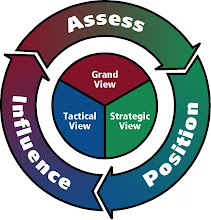
When one understands the Compass of their Tangible Vision, he/she focuses on implementing strong strategic moves, while avoiding weak moves.

Does your strategic process enables your team to understand your strengths and weakness while minding the bigger picture?

###

February 24, 2008
Digital Domain
Maybe Microsoft Should Stalk Different Prey
By RANDALL STROSS

OVER the years, Microsoft has pummeled countless rivals, including the superheavyweight I.B.M. But it has never faced a smaller foe as formidable as Google. The tale of the tape gives Microsoft a $100 billion advantage in market capitalization, but it counts for little: Google appears to be its superior in strength, speed, smarts.

Having exhausted its best ideas on how to deal with Google, Microsoft is now working its way down the list to dubious ones like pursuing a hostile bid for Yahoo. Michael A. Cusumano, who has written several books about the software industry and about Microsoft, is not impressed with Microsoft’s rationale for its Yahoo offer. He said the bid seemed to be a pursuit of an old-style Internet asset, in decline, and at a premium.

Determined to match Google in search and online advertising, Microsoft has managed to overlook a plain-vanilla strategy, the oldest one in the book: build on its own strengths. What it does best is to sell software to corporations, for all sorts of applications, visible and not so visible, at a handsome profit.

If Microsoft thinks this is the right time to try a major acquisition on a scale it has never tried before, it should not pursue Yahoo. Rather, it should acquire another major player in business software, merging Microsoft’s strength with that of another. This is more likely to produce a happier outcome than yoking two ailing businesses, Yahoo’s and its own online offerings, and hoping for a miracle.

For an illustration of how Microsoft could select targets more judiciously, Mr. Cusumano, who is a professor at the Sloan School of Management at the Massachusetts Institute of Technology, pointed to the Oracle Corporation’s strategic acquisitions and its prudent use of capital to roll up firms with similar products and customers to its own. With impressive regularity 13 strategic acquisitions in 2005, another 13 in 2006 and 11 in 2007 Oracle has picked up key products and customers while avoiding an oops slip, venturing too far away from its core business, or paying too much. At no point along the way has it acted in a fit of desperation.

Last month, Oracle pulled in another major prize, BEA Systems, a leading software company, for about $8.5 billion. You’ve probably never heard of BEA: it’s doubly obscure, producing the behind-the-scenes infrastructure that large companies use to build behind-the-scenes software systems for their entire business, or enterprise software. Both Oracle and BEA are based in Silicon Valley, but their side of the street is not lit by klieg lights and does not get the same attention as the Googles and Yahoos.

And, to be honest, it’s not much fun hanging out on the enterprise side of the software business. BEA says its software helps organizations ensure that business processes are optimally defined, managed, executed and monitored. Unless you’re playing Business Jargon Bingo, it’s hard to sit still and remain attentive. You have to admire Oracle’s ability to remain focused on the business that serves business and to not be distracted by the buzz of the Web crowd gathered across the street.

Microsoft does business software well. Approximately half its revenue comes from business customers for its e-mail infrastructure, database systems, developer tools, Office productivity applications and other mainstays. It has also assembled, through acquisitions, a fledgling line of enterprise software that it calls Microsoft Dynamics. Microsoft would like Dynamics to be viewed as competing head to head with the No. 2 name in enterprise software, Oracle, or the No. 1, SAP of Germany. For the moment, however, Microsoft Dynamics’ parity with those big names is nothing more than wishful aspiration.

Professor Cusumano has a suggestion: Rather than acquire Yahoo, Microsoft should pursue SAP.

It’s not an outlandish idea. The two companies held merger talks in late 2003, and perhaps since then, too. Microsoft is in an enviable position: it is a nearly universal presence in corporate data centers, and large enterprise customers are arguably the best customers a software company can have. Clients pay very dear prices for the complex, semicustomized software that runs their business. And once they’ve got their systems running a process that can take years to complete they aren’t inclined to change vendors lightly.

A few dozen well-paying Fortune 500 customers may actually be more valuable than tens of millions of Web e-mail customers` who pay nothing for the service and whose attention is not highly valued by online advertisers.

Today, SAP’s market capitalization is about $59 billion, and a sizable premium to get a deal done would send its price well north of that. Microsoft cannot put both SAP and Yahoo in its shopping cart, deals that together might run well over $120 billion. Microsoft must pick one or the other.

Suppose that Lawrence J. Ellison, the chief executive of Oracle, were the head of Microsoft and was doing the shopping. Which deal would he choose? Past experience suggests that it would not be Yahoo. That acquisition would bring little but duplication headaches and no large enterprise customers.

It’s amusing to note that the most Larry-like choice, Microsoft’s acquiring of SAP and leaving it alone as an autonomous division to avoid a cross-cultural integration fiasco, is the course that would be most discomfiting to Oracle. Frank Scavo, president of Computer Economics, an information technology research firm, in Irvine, Calif., said that a Microsoft-SAP combination would be Oracle’s worst nightmare.

Google would not be happy with a conjoined Microsoft and SAP, either. It has made a pro forma expression of its own opposition to a Microsoft-Yahoo merger, but we can speculate that it may be cheering that deal on. Working in Google’s favor are the hostile nature of Microsoft’s bid, the colossal potential for integration problems, and organizational paralysis in, and exodus of talent from, Yahoo.

But were Microsoft to turn and head in SAP’s direction, Google would have reason for concern. Whatever strengthens Microsoft is bound to influence, later if not sooner, its continuing competition with Google. For its own part, Google is keen to expand its foothold inside large companies. Last year, it acquired Postini, whose software filters corporate e-mail. Google has not done so well with corporate customers on its own, however. Google Apps has conspicuously failed to win adoption quickly.

If Microsoft is to rededicate its attention to its most valuable assets, business customers, a prerequisite is dropping its ill-advised bid for Yahoo. And to find the best acquisition strategy, ask, What would Larry do?

If Microsoft tries to fight Google with wobbly legs, scared witless, it will lose.

/// Microsoft made the assessment to takeover Y! Whether it is right or wrong, Microsoft will live with their decision. If you had the resources of Microsoft, would you make the same move? ///

Randall Stross is an author based in Silicon Valley and a professor of business at San Jose State University. E-mail: stross@nytimes.com.

http://www.nytimes.com/2008/02/24/business/24digi.html

###

Seen small to medium-sized companies making incorrect strategic moves, that places them in a position of chasing the competition.

With our Compass AE process, your company is strategically positioned ahead of the competition.

If you are interested in learning more, please email us at contactus [aa_tt] collaboration360 [d_ott]com

Monday, January 21, 2008

Competing in the Global Economy (Innovation with a Tangible Vision creates Profits)


During the initial building and connecting of the Tangible Vision, the Compass team assesses whether an innovation can match the defined outcome. In most cases, high risk innovation means high rewards.


Before deciding on the "Gold Standard" for their Tangible Vision, the team determines whether the high risk and the high level of complexity creates high rewards.

Through our Compass AE process, the project team comprehends the connections between the goal and the specific objectives. This understanding creates a sense of predictability and efficiency that enables the team to be on time, on budget and on target.

###

The New York Times
January 20, 2008

Ping
The Risk of Innovation: Will Anyone Embrace It?
By G. PASCAL ZACHARY

THE Prius has become one of the hottest cars in America an amazing development, because this hybrid-electric car requires some rather large changes in how people behave.

I learned the need for Prius-style adaptation early this month, when I rented a Prius from Budget Rent A Car in Seattle. Much to my embarrassment, I couldn’t get it to go forward. Once I got going and arrived at my destination, I couldn’t figure out how to put it in reverse.

Fortunately, another Prius owner on the premises they seem to be everywhere these days gave me a quick lesson. You start the Prius by pressing a button on the dashboard, not once but twice. To put it in drive or reverse, you manipulate a very small stick protruding from the dashboard.

The next morning, I awoke before dawn and started the Prius, but no matter how many times I pressed the button, I couldn’t get it to move. I finally called Budget roadside assistance, and a polite man talked me back from my private technology disaster. It turns out that I had failed to tap the brake while moving the gear shifter in a certain inexplicable way.

I don’t think I can adapt to the behaviors required by the Prius. But thousands of people are, and Toyota, its maker, is reaping the benefits.

Whether humans will embrace or resist an innovation is the billion-dollar question facing designers of novel products and services. Why do people adapt to some new technologies and not to others? Fortunes are made and lost on the answer.

Great innovations have foundered over human stubbornness. Consider the Picturephone, trumpeted by AT&T at the New York World’s Fair in 1964 as a major technological advance. Engineers reasoned that if hearing someone’s voice over the phone was terrific, wouldn’t seeing a face be even better?

Consumers didn’t think so. AT&T’s Picturephone, which would have added around $90 to a person’s monthly phone bill in 1974, a huge amount for the time, “was superfluous, adding little information to voice alone, especially considering its high price, said Kenneth Lipartito, a professor of history at Florida International University.

Even today, when adding video to a phone is a trivial cost, consumers may rebel. Video-conferencing often remains an activity forced on people by their employers.

Resistance to technology is an omnipresent risk for every innovator. Even a device as fabulously freeing as the personal computer struck some people as an abomination. In 1990, the poet Wendell Berry famously declared his perpetual allegiance to the typewriter in his essay, “Why I Am Not Going to Buy a Computer.

Few people joined him, however, a reminder that rejection isn’t the real specter facing new gear. Adaptable humans usually trade one technology for another, rather than reject any and all. To be accepted, innovations must deliver benefits enough benefits to make change worthwhile.

“As consumers we’re constantly asking ourselves, where do we draw the line? How far do we go? says Mitchell Kapor, chairman of the Open Source Applications Foundation in San Francisco.

/// With Compass AE, the Compass team collaboratively establishes the sustainability level of their Tangible Vision.

Businesses crave a sweet spot: where the line is drawn in favor of the innovator. The late Akio Morita, founder of Sony, talked about satisfying appetites that people didn’t even know they had. He achieved such a feat with the Sony Walkman, the music player introduced in 1979. While at the Lotus Development Corporation, Mr. Kapor created another such “killer app, or application: the spreadsheet for the PC.

Killer apps are sought-after innovations because people get addicted to them and make behavioral changes that might otherwise be unthinkable. “Those who benefit from a technology adapt to its constraints and become dependent on it, says John Staudenmaier, editor of the journal Technology and Culture and a historian of technology at the University of Detroit Mercy.

Dependency drives profits, the ultimate arbiter for some of an innovation’s success. Look how Apple has converted the mania for the iPod into record profits and a record stock price.

IPod “addiction seems benign. Yet some worry that other innovations may harbor health threats. As a result, they may be vulnerable to what Marc Ventresca, a lecturer at the Saïd Business School at Oxford, calls the “frog boiling problem. For the frog, gradually rising heat causes no alarm until the water is so hot that death is imminent.

“Adaptation can sometimes be dangerous, but the hazard isn’t apparent until it is ‘too late,’ Mr. Ventresca says.

While people may be fearful of allowing a seductive technology to imperil them the “Frankenstein effect they may also fear the consequences of not changing their ways. As the case of climate change illustrates, many consumers are enthusiastic about changing their behavior in this case, the way they drive cars if they believe that by adapting to new technologies they will save themselves and the planet. Think of the Prius again.

FOR technological innovators, the cash register can ring either way. They may achieve a smash-hit breakthrough, or simply make a slight improvement in a technology that humans already feel comfortable with. Most innovators no longer even try to predict human reactions to their creations.

Henry Kressel, a partner at Warburg Pincus and a co-author of “Competing for the Future: How Digital Innovations Are Changing the World, says, “You throw technologies into the market and see what sticks.

The hope is that passionate “early adopters will blaze a path toward mass acceptance of a new technology. Yet the truth is that no one can tell in advance which innovations people will adapt to and which will become the next example of the Picturephone.

Where people draw the line can be known only after the fact. Which is why innovation is always a risky even humbling business.

G. Pascal Zachary teaches journalism at Stanford and writes about technology and economic development. E-mail: gzach@nytimes.com.

Copyright 2008 The New York Times Company

http://www.nytimes.com/2008/01/20/business/20ping.html

###

The lesson is a well-planned innovation creates profits.
With Compass AE, your team can innovate with a Tangible Vision.

Thursday, January 10, 2008

Competing in the Global Economy: A Grand Vision with No Tangibility


Intel exiting from the "One Laptop Per Child" (OLPC) project should not be a surprise. Bad events happen to those who possess a grand vision that lacks tangibility and detailed specifics. Am sure they developed a plan that didn't take account of negative circumstances.

"One Laptop Per Child" people did not plan that there will be competition with grander resources. who will surpass them within a short time period.

Negroponte should have known that his technological edge was minimal at best. The competition should be able to duplicate and improve on their design within a short timeline.

/// Sidebar: Defining and preparing for negative circumstances is considered to be a turnoff for some people. As one Silicon Valley person told me,"... Don't talk negative. It is bad vibe for the team. ... Got to be positive. " ///

Seen this storyline with many global startups who are "social cause-driven" with no concept of the bigger picture, winded up as road kills.


###

Nonprofit slips in race for cheap laptop for world's poor kids
Problems at One Laptop Per Child show how social entrepreneurs can blaze trails but miss the payoff.
By Ben Arnoldy | Staff writer of The Christian Science Monitor
Oakland, Calif.

The vision was grand: Develop a cheap laptop and get it into the hands of 150 million school children in the developing world.

Making the computer turned out to be the easy part. On Wednesday at the Consumer Electronics Show in Las Vegas, Nicholas Negroponte, founder of One Laptop Per Child, showed off the $200 XO. The innovative computer sports a bright screen readable in sunshine and a highly efficient battery that can be recharged by cranking it.

But One Laptop has run into controversy – a corporate partner and the group's chief technology officer pulled out in recent weeks – which has experts noting perils for the broader social entrepreneur movement.

Social entrepreneurs, who aim to solve social problems using business-world principles, have tackled everything from expanding rural credit to marketing indigenous crafts in recent years. But experts say the problems at One Laptop point to a challenge for these emerging entrepreneurs. They often excel at trailblazing new markets among the world's poor but struggle to achieve large-scale sales and distribution.

"In many respects, these social entrepreneurs are pathfinders, they are like the research and development for bigger players that have otherwise ignored the bottom of the pyramid market," says James Koch, a professor at Santa Clara University in California.

For example, One Laptop's XO has proven the concept of cheap laptops. Companies like Lenovo and Intel, sensing the market potential, are now working on their own models. This isn't necessarily bad for One Laptop's ultimate goal.

"Part of our model of success is to have competition, to have other people in this space," says Walter Bender, president of software and content at One Laptop. "We don't need to be the monopoly or biggest player in the market."

/// What we have here is an intangible view of a global economy. MY question is: If you are not going to be big, what are you going to be?

The world is filled with predators waiting for smart but naive people to make the grand mistake.
Dragons create opportunities. Tigers find opportunities. Wolves wait for opportunities. In a life and death struggle, a hungry wolfpack usually prevails over a smaller prey.


But the competitors' products aren't helping One Laptop's efforts to secure big orders. So far, it has orders for 500,000 laptops, with more than 100,000 already en route to places such as Afghanistan and Haiti. But it's far behind its goal to sell 150 million units by the end of 2008.

One reason for the shortfall, One Laptop alleges, is that a former partner – Intel – was disparaging the XO as it developed its own ultra-cheap laptop, the Classmate.

"Their sales people were saying, 'Because we're on the board, we have inside info and we know that everything is broken and it doesn't work,' " says Mr. Bender.

Intel has told a different story, saying that Mr. Negroponte was unreasonably demanding that the company stop marketing the Classmate in regions targeted by One Laptop. Intel didn't respond to an interview request.

/// Inviting current competition to join your group was not a smart idea.

"Do not loan sharp weapons to other men. If you loan sharp weapons to other men, you will be hurt by them and will not live out your allotted span of years." --- Jiang Tai Gong Six Secret Teachings (Sawyer X'lation) ///


Partnerships with multinational corporations can be double-edged swords for nonprofit startups. On the one hand, they're one of the quickest ways for startups to ramp up delivery of a product. On the other hand, nonprofits and corporations have different bottom lines, which means that such partnerships need to develop slowly and carefully,
says Nora Silver, director of the Center for Nonprofit and Public Leadership at the University of California, Berkeley.

A successful partnership between clothing-manufacturer Timberland and CityYear, a nationwide volunteer corps, took years to forge. The Intel partnership, however, seemed hasty and didn't integrate the sales force into the effort, Dr. Silver says.

"Did these folks have a clear contract?" she asks. "You have to be very clear about such basic agreements."

One Laptop was acting as if they had a contract with exclusivity and noncompete clauses, she adds. Bender says there was only a nondisparage agreement.

The difficulty of scaling up a business isn't limited to social entrepreneurs. For-profit startups struggle with it, too. But entrepreneurs have a bigger challenge when they target poor people, especially those who are uneducated and live in remote areas.

Traditional marketing campaigns on TV and billboards may miss these customers entirely. And putting the product on shelves may not be enough. The entrepreneurs may have to find ways to advance small loans to would-be buyers. They may have to find indigenous nonprofit groups that could open markets that a corporation would never devote the time or have the credibility to crack.

One Laptop decided to target ministries of education to get bulk orders for schools. Working with those agencies, even in the developed world, requires a lot of effort and patience, notes John Quelch, a professor at the Harvard Business School.

"One of the knocks against [One Laptop] could be that they focused very much at achieving a price point for the product, but didn't necessarily focus as much on developing a solution for the ministry of education for country X," says Dr. Quelch, adding that this can be a common pitfall.

/// Our Compass AE process focuses on the team collaboratively defining clear specifications from goal to objectives. If the specifics do not connect from milestone to milestone, the Tangible Vision does not work. ///

"Initially, we had three or four people doing that around the globe, which is a stretch," says Bender. One Laptop is now working closely with Brightstar, the world's largest cellphone distributor, to help with global logistics.

from the January 11, 2008 edition - http://www.csmonitor.com/2008/0111/p03s04-stct.html


/// When building a Tangible Vision, it is important to focus on creating strategic positioning from top to bottom.

In the case of OLPC,
their product does not offer any long term tangible "strategic positioning" leverage. The building of their marketing plan should have been focused on creating "strategic positioning".

Remember, Strategic Positioning = Strategic Advantage. ///

Sunday, October 28, 2007

Achieving the Capitalist Dream


Today, I am presenting a different focus on our theme of collaboration. To achieve the capitalist dream, one always need a team.

No matter how successful one is, he/she always collaboratively need a team. ... Not everyone are leaders. Some are happy just being a team player.

First, one needs to
know their role .

We
start by asking the following questions:
1. Are you a collaborative team leader
2. Are you the team star that does the major work?
3. Are you the supporting team player?


Before one can ask those questions,
he/she needs a 360 degree view of how the global game is played. The next step is the viewer must determine whether he/she has the objectivity, the experience and the drive to play the global game.

###

Age of Riches

After Succeeding, Young Tycoons Try, Try Again
By GARY RIVLIN

SAN FRANCISCO Max Levchin is not easily distracted from his work.

A few years ago, Mr. Levchin, one of the young princes of Silicon Valley, bought his first home, a 12-room Edwardian high atop a hill here, for $3.4 million. But Mr. Levchin, who made a fortune at age 27 selling PayPal, the online payment service he helped start in 1998, never moved in. He sold it two years later without having slept there for even one night.

Since then, Mr. Levchin has moved into his second home, a more expensive one found for him by Nellie Minkova, his girlfriend of eight years who has become his fiancée. But so consumed is he by work on his second company, an Internet start-up focused on sharing photos and videos, that the cartons that contain what Mr. Levchin described as 85 percent of my worldly possessions are still stacked in his living room, five months after moving day.

Mr. Levchin, who is now 32, is typical of a new generation of junior titans in Silicon Valley who might be called the prematurely rich techies worth tens of millions of dollars, sometimes more, at an age when many others are just starting to figure out what to do with their lives.

The Internet, a low-overhead medium with a global reach, has greatly accelerated the wealth creation phenomenon, producing a larger breed of multimillionaires even younger and richer than in the past.

They are happy to be wealthy, of course, but many of these baby-faced technology tycoons often seem indifferent to the buying power of their money, at least at this stage of their lives. Instead, nearly all of them have chosen to throw themselves back into a start-up, not so much because they want a spectacular new home or a personal jet though many of them do but because they are in a competition with themselves and one another.

For most of us, doing it again means surpassing what we’ve done previously, said Peter A. Thiel, Mr. Levchin’s partner at PayPal, who also has started a new business, a hedge fund called Clarium Capital. And that can be a really high bar.

Even among this jittery group of overachievers, Mr. Levchin stands out. In part that is because outdoing PayPal may be an all-but-impossible goal. Mr. Levchin acknowledges that he has already earned more money than he could ever spend. But he said he would not consider Slide.com, the photo and video sharing site he founded in 2005 that is still in its start-up phase, a success unless it is ultimately worth, in real dollars, at least $1.54 billion the price eBay paid for PayPal.

Otherwise, he asked rhetorically, what have I learned?

During his PayPal days, Mr. Levchin was so committed to seeing the company succeed that he often sacked out at the office in a sleeping bag he kept under his desk. Considering that he described his apartment during some of this time as scary, that had a certain logic. Cardboard boxes served as his living room furniture; a discarded computer desk was his dining room table.

These days, despite the phenomenal success of PayPal, which gave him the bulk of a fortune worth around $100 million, Mr. Levchin continues to work an average of 15 to 18 hours a day.

We occasionally go out to eat, he sleeps a few hours, he works out, Ms. Minkova said. But other than that, Max works.

Ms. Minkova half-joked that she might appreciate her occasional evenings out with Mr. Levchin more, if only he were not on his BlackBerry, answering e-mail messages and checking his Web site.

One friend, Dennis Fong, who sold a company to MTV Networks last year for $102 million (and is already at work on a new start-up), talks about the weird growling sound that Mr. Levchin tends to make when someone even mentions the name of his chief rival, RockYou.

And so committed is Mr. Levchin to seeing Slide.com succeed that he keeps a blood-pressure monitor on his desk. I don’t know what I would do if I couldn’t start companies, he said. I’d probably think about slitting my wrists.

Wealthy at a Young Age

Maximillian Rafael Levchin was born and raised in Kiev, Ukraine, a Jew living under Soviet rule for 16 years. As the Soviet Union was crumbling, the family moved to the United States and settled in Chicago. But the worst year of his life, he said, was not when he was growing up but after eBay bought PayPal.

He thought he would spend the time after the sale exploring my inner self. Instead, he spent the better part of 12 months feeling worthless and stupid and baffled by what he might do with the remainder of his life. He felt too young to retire or downshift a gear or two and too restless to become a philanthropist.

I enjoy sitting on nice beaches and hanging out with my girlfriend and playing with my dog, but that’s three hours a day, Mr. Levchin said. What about the remaining 18 hours I’m awake?

At first, free time was not much of a problem. Coming into a lot of money at a very young age, Mr. Levchin found himself forced to ponder things like irrevocable trusts and secondary beneficiaries. Several times a week, he would listen to the gentle hectoring of older, well-dressed men and women whom he playfully mimicked, employing a basso profondo, game-show announcer’s voice.

Think of the kids you don’t have, Mr. Levchin quoted them as saying. Think of your unborn grandkids.

As those obligations of his new wealth subsided, Mr. Levchin contemplated what he might do next. For a time, Mr. Levchin, a graduate of the University of Illinois at Urbana-Champaign, thought about returning to school and earning a doctorate. That is what his mother, a physicist, had always wanted him to do, and it seemed to suit his temperament.

But discussions with a friend who teaches computer science at Stanford convinced him that academia was not the life for him. This friend said, ‘Don’t kid yourself, you’re going to start another company,’ Mr. Levchin said. It was one of those things where as soon as he said it, I knew it was true.

He thought, too, about becoming a venture capitalist or an angel investor, a well-paved path for generations of entrepreneurs before him. Sequoia Capital, one of Silicon Valley’s top venture firms, gave him a desk to use while he figured out his next step. The partners at Sequoia would regularly invite him to join pitch meetings, but that experience taught him that he was hardly suited to the more nurturing side of the profession.

I took this perverse pleasure in seeing if I could make someone cry, he said.

At Sequoia, Mr. Levchin met James Hong, another successful entrepreneur who today is one of his closest friends.

We’d go out drinking, and Max’d talk about how miserable he was, and I’d talk about how miserable I was, said Mr. Hong, who was 27 when he and a friend started HotOrNot, a Web site popular with the under-30 crowd.

Mr. Levchin added, We were both pretty pathetic.

While not nearly as rich as Mr. Levchin, Mr. Hong describes himself as well off enough so that work is optional. He was collecting more than $1 million a year from HotOrNot, a project he and his partner had created in seven days and which demanded little of his time.

All of a sudden, you have the luxury or the curse of being able to ponder the meaning of life, Mr. Hong said. You ask yourself, ‘Why am I not happier given how lucky I’ve been?’

Only later did Mr. Hong diagnose the real source of his angst: he was not doing much of anything. So like most of his peers, Mr. Hong decided to throw himself back into work, in his case refocusing on HotOrNot in the hopes of transforming the Web site into a larger business.

In Silicon Valley, said Robert I. Sutton, a professor of management science and engineering at Stanford and co-founder of the Stanford Technology Ventures Program, remaining relevant, if not also admired and respected, requires that an entrepreneur continue to speed along in the fast lane.

In other parts of the country, things like a great estate are the symbols people most respect, Mr. Sutton said. But here, the greatest status symbol is a person’s ability, he added, to still bring out hot new companies and show that you are working on the hot new technologies.

Some, of course, choose to step off the start-up merry-go-round. Pierre Omidyar, 40, the founder of eBay, remains chairman of that company, but he gave up the day-to-day operations in the late 1990s. Since that time, Mr. Omidyar, who has a net worth of $9 billion, has devoted most of his work energies to philanthropic causes and investments in projects in the United States and in the developing world.

Mr. Levchin concluded that his competitive drive was too strong for that kind of life. During his time off, he competed with Mr. Hong over who was the more frugal of the two and challenged him to push-up contests at the gym. No matter how many I’d do, Mr. Hong said, he’d have to do that many plus two.

So Mr. Levchin did what any young titan in his position might have done. He dipped into his deep reserves of cash to pay for a large loft space and hired a half dozen of the smartest computer programmers he knew.

I knew I wanted to be a C.E.O., Mr. Levchin said. I just didn’t know the C.E.O. of what.

Readying for the ‘Next Race’

Mr. Levchin proved vigorous in his pursuit of the right start-up. There are those in Silicon Valley who still create new companies out of a desire to crack a challenging technical problem. But not Mr. Levchin, who, like many of the area’s most highly regarded software engineers nowadays, views himself as the creator of potentially lucrative businesses more than simply the architect of a nifty new technology.

It’s easier to start the next company than it was in the past, said Marc Andreessen, who was a co-founder of Netscape Communications in 1994, when he was 22. It is also potentially more lucrative than it was even a dozen years ago, said Mr. Andreessen, who despite a net worth estimated to be in the hundreds of millions of dollars is now at work on his third start-up, a social networking company called Ning.

For the first time in history, you have a global market of 1 billion-plus people, all connected over an interactive network, Mr. Andreessen said. The opportunities are bigger than ever before.

A site for sharing photos and video was not necessarily Mr. Levchin’s favorite among the dozen or so ideas he pondered. But he chose Slide.com precisely because he thought it had the greatest potential to become a business that could surpass PayPal in size and reach.

In 2005, when he started Slide, the Internet already had plenty of popular photo-sharing sites, but Mr. Levchin saw a new way to cash in on the desire of so many to express themselves in cyberspace: a service that gives people an easy way to dress up their blogs and personal pages with photo slide shows, videos and the like.

Facebook users, for instance, use Slide-produced playthings like its multimedia FunWall or the SuperPoke widgets that let them hug or punch a fellow member (figuratively speaking) or even throw a virtual sheep at someone (as apparently 20,000 people an hour choose to do, according to Slide).

More than 130 million people viewed at least one Slide multimedia presentation in June, according to the Internet traffic monitor ComScore.

I’d run any company; it’s completely irrelevant to me, Mr. Levchin said. It’s really about this drive to win.

Yet what Mr. Levchin calls my particular brand of obsession comes with a cost. He wishes he gave more to charity, but he can never seem to find the time. It’s pathetic how much I give compared to other people I know worth considerably less, he said. And his desire to earn even more means he pays little attention to the wealth he already has in the bank.

This ‘next race’ attitude really shapes your brain, Mr. Levchin said. It’s ‘Ready, set, go,’ and nothing else really matters.

The three-story, five-bedroom house he shares with Ms. Minkova cost him $5.3 million, but it seems to be his only big post-PayPal indulgence.

Indeed, Mr. Levchin has not splurged on the pricey luxuries that some other Silicon Valley luminaries enjoy. Those twin kings of the Valley’s under-35 set Google’s co-founders, Sergey Brin and Larry Page, with a combined net worth of more than $40 billion have splurged on a fully loaded customized Boeing 767-200. But for Mr. Levchin, there is no six-figure car parked in his driveway, and dinners out tend to be at chain eateries rather than at high-end restaurants.

Spending money is a fine pursuit, and anyone’s welcome to do it, said Scott Banister, a close friend of Mr. Levchin’s since college who recently sold an antispam company to Cisco for $830 million and is now working on a social networking site, Zivity, which he describes as a cross between Playboy and American Idol.

But then obviously at that point, you’re spending, he said, not producing.

Copyright 2007 The New York Times Company

http://www.nytimes.com/2007/10/28/business/28invent.html

# # #

Other links:
Born to Build, Not to Play: an Entrepreneur’s ‘Curse’
http://www.nytimes.com/2007/10/28/business/28invent-side.html

Age of Riches
http://topics.nytimes.com/top/news/business/series/age_of_riches/index.html

Tuesday, October 23, 2007

Future Trend of Global Business


To thrive in a global economy, it is important for a company to expand their influence at different locations. Having teams located at different locations is not good enough, the focus is synchronize the members of their distant project teams to operate as one unit. We believe that distant team collaboration is the tangible approach of doing global business.

With the current availability of web conferencing technology and information systems, project teams no longer need to meet at a central location. Having field offices will no longer be needed.

Members usually operate at home, client's office and coffee shops with web access. They connect and collaborate with each other with their Tangible Vision.

The project team that collaboratively build, connect and lead with their Tangible Vision is usually the key to a distant team project success.

###
Enduring attraction

Sep 13th 2007
From The Economist print edition

Success may come at a price, but no one seems put off


THERE is no single route to success as a financial centre. London has been at the heart of a great overseas trading network for centuries. New York rose as the gateway to the New World. Geneva and Zurich sit in a wealthy region and have benefited from favourable tax and regulatory policies. Chicago emerged as a global centre for futures and options because of its proximity to America's agricultural belt. Shanghai and Mumbai, both fledgling international hubs with big ambitions, serve vast, developing national markets. Places such as Singapore or Dubai have had to work hard to lure business to their shores. Yet for all their variety, these financial centres have certain things in common.

Saskia Sassen, a sociologist with a special interest in global cities, argues that one reason for the concentration of financial firms in a small number of centres is the social connection and information that comes from proximity with people in related fields. A second is the use of technology that (counter-intuitively) still filters a lot of apparently dispersed investment back to a few key electronic exchanges.

A third is the increasing globalisation of big corporations. As companies open new factories and national offices, their financial advisers follow. And as more banks and brokers move into financial centres, they attract related businesses such as law firms, accountancy practices and public-relations agencies. Not long ago big investment banks were represented in only a handful of cities. Zoe Cruz, co-president of Morgan Stanley, recalls that when she joined the firm in 1982 it had fewer than 3,000 employees in its main office in New York and two smaller ones in London and Tokyo. Today it has “flags in almost every country in the world” (actually, about 30).

Even though these days anyone with a laptop and a high-speed internet connection can trade financial products from anywhere, people prefer to cluster in the same old places. Trader magazine, a glossy publication designed for hedge-fund managers, currency traders and the like, recently named Chicago, London and New York as its top three cities for traders, though it also lists some less obvious ones in a top 20 that includes Miami and Las Vegas. The ranking was based on a range of factors, from trading infrastructure and taxes to nightlife and recreation facilities.

Quality of life is important to highly paid financiers, and successful centres such as London are changing constantly to keep delivering what it takes. Take a stroll through the narrow lanes of Spitalfields in the old East End of London and see the trendy market stalls and cafés that have arisen from the former wholesale fruit and vegetable market. On nearby Brune Street an historic building that formerly housed a soup kitchen “for the Jewish poor” is being converted into upmarket flats. The sign for Fournier Street, recalling the French Huguenots who settled here to escape religious persecution, is replicated in Bengali to cater for recent South Asian arrivals. Property prices have shot up, with ever more young financiers taking up residence here. The appeal of this traditional haven for working-class immigrants is its close proximity to the financial district, allowing financiers to walk to work.

Growing prosperity, a bigger tax haul and the cosmopolitan lifestyle of young financial professionals have injected new vitality into places like London, New York and Hong Kong. Yet there is also growing inequality, a steep rise in the cost of living and increasing pressure on middle-class families who are having to live ever farther away from city centres.

The income discrepancy between haves and have-nots in the world's financial capitals has not been this great since America's “gilded age” in the late 19th century, says Susan Fainstein, an expert on urban issues at Harvard. The trend began in the 1980s and has become stronger, despite temporary blips such as the dotcom bust in 2001. A report on wealth inequality in Britain in July found that the gap between rich and poor is now bigger than it has been for 40 years, with the proportion of middle-class households shrinking.

“People doing ordinary jobs, like firefighters, cannot afford to live in London,” says Chris Hamnett, a sociologist. The city now has a commuting zone stretching about 80 miles (129 km). Something similar is happening in Manhattan, where the price of an average property has risen above $1m.


Not all this urban gentrification can be laid at the door of financial services, but the new rich in the world's top cities are more likely to be hedge-fund managers than industrialists. Research recently by Mr Kaplan and Mr Rauh of the University of Chicago showed that in 2004 nine times as many Wall Street executives earned over $100m as did chief executives of public companies. The top 25 hedge-fund managers earned more than the chief executives of all the companies in the Standard & Poor's 500 combined.

As the financiers' money cascades across the cities where they live and work, it transforms everything from house prices to shopping patterns. Mr Hamnett draws an analogy with a multi-tiered water fountain, with water flowing first from the financial district to smart residential neighbourhoods, then to slightly less smart areas, and so on. On the other hand, if investment bankers' bonuses dry up, so will their lavish spending.

All this calls for a delicate balancing act from political leaders. The appeal of a vibrant financial sector is clear for politicians, ranging from Michael Bloomberg, New York's mayor, a former business tycoon who counts many of the city's top financiers among his personal friends, to Ken Livingstone, London's mayor, who used to be known as “Red Ken” for his far-left stance. They all understand that capitalism can be good for a city.

Many in the financial elite are closely involved with their communities, raising funds for charities, supporting schools and making donations to political parties. Mr Doctoroff in New York points to public-spirited firms such as AIG, JPMorgan Chase and Merrill Lynch that have set up charitable foundations. London's financiers have also become more generous donors to charity.

Yet the recent backlash against private-equity firms in several countries illustrates the dangers of appearing to favour the financial elites, whether through tax policies or political access. Trade unions, consumer groups and politicians have railed against such perceived favouritism. Moreover, globalisation has meant that the financiers' ties to a “home town” are not as clear as they once were. Mr Doctoroff notes that despite executives' recent public-spiritedness, none is as involved in and committed to public causes in New York as David Rockefeller was decades ago.

Despite such drawbacks, most cities would kill for a thriving financial sector that produced highly paid jobs and juicy tax revenues. Big financial firms have fanned out around the globe and are not shy about telling politicians exactly what they want. Many of the things they are looking for—from good infrastructure to low taxes—are helpful for businesses of all kinds, not just financial firms. Being able to attract the right talent is critical too.

It is the mix of all these factors that has kept New York and London so far ahead of the rest. They may be shockingly expensive places to live, but top financiers clearly think they are worth it. And there are plenty of lesser financial centres that aspire to become more like them.

Copyright © 2007 The Economist Newspaper and The Economist Group. All rights reserved.

http://www.economist.com/displaystory.cfm?story_id=9753281&fsrc=RSS

Tuesday, September 25, 2007

Anthr Day in the Global Economy (India Outsources)


Is this the new trend of the 21st century? India companies becoming the global IT middlemen.

Presuming you are a project implementer. You are located in London. Your marketing guy is in San Francisco. Your ad agency is located in NY City. The outsourced techies are either in
Mumbai, India
or Shanghai, China.

The technology, the project culture and the time zones are the collaborative challenges.
How do you get your team and the outsourced expediters to collaborate as a team?

# # #

September 25, 2007
Outsourcing Works, So India Is Exporting Jobs
By ANAND GIRIDHARADAS

MYSORE, India Thousands of Indians report to Infosys Technologies’ campus here to learn the finer points of programming. Lately, though, packs of foreigners have been roaming the manicured lawns, too.

Many of them are recent American college graduates, and some have even turned down job offers from coveted employers like Google. Instead, they accepted a novel assignment from Infosys, the Indian technology giant: fly here for six months of training, then return home to work in the company’s American back offices.

India is outsourcing outsourcing.

One of the constants of the global economy has been companies moving their tasks and jobs to India. But rising wages and a stronger currency here, demands for workers who speak languages other than English, and competition from countries looking to emulate India’s success as a back office including China, Morocco and Mexico are challenging that model.

Many executives here acknowledge that outsourcing, having rained most heavily on India, will increasingly sprinkle tasks around the globe. Or, as Ashok Vemuri, an Infosys senior vice president, put it, the future of outsourcing is to take the work from any part of the world and do it in any part of the world.

To fight on the shifting terrain, and to beat back emerging rivals, Indian companies are hiring workers and opening offices in developing countries themselves, before their clients do.

In May, Tata Consultancy Service, Infosys’s Indian rival, announced a new back office in Guadalajara, Mexico; Tata already has 5,000 workers in Brazil, Chile and Uruguay. Cognizant Technology Solutions, with most of its operations in India, has now opened back offices in Phoenix and Shanghai.

Wipro, another Indian technology services company, has outsourcing offices in Canada, China, Portugal, Romania and Saudi Arabia, among other locations.

And last month, Wipro said it was opening a software development center in Atlanta that would hire 500 programmers in three years.

In a poetic reflection of outsourcing’s new face, Wipro’s chairman, Azim Premji, told Wall Street analysts this year that he was considering hubs in Idaho and Virginia, in addition to Georgia, to take advantage of American states which are less developed. (India’s per capita income is less than $1,000 a year.)

For its part, Infosys is building a whole archipelago of back offices in Mexico, the Czech Republic, Thailand and China, as well as low-cost regions of the United States.

The company seeks to become a global matchmaker for outsourcing: any time a company wants work done somewhere else, even just down the street, Infosys wants to get the call.

It is a peculiar ambition for a company that symbolizes the flow of tasks from the West to India.

Most of Infosys’s 75,000 employees are Indians, in India. They account for most of the company’s $3.1 billion in sales in the year that ended March 31, from work for clients like Bank of America and Goldman Sachs.

India continues to be the No. 1 location for outsourcing, S. Gopalakrishnan, the company’s chief executive, said in a telephone interview.

And yet the company opened a Philippines office in August and, a month earlier, bought back offices in Thailand and Poland from Royal Philips Electronics, the Dutch company. In each outsourcing hub, local employees work with little help from Indian managers.

Infosys says its outsourcing experience in India has taught it to carve up a project, apportion each slice to suitable workers, double-check quality and then export a final, reassembled product to clients. The company argues it can clone its Indian back offices in other nations and groom Chinese, Mexican or Czech employees to be more productive than local outsourcing companies could make them.

We have pioneered this movement of work, Mr. Gopalakrishnan said. These new countries don’t have experience and maturity in doing that, and that’s what we’re taking to these countries.

Some analysts compare the strategy to Japanese penetration of auto manufacturing in the United States in the 1970s. Just as the Japanese learned to make cars in America without Japanese workers, Indian vendors are learning to outsource without Indians, said Dennis McGuire, chairman of TPI, a Texas-based outsourcing consultancy.

Though work that bypasses India remains a small part of the Infosys business, it is growing. The company can be highly secretive, but executives agreed to describe some of the new projects on the condition that clients not be identified.

In one project, an American bank wanted a computer system to handle a loan program for Hispanic customers. The system had to work in Spanish. It also had to take into account variables particular to Hispanic clients: many, for instance, remit money to families abroad, which can affect their bank balances. The bank thought a Mexican team would have the right language skills and grasp of cultural nuances.

But instead of going to a Mexican vendor, or to an American vendor with Mexican operations, the bank retained three dozen engineers at Infosys, which had recently opened shop in Monterrey, Mexico.

Such is the new outsourcing: A company in the United States pays an Indian vendor 7,000 miles away to supply it with Mexican engineers working 150 miles south of the United States border.

In Europe, too, companies now hire Infosys to manage back offices in their own backyards. When an American manufacturer, for instance, needed a system to handle bills from multiple vendors supplying its factories in different European countries, it turned to the Indian company. The manufacturer’s different locations scan the invoices and send them to an office of Infosys, where each bill is passed to the right language team. The teams verify the orders and send the payment to the suppliers while logged in to the client’s computer system.

More than a dozen languages are spoken at the Infosys office, which is in Brno, Czech Republic.

The American program here in Mysore is meant to keep open that pipeline of diversity.

Most trainees here have no software knowledge. By teaching novices, Infosys saves money and hopes to attract workers who will turn down better-known companies for the chance to learn a new skill.

It’s the equivalent of a bachelor’s in computer science in six months, said Melissa Adams, a 22-year-old trainee. Ms. Adams graduated last spring from the University of Washington with a business degree, and rejected Google for Infosys.

And yet, even as outsourcing takes on new directions, old perceptions linger.

For instance, when Jeff Rand, a 23-year-old American trainee, told his grandmother he was moving to India to work as a software engineer for six months, she said, ‘Maybe I’ll get to talk to you when I have a problem with my credit card.’

Said Mr. Rand with a rueful chuckle, It took me about two or three weeks to explain to my grandma that I was not going to be working in a call center.

Copyright 2007 The New York Times Company

http://www.nytimes.com/2007/09/25/business/worldbusiness/25outsource.html
# # #

Tuesday, September 18, 2007

Current Trend of Global Collaboration


It is only a matter of time that the old way of "traveling to collaborate" will decline. The amount of time that is being wasted in waiting and traveling is quite a lot.

There is a time and a place for traveling and there is a time and place for using video conferencing. Spending time waiting for an airplane can be used in other productive ways.

Are you tired of waiting?

With our Compass AE process, you and your team can collaborate anywhere. It does not matter what technology or what project methodology your team are using. It is all about connecting the team to the Tangible Vision.

The current dilemma is that most people do not know how to collaborate as a team, with or without the challenge of distance and individual culture

Another dilemma that we discovered is they do not know how to collaborate with the latest video collaboration technology.

In a future entry, we will talk about the importance of making a collaborative decision quickly in a global economy and how to integrate Compass AE and video conferencing as one collaborative protocol.

###

September 18, 2007
U.S. Working on Its Welcome
By SARA J. WELCH

In February, Eric Rozenberg, a Belgian travel executive, was en route to a convention in Cancún, Mexico, from Brussels when, he says, he experienced firsthand what other foreign travelers had told him about the problems of getting into the United States.

He said an official took him aside with no explanation as he went through immigration in the Dallas-Fort Worth airport and sent him to a separate room.

After waiting there nearly 90 minutes, Mr. Rozenberg, who travels to the United States on business at least six times a year, said, he very politely asked another officer what was taking so long. The officer glanced at Mr. Rozenberg’s passport again, told him to wait another 10 minutes, then handed it back to him without explaining what had happened.

The officer asked if he had missed his connecting flight, Mr. Rozenberg recalled. When he replied that he had, he said casually: ‘Oh, sorry about that; just tell them you were detained at immigration,’ Mr. Rozenberg said.

Similar complaints from foreign business and leisure travelers have led the United States government to take steps to improve the treatment of travelers upon arrival. In February 2006, the Department of State and the Department of Homeland Security announced a program, called Secure Borders and Open Doors, aimed at balancing the increased need for security after the 2001 terrorist attacks with the desire to ease travel to the United States.

Last February, the Homeland Security Department started the Traveler Redress Inquiry Program, or TRIP (trip.dhs.gov), which provides an online form travelers can use to file complaints electronically about any travel-related government entity. It offers more transparency and a one-stop location for travelers who feel, say, they weren’t treated properly or missed a flight because of a D.H.S. employee’s actions, said Kelly Klundt, a spokeswoman for Customs and Border Protection, which is part of the Homeland Security Department.

But while government officials say they are trying for change, there is no way to tell if progress has been made. Ms. Klundt said she did not know if the government kept statistics on complaints about poor treatment by customs and border officials.

Geoff Freeman is the executive director of the Discover America Partnership, a Washington lobbying group of leaders from the Travel Business Roundtable, Marriott International, Walt Disney Parks and Resorts, the Travel Industry Association and other companies and organizations. Since the organization was formed last September to promote the United States abroad, it has received hundreds of phone calls and e-mail messages, he said, from foreign travelers complaining of poor treatment by customs and border officials.

But, Mr. Freeman said, while most people who’ve come here from overseas since 9/11 say the entry experience is poor, beyond the airport, their U.S. experience is good enough that they’ll probably come back.

The partnership also found, however, that if foreigners had not visited the United States since Sept. 11 or had never visited, the stories they’re reading or hearing about the poor entry experience are discouraging them from visiting, Mr. Freeman said.

He said statistics from the World Trade Organization showed a 17 percent increase in worldwide travel since Sept. 11, while data from the United States Office of Travel and Tourism Industries showed travel to the United States declining the same percentage over the same period.

Former Gov. Tom Ridge of Pennsylvania, who served as the first secretary of the Department of Homeland Security, is working with the Discover America Partnership to find ways to improve the entry experience. By and large, my former colleagues do a good job, Mr. Ridge said. But anecdotally, I’ve heard we have to be a lot more sensitive. If even one traveler in 10,000 has a bad experience, that ripple effect is harmful.

Prakton Mal, who was born in India, lives in Oslo and is a Norwegian citizen, said many of his colleagues would rather participate in a videoconference than travel to the United States and risk embarrassment and ill treatment.

/// *** The continuing trend of more people wanting to use video-conferencing tool.

In March, he said, while on a business trip, he was treated rudely by a very sour and impolite immigration official at the Hartsfield-Jackson Atlanta International Airport because he had forgotten to sign and date his immigration form. It was a small incident, but it could have been avoided, Mr. Mal said. He said he takes 18 international business trips a year, and I sometimes feel that the United States stands out with their arrogant behavior toward innocent incoming businesspeople.


One executive, an American citizen who was born in France, said he presented his American passport to a customs official at Miami International Airport after returning from an overseas business trip. The official noticed he was also carrying a French passport.

He told me it was illegal to carry two passports, the executive recalled. He held both passports in front of me and asked, ‘Which one do you want me to destroy?’ like it was a game.

The executive, who did not want his name disclosed because he was concerned that might affect his business dealings, said he insisted he had the right to carry two passports because he was a dual citizen. (A State Department spokesman confirmed this; the law specifies only that American citizens must present their American passport when entering the United States.)

The official kept him waiting about half an hour, then returned both passports, the executive said. But he said he’d put a note in my file that I was breaking the law and I’d get stopped the next time I traveled. He said he filed a complaint electronically, but they didn’t even acknowledge receiving it.

Ms. Klundt said all customs officials were required to take an annual professionalism training course, which is updated every year. We’re concerned about these negative situations and want to address them, she said. But we also need to focus on our mission, which is keeping bad people and bad things out of the country.

Mr. Ridge said it was that occasional rude person who creates all these horror stories.

The welcome mat has a little dust on it right now, he added. We have to spruce it up a bit.

Copyright 2007 The New York Times Company
http://www.nytimes.com/2007/09/18/business/18entry.html

# # #

September 17, 2007
Seeking Relief
By JOE SHARKEY

NOW what?

Usually, fall brings relief from summertime air traffic delays, cancellations and missed connections. But this year, some travelers are not betting on it.

I’m certainly not going to be happily whistling on my way to the airport, thinking the troubles of the summer are over, said Will A. Allen III, a management consultant from Raleigh, N.C., who is on the road or in the air more than he is home.

So far, this year in air travel merits a place in the record books. During the first eight months of 2007, a quarter of all domestic flights arrived late. Late flights also created a deluge of missed connections, and flight cancellations were higher than ever. In the three months ending Aug. 31, 52,840 domestic flights were canceled, according to FlightStats.com. That number compared with about 16,000 in the same period last year.

/// *** Ask yourself, do you want to spend your time waiting? ... With Compass AE, you and your team can "video-conference" as a team properly.

About the only flight that took off on time this summer was the space shuttle, said Joe Brancatelli, whose subscription business-travel Web site is Joesentme.com.

Airlines usually blame bad weather for problems, and given that the air traffic control system is stretched to its limits, weather can cause excessive delays, even in the fall, said David L. Beckerman, the director of consulting services at Back Aviation Solutions. In a system where carriers have cut domestic capacity and really need every aircraft in service to carry their high passenger loads, this is more problematic than it was a few years ago, he said.

Adding to the problems, the airlines say, is congestion caused by a surge in the use of corporate jets as business travelers try to avoid delays. The situation will only get worse as new four- to six-seat business aircraft, called very-light jets, come off the assembly line.

Shrewd business travelers usually pride themselves on having a backup plan. Given the current mess, how can people cope? Stay home, Mr. Brancatelli said, not entirely facetiously.

Avoiding crowded major-hub airports is one limited alternative. In recent years, some business travelers have been using smaller outlying airports — like Manchester International in New Hampshire, 50 miles from Boston, and Ontario International, 35 miles from downtown Los Angeles — with point-to-point routes that avoid frantic connections. Manchester’s passenger traffic, for instance, increased to more than 4.5 million last year from 1 million in 1997.

Traffic growth at such airports comes mostly from point-to-point travel, often in short-haul regional routes but also in longer ones by nimble carriers like Southwest Airlines.

For the first eight months of 2007, Southwest, whose national route network was built around point-to-point flying, had an 8.3 percent increase in passenger miles flown. On the other hand, American Airlines, which builds its system around major hubs, reported a 2.1 percent decline.

Still, American and the other major airlines carry by far the most passengers and offer the largest number of routes and frequencies, with operations firmly based at hub airports that in some cases, like O’Hare International in Chicago, are often unable to accept new traffic. Many outlying airports have also been operating near capacity, and are often unable to expand operations because of strong opposition from residents who live nearby, analysts say.

Rail alternatives, like Amtrak’s Northeast Corridor service, also operate near capacity. All of which is leading more drivers to another option: driving.

Mr. Allen, the consultant in Raleigh, saw the meltdown coming. Last spring, he began driving occasionally on trips that he used to fly.

My limit is about 400 to 450 miles, eight hours, which is how long you can spend getting to and from an airport and flying somewhere, he said. But not long ago, Mr. Allen drove 900 miles to a job. At least in the car you’re in charge of your own schedule, he said.

Doug Laubach, who owns an engineering business near Syracuse with eight employees, often uses the company Audi for trips. There is no reliability left in the air traffic system, he said. He often drives to avoid delays at the Syracuse airport and to get to a major hub like Chicago, where he then flies to jobs in places like Colorado. Mr. Laubach encourages employees who drive to add recreation to the trip, so the Audi may be loaded not only with laptops and luggage but also bicycles and other sports equipment. I want my people to feel they have a life, he said.

How did the airline schedules come to such a sorry state?

As airlines have reduced costs by cutting capacity, schedules and employees, planes have become fuller than ever. Some critics say that the airlines — now profitable after years of losses — have no motive to add passengers or improve service.

Airlines have also been criticized for clogging routes with more regional jets, which usually accommodate 50 passengers at most. But the airlines say that regional jets — which carry about one of every four passengers — are serving the smaller markets that large jets don’t. Instead, they point the finger at the corporate jets.

Pushed by consumer discontent with commercial airlines, business aviation has been growing rapidly. There are now more than 11,000 private jets in the United States, compared with about 7,000 in 2000, according to the National Business Aviation Association. The trade group argues that business jets mostly use smaller, noncommercial airports and are in the sky far less often than airliners.

Regardless, there will be more of them soon when the very-light jets take off. The short-range jets are relatively inexpensive, from about $1.4 million to more than $2.5 million. The Federal Aviation Administration estimates that more than 350 of them will be flying next year, and that their numbers will grow by 400 to 500 a year for a decade.

We’re going to be filling in gaps where air service is inadequate, said Ed Iacobucci, the chief executive of DayJet in Boca Raton, Fla., a company that is buying hundreds of Eclipse 500 very-light jets to start an air-taxi business, selling seats on demand. The company plans to begin flying among Florida cities that many business travelers now reach by driving or by spending hours in commercial airports.

Some potential customers of air taxis say that saving time outweighs the extra cost, roughly equivalent to a first-class commercial fare. We all have families at home, said Eric Romano, a lawyer in a West Palm Beach, Fla., firm who has signed up to be a DayJet client. Some industry observers, like Michael Boyd of the Boyd Group Consultancy in Evergreen, Colo., say blame for the problems lies not so much with the airlines — big or small — or the weather as with the air traffic control system itself. Responding to that criticism, the F.A.A., which forecasts 768 million domestic passengers flying this year, up from 666 million in 2000, has pointed to future improvements like a $25 billion upgrade using G.P.S. technology to allow planes to fly closer together near hubs.

But Mr. Boyd said that because F.A.A. improvements in the past have been too little and too late, airlines now routinely pad their schedules, adding flight time to hide the extent of delays.

The problem isn’t the weather, it’s the air traffic control system’s inability to deal with the weather, he said.

Still, air traffic keeps growing. We’re assuming the skies are going to get a lot more crowded, said Robert E. Brown, the chief executive of CAE Inc., a company with a worldwide network of 24 pilot-training centers.

Passenger discontent is also increasing over the problem of aircraft stuck on airport aprons. This year, passengers have been stranded at dozens of airports, sometimes for 10 hours or more, as pilots waited for takeoff slots in inclement weather. Kate Hanni, a Napa, Calif., real estate agent, was among the passengers stranded on several dozen flights diverted from Dallas last December. Her plane was sent to Austin, Tex., where the passengers sat for more than nine hours as food ran out and cabin conditions deteriorated.

Since then, she has been advocating federal legislation, a Passengers’ Bill of Rights, specifying when airlines need to allow passengers to get off parked planes and ensuring enough food and water and basic sanitation. Ms. Hanni has marshaled a network of volunteers who keep records, including e-mail messages and phone numbers, from thousands of stranded passengers. The Web site is flyersrights.com.

Ms. Hanni plans a publicity campaign for Wednesday. We’re going to have a strand-in in Washington, she said, with a tent simulating conditions on a stranded plane.

But frequent fliers like Mr. Allen have no illusions that conditions will improve soon. In years past, he said, fliers sharing tales of woe at airport lounges could always find a fellow traveler who chided them for exaggerating the troubles.

I never run into those people anymore, he said.

Copyright 2007 The New York Times Company

http://www.nytimes.com/2007/09/17/business/businessspecial2/17jam.html

###

Thursday, September 13, 2007

Current Trend of Distant Project Teams


As time goes on, distant team collaboration becomes tangible. With the current availability of web conferencing technology and information systems, project teams no longer need to meet at a central location.

Members would operate at home, client's office and coffee shops with web access. They connect and collaborate with each other with their Tangible Vision.

###

Magnets for money
Sep 13th 2007
From The Economist print edition

Financial centres are booming, despite predictions that new technology would spell their doom. But competition is getting keener, says Julie Sell
[ http://www.economist.com/displaystory.cfm?story_id=9788166]

THE late Middle Ages were a golden age for city-states. Merchant guilds created a network of them that dominated trading along the Baltic and North seas for centuries. Cities such as Lübeck, Hamburg and Bergen flourished in this early form of globalisation.

In time, the early 21st century may come to be seen as a golden era for a different sort of globalised city-state. Its protagonists are found in London's Mayfair, lower Manhattan and Hong Kong's central business district. Rather than loading ships, they spend their days (and many nights) in front of computer screens, moving zillions of dollars, pounds, euros and yen around the globe at the flick of a key.

Technology, some predicted, would end this sort of clustering in city centres. Why would financiers want to live and work in pricey, jam-packed urban jungles? Armed with broadband, mobile phones and BlackBerries, they could work from almost anywhere. Yet as this summer's market turmoil showed, a BlackBerry operated from a beach is not always enough. Besides, those urban jungles have their compensations. So rather than dying out, financial centres are proliferating.

Today's financial centres—the cities where big financial transactions are done and a dizzying array of financial products are traded—include not only long-established places such as New York, London and Tokyo, but also a growing number of newer financial hubs in Asia, the Middle East and beyond. As Dubai has shown, following in Singapore's earlier footsteps, a determined government can build an international financial centre from scratch.

Unlike the walled medieval city-states, today's financial centres are increasingly dependent on their connections to one another. Technology, the mobility of capital and the spread of deregulation around the globe have created a vibrant and growing network. When one city is asleep, another is wide awake, so trading goes on round the clock. The number of transactions between financial centres has surged recently as investors have diversified across regions and asset types.

Yet interconnectedness has a cost. In an era of greater volatility, the latest market news spreads from one continent to another in an instant, as financiers have recently been reminded; and knock-on effects on things like bonuses and property prices soon follow.

New York and London have firmly established themselves at the top, but not even the biggest centres can afford to be complacent. New York, still number one in global financial terms by many measures (see chart 1), has recently acknowledged the competition it faces from other centres. London has surged on a wave of new money and talent, but needs to resolve problems of its own. Some cities that once aspired to global status have lost their edge, and new ones are starting up.


Michael Klein of Citigroup cites two big changes that have encouraged the proliferation of financial centres around the globe: the shift of economic activity and jobs towards China, India and other developing countries, and growing demand for natural resources from the Middle East, Russia and parts of Latin America. The resulting shift in liquidity is “one of the greatest transfers of economic activity and wealth in the past 100 years,” says Mr Klein. With barriers to trade falling in many developing countries, the cost of capital has also fallen dramatically.

These changes have made governments in emerging countries more conscious of the benefits of a strong financial sector. More capital and more jobs are good for social and economic stability, so countries that used to rely for capital on banks, the rich or the state are allowing new capital providers into their markets. Money that used to be routed through the world's biggest hubs now often goes through non-traditional capital markets, or directly between emerging markets.

Although financial hubs have proliferated, few of them can claim to be truly global. Many members of the financial community feel that only New York City and London deserve this title. Both are one-stop shops for a full range of financial services. Any big financial organisation has to be represented there. From investment banking to insurance, stocks to derivatives, everything can be found in the world's two pre-eminent financial hubs.

What do they have that others don't? They score well on a package of key criteria that global financial firms are looking for: plenty of skilled people, ready access to capital, good infrastructure, attractive regulatory and tax environments and low levels of corruption. Location and the use of English, the language of global finance, are also important. Based on those measures, a survey by Z/Yen, a consultancy, picks London, New York and Hong Kong as the world's top three financial centres.

Finding and retaining good people has become an ever more important factor. Steven Kaplan and Joshua Rauh, a pair of economists at the University of Chicago, reckon that capital deployed per employee (the amount of money firms have invested divided by the number of staff) at the top 50 American securities firms surged from an average of $136,000 in 1994 to $1.79m in 2004. For many skilled professionals who can pick and choose their place of work, quality of life matters a lot.

Although New York and London are pre-eminent, other big cities play important international roles of their own. Some have prospered as the financial capitals of big national markets (Tokyo and Sydney) or the gateways to emerging regions (Hong Kong, Singapore and Dubai). Others have found success in niches. These include Geneva (private banking), Zurich and Bermuda (insurance and reinsurance), Chicago (futures and options), Qatar (infrastructure finance) and Bahrain (Islamic finance). Yet many of these, too, are trying to diversify.

Governments are paying more attention than ever to wooing and keeping financial firms because of the benefits they bring with them, such as highly paid jobs, large tax revenues and international connections. In New York and Hong Kong the financial sector accounts for more than one-third of total city tax revenues. In smaller centres it often makes up a large chunk of total employment.

Aside from the political and economic gains to the host countries, economists and investment bankers point to two wider benefits from having a range of financial centres around the world. One is the increase in overall liquidity as new countries and regions become integrated into the global financial system. The second is increased efficiency as competition between centres drives down the cost of trading and other financial transactions. New and developing financial centres are knocking down protectionist barriers and emulating the regulatory practices of the more established hubs.

The city-states that dominate today's financial world are connected not only by mobile capital and people, but increasingly by exchanges too. Exchanges have traditionally been at the heart of important financial cities. They grew up serving mainly national markets, but have changed fundamentally in recent years. A growing number are now publicly owned, which has forced them to shed their clubby ways and compete more openly.

Now they are teaming up across national borders. The first ever transatlantic merger between exchanges took place earlier this year when the New York Stock Exchange bought Euronext, a pan-European exchange group. The deal is being closely watched as a precursor to further cross-border consolidation. The London Stock Exchange is merging with Borsa Italiana, Italy's main market. Deutsche Börse is teaming up with the International Securities Exchange in New York. The big exchanges in Western countries are linking up with counterparts farther east as well, from the Dubai Mercantile Exchange to the Tokyo Stock Exchange.

This consolidation raises questions about the future relationship between exchanges and global financial centres. Exchange listing fees and affiliated services are a big source of income for host cities. Exchanges are also seen as important political prizes. But the rapid growth in cross-border trading has made life more difficult for national regulators.

This special report will examine the factors that create and sustain global financial centres and explain why physical financial hubs—teeming with banks and exchanges but also with legal, accountancy and public-relations firms and consultancies—continue to matter so much. It will also consider what their rise means for the global financial system, and how it is changing the cities that are home to these clusters.

Copyright © 2007 The Economist Newspaper and The Economist Group. All rights reserved.


http://www.economist.com/displaystory.cfm?story_id=9753240&fsrc=RSS

###