Showing posts with label Applications of Compass AE. Show all posts

Monday, December 15, 2008

What Divides the Wheat From the Chaff


Survival is not a strategy, neither is change and hope.

One cannot have a strategy without assessing and understanding the grand picture. Guessing the forthcoming situation is not a good idea. It wastes time, resources and effort.

In good times, it is easy to make money when everyone is making money. Making the right decisions in chaotic times is what separates the wheat from the chaff.

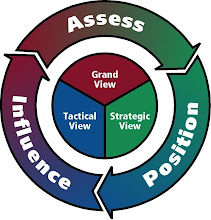
With our Compass AE process, your company can do the following:
  • assess the grand situation with extreme accuracy;
  • position your project team toward success (through our process); and
  • implement your plan with no faults.
Your project team will always make the right decision.

Copyright: 2008 © Collaboration360 Consultants (C360 Consultants).
Copying, posting and reproduction in any form (without prior consent) is an infringement of copyright
#

Survival Is Not a Strategy
In these perilous economic times, the layoff memos often follow a familiar refrain: “We have cut costs by 20 percent. That gives us an additional year’s runway. Or two.” But while yes, companies can cut costs and prolong their survival, when it comes to startups, just because they can doesn’t mean they should.

I’m speaking here of venture-backed startups, which represent a small minority of companies. The sole purpose of most companies is to create a steady income stream for their owners and operators — in other words, survival. Venture-backed startups, on the other hand, are created with the sole purpose of a successful exit.

Why growth is crucial

Whether that exit comes in the form of an acquisition or an IPO, in the meantime, the lifeblood of any startup is growth, be it in terms of customers, usage, revenues or profits. Under most economic conditions, an IPO is impossible without revenue and profit growth, and we are unlikely to see that change any time soon. From an acquisition point of view, stagnant companies are valued at low multiples of revenue, say 1x-2x. And while popular meme suggests that flat is the new growth — given the downturn in the economy, the argument goes, even keeping revenues flat is sufficient — this argument does not apply to startups.

By definition, startups are supposed to be attacking nascent market opportunities and unsaturated markets, and as such should be able to grow even during a downturn. If a startup cannot find growth in this environment, it’s a clear message that the market opportunity might be better served by an established company. Of course, growth in profits or revenues are far better than just growth in usage, but even growth in usage is better than stagnation on all three fronts. There is at least the possibility that a company with strong usage growth might one day be attractive to an acquirer with a good monetization engine.

It’s no fun to work at a startup that isn’t growing. Stagnation leads to low morale, with people sitting around waiting for the axe to fall. Rather than let the company become a zombie, management would be doing their investors and employees a favor by pulling the plug and returning the remaining capital to investors.

Why VCs often don’t put companies out of their misery

Founders and executives have a lot of emotional capital invested in their companies, so when it comes to making the ultimate decision, their reluctance is understandable. What’s surprising is how often VCs let companies turn into zombies. The reason for this is a subtle misalignment of interests between VCs and their investors. As long as a startup still appears to be, on some level, alive, VCs can carry the company on their books at the valuation set by the last round of financing. Once they pull the plug, the fund will receive pennies on the dollar, a loss that has to be recorded on the books and doesn’t look good when the firm goes to raise their next fund. Every VC portfolio, therefore, has its fair share of zombies.

Another contributing factor is excessive preference overhangs. Investors receive preferred stock with the right to get back their invested capital ahead of common shareholders in an exit; in some cases they have the right to receive a multiple of their invested capital ahead of common shareholders. The total amount that investors need to receive before common shareholders can participate in an exit is called the “preference overhang.”

If a company has raised so much capital that any realistic acquisition will be below the overhang, then common shareholders stand to receive nothing from the sale — and company management has no incentive to look for such an exit. In such cases, it’s important for the VCs and management to agree to restructure the preference overhangs to make such exits attractive to management. Otherwise the company is destined to become a zombie.

Every startup founder and employee has to consider three possible outcomes: success, failure and zombiehood. Success is much better than failure, but quick failure beats wasting years of your life on a zombie. If you are a company founder, and you are considering layoffs to extend the runway (perhaps on the advice of your venture investor), you should look in the mirror and ask yourself whether you are cutting away your growth opportunity and just choosing a lingering death over a quick one.

Anand Rajaraman is a co-founder of Kosmix and Founding Partner of Cambrian Ventures. Disclosure: He is also an investor in Giga Omni Media, parent company of GigaOM.

http://gigaom.com/2008/11/21/survival-is-not-a-strategy/

Tuesday, December 2, 2008

Assess the Grand Situation Before 2009


As another year passes, the global economy is getting tighter. The intensity of competition becomes greater. So what is your strategic move?

Those with the skills and the proper network will thrive . Those who don't have one of the two will survive through their basic instincts, until a grand opportunity is created and maximized.


Five simple questions:
q: What is your approach to assessing the grand economy?
q: How do you assess your position in this grand economy?
q: How do you assess your competitor's position in this grand economy?
q: What macro and micro variables are you using for your assessment?
q: What is your foundation for assessing the grand picture?

Forget about politics. Focus on understanding the grand picture first. Understand what object connects to what. Unless the competitors have the grand political influence and/or the grand access to the top tier of the value chain, the politics should not matter that much.


Understand your strategic position and how its connects to the grand picture.

Know what is your grand picture. Then, build your grand plan based on it.

Where there is a crisis, there are opportunities.

By assessing properly, one can either creates it, finds it or waits for it. This is the Dao of Strategy.


2009 should be our year of thriving, not surviving.


Good luck!

Copyright: 2008 © Collaboration360 Consultants (C360 Consultants).
Copying, posting and reproduction in any form
(without prior consent) is an infringement of copyright

Sunday, September 14, 2008

Quality Planning = Quality Decisions


How dos one stand apart from the crowd? To most people, it starts with the vision.

In most cases, the vision is not enough. He/she needs a plan that is specific in terms of the goal and the objectives. It must be formatted in a way that the team is able to make quality strategic decisions.

Do you have a strategic process that enables your team to
make quality strategic decisions from their strategic plan?


Friday, July 18, 2008

Building the Tangible Vision


"You don't know what you don't know
You can't do what you don't know
You don't know until you measure
You don't measure what you don't value
You don't value what you don't measure. .."

Source:
http://www.1000ventures.com/business_guide/mgmt_quality_six_sigma.html
en.wikipedia.org/wiki/Six_Sigma


One cannot build a Tangible Vision (a complete strategy that encompasses the grand picture, a strategic overview and an operational plan) if they do not know the specifics of their grand settings.

For more information on the Tangible Vision, please view the various Compass AE and Tangible Vision related threads that are listed on the right side of this page.

--- More to Come ---

Monday, June 30, 2008

Process Precedes Technology (2)


@ Collaboration360, we rarely get a clutter of e-mail. We devised a specific Tangible Vision that prioritized our e-mails we get.

If you are interested in knowing about what is a Tangible Vision. Click on the "Tangible Vision" tag.


#

June 29, 2008
Preoccupations
I Freed Myself From E-Mail’s Grip

EARLIER this year, I became tired of my usual morning ritual of spending hours catching up on e-mail. So I did something drastic to take back control of my productivity.

I stopped using e-mail most of the time. I quickly realized that the more messages you answer, the more messages you generate in return. It becomes a vicious cycle. By trying hard to stop the cycle, I cut the number of e-mails that I receive by 80 percent in a single week.

It’s not that I stopped communicating; I just communicated in different and more productive ways. Instead of responding individually to messages that arrived in my in-box, I started to use more social networking tools, like instant messaging, blogs and wikis, among many others. I also started to use the telephone much more than I did before, which has the added advantage of being a more personal form of interaction.

I never gave up my work e-mail address, because I still need it for some work-related activities — for example, for one-on-one discussions that are too private and confidential to discuss publicly.

I was in a good position to give up most of my other e-mail because I’m a “social computing evangelist” for I.B.M. and have used social software tools for years to collaborate on projects and to share knowledge. I live in the Canary Islands off the coast of Spain and report to managers in the United States and the Netherlands. Between time differences and participation in various projects, it’s important that I spend my time efficiently.

I have had continuing support from my management in this effort, because I’ve been able to prove how much more I can accomplish by answering a question, and posting it on a blog, for example, than I can by answering the same question over and over. I still help people, but in a more open and collaborative fashion. Other people can join in the discussions — maybe they will have a better idea than mine.

I started this experiment by announcing my intention on a couple of blogs, like my personal one and blogs inside I.B.M.’s firewall. The postings in response were overwhelmingly positive — but I also encountered some skepticism. Many people wondered how I would manage to communicate and collaborate with my peers without using e-mail.

The first step was to decide which social software tools were available for me to use much more extensively. The second was to encourage people to stop using e-mail themselves and to start using some of these same social software tools as well, to share their knowledge and collaborate with one another.

Most social networking tools I use are pretty standard. Instant messaging is my preferred method of collaboration and knowledge sharing while at work because it allows real-time interaction. If an instant-message exchange lasts more than three minutes, I usually move the discussion to the telephone.

Other software used at I.B.M. helps me collaborate in various areas: blogs, social bookmarking and tagging, participation in online communities to which I belong, and an alert system for to-do items.

I.B.M. uses a Facebook-like site called Beehive and a personalized internal directory called Profiles. These help build trust levels with peers in order to get a job done much faster, and they easily locate experts in a particular subject. I share and update big files with a file sharing system that cuts down on the back-and-forth of sending big presentations and video files.

Say someone asks to view a presentation you have done recently, and you decide to share it via an open “file sharing” space. Then, before you know it, strangers thank you for sharing that presentation, which they will be reusing themselves within their own projects. That kind of immediate impact would be unlikely through e-mail.

I use a couple of R.S.S./Atom feed readers, which have become not just another in-box, but my primary method of receiving notifications of content relevant to my work. They give me control of what I receive and when, something I couldn’t say when I was relying much more heavily on e-mail.

I am lucky to have the chance to be exposed to such a wide range of social software and collaborative tools at work. But what if your business does not have blogs or wikis or whatever else? What can you do to help repurpose the way you process your e-mail?

You can do something as simple as calling people instead of e-mailing them. If you work on the same floor, you can even walk over to their desks and talk to them!

You may have some other tools that could host some of those conversations. Mainly, it is about a change of habits, about finding new ways to be much more productive with less effort, so that we can focus on more complex tasks.

Anyone can create a blog or a wiki, or a Twitter account. Almost everyone can use instant-messaging tools at work to get things going. So why not start exploring the possibilities and figure out which conversations you can move out of your e-mail system?

THINK about whether my experience could work for you. Think about how to use social networking tools to eliminate spam and to avoid repeatedly answering the same question from many different people. These tools can also save you from an accumulation of online newsletters that never get read, and from those incessant project status reports that clutter many in-boxes.

E-mail can become extinct, if not repurposed altogether, even at big

companies like I.B.M. An e-mail in-box no longer needs to be like Pandora’s box.

Copyright 2008 The New York Times Company http://www.nytimes.com/2008/06/29/jobs/29pre.html

###


Most people know how to perform and produce as an individual. Not many knows how to collaborate as a team.

If you are interested in knowing about how to collaborate anywhere as a team regardless of the distance, the technology and the project culture. Please contact us at service [at] collaboration360 [dot] com. We have a white paper ready for your reading.

Tuesday, June 24, 2008

Compass AE as an Collaborative Enabler


The great enabler

By Rod Newing

Published: June 29 2007 17:38 | Last updated: June 29 2007 17:38

No single technology can accommodate the complex processes and cultural ramifications of collaborative interactions. Successful collaboration results from using the right balance of face-to-face meetings and technology. Furthermore the technology, or combination of technologies, must be appropriate to each kind of interaction.

/// Conceptually, collaboration results from proper teamwork first.

But trying to work together remotely goes against our natural human instincts. "We are optimally evolved to talk at a range of about 5 feet in groups of no more than 90 people," says Ceri Roderick, a partner in Pearn Kandola, an occupational psychologist practice. "We respond to a rich stream of information and judge nuances, such as pronunciation or slight facial expressions." This enables us to assess people's motives, trustworthiness and reliability.

Take all that away and the bald words on the page can be over-interpreted or misunderstood. "As organisations become larger, more global and more dispersed," Mr Roderick warns, "we stretch the parameters and make life difficult for ourselves." The objective of technology is to replicate that rich stream of information when the communication is particularly important – for example, when building relationships and trust, solving problems or reviewing progress. This means operating in real-time and combining as many forms of communication as possible, such as images, voice and text. This process is called "unified communications" and it is made possible by the latest internet-based technologies. These combine to give much more information to provide more context to the exchange.

"Successful collaboration starts with the people," says Graham Oakes, a technology consultant. "They need to establish contact with each other and agree lines of communication, which is a lot easier to do face to face."

Mr Roderick recommends that people working in virtual teams should make time to meet occasionally. This allows them to understand more about the personal and cultural context of other individuals, which helps when they subsequently telephone or e-mail each other.

/// The team starts by building the Tangible Vision as a team. When they builds their Tangible Vision, they begin to learn something about their counterpart. ... For example, how does he/she think? How does he/she expresses their ideas? etc.

The need to get the balance right is shown by "Congested Lives", a research study of over 1,200 UK businesses employees carried out by YouGov for Polycom, a collaborative communications vendor. This showed that unnecessary face-to-face meetings cost businesses £17bn each year and 82 per cent of respondents who had travelled to meetings in the last year believed many of them were unnecessary.

If people want to build trust and relationships without the time and cost of travel, then video conferencing is the most effective tool. "The purpose of many video conferences is not necessarily to get things done but to build trust and contacts in the relationship," says Jeffrey Mann, vice-president of research at Gartner, the technology analyst. "Video and web conferencing are really relationship building, and not necessarily information passing or for agenda point processing, because people want to know who they are dealing with."

Growth in video conferencing has been forecast for many years, but so far it has failed to materialise. Professor Peter Cochrane, a futurologist and founder of ConceptLabs, puts its failure to date down to poor video and sound quality, no eye contact, no gaze awareness, no body language, small people images and no depth of field.

"Most of this can now be fixed," he says, "notably by Cisco Telepresence, which uses life-size high definition screens, audio straight out of the speaker's mouth from the right direction, eye contact and all in good quality. Hollywood discovered the value of emotions, for which good audio and video are the essential."

Asynchronous communication, where people interact over a period of time, is also a valuable tool. "If you are dealing with someone in another part of the world in another language, it gives them more time to think and react," says Mr Mann. "It is a real disadvantage if they have to think in real-time."

But there is a danger of sharing too much information. Microsoft's Enterprise IQ Survey 2007, in partnership with Henley Management College, found that an average workgroup of 25 people shares information 1,500 times a week and intensive information users share over 5,000 times a week. Even then, 22 per cent of documents are considered to be out of date.

"People are drowning in data and feel overwhelmed by information," says Jean-Anne Stewart, director of corporate programmes at Henley Management College. "There are issues of reliability and accuracy, which may be contributing to calling meetings to gather and share information."

/// When a Compass team leads with their Tangible Vision, they focus on the standards that are listed in their Tangible Vision. The Tangible Vision gives the Compass team a strategic overview of direction, connections and anticipation.

Although a wide range of corporate technologies exists to overcome some of the cultural issues surrounding collaborative working, a new range of consumer-based technologies is beginning to establish itself in the enterprise. Often referred to collectively as "Web 2.0", the technologies include social networks, wikis and blogs.

"The teenagers of today are using technology to communicate and collaborate like never before but the business world is struggling to figure out how to use them," says Neil Sutton, general manager for information technology services at BT.

When today's teenagers start their careers in the commercial world, it will have an impact on the way we communicate. They will prefer different ways of communicating, and this will affect collaboration within, and between businesses – but the business world is not ready for it."

Stewart Mader, wiki evangelist at Atlassian, a software systems company, points out that the generation now entering the workforce are experts in social media and are already collaborating with each other. One of the reasons for the success of Web 2.0 tools is that they blur the line between pure business productivity and the building of an emotional connection, a sense of ownership and involvement, which allows people to interact directly with other people to build their knowledge.

"They approach knowledge as the product of that organic, non-linear human connection and collaboration," he says. "Imagine unleashing that potential in the professional world."

People's individual web profiles are the foundation of social networks, allowing them to connect to each other and to information. These profiles add the necessary "context" to the collaboration.

IBM has been using the same approach for eight years with its 475,000 "Blue Pages" employee and partner profiles. These include an individual's experience, skills, projects they have worked on, their patents and publications, the content they have created, the activities they are involved in and the communities in which they participate.

"They are accessed 6m times a day to find more about the people you know and to find the people you don't know," says Jeff Schick, worldwide vice-president for social software at the company. "You really get a better understanding of who the individual is, what they do and what they know."

The CIX electronic conferencing system has been using the personal information of its users to make connections since before the internet became pervasive. "They are essential for building a mental picture of your remote colleagues," says Graham Davies, the company's managing director. "It helps us to predict how a person will interpret and react to our ideas and suggestions, in the same way their facial emotions and body language would in a face-to-face situation."

Clearly, technology can help to address a number of cultural problems associated with collaboration – but not if they are used exclusively. As Prof Cochrane concludes: "Collaboration still works best if it is supported by human contact that cements trust and familiarity on a regular basis."

Copyright The Financial Times Limited 2008

http://www.ft.com/cms/s/2/a68a825e-265d-11dc-8e18-000b5df10621.html

#

When the Compass team collaboratively builds and connects with their Tangible Vision, they become familiarized with the priorities and the approaches to completing their goal and the circumstances that can occur. ... They know their role and responsibilities in certain situations while learning something about each other. ... The members of the team collaboratively trust each other and know that everyone is accountable. The team is always decisive in their actions as a team and continually trusts their Tangible Vision.

#

"One who excels at warfare will await events in the situation without making any movements. When he sees he can be victorious he will arise; if he see he cannot be victorious he will desist. Thus it is said he doesn’t have any fear, he doesn’t vacillate. Of many harms that can beset any army, vacillations is the greatest. Of disasters that can befall an army, none surpasses doubt.”
– Six Secret Teachings, 26


By connecting with their Tangible Vision, a Compass team always know what are their priorities and the approaches regardless of the circumstances. There is no doubt in the mind of the Compass Implementors.

If you are interested in knowing more about how Compass AE works, please contact us at service [at] collaboration360 [dot] com. We have a white paper ready for your reading.


Copyright © 2008 Collaboration360 Consultants (and Collaboration360.com) All rights reserved. Copying, posting and reproduction in any form (without prior consent) is an infringement of copyright

#

Tuesday, April 8, 2008

The Importance of a Good Strategic Process


To thrive in the global economy, it is important to gain a strategic position.

Collaboration360 believes in the rule of "process precedes technology".

Our idea of team efficiency begins with a project team building, connecting and leading with a strategic overview (Tangible Vision) that enables them to see how the initial objective connects with other objectives, that leads to the overall grand goal. Our process also enables the team in how to manage themselves in various situations.

With a properly-built strategic overview, the team gets a 360 degrees view of the entire project. They know the general priorities, the approaches and the circumstances.

This overview allows the team to perform the following: see the critical path, focus on their strengths while avoiding their weaknesses, adjust strategically
while staying focused on the tangible path, etc.

From a technical view, our Compass AE process focuses the implementers on the goal and objectives. It prevents the team from getting a data overload and unspecific focus.

Our process gives the team a structural focus from top down. During implementation, the implementers are able to be efficient during predictable times and flexible during unpredictable times.

This standard of preparation works if the team has the proper professional experience and a good grand process that encompasses everything from initial preparation to building the strategic overview. and then building marketing development plans, product development plans around it, marketing implementation plans, etc.


q: Does your company utilizes any strategic project management process like this?

If you are interested in knowing more about Compass AE , please contact us at Service[aatt]collaboration360 [ddott]com. We will be more than happy to tell you more about Compass AE and how it can help your company.

Sunday, March 30, 2008

Compass AE + Video Conferencing = A Team Collaborating Without Borders


Traveling costs are going up.


Video conferencing is on the rise


Your virtual team of project implementers are located at
different remotes. How do you get them to collaborate as a team?


If some teams cannot collaborate in close quarters,
what are the chances that they will collaborate
efficiently
well at remote locales?


How do you get them to collaborate as a team?
While technology connects people,
a good strategic team collaborative process is
the key to a project success.
Do you have a process that can get people to
collaborate as a team?

Our Compass AE methodology
is a team collaborative approach that.emphasizes on advanced planning. It enables the project team to use our Tangible Vision component to plan their goal and strategic overview. They are always collaboratively prepared for all situations. The team understands what are the specific priorities, the particular approaches and the different circumstances that could occur.

A properly-built team collaborative process enables the project implementors to effectively utilize their technology in specific situations. Without a process, technology is only effective in limited situations.

Our Compass AE process also allows them to collaborate regardless of the distance, the technology and the project culture.

In future entries, the beneficial values of Compass AE will be explained.

If you are interested in knowing more about Compass AE as a strategic collaborative tool. please e-mail us at Service[aatt]collaboration360[ddott]com


###

Pleased to meet you, virtually

13.03.2008 - Videoconferencing is coming into view for more and more businesses as prices fall and quality improves. Recently, 240 employees of the Revenue Commissioners from 11 regional offices attended a seminar on VAT. In the past, this would have involved a mass exodus of staff to a central location such as Dublin, an administrative hassle trying to accommodate the numbers in one room and thousands of man-hours lost as workers made the journey.

Upon finishing the recent seminar, however, employees were back at their desks in minutes. Videoconferencing technology enabled the workers to link in from the meeting rooms in their offices and partake in the information seminar with minimum disruption to productivity.

Last year, the Revenue Commissioners embarked on a six-figure rollout of videoconferencing. So far, 25 offices in major towns around the country have had a room kitted out with a video screen, audio equipment and network connection, with five more offices due to come on stream shortly.

On top of that, about 115 senior managers have been supplied with desktop webcams to enable live, one-on-one video meetings. The upgrade of the videoconferencing technology is providing tangible benefits for Revenue, says Paul McDonald, business operations manager, Revenue.

"The new system can link up to 12 sites at the moment to deliver seminars and we will be extending this in the future. Previously, we could only link two sites at a time.

"If necessary, we can cram dozens of people in the videoconferencing room. If you're using it for something like a training session all staff members don't need to be visible to the trainer on the other end. They can hear what's being said and get their chance to ask questions."


Cutting costs is not the chief driver for Revenue, says McDonald. "There are benefits vis-à-vis savings in travel costs and at some stage we'd be looking to reduce carbon emissions, but better communication is the main driver."

/// *** Better communication creates efficiency

A lot of Revenue's work is based on legislation so any changes to the law and the knock-on effects for the tax system have to be communicated to all staff at the same time to avoid regional discrepancies. Videoconferencing smooths the passage of this information through to those at the coalface.

For Icon Clinical Research, improving productivity and keeping on top of vital relationships are the benefits of videoconferencing. "One of our drivers for using videoconferencing technology is to ensure we maintain necessary relations with staff, peers and customers without travelling all the time to do so," says Joe Daly, IT director, EU and rest of world, Icon Clinical Research.

/// Think of the time and money that can be saved from not traveling all of the time. Time is money.

The biopharma multinational has offices in 40 countries, many of which utilise dispersed workforces. All the main offices use videoconferencing to keep in contact with each other and also to help manage remote workforces.

It's a development jetlag-weary executives of the 5,500-strong multinational are very glad of.

"We're a global company and we do have quite high travel costs, particularly for client visits and general meetings," explains Daly. Videoconferencing has reduced the number of trips executives make, freeing up time and curbing expenses.

When traveling, the anxiety of waiting for the uncertainty can be overwhelming.
This stress causes
the traveling professionals to be unproductive.
The question is ... do you want your people to perform and produce
below their norm?

Cutting down on trans-Atlantic crossings was also a key driver in NTR Group's adoption of the technology. The company's head office in Dublin had Digicom install a Polycom VX7000 videoconferencing system in its boardroom last year.

As a large global company with a number of subsidiaries, including Greenstar, Bioverda and National Toll Roads, NTR sees videoconferencing as instrumental to how it conducts its business.

"About 40 to 50 staff members in the Dublin office, primarily senior management, use it, as do other members of staff on occasions," says Gareth Delahunt, network administrator, NTR.

He says the decision to deploy videoconferencing was less of a money issue and more to ease the pressures on the diaries of senior executives.

"You can't be in two places at once. It facilitated getting a lot of work done," he quips.

Improvements in the quality of non-proprietary videoconferencing systems that can 'talk' to other systems is also driving uptake of the technology. For example, NTR's videoconferencing system is used both internally for company business and externally for contacting other organisations.

One of the main developments spurring the onset of videoconferencing is the wider bandwidths made available through broadband internet.

Previously, videoconferencing was done over ISDN lines, which was more expensive and awkward to implement. Now, companies use their IP (internet protocol) networks to facilitate internal video communication.

"ISDN was used in the past and it involved getting three lines brought into your building," explains Jared Huet, audiovisual consultant, Digicom. "Nowadays, companies are joining their networks together so they can make video calls over the internet."

The benefits of IP video is there's no cost per minute, whereas with ISDN you're paying per minute, per line. Utilising the three ISDN lines needed for videoconferencing means you're making three international calls and being charged per minute. With IP video there's zero call costs; it's an add-on to your existing network charge.

However, there are challenges around installing videoconferencing, both technical and cultural.

"Typically you use your network to transfer data from one server to another or to send email internally. It doesn't have to get there immediately. In real-time communication, however, a one- or two-second delay would make a conversation unworkable," says Daly.

"Because of that you have to give videoconferencing a higher quality of service on the network. Typically you use up 384Kbps of bandwidth for a two-way conversation between two videoconferencing units. You have to make sure you've enough bandwidth and that you've prioritised that type of traffic so it goes quicker than anything else."

Changing people's habits is perhaps the most challenging aspect, Daly believes. "In all the companies I've worked for, people think it's great initially but the novelty does tend to wear off after a bit."

"Our challenge now is to sell this to our people," says McDonald. "But anyone who has used it is quite impressed. The quality we have now is far better."

A high-definition future for videoconferencing in Ireland

The number of videoconferencing units sold in Ireland has grown about 100pc in the past three years, according to specialist reseller Videnda.

The yearly growth rate of around 33pc is down to three factors, says head of finance and operations, Liam Fahy. The equipment has got better; there's more bandwidth available due to broadband rollouts; and there's growing concern to reduce carbon emissions.

It's also due to people tired of trawling through airports and hotels. "Going over to London or down to Cork from Dublin for a one-hour meeting takes a full day. People are sick of it."

Sales of videoconferencing units are rising and customers are increasingly opting for high-definition (HD) units, says Fahy.

"One of our major suppliers went from shipping no HD units to it being 40pc of what they shipped in the space of six to nine months."

Fahy estimates over 1,000 Irish companies use videoconferencing, with the ratio of standard-definition to HD around 70:30.

Prices range from €3K for entry-level standard-definition units up to €25K for top-of-the-range HD units.

By Niall Byrne

http://www.siliconrepublic.com/news/news.nv?storyid=single10506

Saturday, March 15, 2008

Compass AE principle: Process Precedes Technology


Many companies and governments believes in planning and operating from ground up. These groups rarely implement any advanced thinking and strategic foresight in their plans. If there is a problem, they utilize a "find a technological-driven solution and everything would be solved" type of approach. It usually cost the company more money after the damage is done.


Proper Preparation Prevents Pissed, Poor Performance
Compass AE is a team collaborative process that.emphasizes on advanced planning.

With their Tangible Vision, the Compass team is always prepared for all situations. They understood the specific priorities, the particular approaches and the different circumstances that could occur.

A properly-built process enables the project implementors to effectively utilize the technology in specific situations. Without a process, technology is only effective in limited situations,

If you are interested in knowing more about Compass AE as a strategic collaborative tool. please e-mail us at Service[aatt]collaboration360[ddott]com

###

February 4, 2008

SHANGHAI — For two weeks running, much of this country, long known for its capacity for mass mobilization, has been tied in knots by a series of major snowstorms.

Although the snowfall has been described as the worst here in 50 years, it has been nothing like the deep cover that blankets parts of New England or the upper Midwest in many winters.

But its crippling effect seems to have been mostly because of surprise. The storm knocked out electricity and water supplies, threatened the coal supply that fuels the country’s power plants and stranded millions of Chinese on the eve of the year’s most important holiday.

Many of the worst effects have been in parts of east-central and southern China, which are largely unaccustomed to serious snowfall.

Many victims, however — as many as 100 million people were directly affected — equate surprise on such a huge scale with lack of preparation.

For migrant workers unable to take their annual leave for the Lunar New Year, or for others stuck at home without electricity, water, regular supplies of food or even reliable news, the government, instead of an unpredictable weather system, increasingly appears to be the culprit.

In the last week the Chinese government has worked as hard at public relations over the crisis as it has over crisis management itself.

Prime Minister Wen Jiabao, who has traveled around affected areas almost nonstop, went early in the week to the southern city of Guangzhou, where as many as 800,000 people had gathered at the train station at one point seeking to begin their annual vacations.

President Hu Jintao went to a coal mine in northern Shaanxi Province to encourage miners to redouble their efforts, including forgoing New Year celebrations, to spare the country’s power grid from further brownouts. Mr. Hu, who is known for his circumspection in public, was quoted as saying he was unable to sleep because of the scale of the emergency.

But in many badly affected areas the government seems to have almost disappeared, so overwhelmed it has been by the demand for emergency services. In other areas poor coordination between levels of government and among various agencies has seriously complicated matters.

“The main problem is lack of preparedness,” said Luo Shihong, a relief volunteer in Guiyang, in Guizhou Province. “By late January both the government and people thought the sky would clear up in a couple of days and it would be over. The officials had a lot of confidence initially, then a day or two later they discovered how unprepared they were mentally, physically and in terms of manpower.”

Xie Yonggang, a crisis management expert in northeastern Heilongjiang Province, had a similar explanation: “Despite the weather forecasts, the transportation department didn’t realize how serious this was until all the roads were already blocked.”

In Guangzhou, the capital of southeastern Guangdong Province, which has the largest concentration of migrant labor, these crossed signals may have narrowly missed causing disaster among the desperate crowds stranded at the train station.

Provincial authorities have worked hard for days to convince would-be travelers to abandon their plans to spend the holidays with family in faraway provinces, arranging ticket refunds, setting up shelters and offering nonstop propaganda about the money-saving virtues of staying put. Several hundred thousand people were gradually persuaded to leave the area of the train station.

On Thursday, though, a spokesman for the Railway Ministry said anyone wishing to travel home by train from Guangdong Province would be able to do so within five days. That brought a new surge of passengers, worsening the potentially explosive scene at the station.

Two people reportedly died at the station on Sunday, one crushed in a stampede and the other electrocuted as he tried to jump aboard a train.

“The Railway Ministry has a tone that is different from that of Guangdong, whose attitude had been clear,” said Wen Yunchao, a freelance Internet journalist. It would have been better to hold back as many people as possible so that some could go, instead of telling everyone they could go, he said.

The crisis in Guangdong has been made worse by other contradictions, as well. Although the provincial government has tried to encourage workers to remain at their dormitories, nobody seems to have coordinated with the factories.

“Many factories in the Pearl Delta are already closed or have laid off workers,” said Mr. Wen, the journalist. “The workers at those places have to go home, and they have brought all of their belongings and a few days’ cash out with them. They don’t plan to return to Guangzhou and don’t have a way back home, and we’ve seen no government arrangements directed at this group.”

Transportation is far from the only problem. China’s entire power system, from its extensive reliance on coal to its use of a high-tension power grid spanning the country, has proven surprisingly vulnerable. Agriculture, too, has suffered.

With train service badly affected, the authorities have faced the awkward choice of ferrying passengers or ferrying coal to power plants with the locomotives still in service. By some estimates, China’s coal reserves at power plants had dwindled to a historic low, with only a two-day supply remaining in many places.

Liu Xinfang, a spokesman for the national grid, said that as of Saturday 2,000 transmission towers and about 24,000 miles of transmission cables were still down in central and eastern China. “The wires have been frozen into huge ice sticks,” he said. “Some towers are bearing four times their weight.”

Others said the high number of collapsed transmission towers was a result of the fact that in southern China they are spaced far apart, largely as an economy measure.

One of the worst-hit areas for power has been Chenzhou, a city of four million in Hunan Province, where many have lacked water, electricity, heating or commercial food supplies for 10 days.

“Our power grid system was seriously damaged, in fact torn to pieces, and it is very hard to repair,” said Li Yufang, chief of the city’s emergency operations center. “When one part of the grid is fixed, another suddenly collapses, so power can only be transmitted intermittently.”

In southeastern Guizhou, another hard-hit area, officials said there had been extensive loss of winter crops, like wheat. Power has been out there for weeks.

“In towns and villages life now depends on primitive means,” said Lu Jiang, a spokesman for Southeast Qian Prefecture. “We get light from burning pine, and families grind grains with stone mortars. It’s not difficult to survive, but to live the way we did before the snow began, we will have to wait until the next season.”


Copyright 2008 The New York Times Company

http://www.nytimes.com/2008/02/04/world/asia/04snow.html

Sunday, March 9, 2008

Cooperation Creates Collaboration


Our Compass AE team collaborative process enables your project team to be strategically positioned ahead of the competition.

The following actions occurs:
  • The team knows the critical path toward completing the goal
  • The team focuses on their strengths while avoiding their weaknesses
  • The team always anticipate or seize opportunities
  • The team always know how to strategically adjust to changes
  • The team knows how to properly shape the path that leads to the completion of the project.
  • The team know how to strategically collaborate.
Our Compass AE process enables your project team to collaborate anywhere regardless of the distance, the technology and the project culture. With a compass direction, they collaborate without borders.

If you are interested in knowing more about Compass AE as a strategic collaborative tool. please e-mail us at Service[aatt]collaboration360[ddott]com


#

Following is an Interesting article on cooperation and gaming collaboration.

Cooperative games get casual players involved

Thursday, March 6, 2008

"... developers create more games that invite people to play collaboratively. Army of Two is the first next-generation title to be built from the ground up with cooperative play in mind, which runs through the bloody story line.

Much like Facebook and MySpace have rocketed in popularity through their focus on community and collaboration, a new generation of console games is offering more opportunities to create social modes of interaction. Unlike the solitary experience of playing a game by yourself or the high-stress environment of playing competitively with other players online, co-op offers an easier way to get into video gaming because you're among friends.

"Competition is fun, but it's just as fun to do teamwork," said Nick Puleo, founder of Co-Optimus, a Web site devoted to cooperative gaming. "Co-op is more of a positive thing than going around and killing the other team. It's built around a story or an objective that you can accomplish together."

Video gaming has had elements of co-op play for years. Two decades ago, arcade rats were playing Double Dragon and Contra side by side. With earlier consoles, gamers played on split screens on their televisions. More recently, hardcore PC gamers have banded together in online games like World of Warcraft to create epic battles and embark on various missions.

But in the past couple of years, there has been a co-op renaissance as developers started building the feature into their games, this time with online play so friends can team up remotely. Gears of War, Rainbow Six: Las Vegas and NHL 08 have utilized co-op to good effect. Upcoming titles like Resistance 2, Fable 2 and Haze are all building in more dynamic co-op features that allow up to eight players to work together.

One of the best-known titles in this new crop of co-op games is Rock Band, a four-player music game in which people play as members of the band. Greg LoPiccolo, vice president of product development at Harmonix Music, the developer of Rock Band, said the style of the game and its cooperative play have helped the company not only sell 1.5 million copies in the past few months but also reach out to a broader audience.

"There is a whole vast audience, specifically women, for whom competition is not their main desire for entertainment," LoPiccolo said. "Rock Band has been a good fit for them. From the outset, we hoped we would pull in a new set of customers who don't think of themselves as gamers."

Building co-op features into games isn't as simple as just adding a character. In Army of Two, the developers went to great lengths to ensure that both players can roam separately but
also work well in concert.
That can be harder in story-based games, where one player's progress will set off events in the game. In Army of Two, designers had to be mindful of tracking two players, ensuring their independent movements still work within a linear story line.


/// With Compass AE, each team member always knows what the entire team is focused on. When a Compass team that builds, connect and lead with their Tangible Vision, they will always succeed.


The game also forces players to revive each other, work in tandem to move around, and cover each other during firefights. When done well, the game can be rewarding for friends who are playing only recreationally, said Reid Schneider, senior producer for Army of Two at Electronic Arts.

"It's almost like watching a football game with a buddy as opposed to trying to compete with other," Schneider said. "It's a different experience with different expectations. This is more about the core enjoyment of playing together."

In Rock Band, designers allowed players of different skill levels to play with each other. But if one player falls behind and is on the verge of ending the band's collective round, a star player can save a bandmate through the use of stored "overdrive power."

"That can be really rewarding, if you're struggling and then you have a bandmate rescue you," LoPiccolo said.

Ted Price, president and CEO of Insomniac Games, which is releasing Resistance 2 this fall, said co-op can bring new gamers further into the gaming world. He said games like Resistance 2, which will feature eight-person co-op play, can prepare people for more intense multiplayer battles online.

"We think co-op can serve as a bridge between single player and multiplayer," Price said. "It's not about getting your butt kicked in multiplayer (games). We're introducing multiplayer concepts in a more safe way."

Peter Moore, president of the EA Sports label, said he believes co-op can draw players into games they might have thought were too daunting, such as shooters or sports games like NHL 08 or FIFA 08. By teaming with stronger players, new players can not only have fun but gain confidence, he said.

He said the co-op play was one of the nice features of Gears of War, a title published by Microsoft when he was vice president of Microsoft's gaming business.

"In Gears, you had each other's back and you took care of each other," Moore said. "Even if you were weaker, you could last longer and have more fun."

E-mail Ryan Kim at rkim@sfchronicle.com.

http://www.sfgate.com/cgi-bin/article.cgi?f=/c/a/2008/03/06/BU24VEBTK.DTL

This article appeared on page C - 1 of the San Francisco Chronicle

###