Showing posts with label Chinese Strategy Mindset. Show all posts

Sunday, June 21, 2009

Risk Management: A View from The Seven Strategy Classics of Ancient China


During the act of assessing or planning, he or she must always consider the risk factor.


"One who abandons what is nearby to plan for what is distant will labor without success. One who abandons the distant to plan for the nearby will be at ease and attain lasting results." - Huang Shek Gong, 9


#
June 16, 2009
Settling for Par: Pros More Likely to Play It Safe

By ALAN SCHWARZ

When PGA Tour golfers from Tiger Woods down to the greenest rookie draw back their putters this week at the United States Open, their scorecards will be sabotaged by a force as human as it is irrational: risk intolerance.


Even the world’s best pros are so consumed with avoiding bogeys that they make putts for birdie discernibly less often than identical-length putts for par, according to a coming paper by two professors at the University of Pennsylvania’s Wharton School. After analyzing laser-precise data on more than 1.6 million Tour putts, they estimated that this preference for avoiding a negative (bogey) more than gaining an equal positive (birdie) known in economics as loss aversion costs the average pro about one stroke per 72-hole tournament, and the top 20 golfers about $1.2 million in prize money a year.


Contrary to most academic studies involving sports, at which athletes typically scoff, a handful of the tour’s top putters did not dispute this finding. Simply put if not putt they admitted to being spooked enough by bogeys that they will ultimately cost themselves strokes to avoid them. Call it the bogeyman.

Par putts just seem to be more critical because if you miss you drop a shot if you miss a birdie putt, it doesn’t seem to have the same effect, said Jim Furyk, one of the tour’s best putters.
Added Justin Leonard: When putting for birdie, you realize that, most of the time, it’s acceptable to make par. When you’re putting for par, there’s probably a greater sense of urgency, so therefore you’re willing to be more aggressive in order not to drop a shot. It makes sense.

Of course, it makes no sense at all: each stroke counts as one on a scorecard, whether for eagle or triple-bogey on any particular hole. The goal is to finish with the fewest strokes, regardless of what each might be artificially termed. All else being equal distance from the cup, one’s proximity to the lead or cut, the course difficulty and so on putts should be handled the same way.


But they are not, according to the study of almost 200 tour professionals from 2004 through 2008. Using data the tour regularly records on every ball’s green location accurate to the nearest inch, the professors found that birdie putts were made about 3 percent less often than otherwise identical putts for par. (In effect, players tell themselves before birdie attempts, Let’s just get close, rather than, I have to make this.) Given that players typically attempt nine birdie putts per round, this cost each golfer about one stroke per tournament which can translate to hundreds of thousands of dollars in prize money.


The professors, Devin Pope and Maurice Schweitzer, seemingly anticipated every But what about? reflex from golf experts. The tendency to miss birdie putts more often existed regardless of the player’s general putting or overall skill; round or hole number; putt length; position with respect to the lead or cut; and more.


As would be expected, the difference decreased on routine short putts and also decreased very far from the hole, where the chance of making the putt is small to begin with. It peaked on putts from about 6 to 12 feet. Even Woods, roundly considered the best putter ever, exhibited the trait at roughly the tour average.


The finding may become significant among behavioral economists, many of whom have suspected that the loss aversion found through contrived experiments might not be demonstrated by actual, expert competitors vying for high stakes. The paper is being submitted this week for publication in an economic journal.


Even experienced professionals playing for high stakes are not rational, Pope said. Tiger Woods, the model of perfection and what an economist would think of as a rational agent, even he exhibits these biases. And if he exhibits these biases, why not business leaders? There are a lot of applications.
Rather than resist any insight from ivory tower academics, several golfers admitted to handling identical birdie and par putts differently and appeared somewhat amused at being found out. Geoff Ogilvy, who made par putts 4.1 percent more often than birdie putts from the same distance, said: A par putt seems more final. It shouldn’t make any difference, should it? And Paul Goydos, who showed the effect at 4.4 percent, said it probably affected him even more on putts for eagle.

If I’ve got a 25-footer for eagle, it seems like I’m more conservative than with a 25-footer for either birdie or par for whatever reason, Goydos said. I think the worst thing you can do is three-putt for par on a par 5. That’s one that drives me more crazy than anything else. Maybe that’s why I’m at the very bottom of the tour in eagles made.

But just as quickly as pro golfers admitted to their costly habit, they dismissed the idea of being able to do much about it. Stewart Cink, who showed a 3.3 percent effect, said that try as he might, he would never be able to convince himself that every putt is the same.

You can’t fool yourself, Cink said. But this is one of the reasons why we use sports psychology, and we try to have a preshot routine so we do the same thing, approach every putt the same way. It’s not always glamorous, and it’s not always possible in reality.
The psychological preference to avoid a perceived penalty (losing a stroke relative to par) rather than go for a perceived gain (gaining a stroke) has some benefit.

Golfers tended to leave their conservatively stroked birdie putts slightly closer to the cup than more aggressively missed pars leading to their making their follow-up shot more often. But that temporary gain was far outweighed by the overall cost in strokes.
The birdie-versus-par effect varies in ways that many golfers would instinctually predict. The tendency to make similar birdie putts less often than pars becomes less prevalent with each tournament round as players are judged more against one another than against par.

The elite tour players generally show less of the trait than marginal ones. And the difference decreases as a player sees himself or his partners handle a particular green.
But the effect is always there, even if a good reason for it is not. A 10-footer for par feels more important than one for birdie, said Goydos, a two-time winner on the tour. The reality is, that’s ridiculous. I can’t explain it in any way other than that it’s subconscious. And pars are O.K. bogeys aren’t.

Larry Dorman contributed reporting.

Copyright 2009 The New York Times Company

http://www.nytimes.com/2009/06/16/sports/golf/16study.html?em


Those who are positionally competing in an intensive competition, should remember the following quote from Questions and Replies between T'ang T'ai-tsung and Li Wei-kung.

"According to Fan Li's book, 'If you're last use yin tactics, if you're first then use yang tactics. When you have exhausted the enemy's yang tactics. When you have exhausted the enemy's tactics. When you have exhausted the enemy measures, then expand your yin to the full and seize them.' This then is the subtle mysteriousness of yin and yang according to the strategists."


Sunday, February 1, 2009

Applying SunZi Principles in a Competitive Arena


A drafted post that was lost in the archives.

When a visiting team enters the home territory of their opposition, they must remember the following: "... In dispersive ground the opposition must unify the determination of the army. ... Ground equally accessible to both the enemy and me is communicating. ... Do not attack an enemy who occupies key ground; in communicating ground do not allow your formations to become separated. ... In difficult ground, press on; in encircled ground, devise stratagems; in death (desperate) ground, fight. ... " --- Sun Zi AoW, Chapter 11 Nine Grounds


Notes:
Dispersive ground
is a competing situation where a competitor attempts to challenge you before your preparation is completed .

Key ground is a competing situation where one secures great advantage by having the expediency of utilizing the resources at hand.

Communicating ground
is a competing situation where you and your competitor(s) are able to advance and retreat easily. The challenge is to secure the space of one's terrain with maximum efficiency, speed and the least amount of resources, without exposing one's weakness.

Difficult ground is a competing situation where you or your competitor encounter major barriers. The challenging part of this situation is deciding whether to advance or retreat.

Serious ground
is a competing situation where you or your competitor have gain significant ground in the terrain of their competing arena. The two challenging points of this situation is: (1) the risk of running out of resources and provisions; and (2) determining how to secure more resources as one progress along .

Encircled ground
is a competitive situation where you or your competitor are almost out of resources. The recommended protocol is to study the strategic positioning of the "encircling" player, pinpoint weaknesses and devise stratagems to avoid the state of desperation.

Death ground is a competitive situation where the encircled competitor is at a desperate situation. In order to gain new momentum and life, he or she focuses on fast wins through direct confrontation. Any delayed strategic action would guarantee the end of their endeavor.

#

Following are the steps that we recommend to the advantageous competitor:
  • Force the Dispersive circumstance into the heart of the opposition by commanding the Key ground and controlling the Communicating ground;
  • Move intensively fast; and
  • Secure the Serious ground while understanding that the grand settings behind the goal must not be destroyed.
This is the essence of Sunzi strategic concepts.

# # #

NFL says Patriots claim of extra crowd noise unsubstantiated
ESPN.com news services

Updated: November 5, 2007, 3:21 PM ET


The NFL says no artificial crowd noise was pumped into the RCA Dome on Sunday during the New England-Indianapolis game, despite claims otherwise by Patriots team president Jonathan Kraft.

"CBS has informed us that the unusual audio moment heard by fans during the Patriots-Colts telecast was the result of tape feedback in the CBS production truck and was isolated to the CBS broadcast," NFL spokesman Greg Aiello said Monday. "It was in no way related to any sound within the stadium and could not be heard in the stadium." Yahoo! Sports reported earlier that the NFL was looking into charges Kraft made after Sunday's 24-20 New England win. Kraft told NFL vice president of security Milt Ahlerich -- the same man involved in confiscating the Patriots' videotape made in a Week 2 game against the New York Jets that cost Belichick $500,000, the Patriots $250,000 and a first-round draft pick -- that he felt there was extra noise in the stadium. Aiello said, according to Yahoo!: "We're aware of it and we're looking into it. It may just be the TV feed from CBS, but we're checking it out." Monday, he said that was indeed the case. Kraft is the latest in a line of people who have accused the Colts of enhancing crowd noise in their domed stadium. It has never been proven.
http://sports.espn.go.com/nfl/news/story?id=3095903

###

q: How do you stop the opposition from utilizing this advantage?
a: From another Chinese strategy classic, "one uses 'Yin' (soft) methods to counter the opponent's 'Yang' (hard) methods."

q: What soft method could the Patriots have used to shut down the channeled loud noise?
De-accelerate the pace of the game by implementing a "long and tedious no-huddle run first" attack. The slower the game gets, the more bored the crowd becomes. Once one gets two long consecutive scoring drives and if the opposition fails in their scoring. Most likely, the crowd will no longer be involved in the game.


Water (soft methods) can isolate an enemy but cannot destroy his supplies or equipment (team unity or fan support). ... Those who use fire (hard methods) to assist their attacks are intelligent; those who use inundations (a combination of soft and hard methods) are powerful.
- Sun Tzu's The Art of War: Chapter 12 Attack by Fire (Use of Influence)


More examples on the maneuvering of Yin and Yang tactics will be covered in our Strategic Assessment book.

# # #

Collaboration360 Consultants (C360 Consultants). Copyright:2009 © All rights reserved
Copying, posting and reproduction in any form (without prior consent) is an infringement of copyright.

Sunday, December 7, 2008

Strategizing from a Superior Position

One trademarked move of the Chinese Strategies approach is creating misdirection at one point while attacking from another.

This following article is from Stratfor.com (an astute group dedicated to analyzing geopolitics)

#
Last Wednesday evening, a group of Islamist operatives carried out a complex terror operation in the Indian city of Mumbai. The attack was not complex because of the weapons used or its size, but in the apparent training, multiple methods of approaching the city and excellent operational security and discipline in the final phases of the operation, when the last remaining attackers held out in the Taj Mahal hotel for several days. The operational goal of the attack clearly was to cause as many casualties as possible, particularly among Jews and well-to-do guests of five-star hotels. But attacks on various other targets, from railroad stations to hospitals, indicate that the more general purpose was to spread terror in a major Indian city.

... More important than the question of the exact group that carried out the attack, however, is the attackers' strategic end. There is a tendency to regard terror attacks as ends in themselves, carried out simply for the sake of spreading terror. In the highly politicized atmosphere of Pakistan's radical Islamist factions, however, terror frequently has a more sophisticated and strategic purpose. Whoever invested the time and took the risk in organizing this attack had a reason to do so. Let's work backward to that reason by examining the logical outcomes following this attack.

An End to New Delhi's Restraint
The most striking aspect of the Mumbai attack is the challenge it presents to the Indian government — a challenge almost impossible for New Delhi to ignore. A December 2001 Islamist attack on the Indian parliament triggered an intense confrontation between India and Pakistan. Since then, New Delhi has not responded in a dramatic fashion to numerous Islamist attacks against India that were traceable to Pakistan. The Mumbai attack, by contrast, aimed to force a response from New Delhi by being so grievous that any Indian government showing only a muted reaction to it would fall.


... This time, however, the attackers struck in such a way that New Delhi couldn't allow the incident to pass. As one might expect, public opinion in India is shifting from stunned to furious. India's Congress party-led government is politically weak and nearing the end of its life span. It lacks the political power to ignore the attack, even if it were inclined to do so. If it ignored the attack, it would fall, and a more intensely nationalist government would take its place. It is therefore very difficult to imagine circumstances under which the Indians could respond to this attack in the same manner they have to recent Islamist attacks.

What the Indians actually will do is not clear. In 2001-2002, New Delhi responded to the attack on the Indian parliament by moving forces close to the Pakistani border and the Line of Control that separates Indian- and Pakistani-controlled Kashmir, engaging in artillery duels along the front, and bringing its nuclear forces to a high level of alert. The Pakistanis made a similar response. Whether India ever actually intended to attack Pakistan remains unclear, but either way, New Delhi created an intense crisis in Pakistan.

The U.S. and the Indo-Pakistani Crisis
... The crisis with India produced an opening for the United States. Eager to get India to stand down from the crisis, the Pakistanis looked to the Americans to mediate. And the price for U.S. mediation was increased cooperation from Pakistan with the United States. The Indians, not eager for war, backed down from the crisis after guarantees that Islamabad would impose stronger controls on Islamist groups in Kashmir.

In 2001-2002, the Indo-Pakistani crisis played into American hands. In 2008, the new Indo-Pakistani crisis might play differently. The United States recently has demanded increased Pakistani cooperation along the Afghan border. Meanwhile, President-elect Barack Obama has stated his intention to focus on Afghanistan and pressure the Pakistanis.

Therefore, one of Islamabad's first responses to the new Indo-Pakistani crisis was to announce that if the Indians increased their forces along Pakistan's eastern border, Pakistan would be forced to withdraw 100,000 troops from its western border with Afghanistan. In other words, threats from India would cause Pakistan to dramatically reduce its cooperation with the United States in the Afghan war. ...

We expect the United States to pressure India not to create a crisis, in order to avoid this outcome. As we have said, the problem is that it is unclear whether politically the Indians can afford restraint. At the very least, New Delhi must demand that the Pakistani government take steps to make the ISI and Pakistan's other internal security apparatus more effective. Even if the Indians concede that there was no ISI involvement in the attack, they will argue that the ISI is incapable of stopping such attacks. They will demand a purge and reform of the ISI as a sign of Pakistani commitment. Barring that, New Delhi will move troops to the Indo-Pakistani frontier to intimidate Pakistan and placate Indian public opinion.

Setting the Stage for a New Indo-Pakistani Confrontation
That will set the stage for another Indo-Pakistani confrontation. India will push forces forward all along the Indo-Pakistani frontier, move its nuclear forces to an alert level, begin shelling Pakistan, and perhaps — given the seriousness of the situation — attack short distances into Pakistan and even carry out airstrikes deep in Pakistan. India will demand greater transparency for New Delhi in Pakistani intelligence operations. The Indians will not want to occupy Pakistan; they will want to occupy Pakistan's security apparatus.

... In the meantime, the Pakistanis certainly will withdraw forces from western Pakistan and deploy them in eastern Pakistan. That will mean that one leg of the Petraeus and Obama plans would collapse. Washington's expectation of greater Pakistani cooperation along the Afghan border will disappear along with the troops. This will free the Taliban from whatever limits the Pakistani army had placed on it. The Taliban's ability to fight would increase, while the motivation for any of the Taliban to enter talks — as Afghan President Hamid Karzai has suggested — would decline. U.S. forces, already stretched to the limit, would face an increasingly difficult situation, while pressure on al Qaeda in the tribal areas would decrease.

Now, step back and consider the situation the Mumbai attackers have created. First, the Indian government faces an internal political crisis driving it toward a confrontation it didn't plan on. Second, the minimum Pakistani response to a renewed Indo-Pakistani crisis will be withdrawing forces from western Pakistan, thereby strengthening the Taliban and securing al Qaeda. Third, sufficient pressure on Pakistan's civilian government could cause it to collapse, opening the door to a military-Islamist government — or it could see Pakistan collapse into chaos, giving Islamists security in various regions and an opportunity to reshape Pakistan. Finally, the United States' situation in Afghanistan has now become enormously more complex.

By staging an attack the Indian government can't ignore, the Mumbai attackers have set in motion an existential crisis for Pakistan. The reality of Pakistan cannot be transformed, trapped as the country is between the United States and India. Almost every evolution from this point forward benefits Islamists. Strategically, the attack on Mumbai was a precise blow struck to achieve uncertain but favorable political outcomes for the Islamists.

... So it is up to Rice, in one of her last acts as secretary of state, to come up with a miraculous solution to head off a final, catastrophic crisis for the Bush administration — and a defining first crisis for the new Obama administration. Former U.S. Defense Secretary Donald Rumsfeld once said that the enemy gets a vote. The Islamists cast their ballot in Mumbai.

#

This situation is similar to two classical strategies from the Ancient Chinese 36 Strategies system. The following are from [http://www.chinastrategies.com]

[Strategy #2 of 36 Strategies: Besiege Wei to Rescue Zhao]
When the enemy is too strong to attack directly, then attack something he holds dear. Know that in all things he cannot be superior. Somewhere there is a gap in the armour, a weakness that can be attacked instead.

Warring States Era China
This strategy derives its name from a famous incident that occurred in 354 BC. At this time one of China's most renowned strategists, Sun Bin (A descendent of the even then famous Sun Zi) was an advisor to the king of Qi. Sun had earlier been at the court of Wei but another minister, Pang Juan, became jealous of Sun's cleverness. Through court intrigues he had Sun framed as a spy, sentenced to mutilation, and imprisoned. Sun escaped and fled to Qi. Several years later the king of Wei appointed the same Pang Juan as commander of the army and sent him to attack the capital of Zhao. The king of Zhao immediately appealed to Qi for help. The king of Qi consulted his advisors who all spoke in favour of rushing to aid their ally, only Sun Bin recommended against attacking. Sun advised: " To intervene between two warring armies is like trying to divert a tidal way by standing in its path. It would be better to wait until both armies have worn themselves out." The king agreed to wait.

The siege of Zhao had lasted more than a year when Sun Bin decided the time was ripe to come to Zhao's aid. The king of Qi appointed prince Tian Ji as general and Sun as military advisor. Tian Ji wanted to attack the Wei forces directly to lift the siege of Zhao, but again Sun advised against direct intervention saying: " Since most of Wei's troops are out of the country engaged in the siege, their own defence must be weak. By attacking the capital of Wei, we will force the Wei army to return to defend their own capital thereby lifting the siege of Zhao while destroying the Wei forces in turn." Tian Ji agreed to the plan and divided his army into two parts, one to attack the capital of Wei, and the other to prepare an ambush along the route to the capital.

When the Wei general Pang Juan heard that the capital was being attacked, he rushed his army back to defend the capital. Weakened and exhausted from the year long siege and the forced march, the Wei troops were completely caught by surprise in the ambush and suffered heavy losses. Chao was thus rescued while Pang Juan barely escaped back to Wei to recoup his losses. Sun Pin would later defeat his nemesis Pang Juan using another classic strategy.

[ Strategy #6 of 36 Strategies: Clamor in the East, Attack in the West]
In any battle the element of surprise can provide an overwhelming advantage. Even when face to face with an enemy, surprise can still be employed by attacking where he least expects it. To do this you must create an expectation in the enemy's mind through the use of a feint.

Song Dynasty China
Once there was an official who was transferred to the capital. The front part of the inn where he stayed was a teahouse, and across the street was a shop that sold expensive dyed silks. Whenever he had nothing to do, he would sit at a table watching the people and activity on the street. One day he noticed with surprise that several suspicious looking characters were walking back and forth observing the silk shop with great interest. One of them came up to his table and whispered: "We're in the robbery business and we're here to steal those fine silks. Since you noticed us I came to ask you not to mention it."

"That has nothing to do with me," the official replied. "Why should I say anything about it?"

The fellow thanked him and left him. The official thought to himself: 'the silk shop has its wares openly displayed on a busy street. In broad daylight, with a thousand eyes watching, if they have the skill to steal those silks, then they must be smart thieves indeed.' So he watched carefully to see how they would manage it. But what he saw was only the same people walking back and forth in front of the silk shop. Sometimes they gathered on the left, sometimes on the right. The official sat watching until after sunset when everyone had gone and the shop had closed.

"Those fools." said the official to himself. "They were putting one over on me." When he returned to his room to order some food, he discovered that all his belongings were gone.

# # #

Strategies like these are used in situations when time and resources are to one's advantage, when there is no need to rush, and detailed planning can be carried out.

The attackers had the benefit of formlessness. Therefore they were able to maximize this opportunity to its fullest.

--- eof

Tuesday, October 28, 2008

Operating from a Position of Strategic Advantage


One of the most popular Chinese Strategy Classics is the 36 Stratagems. This essay focuses on
six categories of strategies that are based on the positions of all competitors

When one's has the advantage of time and resources, the professional strategist does not rush into the situation. He builds a detailed plan and uses the approach of "Advantageous Strategems".

"Conserving energy while the enemy tires himself out" (以逸待劳 or "Yi Yi Dai Lao")
It is an advantage to choose the time and place for battle. In this way you know when and where the battle will take place, while your opposition does not. When the opposition has expend their energy in futile quests while you conserve your strength. When he is exhausted and confused, you attack with energy and purpose.

"Looting a house on fire" (趁火打劫 or "Chen Huo Da Jie")
When a company is beset by internal conflicts, they are not able to deal with an outside threat. This is the time for the superior company to attack.

###

Big tech goes bargain hunting
If you're a corporate giant with billions in cash, there's good news in the fear spreading around Silicon Valley. All those startups with technology you coveted? Fire sale!!!
By Michael V. Copeland, senior writer
October 28, 2008: 6:14 AM ET

(Fortune Magazine) -- These are the days that bring out the power shopper in Larry Ellison. With so much chaos in the markets and panic in the boardrooms, the Oracle CEO sees right now as a fine time to stroll through Silicon Valley and buy pretty much whatever he wants.

"We are better positioned than our peers to do well in tough times," Ellison declared at Oracle's annual meeting in October. "Acquisitions we have been looking at for some time are more attractive."

He's not talking about buying anything with stock. Like every tech company's shares, ORCL has been clobbered - it's down 22% since January, compared with -36% for the Nasdaq. No, he's talking about cash. Oracle (ORCL, Fortune 500) has $13 billion - and Ellison is ready to spend. Some of that money will be deployed to repurchase Oracle shares. (The company's board recently approved a stock buyback of up to $9.3 billion.) But Ellison said at the annual meeting that he planned on keeping up his 12-company-a-year buying habit.

What's he feeding on? A diet of "small companies that are fast-growing," though he doesn't rule out big purchases. Two days before his speech, as markets were melting, Ellison put down an estimated $300 million to buy Primavera Software, a privately held project-management technology company.

Ellison, of course, isn't the only tech potentate sitting on a pile of cash. Cisco (CSCO, Fortune 500)'s John Chambers, HP (HPQ, Fortune 500)'s Mark Hurd, Microsoft (MSFT, Fortune 500)'s Steve Ballmer, and Google (GOOG, Fortune 500)'s Eric Schmidt, among others, all have billions at their disposal. Even the normally purchase-resistant Steve Jobs sounded a bit acquisitive during Apple's recent earnings conference call. (Other big tech names may not join in the shopping spree - Sun Microsystems (JAVA, Fortune 500) and Yahoo come to mind, both of which have had serious sales declines. IBM is still growing revenues and has cash, but it's also carrying $34.4 billion in debt.)

So who's going to get bought? For now, the quarry seems to be small private outfits with technology the big guys covet. Recent examples: HP's purchase of storage startup Lefthand Networks for $360 million; Intel's acquisition of networking-gear maker NetEffect for $8 million.

"The deal flow is as busy as I've seen it," says Michael Barker, managing director with Revolution Partners, a boutique investment bank. "Sure, you have some VCs who think their zero-revenue social-networking company is still worth $500 million, but mostly they understand that prices are coming down. If you are a buyer, you have carte blanche."

If you are a seller, you are over a barrel. VCs are loath to sell their best companies now, because they know it's a buyer's market. "In this environment it turns into a fire sale," says Jason Green, a VC with Emergence Capital, based in San Mateo, Calif. But those sales are happening anyway, as VCs comb through portfolios deciding which companies to hang on to and which to let go.

Two types of companies are destined for the sales bin. Type one: startups without revenue that will soon need another round of financing just to get by. Any number of the dozens of Internet video startups that launched in the past two years fall into that category.

Type two: later-stage companies with big burn rates that have been hoping to go public. Just scan the tech companies withdrawing IPOs, such as content-delivery company Synacor and software maker Varolii, for example. With both types of companies, the money they and their VCs were banking on has been squeezed off, so selling for cheap might be the only option.

Even facing that pain, there is no lack of sellers, says Ned Hooper, Cisco's head dealmaker. Hooper led Cisco's purchases of WebEx (online conferencing service) and IronPort (security software). And Cisco, which has a Valley-leading $26.2 billion in cash, is in the market for more.

Before 10 o'clock one recent morning, Hooper already had three eager bankers dial him up. He says recent calls tend to start the same way: "Hey, Ned it's been a while. I've got a great idea I want to run by you." Then they talk about Cisco buying their company. "If it's not nailed down, it's for sale," Hooper says. "It hasn't been like this since 2001."

Cisco has always been a buyer, in good times and bad, but it likes picking up companies during downturns, after they've had to learn some financial discipline. Hooper says that any purchase Cisco makes will have to be strategic (translation: add revenue). That, more than price, will determine Cisco's level of interest. "If you are three months from raising a round of financing and it's clear that is why you are selling, don't come to us," Hooper says. "We are not the buyer of last resort."

What's clear is that after several years of paying up for tech companies - of being forced into bidding wars with massive private equity shops and hedge funds dabbling in venture capital - the Valley's big tech leaders are glad to be back in demand and in control of the deals.

Case in point: Dan Warmenhoven, CEO of data-storage company Network Appliance. Over lunch in San Francisco recently, Warmenhoven clearly enjoys his fish and chips about as much as he relishes his new position of strength. NetApp may not have the massive coffers of Cisco, but Warmenhoven has $2.1 billion in cash at the ready.

He says he wouldn't mind picking up "something that adds to our toolkit." Like what? "Technology that would have cost me $100 million a year ago but might go for $11 million today. Deals like that." He checks a burst of incoming messages on his BlackBerry and says with a grin, "Look, the offers are coming in right now."


fat_wallets_chart.03.jpg
http://money.cnn.com/2008/10/28/technology/techbargains_copeland.fortune/index.htm
--

Wednesday, October 15, 2008

New Application for the C360 Strategic Assessment Process


Was working with a potential client. We showed him how to use our strategic assessment process for intelligence gathering.

While the grand process is the same but the operational process is quite different.

If you are interested in this topic, contact us at service(aatt)collaboration360(ddoottt)com

Sunday, October 12, 2008

An Endorsement for Our Strategic Assessment Process from Roger Ames


"a very contemporary, very intelligent application of Sunzi."
-- Dr. Roger T. Ames, author of Sun Tzu: The Art of Warfare and
Sun Pin: The Art of Warfare

Roger T. Ames is a Professor of Philosophy and the Director of the Center for Chinese Studies at the University of Hawaii. He is the editor of the journal Philosophy East & West.


Copyright: 2008 © Collaboration360 Consultants (C360 Consultants).
Copying, posting and reproduction in any form
(without prior consent) is an infringement of copyright

Saturday, August 16, 2008

The C360's Compass View of Strategy (1)

Many professionals are not properly trained in identifying or defining a grand picture that is tangible. They would rather build things from the ground up. Improvising and making new changes without any strategic guidelines every 2-5 days. No idea of outcome. No direction. No connections. No anticipation. Regardless of the outcome, time and resources are wasted.

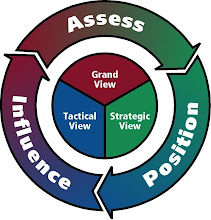
With our Compass AE process, the project implementers build a Tangible Vision by focusing on "the end in mind" first. The first step is delineating the specifics of the direction from a top down direction. Then they continue by optimizing the delineated tactical specifics from bottom up. The tactical details matches the specifics of each tactical milestone

If you are interested in knowing more about the Compass AE, please contact us at service(aa tt)collaboration360(ddott)com.

Copyright: 2008 © Collaboration360 Consultants (C360).
Copying, posting and reproduction in any form (without prior consent) is an infringement of copyright.

Monday, May 26, 2008

Our View of Sunzi 's Strategic Approach

How we viewed the structure of Sun Zi's (Sun Tzu) strategic system:


#


Our Compass AE process of strategic assessment is based on the use of Sunzi (Sun Tzu) strategy principles.


#


#


/// note: The mindmaps listed above, were used in our
recent "Southern New Hampshire University" presentation.

#

By using our strategic assessment process, you are able to out-do your competition in terms of faster execution, minimize costs, mitigate risks, etc.

If you are interested in the specifics in using our strategic assessment process, please e-mail us at contactus(aatt)collaboration360(ddott)com. Otherwise you will have to wait for our white paper on Strategic Assessments sometime in 2009.

Monday, May 5, 2008

The Basics of Compass AE (Inspired by the Chinese Strategy Classics)


Assess The Big Picture Before Building the Tangible Vision
It is important for a project team to assess their grand settings before building their Tangible Vision.

After estimating the advantages in accord with what you have heard, put it into effect with strategic power supplemented by field tactics that respond to external factors. As for strategic power, it is controlling the tactical imbalance of power in accord with the gains to be realized.
--- The Art of War, 1


Once a Compass team assesses their grand settings, they determine the advantages and the disadvantages of different conditions. Then the collaborative process of building their Tangible Vision begins.


Once the Team connected with the Tangible Vision, they are able to lead with it
One who excels at warfare seeks victory through the strategic configuration of power, not from reliance of men. Thus he is able to select men and employ strategic power." --- The Art of War, 5

The compass of the built Tangible Vision sets the realistic standards that team must comply with.
...
Once the Compass team leads with the Tangible Vision, they maneuver with momentum and timing.

One who employs strategic power commands men in battles if he were rolling logs and stones. The nature of wood and stone is to be quiet when stable but to move when on precipitous ground. If they are square, they stop, if round they tend to move. Thus the strategic power of one who excels at employing men in warfare is comparable to rolling round boulders down a thousand-fathom mountain. Such is the strategic configuration of power. - The Art of War, 5

#

Does your strategic collaborative process
do that?

If you are interested in knowing more about getting your team to collaborate as a team, please contact us at Service[aatt]collaboration360 [ddott]com.

We will be more than happy to tell you more about our process and how it can help your project team to perform as a team.

In future entries, we will explain how the Compass AE process enables your team complete their project while minimizing costs and mitigating risks.

Thursday, March 20, 2008

Recommended Strategy Book to Budding Strategists

Dr. Sawyer book "Tao of Deception" has just been translated to Chinese. Recommend the book quite highly.


The following content is from Ralph Sawyer's web site:

The Tao of Deception: Unorthodox Warfare in Historic and Modern China
First articulated by Sun-tzu in the Art of War, the concept of unorthodox warfare grounded Chinese theorizing on military activities for more than two millennia. Being defined against the orthodox and expected, the unorthodox can not be reduced to mere trickery or simplistic posturing, but rather constitutes the very essence of knowledge based, maneuver warfare. Unorthodox actions are designed to create and facilitate localized tactical imbalances, the requisite condition for exploiting overwhelming strategic power and thereby achieving a stunning, apparently easy victory.

While its implementation stresses special operations and manipulating the enemy, the concept of the unorthodox encompasses elements currently identified with asymmetrical warfare but in a more esoteric, often almost metaphysical conception due to Sun-tzu’s well known original formulation: “In warfare, the strategic configurations of power do not exceed the unorthodox and orthodox, but the changes of the unorthodox and orthodox can never be completely exhausted. The unorthodox and orthodox mutually produce each other, just like an endless cycle. Who can exhaust them ?”

Numerous pivotal historical battles in which desperate forces overcame immense odds by relying upon craft, cunning, and knowledge and thereby came to define the nature of unorthodox techniques are included. Collated in the military compendia, they invariably furnished a library of examples and methodology for later commanders.

"The Tao of Deception is a striking success and the first book to link ancient Chinese texts to current Chinese military planning. It has long been suspected that Chinese leaders today draw many specific lessons from their ancient classics. Ralph Sawyer, after a lifetime of translating classic Chinese military texts, has made a dramatic breakthrough to help us all understand the sources of potential Chinese calculations -- and miscalculations." Michael Pillsbury

Source: http://ralphsawyer.com/work3.htm

# # #

Wrote a review for this book last year and will publish it here sometime this year.

Saturday, January 26, 2008

The Strategist as a Fisherman (3)


The Way of the Ultra Strategist:
He
creates the opportunities that lures their targets in, via transforming ordinary events into something extraordinary.

What is the Approach of the Ultra Strategist?
The strategist views the big picture. He builds his plan by assessing ideas, positioning events and choosing the best people to complete the goal. The key is the use of the Tangible Vision as his compass.

Do you have a strategic process that enables your team to perform the above?


###

Fishing, Nation and Attracting Talents-Six Teachings

(Tai Gong Six Teachings-Civil Teaching Chapter 1)

King Wen said:" I would like to hear about these greater principles."

Tai Gong said:" When the source is deep, water flows endlessly. When the water flows endlessly, fish spawn there. This is nature. When the roots of the trees are deep, the tree is tall. When the tree is tall, fruits are produced. This is nature. When men of true worth have views in common, they will come together. When they are drawn together, accomplishments can be achieved. This is nature. Speech and response are merely adornment of inner emotions. Speaking about the truth is the best. What I am about to say is all the truth without adornment, will you find it abhorrent?"

King Wen said:" Only a man of true benevolence can accept corrections and remonstrance. What makes you think I will be? Please continue."

Tai Gong continued:" When the fishing line is thin and the bait is glittering, only small fish will bite. When the line is thicker and bait is fragrant, medium sized fish will bite. When the line is thick and the bait is generous, large fish will bite. When the fish take the bait, they will be caught on the line. When men take salary, they will submit to their ruler. When you catch with bait, the fish can be killed. When you give remuneration, men can be made to exhaust their capabilities for you. If you regard families, as the basic foundation of state, the state is yours. If you use the state as your base to conquer the kingdom, you can conquer the kingdom."

###

Sunday, January 6, 2008

Competing in the Global Economy ( The Dao of Strategy)


Regardless of the sports and the event, mindless jocks and reporters give the same reasoning why a certain team will win the big game- emotion, individual speed, athleticism and the attitude. Rarely do they say anything that is significantly relevant regarding to the coming "big"game.

There are other important factors that also play a major role in the outcome of the game like talent, injuries, home-field advantage and big game experience.

To compete in the global economy, contemplate like a strategist, not a mindless, hooded jock-warrior dressed in a new suit. This is why ultra professionals like Phil Jackson and Belichek wins most of the time.


Conclusion: Good strategic thinking and implementation is like money in the bank.


#

During the early phase of our Compass AE development, we learned a great deal about how people devise their strategy. We concluded that their professional experience and skill set plays a grand role in viewing strategic situations and the big picture.

While most tacticians cannot perform the role of the grand strategist, many grand strategists cannot operate as a tactician.

Will touch on this topic later.


Copyright:2008 © Collaboration360 Consultants (C360).

Saturday, December 29, 2007

The Strategist as a Fisherman (1)


Each body of water has its risk and rewards. The good fisherman usually have the skill and the gear to match that body of water. He must also understand the risk that comes with that body of water for that chosen moment.

The great Jiang Tai Gong (the author of The Six Secret Teachings) possessed the strategic skills
and experience to help the ruler of Zhou to overthrow the Shang dynasty of ancient China, believed in the following five concepts:
1. Understanding the big picture;
2. Targeting the big fish (not a batch of shrimps);
3. Establishing a position of strategic advantage;
4. Creating the bait that enables the big fish to come willingly;
5. Waiting patiently until the circumstances ripen.

#

Does your plan includes the following five grand points?
* Is your plan based on the grand setting of your competitive arena?
* Is your plan focused on a bigger target or a smaller target?
* Is the initial stage of your plan based on establishing a strategic advantage?
* Is your plan focused on getting people to complete the team willingly?
* Does your plan include situations that enable you and your team to get a minimum of two steps closer to the goal?

If your plan does not include those five points, you need our Compass AE methodology to get your team "strategizing" as a team?

"One who excels at warfare, seeks victory through the strategic configuration of power, not from reliance on men. Thus he is able to select men and employ strategic power." - Sun Tzu’s Art of War Chapter 5: Strategic Power (Sawyer's translation)

When a Compass team builds and connects with their Tangible Vision, they see the critical path that leads to the completion of the goal. They can also collaboratively configure the strategic influence that allows them to completes the goal effectively.

Does your project process focuses on that feature?

Copyright: 2008 © Collaboration360 Consultants (C360 Consultants).
Copying, posting and reproduction in any form (without prior consent) is an infringement of copyright

Thursday, December 27, 2007

The Dao of the Chinese Strategy Mindset


Utilizing Art of War (AoW) principles with an abundant of resources against inferior competition does not mean the implementers are great strategists

Competing and winning in an underdog situation where the resources are low and the competitions are strong, is impossible. A Compass team of high achievers understands the need of the Tangible Vision.

There are so many reasons why a strategy fails and many reasons why a strategy succeed. If you're interested in this viewpoint, the Chief Architect will elaborate on this topic later.

After reading many global strategy classics and implementing tons of project plans, Collaboration360 Consultants developed a strategic process that enables the implementers to understand the total objective from a geometric view.
fyi- Ancient Daoist like Wang Xu emphasizes this process of thinking in his writings.

If one's unable to see and adjust to all the situations relating to their endeavors, there is no sympathy for the loser. One can learn all the history he/she wants. If it is not applied properly in their game plan esp. against a world class opponent. The penalty is usually defeat.

Presume you have read Sunzi and other strategic classics. DO you think you can recite and practice any or all 300+ lines of Sunzi writings immediately? Unlike ppl from other strategy forums where they spend time talk about strategies, tactics and tricks. This Chief Architect believes in the practice of concepts in terms of habits.

Reciting lines of Sunzi are for street corner philosophers and arm chair generals who never stain their hands in hi-risk projects and street fights.

Before one can perform the practice of concepts as a habit, he becomes conscious aware of his surroundings. Develop your state of conscious awareness and extend it. At that point, you can strategize better than the masses.

Copyright: 2007 © Collaboration360 Consultants (C360 Consultants).
Copying, posting and reproduction in any form (without prior consent) is an infringement of copyright

###

From Gulf War to Global War on Terror. A Distorted Sun Tzu in US Strategic Thinking?

Dec 2007, Vol. 152, No. 6
By Charles Chao Rong Phua

It is claimed that Sun Tzu’s precepts were applied in US strategy for both the First Gulf War and the ongoing Global War on Terror. General Norman Schwarzkopf, who led the US and coalition forces in the Gulf War, was a student of Sun Tzu and employed tactics from The Art of War to secure victory. In the latest war in Iraq and Afghanistan, former CENTCOM Commander, General Tommy Franks, was reported to be a devotee of Sun Tzu and often found quoting him. However, the results differ. The Gulf War was a short and victorious war while the Global War on Terror (GWOT) is long and hitherto inconclusive. This essay does not seek to judge the success of the GWOT, but rather understand why the results of the US application of Sun Tzu are so different, given McNeilly’s claim that Sun Tzu’s influence is growing in the US military amongst the higher-ranking officers, to the extent that an essay competition in Sun Tzu’s name has been inaugurated at the National Defense University

http://www.rusi.org/publication/journal/ref:A476686FF71AE9/

###

The use of individual quotations from the AoW book as a source of fortune cookie-like proverbs and not seeing the general coherence of the text has been criticized by many scholars of Chinese history

http://en.wikipedia.org/wiki/The_Art_of_War

Sunday, December 23, 2007

What makes a Good Risktaker? (1)


Efficient Strategy development is about balancing the goal and the objectives.

The following set of questions determines the type of goal pursuer that you are and
the type of risk that you are willing to take.

Regardless of your fishing style, what body of water do you prefer to fish at, the pond? the lake? the river? or the ocean?

#

The pond is for the low achievers who prefer low risk and small catches. It is greatly affected by small climate change. For those who want more risk and a larger catch, they might choose the lake.

The river is for the greater risk takers who are willing to wait or go with the flow of the water. The X factor is the climate effect (constant change). Finally, there are those who love a wide variety of catches, a fast velocity of change and the constant dramatic change of climate, prefers the
ocean.

The choice of the "body of water", its grand settings, and seasonal climates determine the proficiency level of
achievement, difficulty and risk. This is "The Dao of the Fisherman". This is also "The Dao of Strategy".

Always remember this rule: "The greater the catch, the greater the risk, the greater the reward for the strategist. . . . Always follow the Dao."

So what type of fisherman
(strategist) are you?

#

When building the Tangible Vision, it is important to know the risks that lead to the grand rewards.

In future articles, we will focus on how does goal setting and risk applies to the Compass AE process.

#
Copyright: 2007 © Collaboration360 Consultants (C360 Consultants).
Copying, posting and reproduction in any form (without prior consent) is an infringement of copyright

Monday, December 17, 2007

Learning Leadership from The Amateurs


There is nothing like the non-professionals who have never done any dirty work from the ground level, telling the amateur professionals how to be a leader.

If those five virtues ("wise (zhi), trustworthy (xin), humane (ren), courageous (yong) and strict discipline (yan)") of leadership are not embedded in the conscious of the readers, they will rarely do the right thing.

One cannot read something and understand it immediately. They need to study it from a content perspective first. To get the tangible view of the greater picture, it is important to understand it from a context view. Learning, experiencing and finally leading with proper leadership is a difficult process for most amateurs.


# # #

December 16, 2007
Phenomenon
The Newest Mandarins
By ANNPING CHIN

Lei Bo is a philosophy graduate student in China whose faith is in history, and by habit he considers the world using the thousands of classical passages that live in his head. Three years ago he was studying in an empty room in the School of Management at his university in Beijing when students began to amble in for their class on Sun Tzu's "Art of War," a work from either the fifth or the fourth century B.C. Lei Bo decided to stay. He had taken two courses on "The Art of War" in the philosophy and the literature departments, and was curious to see how students in business and management might approach the same subject. The discussion that day was on the five attributes of a military commander. Sun Tzu said in the first chapter of the book, "An able commander is wise (zhi), trustworthy (xin), humane (ren), courageous (yong) and believes in strict discipline (yan)."

The students thought that a chief executive today should possess the same strengths in order to lead. But how did the five attributes apply to business? Here they were stuck, unable to move beyond what the words suggest in everyday speech. Even their teacher could not find anything new to add. At this point, Lei Bo raised his hand and began to take each word back to its home, to the sixth century B.C., when Sun Tzu lived, and to the two subsequent centuries when the work Sun Tzu inspired was actually written down.

On the word yong (courage), Lei Bo cited chapter seven of The Analects, where Confucius told a disciple that if he "were to lead the Three Armies of his state," he "would not take anyone who would try to wrestle a tiger with his bare hands and walk across a river [because there is not a boat]. If I take anyone, it would have to be someone who is wary when faced with a task and who is good at planning and capable of successful execution." No one ever put Confucius in charge of an army, said Lei Bo, and Confucius never thought that he would be asked, but being a professional, he could expect a career either in the military or in government. And his insight about courage in battle and in all matters of life and death pertains to a man's interior: his judgment and awareness, his skills and integrity. This was how Lei Bo explored the word "courage": he located it in its early life before it was set apart from ideas like wisdom, humaneness and trust. He tried to describe the whole sense of the word. The business students and their teacher were hooked. They wanted Lei Bo back every week for as long as they were reading "The Art of War."

Scores of men and women in China's business world today are studying their country's classical texts, not just "The Art of War," but also early works from the Confucian and the Daoist canon. On weekends, they gather at major universities, paying tens of thousands of yuan each, to learn from prominent professors of philosophy and literature, to read and think in ways they could not when they were students and the classics were the objects of Maoist harangue . Those inside and outside China say that these businessmen and -women, like most Chinese right now, have caught the "fever of national learning."

Scholars, however, are cautious. They revel in the possibility of being able to study the classical texts without an ideological tether. But they warn that this kind of learning cannot be rushed and does not lend itself to easy adaptation. The classics are not simply primers on how to succeed or lessons in the glory of the Chinese nation. Having survived the ravages of the Maoist era, when Confucius' call to "revive the spirit and the practice of the earlier rites" was derided as "an attempt to reverse the course of history," the classics must not lose their distinction in the hullabaloo of the market economy or under the pressure of globalization.

These scholars are also doubtful that the "fever of national learning" will last. They see it as a political event, staged by party leaders to celebrate national pride. But students like Lei Bo and many of his classmates and friends discovered the joy of reading classical texts long before the political rally began. One friend became enamored with books when he was a toddler, and by the time he was in junior high, he was poring over intellectual and political history from the 11th and 12th centuries. Another was drawn to the sound and beat of classical poems ever since he could remember, and so now he is studying Tang poetry in graduate school. Lei Bo's journey was more tortuous. (Unlike his two friends, whose parents are factory workers and farmers, his father is an environmental scientist and his mother, a librarian.) After being steeped in Marxist education, Lei Bo took a sharp turn in college while he was pursuing a degree in chemistry. He became disenchanted with communism and was deeply suspicious of any political philosophy that encouraged fixation on a single goal without any regard for the grim consequences this could have. He aired his displeasure on a Web site, which led to a brush with the public-security police.

It was readings in Western philosophy that saved him from more serious trouble. Translated works were widely accessible in China when Lei Bo was an undergraduate. Habermas, Heidegger, Arendt, Popper, Foucault and Derrida were all popular then, and now Carl Schmitt and Leo Strauss have been added to the list. Chinese men and women, especially the educated young, are book-hungry, and writings in Western political philosophy offer them several ways out of the firm grip that Marxism has had on their reasoning and their judgment. Lei Bo latched on to Heidegger, who alerted him to the importance of historical thinking and historical imagination; his writings convinced Lei Bo that any experience is inseparable from its past and future.

This, however, does not mean that Lei Bo avoids the more pressing subjects of the day. Now in China, he says, it is the students in law and the social sciences who call for more personal freedom, and it is also this group that sees great promise in the concept of democratic government.

But students studying history and philosophy seem to ask more questions. They want to know whether there is an appropriate way to pursue the idea of freedom; whether this chase, which is often complicated by the tangles of human relationships and life's unwanted circumstances, can become a test of one's interior strength. Learning the texts, for them, is learning to think. Lei Bo and his friends, for instance, found resonance in Confucius' description of freedom at the age of 70: "I was able to follow what my heart desired without overstepping the moral bounds." They thought that this was perhaps the most perfect freedom one could experience.

In speaking with Lei Bo and other students, I've been struck by the clarity of their convictions about China's past and future. They understand why Confucius described himself as a transmitter and not a creator and why he said that he "had faith in antiquity." History does not just provide actual lessons from the past, but, more important for the students, history gives them the chance to consider the right and wrong of human judgment even though the deeds were done long ago. And for this reason, they are taking the long view of their country's future and are reluctant to put their hope in any sort of quick fix or in any ideal, even one that is as appealing as democracy. They want change but are not ready to consider drastic corrections, not until they have absorbed what is stored in their history and cultural tradition. They are not utopians. They want reforms but, for now, only as measures to check the totalizing tendencies of their state. And, some of them ask, was this not the intent of the founding fathers when they wrote the American Constitution?

Annping Chin teaches in the history department at Yale University. Her most recent book, "The Authentic Confucius: A Life of Thought and Politics," has just been published.

http://www.nytimes.com/2007/12/16/magazine/16wwln-idealab-t.html?ref=magazine

Copyright 2007 The New York Times Company