Showing posts with label Tangible Vision. Show all posts

Wednesday, March 18, 2009

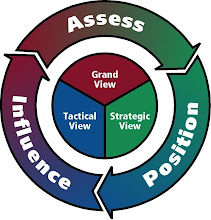
The Dao of Strategic Assessment (9): Assess, Position and Implement


In terms of strategic project over-viewing, Gates assessed the grand picture, understood the rule of "economic laws never change, while technology changes", and made the wise decision on focusing on the "75% solution" approach instead choosing the "gold plated" solution.

Due to the urgency of their current needs and the constant change of technology, it was more efficient for the Dept of Defense to focus on a series of pragmatic solutions.

Good strategic planning and decision making depends greatly on one's assessment of themselves, their opposition and what is the possible reaction from the opposition. Then building a plan upon that evaluation.

Against a "poorly resourced" opposition, one has more latitude in their decision-making. He can afford some loss of time and resources.

When competing against an
unknown opposition with greater resources, there is always uncertainty in their reaction. Regardless of their resources, there is always an weakness lurking somewhere in their armor. The underdog must properly assess the opposition in order to detect that "Achilles heel."

When leading with Sunzi’s strategic principles, one focuses on defeating the opposition in the least amount of time, with the minimum cost and the smallest damage to the grand settings.

The approach sounds conceptually simple.

The question is: does the company have the experienced professionals that are required to complete this objective? ... It is always a challenge to complete an objective on time, on budget and on target.


Strategic Disposition
After completing the assessment, the next stage is developing one's strategic disposition through solid planning and the understanding of each competitor's strategic disposition.

When developing the game plan, one determines whether to be flexible or efficient in their strategic approach.

Chinese strategy classics emphasize the importance of focusing on flexibility and being efficient in an unpredictable setting. While completing short term goals and objectives, one builds momentum for a forthcoming predictable setting.

When implementing in a predictable setting, focus on becoming efficient while minding the grand settings.

By using our Compass AE process, you are able to do the following:
  • Focus on the current objective while minding the Tangible Vision (the big picture);
  • Avoid negative circumstances while focusing on positive circumstances;
  • Maximize opportunities;
  • Adjust strategically;
  • Shape the Tangible Vision; and
  • Lead with strategic leadership .
By following your strategic dispositions, you can make better decisions. You will stay on course and complete your goal regardless of the circumstances.

Does your current plan do that?

What is the Tangible Vision?
The Tangible Vision is a goal, a plan that you work with. It also emphasizes a clearly-defined vision or mission statement that you believe in.

The first step is establishing your desired "end-in-mind" with specific details. The ideal outcome must have the value points and a tangible model that you can relate to. It also encompasses the contra-position of the desired outcome.

The next step is building the specific guidelines for each milestone. Those guidelines are based on the priorities, the approach and various circumstances for that phase.

The final step is outlining the operational steps that match the specific guidelines for each milestone.


The guidelines stated in the Tangible Vision become the strategic standard for the implementer to make decisions with. They know the positives and the negatives based on anticipated situations.

The Tangible Vision also guides the implementer on when and how to adapt the changes, what are the contingencies, etc.

In a future post, we will talk more about the basics of the Tangible Vision.

If you are interested in knowing more about our Compass AE process, please contact us at service[aatt] collaboration360[ddott]com

Copyright: 2009 Collaboration360 Consultants (C360).
Copying, posting and reproduction in any form (without prior consent) is an infringement of copyright.

#

March 17, 2009
Drones Are Weapons of Choice in Fighting Qaeda
By CHRISTOPHER DREW

A missile fired by an American drone killed at least four people late Sunday at the house of a militant commander in northwest Pakistan, the latest use of what intelligence officials have called their most effective weapon against Al Qaeda. And Pentagon officials say the remotely piloted planes, which can beam back live video for up to 22 hours, have done more than any other weapons system to track down insurgents and save American lives in Iraq and Afghanistan.

The planes have become one of the military’s favorite weapons despite many shortcomings resulting from the rush to get them into the field. An explosion in demand for the drones is contributing to new thinking inside the Pentagon about how to develop and deploy new weapons systems.

Air Force officials acknowledge that more than a third of their unmanned Predator spy planes which are 27 feet long, powered by a high-performance snowmobile engine, and cost $4.5 million apiece have crashed, mostly in Iraq and Afghanistan. Pilots, who fly them from trailers halfway around the world using joysticks and computer screens, say some of the controls are clunky.

For example, the missile-firing button sits dangerously close to the switch that shuts off the plane’s engines. Pilots are also in such short supply that the service recently put out a call for retirees to help. But military leaders say they can easily live with all that.

Since the height of the cold war, the military has tended to chase the boldest and most technologically advanced solution to every threat, leading to long delays and cost overruns that result in rarely used fighter jets that cost $143 million apiece, and plans for a $3 billion destroyer that the Navy says it can no longer afford.

Now the Pentagon appears to be warming up to Voltaire’s saying, The perfect is the enemy of the good.

/// Perfection is the state of mind. Being good is not enough. Focus on becoming excellent is the key.

In speeches, Defense Secretary Robert M. Gates has urged his weapons buyers to rush out 75 percent solutions over a period of months rather than waiting for gold-plated solutions. And as the Obama administration prepares its first budget, officials say they plan to free up more money for simpler systems like drones that can pay dividends now, especially as fighting intensifies in Afghanistan and Pakistan.

/// At this level, it is all about choosing a set of simple solutions that can provide immediate wins. Against the weak opposition, simplicity is acceptable. At some point of time, the superior competitor will compete against a greater opposition with the similar technology with advanced features.

A rare behind-the-scenes look at the use of the Predator shows both the difficulties and the rewards in pushing out weapons more quickly. I’ll be really candid, said Col. Eric Mathewson, who directs the Air Force’s task force on unmanned aerial systems. We’re on the ragged edge. He said the service has been scrambling to train more pilots, who fly the drones via satellite links from the western United States, to keep up with a near-tripling of daily missions in the last two years. Field commanders in Iraq and Afghanistan, where the Air Force is in charge of the Predators, say their ability to linger over an area for hours, streaming instant video warnings of insurgent activity, has been crucial to reducing threats from roadside bombs and identifying terrorist compounds. The C.I.A. is in charge of drone flights in Pakistan, where more than three dozen missiles strikes have been launched against Al Qaeda and Taliban leaders in recent months.

Considered a novelty a few years ago, the Air Force’s fleet has grown to 195 Predators and 28 Reapers, a new and more heavily armed cousin of the Predator. Both models are made by General Atomics, a contractor based in San Diego. Including drones that the Army has used to counter roadside bombs and tiny hand-launched models that can help soldiers to peer past the next hill or building, the total number of military drones has soared to 5,500, from 167 in 2001. The urgent need for more drones has meant bypassing usual procedures. Some of the 70 Predator crashes, for example, stemmed from decisions to deploy the planes before they had completed testing and to hold off replacing control stations to avoid interrupting the supply of intelligence. The context was to do just the absolute minimum needed to sustain the fight now, and accept the risks, while making fixes as you go along, Colonel Mathewson said. It is easier, of course, for the military to take more risks with unmanned planes.

Complaints about civilian casualties, particularly from strikes in Pakistan, have stirred some concerns among human rights advocates. Military officials say the ability of drones to observe targets for lengthy periods makes strikes more accurate. They also said they do not fire if they think civilians are nearby. The Predators were still undergoing basic testing when they were rushed into use in Bosnia and Kosovo in the 1990s and then hastily armed with missiles after the September 2001 terrorist attacks. But it was only after the military turned to new counterinsurgency techniques in early 2007, that demand for drones became almost insatiable.

Since then, Air Force Lt. Gen. Gary North, the air-component commander for the combined forces in Iraq and Afghanistan, said the service has gone to amazing lengths to increase their use. The Predators and Reapers are now flying 34 surveillance patrols each day in Iraq and Afghanistan, up from 12 in 2006. They are also transmitting 16,000 hours of video each month, some of it directly to troops on the ground.

The strains of these growing demands were evident on a recent visit to Davis-Monthan Air Force Base in Tucson, Ariz., one of four bases where Air National Guard units have been ordered to full-time duty to help alleviate crew shortages. The Guard members, along with Air Force crews at a base in the Nevada desert, are 7,000 to 8,000 miles away from the planes they are flying. Most of the crews sit at 1990s-style computer banks filled with screens, inside dimly lit trailers. Many fly missions in both Iraq and Afghanistan on the same day.

On a recent day, at 1:15 p.m. in Tucson 1:15 the next morning in Afghanistan a pilot and sensor operator were staring at gray-toned video from the Predator’s infrared camera, which can make even the darkest night scene surprisingly clear. The crew was scanning a road, looking for but not finding signs of anyone planting improvised explosive devices or lying in wait for a convoy.

As the Predator circled at 16,000 feet, the dark band of a river and craggy hills came into view, along with ribbons of farmland. We spend 70 to 80 percent of our time doing this, just scanning roads, said the pilot, Matthew Morrison.

At other times, the crews monitor insurgent compounds and watch over troops in battle. When you’re on the radio with a guy on the ground, and he is out of breath and you can hear the weapons fire in the background, you are every bit as engaged as if you were actually there, Major Morrison said. When Predators spot possible targets, officers monitoring video at command centers in Iraq and Afghanistan decide whether to order an attack.

Col. Gregg A. Davies, commander of the group that flies Predators for the Arizona Guard, said fighter planes with bigger bombs are often sent in to make the strikes. In all, the Air Force says, Predators and Reapers shot missiles on 244 of the 10,949 missions in Iraq and Afghanistan in 2007 and 2008. Air Force officials said a few crew members have had a difficult time watching the strikes. And some pilots said it can be hard to transition from being a computer-screen warrior to dinner at home or their children’s soccer games.

Another problem has been that few pilots wanted to give up flying fighter jets to operate drones. Given the shortages, the Air Force has temporarily blocked transfers out of the program. It also has begun training officers as drone pilots who have had little or no experience flying conventional planes.

Colonel Mathewson, director of the Air Force’s task force on unmanned aerial systems, said that while upgrades have been made to control stations, the service plans to eventually shift to simpler and more intuitive ground systems that could allow one remote pilot to control several drones.

Now, pilots say, it takes up to 17 steps including entering data into pull-down windows to fire a missile. And even though 13 of the 70 Predator crashes have occurred over the last 18 months, officials said the accident rate has fallen as flying hours have shot up. All told, 55 have been lost because of equipment failure, operator errors or weather. Four were shot down in Bosnia, Kosovo and Iraq; 11 were lost in combat situations, like running out of fuel while protecting troops under fire.

Given the demand for video intelligence, the Air Force is equipping 50 manned turbo-prop planes with similar cameras. And it is developing new camera systems for Reapers that could vastly expand the intelligence each plane can collect. P. W. Singer, a defense analyst at the Brookings Institution, said the Predators have already had an incredible effect, though the remote control raised obvious questions about whether the military could become more cavalier about using force.

Still, he said, these systems today are very much Model T Fords. These things will only get more advanced.

Copyright 2009 The New York Times Company
http://www.nytimes.com/2009/03/17/business/17uav.html

Sunday, January 4, 2009

Position with the Plan ( Building the Tangible Vision)


Regardless of having passion in one's endeavor, one must have a plan.

There are good plans and bad plans.

The challenge is building a plan that
enables you to do the following:
1. Focus on your objective while mind the Tangible Vision;
2. Avoid negative circumstances, while focusing on positive situations;
3. Maximize opportunities;
4. Adjust strategically;
5. Shape the Tangible Vision; and
6. Lead with strategic leadership .

When you can do that with your plan, you can make better decisions. You will stay on course and complete your goal regardless of the circumstances.

Does your current plan do that?


What is the Tangible Vision?
The Tangible Vision is a goal, a plan that you work with. It also emphasizes a clearly-defined vision or mission statement that you believe in.

The first step is establishing your desired "end-in-mind" with specific details. The ideal outcome must have the value points and a tangible model that you can relate to. It also encompasses the contra-position of the desired outcome.

The next step is building the specific guidelines for each milestone. Those guidelines are based on the priorities, the approach and various circumstances for that phase.

The final step is outlining the operational steps that match the specific guidelines for each milestone.


The guidelines stated in the Tangible Vision become the strategic standard for the implementer to make decisions with. They know the positives and the negatives based on anticipated situations.

The Tangible Vision also guides the implementer on when and how to adapt the changes, what are the contingencies, etc.

In a future post, we will talk more about the basics of the Tangible Vision.

If you want to know about how to build a good plan, please contact us at service[@t]collaboration360[doott].com

Replace @t with "@" and doott with "." .


Collaboration360 Consultants (C360). Copyright:2006-2009 © All rights reserved
Copying, posting and reproduction in any form (without prior consent) is an infringement of copyright.

Sunday, December 28, 2008

Pragmatic Strategic Guidelines in Unpredictable Times


Lately, there have been some chaotic situations that gotten us to reread our situational guidelines list

Following are some of our strategic guidelines for the traveling strategists:
  • Plan and prepare early
  • Focus on the safety of you (and your entire team)
  • Leave early. Carry lightly. Travel fast and quietly.
  • Use a transportation service that is trustworthy and reliable
  • Leave for the airport before dawn breaks
  • Arrive promptly and quietly
  • Take rooms between 3rd floor and the 9th floor
  • Never take rooms near elevators and exits
  • Always have a min. of two escape routes
  • Always have a lightweight "Go" bag of essentials available
  • Carry a paper map just in case your PDA is not available
  • Store your corporate data in a separate portable digital storage device
  • Always carry a paper list of contact phone numbers (include fax #'s) and a calling card.
  • Always have some "all-climate" clothes available in your clothing pack
  • When traveling alone, keep one hand free and always be aware of your grand settings.


Why Plan?
"In planning, no useless move. In strategy, no useless move in vain." - Chen Hao

It has been said that a bad plan is always better than no plan. Why? One can always adjust a bad plan. The question is, how can one adjust their strategic focus when they have no plan?


Tactical Deployment
"In the field of observation, fortune favors the prepared mind." - Louis Pasteur
  • Stay centered, relaxed, ground, calm and consciously aware
  • Always play it safe
  • Never make decisions based on emotions
  • Never take large risk for a small gain
  • Focus on executing a purposeful move that propels a gain of strategic value.

Copyright: 2008 © Collaboration360 Consultants
(C360 Consultants).
Copying, posting and reproduction in any form (without prior consent) is an infringement of copyright

Sunday, November 9, 2008

A Benefit from Strategic Assessment


Before building your plan, it is important to assess the grand picture. The Strategic Assessment module of the Compass AE process gives you this capability to see the direct and the indirect connections from the starting point to the finishing point. This feature enables one to think outside the box.

The more specifics you know about your grand picture, the better the operational plan becomes. ...
The better your operational plan is, the "quality of your decision-making" rises.

The question is ... do you know how to assess the grand picture?

When using our "Strategic Assessment" module, the implementers will not be deceived by hype and/or misconstrued events for opportunities. They will not develop a plan that underestimates the cost of the implemented strategy and miscalculates the risks and consequences of their project.

Does your project process do that?

If you are interested in our Compass AE process, e-mail us at service(aatt)collaboration360(dott)com.

Copyright: 2008 © Collaboration360 Consultants (C360 Consultants).
Copying, posting and reproduction in any form (without prior consent) is an infringement of copyright

Friday, September 26, 2008

The Basic of the Tangible Vision: Insert Performance Metrics

When developing a Tangible Vision, it starts with specific objectives with detailed measures.

#
HP's grand vision: measure everything

Perhaps the world's most ambitious nanotech project is underway at Hewlett-Packard. Stan Williams' lab aims to build 'a central nervous system for the earth.'
By David Kirkpatrick, senior editor

NEW YORK (Fortune) -- Imagine walking down the supermarket aisle with a cheap device you could hold up to a tomato. If the sensor detects a pesticide residue, you'd know the "organic" label is a lie. Similar tools could track the chemical content of water in a stream, telling you if there was lead contamination and when it got there, or keep constant watch on a bridge and tell if a structural steel beam was at risk of collapse.

Such products are almost certain to become common in coming decades, according to Stan Williams, who heads Hewlett-Packard's Information and Quantum Systems Laboratory.

He aims to develop a panoply of microscopic-scale nanotech devices that will be able to measure essentially anything - and at low cost to boot. Viruses, bacteria, the chemical composition of molecules, vibration, moisture levels, particular sounds - these are just some of the things that the super-cheap devices he envisions will be able to detect.

In an exclusive conversation with Fortune, Williams described in detail a project HP (HPQ, Fortune 500) began way back in 1994. He will speak about it in public for the first time next week at Fortune's Brainstorm Tech conference. No other company he knows of is developing similar products.

"The theme for the lab is CeNSE - for Central Nervous System for the Earth," he says. Williams feels such a grandiose name is justified. Because these sensors will be built with standard semiconductor technology, they will ultimately be cheap enough to build "in the trillions." That will make it possible to deploy arrays of measuring devices anywhere at a reasonable cost.

In our era of rapidly decaying global environment, such tools could help us know with certainty how our world is changing, and help us make better-informed choices about how to respond.

Applying these devices to monitor the entire planet will take time. None of these nano-sensors will even come into existence for at least two years, and will not be deployed in quantity for 5-10 years. Before we monitor the planet we will likely use those sensors to monitor the strength of a bridge's beams. Others might maintain vigilance over a high-rise building's structure, or the steel in a ship's hull or a train track.

The first versions, emerging in the next several years, will be expensive and are likely to be used to monitor systems in oil and gas refineries and chemical plants, where investments in monitoring vibration and chemical composition will pay off the most. "Think of our sensors as stethoscopes," says Williams. "As soon as something started vibrating a little bit differently we'd know it."

HP has two fundamental types of nano-sensors under development in its lab. The first is a type of measurement device made from a relatively small number of atoms. Because of its small size, even the tiniest changes in the environment can perturb it. And that perturbance can be measured. "When you are able to craft matter at the nanometer scale," says Williams, "you have essentially achieved the ultimate level of control over directing matter, electrons or photons."

Such devices would be able to measure minute amounts of biological material, or ultra-tiny vibrations, with tremendous sensitivity. "We're working on being able to detect individual molecules of whatever you may be concerned about - or individual viruses or bacteria," Williams says.

Because these silicon-fabricated nano-measurers can be put by the millions onto one tiny chip, some of the products HP envisions resemble a nose - with multiple receptors for various "smells."

But another nano-device that Williams has high hopes for would be optical: "A very tiny laser would light up and we could look at the optical spectra of chemicals. Each one is like a fingerprint, with a unique spectral identity. That would be a single universal detector." Though a laser capable of such a task would today cost around $100, Williams thinks they can eventually be produced for about 10 cents.

HP already has working prototypes of various sorts of nano-detectors working in its 90-person lab.

The company would likely license the sensor designs to others and buy back the devices to integrate into its own measurement and control information systems. Only once such sensors are combined with sophisticated database and analysis technologies can their promise be delivered. HP sees its business opportunity in helping customers manage the vastly greater amount of information such monitoring will generate.

While Williams is confident HP has a huge head start (and he's not afraid to talk about the project -"We welcome competition," he says), this work can only proceed so fast. There simply aren't enough capable engineers in this highly rarified field, he says. Though the pathway is starting to seem clear, it remains long.

f. 07.18.2008 Fortune magazine's Fast Forward

Thursday, September 18, 2008

The Importance of Strategic Preparation (1)

"A team that is unable to discern good fortune and misfortune in the as-yet-uninformed does not understand preparations." - Military Methods, 22 (A minor revision on a quote from Sun Bin)


Strategic preparation is not about one thing. It is about many things.

The stages of strategic preparation are:
  • Gather intelligence;
  • Assess the intelligence;
  • Develop a grand plan based on the assessed intelligence;
  • Develop an operational plan that connects with the grand plan;
  • Get the team to connect with the both plans.


"Failure to Prepare is to Prepare to Failure." - Bill Walsh, the Architect of the West Coast Offense. Former Coach of San Francisco Forty Niners (Super Bowl Champions 1981-82, 1984-85, and 1988-89).

A team that knows how to strategically assess themselves, their competition and their settings is a team with a strategic advantage.

Most competitors barely possess the attitude to prepare properly. In some cases, they do not possess the fundamentals of preparing properly. They lack the conscious to assess the opposition. They also have the skills to prepare and plan. These people would rather improvise.

With proper competitive intelligence, one assesses many things. He determines what is happening now and later. Then he builds a proper plan based on that assessed intelligence.

With our Compass AE process, your team builds a plan that enables them to do the following:
  • focus on their critical path while minding their grand settings;
  • focus on the positive situations while avoiding negative situations;
  • anticipate opportunities;
  • adjust strategically;
  • shape the plan and their grand settings; and
  • lead by strategic collaboration.

" ... Organization leads to preparation. . . . Preparation eliminates the unexpected.
Be ready for everything. . . . Overlook nothing. ... " - Brian Billick, Former Head Coach of Baltimore Ravens (Super Bowl Champions 2000-2001 season)


"If you have a plan, and if you have your direction laid out, you can chart your progress to your dreams at each stop along the way. ... And just as important, all along the way you can see how far you've come."
- Michael Shanahan, Current Head Coach of the Denver Broncos (Super Bowl Champions 1997-1998, 1998-1999)


The focus of future entries is on how to prepare your team strategically with our Compass AE process.

Tuesday, August 26, 2008

C360's Compass View of Strategy (3)


Not all processes are alike.

Compass AE is a strategic process that gives the implementers a “high level, top to bottom” overview of the priorities, approaches and circumstances for any Tangible Vision-driven projects.

Does your company have a process like that?

Sunday, August 24, 2008

C360's Compass View of Strategy (2)

To succeed in one’s venture, one’s intelligence gathering process must be correct.

If the gathered intelligence and the implementation of the strategic assessment process are correct, then the strategic assessment of the intelligence is valid.

If the strategic assessment is valid, the project team's plan of action (based on the strategic assessment) will be correct.

The C360 View:
When the Compass team properly gathers
intelligence, they assess themselves, the competition and their grand settings. Then, they collaboratively build the Tangible Vision.

By using the Tangible Vision, the team properly defines the grand goal, the tactical objectives, and the connections between the objectives and the goal. Then they delineate the tactical requirements of each objective.


When the Compass team leads with their Tangible Vision, they perform the following:
  • minimize the costs;
  • mitigate the risks;
  • accelerate the delivery;
  • maximize the opportunities;
  • ensure the quality
At the end, success is the absolute.

Does your process enable your team to do the above?

If you are interested in knowing more about our Compass AE process, please contact us at service (att)collaboration360(dott)com.

Copyright: 2008 © Collaboration360 Consultants (C360 Consultants).
Copying, posting and reproduction in any form (without prior consent) is an infringement of copyright

Saturday, August 16, 2008

Learning Lessons of Strategy from the Recent Russian Blitz


The following article is something that most businesses can learn from the "Russian Blitz".


#
August 17, 2008
Military Analysis

Russian Blitz Melded Old-School Onslaught With Modern Military Tactics

WASHINGTON — Russia’s victorious military blitz into the former Soviet republic of Georgia brought something old and something new — but none of it was impromptu, despite appearances that a long-frozen conflict had suddenly turned hot.

The Russian military borrowed a page from classic Soviet-era doctrine: Moscow’s commanders sent an absolutely overwhelming force into Georgia. It was never going to be an even fight, and the outcome was predictable, if not preordained.

/// In any "real" competition, there is no such thing as even parity.

At the same time, the Russian military picked up what is new from the latest in military thinking, including American military writings about the art of war, replete with the hard-learned lessons of Iraq and Afghanistan.

So along with the old-school onslaught of infantry, armor and artillery, Russia mounted joint air and naval operations, appeared to launch simultaneous cyberattacks on Georgian government Web sites and had its best English speakers at the ready to make Moscow’s case in television appearances.

If the rapidly unfolding events caught much of the world off guard, that kind of coordination of the old and the new did not look accidental to military professionals.

“They seem to have harnessed all their instruments of national power — military, diplomatic, information — in a very disciplined way,” said one Pentagon official, who like others interviewed for this article disclosed details of the operation under ground rules that called for anonymity. “It appears this was well thought out and planned in advance, and suggests a level of coordination in the Russian government between the military and the other civilian agencies and departments that we are striving for today.”

In fact, Pentagon and military officials say Russia held a major ground exercise in July just north of Georgia’s border, called Caucasus 2008, that played out a chain of events like the one carried out over recent days.

“This exercise was exactly what they executed in Georgia just a few weeks later,” said Dale Herspring, an expert on Russian military affairs at Kansas State University. “This exercise was a complete dress rehearsal.”

/// In some project culture, "amateur professionals" rarely spent enough time preparing and rehearsing their implementation.

1st rule of preparation is ...The amount of time it takes to deploy one's plan is inversely proportional to the amount of time that is spent planning your plan

Compass AE process requires the project implementers to review and rehearse their recently-built Tangible Vision process before connecting to it. ///

Russian commentators have countered that more than 1,000 American military personnel were in Georgia for an exercise last month. But that exercise focused on counterinsurgency operations to prepare a Georgian brigade for duty in Iraq, a different mission than the seizing of territory or denying an aggressor a new stake on the land.

Even as the Russian military succeeded at its most obvious objectives — taking control of South Ossetia and Abkhazia, humiliating the Georgian government and crippling the republic’s army and police units — serious shortcomings on the Russian side were revealed during the brief fighting, Pentagon and military officials said.

To the surprise of American military officers, an impaired Georgian air-defense system was able to down at least six Russian jets. The Sukhoi-25, an aging ground attack plane, appeared to be the most vulnerable.

Georgia never has fielded an integrated, nationwide air defense system, and those ground-to-air weapons that survived early Russian shelling operated without any central control — and some without battle-command radars, as they were destroyed by Russian strikes.

That they bloodied the Russian air wing was taken as a clear sign of poor Russian aircraft maintenance, poor Russian piloting skills — or, most likely, years of insufficient funds for adequate flight training.

Russian-language media and unofficial national security Web sites in Moscow, which since the days of the disastrous Soviet foray into Afghanistan have developed a skeptical independent streak, also noted other shortcomings.

A Russian general in command of the 58th Army was wounded in the leg when he led a column of 30 armored vehicles toward the capital of South Ossetia, apparently without sufficient intelligence from scouts on the ground or surveillance aircraft overhead to know a Georgian ambush was awaiting.

The Russians also suffered losses as they came through the Roki Tunnel, which connects South Ossetia to the neighboring region of North Ossetia in Russia proper. Russian national security analysts said there was no air cover to protect Moscow’s forces in their first minutes on Georgian soil outside the safety of the mountain tunnel.

Despite these failings, the Russian military was able to coordinate infantry advances with movement of airborne troops, simultaneously with the deployment of armor and artillery. To be sure, they only had to travel short distances, but Russia was able to inject 9,000 to 10,000 troops, 150 tanks and 700 other armored vehicles onto Georgian territory in the first weekend of fighting, officials said.

Russian warships moved off the coast of Georgia, and Russian special operations forces infiltrated into Georgia through Abkhazia, according to Pentagon and military officials.

“This was not the Russian Army from the humiliation of Afghanistan, and it’s not the Russian military that had to flatten Chechnya to save it,” said one Pentagon official knowledgeable of how the fighting unfolded. Another said: “The Russian military is back. They are to be contended with.”

Despite a recent increase in Russian long-range bomber flights along old, cold war routes near United States airspace, the offensive into Georgia gave little indication of a renewed capacity or renewed interest in global projection of power by the Russians.

But Moscow’s military is wholly capable of pressing the Kremlin’s designs on hegemony over the formerly Communist states along the border that Russian leaders call “the near abroad.”

Russia prepared the battlefield in the months leading up to the outbreak of fighting.

In April, Russia reinforced its peacekeeping force in Abkhazia with advanced artillery, and in May it sent construction troops to fix a railroad line linking that area with Russia.

Georgia’s overmatched army of about 30,000 was able to field four combat brigades of about 3,300 soldiers each.

At the start of the fighting, the Georgian Army’s First Brigade was in Iraq, and subsequently was airlifted home aboard American aircraft — but without their war-fighting gear. The Fourth Brigade was in training for the next rotation to Iraq. The Second and Third Brigades were in western Georgia, closer to Abkhazia than to South Ossetia, where the fighting started.

The American military training for the Georgian troops has been described as involving counterterrorism for domestic security and counterinsurgency for the Iraq mission, with little emphasis on taking ground, holding ground or defending against invasion.

The influx of American training and American support might have left the Georgians feeling that their far smaller military could stand up to Russia in asserting sovereignty over South Ossetia and Abkhazia.

But Georgian command and control withered quickly under the Russian attack, and army and police units were operating on their own, often at cross purposes or overlapping missions.

/// Opposing operational responsibilities create internal conflicts. It also wastes time and resources.

With our Compass AE process, the implementers always know their objectives and how it connects to other team's objectives . A collaboratively-built Tangible Vision increases efficiency while eliminating redundancy. ///

Although the Georgian units had been taught that speed of operations brings a mass all its own to the battlefield, and that improving accuracy in firepower brings a mass all its own, the lesson of the conflict is that, in some cases, mass has a mass all its own.

Russia easily smothered the smaller Georgian force.

http://www.nytimes.com/2008/08/17/world/europe/17military.html

#


C360's View on Achieving World Class Standards of Performance
Professionals of this caliber are able to coordinate and implement multiple processes in parallel order. Without a macro process to coordinate multiple processes, people are reduced to doing one thing at a time. This level of performance does not work when competing against competition with great resources.

With our Compass AE process, any project team can achieve this level of performance. They build a strategic overview (Tangible Vision) that allows their implementers to view the "multiple process" in any geometric order. By understanding how everything is connected strategically, the team knows what to do in advance in certain circumstances.


C360's View of the Importance of Momentum:
"When torrential water tosses boulders, it is because of momentum; ... When the strike of a hawk breaks the body of its prey, it is because of timing. ... Thus the momentum of one skilled in war is overwhelming, and his attack precisely regulated. His potential is that of a fully drawn crossbow; his timing, the release of the trigger. ... " Art of War, 5

A Compass team that builds and connects with the Tangible Vision, is prepositioned to move with momentum.

If you are interested in knowing more about our Compass AE process, please contact us at service (att)collaboration360(dott)com.

Copyright: 2008 © Collaboration360 Consultants (C360).
Comments made by Collaboration360 blogger is copyrighted.
Copying, posting and reproduction in any form (without prior consent) is an infringement of copyright.

The C360's Compass View of Strategy (1)

Many professionals are not properly trained in identifying or defining a grand picture that is tangible. They would rather build things from the ground up. Improvising and making new changes without any strategic guidelines every 2-5 days. No idea of outcome. No direction. No connections. No anticipation. Regardless of the outcome, time and resources are wasted.

With our Compass AE process, the project implementers build a Tangible Vision by focusing on "the end in mind" first. The first step is delineating the specifics of the direction from a top down direction. Then they continue by optimizing the delineated tactical specifics from bottom up. The tactical details matches the specifics of each tactical milestone

If you are interested in knowing more about the Compass AE, please contact us at service(aa tt)collaboration360(ddott)com.

Copyright: 2008 © Collaboration360 Consultants (C360).
Copying, posting and reproduction in any form (without prior consent) is an infringement of copyright.

Friday, July 18, 2008

Building the Tangible Vision


"You don't know what you don't know
You can't do what you don't know
You don't know until you measure
You don't measure what you don't value
You don't value what you don't measure. .."

Source:
http://www.1000ventures.com/business_guide/mgmt_quality_six_sigma.html
en.wikipedia.org/wiki/Six_Sigma


One cannot build a Tangible Vision (a complete strategy that encompasses the grand picture, a strategic overview and an operational plan) if they do not know the specifics of their grand settings.

For more information on the Tangible Vision, please view the various Compass AE and Tangible Vision related threads that are listed on the right side of this page.

--- More to Come ---

Sunday, July 6, 2008

Competing in the Global Economy: Why Honda Prevails.

Following is a list of why Honda dominates in the automotive industry:
1. Everyone in their "assembly" team can do everyone's else job.

2. Honda has a technological system that adapts to any car model.
3. Honda spends a great deal of time on the ground.
/// They always knowing what are the current and future intents of the vendors. Honda's intelligence gathering and strategic assessments protocols enable their implementers to strategize ahead.

4. They adjust strategically as a team.

/// Honda has a strategic project management process that enables the team to collaborate anywhere as a team,

Regardless of the times, Honda has a grand strategic process (a Tangible Vision) that enables them to adjust strategically. Currently, they are #1 in car manufacturing in the United States.

#

July 3, 2008

The Struggles of Detroit Ensnare Its Workers

By BILL VLASIC and NICK BUNKLEY

DETROIT Their pickups and sport utility vehicles are not selling, and now General Motors, Ford Motor and Chrysler have to pay thousands of auto workers not to make them.

With more than 15 of their assembly plants across the country set to be idled or slowed because of shift cutbacks, the Detroit automakers will temporarily lay off upward of 25,000 auto workers this summer and fall.

Because of their union contracts, G.M., Ford and Chrysler are obligated to pay workers more than half of their regular take-home wages, plus health benefits, with state unemployment benefits picking up a portion of the rest.

Despite cutting more than 100,000 jobs since 2006 through buyouts and special retirement programs, the Detroit companies still cannot match their production capacity with their steadily declining market share.

Consumers are shifting to more fuel-efficient vehicles, if they are stepping into a showroom at all. New vehicle sales plummeted 18 percent in June, and Detroit's share of the declining market fell to a combined 46 percent.

Moreover, all three companies are losing money in North America and burning through cash reserves. On Wednesday, G.M.'s stock fell 15 percent after a Merrill Lynch analyst issued a report saying that "bankruptcy is not impossible" if the overall market continues to deteriorate.

Unlike many factories operated by Japanese manufacturers in the United States, Detroit's plants are not flexible enough to switch their production to better-selling models.

So while some G.M. and Ford factories are scrambling to build more cars, even paying workers overtime to meet demand, other assembly lines are shutting down.

"It's an unprecedented situation," said Harley Shaiken, a labor professor at the University of California, Berkeley. "Despite enormous reductions in total employment, the market is forcing massive temporary layoffs."

Detroit's Big Three, it appears, can't escape their past.

Since the 1980s, the companies by dint of their contracts with the United Automobile Workers union have parked idled workers in so-called "jobs banks" where they received full pay while doing community service or simply clocking in.

New contracts with the U.A.W. signed last year were supposed to pave the way for elimination of the jobs banks and make the companies more competitive on health care and wages for new hires.

In addition, the historic buyout and early-retirement programs were meant to better align, at enormous expense, the automakers' workforce with demand for its vehicles. Even before this year, the companies had announced plans to close several plants.

But the restructuring plans did not account for the huge drop in sales and the shift by consumers to smaller vehicles that have resulted from soaring gas prices and the weak economy.

"You have the demand for large vehicles dropping, combined with growing demand but limited supply of smaller vehicles," said Jesse Toprak, executive director of industry analysis for Edmunds.com, an automotive-research Web site. "What you end up with is miserable sales numbers."

Rather than flood the market with unwanted trucks and S.U.V.'s, the Detroit automakers have announced broad, temporary layoffs on a scale unseen since the early 1990s.

"Instead of building vehicles and selling them at deep discounts, the companies are shutting the plants," said Ron Harbour, managing partner of the consulting firm Oliver Wyman, which issues a widely followed annual report on auto manufacturing trends. "It's painful, but it's smarter than the alternative."

G.M. plans to send about 11,000 United States workers home on layoffs the rest of the year, some for weeks and others for months. It also has about 1,000 workers still on the rolls of jobs banks from plants long since closed.

Ford is idling about 5,000 of its hourly employees, in addition to the estimated 500 workers it has in the jobs bank. Chrysler, which has 300 people in the jobs bank, will lay off about 9,500 workers.

There are also layoffs scheduled at plants in Canada and Mexico.

Virtually all of the laid-off workers are at plants building slow-selling pickups like the Ford F-Series or big S.U.V.'s such as G.M.'s Chevrolet Suburban and Chrysler's Dodge Durango.

Some of those workers will, over time, be moved to car plants that are adding shifts or otherwise increasing production.

But the vast majority of the laid-off workers in the United States will stay at home and collect 95 percent of their average after-tax, take-home pay about $816 a week, according to U.A.W. documents posted on the union's Website.

Of that $816, the automaker pays about 55 percent and state unemployment covers the remainder. In G.M.'s case, the cost of supporting 11,000 laid-off workers averages about $1 million a day.

"It is a very expensive issue, but it's not the critical one for Detroit," said Mr. Shaiken. "The reason these plants are going down is that some catastrophic decisions were made in the past to continue building so many trucks."

The companies are trying to mitigate the impact of the production changes. Ford, for example, will cut a shift at its Missouri truck plant and almost immediately move the workers to a nearby factory making small S.U.V.'s.

At a Kentucky plant that makes Explorer sport utility vehicles, Ford will slash production from two shifts to one. But rather than lay off workers, the shifts will start to alternate work weeks.

Still, the Detroit automakers are hamstrung by the inability of their factories to shift production from slow-selling vehicles to hotter models. Rivals such as Honda can quickly move from making an S.U.V. such as the Element in its Ohio plant to Civic sedans.

"The key is they are able to change the mix of products to what is selling right now," said Mr. Harbour.

While plants operated by G.M., Ford and Chrysler have markedly improved their productivity and lowered their worker rolls in recent years, they generally are confined to making variations on a single truck or car platform.

The stunning drop in truck sales has forced the Detroit companies to make some hard decisions. Chrysler this week said it will close a minivan plant in Fenton, Mo., near St. Louis, and cut a shift at a neighboring factory that makes Ram pickups.

The double blow stunned workers. About 1,500 workers at the minivan plant will go on indefinite layoff in October, while 900 workers at the Ram factory will be idled in September.

"It's very scary," said Joe Wilson, a 40-year-old worker at the minivan plant. "We'd been led to believe we'd have a future. Now they pull the rug out from under us."

Mr. Wilson said that getting a paycheck for not working is hardly a relief when his job is disappearing. He was already cutting back on expenses, and had bought an old Ford Escort to save money on gas for his commute.

"It takes three weeks to get that first check and by then we owe everybody and their uncle," he said.

A worker at the Ram pickup plant, Dave Jacobs, said the plant's long-term prospects have been clouded by the reduction to one shift.

"They can't afford to run this place with one shift," he said. "One shift pays the bills and the others are for profits."

Laid-off workers can receive their unemployment pay for up to 48 weeks. At that time, workers can shift into the jobs bank for another two years.

But one Chrysler worker, Andy Marlow, said the cutbacks are coming so fast that employees fear the worst.

"You can sit and try to ride it out and hope the plant comes back up," said Mr. Marlow. "But then if that pay runs out, you're unemployed."

Bill Vlasic reported from Detroit, and Nick Bunkley from Fenton, Mo.
http://www.nytimes.com/2008/07/03/business/03auto.html

--- eof


If your company needs a strategic collaborative management process that enables your team to collaborate anywhere as a team regardless of the distance, the technology and the project culture.

Please contact us at service [aatt] collaboration360 [dottt] com. We have a white paper ready for your reading.

Monday, June 30, 2008

Process Precedes Technology (2)


@ Collaboration360, we rarely get a clutter of e-mail. We devised a specific Tangible Vision that prioritized our e-mails we get.

If you are interested in knowing about what is a Tangible Vision. Click on the "Tangible Vision" tag.


#

June 29, 2008
Preoccupations
I Freed Myself From E-Mail’s Grip

EARLIER this year, I became tired of my usual morning ritual of spending hours catching up on e-mail. So I did something drastic to take back control of my productivity.

I stopped using e-mail most of the time. I quickly realized that the more messages you answer, the more messages you generate in return. It becomes a vicious cycle. By trying hard to stop the cycle, I cut the number of e-mails that I receive by 80 percent in a single week.

It’s not that I stopped communicating; I just communicated in different and more productive ways. Instead of responding individually to messages that arrived in my in-box, I started to use more social networking tools, like instant messaging, blogs and wikis, among many others. I also started to use the telephone much more than I did before, which has the added advantage of being a more personal form of interaction.

I never gave up my work e-mail address, because I still need it for some work-related activities — for example, for one-on-one discussions that are too private and confidential to discuss publicly.

I was in a good position to give up most of my other e-mail because I’m a “social computing evangelist” for I.B.M. and have used social software tools for years to collaborate on projects and to share knowledge. I live in the Canary Islands off the coast of Spain and report to managers in the United States and the Netherlands. Between time differences and participation in various projects, it’s important that I spend my time efficiently.

I have had continuing support from my management in this effort, because I’ve been able to prove how much more I can accomplish by answering a question, and posting it on a blog, for example, than I can by answering the same question over and over. I still help people, but in a more open and collaborative fashion. Other people can join in the discussions — maybe they will have a better idea than mine.

I started this experiment by announcing my intention on a couple of blogs, like my personal one and blogs inside I.B.M.’s firewall. The postings in response were overwhelmingly positive — but I also encountered some skepticism. Many people wondered how I would manage to communicate and collaborate with my peers without using e-mail.

The first step was to decide which social software tools were available for me to use much more extensively. The second was to encourage people to stop using e-mail themselves and to start using some of these same social software tools as well, to share their knowledge and collaborate with one another.

Most social networking tools I use are pretty standard. Instant messaging is my preferred method of collaboration and knowledge sharing while at work because it allows real-time interaction. If an instant-message exchange lasts more than three minutes, I usually move the discussion to the telephone.

Other software used at I.B.M. helps me collaborate in various areas: blogs, social bookmarking and tagging, participation in online communities to which I belong, and an alert system for to-do items.

I.B.M. uses a Facebook-like site called Beehive and a personalized internal directory called Profiles. These help build trust levels with peers in order to get a job done much faster, and they easily locate experts in a particular subject. I share and update big files with a file sharing system that cuts down on the back-and-forth of sending big presentations and video files.

Say someone asks to view a presentation you have done recently, and you decide to share it via an open “file sharing” space. Then, before you know it, strangers thank you for sharing that presentation, which they will be reusing themselves within their own projects. That kind of immediate impact would be unlikely through e-mail.

I use a couple of R.S.S./Atom feed readers, which have become not just another in-box, but my primary method of receiving notifications of content relevant to my work. They give me control of what I receive and when, something I couldn’t say when I was relying much more heavily on e-mail.

I am lucky to have the chance to be exposed to such a wide range of social software and collaborative tools at work. But what if your business does not have blogs or wikis or whatever else? What can you do to help repurpose the way you process your e-mail?

You can do something as simple as calling people instead of e-mailing them. If you work on the same floor, you can even walk over to their desks and talk to them!

You may have some other tools that could host some of those conversations. Mainly, it is about a change of habits, about finding new ways to be much more productive with less effort, so that we can focus on more complex tasks.

Anyone can create a blog or a wiki, or a Twitter account. Almost everyone can use instant-messaging tools at work to get things going. So why not start exploring the possibilities and figure out which conversations you can move out of your e-mail system?

THINK about whether my experience could work for you. Think about how to use social networking tools to eliminate spam and to avoid repeatedly answering the same question from many different people. These tools can also save you from an accumulation of online newsletters that never get read, and from those incessant project status reports that clutter many in-boxes.

E-mail can become extinct, if not repurposed altogether, even at big

companies like I.B.M. An e-mail in-box no longer needs to be like Pandora’s box.

Copyright 2008 The New York Times Company http://www.nytimes.com/2008/06/29/jobs/29pre.html

###


Most people know how to perform and produce as an individual. Not many knows how to collaborate as a team.

If you are interested in knowing about how to collaborate anywhere as a team regardless of the distance, the technology and the project culture. Please contact us at service [at] collaboration360 [dot] com. We have a white paper ready for your reading.

Thursday, June 19, 2008

The Essence of the Tangible Vision


"Skate to where the puck is going, Not to where it has been." --- Wayne Gretzky


Whether it is a sporting event or managing a project, my focus is on the current moment while determining what will happen next. It is a skill that people can master. Whether they want to do it is a different story.

Regardless of the competitive arena, the professionals focus on their objectives while minding the big picture. They usually follow where the momentum of trends is heading to. Depending on the skill level and the resources of the strategist, he goes with it or intercepts it. Sometimes, he reverses it. This skill level is what distinguish the professionals from the masses of amateurs.

(fyi- The
Chinese strategic classics emphasizes this point with clarity.)

#

A well-written Tangible Vision focuses on where the goal is going to take the implementers to. It delineates the direction,
the values, the risk and rewards, etc. If the specifics of the goal are right, the foundation for delineating the operational side is established.

The more tangible the specifics of the goal are, the more predictable the operation will be coming. Do you know what those specifics are?

The Tangible Vision is more than an endpoint. It is a strategic overview. The team collaboratively uses it to decide on strategic matters and long term objectives.


Building the Tangible Vision
The client and I would usually establish the ideal outcome, the
direction and the connections from outcome to milestones. The next step is building the specifics for each milestone. The final step is building the operational steps that matches the operating specifics for each milestone.

The guidelines stated in the Tangible Vision become the strategic standard for the team to make decisions with. They know the positives and the negatives based on anticipated situations. The Tangible Vision also guides the team on when and how to adapt the changes, who is the consensus, etc.

After estimating the advantages in accord with what you have heard, put it into effect with strategic power supplemented by field tactics that respond to external factors. As for strategic power, it is controlling the tactical imbalance of power in accord with the gains to be realized. --- The Art of War, 1

Connecting with The Tangible Vision
The team connects with their Tangible Vision when they understand the connections between each milestones from start to finish.

Leading with The Tangible Vision
Once a team properly built and connected with their Tangible Vision, they lead with it. With their Tangible Vision, the team members focuses on their own objectives while minding the big picture.

They also do the following:
  1. Understand the critical path;
  2. Avoid the negatives, focus on positives;
  3. Anticipate opportunities;
  4. Adjust strategically;
  5. Shape the Tangible Vision; and
  6. Lead by strategic collaboration
#

If your strategic process does not enable your team to do the above, it is time for you to review your approach.


Those who know the big picture and the fundamentals that leads to the big picture, are ahead of the game.

#

By using our Compass AE process, you and your project team are able to out-do your competition in terms of faster execution, minimize costs, mitigate risks, etc. We will touch on these important points later.

If you are interested in knowing more about Compass AE, please contact us at contactus(aatt)collaboration360(ddott)com.