Thursday, January 31, 2008

Lessons from the New England Patriots (1)


Following are some of those lessons:

1. Emphasizes that a collaborative system of schemes and mismatches prevail over talent
In a grand setting, the origin of the New England Patriots success is due to one thing- a collaboration of many people that are behind closed doors. Whether it is recruiting new players or out-strategizing their opponent during gametime, they usually target their strengths against the opposition weaknesses with strategic timing.

2. Emphasizes detailed preparation from start to finish
Belichick and his staff collaboratively delineated a specific goal and a set of specific objectives. Then they plan on how to achieve it. (The basics of Tangible Vision) ... In terms of organization development, the Patriots has made the most of the salary cap, free agency era. ... Before gametime, Belichick usually prepares his players on many possible scenarios. They always know what are the possible moves and when to adjust strategically. Proper Preparation Prevents Pissed Poor Performance.

3. Understands the cycles relating to one's settings
During gametime, Belichick recognized two things: the current scenario and the next possible event. He also knows when and how to take advantage of a tired opposition. This is how a consummate strategist has the "big picture" view.
In terms of players management, New England Patriots always know when to "retire" their players one season before, then one season later. ...

4.
Be professional
When one is a champion, trash-talking is not the norm.

5. Emphasizes loyalty

The Patriots believe in loyalty from start to finish.

6. Recruits personnel who are multi-skilled, smart and move fast
The Patriots have many players who play multi-positions like Troy Brown, Randy Moss, Adalius Thomas, Wes Welker and others. It gives the coaches more strategic options.

7. Success breeds success
New England has a successful record and three Super Bowl . While talented players like Moss, Welker and Thomas always want to join a winner. ... With mountains of successes, Belichick convinces formerly egotistical players put aside their personal ambitions for the greater good of the team.

8.
Always be secretive (never trust outsiders)
Outsiders has a way of disrupting team unity. Ask Belichick and Moss about outside distractions.

9. Always learn from the best
"... In addition, Belichick is a devoted student of the game; during the offseason, he has spent significant amounts of time visiting with other programs to learn from their experiences. For example, he has studied the Navy run offense, sought Bill Walsh (in past years) to understand more about the San Francisco 49ers as an organization and the West Coast offense as a system,[14] and spent time with Jimmy Johnson to learn about drafting and contract negotiations.[15] ..."
- http://en.wikipedia.org/wiki/Bill_Belichick

#

Belichick is also a student of Sun Tzu's Art of War. "With genius coach Bill Belichick systemically crafting game plans and victory marches straight from the teachings of Sun Tzu, the Patriots - who scored an NFL-record 589 points and posted the largest point differential (315) in a season - do appear to be one of the greatest NFL teams of all time. That's not hyperbole; that's fact. ..."
- http://www.sfgate.com/cgi-bin/article.cgi?f=/c/a/2008/01/29/SPUDUNPV8.DTL


More conceptual details on Point #2 to #8 can be found in Sun Tzu's (Sun zi) Art of War.


# # #

Patriot Way' needs good citizens - even Moss
Nancy Gay, San Francisco Chronicle

Thursday, January 31, 2008

(01-31) 04:00 PST Phoenix --

They're quick to cite the "Patriot Way" in New England as the reason for three Super Bowl championships and six division titles in the 21st century. It's a catchphrase that would seem overly pretentious if it weren't for a trophy case full of hardware to back up the notion.

Then there is the unprecedented 18-0 record that stands to remain unblemished Sunday if the Patriots complete the anticipated season sweep and defeat the New York Giants in Super Bowl XLII.

The textbook Patriots player, as defined by owner Robert Kraft, coach Bill Belichick and vice president of player personnel Scott Pioli, is hard working, dependable, accountable for his actions. He must have good character. You don't see a Jerramy Stevens on the Patriots roster.

There is an occasional blip - safety Rodney Harrison, for example, served an NFL-imposed four-game suspension at the beginning of the season after admitting he had obtained human growth hormone. The safety is among the team's most respected leaders.

Rather than blame the bust on a tainted supplement, a popular line of defense for such embarrassing infractions, Harrison held himself accountable by publicly apologizing for being a poor role model.

During Super Bowl week, he has expanded on his contrition. "My message to young kids basically was, 'Hey, you make a mistake, own up to it, accept your consequences and move forward.' We, as people, have to do that," Harrison said. "I mean, we all have skeletons in our closet. No one's perfect here. The way you make amends is by becoming a better person."

This is the type of player the Patriots covet. They are not perfect. But they try.

Pioli, the media-shy architect of so many of the team's brilliant personnel moves, made himself available the past two days and the question of how New England built an 18-0 team via the Patriot Way was at the forefront.

"We know what we're looking for in terms of, there is a certain type of person that Bill wants to coach, and that wants to be coached by Bill," Pioli said. "Ultimately, it comes down to the players being able to do that.

"Bill is looking for people who are professionals, people who are just like him ... getting people who care about football. When we talk about finding disciplined football players, it has nothing to do with how long their hair is or how much jewelry they're wearing.

"It has everything do with how disciplined they are about their job and being committed. Showing up on time, paying attention, working hard and being accountable to people that you work with."

How does New England get it right every year and other teams - oh, say, the two in the Bay Area - tend to make one expensive mistake after another and fail?

"You know there are a lot of different vehicles to build a team. There is the draft, free agency, it's the waiver system, it's trades," Pioli explained, as if this were really simple stuff. "You try to build a team using all the vehicles available to you."

Here's how he spent the 2007 offseason: After losing the AFC Championship Game to the Colts last January, the Patriots signed top free agents such as linebacker Adalius Thomas, tight end Kyle Brady and wide receiver Donte Stallworth. They swung trades to acquire wide receivers Randy Moss and Wes Welker.

You figure that Welker, a hard worker who evolved from an undrafted Dolphins' free agent into one of the NFL's most versatile receiver/returners, was a no-brainer fit for the Patriot Way.

But Moss? That sullen guy who appeared to mail it in for two seasons with the Raiders?

"We know a lot of people (who) spent time with Randy, we know a lot of people (who) played with Randy, who coached Randy. We know Randy and we were comfortable bringing him here," said Pioli. People in the Raiders organization told him that Moss still had his legs and still could run. "Perception and reality sometimes are two completely different things."

Here in Super Bowl land, several NFL insiders have confirmed that Raiders owner Al Davis has made it known across the league that he believes coach Lane Kiffin forced his hand on that trade, a steal for a fourth-round pick ultimately used on a bench-warming defensive back, John Bowie.

Here is how Pioli describes the transaction, which took place at the conclusion of Day 1 of the draft. And Davis - regardless of how much he might regret dumping Moss - was directly involved.

"It was quick. The conversations with Mr. Davis didn't start taking place until (late) ... because of the time difference. It was late," Pioli recalled. "It was at the end of the first day of the draft. It went late into the night. It went very late (and) early into the (next) morning. We spoke to Mr. Davis and got to the parameters of what we thought (that) the trade would be, but there were other things that we had to discuss.

"Part was getting together with Randy, part was to talk about his contract because he was due to make $9.75 million this year. There were a number of things that had to get done. The process was (that) again we spoke to the Raiders. Randy was, I believe, somewhere in Texas. He got on a plane, flew up in the middle of the night. (He) got in early in the morning, took a physical and met with Bill and I. (And) then we consummated the trade."

Pioli, Belichick and Kraft convinced Moss to play for them for $2.5 million in base salary, a $500,000 signing bonus and promises of other riches (about $2 million more) if he made the Pro Bowl and the Pats made the postseason.

No problem.

Moss, who caught an NFL-record 23 touchdown passes, is now celebrated for being the perfect teammate and model employee.

"In his case," Kraft said, "he came to us and wanted to be part of a team that could win and he said to me, 'Mr. Kraft, I have made a lot of money, more money probably than I need. This is about winning.' "

Moss made $15 million in two seasons in Oakland, but apparently it wasn't all about the cash. After getting hurt in the fifth game of the 2005 season and then rotting from lack of use under the bed-and-breakfast offense designed by former offensive coordinator Tom Walsh and head coach Art Shell, Moss' will was destroyed. Ask Jerry Porter about that.

On Wednesday, Moss said it's his hope that he and the Pats can come up with a deal once his one-year contract expires Feb. 29.

"Hopefully, we can work something out after this season is over. The sky is the limit," Moss said. "I really don't know if I'm going to be a New England Patriot, but to answer your question, I would love to retire a Patriot, yes."

Said Kraft: "He's lived up to every commitment that he has made, and he also treats people very well in the organization. Everything that I've seen, he has conducted himself very well."

It's the Patriot Way. Randy Moss bought into it. Thrived under it.

The rest of the NFL, chasing a franchise that has a lock on consistency this decade, can only hope to do the same.

E-mail Nancy Gay at ngay@sfchronicle.com.

http://sfgate.com/cgi-bin/article.cgi?f=/c/a/2008/01/31/SPPVUOV6R.DTL
This article appeared on page D - 1 of the San Francisco Chronicle

More profile information on Bill Belichek
http://fifthdown.blogs.nytimes.com/2008/01/24/who-is-bill-belichick/

# # #

Does your planning process encompasses all of these specifics?
If not, you need Compass AE.

If you are interested in learning more about Compass AE, please e-mail us at contactus [at]collaboration360[dott] com. [ Replace [at] with "@" and [dot] with "." ]

fyi- We also have an abridged version of the Tangible Vision that describes "The Patriot Way".

Saturday, January 26, 2008

The Strategist as a Fisherman (3)


The Way of the Ultra Strategist:
He
creates the opportunities that lures their targets in, via transforming ordinary events into something extraordinary.

What is the Approach of the Ultra Strategist?
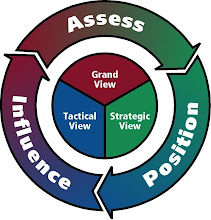
The strategist views the big picture. He builds his plan by assessing ideas, positioning events and choosing the best people to complete the goal. The key is the use of the Tangible Vision as his compass.

Do you have a strategic process that enables your team to perform the above?


###

Fishing, Nation and Attracting Talents-Six Teachings

(Tai Gong Six Teachings-Civil Teaching Chapter 1)

King Wen said:" I would like to hear about these greater principles."

Tai Gong said:" When the source is deep, water flows endlessly. When the water flows endlessly, fish spawn there. This is nature. When the roots of the trees are deep, the tree is tall. When the tree is tall, fruits are produced. This is nature. When men of true worth have views in common, they will come together. When they are drawn together, accomplishments can be achieved. This is nature. Speech and response are merely adornment of inner emotions. Speaking about the truth is the best. What I am about to say is all the truth without adornment, will you find it abhorrent?"

King Wen said:" Only a man of true benevolence can accept corrections and remonstrance. What makes you think I will be? Please continue."

Tai Gong continued:" When the fishing line is thin and the bait is glittering, only small fish will bite. When the line is thicker and bait is fragrant, medium sized fish will bite. When the line is thick and the bait is generous, large fish will bite. When the fish take the bait, they will be caught on the line. When men take salary, they will submit to their ruler. When you catch with bait, the fish can be killed. When you give remuneration, men can be made to exhaust their capabilities for you. If you regard families, as the basic foundation of state, the state is yours. If you use the state as your base to conquer the kingdom, you can conquer the kingdom."

###

Wednesday, January 23, 2008

Determining The Tangibility of a Goal


When developing goals and objectives, most people focus on the positives, rarely on the negatives. The reason behind this train of logic is that some people consider
negativity is bad for morale. In most cases, that is not tangible.

When a team collaboratively understands the positives and the negatives of their venture, they can determine whether their project is tangible. This grand point enables them to connect with it as a team. This state of team unification enables the team to plan their operation effectively.

Collaboration360 believes in that concept. With Compass AE, a project team determines the tangibility of their intent.

They begin by defining their outcome first. Then transferring the specifics in terms of the priorities, the approaches, positive circumstances and negative circumstances.

Defining the circumstances is a part of our collaborative process of determining what parts of their goal and objectives is tangible.

Does your project process enables your team to achieve that?

###

Weakness at Yahoo Doesn't Bode Well for Google

By Betsy Schiffman January 23, 2008 | 2:51:02 PM

Until a couple days ago, Google's stock looked recession proof. Despite mounting talk of an advertising slowdown, shares hit an all-time high in November. Now, it finally seems that recession concerns are catching up with the web giant.

Although Google and Yahoo are in different competitive positions (Google could eat Yahoo for a mid-afternoon snack), they are both dependent on advertising for the majority of their income, and as a result, both are poised to take a thunderous hit in the event of a recession.

The key difference between Yahoo and Google is that nobody has high expectations of Yahoo. Its problems have been widely chronicled: Former CEO Terry Semel was sacked last spring; its search business is troubled; and now Yahoo is reportedly planning layoffs to keep its finances in check.

On the other hand, investors and customers alike expect great things of Google. The tight-lipped, overachieving company is notoriously uncommunicative with the financial community, but its silence is usually interpreted to mean that business is growing at mind-blowing rates. Over the last two years, Google's earnings handily exceeded analysts' expectations in six of the eight quarters. Now, with a looming recession and nervousness surrounding the online advertising market, at least a couple analysts think that Yahoo's woes are not unique to the company and could drag on Google, too.

"Advertising is linked to the economic cycle, and the market has come to the conclusion that Google will not be immune to a recession," says Laura Martin, an analyst with Soleil - Media Metrics. "I think what's going to happen is [on the earnings conference call,] somebody will ask about the outlook, and I would expect [Google management] to be conservative. And the market is not going to like that."

The market may already be anticipating the bad news: Over the last two days, Google shares have dropped more than $58, closing at $548.62 on Tuesday. How long before the stock drops below $500? At this rate, it'll be a day or two.

Photo: Flickr/Thomas Hawk

http://blog.wired.com/business/2008/01/weakness-at-yah.html

Tuesday, January 22, 2008

Connect to Collaborate in a Global Economy


One problem with distance collaboration is getting the trust of your remotely located team

Collaboration360 Consultants believes that the best way to create team trust is to have the members collaboratively build a plan together. If they collaboratively believes in the plan and each other, the team will connect to it. This connection enables them to collaboratively lead with it from start to finish.

Through our Compass AE process, the team learns to collaboratively build and connect with their Tangible Vision. When they lead with their Tangible Vision, they collaborate regardless of the distance, the technology and the project culture.


[sidebar]
Q: What is the Tangible Vision?
A: The Tangible Vision is a goal, a plan that a Compass AE project team collaborates through. It also emphasizes a clearly-defined vision or mission statement that a team believes in.

###


How Email Brings You Closer to the Guy in the Next Cubicle

By Tim Harford 01.18.08 | 6:00 PM

As a columnist (which is fancy for "journalist in jammies"), I ought to personify th conventional wisdom that distance is dead: All I need to get my work done is a place to perch and a Wi-Fi signal. But if that's true, why do I still live in London, the second-most expensive city in the world?

If distance really didn't matter, rents in places like London, New York, Bangalore, and Shanghai would be converging with those in Hitchcock County, Nebraska (population 2,926 and falling). Yet, as far as we can tell through the noise of the real estate bust, they aren't. Wharton real estate professor Joseph Gyourko talks instead of "superstar cities," which have become the equivalent of luxury goods — highly coveted and ultra-expensive. If geography has died, nobody bothered to tell Hitchcock County.

Maybe it's because society hasn't wholeheartedly accepted the idea of working remotely. Or perhaps communications technology just isn't all it's hyped up to be. After all, the journalists and consultants who tell us that location is insignificant are biased. Like me, they're the people whose lives have been most transformed by the Internet and cell phones.

But I think the truth is more profound than either of those glib explanations: Technology makes it more fun and more profitable to live and work close to the people who matter most to your life and work. Harvard economist Ed Glaeser, an expert on city economies, argues that communications technology and face-to-face interactions are complements like salt and pepper, rather than substitutes like butter and margarine. Paradoxically, your cell phone, email, and Facebook networks are making it more attractive to meet people in the flesh.

The most obvious example is online dating. With sites like BBW (Big Beautiful Women) Datefinder and Senior People Meet, it's a lot easier to find like-minded flames. But that's not much use unless you live within driving range of your 98 percent-compatible love connection. The kind of contact that follows online winking is far from virtual.

It follows that matchmaking is most effective in densely populated areas, where there are plenty of fish but an awfully big sea. If you live in Los Angeles, online dating is the killer app. If you live in a small town, you've likely already met all your potential mates at church or a bar.

Of course, the rest of life isn't like courting. Or is it? In big cities, our communication tools are especially helpful because they keep us from getting lost in the crowd (which is not something you worry about in a one-street town). There are even services that tell you where your friends are by locating their cell signals.

New technologies can strengthen ties within your business, too. A 2007 study by economists Neil Gandal, Charles King, and Marshall Van Alstyne looked at the networks formed by 125,000 email messages from the staff of an executive-recruiting firm. It found that email's real value isn't in communicating with Kuala Lumpur but with Betsy in the next cubicle. The most productive workers have the densest intracompany email web.

This shouldn't surprise us. Email makes it quicker and easier to reach your colleagues — you don't have to interrupt them, and messages are easy to process. But email doesn't stop you from wanting facetime, too. Just the opposite: By enabling us to maintain productive business relationships with more people, it encourages more face-to-face contact. Have you noticed business travel dying out? Neither have I. Air travel is at record highs.

One day, perhaps, virtual communication will become so good we'll no longer feel the need to shake hands with a new collaborator or brainstorm in the same room. But for now, the world seems to be changing in a way that actually demands more meetings. Business is more innovative, and its processes more complex. That demands tacit knowledge, collaboration, and trust — all things that seem to follow best from person-to-person meetings. "Ideas are more important than ever," Glaeser says, "and the most important ideas are communicated face-to-face."

/// Compass AE process enables a team to build trust while building a project plan.

Which explains why the highest-tech industries are the most dependent on geography. In a study published in the American Economic Review, researchers examined 4,000 US-based commercial innovations and found that more than half came from just three areas: California, New York/New Jersey, and Massachusetts. Almost half of all US pharmaceutical innovations were invented in New Jersey, a state with less than 3 percent of the nation's population.

In theory, technology should allow new-economy firms to prosper as easily in Nebraska as in Silicon Valley. But far from killing distance, it has made proximity matter more than ever.

/// With the Compass AE process, the project team collaborates without borders. Distance, technology and project culture becomes irrelevant.

As for me, I've been finishing off this essay between a coffee date with my wife and some essential chitchat with my publishers at a central London restaurant. This old city isn't cheap, and it isn't easy. But with my cell phone and laptop to back me up, I can't afford to live anywhere else.

Tim Harford (undercovereconomist@gmail.com) is the author of The Logic of Life: The Rational Economics of an Irrational World.

http://www.wired.com/culture/lifestyle/magazine/16-02/st_essay

###

If you want your team to collaborate without borders, please email us at contact us at contactus [tat]collaboration360[dott] com . [ Replace [tat] with "@" and [dot] with "." ]

Monday, January 21, 2008

Competing in the Global Economy (Innovation with a Tangible Vision creates Profits)


During the initial building and connecting of the Tangible Vision, the Compass team assesses whether an innovation can match the defined outcome. In most cases, high risk innovation means high rewards.


Before deciding on the "Gold Standard" for their Tangible Vision, the team determines whether the high risk and the high level of complexity creates high rewards.

Through our Compass AE process, the project team comprehends the connections between the goal and the specific objectives. This understanding creates a sense of predictability and efficiency that enables the team to be on time, on budget and on target.

###

The New York Times
January 20, 2008

Ping
The Risk of Innovation: Will Anyone Embrace It?
By G. PASCAL ZACHARY

THE Prius has become one of the hottest cars in America an amazing development, because this hybrid-electric car requires some rather large changes in how people behave.

I learned the need for Prius-style adaptation early this month, when I rented a Prius from Budget Rent A Car in Seattle. Much to my embarrassment, I couldn’t get it to go forward. Once I got going and arrived at my destination, I couldn’t figure out how to put it in reverse.

Fortunately, another Prius owner on the premises they seem to be everywhere these days gave me a quick lesson. You start the Prius by pressing a button on the dashboard, not once but twice. To put it in drive or reverse, you manipulate a very small stick protruding from the dashboard.

The next morning, I awoke before dawn and started the Prius, but no matter how many times I pressed the button, I couldn’t get it to move. I finally called Budget roadside assistance, and a polite man talked me back from my private technology disaster. It turns out that I had failed to tap the brake while moving the gear shifter in a certain inexplicable way.

I don’t think I can adapt to the behaviors required by the Prius. But thousands of people are, and Toyota, its maker, is reaping the benefits.

Whether humans will embrace or resist an innovation is the billion-dollar question facing designers of novel products and services. Why do people adapt to some new technologies and not to others? Fortunes are made and lost on the answer.

Great innovations have foundered over human stubbornness. Consider the Picturephone, trumpeted by AT&T at the New York World’s Fair in 1964 as a major technological advance. Engineers reasoned that if hearing someone’s voice over the phone was terrific, wouldn’t seeing a face be even better?

Consumers didn’t think so. AT&T’s Picturephone, which would have added around $90 to a person’s monthly phone bill in 1974, a huge amount for the time, “was superfluous, adding little information to voice alone, especially considering its high price, said Kenneth Lipartito, a professor of history at Florida International University.

Even today, when adding video to a phone is a trivial cost, consumers may rebel. Video-conferencing often remains an activity forced on people by their employers.

Resistance to technology is an omnipresent risk for every innovator. Even a device as fabulously freeing as the personal computer struck some people as an abomination. In 1990, the poet Wendell Berry famously declared his perpetual allegiance to the typewriter in his essay, “Why I Am Not Going to Buy a Computer.

Few people joined him, however, a reminder that rejection isn’t the real specter facing new gear. Adaptable humans usually trade one technology for another, rather than reject any and all. To be accepted, innovations must deliver benefits enough benefits to make change worthwhile.

“As consumers we’re constantly asking ourselves, where do we draw the line? How far do we go? says Mitchell Kapor, chairman of the Open Source Applications Foundation in San Francisco.

/// With Compass AE, the Compass team collaboratively establishes the sustainability level of their Tangible Vision.

Businesses crave a sweet spot: where the line is drawn in favor of the innovator. The late Akio Morita, founder of Sony, talked about satisfying appetites that people didn’t even know they had. He achieved such a feat with the Sony Walkman, the music player introduced in 1979. While at the Lotus Development Corporation, Mr. Kapor created another such “killer app, or application: the spreadsheet for the PC.

Killer apps are sought-after innovations because people get addicted to them and make behavioral changes that might otherwise be unthinkable. “Those who benefit from a technology adapt to its constraints and become dependent on it, says John Staudenmaier, editor of the journal Technology and Culture and a historian of technology at the University of Detroit Mercy.

Dependency drives profits, the ultimate arbiter for some of an innovation’s success. Look how Apple has converted the mania for the iPod into record profits and a record stock price.

IPod “addiction seems benign. Yet some worry that other innovations may harbor health threats. As a result, they may be vulnerable to what Marc Ventresca, a lecturer at the Saïd Business School at Oxford, calls the “frog boiling problem. For the frog, gradually rising heat causes no alarm until the water is so hot that death is imminent.

“Adaptation can sometimes be dangerous, but the hazard isn’t apparent until it is ‘too late,’ Mr. Ventresca says.

While people may be fearful of allowing a seductive technology to imperil them the “Frankenstein effect they may also fear the consequences of not changing their ways. As the case of climate change illustrates, many consumers are enthusiastic about changing their behavior in this case, the way they drive cars if they believe that by adapting to new technologies they will save themselves and the planet. Think of the Prius again.

FOR technological innovators, the cash register can ring either way. They may achieve a smash-hit breakthrough, or simply make a slight improvement in a technology that humans already feel comfortable with. Most innovators no longer even try to predict human reactions to their creations.

Henry Kressel, a partner at Warburg Pincus and a co-author of “Competing for the Future: How Digital Innovations Are Changing the World, says, “You throw technologies into the market and see what sticks.

The hope is that passionate “early adopters will blaze a path toward mass acceptance of a new technology. Yet the truth is that no one can tell in advance which innovations people will adapt to and which will become the next example of the Picturephone.

Where people draw the line can be known only after the fact. Which is why innovation is always a risky even humbling business.

G. Pascal Zachary teaches journalism at Stanford and writes about technology and economic development. E-mail: gzach@nytimes.com.

Copyright 2008 The New York Times Company

http://www.nytimes.com/2008/01/20/business/20ping.html

###

The lesson is a well-planned innovation creates profits.
With Compass AE, your team can innovate with a Tangible Vision.