Showing posts with label Strategic Advantage. Show all posts

Tuesday, June 23, 2009

Protect your Competitve Advantage


One thrives in this global economy by incrementally enhancing their "competitive advantage"

The two must important steps that most people misses are:
  • Defining what is the advantage
  • Determining the protection of the advantage.

Jiang Tai Gong book "Six Secret Teachings" emphasizes "the importance of protecting one's advantage" regardless of the situation.

King Wen asked Tai Gong:"How does one preserve the state's territory?"

Tai Gong said: "Do not estrange your relatives. Do not neglect the masses. Be concillatory and solicitous towards nearby states and control all that is under you. Do not loan the authority of state to other men. If you loan the authority of state to other men, then you will lose your authority. Do not hurt those of lower position to benefit those of higher position. Do not abandon the fundamental to save those that are inconsequential.

When the sun is at midday, you should dry things. If you grasp a knife, you must cut. If you hold an axe, you must attack."

"If at the height of the day, you do not dry things in the sun, this is termed losing the opportunity.

If you grasp a knife but do not cut anything, you will lose the moment for profits. If you hold an axe and do not attack, enemies will attack instead."

"If trickling streams are not blocked, they will become great rivers. If you do not extinguish the smallest flames, there is nothing much you can do when it turns into great flames.

If you do not eliminate the two-leaf sapling, you might have to use the axe to remove it in future." "For this reason, the ruler must focus on developing wealth within his state. Without material wealth, he has nothing with which to spread beneficence or to bring his relatives together.

If he estranges his relatives it will be harmful. If he loses the common people, he will be defeated. "

"Do not loan sharp weapons to other men. If you loan sharp weapons to other men, you will be hurt by them and will not live out your allotted span of years."
King Wen said:"What do you mean by benevolence and righteousness?"

Tai Gong replied: "Respect the common people, unite your relatives. If you respect the common people, they will be in harmony. And if you unite your relatives, they will be happy. This is the way to implement the essential cords of benevolence and righteousness."

"Do not allow other men to snatch away your awesomeness.
Rely on your wisdom, follow the norm. Those that submit and accord with you, treat them generously and virtuously. Those that oppose you, break with force. If you respect the people and trust, the state will be peaceful and populace submissive." - T’ai Kung Liu-t’ao (Six Secret Teachings)

More on this topic can be found in Dr. Ralph Sawyer's Seven Military Classics of Ancient China.


June 23, 2009
Apple’s Obsession With Secrecy Grows Stronger
By BRAD STONE and ASHLEE VANCE

SAN FRANCISCO Apple is one of the world’s coolest companies. But there is one cool-company trend it has rejected: chatting with the world through blogs and dropping tidbits of information about its inner workings.

Few companies, indeed, are more secretive than Apple, or as punitive to those who dare violate the company’s rules on keeping tight control over information. Employees have been fired for leaking news tidbits to outsiders, and the company has been known to spread disinformation about product plans to its own workers.

They make everyone super, super paranoid about security,” said Mark Hamblin, who worked on the touch-screen technology for the iPhone and left Apple last year. I have never seen anything else like it at another company.”

But even by Apple’s standards, its handling of news about the health of its chief executive and co-founder, Steven P. Jobs, who has battled pancreatic cancer and recently had a liver transplant while on a leave of absence, is unparalleled.

Mr. Jobs received the liver transplant about two months ago, according to people briefed on the matter by current and former board members. Despite intense interest in Mr. Jobs’s condition among the news media and investors, Apple representatives have declined to address the matter, reciting with maddening discipline only that Mr. Jobs is due back at the company by the end of June.

Mr. Jobs was actually at work on Apple’s sprawling corporate campus on Monday, according to a person who saw him there. Company representatives would not say whether he had returned permanently.

Even senior officials at Apple fear crossing Mr. Jobs. One official, who is normally more open, when asked for a deep-background briefing about Mr. Jobs’s health after the news of the transplant had become public, replied: Just can’t do it. Too sensitive.”

Secrecy at Apple is not just the prevailing communications strategy; it is baked into the corporate culture. Employees working on top-secret projects must pass through a maze of security doors, swiping their badges again and again and finally entering a numeric code to reach their offices, according to one former employee who worked in such areas.

Work spaces are typically monitored by security cameras, this employee said. Some Apple workers in the most critical product-testing rooms must cover up devices with black cloaks when they are working on them, and turn on a red warning light when devices are unmasked so that everyone knows to be extra-careful, he said.

Apple employees are often just as surprised about new products as everyone else.

I was at the iPod launch,” said Edward Eigerman, who spent four years as a systems engineer at Apple and now runs his own technology consulting firm. No one that I worked with saw that coming.”

Mr. Eigerman was fired from Apple in 2005 when he was implicated in an incident in which a co-worker leaked a preview of some new software to a business customer as a favor. He said Apple routinely tries to find and fire leakers.

Philip Schiller, Apple’s senior vice president for marketing, has held internal meetings about new products and provided incorrect information about a product’s price or features, according to a former employee who signed an agreement not to discuss internal matters. Apple then tries to track down the source of news reports that include the incorrect details.

Five years ago, Apple took its obsession with secrecy to the courts. It sued several bloggers who had covered the company, arguing that they had violated trade-secret laws and were not entitled to First Amendment protections. A California appeals court ruled for the bloggers, and the company had to pay $700,000 in legal fees.

Apple also sued a blog called Think Secret and settled the case for an undisclosed amount, but as part of the settlement that blog shut down.

Regis McKenna, a well-known Silicon Valley marketing veteran who advised Apple on its media strategy in its early days, said the culture of secrecy had its origin in the release of the first Macintosh, which competitors like Microsoft and Sony knew about before it was unveiled.

It really started around trying to keep the surprise aspect to product launches, which can have a lot of power,” Mr. McKenna said.

He added: But what most people don’t understand is that Steve has always been very personal about his life. He has always kept things close to the vest since I’ve known him, and only confided in relatively few people.”

Apple’s decision to severely limit communication with the news media, shareholders and the public is at odds with the approach taken by many other companies, which are embracing online outlets like blogs and Twitter and generally trying to be more open with shareholders and more responsive to customers.

They don’t communicate. It’s a total black box,” said Gene Munster, an analyst at Piper Jaffray who has covered Apple for the last five years.

Mr. Munster said he jokes with other colleagues covering the company about how Apple routinely jams the frequencies,” or gives them misinformation to throw them off the scent of a new product or other news it hopes to keep confidential. Four years ago, he said, a senior Apple executive directly told him the company had no interest in developing a cheap iPod with no screen. Soon after, the company released just that: the iPod Shuffle.

For corporate governance experts, and perhaps federal regulators, the biggest question is whether Mr. Jobs’s approach has led to violating laws that cover what companies must disclose to the public about the well-being of their chief executive.

On that key issue, the experts are divided. Some believe Apple did not need to disclose Mr. Jobs’s liver transplant because Mr. Jobs was on a leave of absence and had passed responsibility for the day-to-day operations of the company to the chief operating officer, Timothy Cook.

Other governance experts argue that the liver transplant now makes one of Apple’s assertions from January that Mr. Jobs was suffering only from a hormonal imbalance seem like a deliberate mistruth, unless Mr. Jobs’s health condition suddenly deteriorated. Of course, no one knows enough to say definitively.

Most governance experts do seem to agree on one point: that the secrecy that adds surprise and excitement to Apple product announcements is not serving the company well in other areas.

In this environment, where transparency is critical, the more information you give the marketplace the better,” said Charles Elson, director of the John L. Weinberg Center for Corporate Governance at the University of Delaware. For a technology company that views itself as innovative, it’s a little odd that they are getting a reputation for lack of transparency.”

Apple’s stock dropped $2.11 to $137.37 on Monday amid a larger market sell-off. And the company did, in fact, have something to reveal: it said it had sold a million units of its new iPhone 3G S over the weekend, well above analysts’ forecasts.

Copyright 2009 The New York Times Company
http://www.nytimes.com/2009/06/23/technology/23apple.html


Following are the two questions that you should always ask yourself:
  • "What is your competitive advantage!?"
  • "What is your approach for protecting it?"

Sunday, March 1, 2009

Protect Your Competitive Advantage!


To thrive in this global economy, one focuses on maintaining and enhancing their "competitive advantage incrementally."

Following are the two questions that you should ask yourself:
  • "What is your competitive advantage!?"
  • "How are you protecting it?"

Jiang Tai Gong book "Six Secret Teachings" emphasizes "the importance of protecting one's advantage."

King Wen asked Tai Gong:"How does one preserve the state's territory?"

Tai Gong said: "Do not estrange your relatives. Do not neglect the masses. Be concillatory and solicitous towards nearby states and control all that is under you. Do not loan the authority of state to other men. If you loan the authority of state to other men, then you will lose your authority. Do not hurt those of lower position to benefit those of higher position. Do not abandon the fundamental to save those that are inconsequential.

When the sun is at midday, you should dry things. If you grasp a knife, you must cut. If you hold an axe, you must attack."


"If at the height of the day, you do not dry things in the sun, this is termed losing the opportunity.

If you grasp a knife but do not cut anything, you will lose the moment for profits. If you hold an axe and do not attack, enemies will attack instead."

"If trickling streams are not blocked, they will become great rivers. If you do not extinguish the smallest flames, there is nothing much you can do when it turns into great flames.

If you do not eliminate the two-leaf sapling, you might have to use the axe to remove it in future."
"For this reason, the ruler must focus on developing wealth within his state. Without material wealth, he has nothing with which to spread beneficence or to bring his relatives together.

If he estranges his relatives it will be harmful. If he loses the common people, he will be defeated. "

"Do not loan sharp weapons to other men. If you loan sharp weapons to other men, you will be hurt by them and will not live out your allotted span of years."

King Wen said:"What do you mean by benevolence and righteousness?"

Tai Gong replied: "Respect the common people, unite your relatives. If you respect the common people, they will be in harmony. And if you unite your relatives, they will be happy.

This is the way to implement the essential cords of benevolence and righteousness."
"Do not allow other men to snatch away your awesomeness.

Rely on your wisdom, follow the norm. Those that submit and accord with you, treat them generously and virtuously. Those that oppose you, break with force. If you respect the people and trust, the state will be peaceful and populace submissive."

- T’ai Kung Liu-t’ao (Six Secret Teachings)

More on this topic can be found in Dr. Ralph Sawyer's Seven Military Classics of Ancient China.

#

When a business component is no longer cost effective and significant to the greater part of the system, there is a strong possibility that it will be outsourced.


August 12, 2008
Cost-Cutting in New York and London, a Boom in India
By HEATHER TIMMONS

GURGAON, India On the top floor of a seven-story building in this dusty aspiring metropolis, Copal Partners churns out equity, fixed income and trading research for big name analysts and banks. It is a long way from the well-cooled corridors of Wall Street, and quarters are tight; business is up about 40 percent this year alone.

"This is one bulge-bracket bank," said Joel Perlman, president of Copal, pointing toward a team behind an opaque glass wall. "And this," he said, motioning across a narrow corridor "is another."

The banks edit and add to what they get from Copal, a research provider, then repackage the information under their own names as research reports, pitch books and trading recommendations.

Wall Street's losses are fast becoming India's gain. After outsourcing much of their back-office work to India, banks are now exporting data-intensive jobs from higher up the food chain to cities that cost less than New York, London and Hong Kong, either at their own offices or to third parties.

Bank executives call this shift "knowledge process outsourcing," "off-shoring" or "high-value outsourcing." It is affecting just about everyone, including Goldman Sachs, Morgan Stanley, JPMorgan, Credit Suisse and Citibank to name a few.

The jobs most affected so far are those with grueling hours, traditionally done by fresh-faced business school graduates research associates and junior bankers on deal-making teams paid in the low to mid six figures.

Cost-cutting in New York and London has already been brutal thus far this year, and there is more to come in the next few months. New York City financial firms expect to hand out some $18 billion less in pay and benefits this year than 2007, the largest one-year drop ever. Overall, United States banks will cut a total of 200,000 employees by 2009, the banking consultancy Celent said in April.

The work these bankers were doing is not necessarily going away, though. Instead, jobs are popping up in places like India and Eastern Europe, often where healthier local markets exist.

In addition to moving some lower-level banking and research positions to support bankers and analysts in New York and London, firms are shipping some of their top bankers from those cities to faster-growing developing markets to handle clients there.

Owing in part to credit weaknesses and billion-dollar charges from the subprime crisis, "people who were off-shoring high value jobs are increasing the intensity of that, and people who were not are now in the planning stage," said Andrew Power, a financial services partner at Deloitte Consulting.

Wall Street banks started cautiously sending research jobs to India a few years ago, hiring employees by the handful and running pilot programs with firms like Copal, Office Tiger, Pipal Research and Tata Consultancy Services.

In 2003, JPMorgan and Morgan Stanley said they planned to move a few dozen research jobs to Mumbai, Lehman Brothers was working on a pilot program to create research presentations in India and both Merrill Lynch and Goldman Sachs said they had not moved any research to the country.

Five years later, the trickle is a flood. Third-party firms say they are seeing a 20 to 40 percent upswing in business this year alone.

Morgan Stanley has about 500 people employed in India doing research and statistical analysis. About 100 of Goldman Sachs' 3,000 employees in Bangalore are working on investment research.

JPMorgan has 200 analysts in Mumbai working for its investment banking operations around the world, doing industry analysis, and compiling data and charts for marketing materials. It has an additional 125 analysts in Mumbai supporting the bank's global research division.

Citigroup employs about 22,000 people in India, several hundred of whom work in investment research. Deutsche Bank has 6,000 employees in India, according to the bank's Web site. Deutsche started a pilot program to outsource some research in 2003, and would not provide any update.

Theoretically, as much as 40 percent of the research-related jobs on Wall Street, tens of thousands of jobs, could be sent off-shore, said Deloitte's Mr. Power, though the reality will be less than that.

The jobs off-shore are more likely to come from the investment bank and trading divisions of Wall Street firms, rather than the sales side, which produces analyst reports about companies and industries, said Andy Kessler, a former analyst who has written several books about Wall Street.

"There's a huge amount of grunt work that has been done by $250,000-a-year Wharton M.B.A.'s," Mr. Kessler said. "Some of that stuff, it's natural to outsource it."

He added, "These are middle of the office jobs, not back office, but they're not the people on the front line."

After research, the next wave may include more sophisticated jobs like the creation of derivative products, quantitative trading models and even sales jobs from the trading floors.

Proponents of the change say Wall Street's wary embrace of the activity may signal the beginning of a profound shift in the way investment banks are structured, with everyone but the top deal makers, client representatives and the bank management permanently relocated to cheaper locales like India, the Philippines and Eastern Europe.

In the future, executives in India like to joke, the only function for highly paid bankers in New York or London will be to greet clients and shake hands when the deals close.

"Wall Street has to look at the world differently," said Manoj Jain, the chairman of Pipal Research, a 400-person firm with offices in Chicago, Delhi and Gurgaon. Moving high-value jobs out of high-cost cities is "no longer a hypothesis," he said.

Pipal has "more work than it can take" right now, he said, and is seeing new clients beyond United States banks, like investment management companies and European financial firms. Like analysts at most offshore research operations, Pipal's number crunchers do not make recommendations, or generally put their name to the research they write. Instead, they work with the big-name bank or fund analyst to create the research that they want.

Permanently moving banking jobs out of New York or London is a touchy subject on Wall Street. Many investment banks, including Morgan Stanley, Goldman Sachs, Merrill Lynch and Citigroup, would not make executives available to discuss the topic.

Press officers for most banks asked not to be quoted or argued over semantics. For example, one spokesman said his bank's fast-growing India support operations are not an outsourcing facility, but a "center of excellence"; another argued that large cost cuts at his bank's New York and London headquarters were really "re-engineering" so the bank should not be included in such an article.

"Some of that is self-serving," Octavio Marenzi, chief executive of Celent, said of the impulse to keep quiet. "If I admit that research analysts can be off-shored to India, that means that I could too."

He said the "more advanced firms" will be able to use the cost differences and talent pools in India, and in the future in China, to their advantage.

A few banks have openly embraced off-shoring. Credit Suisse has 6,500 employees around the world working in lower-cost locations in India, Poland and Singapore. Of these about 500 are doing high-value jobs.

"We have people helping the execution of deals, data gathering, helping to build financial models, writing research, and doing scenario analysis," said Vineet Nagrani, head of knowledge process outsourcing at the bank.

The bank has small teams working on fixed-income research, credit research and foreign exchange research, "all of which are going to grow" Mr. Nagrani said. Credit Suisse is also doubling the number of investment bankers and private bankers in India who deal with local clients in the next 12 months.

The bank's clients, so far, seem happy. "As long as clients get a good quality product and can talk to their favorite research analyst" they do not care if the grunt work is done in New York or India, Mr. Power said.

Third-party outsourcing firms face two hurdles when winning this business, N. Chandrasekaran, chief operating officer of Tata Consultancy Services, said. First, banks need to be confident that third parties are capable of doing the work. Second, they need to decide whether they want to move the work out of the bank at all.

To address the first issue, Tata sets up pilot programs with clients. A new Tata office in Cincinnati, which will employ 1,000 people in three years, is intended to give the company a United States presence.

In addition to growth outside India, these outsourcing experts are bringing in Chinese nationals, Arabic speakers and even the very people they are replacing: business school graduates from America.

Daniel Peng, who will be a senior at Dartmouth next year, is working in the equity research department of Copal Partners as a summer intern. "I thought it would be a good emerging markets experience," he said.

Tellingly, Mr. Peng still hopes for an old-fashioned Wall Street job when he graduates. New York would be "ideal," he said.

Copyright 2008 The New York Times Company

http://www.nytimes.com/2008/08/12/business/worldbusiness/12indiawall.html?

Sunday, January 11, 2009

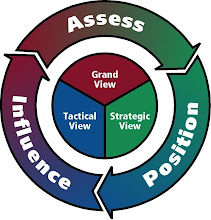
Assess the Grand Situation ( Applying Sunzi (Sz) Art of War principles) #2


Before you enter into a new competitive arena, you should always assess the strategic position of each competitors (including yourself).


Also know the history and the rules of that particular arena.

Finally, compare, contrast and calculate the actions of each competitor and its relationship to the grand settings.

If you believe you have a "superior" strategic advantage over your future competitors, then it is time for you to build your Tangible Vision (your grand mission with detailed specifics).


#

Rethink your business strategy
Perfect your products before you succumb to the "expand or die" philosophy of business in uncertain times
By Ephraim Schwartz
January 6, 2009

I can't speak for the rest of the world, but in the U.S., the overriding business philosophy of companies both large and small is expand or wither away and die.

For retail outlets, this means building more and more stores until, like Starbucks in Seattle, there are two across the street from each other. For high-tech companies, it takes the form of reaching beyond one's area of expertise. Anyone still own a Dell TV or a Toshiba server?

How about driving around town in a car made by TaTa? I would buy an HP printer in a heartbeat but not an HP camera.

Another classic example was Heinz, which spent millions in advertising to get into the soup business. The result of all that advertising? Sales of Campbell's soup increased dramatically.

Companies never seem to learn their lesson. Perhaps it is hubris. Knowing others failed before them doesn't phase some companies in the least, because they believe they know better.

By the way, the opposite of this expand-or-die philosophy is to improve, perfect, and capture your market. In other words, offer products far superior to anyone else's and you will own the market. Unfortunately, many companies learn too late that respect for products in one field does not extend to another. The latest to succumb may be Cisco, which this week announced it will enter the consumer-electronics business, specifically digital stereo systems. Wi-Fi is one thing; stereo systems quite another. And then there's HP, which wants to be your data warehouse provider.

More of the same sad news. Granted, HP in data warehousing is less of a stretch than Cisco stereos. HP has the iron to do it. But if the folks at HP think the backbone of the data warehousing business is hardware, they are already on the wrong track. HP did, however, buy strategic business expertise when it acquired EDS. And this is what is really needed to sell data warehousing, which is much more about strategy than operations. What HP has to do is learn to turn hunks of metal and pieces of crystal into a services rather than a hardware sale. After that, they will still have to convince cash-strapped enterprises to invest millions of dollars in products and services from the new kid on the block in an uncertain economic climate. HP's competition -- Teradata, Oracle, IBM, and Microsoft -- is already stiff. And if it isn't careful, HP's hard-sell pitch to its largest hardware customers might just convince them that they need data warehousing -- a need they may wish to fulfill by buying a data warehousing solution from Teradata, Oracle, IBM, or Microsoft. Yes, HP, the mistake Heinz made has legs, and like it or not, you may not be any smarter than Heinz was. As for Cisco's New Year's resolution to build your digital entertainment system, my suggestion for Cisco is to stick to its plumbing. As I've often said, I don't have an MBA -- I don't even have an MA, having failed the French exam to prove proficiency in a second language, a long, sad story -- but I have watched the consumer market for 25 years, and I know that in consumer electronics, brand is everything.

Like the old real-estate axiom "location, location, location," in consumer electronics, it is "brand name, brand name, brand name." Yes, we have a more sophisticated audience than we did even five years ago. But most non-techies who are familiar with Cisco are so because somebody told them to buy Cisco stock. "What do they do?" a prospective buyer might ask the savvy friend advising them. "Oh, they make all the stuff for the Internet and for networking. You can't miss."

And for the most part, you couldn't. But nobody has to ask, What does Sony do? I would guess nine out of 10 people on the street, even Jay Leno's Jay Walkers, could answer that one. I wouldn't try the name Cisco on Jay Walkers, that's for sure. Whatever Cisco spends on advertising dollars now, it would probably have to increase tenfold, or twentyfold even, to become a blip on the list of names recognized in most households. Even more to become a household name consumers would feel comfortable buying stereos from. Far be it from me to offer advice to HP and Cisco.

Rather, I offer advice to other companies with similar strategies in mind. Markets are global, and once the current economic climate settles, there will be an even larger demand for the product lines you already offer, from India, China, and Indonesia, as well as the nations of Africa and the Middle East.

If you can polish your reputation in the areas where you are currently strongest, you should have enough business to keep your company growing for at least another generation or two. Not only will you be successful, but your business customers will have better, more reliable products with which to work.


http://weblog.infoworld.com/realitycheck/archives/2009/01/rethink_your_bu.html

Thursday, January 31, 2008

Lessons from the New England Patriots (1)


Following are some of those lessons:

1. Emphasizes that a collaborative system of schemes and mismatches prevail over talent
In a grand setting, the origin of the New England Patriots success is due to one thing- a collaboration of many people that are behind closed doors. Whether it is recruiting new players or out-strategizing their opponent during gametime, they usually target their strengths against the opposition weaknesses with strategic timing.

2. Emphasizes detailed preparation from start to finish
Belichick and his staff collaboratively delineated a specific goal and a set of specific objectives. Then they plan on how to achieve it. (The basics of Tangible Vision) ... In terms of organization development, the Patriots has made the most of the salary cap, free agency era. ... Before gametime, Belichick usually prepares his players on many possible scenarios. They always know what are the possible moves and when to adjust strategically. Proper Preparation Prevents Pissed Poor Performance.

3. Understands the cycles relating to one's settings
During gametime, Belichick recognized two things: the current scenario and the next possible event. He also knows when and how to take advantage of a tired opposition. This is how a consummate strategist has the "big picture" view.
In terms of players management, New England Patriots always know when to "retire" their players one season before, then one season later. ...

4.
Be professional
When one is a champion, trash-talking is not the norm.

5. Emphasizes loyalty

The Patriots believe in loyalty from start to finish.

6. Recruits personnel who are multi-skilled, smart and move fast
The Patriots have many players who play multi-positions like Troy Brown, Randy Moss, Adalius Thomas, Wes Welker and others. It gives the coaches more strategic options.

7. Success breeds success
New England has a successful record and three Super Bowl . While talented players like Moss, Welker and Thomas always want to join a winner. ... With mountains of successes, Belichick convinces formerly egotistical players put aside their personal ambitions for the greater good of the team.

8.
Always be secretive (never trust outsiders)
Outsiders has a way of disrupting team unity. Ask Belichick and Moss about outside distractions.

9. Always learn from the best
"... In addition, Belichick is a devoted student of the game; during the offseason, he has spent significant amounts of time visiting with other programs to learn from their experiences. For example, he has studied the Navy run offense, sought Bill Walsh (in past years) to understand more about the San Francisco 49ers as an organization and the West Coast offense as a system,[14] and spent time with Jimmy Johnson to learn about drafting and contract negotiations.[15] ..."
- http://en.wikipedia.org/wiki/Bill_Belichick

#

Belichick is also a student of Sun Tzu's Art of War. "With genius coach Bill Belichick systemically crafting game plans and victory marches straight from the teachings of Sun Tzu, the Patriots - who scored an NFL-record 589 points and posted the largest point differential (315) in a season - do appear to be one of the greatest NFL teams of all time. That's not hyperbole; that's fact. ..."
- http://www.sfgate.com/cgi-bin/article.cgi?f=/c/a/2008/01/29/SPUDUNPV8.DTL


More conceptual details on Point #2 to #8 can be found in Sun Tzu's (Sun zi) Art of War.


# # #

Patriot Way' needs good citizens - even Moss
Nancy Gay, San Francisco Chronicle

Thursday, January 31, 2008

(01-31) 04:00 PST Phoenix --

They're quick to cite the "Patriot Way" in New England as the reason for three Super Bowl championships and six division titles in the 21st century. It's a catchphrase that would seem overly pretentious if it weren't for a trophy case full of hardware to back up the notion.

Then there is the unprecedented 18-0 record that stands to remain unblemished Sunday if the Patriots complete the anticipated season sweep and defeat the New York Giants in Super Bowl XLII.

The textbook Patriots player, as defined by owner Robert Kraft, coach Bill Belichick and vice president of player personnel Scott Pioli, is hard working, dependable, accountable for his actions. He must have good character. You don't see a Jerramy Stevens on the Patriots roster.

There is an occasional blip - safety Rodney Harrison, for example, served an NFL-imposed four-game suspension at the beginning of the season after admitting he had obtained human growth hormone. The safety is among the team's most respected leaders.

Rather than blame the bust on a tainted supplement, a popular line of defense for such embarrassing infractions, Harrison held himself accountable by publicly apologizing for being a poor role model.

During Super Bowl week, he has expanded on his contrition. "My message to young kids basically was, 'Hey, you make a mistake, own up to it, accept your consequences and move forward.' We, as people, have to do that," Harrison said. "I mean, we all have skeletons in our closet. No one's perfect here. The way you make amends is by becoming a better person."

This is the type of player the Patriots covet. They are not perfect. But they try.

Pioli, the media-shy architect of so many of the team's brilliant personnel moves, made himself available the past two days and the question of how New England built an 18-0 team via the Patriot Way was at the forefront.

"We know what we're looking for in terms of, there is a certain type of person that Bill wants to coach, and that wants to be coached by Bill," Pioli said. "Ultimately, it comes down to the players being able to do that.

"Bill is looking for people who are professionals, people who are just like him ... getting people who care about football. When we talk about finding disciplined football players, it has nothing to do with how long their hair is or how much jewelry they're wearing.

"It has everything do with how disciplined they are about their job and being committed. Showing up on time, paying attention, working hard and being accountable to people that you work with."

How does New England get it right every year and other teams - oh, say, the two in the Bay Area - tend to make one expensive mistake after another and fail?

"You know there are a lot of different vehicles to build a team. There is the draft, free agency, it's the waiver system, it's trades," Pioli explained, as if this were really simple stuff. "You try to build a team using all the vehicles available to you."

Here's how he spent the 2007 offseason: After losing the AFC Championship Game to the Colts last January, the Patriots signed top free agents such as linebacker Adalius Thomas, tight end Kyle Brady and wide receiver Donte Stallworth. They swung trades to acquire wide receivers Randy Moss and Wes Welker.

You figure that Welker, a hard worker who evolved from an undrafted Dolphins' free agent into one of the NFL's most versatile receiver/returners, was a no-brainer fit for the Patriot Way.

But Moss? That sullen guy who appeared to mail it in for two seasons with the Raiders?

"We know a lot of people (who) spent time with Randy, we know a lot of people (who) played with Randy, who coached Randy. We know Randy and we were comfortable bringing him here," said Pioli. People in the Raiders organization told him that Moss still had his legs and still could run. "Perception and reality sometimes are two completely different things."

Here in Super Bowl land, several NFL insiders have confirmed that Raiders owner Al Davis has made it known across the league that he believes coach Lane Kiffin forced his hand on that trade, a steal for a fourth-round pick ultimately used on a bench-warming defensive back, John Bowie.

Here is how Pioli describes the transaction, which took place at the conclusion of Day 1 of the draft. And Davis - regardless of how much he might regret dumping Moss - was directly involved.

"It was quick. The conversations with Mr. Davis didn't start taking place until (late) ... because of the time difference. It was late," Pioli recalled. "It was at the end of the first day of the draft. It went late into the night. It went very late (and) early into the (next) morning. We spoke to Mr. Davis and got to the parameters of what we thought (that) the trade would be, but there were other things that we had to discuss.

"Part was getting together with Randy, part was to talk about his contract because he was due to make $9.75 million this year. There were a number of things that had to get done. The process was (that) again we spoke to the Raiders. Randy was, I believe, somewhere in Texas. He got on a plane, flew up in the middle of the night. (He) got in early in the morning, took a physical and met with Bill and I. (And) then we consummated the trade."

Pioli, Belichick and Kraft convinced Moss to play for them for $2.5 million in base salary, a $500,000 signing bonus and promises of other riches (about $2 million more) if he made the Pro Bowl and the Pats made the postseason.

No problem.

Moss, who caught an NFL-record 23 touchdown passes, is now celebrated for being the perfect teammate and model employee.

"In his case," Kraft said, "he came to us and wanted to be part of a team that could win and he said to me, 'Mr. Kraft, I have made a lot of money, more money probably than I need. This is about winning.' "

Moss made $15 million in two seasons in Oakland, but apparently it wasn't all about the cash. After getting hurt in the fifth game of the 2005 season and then rotting from lack of use under the bed-and-breakfast offense designed by former offensive coordinator Tom Walsh and head coach Art Shell, Moss' will was destroyed. Ask Jerry Porter about that.

On Wednesday, Moss said it's his hope that he and the Pats can come up with a deal once his one-year contract expires Feb. 29.

"Hopefully, we can work something out after this season is over. The sky is the limit," Moss said. "I really don't know if I'm going to be a New England Patriot, but to answer your question, I would love to retire a Patriot, yes."

Said Kraft: "He's lived up to every commitment that he has made, and he also treats people very well in the organization. Everything that I've seen, he has conducted himself very well."

It's the Patriot Way. Randy Moss bought into it. Thrived under it.

The rest of the NFL, chasing a franchise that has a lock on consistency this decade, can only hope to do the same.

E-mail Nancy Gay at ngay@sfchronicle.com.

http://sfgate.com/cgi-bin/article.cgi?f=/c/a/2008/01/31/SPPVUOV6R.DTL
This article appeared on page D - 1 of the San Francisco Chronicle

More profile information on Bill Belichek
http://fifthdown.blogs.nytimes.com/2008/01/24/who-is-bill-belichick/

# # #

Does your planning process encompasses all of these specifics?
If not, you need Compass AE.

If you are interested in learning more about Compass AE, please e-mail us at contactus [at]collaboration360[dott] com. [ Replace [at] with "@" and [dot] with "." ]

fyi- We also have an abridged version of the Tangible Vision that describes "The Patriot Way".

Friday, November 9, 2007

Does your Project Team Anticipate or React?


One who excels at warfare, seeks victory through the strategic configuration of power, not from reliance on men. Thus he is able to select men and employ strategic power.
- Sunzi Art of War, Chapter 5: Strategic Power

###

Ever work on projects where people are reacting not anticipating? They work from a ground up perspective that prevents them to connect to the specific objectives and the grand goal.

In some cases, people say that is ok.

Some of the news media and business leaders propagates the message of immediate results and instant gratification without any regard to long-range objectives. It also propels the concept of grinding it out is acceptable because it is so romantically adventurous.

From our view, the grinders are those who possess no tangible vision and relies on a tactical checklist to complete their objectives. They waste time and money by replicating tasks while squandering away important resources that can be used for something else.

When smart people are collaborating, they need to view the big picture while deciding on their objectives and task lists. Then determining how everything connects as one unit.

With Compass AE, smart people can do that.

The Compass project team is usually strategically positioned to stay ahead of the change curve instead of grinding it out step by step. There is no guessing or paralysis in analysis in understanding the goal and objectives during the Compass Cycle, They are always two steps ahead of the game. With their Tangible Vision, the Compass team anticipates the opportunities while prepared for negative circumstances.

When the the change curve is steep and deep, the Compass AE team looks for the critical path of least resistance.

The bottom line is that the Compass team is strategically positioned for all general and specific situations. Remember, being
ahead of the curve is always more fun than grinding step by step.

###

Sunday, September 30, 2007

The Myth of Product Completion (The Unsung Heroes Who Move Products Forward [from NYT])


Behind every hero is a support team that collaboratively supports him or her.

If you are running a small-medium sized company, how do you get your company competitively ready to contend with your larger competitors? Quietly, you hope that your team are collaborating well as a team.

Behind every hero is a support team that collaboratively supports
him or her.

If you are running a small-medium sized company, how do you get your company competitively ready to contend with your larger competitors? Quietly, you hope that your team are collaborating
well as a team.

My questions to you are:
Does your company possess the same resource capacity and manpower as your competitors?

If your team fails as a team, can you survive the failure like a larger company would?

Is your company using the same team collaborative process as your competitor?

What team collaborative advantage does your company have?

Is your project team collaboratively moving as a team?

When they collaborate, do they see the big picture of how everything connects?

Is your company moving as one single entity?

If not, ask yourself the question "Will your company survive in the next three years?"

Does your project team hold the key to the success of your company?

Does your project team need a Compass to collaboratively understand what direction they are focusing on?

# # #

September 30, 2007
Ping
The Unsung Heroes Who Move Products Forward
By G. PASCAL ZACHARY

AT first blush, the iPhone from Apple, the new microprocessor family from Intel and the ubiquitous Google search engine have nothing in common. One is a gadget, one is an electronic part and one is a service.

Yet all of these products much acclaimed for their creativity depend on obscure process innovations that, while highly complex and lacking glamour, are an essential part of establishing a winning edge in commercial electronics. Indeed, the success of Apple, Intel, Google and scores of other technology companies has as much or more to do with their process innovations as the products that inspire loyalty among fans and admiration from foes.

First, a definitional detour. Processes are the stuff in the proverbial black box, the alchemy unseen by consumers or the inelegantly termed end users who buy computers, cellphones, cameras and all manner of digital devices and services.

Snazzy products are the stuff of legends, romanticized by early adopters and skewered by neo-Luddites. Yet while these products bring glory to companies, novel processes are often more important in keeping the cash registers ringing.

The proof of this proposition is that while companies often spend millions to advertise and market new product designs and innovations, they guard intensely the details of their process innovations.

Consider the question of Google’s greatest business secret. Is it the algorithms behind its search tools? Or is it the way it organizes vast clusters of computers around the globe to answer queries so quickly? Perhaps predictably, Google won’t disclose the number of computers deployed in its vast information network (though outsiders speculate that the network has at least 450,000 computers).

I believe that the physical network is Google’s secret sauce, its premier competitive advantage. While a brilliant lone wolf can conceive of a dazzling algorithm, only a superwealthy and well-managed organization can run what is arguably the most valuable computer network on the planet. Without the computer network, Google is nothing.

Eric E. Schmidt, Google’s chief executive, appears to agree. Last year he declared, We believe we get tremendous competitive advantage by essentially building our own infrastructures.

Process innovations like Google’s computer network are often invisible to the public, and impossible to duplicate by rivals. Yet successful companies realize that maintaining competitive advantage depends heavily on sustaining process innovations. Great process innovators often support basic research in relevant fields, maintain complete control over the creation of every aspect of a product and refuse to rely on outside suppliers for important components. Certainly, there are exceptions to these patterns, but even companies like Apple that buy essential processes on the open market nevertheless invest in gaining a working knowledge of the technologies and an understanding of their future arc.

Intel treats its process innovations as a competitive weapon, striving to create a new generation every two years. That enables the company’s chips, even if there were no changes in their design, to perform better and cost less to make.

Consumers are usually blind to the importance of novel processes. Even when they learn about these innovations, they tend to think only of the product itself.

The average consumer doesn’t care what processes are used, says Mark T. Bohr, an Intel physicist who oversaw what is arguably the most important advance in decades in the technology for making microprocessors, the brains inside computers and other digital devices.

Faced with ever-faster chips that threatened to explode into flames, Intel searched desperately for new processes to make microprocessors. Enter hafnium, a rare metal. Designers led by Mr. Bohr in Hillsboro, Ore., chose hafnium to replace silicon oxide, the venerable insulator in chips and a material used in making glass. Mr. Bohr also helped to identify new materials, whose identity Intel is keeping secret, for the crucial transistor gates that sit atop a chip’s insulators.

On Nov. 12, Intel will begin shipping its first chips using the new processes. Gordon E. Moore, Intel’s co-founder, recently declared that the hafnium-and-gate process innovations should allow his so-called Moore’s Law, whereby chips grow ever faster and less expensive, to hold true for some time.

Despite the enormity of the achievement, Mr. Bohr is relatively anonymous, even within Intel. The work of process development comes second to creating new designs for chips, he says. Not surprisingly, when Intel starts shipping the new chips, neither the hafnium nor the gates innovations will be trumpeted as selling points. Rather, Intel will emphasize how customers can benefit from using the chips.

If process innovations are unheralded, consumers may misunderstand the nature of technological change.

Process innovation tends to receive less attention from the informed public for the same reason that incremental innovation tends to receive too little attention: it is more difficult to encapsulate in a press release or photo opportunity, says David C. Mowery, a business professor at the University of California, Berkeley, and a scholar of technological change.

Process innovation, even more than most product innovations, also tends to realize its economic potential through a lengthy process of incremental improvement based on learning by doing and other types of learning, he added. So ‘breakthroughs’ in process engineering are, if anything, even rarer than in product innovation.

As a result, process gurus are resigned to playing in the shadows, leaving fame, if not fortune, to others. John Feland, human interface architect at Synaptics Inc. in Santa Clara, Calif., knows this enduring truth of invention. He helps design arrays of sensors that drive the touch screens in the newest cellphones like the Prada from LG. Such touch screens are earning raves from consumers, yet Mr. Feland is essentially an invisible man.

My job is to make our customers look like heroes, he says philosophically. Then he sums up the special role played by fellow members of the process tribe: We are like Q to James Bond.

G. Pascal Zachary teaches journalism at Stanford and writes about technology and economic development. E-mail: gzach@nytimes.com.

Copyright 2007 The New York Times Company

http://www.nytimes.com/2007/09/30/technology/30ping.html
# # #

Thursday, June 7, 2007

Usng the Shi (Strategic Advantage) to Complete the Tangible Vision

The world class strategist seeks his victory from strategic advantage (shi) and does not demand it from his men. He is thus able to select the right men and exploit the strategic . He who exploits the strategic advantage sends his men like rolling logs and boulders. It is the nature of logs and boulders and boulders that on flat ground, they are stationary, but on steep ground they roll; the square in shape tends to stop but the round tends to roll. Thus the strategic advantage of the world class strategist- commander in exploiting his men in battle can be likened to rolling round bounders down a steep ravine thousands of feet high says something about his strategic advantage. --- Sun Zi and The Art of Warfare (Chapter 5)

# # #

What is the Strategic Advantage (Shi) behind Compass AE?
When a team collaboratively connects to their Tangible Vision, they also collaboratively connect to each other. This "Collaboration With Direction" approach is the strategic advantage that most emerging companies need to compete against the global companies.

Implementing this advantage properly and promptly is always the challenge.


Copyright:2007 © Collaboration360 Consultants (C360).
Copying, posting and reproduction in any form (without prior consent) is an infridgement of copyright.