Showing posts with label Strategic Decision Guide. Show all posts

Saturday, May 23, 2009

Best Practices of Desktop Strategists (6)


From our experience, we have seen a few people who can think, strategize and implement regardless of the technology, the distance and the grand settings. We referred to them as world class strategists.

These people can also stay focused on the current objective while minding the grand picture.
It is a rare skill. Does your team possess this set of skills?

Following are some of the other questions that we usually ask our clients:
  • How does your team look at your projects and plans?
  • Do they know what is the grand picture for your plan?
  • Can your team view your entire plan from a top down view?
  • Do they understand your plan from a "bottom up" perspective?
  • Can your team see the tactical specifics for each milestone?
  • Can your team see what is ahead after each completed milestone?
  • If a strategic change in one milestone occurs, can they also see the consequential strategic change from one milestone to the following milestones?
  • Regardless of the amount of critical information at your team's fingertips, do you sometimes feel that your team feel overwhelmed by an information overload that they are caught in a phase of paralysis by analysis?
  • Do you feel that your team is not receiving the quality information, that they cannot make a good decision?
Poor quality of information usually prevents one from gaining the strategic insight of the current situation.
  • How many times in your professional career, has your team been able to instinctively perform your projects without fear and uncertainty?
  • Has your team ever automatically connect the dots and reap the rewards?
Technology comes. Technology goes. It is just a tool that does specialized tasks. Nothing more. Nothing less.

To prevail in the global economy, one needs the dual skills of analyzing the information and connecting the dots.
  • Does your team possess that set of skills?
  • If they cannot effectively connect the dots, will they reap the rewards?
  • Is your team still able to effectively compete in spite of the situation?
If not, it is time for you and your team to reconsider the strategic process of seeing the grand picture.

Conclusively, it should always be the plan that runs the technology, not the other way around.
Do you have a process to build that specific plan?

If not, you should contact us at service[@tt]collaboration360[dott].com.

Collaboration360 Consultants (C360 Consultants). Copyright:2009 © All rights reserved. Copying, posting and reproduction in any form (without prior consent) is an infringement of copyright.

#


Beyond BlackBerry, high-tech execs shun gadgets
Fri May 22, 2009 4:13pm EDT

By Franklin Paul

NEW YORK (Reuters) - You'd think the leaders of the world's biggest and coolest tech companies would be total gadget freaks, 'tricorder'-carrying whiz kids sporting the latest doodads months before the masses.

Think again.

Top brass and chief thinkers from companies from Web upstart Twitter to "Big Blue" IBM told the Reuters Global Technology Summit that, when not developing "the next big thing," they turn to hobbies similar to that of non-geeks.

They read books and go fishing. Very un-Star Trek, eh?

"I'm not actually a gadget freak. And I'm not a computer freak. I'm a physicist," said Eli Harari, chief executive of SanDisk Inc, which makes those ubiquitous fingernail-sized digital memory cards and USB thumb drives.

"I love technology. But I don't like gadgets. I rarely use my notebook PC -- and I type with two fingers," he said.

Popular folklore and network TV, fuel a belief in a high-tech world of anti-social genius's like Sheldon from "The Big Bang Theory" or Jack Bauer of Fox's hit show "24", who have critical data at their fingertips via powerful gadgets.

But most of the summit guests admitted that the only super device they wield is a mobile phone -- Research in Motion's Blackberry or Apple Inc's iPhone -- with most saying they would suffer without them. ...

BOOKS OR KINDLES?
Technology executives said their busy lifestyles don't leave much time for dabbling with sophisticated devices that do not pertain to building their own businesses.

"I like to get away from electronics," said John Chen, CEO of business software provider of Sybase. "I have found that very constantly grinding (is) quite stressful."

Like many of his peers, Chen seeks respite in the printed word. But two camps are evolving, now that Amazon.com Inc's Kindle digital reader has captured the fancy of executives bored with sitting around airports.

"This morning I got on a plane to come down here," Corning Inc Chief Financial Officer Jim Flaws said. "I had checked to make sure it downloads the Wall Street Journal and The New York Times. I can read both of them on my BlackBerry, but it's a little easier to read on your Kindle, which is...bigger."

Venture capitalist Tim Draper, a man accustomed to writing million-dollar checks, said he was itching to buy a Kindle, but was too frugal to do it yet.

"I have a little bit of Kindle envy," he said. "I have a Sony Reader, and I have a whole bunch of books on it. I'm so cheap, I want to be sure I've read all of those books before I buy a Kindle."

Sybase's Chen, a self-described old-fashioned guy, says he will pass on Kindle. "If I get on a plane for a long ride, I read a book. I can't stand Kindle. It's not an Amazon issue -- I like the feel of a book."

The aversion to toting gadgets doesn't mean that tech leaders aren't wowed by their electronic abilities. Take, for example, one new take on an activity thousands of years old.

"The last thing I bought was a fish finder -- it's amazing technology," Ralph de la Vega, AT&T Inc's mobile chief, said of a device made by satellite navigation tool maker Garmin Ltd . "I don't know how people used to fish before -- you had to have a lot of stored knowledge."

"You can go to a place, scout it out and say 'I think there's fish over there!' Its such a better thing to do than just casting a fly, and you don't know where the fish are."

He pulls out his other favorite device -- an iPhone -- to show off a snapshot of his prized catch, a Bass. ...

(Reporting by Franklin Paul, editing by Tiffany Wu, Leslie Gevirtz)

http://www.reuters.com/article/GlobalTechnology09/idUSTRE54L63T20090522

Wednesday, March 18, 2009

The Dao of Strategic Assessment (9): Assess, Position and Implement


In terms of strategic project over-viewing, Gates assessed the grand picture, understood the rule of "economic laws never change, while technology changes", and made the wise decision on focusing on the "75% solution" approach instead choosing the "gold plated" solution.

Due to the urgency of their current needs and the constant change of technology, it was more efficient for the Dept of Defense to focus on a series of pragmatic solutions.

Good strategic planning and decision making depends greatly on one's assessment of themselves, their opposition and what is the possible reaction from the opposition. Then building a plan upon that evaluation.

Against a "poorly resourced" opposition, one has more latitude in their decision-making. He can afford some loss of time and resources.

When competing against an
unknown opposition with greater resources, there is always uncertainty in their reaction. Regardless of their resources, there is always an weakness lurking somewhere in their armor. The underdog must properly assess the opposition in order to detect that "Achilles heel."

When leading with Sunzi’s strategic principles, one focuses on defeating the opposition in the least amount of time, with the minimum cost and the smallest damage to the grand settings.

The approach sounds conceptually simple.

The question is: does the company have the experienced professionals that are required to complete this objective? ... It is always a challenge to complete an objective on time, on budget and on target.


Strategic Disposition
After completing the assessment, the next stage is developing one's strategic disposition through solid planning and the understanding of each competitor's strategic disposition.

When developing the game plan, one determines whether to be flexible or efficient in their strategic approach.

Chinese strategy classics emphasize the importance of focusing on flexibility and being efficient in an unpredictable setting. While completing short term goals and objectives, one builds momentum for a forthcoming predictable setting.

When implementing in a predictable setting, focus on becoming efficient while minding the grand settings.

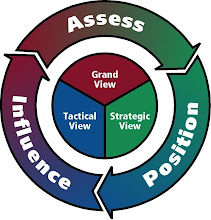
By using our Compass AE process, you are able to do the following:
  • Focus on the current objective while minding the Tangible Vision (the big picture);
  • Avoid negative circumstances while focusing on positive circumstances;
  • Maximize opportunities;
  • Adjust strategically;
  • Shape the Tangible Vision; and
  • Lead with strategic leadership .
By following your strategic dispositions, you can make better decisions. You will stay on course and complete your goal regardless of the circumstances.

Does your current plan do that?

What is the Tangible Vision?
The Tangible Vision is a goal, a plan that you work with. It also emphasizes a clearly-defined vision or mission statement that you believe in.

The first step is establishing your desired "end-in-mind" with specific details. The ideal outcome must have the value points and a tangible model that you can relate to. It also encompasses the contra-position of the desired outcome.

The next step is building the specific guidelines for each milestone. Those guidelines are based on the priorities, the approach and various circumstances for that phase.

The final step is outlining the operational steps that match the specific guidelines for each milestone.


The guidelines stated in the Tangible Vision become the strategic standard for the implementer to make decisions with. They know the positives and the negatives based on anticipated situations.

The Tangible Vision also guides the implementer on when and how to adapt the changes, what are the contingencies, etc.

In a future post, we will talk more about the basics of the Tangible Vision.

If you are interested in knowing more about our Compass AE process, please contact us at service[aatt] collaboration360[ddott]com

Copyright: 2009 Collaboration360 Consultants (C360).
Copying, posting and reproduction in any form (without prior consent) is an infringement of copyright.

#

March 17, 2009
Drones Are Weapons of Choice in Fighting Qaeda
By CHRISTOPHER DREW

A missile fired by an American drone killed at least four people late Sunday at the house of a militant commander in northwest Pakistan, the latest use of what intelligence officials have called their most effective weapon against Al Qaeda. And Pentagon officials say the remotely piloted planes, which can beam back live video for up to 22 hours, have done more than any other weapons system to track down insurgents and save American lives in Iraq and Afghanistan.

The planes have become one of the military’s favorite weapons despite many shortcomings resulting from the rush to get them into the field. An explosion in demand for the drones is contributing to new thinking inside the Pentagon about how to develop and deploy new weapons systems.

Air Force officials acknowledge that more than a third of their unmanned Predator spy planes which are 27 feet long, powered by a high-performance snowmobile engine, and cost $4.5 million apiece have crashed, mostly in Iraq and Afghanistan. Pilots, who fly them from trailers halfway around the world using joysticks and computer screens, say some of the controls are clunky.

For example, the missile-firing button sits dangerously close to the switch that shuts off the plane’s engines. Pilots are also in such short supply that the service recently put out a call for retirees to help. But military leaders say they can easily live with all that.

Since the height of the cold war, the military has tended to chase the boldest and most technologically advanced solution to every threat, leading to long delays and cost overruns that result in rarely used fighter jets that cost $143 million apiece, and plans for a $3 billion destroyer that the Navy says it can no longer afford.

Now the Pentagon appears to be warming up to Voltaire’s saying, The perfect is the enemy of the good.

/// Perfection is the state of mind. Being good is not enough. Focus on becoming excellent is the key.

In speeches, Defense Secretary Robert M. Gates has urged his weapons buyers to rush out 75 percent solutions over a period of months rather than waiting for gold-plated solutions. And as the Obama administration prepares its first budget, officials say they plan to free up more money for simpler systems like drones that can pay dividends now, especially as fighting intensifies in Afghanistan and Pakistan.

/// At this level, it is all about choosing a set of simple solutions that can provide immediate wins. Against the weak opposition, simplicity is acceptable. At some point of time, the superior competitor will compete against a greater opposition with the similar technology with advanced features.

A rare behind-the-scenes look at the use of the Predator shows both the difficulties and the rewards in pushing out weapons more quickly. I’ll be really candid, said Col. Eric Mathewson, who directs the Air Force’s task force on unmanned aerial systems. We’re on the ragged edge. He said the service has been scrambling to train more pilots, who fly the drones via satellite links from the western United States, to keep up with a near-tripling of daily missions in the last two years. Field commanders in Iraq and Afghanistan, where the Air Force is in charge of the Predators, say their ability to linger over an area for hours, streaming instant video warnings of insurgent activity, has been crucial to reducing threats from roadside bombs and identifying terrorist compounds. The C.I.A. is in charge of drone flights in Pakistan, where more than three dozen missiles strikes have been launched against Al Qaeda and Taliban leaders in recent months.

Considered a novelty a few years ago, the Air Force’s fleet has grown to 195 Predators and 28 Reapers, a new and more heavily armed cousin of the Predator. Both models are made by General Atomics, a contractor based in San Diego. Including drones that the Army has used to counter roadside bombs and tiny hand-launched models that can help soldiers to peer past the next hill or building, the total number of military drones has soared to 5,500, from 167 in 2001. The urgent need for more drones has meant bypassing usual procedures. Some of the 70 Predator crashes, for example, stemmed from decisions to deploy the planes before they had completed testing and to hold off replacing control stations to avoid interrupting the supply of intelligence. The context was to do just the absolute minimum needed to sustain the fight now, and accept the risks, while making fixes as you go along, Colonel Mathewson said. It is easier, of course, for the military to take more risks with unmanned planes.

Complaints about civilian casualties, particularly from strikes in Pakistan, have stirred some concerns among human rights advocates. Military officials say the ability of drones to observe targets for lengthy periods makes strikes more accurate. They also said they do not fire if they think civilians are nearby. The Predators were still undergoing basic testing when they were rushed into use in Bosnia and Kosovo in the 1990s and then hastily armed with missiles after the September 2001 terrorist attacks. But it was only after the military turned to new counterinsurgency techniques in early 2007, that demand for drones became almost insatiable.

Since then, Air Force Lt. Gen. Gary North, the air-component commander for the combined forces in Iraq and Afghanistan, said the service has gone to amazing lengths to increase their use. The Predators and Reapers are now flying 34 surveillance patrols each day in Iraq and Afghanistan, up from 12 in 2006. They are also transmitting 16,000 hours of video each month, some of it directly to troops on the ground.

The strains of these growing demands were evident on a recent visit to Davis-Monthan Air Force Base in Tucson, Ariz., one of four bases where Air National Guard units have been ordered to full-time duty to help alleviate crew shortages. The Guard members, along with Air Force crews at a base in the Nevada desert, are 7,000 to 8,000 miles away from the planes they are flying. Most of the crews sit at 1990s-style computer banks filled with screens, inside dimly lit trailers. Many fly missions in both Iraq and Afghanistan on the same day.

On a recent day, at 1:15 p.m. in Tucson 1:15 the next morning in Afghanistan a pilot and sensor operator were staring at gray-toned video from the Predator’s infrared camera, which can make even the darkest night scene surprisingly clear. The crew was scanning a road, looking for but not finding signs of anyone planting improvised explosive devices or lying in wait for a convoy.

As the Predator circled at 16,000 feet, the dark band of a river and craggy hills came into view, along with ribbons of farmland. We spend 70 to 80 percent of our time doing this, just scanning roads, said the pilot, Matthew Morrison.

At other times, the crews monitor insurgent compounds and watch over troops in battle. When you’re on the radio with a guy on the ground, and he is out of breath and you can hear the weapons fire in the background, you are every bit as engaged as if you were actually there, Major Morrison said. When Predators spot possible targets, officers monitoring video at command centers in Iraq and Afghanistan decide whether to order an attack.

Col. Gregg A. Davies, commander of the group that flies Predators for the Arizona Guard, said fighter planes with bigger bombs are often sent in to make the strikes. In all, the Air Force says, Predators and Reapers shot missiles on 244 of the 10,949 missions in Iraq and Afghanistan in 2007 and 2008. Air Force officials said a few crew members have had a difficult time watching the strikes. And some pilots said it can be hard to transition from being a computer-screen warrior to dinner at home or their children’s soccer games.

Another problem has been that few pilots wanted to give up flying fighter jets to operate drones. Given the shortages, the Air Force has temporarily blocked transfers out of the program. It also has begun training officers as drone pilots who have had little or no experience flying conventional planes.

Colonel Mathewson, director of the Air Force’s task force on unmanned aerial systems, said that while upgrades have been made to control stations, the service plans to eventually shift to simpler and more intuitive ground systems that could allow one remote pilot to control several drones.

Now, pilots say, it takes up to 17 steps including entering data into pull-down windows to fire a missile. And even though 13 of the 70 Predator crashes have occurred over the last 18 months, officials said the accident rate has fallen as flying hours have shot up. All told, 55 have been lost because of equipment failure, operator errors or weather. Four were shot down in Bosnia, Kosovo and Iraq; 11 were lost in combat situations, like running out of fuel while protecting troops under fire.

Given the demand for video intelligence, the Air Force is equipping 50 manned turbo-prop planes with similar cameras. And it is developing new camera systems for Reapers that could vastly expand the intelligence each plane can collect. P. W. Singer, a defense analyst at the Brookings Institution, said the Predators have already had an incredible effect, though the remote control raised obvious questions about whether the military could become more cavalier about using force.

Still, he said, these systems today are very much Model T Fords. These things will only get more advanced.

Copyright 2009 The New York Times Company
http://www.nytimes.com/2009/03/17/business/17uav.html

Sunday, September 28, 2008

Process Precedes Technology (3)


Technology connects a team together regardless of the distance.

Can the team make strategic decisions as a team regardless of the distance, the technology, the number of the people and the project culture? With our Compass AE process, they know what are the important decisions and they are ensured that they will make right decision every time.


Does your strategic project process enables your team to do that?

If you have any questions about Compass AE process, you can contact us at service [aatt] collaboration360 [dott] com