"It is the business of a general to be serene and inscrutable, impartial and self-controlled."- Art of War 11 (Griffith's translation)
Lesson #1 Never interrupt your enemy when he is making a mistake. - Napoleon If one is ahead of the game, he/she creates situations that force the opposition to self-destruct. The "pole position" holder should never be in "risky" situations that reverses the roles of "host and guest" "According to Fan Li's book, 'If you're last use yin tactics, if you're first then use yang tactics. When you have exhausted the enemy's yang tactics. When you have exhausted the enemy's tactics. When you have exhausted the enemy measures, then expand your yin to the full and seize them.' This then is the subtle mysteriousness of yin and yang according to the strategists."- Questions and Replies between T'ang T'ai-tsung and Li Wei-kung.
Lesson#2 Never give the opposition any emotional ammunition to rally their team and recover. Stay silent and smile.
Lesson#3 In planning, no useless move. In strategy, no step is in vain -Chen Hao It always amazes us that some people do not spend any time preparing themselves emotionally before broadcasting a public message. They would rarely ad-lib, thinking that he/she has the situation under control.
Regardless of one's advantage of momentum and timing, there are no positives in offending someone publicly. One should always show reverence to the opposition. In the game of politics, one's past and current opposition could be their future ally.
#
Obama Rallies the Troops and Money With DeMint’s “Waterloo”
July 21, 2009 5:18 PM
ABC News'Sarah Tobianski reports:
What started as a battle of words Monday when President Obama hit back at Republican Senator Jim DeMint of South Carolina for saying health care could be Obama’s “Waterloo," has now turned into a full blown war to rally support and money behind the president’s health care policies.
Obama’s “Organizing for America” and MoveOn.org are ramping up their campaigns to curtail - what they say - are the same old Republican “scare tactics and outright lies to stall reform.”
The groups are flooding the inboxes of supporters with requests for money and calls to members of Congress as it tackles reform in the days leading up to recess.
“With Congress only days away from finalizing their plans for reform, it's time to stand up with the President and fight back against this disastrous brand of old-style politics,” says Mitch Stewart, Director of Organizing for America. “So we need as many people as possible to publicly support the President's principles for health care reform and call on Congress to act.”
In the coming days, Organizing for America will also collect signatures of supporters on its website and publish them in papers across the country.
On Monday, the president took a similar tactic first hand.
“This isn't about me,” Obama said at a Children’s hospital. “This isn't about politics. This is about a health care system that is breaking America's families, breaking America's businesses and breaking America's economy. And we can't afford the politics of delay and defeat when it comes to health care. Not this time, not now. There are too many lives and livelihoods at stake.”
This likely won’t be the last time we see Democrats using DeMint’s words, painting Republicans as being too political, as they attempt to win the health care battle.
We told you yesterday that the White House planned on using the comments of Sen. Jim DeMint, R-SC, about opposing President Obama's health care reform efforts against the GOP.
"If we're able to stop Obama on this, it will be his Waterloo, it will break him and we will show that we can along with the American people, begin to push those freedom solutions that work in every area of our society," DeMint said on a conference call.
Today, Mr. Obama did so.
Speaking at a children's hospital, the president said, "Now, there are some in this town who are content to perpetuate the status quo, are in fact fighting reform on behalf of powerful special interests. There are others who recognize the problem, but believe -- or perhaps, hope -- that we can put off the hard work of insurance reform for another day, another year, another decade.
"Just the other day," the president continued, "one Republican senator said -- and I'm quoting him now -- 'If we're able to stop Obama on this, it will be his Waterloo. It will break him.' Think about that. This isn't about me. This isn't about politics. This is about a health care system that is breaking America's families, breaking America's businesses, and breaking America's economy." http://blogs.abcnews.com/politicalpunch/2009/07/president-obama-finds-demint-fresh.html
If one wants to connect with the masses, always focus on the needs and the wants of the majority.
Always assess, never assume. Then develop your gameplan by building your strategic overview (Tangible Vision) and your operational plan. Perform proper market research on the audience. Learn about your audience, your competition and yourself.
... I believe in the message of selling values that make sense to them. Talk to them. Learn about their values. Focus on the common values that make sense to them. Respect your audience by relating to their needs and wants. Be honest and pragmatic in your message. Sell them on new dreams and inspiring hope. Gain their trust. Connect to their soul. In terms of strategy, assess the grand picture. Gather intelligence. Reassess the intelligence and then build your Tangible Vision. Constantly gather new intelligence and know when to adjust your Tangible Vision.
If one can do that, their candidate can win. This is the Dao of the Pragmatic Strategist.
To those who have never read the Art of War, we recommend the following translations: Ames, Griffith, Mair, Minford and Sawyer,
#
Advice for California's GOP candidates for governor
The ghost of Reagan can be useful, but only to a point. Tell your own engaging stories.
By Bill Whalen
April 6, 2009
Meg Whitman struck it rich last month when she appeared on the cover of Fortune magazine, with a headline that asked if the Republican gubernatorial hopeful can "save California." It was a flattering profile, with friends and business associates attesting to her leadership skills as the former chief executive of EBay.
Less fortunate was Fortune's choice of a cover shot, which had Whitman next to a horse, holding the reins. It was similar to a photo taken years ago of a certain former California governor -- prompting Fortune editor at large Patricia Sellers to comment on CNNMoney.com that Whitman is "vying for her next big gig ... Reagan style."
Personally, I don't think Whitman was deliberately trying to tap into the GOP's subconscious by playing the Gipper card. But even if she was, if someone is willing to wear jodhpurs, clear brush and snack on jelly beans, well, that person must really want the job.
Still, the fact that a candidate would be perceived, fairly or unfairly, as mimicking Ronald Reagan a quarter of a century after he last ran for office underscores at least two problems facing California Republicans going into the 2010 gubernatorial election.
First, there's the matter of generational appeal.
The youngest Californian to have voted for Reagan in 1980 -- his first presidential landslide -- is now in his or her mid-40s, close in age to President Obama. As for Generations X and Y, its members have trouble relating to the Reagan revolution, much less to the man himself. Ask young voters who waged the Cold War and they'll likely say NyQuil and Alka-Seltzer. For the same reason that the Dodgers showcase Manny Ramirez and not Kirk Gibson, California Republicans have to resist the urge to revisit the greatest hits of the 1980s and making the election a history lesson on "Morning in America." Save it for Lincoln Day dinners, not the campaign trail.
The second problem: authenticity.
For all its foibles, the electorate has a good truth detector. Hillary Rodham Clinton ran for president and handled the Iraq war issue as her husband would: triangulation and double-talk. Enough Democratic primary voters saw through it to deny her the nomination. Ditto Mitt Romney, who couldn't sell Republicans beyond the Iowa caucuses on a centrist record in Massachusetts and an overly simplistic conservative agenda. Here in California, Arnold Schwarzenegger played the role of the "next Hiram Johnson" and the "next Pat Brown" before the current star-turn as a "post-partisan" governor. Republicans don't know which if any of the many Arnolds to believe, so now they'll attempt to punish him in next month's special election.
For Whitman and Steve Poizner, the state insurance commissioner and her principal rival in the GOP primary, authenticity is key to replacing an actor-turned-governor. Both candidates are relative newcomers to politics (it's Whitman's first campaign; Poizner's third in six years). They will have to answer to accusations that their candidacies are fueled more by opportunism and voter restlessness than core convictions.
But there is one area where they would do well to shamelessly imitate Reagan -- his path to office. As with Whitman's campaign today, the first Reagan run for governor began to take shape soon after the Democrats' winning presidential election in 1964 and a coast-to-coast Republican meltdown. But, although the Reagan campaign was born of the moment, the candidate had been rethinking his progressive roots for the better part of 15 years, ultimately rejecting President Franklin D. Roosevelt's New Deal and the Democratic Party.
Perhaps Whitman and Poizner can't claim the same ideological evolution or the same prolonged path to the state stage. But, at a minimum, they can tell us how they got to where they are today and what seminal moments shaped -- or reshaped -- their thinking. For Whitman, was it cracking the glass ceiling in the corporate world? For Poizner, was it teaching low-income kids?
Using candor and insightfulness to weave an engaging narrative worked for Reagan four decades ago in explaining how he came to distrust government. More recently, it worked for Schwarzenegger in the 2003 recall election in convincing voters that the tough guy on screen had an open heart and an open mind.
As individuals whose run for office is financed by personal fortunes born of ingenuity rather than the GOP cliche of trust funds, Whitman and Poizner should leap at the chance to show they are reflective souls, not some manifestation of focus groups and hackneyed rhetoric or the product of political consultants.
To borrow very loosely from Reagan, taking such an approach might go a long way in tearing down the wall that keeps Republicans out of higher office in California.
Bill Whalen, a research fellow at Stanford University's Hoover Institution, was chief speechwriter for former California Gov. Pete Wilson.
Go is one of the most popular board strategy game in Asia. While this game takes less than one hour to learn and a lifetime to master, it has more technical complexity than Chess.
Unlike the game of Chess, the top masters of this game have not been defeated by a computer. This game was developed in ancient China and refined in Japan. It is called WeiQi in Chinese or more popularly known by the Japanese word Go. The literal meaning is to surround. (As a side note, Go is called Baduk in Korea.) For this post, the term Go will be used to describe this mysterious but ancient Asian board strategy game.
Historically, Go was considered one of the four great accomplishments of ancient China, one of the worthy pursuits of a lifetime, along with poetry, archery, and calligraphy. It is both an art and a mental exercise - ingeniously disguised as a game. People of all ages can play and enjoy Go, from children of five or six to people in their nineties. Not only was Go popular with royalty, it was also a favorite exercise for warriors, scholars and philosophers.
The object of this game is simple: control the greatest quantity of territory by surrounding your opponent's stones in a 19 x 19 gridded board with the minimal amount of pieces. Stones are placed on any of the three hundred sixty-one intersections. To some enthusiasts of Go, there is a philosophical bent to it. As in martial arts, a player's Go game is an extension of their view of life.
History
Go originated in China about 4000 years ago. Japan imported the game of Go around the eighth century. Players in eastern Asia have excelled at this game throughout modern times. Go reached the western hemisphere in the late 1800s. Completely logical in design, the game of Go has withstood the test of time. Today Go survives in its original form as the oldest game in the world. It has been said that there are over 100 million devotees of this game.
Asian Go masters considered the Go board to be a microcosm of the universe - an extremely complex and chaotic universe. In their eyes, an empty game board is a visual paradigm of simplicity and order.
In fact, the possibilities of game play are endless. The ancient Go masters has said that Go games are just like snowflakes – no two games are alike.
Playing the Game
A typical game of Go starts with two players and an empty game board. Players would alternate putting black and white stones on the board to surround an area or territory. Whoever has more territory at the end of the game is the winner. There are nineteen horizontal and nineteen vertical game lines on the standard board,which forms a grid of 361 intersections or "points."
During a typical game of Go, the four major goals of each player are the following:
Surround territory.
Reduce their opponent's territory.
Capture enemy stones.
Protect their own stones.
The winner is always the player who has accomplished these goals more efficiently.
The goal is to make the opponent to say, "‘I pass," meaning there is no way of achieving any of the above goals. The game is then over.
Passing presumes that all claimed territories are completely surrounded (all fence sections are in place) and no stones are in atari (a position to be captured) along the borders between opposing live groups.
To win in Go, all you have do to control a minimum of 181 points of the board. Sound simple?
Learning Curve
It has been said that Go is a game that takes a minimum of nine minutes to learn and nine years to win. In reality, it usually takes a lifetime to master.
After hundred of games, one gains the experience that spending too much time looking at the small-scale tactical side of a confrontation can cause one to miss the large picture and as a consequence, lose badly. On the other hand, if one sets up patterns of safety or executes attacks without caring to examine and adapt to the changing situation, the other player can prevail. In both cases it becomes difficult to win.
The consummate Go players are those who don't waste a move or a resource. Every move that is executed should serve a small but continuous move toward the long-term objective of the player. It has been said that the three attributes of a consummate Go player are patience, persistence and the ability to adapt to any game situations.
Playing Against Go Computer Software
While Go is a simple game to learn, with its endless permutations it is almost impossible to master. Currently, the brute force of computers like Deep Blue, which can rapidly explore the possible outcomes of a game and choose the best course of action, is overwhelming chess masters. This "brute force" approach is not applicable to Go. For one thing, brute force depends on the ability to perform a quick, accurate positional analysis, but it is qualitatively more difficult to evaluate a "Go" position than a "Chess" position. To succeed in the game of Go, deep analysis is often required just to decide which strategic position favors one side or the other. A single mistake in this analysis could fatally throw off a computer evaluation.
As a result, Go is a much more interesting computing problem than Chess. Go programmers must try to replace exhaustive search with expert knowledge, as human players do. They must approximate human perception judgment and reasoning. So far there has been little success: the best Go computers today play at the level of an experienced beginner.
Comparing the Game of Go to the Game of Chess
Before a Go game starts, the board is empty, whereas in Chess the game board is full of pieces. In a game of Chess, from the start to finish pieces are usually exchanged and positions are minimized to an empty board with a few men left standing. The winner is when one of the player's kings is captured.
Compared to Chess, Go is a total technical paradox. A typical Go game starts with an empty board and usually ends with a full board with the occupation of pieces by both sides with some exchanges of pieces for the control of selective territory. What makes Go more distinguishable from Chess is that all of the pieces possess equal importance.
Someone told me that comparing the technicalities of Go to that of Chess is like comparing philosophies of two different cultures - Asian and Western. This quote from Descartes describes an aspect of the Western culture and the game of Chess: "I think, therefore I am." Where the quote "We think therefore I am…" illustrates a basic of Asian culture and the game of Go.
The success of a winning Go game is when all of the pieces can work together, whereas in the game of Chess an uncertain number of pieces are usually sacrificed for the single aim of victory.
A quote from Trevanian's book, Shibumi, is a good representation of the metaphorical difference between Go and Chess: "Go appeals to the philosopher in any man and Chess to the merchant in him."
Conclusion
What the game of Go has taught a budding player is to think from a grand view. Do not take anything only at face value: Examine the possibilities. Test them if possible. Anything you do (practice, perform, and produce) is only as good as you are. To succeed in life as in the game of Go, one must start by occupying a strategic corner, then develop a strategic sphere of influence by focusing on continuous progress toward long-term strategic supremacy.
If you want to learn a discipline that focuses on developing a strategic sphere of influence by forsaking short-term territorialgains and concentrating only on continuous progress toward long-term dominance, the game of Go may be the answer that you are seeking. It only takes less than an hour (nine minutes if you were a genius) to learn Go, but do you have a lifetime to master this game?
Following is our example of combining the Ten Golden Rules of Go (围棋十决) with some of the principles from the Art of War:
1. Tan Bu De Sheng (贪不得胜)- The greedy does not succeed. "And for this reason, the wise general in his deliberations must consider both favourable and unfavourable factors. By taking into account the favourable factors, he makes his plan feasible; by taking into account the unfavourable, he may resolve the difficulties." - The Art of War, 8
2. Ru Jie Yi Huan (入界宜缓)- Be unhurried to enter opponent´s territory "In level ground occupy a position which facilitates your action. With heights to your rear and right, the field of battle is to the front and the rear is safe." - The Art of War, 7
3. Gong Bi Gu Wo (攻彼顾我)- Take care of oneself when attacking the other Anciently the skillful warriors first made themselves invincible and awaited the enemy's moments of vulnerability. Invincibility depends on one's self; the enemy's vulnerability on him. It follows that those skilled in war can make themselves invincible but cannot cause an enemy to be certainly vulnerable. ...
Therefore it is said that one may know how to win, but cannot necessarily do so. Invincibility lies in the defense; the possibility of victory in the attack. One defends when his strength is inadequate; he attacks when it is abundant. The experts in defense conceal themselves as under the ninefold earth; those skilled in attack move as from above the ninefold heavens. Thus they are capable both of protecting themselves and of gaining complete victory. - The Art of War, 4
Generally, he who occupies the field of battle first and awaits his enemy is at ease; he who comes later to the scene and rushes into the fight is weary. And therefore those skilled in war bring the enemy to the field of battle and are not brought there by him. One able to make the enemy come to his own accord does so by offering him some advantage. And one able to prevent him from coming does so by hurting him. - The Art of War, 6 4. Qi Zi Zheng Xian (弃子争先)- Discard a stone to gain sente "When torrential water tosses boulders, it is because of momentum; When the strike of a hawk breaks the body of its prey, it is because of timing. Thus the momentum of one skilled in war is overwhelming, and his attack precisely regulated. His potential is that of a fully drawn crossbow; his timing, the release of the trigger. - The Art of War, 5
"When campaigning, be swift as the wind; in leisurely march, majestic as the forest; in raiding and plundering, like fire; in standing, firm as the mountains. As unfathomable as the clouds, move like a thunderbolt." - The Art of War, 7
/// note: The proverb is about sacrificing time, space and resources to continue one's momentum.
5. She Xiao Jiu Da (舍小就大)- Abandon small to save big Ground in which the army survives only if it fights with the courage of desperation is called 'death'. And therefore, do not fight in dispersive ground; do not stop in frontier borderlands.
Do not attack an enemy who occupies key ground; in communicating ground do not allow your formations to become separated. - The Art of War, 11
6. Feng Wei Xu Qi ((逢危须弃)- When in danger, sacrifice In enclosed ground, resourcefulness is required. In death ground, fight. - The Art of War, 8
7. Shen Wu Qing Su (慎勿轻速) - Make thick shape, avoid hasty moves "When you plunder the countryside, divide your forces. When you conquer territory, divide the profits. Weigh the situation, then move. ..." - The Art of War, 7 8. Dong Xu Xiang Ying (动须相应) - A move must respond to the opponent's "In planning no useless move. In strategy, no step is vain." - Chen Hao
9. Bi Qiang Zi Bao (彼强自保) - Against strong positions, play safely
When the army traverses mountains, forests, precipitous country, or marches through defiles, marshlands, or swamps, or any place where the going is hard, it is difficult ground.
- The Art of War, 11
10. Shi Gu Qu He (势孤取和) - Look for peace, avoid fighting in an isolated or weak situation You should not encamp in low-lying land. In communicating ground, unite with your allies. You should not linger in desolate ground. - The Art of War, 8
In terms of strategic project over-viewing, Gates assessed the grand picture, understood the rule of "economic laws never change, while technology changes", and made the wise decision on focusing on the "75% solution" approach instead choosing the "gold plated" solution.
Due to the urgency of their current needs and the constant change of technology, it was more efficient for the Dept of Defense to focus on a series of pragmatic solutions.
Good strategic planning and decision making depends greatly on one's assessment of themselves, their opposition and what is the possible reaction from the opposition. Then building a plan upon that evaluation.
Against a "poorly resourced" opposition, one has more latitude in their decision-making. He can afford some loss of time and resources.
When competing against an unknown opposition with greater resources, there is always uncertainty in their reaction. Regardless of their resources, there is always an weakness lurking somewhere in their armor. The underdog must properly assess the opposition in order to detect that "Achilles heel."
When leading with Sunzi’s strategic principles, one focuses on defeating the opposition in the least amount of time, with the minimum cost and the smallest damage to the grand settings.
The approach sounds conceptually simple.
The question is: does the company have the experienced professionals that are required to complete this objective? ... It is always a challenge to complete an objective on time, on budget and on target.
Strategic Disposition After completing the assessment, the next stage is developing one's strategic disposition through solid planning and the understanding of each competitor's strategic disposition.
When developing the game plan, one determines whether to be flexible or efficient in their strategic approach.
Chinese strategy classics emphasize the importance of focusing on flexibility and being efficient in an unpredictable setting. While completing short term goals and objectives, one builds momentum for a forthcoming predictable setting.
When implementing in a predictable setting, focus on becoming efficient while minding the grand settings.
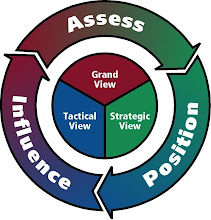
By using our Compass AE process, you are able to do the following:
Focus on the current objective while minding the Tangible Vision (the big picture);
Avoid negative circumstances while focusing on positive circumstances;
Maximize opportunities;
Adjust strategically;
Shape the Tangible Vision; and
Lead with strategic leadership .
By following your strategic dispositions, you can make better decisions. You will stay on course and complete your goal regardless of the circumstances.
Does your current plan do that? What is the Tangible Vision? The Tangible Vision is a goal, a plan that you work with. It also emphasizes a clearly-defined vision or mission statement that you believe in.
The first step is establishing your desired "end-in-mind" with specific details. The ideal outcome must have the value points and a tangible model that you can relate to. It also encompassesthe contra-position of the desired outcome. The next step is building the specific guidelines for each milestone. Those guidelines are based on the priorities, the approach and various circumstances for that phase.
The final step is outlining the operational steps that match the specific guidelines for each milestone.
The guidelines stated in the Tangible Vision become the strategic standard for the implementer to make decisions with. They know the positives and the negatives based on anticipated situations.
The Tangible Vision also guides the implementer on when and how to adapt the changes, what are the contingencies, etc.
In a future post, we will talk more about the basics of the Tangible Vision.
If you are interested in knowing more about our Compass AE process, please contact us at service[aatt] collaboration360[ddott]com
Copyright: 2009 Collaboration360 Consultants (C360). Copying, posting and reproduction in any form (without prior consent) is an infringement of copyright. #
March 17, 2009 Drones Are Weapons of Choice in Fighting Qaeda By CHRISTOPHER DREW
A missile fired by an American drone killed at least four people late Sunday at the house of a militant commander in northwest Pakistan, the latest use of what intelligence officials have called their most effective weapon against Al Qaeda. And Pentagon officials say the remotely piloted planes, which can beam back live video for up to 22 hours, have done more than any other weapons system to track down insurgents and save American lives in Iraq and Afghanistan.
The planes have become one of the military’s favorite weapons despite many shortcomings resulting from the rush to get them into the field. An explosion in demand for the drones is contributing to new thinking inside the Pentagon about how to develop and deploy new weapons systems.
Air Force officials acknowledge that more than a third of their unmanned Predator spy planes which are 27 feet long, powered by a high-performance snowmobile engine, and cost $4.5 million apiece have crashed, mostly in Iraq and Afghanistan. Pilots, who fly them from trailers halfway around the world using joysticks and computer screens, say some of the controls are clunky.
For example, the missile-firing button sits dangerously close to the switch that shuts off the plane’s engines. Pilots are also in such short supply that the service recently put out a call for retirees to help. But military leaders say they can easily live with all that.
Since the height of the cold war, the military has tended to chase the boldest and most technologically advanced solution to every threat, leading to long delays and cost overruns that result in rarely used fighter jets that cost $143 million apiece, and plans for a $3 billion destroyer that the Navy says it can no longer afford.
Now the Pentagon appears to be warming up to Voltaire’s saying, The perfect is the enemy of the good.
/// Perfection is the state of mind. Being good is not enough. Focus on becoming excellent is the key.
In speeches, Defense Secretary Robert M. Gates has urged his weapons buyers to rush out 75 percent solutions over a period of months rather than waiting for gold-plated solutions. And as the Obama administration prepares its first budget, officials say they plan to free up more money for simpler systems like drones that can pay dividends now, especially as fighting intensifies in Afghanistan and Pakistan.
/// At this level, it is all about choosing a set of simple solutions that can provide immediate wins.Against the weak opposition, simplicity is acceptable. At some point of time, the superior competitor will compete against a greater opposition with the similar technology with advanced features.
A rare behind-the-scenes look at the use of the Predator shows both the difficulties and the rewards in pushing out weapons more quickly. I’ll be really candid, said Col. Eric Mathewson, who directs the Air Force’s task force on unmanned aerial systems. We’re on the ragged edge. He said the service has been scrambling to train more pilots, who fly the drones via satellite links from the western United States, to keep up with a near-tripling of daily missions in the last two years. Field commanders in Iraq and Afghanistan, where the Air Force is in charge of the Predators, say their ability to linger over an area for hours, streaming instant video warnings of insurgent activity, has been crucial to reducing threats from roadside bombs and identifying terrorist compounds. The C.I.A. is in charge of drone flights in Pakistan, where more than three dozen missiles strikes have been launched against Al Qaeda and Taliban leaders in recent months.
Considered a novelty a few years ago, the Air Force’s fleet has grown to 195 Predators and 28 Reapers, a new and more heavily armed cousin of the Predator. Both models are made by General Atomics, a contractor based in San Diego. Including drones that the Army has used to counter roadside bombs and tiny hand-launched models that can help soldiers to peer past the next hill or building, the total number of military drones has soared to 5,500, from 167 in 2001. The urgent need for more drones has meant bypassing usual procedures. Some of the 70 Predator crashes, for example, stemmed from decisions to deploy the planes before they had completed testing and to hold off replacing control stations to avoid interrupting the supply of intelligence. The context was to do just the absolute minimum needed to sustain the fight now, and accept the risks, while making fixes as you go along, Colonel Mathewson said. It is easier, of course, for the military to take more risks with unmanned planes.
Complaints about civilian casualties, particularly from strikes in Pakistan, have stirred some concerns among human rights advocates. Military officials say the ability of drones to observe targets for lengthy periods makes strikes more accurate. They also said they do not fire if they think civilians are nearby. The Predators were still undergoing basic testing when they were rushed into use in Bosnia and Kosovo in the 1990s and then hastily armed with missiles after the September 2001 terrorist attacks. But it was only after the military turned to new counterinsurgency techniques in early 2007, that demand for drones became almost insatiable.
Since then, Air Force Lt. Gen. Gary North, the air-component commander for the combined forces in Iraq and Afghanistan, said the service has gone to amazing lengths to increase their use. The Predators and Reapers are now flying 34 surveillance patrols each day in Iraq and Afghanistan, up from 12 in 2006. They are also transmitting 16,000 hours of video each month, some of it directly to troops on the ground.
The strains of these growing demands were evident on a recent visit to Davis-Monthan Air Force Base in Tucson, Ariz., one of four bases where Air National Guard units have been ordered to full-time duty to help alleviate crew shortages. The Guard members, along with Air Force crews at a base in the Nevada desert, are 7,000 to 8,000 miles away from the planes they are flying. Most of the crews sit at 1990s-style computer banks filled with screens, inside dimly lit trailers. Many fly missions in both Iraq and Afghanistan on the same day.
On a recent day, at 1:15 p.m. in Tucson 1:15 the next morning in Afghanistan a pilot and sensor operator were staring at gray-toned video from the Predator’s infrared camera, which can make even the darkest night scene surprisingly clear. The crew was scanning a road, looking for but not finding signs of anyone planting improvised explosive devices or lying in wait for a convoy.
As the Predator circled at 16,000 feet, the dark band of a river and craggy hills came into view, along with ribbons of farmland. We spend 70 to 80 percent of our time doing this, just scanning roads, said the pilot, Matthew Morrison.
At other times, the crews monitor insurgent compounds and watch over troops in battle. When you’re on the radio with a guy on the ground, and he is out of breath and you can hear the weapons fire in the background, you are every bit as engaged as if you were actually there, Major Morrison said. When Predators spot possible targets, officers monitoring video at command centers in Iraq and Afghanistan decide whether to order an attack.
Col. Gregg A. Davies, commander of the group that flies Predators for the Arizona Guard, said fighter planes with bigger bombs are often sent in to make the strikes. In all, the Air Force says, Predators and Reapers shot missiles on 244 of the 10,949 missions in Iraq and Afghanistan in 2007 and 2008. Air Force officials said a few crew members have had a difficult time watching the strikes. And some pilots said it can be hard to transition from being a computer-screen warrior to dinner at home or their children’s soccer games.
Another problem has been that few pilots wanted to give up flying fighter jets to operate drones. Given the shortages, the Air Force has temporarily blocked transfers out of the program. It also has begun training officers as drone pilots who have had little or no experience flying conventional planes.
Colonel Mathewson, director of the Air Force’s task force on unmanned aerial systems, said that while upgrades have been made to control stations, the service plans to eventually shift to simpler and more intuitive ground systems that could allow one remote pilot to control several drones.
Now, pilots say, it takes up to 17 steps including entering data into pull-down windows to fire a missile. And even though 13 of the 70 Predator crashes have occurred over the last 18 months, officials said the accident rate has fallen as flying hours have shot up. All told, 55 have been lost because of equipment failure, operator errors or weather. Four were shot down in Bosnia, Kosovo and Iraq; 11 were lost in combat situations, like running out of fuel while protecting troops under fire.
Given the demand for video intelligence, the Air Force is equipping 50 manned turbo-prop planes with similar cameras. And it is developing new camera systems for Reapers that could vastly expand the intelligence each plane can collect. P. W. Singer, a defense analyst at the Brookings Institution, said the Predators have already had an incredible effect, though the remote control raised obvious questions about whether the military could become more cavalier about using force.
Still, he said, these systems today are very much Model T Fords. These things will only get more advanced.
Copyright 2009 The New York Times Company http://www.nytimes.com/2009/03/17/business/17uav.html
We are a strategic project consulting and training company that trains project teams to operate effectively by using our Compass AE methodology. Our process also enables project implementers to make quality strategy decisions anywhere as a team regardless of the distance, the technology and the project culture. We also advise clients on how to utilize the Chinese strategy principles and general strategic processes as they apply in competitive situations.