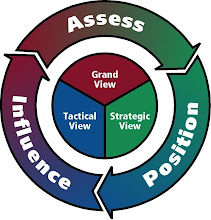
During the act of assessing or planning, he or she must always consider the risk factor.
 "One who abandons what is nearby to plan for what is distant will labor without success. One who abandons the distant to plan for the nearby will be at ease and attain lasting results." - Huang Shek Gong, 9
#
June 16, 2009
Settling for Par: Pros More Likely to Play It Safe
By ALAN SCHWARZ
When PGA Tour golfers from Tiger Woods down to the greenest rookie draw back their putters this week at the United States Open, their scorecards will be sabotaged by a force as human as it is irrational: risk intolerance.
Even the world’s best pros are so consumed with avoiding bogeys that they make putts for birdie discernibly less often than identical-length putts for par, according to a coming paper by two professors at the University of Pennsylvania’s Wharton School. After analyzing laser-precise data on more than 1.6 million Tour putts, they estimated that this preference for avoiding a negative (bogey) more than gaining an equal positive (birdie) known in economics as loss aversion costs the average pro about one stroke per 72-hole tournament, and the top 20 golfers about $1.2 million in prize money a year.
Contrary to most academic studies involving sports, at which athletes typically scoff, a handful of the tour’s top putters did not dispute this finding. Simply put if not putt they admitted to being spooked enough by bogeys that they will ultimately cost themselves strokes to avoid them. Call it the bogeyman.
Par putts just seem to be more critical because if you miss you drop a shot if you miss a birdie putt, it doesn’t seem to have the same effect, said Jim Furyk, one of the tour’s best putters.
Added Justin Leonard: When putting for birdie, you realize that, most of the time, it’s acceptable to make par. When you’re putting for par, there’s probably a greater sense of urgency, so therefore you’re willing to be more aggressive in order not to drop a shot. It makes sense.
Of course, it makes no sense at all: each stroke counts as one on a scorecard, whether for eagle or triple-bogey on any particular hole. The goal is to finish with the fewest strokes, regardless of what each might be artificially termed. All else being equal distance from the cup, one’s proximity to the lead or cut, the course difficulty and so on putts should be handled the same way.
But they are not, according to the study of almost 200 tour professionals from 2004 through 2008. Using data the tour regularly records on every ball’s green location accurate to the nearest inch, the professors found that birdie putts were made about 3 percent less often than otherwise identical putts for par. (In effect, players tell themselves before birdie attempts, Let’s just get close, rather than, I have to make this.) Given that players typically attempt nine birdie putts per round, this cost each golfer about one stroke per tournament which can translate to hundreds of thousands of dollars in prize money.
The professors, Devin Pope and Maurice Schweitzer, seemingly anticipated every But what about? reflex from golf experts. The tendency to miss birdie putts more often existed regardless of the player’s general putting or overall skill; round or hole number; putt length; position with respect to the lead or cut; and more.
As would be expected, the difference decreased on routine short putts and also decreased very far from the hole, where the chance of making the putt is small to begin with. It peaked on putts from about 6 to 12 feet. Even Woods, roundly considered the best putter ever, exhibited the trait at roughly the tour average.
The finding may become significant among behavioral economists, many of whom have suspected that the loss aversion found through contrived experiments might not be demonstrated by actual, expert competitors vying for high stakes. The paper is being submitted this week for publication in an economic journal.
Even experienced professionals playing for high stakes are not rational, Pope said. Tiger Woods, the model of perfection and what an economist would think of as a rational agent, even he exhibits these biases. And if he exhibits these biases, why not business leaders? There are a lot of applications. Rather than resist any insight from ivory tower academics, several golfers admitted to handling identical birdie and par putts differently and appeared somewhat amused at being found out. Geoff Ogilvy, who made par putts 4.1 percent more often than birdie putts from the same distance, said: A par putt seems more final. It shouldn’t make any difference, should it? And Paul Goydos, who showed the effect at 4.4 percent, said it probably affected him even more on putts for eagle.
If I’ve got a 25-footer for eagle, it seems like I’m more conservative than with a 25-footer for either birdie or par for whatever reason, Goydos said. I think the worst thing you can do is three-putt for par on a par 5. That’s one that drives me more crazy than anything else. Maybe that’s why I’m at the very bottom of the tour in eagles made.
But just as quickly as pro golfers admitted to their costly habit, they dismissed the idea of being able to do much about it. Stewart Cink, who showed a 3.3 percent effect, said that try as he might, he would never be able to convince himself that every putt is the same.
You can’t fool yourself, Cink said. But this is one of the reasons why we use sports psychology, and we try to have a preshot routine so we do the same thing, approach every putt the same way. It’s not always glamorous, and it’s not always possible in reality. The psychological preference to avoid a perceived penalty (losing a stroke relative to par) rather than go for a perceived gain (gaining a stroke) has some benefit.
Golfers tended to leave their conservatively stroked birdie putts slightly closer to the cup than more aggressively missed pars leading to their making their follow-up shot more often. But that temporary gain was far outweighed by the overall cost in strokes. The birdie-versus-par effect varies in ways that many golfers would instinctually predict. The tendency to make similar birdie putts less often than pars becomes less prevalent with each tournament round as players are judged more against one another than against par.
The elite tour players generally show less of the trait than marginal ones. And the difference decreases as a player sees himself or his partners handle a particular green. But the effect is always there, even if a good reason for it is not. A 10-footer for par feels more important than one for birdie, said Goydos, a two-time winner on the tour. The reality is, that’s ridiculous. I can’t explain it in any way other than that it’s subconscious. And pars are O.K. bogeys aren’t.
Larry Dorman contributed reporting.
Copyright 2009 The New York Times Company
http://www.nytimes.com/2009/06/16/sports/golf/16study.html?em

Those who are positionally competing in an intensive competition, should remember the following quote from Questions and Replies between T'ang T'ai-tsung and Li Wei-kung.
"According to Fan Li's book, 'If you're last use yin tactics, if you're first then use yang tactics. When you have exhausted the enemy's yang tactics. When you have exhausted the enemy's tactics. When you have exhausted the enemy measures, then expand your yin to the full and seize them.' This then is the subtle mysteriousness of yin and yang according to the strategists."


+%28XL%29.jpg)