skip to main |
skip to sidebar
 There is a slow inclining trend of virtual offices and large empty office buildings. ...
Our research tells us that the era of working in one central office is on a decline. The era of the virtual office began in the early 1990's and will continue to grow exponentially.
The question is how do you get your team to strategically collaborate as a team?

#
March 2, 2008
The Office as Architectural Touchstone By DAVID W. DUNLAP
IT will be either one of the most challenging fixer-uppers in the history of modern architecture or one of the most significant tear-downs. In any case, Alcatel-Lucent Bell Labs in Holmdel, N.J., is for sale.
A decade ago, as many as 6,500 people worked in the low-slung complex, whose pioneering mirrored-glass facade reflects a gleaming three-legged water tower that looks like a giant Bell Laboratories transistor and pond-speckled landscapes where waterfowl outnumber humans. Today, it is empty but for a few caretakers.
On a winter day, its vast atriums shudder with the sound of wind buffeting the sawtooth skylights. The only things moving along the miles of corridors are shadows. And a prospective owner — probably more attracted by a contiguous 473-acre parcel near the Garden State Parkway in Monmouth County than by a vast, unwieldy monument — could demolish every bit of it. Designed in 1957 for Bell Laboratories, part of the former Bell System, by the architectural giant Eero Saarinen and the landscape firm Sasaki, Walker & Associates, the complex no longer suits today’s much smaller Bell Labs or its corporate parent, Alcatel-Lucent.
The property is on the market, but it is hard to imagine finding a new occupant for a structure custom-built two generations ago for physical lab work by a giant monopoly that no longer exists. The main building, with 1.675 million square feet of space, is organized into four pavilions set among atriums and linked by sky bridges. The perimeter circulation pattern leaves few offices with their own windows. Concrete walls divide many spaces. While the fate of the Holmdel building is the most compelling preservation drama of the moment, it is not the only suburban corporate campus confronting 21st-century realities.Mr. Saarinen’s research center for I.B.M. in Yorktown Heights, and Edward Durell Stone’s PepsiCo World Headquarters in Purchase, both in Westchester County, are among those that have been immaculately kept by their corporate occupants. But Union Carbide’s former headquarters in Danbury, Conn., has been in a state of flux almost since it opened. Others, like the General Foods headquarters in White Plains, have shed their original use and identity. I.B.M. kept its headquarters in Armonk, but in a newer and much smaller building.
“The less-centralized business model that I.B.M. has moved to can be done without the massive physical headquarters of past business eras,” said Fred P. McNeese, director of I.B.M.’s corporate media relations. “There is also a different way of working, caused by advances in technology, that provides persons the ability to work remotely, doing the things that would have required them to come into a headquarters building in the past.”/// Project implementors operate remotely is the growing trend.
How much longer can any of these postwar corporate centers — perfect embodiments of a moment in history when cities began to feel pestilential, when suburban flight grew easier on the interstates and when faith in America’s corporate power was unshakable — maintain the architecture and landscaping that made them such landmarks?
... ... Precisely because of those changes, solitary corporate campuses are regarded as “an evolutionary dead end” by Robert D. Yaro, president of the Regional Plan Association, a nonprofit planning group concerned with New Jersey, New York and Connecticut. “They don’t provide the adaptable, flexible space that companies need,” he said. “They’re great architecture, but they act as a kind of straitjacket.”... “Driving a long distance to a sylvan location is less appealing than it used to be,” Mr. Yaro said. In the tumultuous wake of World War II, the stand-alone corporate center in a verdant setting seemed like the wave of the future. The prospect of World War III loomed large enough that when the General Foods Corporation announced it was trading Park Avenue for Westchester Avenue in 1951, it took pains to say that “the possibility of an atomic attack on New York was not a factor.”
///
The emergence of the global economy and information technology has changed the rules of the global marketplace. ... The ease of communications and absolute privacy are essential to the remote project team. It is also important to collaborate as a team. Does your team know how to collaborate anywhere as a team?
Copyright 2008 The New York Times Company
http://www.nytimes.com/2008/03/02/nyregion/nyregionspecial2/02Rlandmark.html?
 The question is: how do you get a crowd to work as a team?###March 3, 2008E-Commerce ReportPutting Innovation in the Hands of a CrowdBy BOB TEDESCHIIF executives are going to rely on the wisdom of the masses for business help, it’s probably time the masses get a little compensation for it.That’s the theory behind Kluster, the newest in a lineup of companies using the Web to channel the collective wisdom of strangers into meaningful business strategies. With a cash reward system for contributors and a big beginning at the TED conference last week in Monterey, Calif., Kluster hopes to attract just enough visitors with just enough business smarts to gain early momentum.Along with members of the public, the 1,000 attendees of TED, a conference named for technology, entertainment and design that attracts leaders from many industries, used Kluster to generate ideas for a new product, then chose the most promising one and collaborated on the design. The result was Over There, an educational board game intended to promote cultural awareness, with questions like, What percentage of the world’s population lives further than one mile from their nearest pure water source?According to Ben Kaufman, Kluster’s 21-year-old founder, there were a few parameters, including provisions that the product could not be wider or longer than eight inches and only specific materials, like single-injection plastic, could be used. Going into the process, Mr. Kaufman said he hoped the product would be something that doesn’t just serve an uninteresting consumer need, but a humanitarian product that can be used by everyone.Mr. Kaufman said that would actually be a departure for him. As a founder of Mophie, a manufacturer of iPod accessories, Mr. Kaufman last year held a product design contest at the Macworld conference, with attendees submitting ideas and using a company Web site to refine designs and vote on the winner.Out of that came the Bevy a key chain and bottle opener built into the case for an iPod Shuffle which Mophie sold by the thousands to retailers around the world. On the heels of that success, Mr. Kaufman in August sold Mophie for an undisclosed sum, then set out to build a business out of the process he used at Macworld.Kluster includes a number of refinements to that process. Those who join are given 1,000 units of Kluster scrip, called watts, and they may earn more by telling the site more about themselves, like their area of expertise, age and income. Meanwhile, businesses are invited to post specific tasks to be addressed, like creating a new product, logo or corporate event.Participants browsing the ideas offered by Kluster members can bet some or all of their watts on the ideas they most believe in, or post ideas of their own. Those who had winning ideas earn at least 20 percent of the bounty offered by the company that sought the idea, as well as more watts, while those who bet on the winning idea earn watts. Those who bet wrong lose what they wagered.Mr. Kaufman said several well-known manufacturers would offer projects on the site after the TED contest. He would not disclose the identities of those businesses, but some, he said, would offer $50,000 or more for winning ideas, while others expect to give far less and hope that they have enough good will among their customers to spur ideas.Kluster will make money, he said, by taking 15 percent of any rewards offered to projects and by charging fees for prominent placement of projects on the site, among other things.Don Tapscott, the business strategy consultant and co-author of the book Wikinomics, said executives were quickly warming to the strategic value of P.F.E. ideas, or those proudly found elsewhere.Throughout the 20th century, we’ve had this view that talent is inside the company, Mr. Tapscott said. But with the Web, collaboration costs are dropping outside the boundaries of companies, so the world can become your talent.Mr. Tapscott, who credited Procter & Gamble with the P.F.E. concept, said executives can go overboard with the idea of outsourcing innovation if, in seeking such help, they expose too much of a company’s trade secrets. But so far, he knows of no business that has done so.They always err on the other side, he said. They don’t do enough.Among the obstacles in Kluster’s path are sites like InnoCentive and Cambrian House, which operate similarly. InnoCentive, based in Waltham, Mass., was until late last year a forum for solving science-related problems, typically for cash rewards. In September, it expanded into business, engineering and computer science, among other things. Since then it has grown by 15,000 participants, to 140,000, the company said.Cambrian House, which is based in Calgary, Alberta, and has 64,000 participants, will also expand its Web site this year to accommodate projects across a broader range of industries. Until now, said Jasmine Antonick, a Cambrian House founder, the site has attracted mostly software and Web entrepreneurs.Ms. Antonick expects the site to be profitable later this year, when it receives a share of payments made by businesses to several of Cambrian House’s participants, like two men who created Gwabs, an online video game that is to be distributed by an undisclosed company this summer.Next month, it will introduce VenCorps, a site on which venture capitalists and other investors will review business ideas from the public and, after about 30 days, reward the best idea with $50,000 in exchange for a share of ownership.VenCorps is a partnership between Cambrian House and Spencer Trask Collaborative Venture Partners, a division of the New York venture firm Spencer Trask. Sean Wise, a Collaborative Venture Partners founder, says he has high hopes for the site.No matter how good a V.C. I could be, he said, I could never be smarter than the wisdom of a collective community.Josh Bernoff, an analyst with Forrester Research, said that Kluster had commercial potential. Asking communities for help with solving problems is certainly going to help businesses, he said. It’s just not something you can count on delivering business value yet.Copyright 2008 The New York Times Companyhttp://www.nytimes.com/2008/03/03/technology/03ecom.html
# # #
 Step1: Determine Your Ground Level
Phase 1: Strategic Positions
- Know what is your position and the position of the opposition
Phase 2. Strategic Power
- Know who possesses the strategic power.
Phase 3. Weakness and Strengths
- Know who has what weaknesses and what strengths.
#
By knowing their strategic position and power, they can determine their weaknesses and strengths. Understanding the tangibility of each phase before proceeding the next phase is the key.
More on this topic later.
fyi- Collaboration360 Consultants are planning to publish a book on "Strategic Assessments" via the Sun Zi's strategy principles. We have not decided on the timeline yet.
Copyright: 2008 © Collaboration360 Consultants
Copying, posting and reproduction in any form (without prior consent) is an infringement of copyright.
 Many companies and sport teams fail in their ventures due to incorrect strategic assessments and a poorly written big picture.
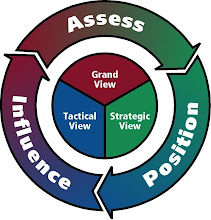
When one understands the Compass of their Tangible Vision, he/she focuses on implementing strong strategic moves, while avoiding weak moves.Does your strategic process enables your team to understand your strengths and weakness while minding the bigger picture?###
February 24, 2008Digital DomainMaybe Microsoft Should Stalk Different PreyBy RANDALL STROSSOVER the years, Microsoft has pummeled countless rivals, including the superheavyweight I.B.M. But it has never faced a smaller foe as formidable as Google. The tale of the tape gives Microsoft a $100 billion advantage in market capitalization, but it counts for little: Google appears to be its superior in strength, speed, smarts.Having exhausted its best ideas on how to deal with Google, Microsoft is now working its way down the list to dubious ones like pursuing a hostile bid for Yahoo. Michael A. Cusumano, who has written several books about the software industry and about Microsoft, is not impressed with Microsoft’s rationale for its Yahoo offer. He said the bid seemed to be a pursuit of an old-style Internet asset, in decline, and at a premium.Determined to match Google in search and online advertising, Microsoft has managed to overlook a plain-vanilla strategy, the oldest one in the book: build on its own strengths. What it does best is to sell software to corporations, for all sorts of applications, visible and not so visible, at a handsome profit.If Microsoft thinks this is the right time to try a major acquisition on a scale it has never tried before, it should not pursue Yahoo. Rather, it should acquire another major player in business software, merging Microsoft’s strength with that of another. This is more likely to produce a happier outcome than yoking two ailing businesses, Yahoo’s and its own online offerings, and hoping for a miracle.For an illustration of how Microsoft could select targets more judiciously, Mr. Cusumano, who is a professor at the Sloan School of Management at the Massachusetts Institute of Technology, pointed to the Oracle Corporation’s strategic acquisitions and its prudent use of capital to roll up firms with similar products and customers to its own. With impressive regularity 13 strategic acquisitions in 2005, another 13 in 2006 and 11 in 2007 Oracle has picked up key products and customers while avoiding an oops slip, venturing too far away from its core business, or paying too much. At no point along the way has it acted in a fit of desperation.Last month, Oracle pulled in another major prize, BEA Systems, a leading software company, for about $8.5 billion. You’ve probably never heard of BEA: it’s doubly obscure, producing the behind-the-scenes infrastructure that large companies use to build behind-the-scenes software systems for their entire business, or enterprise software. Both Oracle and BEA are based in Silicon Valley, but their side of the street is not lit by klieg lights and does not get the same attention as the Googles and Yahoos.And, to be honest, it’s not much fun hanging out on the enterprise side of the software business. BEA says its software helps organizations ensure that business processes are optimally defined, managed, executed and monitored. Unless you’re playing Business Jargon Bingo, it’s hard to sit still and remain attentive. You have to admire Oracle’s ability to remain focused on the business that serves business and to not be distracted by the buzz of the Web crowd gathered across the street.Microsoft does business software well. Approximately half its revenue comes from business customers for its e-mail infrastructure, database systems, developer tools, Office productivity applications and other mainstays. It has also assembled, through acquisitions, a fledgling line of enterprise software that it calls Microsoft Dynamics. Microsoft would like Dynamics to be viewed as competing head to head with the No. 2 name in enterprise software, Oracle, or the No. 1, SAP of Germany. For the moment, however, Microsoft Dynamics’ parity with those big names is nothing more than wishful aspiration.Professor Cusumano has a suggestion: Rather than acquire Yahoo, Microsoft should pursue SAP.It’s not an outlandish idea. The two companies held merger talks in late 2003, and perhaps since then, too. Microsoft is in an enviable position: it is a nearly universal presence in corporate data centers, and large enterprise customers are arguably the best customers a software company can have. Clients pay very dear prices for the complex, semicustomized software that runs their business. And once they’ve got their systems running a process that can take years to complete they aren’t inclined to change vendors lightly.A few dozen well-paying Fortune 500 customers may actually be more valuable than tens of millions of Web e-mail customers` who pay nothing for the service and whose attention is not highly valued by online advertisers.Today, SAP’s market capitalization is about $59 billion, and a sizable premium to get a deal done would send its price well north of that. Microsoft cannot put both SAP and Yahoo in its shopping cart, deals that together might run well over $120 billion. Microsoft must pick one or the other.Suppose that Lawrence J. Ellison, the chief executive of Oracle, were the head of Microsoft and was doing the shopping. Which deal would he choose? Past experience suggests that it would not be Yahoo. That acquisition would bring little but duplication headaches and no large enterprise customers.It’s amusing to note that the most Larry-like choice, Microsoft’s acquiring of SAP and leaving it alone as an autonomous division to avoid a cross-cultural integration fiasco, is the course that would be most discomfiting to Oracle. Frank Scavo, president of Computer Economics, an information technology research firm, in Irvine, Calif., said that a Microsoft-SAP combination would be Oracle’s worst nightmare.Google would not be happy with a conjoined Microsoft and SAP, either. It has made a pro forma expression of its own opposition to a Microsoft-Yahoo merger, but we can speculate that it may be cheering that deal on. Working in Google’s favor are the hostile nature of Microsoft’s bid, the colossal potential for integration problems, and organizational paralysis in, and exodus of talent from, Yahoo.But were Microsoft to turn and head in SAP’s direction, Google would have reason for concern. Whatever strengthens Microsoft is bound to influence, later if not sooner, its continuing competition with Google. For its own part, Google is keen to expand its foothold inside large companies. Last year, it acquired Postini, whose software filters corporate e-mail. Google has not done so well with corporate customers on its own, however. Google Apps has conspicuously failed to win adoption quickly.If Microsoft is to rededicate its attention to its most valuable assets, business customers, a prerequisite is dropping its ill-advised bid for Yahoo. And to find the best acquisition strategy, ask, What would Larry do?If Microsoft tries to fight Google with wobbly legs, scared witless, it will lose.
/// Microsoft made the assessment to takeover Y! Whether it is right or wrong, Microsoft will live with their decision. If you had the resources of Microsoft, would you make the same move? ///
Randall Stross is an author based in Silicon Valley and a professor of business at San Jose State University. E-mail: stross@nytimes.com.http://www.nytimes.com/2008/02/24/business/24digi.html###
Seen small to medium-sized companies making incorrect strategic moves, that places them in a position of chasing the competition.
With our Compass AE process, your company is strategically positioned ahead of the competition.
If you are interested in learning more, please email us at contactus [aa_tt] collaboration360 [d_ott]com
 Many people are currently living in the suburbs. traveling many miles to get to work. The amount of time it takes to travel from home to the office (and vice-versa) has become so unproductive to the company and their family. That the negative effects have started to affect the worker in many ways.
People asked me, "Is there a better way to use their time?"
Instead of wasting their time traveling from place to place, a project team trained under Compass AE, can spend their time productively, working on their projects at home or anywhere.
With our Compass AE process, the team collaborates without borders. In other words, they can collaborate anywhere regardless of the distance, the technology and the project culture.
If you are interested in learning more, please email us at contactus [aa_tt] collaboration360 [d_ott]com
###
Sunday, February 3, 2008 (SF Chronicle)Riding That Train/Meet the people who seem to travel as many hours as they work on a long commute to SacramentoSam WhitingAt 6 on a Wednesday morning, Jim Bourgart is already 15 minutes into a 175-minute commute by foot, bus, train and foot again. From downtown San Francisco he'll catch an Amtrak motor coach to the Emeryville station, where he'll sit 20 minutes on a hard plastic bench waiting for the 6:40 to Sacramento.He doesn't mind as long as he is moving. It is the lost sleep time in the waiting room that hurts. Since the Capitol Corridor runs both the bus and the train, you'd think it could tighten the time-cushion allowed for traffic that never appears on the eastbound bridge."I could use those extra 20 minutes, or even 10 or 5," says Bourgart, who starts his day with a 12-minute walk in the dark from his SoMa condo to the bus stop at the Market Street entrance to Bloomingdale's. "Every minute counts, especially in the morning."The Capitol Corridor is a line made possible by the voters, who in 1990 approved Prop. 116 to provide state funding for intercity passenger rail service. Until 1998, there were only four trains each direction per day and the morning commute was essentially westbound only. Now there are 16 roundtrips. The State of California owns the rolling stock, Union Pacific owns the tracks, BART supplies administration, Amtrak staffs the trains and stations and a joint powers authority oversees it. The Capitol Corridor is like Caltrain with more layers of agencies.Between four morning trains, 1,000 passengers ride from the Bay Area to Sacramento daily. Emeryville is by far the busiest station, with 135 daily commuters. They may be unhappy about spending four hours a day on a train, but they are less unhappy than they would be spending three hours a day in a car. By either mode of transit they are less unhappy than they would be living in the great Central Valley. That goes for patent attorney John O'Banion, who upped and moved with his wife to San Francisco after 35 years in the state capital."We're blessed with this beautiful city, and you don't have that in Sacramento," says O'Banion, who walks down California Street from Nob Hill to meet his bus. "So you give up a little bit."Most of what you give up is sleep. O'Banion, 54, gets by on 5 1/2 hours. He looks fresh in the Emeryville waiting room, though he won't get his cup of coffee until the train leaves the Suisun/Fairfield stop, an hour away.(Among other things you learn from the conductors is that the proper pronunciation is "Sue-son.")The 6:40 is the most popular morning run and the San Franciscans can't get off those plastic chairs and out of that bright waiting room fast enough. A few minutes before the boarding call, they blow right by the sign that reads "Warning: Please remain behind this sign until the train stops," cross the tracks and are on the platform.Of the 135 riders who board here, 80 are bound for Sacramento and 55 for Davis. Those going to Sacramento on the 6:40 are mostly lawyers and policymakers. The Davis riders are shabby graduate students and earthy faculty with bicycles heading to the UC campus. The students stash their bikes in the rear and climb upstairs into the quiet car, which is kept dark so they can curl up in a double seat and get another hour of sleep.The Capitolists are one car up. Because the train originates in Oakland, as opposed to San Jose, it is still on time and empty when it reaches Emeryville. Not as empty as the Amtrak bus coming over from the city, but empty enough that everyone gets a two seater, and some get a four seatbooth with a table in the middle."I've got two offices," says O'Banion, unsnapping his briefcase. "I've got Amtrak and I've got Sacramento." Seated in the immediate vicinity, like the traveling salesmen in "theMusic Man" are Bourgart, Deputy Secretary for Transportation and Infrastructure; David Crane, Special Advisor to the Governor for Jobs and Economic Growth; Preston DuFauchard, California Corporations Commissioner; and John Rea, General Counsel for the California Labor & Workforce Development Agency.They spread out, put their 10-ride tickets on the edge of their tables - so as not to be interrupted by the conductor - and begin their efficiencies. Three minutes into it, Crane has his laptop open and his BlackBerry working, his breakfast set out and his hard-boiled egg peeled."Without wireless, this would be a much less productive run," says Crane, who is on the intense end. He went to law school, just for the fun of taking the bar exam. He never intended to practice. When Schwarzenegger was elected, Crane started by driving to the Capitol, but switched to the train four years ago. Sometimes he returns on the 7:40 p.m., which gets inat 9:20, getting him home at 10 to get up at 4:30 or 5 and start over."Because you can work so pleasantly in the train, it's delightful," he says, "as long as you like to work."The fare from San Francisco is $24 one-way. Half the passengers buy blocks of tickets, bringing it down to $14 one-way. Unlike Amtrak lines, there is no federal money involved in the Capitol Corridor. Its $40 million budget comes from passenger fares and the state, on a 50-50 split.At least two of the regulars on the 6:40 have some indirect connection to funding - Bourgart, 62, whose agency oversees Caltrans, a major funding source of the Capitol Corridor, and Crane, 54, who serves on the high-speed rail authority.To be sure everything goes smoothly, Gene Skoropowski, managing director of the Capitol Corridor, boards the train in Martinez.Skoropowski is quick to point out that the Capitol Corridor is one of only two lines in the country to still put fresh paper headrests on each seat."They're changed at least every day and oftentimes twice a day," brags Skoropowski, 63, a former architect who used to commute on the Boston line. His mother got tired of hearing him gripe about it. "She said 'If you want to change it you've got to get involved." So he did. That was 41 years ago. "I've been doing trains ever since."It doesn't take too long before the topic of the 20-minute lag time between the arrival of the San Francisco bus and the departure of the 6:40 works its way into the conversation. "It's the closest to a guaranteed connection that we can make," says Skoropowski, who promises to look intoit. He's heard a few complaints on this, but nothing like when the bar car dropped Sierra Nevada Pale Ale. Now that was a problem. He fielded 250 e-mails on that before he had a chance to restock it."It's whatever the riders want," he says. There is some debate as to whether riders want the seats to face forward or backward. People who are accustomed to riding Muni are used to facing forward so they can read without getting carsick. People who are wary of a train wreck like to face backward because the neck is protected from whiplash.Then there is the debate over sitting on the east side facing the hills, versus the west side, facing the bay. On the 6:40, east side seats facing backward have the benefit of the sunrise. When it pases the oil refineries of Richmond, all the lights are still on, giving it the effect of a themepark ride.Riding on the west side, it feels like the train is out over the water. Plus you get to see remnants of the old working bayfront of junk yards and boat docks and dilapidated fishing clubs on stilts. One looks to be sinking into the bay, carrying its "for sale" sign with it. The train bends with the shoreline, up against the hills, barely wide enough for the tracks. Then it runs under the Carquinez Bridge, old span and new."The interesting thing about the train is you really take a ride through California's history," says DuFauchard as the train passes by the C&H Sugar plant. "There's manufacturing history, there's agricultural history. It's like that book 'Angle of Repose.' "At Martinez it turns left and crosses the Carquinez Strait on an 80-year-old truss bridge between the two spans of the auto bridge. Then it bisects across farming and duck-hunting country, where you can see the elaborate blinds built to keep hunters camouflaged yet comfortable while waiting for the birds to come in.The train passes under I-80 and cuts through cow country as it approaches Dixon. Skoropowski likes to tell the story of escorting some East Coast transportation experts through here. "One of them looked out the window and said 'where the hell are all the people out here? All I see is cowsand open space. I keep hearing that everything in California is overrun and overbuilt.' Skoropowski took the measure of the man. "Well, you're not getting correct information, are you?"Then again, maybe they were. As the 6:40 rolls out of Dixon you get to see the subprime mortgage meltdown in trackside housing tracts. As it rolls into Davis the students are lined up with their bikes at the door to disembark for their 8 o'clock classes, which started two minutes ago.From here it is a straight 15 minutes to its final destination in Sacramento, with 10 minutes of padding on the schedule. It is past 8, so the cell phones are drawn out and flipped open. Back in the sleeping car, Jackie Valle, 27, wakes up in precisely the same spot every day and startsto apply makeup for her job at the Department of Public Health."My body is accustomed to it," says Valle, who lives in the Lower Haight and starts her day with a 5:30 Muni ride to Powell Street, where she crosses Market to catch the 6 a.m. Amtrak bus.The Sacramento station, built in the 1920s for the old Southern Pacific line, is the opposite of the sanitized Emeryville station, which opened 15 years ago. The terminus of the Capitol Corridor is a grand brick building with arched windows and ceiling, hanging chandeliers and wooden phonebooths. At one end is a mural depicting the triumph of the Iron Horse, with non-iron horses standing by and Leland Stanford orating.The waiting room still has those curvy wooden benches with heat coming up through iron grates atop the backrests. A group of Amish - men in Abe Lincoln beards and bowler hats, plain wives in bonnets - seems to be enjoying this modernity while waiting for the train to carry them back toLancaster County, Pa., in the absence of the stagecoach that used to come through here.Forty Amtrak trains come through here a day, and there is an air of excitement when two runs pull in at once. A volunteer station host is standing on the platform to make sure passengers don't get turned around and end up on the California Zephr for Chicago when they are ticketed for San Francisco.Bourgart is a volunteer station host in his own right. Exiting the train, he takes hold of two blind men and slowly leads them off the platform so their white canes don't get caught in the tracks.Most commuters are homeward bound on the 3:35 or 4:40, but Bourgart usually catches the 5:40. The train pulls into Emeryville at 7:20 and his bus is waiting, engine running, as he walks across the platform and through the station. The connection is timed to the minute, the way hewishes the morning was.If there is no bridge traffic, he is back at that lonely stop in front of Bloomingdale's before 8 p.m., and 12 minutes later he is home. There isn't time for exercise or sports on TV. Dinner with his wife is about it, because 9 1/2 hours after he walks in the door he's walking back out.E-mail Sam Whiting at swhiting@ sfchronicle.com----------------------------------------------------------------------
Copyright 2008 SF Chronicle
http://www.sfgate.com/cgi-bin/article.cgi?file=/c/a/2008/02/03/CMMLTSV10.DTL