Showing posts with label C360 View. Show all posts

Monday, September 28, 2009

The Way of Strategy (15): Our Definition of An Expert

Q: What is our definition of an expert?
A: Following is our list of attributes that makes an expert:
  • Analytical
  • Astute
  • Clever
  • Comprehensive
  • Insightful
  • Logical
  • Master
  • Professional
  • Proficient
  • Reasoned
  • Skilled,
  • Specialist
  • Thoughtful
  • Accomplished
  • Polished.
The road to becoming an expert is solitary, hard, brutish, and hardly ever short enough.

Wednesday, September 23, 2009

The Way of Strategy (13): What Makes An Expert


expert
1. a person who has special skill or knowledge in some particular field; specialist; authority: a language expert.
http://dictionary.reference.com/browse/expert


We at C360 Consulting Group are always amazed that the news media has a tendency of interviewing experts who claim that they are the consummate know-it all about a specific subject matter.


Most of them are quite polished in their messages and their viewpoints. Some are extremely biased in their opinions. Our assessment tells that some of these experts are indirectly paid by larger companies to push their products and services. It is uniquely rare that there is not an expert who is not promoting their wares or someone else's product and services.

Our gripe with some of these so-called experts is that they cannot connect their viewpoints and the current scenario with the grand picture of the masses.

Many years ago, our old consulting mentor told us the story behind the value chain of experts, The "Number One"-ranked expert is someone who gets the high profile interviews and contracts (based on his or her past historical achievements).

The "Number Two"-ranked expert is someone who sometimes does the TV news media commentary route when the "Number One" expert is not available. Invariably, he or she indirectly tells people that he/she should be number one. ...

Sometime both experts outsource the work to the other experts while they take the credit.

The
"Number Three"-ranked expert is the person who rarely promotes him or her selves. Instead, this expert focuses on promoting the profession. He/she receives most of the low profile, middle to upper middle level work and grinds away with very little complaint. Internally, this professional is consistently busy and happy.

...
When people asks "who is the best?" They would always humbly, pointed to themselves. But they will always say the "Number Three"-ranked expert is the second best. ..."

In our global society, the strong prevails over the weak consistently. However, the smart takes from the strong. ... Most "Number Three"-ranked experts are quite smart (and wise).

Regardless of the extremity of the competition,
the expert is someone who consistently maintains his or her competitive advantage by understanding how everything connects to the grand picture.

In life, "three" is a good number.

Collaboration360 Consultants (C360 Consultants). Copyright:2009 © All rights reserved. Copying, posting and reproduction in any form (without prior consent) is an infringement of copyright.

Saturday, September 19, 2009

The Way of Strategy (12): The Script (2)


note: The picture is from Coachoffice.com

Sidebar: This post will appeal to the football fans.

As a reminder, the scripting action only works when one has properly assessed the opposition.

Q: How does one used the script to set up the opposition?
A: Some of the scripted run plays are used to set up for various play action pass. While other scripted pass plays are used to set for special run plays.

For example, the offensive coordinator might call a quick sweep on the second play, with the flanker involved in a fake reverse motion, (then a possible flea flicker). After the QB hands off the ball to the running back. He continues with a fake weakside rollout, with a motion of a pass toward a receiver who is sprinting down the field. After the 25 plays are implemented, the offensive coordinator tells the QB to signals this play, with some technical differences where he fakes the handoff, rolls out the weakside, passes the ball to the open man.

In the case of the pass play,, the offensive coordinator might call a short slant pass to the flanker isolated on the weakside. Later in the game, under similar situation, the QB implements the same play, fakes the pass and hands off the ball to the blocking halfback on a slow draw.

As mentioned before, the premise of the script is to reveal the opposition's tendencies that the implementer can exploit later.

In future posts, we will focus on transferring the assessed project data into a strategic overview and an operational script.


#

Sidebar: There are many ways to set up the opposition. In Ancient China, the military professionals used stratagems that can be found in the 100 Unorthodox Strategies book. We will discuss the topic of unorthodox strategies in a future post.

Sunday, September 13, 2009

The Way of Strategy (11): The Script


update on 08.16.2014
Click here for an technical update of this post.

#
Football season is here. Armchair quarterbacks rejoice.Beside the utilization of Chinese strategy principles as a process, one of our favorite tools is "The Script."
 

"The Script" is a game preparation and implementation tool that was invented by Bill Walsh, an American head football coach of the San Francisco 49ers and Stanford University, during which time he popularized the West Coast offense. Walsh went 102–63–1 with the 49ers, winning ten of his fourteen postseason games along with six division titles, three NFC Championship titles, and three Super Bowls. He was named the NFL's Coach of the Year in 1981 and 1984.

The Intent of The Script
 
The purpose of The Script is to see exactly how the other team reacts to each offensive play at the opening stage of the game. The strategist would use this information to plan the offensive strategy for the remainder of the game. Regardless of the game situation, the disciples of the West Coast Offense are trained to stick to The Script regardless of the down, the distance and the defensive alignment, except for the fourth down. 
Applying the Script Before the Game 
Idealistically,the offensive coordinator informs the players "The Script" one or two practices before game day. On the last practice, the team rehearses "The Script." Beside eliminating anxiety (rather than create anxiety) among the players. the offense coordinator discovers whether the players are able to master those plays and decides whether to adjust the technicalities of the play.

Overall, it requires a great deal of experience, discipline and emotional intelligence to run "The Script" tool.
#

The Master of the Game PlanPreparation and Execution Perfected


Bill Walsh, ever the innovator, conceived a plan, now routine in the NFL, to "script" in advance the offensive plays he would call early in a game.


Walsh still remembers the criticism and skepticism from the NFL coaching establishment that greeted him in the 1970s when, as an offensive assistant with the Cincinnati Bengals, he started scripting plays. All the planning could be done in the office during the week instead of on the sidelines during the frenzy of a game.

With a script, the offensive players could devote more study time to plays that definitely would be used in the game, as opposed to studying an entire game plan that invariably included a bunch of plays that would not be called.


"It got to the point where our offensive team really wanted to know those plays," Walsh recalled. "The players really appreciate the idea that you're giving them a (head) start on the game. You can sleep easier, you have more confidence going into the game, and you're more at ease.

For the coaches, you can feel comfortable that the game is almost on automatic pilot when it starts."
"You know what's going to be called and there's no reason to make a mistake," veteran tight end Shannon Sharpe said of the system in Denver, where coach Mike Shanahan scripts the first 15 offensive plays every week. "You already know if (the defense does) this, who we're going to. So that makes your job a lot easier."

Just about every team in the NFL now uses some form of scripting. Walsh used to do 25 plays, but most teams now script about 15 plays.
There are, of course, some misconceptions about scripting. While there might be a long script of plays, they are not called blindly in order. "Would you run 25 in order? No," Walsh said. "Let's say, of the 25, you'd run 18 or 19 sort of in order. If something really worked or you saw something in the defense, you'd go back to (a play).

To me, it was just sort of a safety net because there's so much emotion to start the game, you want to think clearly, and this, in a sense, forces you to stay with a regimen that you clinically planned prior to the game."
"The scripting saved us because I couldn't think," he said. "It was minus-35 wind chill, and there was no way I could look at a game plan or pull something out of my head. All I wanted to do was run for cover, go in where it was warm, for survival. So in that case, the plan was what saved us."

Excerpts from NFL Insider/NFL.com article from 2002 by Ira Miller.

http://www.squidoo.com/billwalsh


Questions and Answers on Walsh's Starter Script
Q: Most coaches run a 15 play script. Why did Walsh utilized a 25 play script?
A:
The aim of the 15 play script is to immediately attack the tendencies and the physical weaknesses of the opposition's defense. The 25 play script focused on revealing the entire opposition's defensive arsenal while pinpointing their true weaknesses. We believed that Walsh liked the idea of forcing the opposition to expose their arsenal.Q: What was in Walsh's script?
A: A balance of pass plays and run plays that have never appeared in previous games. Walsh would o
ccasionally throw in one or two gadget plays that the opposition has never seen before.

We have heard one former Niners player referred "The 25 Plays" as "The 25 Lies." The story behind that statement is based on that the opposition became too focused on stopping Walsh's 25 play script that they forgot to focus on their own game.
Retrospectively, it is also a psychological gaming tool and an "informational feedback strategy" tool.

The implementation of a 25 play script requires a person with great patience, control and strategic insight. Bill Walsh was that person.
Rarely does anyone ever talk about the keys for the following:
  • when to stay with the script;
  • when to leave the script; and
  • when to return to it.
The amateurs think that they know what "The Script" is about. However there are a few who understand its true range and the reason why it works.

In the football business, the Script is used by many coaches. Our observations tell us that many of them do not possess the strategic training to use it properly. At the same time, some of the quarterbacks are not trained to run "The Script."

The most difficult challenge for most football teams is to run "The Script" from a no-huddle mode. We will touch on that topic in a future post.


Summary 

The key to building The Script is to properly assess the competition and the grand situation. In our future book project, we will focus on this topic
Being a fan of world class strategists and an implementer of Best Practices, we recommended to our clients to script their operational strategy. In future, we will touch more on "The Script."

We believed that this set of arcane knowledge is usually given to those who are operating on a "need to know" basis.to those under the clause of "they are worthy."

We at C360 usually apply our version of the script in all of our operational situations

 If you are interested in securing an abridged version of our Compass Script, please send us a request at www.formspring.me/Compass360CG

#
49ers on cusp of new era - or total failure

Gwen Knapp, Chronicle Staff Writer
Sunday, September 13, 2009

(09-12) 20:41 PDT -- The 49ers' seventh offensive coordinator in seven years used some interesting language late last week. "We always script the first 12 'openers,' " Jimmy Raye said, "the first third down and short, the first third and medium, the first short-yardage play."

We always? Until late January, Raye had not been connected to the 49ers since 1977, when he served as receivers coach for a single year.

He was gone when Bill Walsh appeared two seasons later, transforming the franchise and establishing the principle of scripting the opening plays on offense. By "we always," Raye meant all of his own offenses over the years, from Los Angeles to Tampa Bay to Washington. Like so many other coaches, he said, he must have borrowed the philosophy from Walsh and made it his own.

Today's 49ers have no traditions worth preserving. Small remnants from the dynastic Walsh era may survive, but after six dreary seasons, the phrase "we always" can legitimately precede nothing good. (We always lose at least nine games a season. We always change offensive coordinators.)

... The 49ers would be linked to Walsh only through the brief mentoring he provided for Singletary and the ripple effect that brought scripted openers to Raye. But they would also disengage from the last six years, leaving the threshold of Lost Franchises.

E-mail Gwen Knapp at gknapp@sfchronicle.com.

http://sfgate.com/cgi-bin/article.cgi?f=/c/a/2009/09/13/SPHA19MBJ5.DTL
This article appeared on page B - 1 of the San Francisco Chronicle

# updated on 09/01/2011

Monday, September 7, 2009

The Way of Strategy (9): Penetrate and Dominate


China's solar energy businesses assessed the grand settings of their global market terrain in terms of their competitive position, the state of predictability and the configuration of the terrain, the Compass for their strategy was defined.

The advantage of lower operating costs enabled China to gain the control of the marketplace. Their i
mmediate momentum and the timing also allowed them to advance deeply into their competitor's territory and became the bellwether of the market-place. ...

Once China assessed their grand picture. They positioned themselves with a complete top down strategy and implemented with extreme efficiency.

This is a good example of what the "Dao of Competition" (warfare) is supposed to be.


#

August 25, 2009
China Racing Ahead of U.S. in the Drive to Go Solar
By KEITH BRADSHER

WUXI, China — President Obama wants to make the United States “the world’s leading exporter of renewable energy,” but in his seven months in office, it is China that has stepped on the gas in an effort to become the dominant player in green energy — especially in solar power, and even in the United States.

Chinese companies have already played a leading role in pushing down the price of solar panels by almost half over the last year. Shi Zhengrong, the chief executive and founder of China’s biggest solar panel manufacturer, Suntech Power Holdings, said in an interview here that Suntech, to build market share, is selling solar panels on the American market for less than the cost of the materials, assembly and shipping.

Backed by lavish government support, the Chinese are preparing to build plants to assemble their products in the United States to bypass protectionist legislation. As Japanese automakers did decades ago, Chinese solar companies are encouraging their United States executives to join industry trade groups to tamp down anti-Chinese sentiment before it takes root.

The Obama administration is determined to help the American industry. The energy and Treasury departments announced this month that they would give $2.3 billion in tax credits to clean energy equipment manufacturers. But even in the solar industry, many worry that Western companies may have fragile prospects when competing with Chinese companies that have cheap loans, electricity and labor, paying recent college graduates in engineering $7,000 a year.

“I don’t see Europe or the United States becoming major producers of solar products — they’ll be consumers,” said Thomas M. Zarrella, the chief executive of GT Solar International, a company in Merrimack, N.H., that sells specialized factory equipment to solar panel makers around the world.

Since March, Chinese governments at the national, provincial and even local level have been competing with one another to offer solar companies ever more generous subsidies, including free land, and cash for research and development. State-owned banks are flooding the industry with loans at considerably lower interest rates than available in Europe or the United States.
Suntech, based here in Wuxi, is on track this year to pass Q-Cells of Germany, to become the world’s second-largest supplier of photovoltaic cells, which would put it behind only First Solar in Tempe, Ariz.

Hot on Suntech’s heels is a growing list of Chinese corporations backed by entrepreneurs, local governments and even the Chinese military, all seeking to capitalize on an industry deemed crucial by China’s top leadership.

Dr. Shi pointed out that other governments, including in the United States, also assist clean energy industries, including with factory construction incentives.

China’s commitment to solar energy is unlikely to make a difference soon to global warming. China’s energy consumption is growing faster than any other country’s, though the United States consumes more today. Beijing’s aim is to generate 20,000 megawatts of solar energy by 2020 — or less than half the capacity of coal-fired power plants that are built in China each year.

Solar energy remains far more expensive to generate than energy from coal, oil, natural gas or even wind. But in addition to heavy Chinese investment and low Chinese costs, the global economic downturn and a decline in European subsidies to buy panels have lowered prices.

The American economic stimulus plan requires any project receiving money to use steel and other construction materials, including solar panels, from countries that have signed the World Trade Organization’s agreement on free trade in government procurement. China has not.

In response to this, and to reduce shipping costs, Suntech plans to announce in the next month or two that it will build a solar panel assembly plant in the United States, said Steven Chan, its president for global sales and marketing.

“It’ll be to facilitate sales — ‘buy American’ and things like that,” Mr. Chan said, adding that the factory would have 75 to 150 workers and be located in Phoenix, or somewhere in Texas.

But 90 percent of the workers at the $30 million factory will be blue-collar laborers, welding together panels from solar wafers made in China, Dr. Shi said.

Yingli Solar, another large Chinese manufacturer, said on Thursday that it also had a “preliminary plan” to assemble panels in the United States.

Western rivals, meanwhile, are struggling. Q-Cells of Germany announced last week that it would lay off 500 of its 2,600 employees because of declining sales. It and two other German companies, Conergy and SolarWorld, are particularly indignant that German subsidies were the main source of demand for solar panels until recently.

“Politicians might ask whether this is still the right way to do this, German taxpayers paying for Asian products,” said Markus Wieser, a Q-Cells spokesman.

But organizing resistance to Chinese exports could be difficult, particularly as Chinese discounting makes green energy more affordable.

Even with Suntech acknowledging that it sells below the marginal cost of producing each additional solar panel — that is, the cost after administrative and development costs are subtracted — any antidumping case, in the United States, for example, would have to show that American companies were losing money as a result.

First Solar — the solar leader, in Tempe — using a different technology from many solar panel manufacturers, is actually profitable, while the new tax credits now becoming available may help other companies.

Even organizing a united American response to Chinese exports could be difficult. Suntech has encouraged executives at its United States operations to take the top posts at the two main American industry groups, partly to make sure that these groups do not rally opposition to imports, Dr. Shi said.

The efforts of Detroit automakers to win protection from Japanese competition in the 1980s were weakened by the presence of Honda in their main trade group; they expelled Honda in 1992.

Some analysts are less pessimistic about the prospects for solar panel manufacturers in the West. Joonki Song, a partner at Photon Consulting in Boston, said that while large Chinese solar panel manufacturers are gaining market share, smaller ones have been struggling.

Mr. Zarrella of GT Solar said that Western providers of factory equipment for solar panel manufacturers would remain competitive, and Dr. Shi said that German equipment providers “have made a lot of money, tons of money.”

The Chinese government is requiring that 80 percent of the equipment for China’s first municipal power plant to use solar energy, to be built in Dunhuang in northwestern China next year, be made in China.

Dr. Shi said his company would try to prevent similar rules in any future projects. The reason is clear: almost 98 percent of Suntech’s production goes overseas.

Copyright 2009 The New York Times Company
http://www.nytimes.com/2009/08/25/business/energy-environment/25solar.html


Sunday, August 23, 2009

The Dao of Strategic Assessment (35): The Return of Yahoo !?


Making presumptions and using technology as a general solution does not always work for everyone. In business as in life, even parity does not exist.

Compared to Google, Yahoo has limited resources. In order to compete effectively, they had to manage their time and energy effectively. They assessed what the general client base wanted and positioned themselves with a plan based on their assessment.


Having paid heed to the advantages of my plans, the general must create situations (strategic advantage) which will contribute to their accomplishment. By 'situations' I mean that he should act expediently in accordance with what is advantageous and so control the balance. - Art of War 1 (Griffith Translation)

Google has a general philosophy of "Technology is everything and the users make the individual choice of what they want to use." Overall, Google has the resources to overwhelm any competitor and feel no urgency to change. They will stay with their belief of a general technology-driven solution that enables the users to make their choice.


Currently web statistics show that Yahoo is ahead of Google in the arena of financial information. Whether they can beat Google on the long run is debatable.

It is a contest where one's killer app can be duplicated in less than nine months.

Following are three questions for the readers:
  • Do you assess before you plan?
  • What is your approach for assessing?
  • Based on your assessment, how do you define your goal?
We will touch on these three questions at a later post.

#
August 23, 2009
Digital Domain
Where Yahoo Leaves Google in the Dust
By RANDALL STROSS

GOOGLE has an outsize image as the deft master of information. Its superior technology seems to pitilessly grind up its rivals. But Google’s domination in search has proved hard for it to match in some information domains. When serving financial news and information, for example, Yahoo draws 17.5 times the traffic of Google, according to comScore Media Metrix.

Yahoo Finance, which has occupied the top spot in the category for 19 consecutive months, drew 21.7 million unique United States visitors in July; Google Finance drew only 1.2 million unique visitors, placing it 17th in comScore’s rankings for the category, one slot above a site called FreePressRelease.com.

Yahoo understands that information about money — a user’s own money — presents some tricky psychological issues. James Pitaro, vice president of Yahoo’s audience group, said, “In our research with users, we found that the more information that was displayed on the page, the greater the anxiety.”

He said Yahoo deliberately adopted what he calls “the Apple model — simplicity in design; a clean, simple look, not overburdening our users with too much information on the page.”

Google seems to pay no heed to such psychology. Google Finance, which was introduced in 2006 and shed its “beta” label earlier this year, hews to its original strategy: offer the best data and charts. And when that doesn’t work, offer still more data and charts.

Yahoo Finance is organized into sections: investing; news and opinion; personal finance; customized portfolio tracking; and “Tech Ticker,” short video features that have supplied an average of 450,000 streams a day in recent months, Yahoo says. When you click on a link to a news story accompanied by a Tech Ticker video, it starts automatically and seems intended to insert a warm human presence on the page. The video player is on one side of the page and is stationary; the visitor scrolls down on the other side to read news articles.

“It’s made for multitasking,” Mr. Pitaro said.

About 5 percent of the finance site’s information is original, he said, though his group is looking at ways to increase that to about 10 percent, matching the proportion on Yahoo Sports.

Mr. Pitaro credited Yahoo’s home page with sending traffic to Yahoo Finance.

“We have a great relationship with the front-page team to identify topics we should cover,” he said. An example of a “featured” story found last week on Yahoo’s front page: “Where Rich Singles Live,” accompanied by a picture of an attractive young woman smiling at the camera while pulling papers out of a briefcase. A click whisked the interested reader to Yahoo Finance.

Google does not use the mostly empty home page of the mothership to let visitors know that it has a finance site — some may not even know it exists. (To reach it, a user must click on the word “more” at the top of the home page.) But Google’s finance site offers something rather basic that Yahoo doesn’t: free real-time price quotations obtained directly from the New York Stock Exchange and Nasdaq.

Over at Yahoo, the price quotations come from the BATS Exchange, an electronic equity exchange. A Yahoo spokeswoman said that in terms of accuracy and speed, its data “are very close to that from the larger exchanges, and for the average investor, the differences would hardly be noticeable.” (In my side-by-side comparison, the BATS quote on Yahoo for “YHOO” usually lagged Nasdaq’s on Google by a minute.)

If Yahoo customers would like the quotations directly from the two largest United States exchanges, they must pay Yahoo $10.95 or $13.95 a month for the privilege of getting the same data that Google offers free.

Among all visitors to Yahoo Finance who are referred by another site, 47.8 percent came from another Yahoo property, according to comScore’s data for July. Only 28.8 percent of Google Finance visitors came from another Google property. (As for MSN Money, which holds third place, 72.7 percent came from other Microsoft sites.)

Compare the total United States traffic on all Google sites with the total on all of Yahoo’s and you’ll see that Google edged past Yahoo last year to take the overall lead. Since then, Google has stayed on top, though with only a slim advantage, according to comScore. So finance is an important category that allows Yahoo to remain neck-and-neck with Google over all.

Yahoo Finance is not just coasting, either: it enjoyed 12 percent growth in traffic from July 2008 to July 2009, while Google Finance’s traffic grew by only 3 percent.

GOOGLE has not adopted the features that Yahoo uses to create a more appealing look and feel for a finance site. While Google also provides news and portfolio tracking, it doesn’t have its own videos or columnists.

Invited to show off features that differentiated Google’s site from Yahoo’s, Ayan Mandal, a Google product manager, pointed to new charting tools, called “Technicals. Added this summer, they allow users to analyze stock prices over time with 12 technical formulas.

It seems unlikely, however, that Google’s new tools — whose metrics include one called the Fast Stochastic Oscillator — will do as much for building traffic as a fluffy news story or a short video featuring talking heads. Yahoo understands that a free finance site prospers by drawing less from the world of mathematics and more from the world of entertainment, informing just enough to satisfy users without setting off an anxiety attack.

Randall Stross is an author based in Silicon Valley and a professor of business at San Jose State University. E-mail: stross@nytimes.com.

http://www.nytimes.com/2009/08/23/business/23digi.html?hpw

Thursday, August 6, 2009

The Dao of Strategic Assessment (33): Assessing the Client Profile


We live in an information society where the attention span of the masses is about five minutes or less. They want immediate feedback and then they go on. (Most of the time, this group do not want to focus on the grand picture. They live for the now moment with no regard for the future. That is another post.) ...

Twitter is the web medium for those attention-challenged,
obsessively-compulsive individuals who need immediate information feedback.

Currently, customer-based businesses and celebrities utilize Twitter as their immediate connection to their many followers. To maintain their loyalty, one must recognize their supporter's profile by properly assessing their needs and wants.


Building the Psychological Profile
The first step of assessing the data is to gather the right data set. It must be based on the targeted social-economic group. The next step is identifying their
behavior by determining their most common habits and inclinations under the criteria of delineated economic changes and the technical specifics of the market terrain. He/she then compares the data to other sources in order to have the most authentic data set. (As a safeguard, we usually implement another round of intelligence gathering from the ground level).

Proper strategic assessment of intelligence gives the reader a better under-standing of the followers in terms of predictability and direction

Connecting the follower's profile to the projected outcome enables the readers to understand how their fans connect to the greater picture.

Conclusively, our approach gives the client an objective outlook of their competitive positioning in their marketplace.


Cardinal Rule: The amount of quality intelligence is inversely proportional to the amount of knowledge one knows their marketplace.


#

Martha Stewart: Twitter is Better than Facebook

Yesterday, Bill Gates admitted that he has abandoned Facebook because he had too many friend requests and could not tell who he knew and who he didn’t. Now we have another well-known public figure who isn’t very fond of Facebook: Martha Stewart

The master of home décor, in an interview with The Daily Beast, talks up Twitter and describes Facebook as “dippy.” Unlike Gates though, she extensively discusses why Twitter has a special place in her heart.

Here’s a little of what she to the Beast:
“I just love it so much more than Facebook … First of all, you don’t have to spend any time on it, and, second of all, you reach a lot more people. And I don’t have to ‘befriend’ and do all that other dippy stuff that they do on Facebook.”

Martha continues to praise Twitter, even calling it “the Wal-Mart of the Internet” (that’s an interesting analogy…). She also stated that the Facebook v. Twitter debate doesn’t matter all that much, specifically because, “they’re all going to be owned by the same company eventually.” The Beast even got a quote from Brandee Barker, Facebook’s Director of Communications, on the subject of Martha Stewart and Facebook:

“I think Martha has built a tremendous fan base and she obviously knows how to use many different ways to communicate with them … I’m a big fan of Martha Stewart and her brand—and I hope she finds more ways to use Facebook.”


Really though, what else could Brandee say that didn’t bash Martha or Twitter?

Are Stewart’s words indicative of anything?
While it’s humorous that she calls Twitter the Wal-Mart of the Internet (and that she thinks they’ll both be owned by the same company someday), she does bring up some interesting points about how people, especially celebrities, utilize Facebook and Twitter differently. She uses it to get answers to her questions fast, to host giveaways, and even to purposely rattle the cages and to make some buzz, when she asked if Bruno (the movie) was about decorating.

Can Facebook really accomplish these things, especially for a celebrity with a massive following?
While it’s true that there’s a competition brewing between Facebook and Twitter, we seem to forget that they’re different products that have different purposes.

Facebook is about intimate connections and sharing multimedia with a group of friends. Twitter is about broadcasting and spreading your message to the entire world. With that in mind, which platform do you think celebrities require more? There’s a rational set of reasons that explain why celebrities have been cheerleaders for the microblogging startup.

Source: http://mashable.com #

Wednesday, July 15, 2009

The Dao of Strategic Assessment (29): Assess with the Right Data


What is your approach for gathering intelligence?

What is your approach to determine if the data is correct?

If you don't know the answers, what will you do when you chasing the hindquarters of your competition?

One always need the correct data before assessing the big picture. How do you know if you have it?

Many C-level officers assume that they have the latest data. The question is whether due diligence has been performed!?

In the global economy, it is not that difficult to deceive the competition with bells, whistles, smoke and mirrors. In future posts, we will touch on that topic.


#

Wednesday, July 08, 2009 11:19 AM/EST

Law of Averages Overturned

by Tony Kontzer

All those business school lessons about using historical averages to predict probable outcomes? Apparently, that may have been precisely the wrong approach.

In his new book, The Flaw of Averages (2009, John Wiley & Sons, Inc.), Sam Savage, a consulting professor of management science and engineering at Stanford University, posits the theory that averages are a hopelessly useless statistic for determining risk, and that it's time for business decisions to be made using more accurate predictors.

One possible answer, Savage claims, is the emerging field of "probability management," which draws upon a type of data Savage has helped define known as "distribution strings." Unlike numbers, distribution strings are based on the unknown, making it possible to take the uncertain into account when determining a probability. So instead of a spreadsheet cell containing one number, it contains a distribution string of thousands of numbers--called Monte Carlo trials--that constantly are updated any time another cell in the spreadsheet is changed. The idea is that risk isn't a fixed number--it's an ever-changing collection of averages that are inter-related.

"The flaw of averages happens when people plug a single number into a cell to represent a probability," Savage said during a recent interview. "Think of taking a spreadsheet and adding a third dimension to it. Any cell in your spreadsheet should be able to provide you with an average."

It's a big concept to get one's brain around, so to illustrate the problem consider this crude example of how Savage believes averages doom many IT projects: Take a software development project in which 10 separate teams are each working on a particular sub-routine, with no interdependence between them at all. The project manager isn't sure how long each sub-routine will take, but he knows the average will be 3 months, so he relays that to the boss when pressed.

Unfortunately, according to Savage, there is only one chance in a thousand that the project will be done in 3 months--the same odds as flipping a quarter and have it come up heads 10 straight times. In the end, the boss is unhappy, the project manager is held responsible, and stress levels for the next development project rise. Ultimately, companies find themselves resigned to accept that most software projects will take longer than expected, when in fact the problem is that the practice of using historical averages to compute probable completion dates is fundamentally flawed.

The way Savage see it, this dependence on averages has had some pretty grave consequences, which the recession highlights. "We ignored this, and we flew into the side of a cliff," says Savage. He expects that risk analysis will be handled quite differently going forward. "There will be a tremendous move, after this recent meltdown, of people trying to understand risk and uncertainty better."

For IT, in addition to rethinking how project timelines are estimated, this is likely to mean the need to deploy and support tools that can handle this ramped up focus on risk and uncertainty. New applications will be needed for processing distribution string data, and then for analyzing that data to determine probabilities.

In the meantime, if you want to give probability management a test drive, you have two options. You can purchase Frontline Systems' RiskSolver application, which is the brainchild of company President Dan Fylstra, who was the original distributor of VisiCalc back when the Apple II made its debut in 1979. Or, you can try downloading Savage's less powerful--and less expensive--XLSim.

And you may want to brush up on your knowledge of probability management, distribution strings and Monte Carlo trials--something tells me your ability to sufficiently analyze risk and uncertainty will soon depend on it.

Related: Scott Rosenberg on the difficulties of software development.

http://blogs.cioinsight.com/knowitall/content001/software/law_of_averages_overtuned.html

Monday, July 6, 2009

Another View of Sunzi (Sun Tzu)


We found this item in our archives

# # #

Sun Tzu, Hamlet, and Bruce Lee
by Paul McGuire filed under Product Reviews
You have probably already read Super System by Doyle Brunson-the book poker players like to call "The Bible." I'm sure you've also read the followup titled Super System 2, along with the Theory of Poker by David Sklansky and anything written by Dan Harrington.

I always recommend those books to novice players but I also give them a few non-poker titles, because there are many valuable lessons that poker players can learn by reading them.

Here are three books that you might like...


1. Art of War by Sun Tzu was written in the 6th century B.C., yet some of Sun Tzu's military strategies and tactics are stilled employed to this day by both the military and astute businessmen. Sun Tzu stressed the role of positioning in strategy, which is affected by both the environment and the subjective opinions of the combatants involved. His philosophy was that proper strategy required quick responses to ever changing conditions. Sun Tzu said, "All warfare is based on deception." That is one his most valuable pieces of wisdom, which I think about every time I sit down at the tables. If Sun Tzu played online poker, my guess is that he would crush the game.

Through an assortment of relevant strategic experience and a good sense of conscious awareness, one can respond effectively to the ever-changing conditions.

The writer might know some of the generalities. However, we disbelieve if he understood the intent behind the application of the strategic principles of the AoW.
The key to the AoW's approach is to neutralize the opposition (or finish one's mission with maximum efficiency.

Another words, secure a total win by the following criteria:

(a) in the shortest possible time;
(b) with the least amount of resources;
(c) with minimum damage to the settings


Overall, the writer's view of the Art of War is quite general.


2. The Warrior Within: Philosophies of Bruce Lee
by John Little, is a book that I have written about in a previous column. The Warrior Within is one of the more influential books that I have read in the last couple of years, because it helped me to focus on knowing myself and exploring my limitations. Most people view Bruce Lee as just a kung fu actor and overlook his attempt to apply Eastern philosophy to Western living, which is chronicled in the book. Throughout his life, Lee formulated a complex personal philosophy that celebrated the virtues of knowledge and complete mastery of one's self. His most influential sections deal with the ability to defeat adversity by adapting to circumstances, which is something that every poker player has to apply to their game.

As a kung fu instructor, Lee didn't specifically teach his style of fighting; rather he encouraged his students to find themselves.
Lee is who he is because he was not copying anyone else. He evolved into his own person. He was never fond of styles, because he felt that they prohibited true expression. It was important to learn technique but not as important as learning about yourself.


3. Hamlet by William Shakespeare is one of his most celebrated plays. I have a morbid fascination with Hamlet and have spent many late nights pondering the actions of the indecisive 30-year old Danish prince and what lessons could be learned from his mistakes. Hamlet is the most compelling character in all of literature. This is a guy wrought with emotional conflict and guilt due to his inaction. He knows that his Uncle Claudius killed his father and yet he's slow to avenge his murder. The conflicted Hamlet accidentally killed Polonius, the father of his girlfriend

Ophelia, who in turn committed suicide by drowning herself which triggered the series of events climaxing with one of the most brutal endings in the history of storytelling.

The story of Hamlet had existed for many years before Shakespeare penned it four hundred years ago. He was the first to adapt the legend of Hamlet and he turned it into one of his most famous pieces of work. The themes that Shakespeare touched on four centuries ago still hold today in an extremely dissonant world.
Inaction and slow decision making are personality flaws that best describe Hamlet. He was doomed from the start and if you carry around those two traits in your emotional baggage, then you're doomed as well.

http://www.pokerplayernewspaper.com/viewarticle.php?id=2405

Saturday, July 4, 2009

The Way of Strategy (3): Adjusting to the Big Picture


The key to adjusting to changes within one's big picture is to understand the important connections from the various points within the image.


In most competitions, there is always an exchange of point/counterpoint.

E
very strategic move has a counter move. The understanding of the big picture always enables the consummate strategist to create a countermeasure (on time and on budget) that causes a strategic impact with a long time line and a minimum use of his/her resources.

The following story is a good example of disruptive technology that causes social-economic havoc. (This is a favorite topic in our virtual office.) The opposition immediately counter the disruptive technology with a countermeasure.


#

S.F. techie helps stir Iranian protests

Matthew B. Stannard, Chronicle Staff Writer

Wednesday, June 17, 2009

6-16) 20:52 PDT -- Little about Austin Heap's first online venture, a site hosting free episodes of the cartoon "South Park," suggested he would one day use his computer skills to challenge a government.

But for the past few days, Heap, an IT director in San Francisco, has been on the virtual front lines of the crisis in Iran, helping people there protest the presidential election, which opponents of the incumbent regime maintain was fraudulent.

Hundreds of thousands of demonstrators have taken to the streets since Saturday, organizing and sharing news on sites such as Twitter, Facebook and YouTube. The Iranian government, in response, has blocked those sites, along with mobile phone service and other communications tools./

But Iran has the highest number of bloggers per capita in the world, said Abbas Milani, director of the Iranian Studies Program at Stanford University, and they were undeterred. "People used Twitter, and people used their cell phones and used all kinds of mechanisms."

Heap, 25, has never followed Iranian news much. But as reports of the election began dominating Twitter - but not, he believed, American mainstream news - Heap felt the same defiant frustration that led him in the past to butt heads with the music and movie industry associations by creating file-sharing sites.

"I believe in free information," he said Tuesday. "And I especially have no room for a tyrannical regime shutting up a whole population. I was 13 and able to take on a huge company like Comedy Central from my bedroom. With a computer, everybody has the power to do that."

Proxy server a weapon

Heap's weapon in the past few days was the proxy server, a computer configured to act as an intermediary between a computer user and the Internet. Such servers have many legitimate functions, such as speeding response times, and some illegitimate ones, such as helping spammers hide their identities.

What interested Heap was the use of a proxy server to bypass censorship. Properly configured, a proxy server could identify Web surfers in Iran and route them to Twitter and other sites the government had restricted.

People around the world were posting network addresses for such proxies on Twitter and elsewhere, Heap said, but there was no organization and the servers were unpredictable.

Simple first effort

Heap's first effort was simple: a list of working proxy servers that he published Sunday afternoon. Almost immediately, those servers began to vanish. Perhaps spammers or pornographers, who constantly cruise the Internet looking for open proxies, were overwhelming the system, he thought.

It was only later that Iranians on Twitter warned Heap - and others publishing lists of open proxies - that by posting public lists they were exposing those proxies to attack.

"I really didn't expect their government to be this on top of it," he said. "I know everybody knows about Twitter. But I didn't think it was going to be to this extent."

So Heap took another tack, creating a password-protected list of proxy servers and giving only a handful of people access to each, reducing the possibility of a widespread attack. On his blog, he published simple instructions for configuring proxy servers.

Heap wasn't the only techie setting up or promulgating proxies, but his easy-to-follow instructions quickly spread through Twitter and the blogosphere.

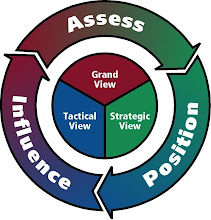
/* That is a good example of our API (Assess, Position and Implement) process. Heap assessed the grand picture, positioned himself with a plan and then a tool and finally implements his tool. After a while, the competitor assessed the grand picture and counters his move. Heap adjusts by repeating the API cycle.

Suddenly, people were sending him addresses for new proxy servers in Australia, Japan and Mexico. Traffic on his blog grew from a couple of dozen unique users a day to more than 100,000 in 24 hours. A woman in Canada asked him for help getting her Iranian family back online.

On Twitter, a Tehran resident posted: "@austinheap Thank you for all you are doing to help my people. This support and kindness will never be forgotten."

'Almost made me cry'

"Most of the reactions from Iran have almost made me cry," he said. "Having somebody tell me that their family thanks me - that's the power of the Internet."

The last 24 hours have been less fun, Heap said. He's had to figure out which of the professed Iranians contacting him he can trust and which might be seeking access to a proxy service to shut it down.

Monday night, his site came under a denial-of-service attack - a flood of phantom file requests from the United Kingdom designed to bring his system to its knees. Tuesday morning he received his first e-mailed threats.

Still, he thinks he's doing the right thing.

"If I can help them get their message out and help them tell the story and step back, that's my job," he said. "(But) my mom is terrified right now."

By mid-Tuesday, Iran appeared to be blocking all non-encrypted Internet traffic, making the 1,600 new proxy-server addresses now in his in-box temporarily useless. But Heap was working with other professionals and companies seeking new ways to reconnect.

"I haven't been in the middle of an outpouring like this, ever. And it makes me incredibly proud of the IT community," he said.

While it's not clear how much impact Heap's efforts are having, history may look back on his tweets about proxy servers as a profound moment in political evolution, said Stanford's Milani.

"The regime probably doesn't recognize it, but I can tell you, the marriage of civil disobedience with the social networking savvy is the death of despotism in these places," he said. "If you combine these two, you have a very potent force."

E-mail Matthew B. Stannard at mstannard@sfchronicle.com.
http://sfgate.com/cgi-bin/article.cgi?f=/c/a/2009/06/17/MN75188C6K.DTL

This article appeared on page A - 1 of the San Francisco Chronicle

#

Sunday, June 21, 2009

Risk Management: A View from The Seven Strategy Classics of Ancient China


During the act of assessing or planning, he or she must always consider the risk factor.


"One who abandons what is nearby to plan for what is distant will labor without success. One who abandons the distant to plan for the nearby will be at ease and attain lasting results." - Huang Shek Gong, 9


#
June 16, 2009
Settling for Par: Pros More Likely to Play It Safe

By ALAN SCHWARZ

When PGA Tour golfers from Tiger Woods down to the greenest rookie draw back their putters this week at the United States Open, their scorecards will be sabotaged by a force as human as it is irrational: risk intolerance.


Even the world’s best pros are so consumed with avoiding bogeys that they make putts for birdie discernibly less often than identical-length putts for par, according to a coming paper by two professors at the University of Pennsylvania’s Wharton School. After analyzing laser-precise data on more than 1.6 million Tour putts, they estimated that this preference for avoiding a negative (bogey) more than gaining an equal positive (birdie) known in economics as loss aversion costs the average pro about one stroke per 72-hole tournament, and the top 20 golfers about $1.2 million in prize money a year.


Contrary to most academic studies involving sports, at which athletes typically scoff, a handful of the tour’s top putters did not dispute this finding. Simply put if not putt they admitted to being spooked enough by bogeys that they will ultimately cost themselves strokes to avoid them. Call it the bogeyman.

Par putts just seem to be more critical because if you miss you drop a shot if you miss a birdie putt, it doesn’t seem to have the same effect, said Jim Furyk, one of the tour’s best putters.
Added Justin Leonard: When putting for birdie, you realize that, most of the time, it’s acceptable to make par. When you’re putting for par, there’s probably a greater sense of urgency, so therefore you’re willing to be more aggressive in order not to drop a shot. It makes sense.

Of course, it makes no sense at all: each stroke counts as one on a scorecard, whether for eagle or triple-bogey on any particular hole. The goal is to finish with the fewest strokes, regardless of what each might be artificially termed. All else being equal distance from the cup, one’s proximity to the lead or cut, the course difficulty and so on putts should be handled the same way.


But they are not, according to the study of almost 200 tour professionals from 2004 through 2008. Using data the tour regularly records on every ball’s green location accurate to the nearest inch, the professors found that birdie putts were made about 3 percent less often than otherwise identical putts for par. (In effect, players tell themselves before birdie attempts, Let’s just get close, rather than, I have to make this.) Given that players typically attempt nine birdie putts per round, this cost each golfer about one stroke per tournament which can translate to hundreds of thousands of dollars in prize money.


The professors, Devin Pope and Maurice Schweitzer, seemingly anticipated every But what about? reflex from golf experts. The tendency to miss birdie putts more often existed regardless of the player’s general putting or overall skill; round or hole number; putt length; position with respect to the lead or cut; and more.


As would be expected, the difference decreased on routine short putts and also decreased very far from the hole, where the chance of making the putt is small to begin with. It peaked on putts from about 6 to 12 feet. Even Woods, roundly considered the best putter ever, exhibited the trait at roughly the tour average.


The finding may become significant among behavioral economists, many of whom have suspected that the loss aversion found through contrived experiments might not be demonstrated by actual, expert competitors vying for high stakes. The paper is being submitted this week for publication in an economic journal.


Even experienced professionals playing for high stakes are not rational, Pope said. Tiger Woods, the model of perfection and what an economist would think of as a rational agent, even he exhibits these biases. And if he exhibits these biases, why not business leaders? There are a lot of applications.
Rather than resist any insight from ivory tower academics, several golfers admitted to handling identical birdie and par putts differently and appeared somewhat amused at being found out. Geoff Ogilvy, who made par putts 4.1 percent more often than birdie putts from the same distance, said: A par putt seems more final. It shouldn’t make any difference, should it? And Paul Goydos, who showed the effect at 4.4 percent, said it probably affected him even more on putts for eagle.

If I’ve got a 25-footer for eagle, it seems like I’m more conservative than with a 25-footer for either birdie or par for whatever reason, Goydos said. I think the worst thing you can do is three-putt for par on a par 5. That’s one that drives me more crazy than anything else. Maybe that’s why I’m at the very bottom of the tour in eagles made.

But just as quickly as pro golfers admitted to their costly habit, they dismissed the idea of being able to do much about it. Stewart Cink, who showed a 3.3 percent effect, said that try as he might, he would never be able to convince himself that every putt is the same.

You can’t fool yourself, Cink said. But this is one of the reasons why we use sports psychology, and we try to have a preshot routine so we do the same thing, approach every putt the same way. It’s not always glamorous, and it’s not always possible in reality.
The psychological preference to avoid a perceived penalty (losing a stroke relative to par) rather than go for a perceived gain (gaining a stroke) has some benefit.

Golfers tended to leave their conservatively stroked birdie putts slightly closer to the cup than more aggressively missed pars leading to their making their follow-up shot more often. But that temporary gain was far outweighed by the overall cost in strokes.
The birdie-versus-par effect varies in ways that many golfers would instinctually predict. The tendency to make similar birdie putts less often than pars becomes less prevalent with each tournament round as players are judged more against one another than against par.

The elite tour players generally show less of the trait than marginal ones. And the difference decreases as a player sees himself or his partners handle a particular green.
But the effect is always there, even if a good reason for it is not. A 10-footer for par feels more important than one for birdie, said Goydos, a two-time winner on the tour. The reality is, that’s ridiculous. I can’t explain it in any way other than that it’s subconscious. And pars are O.K. bogeys aren’t.

Larry Dorman contributed reporting.

Copyright 2009 The New York Times Company

http://www.nytimes.com/2009/06/16/sports/golf/16study.html?em


Those who are positionally competing in an intensive competition, should remember the following quote from Questions and Replies between T'ang T'ai-tsung and Li Wei-kung.

"According to Fan Li's book, 'If you're last use yin tactics, if you're first then use yang tactics. When you have exhausted the enemy's yang tactics. When you have exhausted the enemy's tactics. When you have exhausted the enemy measures, then expand your yin to the full and seize them.' This then is the subtle mysteriousness of yin and yang according to the strategists."


Tuesday, June 16, 2009

The Dao of Strategic Assessment (26): Assess One's Grand Settings


From the late 60's to the early 80's, the Red Wings went on a losing slump in which they only made the playoffs twice, winning one series.

In 1983, the Red Wings organization changed to a new owner who brought his own management team. Their first set of objective was to assess their global settings and determined what was their overall philosophy in terms of organizational leadership, talent, game style. Once they built and connected to their strategic overview (
Tangible Vision). The Red Wings used their Tangible Vision as their guide and started to search for the best global hockey talent that fit their game philosophy of puck control, speed teamwork and quickness. They immediately began to win. Between 1988 to present, the Red Wings won four Stanley cups, six Conference championships and 14 Division championships

During 2004-2005 season, the economic state of the US professional hockey game changed. The Red Wings and other hockey teams were forced to modify its contracts system and displaced some of its high-priced players. Concurrently, they were also forced to re-think their gameplay approach. In some of their games, they noticed that the stronger opponents were out-muscling them in close games.

The Red Wings management decided to maintain their emphasis on puck control and game speed. However, they adjusted their game by focusing
its European players to play more physically aggressive and go into corners after pucks. It worked quite well that they won the Stanley Cup in 2007-2008 and were playing in the NHL Stanley Cup Finals this past season.


#

In NHL, Detroit Turns to Imports

As Motor City Slumps, Red Wings Thrive With European Players; Swedes Rejoice

By REED ALBERGOTTI

As the ailing Motor City rallies around the Detroit Red Wings, who face the Pittsburgh Penguins on Friday in Game 7 of the Stanley Cup Finals, there is one tiny bit of irony: Michigan’s top team is powered more than ever by European imports.

Less than half the Red Wings’ roster comes from North America. The rest, and most of the team’s top talent, hail from Sweden, the Czech Republic, Russia and Finland. In all, five players are from the U.S. Years ago, when the Big Three auto makers were allowing overseas competitors to pull ahead, the world was getting flat inside Joe Louis Arena. Starting in the 1980s, the Red Wings began building a dynasty by recruiting talent from Russia and adopting a new, European style of hockey.

The Red Wings’ success—they have won four Stanley Cups since 1997–paved the way for the rest of the league to follow. Today 30% of the NHL’s players hail from outside North America. The Red Wings are still the most international team, with 54% of their players hailing from overseas. This season, more than 80% of the Red Wings’ goals were scored by players born outside North America, up from 41.5% in the 1996-1997 season.

At the same time, the pool of available talent at home seems to be thinning. In Michigan, one of the nation’s top junior-hockey states, the struggling economy—and the high cost of junior hockey—is taking a toll on participation. USA Hockey says youth participation in the state has fallen 14% in the past three seasons.

In many ways, the Red Wings are a case study in harnessing globalization. Team scouts travel the world in search of new talent and new ideas. Instead of an employee-training program, the team uses its farm team, the Grand Rapids Griffins of the American Hockey League, to develop talent.

“It’s a global sports market now,” says Michael Maroone, the chief operating officer of AutoNation and part owner of the NHL’s Florida Panthers. “Detroit was certainly out in front on the hockey side. It reminds me of Toyota, honestly.”

Giving Away Cars

In the 1980s, Red Wings owner Mike Ilitch had to give away cars at every home game to persuade fans to watch the beleaguered “Dead Things,” which hadn’t won a championship since 1955.

Team officials Jimmy Devellano and Ken Holland set out on a radical mission: to draft and sign European players who played a brand of hockey completely different from what was common in North America. The Wings drafted Russian Sergei Fedorov and Swede Nicklas Lidstrom in 1989 . Players then switched to a cleaner, faster, less pugnacious puck-control style of hockey that eventually led the team to championships in 1997, 1998 and 2002.

After the lockout in 2004-2005, the team found itself in a bind. It had a payroll of $75 million that had to be shrunk to $39 million. To make room for the new salary cap, Detroit chose fast and talented European players and got rid of many of its beloved North American stars.

The team had mild success, but was knocked out of the playoffs in the first round by Edmonton in 2006. Next the team considered trading in some of its European stars for North Americans who could hit and fight and were more popular with the fans. “Maybe a little more North American—away from our philosophy a bit,” says Mr. Holland.

After much discussion, the team decided to stick with its original plan and instead teach its European players to play more physically and go into corners after pucks. It worked. The team won the Stanley Cup by 2008 and is now one game away from winning two years in a row with a team buttressed by Europeans like Sweden’s Johan Franzen and Russia’s Pavel Datsyuk. Together they won the team another championship last season. “You’re not really going to Europe looking for toughness,” says Mr. Holland.

The NHL and the Red Wings say they’re making an effort to boost development programs in the U.S. and North America. This past fall, the NHL upped the money available to USA Hockey, the country’s governing body, to $8 million from $1 million. In part, the money is going to support initiatives like the American Development Model, a national set of standards based on international best practices in developing athletic talent. The program costs about $2 million annually.

No matter how the team is composed, Detroiters show no lack of support for the Red Wings—and have proven especially devoted this season.

“You would think if there was a town that would not grasp on to an international team, it might be Detroit, because of the ‘buy American’ thing and patriotic feelings,” says Michael Robinet, vice president of vehicle forecasts for consulting firm CSM Worldwide. “It shows Detroit is willing to think outside of the box and has embraced this team.

John Cooney, a stay-at-home dad from Livonia, Mich. Says he’s all for the Red Wings’ foreign roster. “I think that it’s important to search the four corners of the earth for talent,” he said.

Auto-industry experts are quick to note that the auto makers are not by any means unaware of foreign markets, especially Europe. General Motors says it actually has more employees outside the United States than in, and that it sells more vehicles abroad. Many global suppliers have added a presence in Detroit, bringing in workers from all over the world and making the city more global.

The only difference is the level of success they’ve had bringing European ideas to North America.

“Detroit has had to move from its domestic focus of 30 to 40 years ago to one where their survival depends on going global,” says Mr. Robinet of CSM. “That’s how the Red Wings saw things before many, many other teams,” he says.

Bruce Belzowski, assistant research scientist at University of Michigan’s Transportation Research Institute says the auto makers would have certainly taken a page from the Detroit Red Wings, had it been that simple. “I think it’s a lot easier to go out and scout for four or five good players than it is to turn huge companies around.”

Global Auto Makers

Shawn Morgan, spokeswoman for Chrysler Group says that in a global marketplace, the auto industry has been working hard to be prepared, “which is very similar to what the Wings have done,” she says. “Just like the Ilitches have made a great team, I think we’re putting together a great team.” A Ford spokesman says nobody is more supportive of the team than the company’s Swedish employees. “We’re an international auto maker based in Detroit,” he says.

The Red Wings, for their part, say they hope a Stanley Cup would serve as a respite from a wave of terrible news. “Times are difficult in Detroit and the State of Michigan,” a spokesman said. “We’re just trying to do our part to give the fans something to be proud of and to feel good about.”

Michigan governor Jennifer Granholm puts a different spin on the issue. “Having Swedish roots myself, I get a kick out of the Red Wings having Swedes on their roster—nearly a third of their lineup,” she says. “The Wings are a diverse team, and that diversity is reflective of Michigan.”

—Andrew Grossman contributed to this article.

Write to Reed Albergotti at Reed.Albergotti@wsj.com

http://online.wsj.com/article/SB10001424052970204482304574221962202473816.html#