Showing posts sorted by relevance for query script. Sort by date Show all posts

Sunday, September 13, 2009

The Way of Strategy (11): The Script


update on 08.16.2014
Click here for an technical update of this post.

#
Football season is here. Armchair quarterbacks rejoice.Beside the utilization of Chinese strategy principles as a process, one of our favorite tools is "The Script."
 

"The Script" is a game preparation and implementation tool that was invented by Bill Walsh, an American head football coach of the San Francisco 49ers and Stanford University, during which time he popularized the West Coast offense. Walsh went 102–63–1 with the 49ers, winning ten of his fourteen postseason games along with six division titles, three NFC Championship titles, and three Super Bowls. He was named the NFL's Coach of the Year in 1981 and 1984.

The Intent of The Script
 
The purpose of The Script is to see exactly how the other team reacts to each offensive play at the opening stage of the game. The strategist would use this information to plan the offensive strategy for the remainder of the game. Regardless of the game situation, the disciples of the West Coast Offense are trained to stick to The Script regardless of the down, the distance and the defensive alignment, except for the fourth down. 
Applying the Script Before the Game 
Idealistically,the offensive coordinator informs the players "The Script" one or two practices before game day. On the last practice, the team rehearses "The Script." Beside eliminating anxiety (rather than create anxiety) among the players. the offense coordinator discovers whether the players are able to master those plays and decides whether to adjust the technicalities of the play.

Overall, it requires a great deal of experience, discipline and emotional intelligence to run "The Script" tool.
#

The Master of the Game PlanPreparation and Execution Perfected


Bill Walsh, ever the innovator, conceived a plan, now routine in the NFL, to "script" in advance the offensive plays he would call early in a game.


Walsh still remembers the criticism and skepticism from the NFL coaching establishment that greeted him in the 1970s when, as an offensive assistant with the Cincinnati Bengals, he started scripting plays. All the planning could be done in the office during the week instead of on the sidelines during the frenzy of a game.

With a script, the offensive players could devote more study time to plays that definitely would be used in the game, as opposed to studying an entire game plan that invariably included a bunch of plays that would not be called.


"It got to the point where our offensive team really wanted to know those plays," Walsh recalled. "The players really appreciate the idea that you're giving them a (head) start on the game. You can sleep easier, you have more confidence going into the game, and you're more at ease.

For the coaches, you can feel comfortable that the game is almost on automatic pilot when it starts."
"You know what's going to be called and there's no reason to make a mistake," veteran tight end Shannon Sharpe said of the system in Denver, where coach Mike Shanahan scripts the first 15 offensive plays every week. "You already know if (the defense does) this, who we're going to. So that makes your job a lot easier."

Just about every team in the NFL now uses some form of scripting. Walsh used to do 25 plays, but most teams now script about 15 plays.
There are, of course, some misconceptions about scripting. While there might be a long script of plays, they are not called blindly in order. "Would you run 25 in order? No," Walsh said. "Let's say, of the 25, you'd run 18 or 19 sort of in order. If something really worked or you saw something in the defense, you'd go back to (a play).

To me, it was just sort of a safety net because there's so much emotion to start the game, you want to think clearly, and this, in a sense, forces you to stay with a regimen that you clinically planned prior to the game."
"The scripting saved us because I couldn't think," he said. "It was minus-35 wind chill, and there was no way I could look at a game plan or pull something out of my head. All I wanted to do was run for cover, go in where it was warm, for survival. So in that case, the plan was what saved us."

Excerpts from NFL Insider/NFL.com article from 2002 by Ira Miller.

http://www.squidoo.com/billwalsh


Questions and Answers on Walsh's Starter Script
Q: Most coaches run a 15 play script. Why did Walsh utilized a 25 play script?
A:
The aim of the 15 play script is to immediately attack the tendencies and the physical weaknesses of the opposition's defense. The 25 play script focused on revealing the entire opposition's defensive arsenal while pinpointing their true weaknesses. We believed that Walsh liked the idea of forcing the opposition to expose their arsenal.Q: What was in Walsh's script?
A: A balance of pass plays and run plays that have never appeared in previous games. Walsh would o
ccasionally throw in one or two gadget plays that the opposition has never seen before.

We have heard one former Niners player referred "The 25 Plays" as "The 25 Lies." The story behind that statement is based on that the opposition became too focused on stopping Walsh's 25 play script that they forgot to focus on their own game.
Retrospectively, it is also a psychological gaming tool and an "informational feedback strategy" tool.

The implementation of a 25 play script requires a person with great patience, control and strategic insight. Bill Walsh was that person.
Rarely does anyone ever talk about the keys for the following:
  • when to stay with the script;
  • when to leave the script; and
  • when to return to it.
The amateurs think that they know what "The Script" is about. However there are a few who understand its true range and the reason why it works.

In the football business, the Script is used by many coaches. Our observations tell us that many of them do not possess the strategic training to use it properly. At the same time, some of the quarterbacks are not trained to run "The Script."

The most difficult challenge for most football teams is to run "The Script" from a no-huddle mode. We will touch on that topic in a future post.


Summary 

The key to building The Script is to properly assess the competition and the grand situation. In our future book project, we will focus on this topic
Being a fan of world class strategists and an implementer of Best Practices, we recommended to our clients to script their operational strategy. In future, we will touch more on "The Script."

We believed that this set of arcane knowledge is usually given to those who are operating on a "need to know" basis.to those under the clause of "they are worthy."

We at C360 usually apply our version of the script in all of our operational situations. 

 If you are interested in securing an abridged version of our Compass Script, please send us a request at www.formspring.me/Compass360CG

#
49ers on cusp of new era - or total failure

Gwen Knapp, Chronicle Staff Writer
Sunday, September 13, 2009

(09-12) 20:41 PDT -- The 49ers' seventh offensive coordinator in seven years used some interesting language late last week. "We always script the first 12 'openers,' " Jimmy Raye said, "the first third down and short, the first third and medium, the first short-yardage play."

We always? Until late January, Raye had not been connected to the 49ers since 1977, when he served as receivers coach for a single year.

He was gone when Bill Walsh appeared two seasons later, transforming the franchise and establishing the principle of scripting the opening plays on offense. By "we always," Raye meant all of his own offenses over the years, from Los Angeles to Tampa Bay to Washington. Like so many other coaches, he said, he must have borrowed the philosophy from Walsh and made it his own.

Today's 49ers have no traditions worth preserving. Small remnants from the dynastic Walsh era may survive, but after six dreary seasons, the phrase "we always" can legitimately precede nothing good. (We always lose at least nine games a season. We always change offensive coordinators.)

... The 49ers would be linked to Walsh only through the brief mentoring he provided for Singletary and the ripple effect that brought scripted openers to Raye. But they would also disengage from the last six years, leaving the threshold of Lost Franchises.

E-mail Gwen Knapp at gknapp@sfchronicle.com.

http://sfgate.com/cgi-bin/article.cgi?f=/c/a/2009/09/13/SPHA19MBJ5.DTL
This article appeared on page B - 1 of the San Francisco Chronicle

# updated on 09/01/2011

Saturday, September 19, 2009

The Way of Strategy (12): The Script (2)


note: The picture is from Coachoffice.com

Sidebar: This post will appeal to the football fans.

As a reminder, the scripting action only works when one has properly assessed the opposition.

Q: How does one used the script to set up the opposition?
A: Some of the scripted run plays are used to set up for various play action pass. While other scripted pass plays are used to set for special run plays.

For example, the offensive coordinator might call a quick sweep on the second play, with the flanker involved in a fake reverse motion, (then a possible flea flicker). After the QB hands off the ball to the running back. He continues with a fake weakside rollout, with a motion of a pass toward a receiver who is sprinting down the field. After the 25 plays are implemented, the offensive coordinator tells the QB to signals this play, with some technical differences where he fakes the handoff, rolls out the weakside, passes the ball to the open man.

In the case of the pass play,, the offensive coordinator might call a short slant pass to the flanker isolated on the weakside. Later in the game, under similar situation, the QB implements the same play, fakes the pass and hands off the ball to the blocking halfback on a slow draw.

As mentioned before, the premise of the script is to reveal the opposition's tendencies that the implementer can exploit later.

In future posts, we will focus on transferring the assessed project data into a strategic overview and an operational script.


#

Sidebar: There are many ways to set up the opposition. In Ancient China, the military professionals used stratagems that can be found in the 100 Unorthodox Strategies book. We will discuss the topic of unorthodox strategies in a future post.

Thursday, January 1, 2009

Assess the Grand Situation or Call a Psychic!?


Assessing the grand situation allows one to see the order within the disorder. It also enables one to minimize the chaos while focusing on maintaining stability. One starts by defining the specifics and then developing the connections between the specifics.


The skill of assessing the grand situation while mastering the basics of one's specialty takes some time. With each execution, experience is gained.

At the end, there is no substitute for hard work and experience. The question is: are you willing to take time to assess the grand situation?

#

November 23, 2008
Love, Jobs & 401(k)s
By RUTH LA FERLA

ON a good day last summer, Thomas Taccetta, a stock trader, might have checked his financial charts before plotting the day’s investments. Today he is likely to check in with his psychic as well. I’ll play the broadest index, the S.&P. 500, Mr. Taccetta said, and if she tells me she is getting a negative view, I will sell.

Since September, when the Dow collapsed, Mr. Taccetta, who trades for his own portfolio in Boca Raton, Fla., has talked with his psychic about once a month, roughly twice as often as a year ago. There is no rhyme or reason to the way the market is trading, he said. When conditions are this volatile, consulting a psychic can be as good a strategy as any other.

In an era when even Henry M. Paulson Jr., the Treasury secretary, changes his mind weekly about how to rescue the United States economy, Mr. Taccetta’s decision to seek the advice of a psychic may not seem all that irrational. With Washington flinging pieces of the $700 billion bailout package around, dithering about whom to rescue homeowners? automakers? cousin Fred? a good set of tarot cards might come in handy.

Your mortgage agents, your realtors, your bankers, you can’t go to these people anymore, said Tori Hartman, a psychic in Los Angeles. They’re just reading a script at least that’s how my clients feel. People are sensing that the traditional avenues have not worked, that all of a sudden this so-called security that they’ve built up isn’t there anymore. They come to a psychic for a different perspective.

Psychics say their business is robust, as do astrologers and people who channel spirits, read palms and otherwise predict the future (albeit not the winning lottery numbers). Their clients, who include a growing number of men, are often professional advice-givers themselves, in fields like real estate and investments, and they typically hand over anywhere from $75 to $1,000 an hour for this form of insight.

My Web traffic is up and up and up, said Aurora Tower, a New Yorker who constructs spidery star charts for her growing clientele. People will entertain the irrational when what they consider rational collapses.

Quackery? Whatever. But after all, the nation’s supposed experts on the economy, from pundits on the networks to billionaire investment bankers, have not been exactly reliable. And spiritual readings, as they are known, appear to be one of the few growth sectors in a contracting economy.

My phone is ringing off the hook, said Roxanne Usleman, a psychic in Manhattan.

Ms. Usleman, who says she channels angels to advise her clients on interpersonal and financial matters, reported both a spike in traffic on her Web site and a significant surge in private consultations. She used to see comfortably 15 to 20 clients a week, she said. Now she meets with more than twice that number. I’m having trouble squeezing in appointments, she said.

Dawn Carr, a psychic in Boston, said her holiday bookings jumped as much as 70 percent this year over last, fueled in part by corporate bookings for holiday parties. These people are looking for someone not just to entertain them, but to enlighten them, she said.

Although most of us would settle for just enough telepathy to read our spouse’s mind, some people crave more.

When you don’t know what to expect of a job interview or a business partnership, said Gita V. Johar, a professor of at the Columbia University Business School, that is when you’re most likely to turn to a psychic.

Professor Johar, whose specialty is studying the effects of superstition on consumer behavior, suggested that when your portfolio is shrinking or your business is tanking, talking to a soothsayer may be one way of feeling in control. She needed no crystal ball herself to predict that given the uncertainty of the economy, psychics are going to see an increase in business.

The steep prices charged by practitioners of divination do not seem to have deterred many of the financially fretful. Ms. Hartman, the Los Angeles psychic, said her Internet traffic has picked up substantially, from about 30 visitors a day to more than 200. She charges from $150 for a 30-minute telephone reading to $500 for 90 minutes of intuitive counseling. In what is perhaps a sign of the times, the $70 moss-scented prosperity candle offered on her Web site has become her best seller, she said.

Many more men have joined the ranks of seekers. In the old days men would turn to their wives and ask, ‘What did that goofball say, honey?’ said Michael Lutins, a New York writer and astrologer. Now they are raising their heads, interested in matters that were once considered women’s stuff. Mr. Lutin has lectured about astrology at such male-dominated institutions as the Harvard Business School Club of New York.

Ms. Usleman said that her once predominantly female clientele has also expanded. Men among them lawyers, doctors, chief executives and insurance brokers now make up about 50 percent of her business. They approach her, she said, with highly targeted questions, as if they were grilling an investment counselor. Before agreeing to a reading, they will ask: ‘What is your accuracy rate? Can you guarantee your readings? How do you get your information and can I depend on it?’

Aside from storefront readers, psychics rarely hang out a shingle, making their earnings hard to track. But one person who has attempted to quantify the rising popularity of psychics is Robert LoCasio, the chief executive of LivePerson.com, a site offering telephone consultations with experts in fields from finance to fly fishing.

When he bought his company a year ago, Mr. LoCasio checked the Consumer Sentiment Index, which is published by the University of Michigan and charts consumer confidence, from 2005 through September of this year. He then compared the data with records from his own company, and drew the conclusion that when the economy is down, consultations with psychics spike noticeably.

Live Person earned revenues of $30 million this year, about 70 percent derived from spiritual readers, Mr. LoCasio said. In this day and age, a spiritual guide is an everyday therapist that’s what the business has become, he said.

In more ordinary economic cycles, psychics tend to offer guidance on romance and relationships. These days, they are besieged with questions about whether a pink slip is in the cards, whether a condo will sell, or whether a company will continue to prosper.

Alicia Bowling, who runs a sports bar in Manhattan, consulted a psychic when friction with a business partner seemed about to imperil her livelihood. I used to go to my psychic about twice a year, but in the past year, yikes, I may have talked to her a dozen times, said Ms. Bowling, 49. I used to ask more about love, or will I ever be married, but with all these hard times, I wonder, ‘What’s going to happen to my bar and will I survive?’

Sergei Pamukh, a New York stock trader, considers himself a skeptic about supernatural matters, but softened his stance after consulting Ms. Usleman, the Manhattan psychic. When his business was flailing earlier this fall, she suggested that he travel to Moscow to meet with a billionaire mogul. In two or three weeks I am going, he said.

Ms. Usleman said she typically fields questions these days like, Should I go back and live with my parents? and Is it O.K. to take my children out of private school? In the past, she added, they would ask, ‘Should I have a baby?’ But now they have put that on hold.

Basically, what people want to know in a troubled economy, she said, is what can they do to reinvent themselves.

Fahrusha, a Madame Blavatsky from Manhattan, said that clients have been pressing her with highly focused queries. They might want to know about investing in a particular security, or ask how the euro will fare against the dollar, she said. In flusher times, they might have consulted a financial expert, she said, but some of these people are experts themselves.

Maria Napoli, a Manhattan astrologer whose clientele includes a growing circle of the rich and famous in the worlds of fashion, art and finance, observed that many of her clients were fretting about a global picture, not just their careers. They are asking: ‘Where are we headed as a country? Are we entering a depression?’ I get a lot of Republicans wondering where their party is going.

Mostly they are after a little peace of mind.

It pays to cover all your bets, said Stuart McFaul, who runs a marketing and public relations company in San Francisco.

Mr. McFaul checks in with his psychic when he is stumped for answers about where his business, and his competition, might be headed. I’m a big believer that you really don’t dismiss any opinion, he said.

Ms. Bowling, the bar owner, is grateful for the slightest shred of insight. In times that are this nerve-racking, all it takes is one word that kind of helps you get through your day, she said.
Copyright 2008 The New York Times Company

http://www.nytimes.com/2008/11/23/fashion/23psychic.html


If these psychics knew the future, would he/she be focused on investing their money in the market.


In unpredictable times, the best strategist quietly does the following:
  • Gather the best information;
  • Assess it properly;
  • Decide on his or her priorities and approaches;
  • Build a top-down plan (with a solid understanding of the fundamentals and the ground level circumstances); and
  • Execute.
"Even in the good times, one needs to be conservative, totally focused and not expand beyond their means. The good times or bad times can never last forever. Things come in cycles always. "
-
Chinese strategy classics:

Wednesday, October 14, 2009

The Way of Strategy (#20): Always Assess Your Opposition


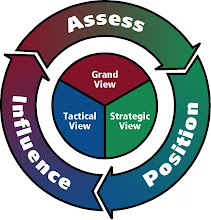
Compass 1st Rule of Competition: Assess, Position and Influence

Cardinal Rule of Competition: Stay focused on your grand objective during the competition.

One who loses their emotional balance, usually become so engaged to the micro-event, that he/she surrenders their focus of the grand objective.

A leader should never lose their cool especially in the field of competition. There is no excuse.


#
49ers Post game


/// A competitor who does not stay focused on the grand picture, is usually the one who is being pawned.

This game had everything, including a nice shouting match between Mike Singletary and the acknowledged dirtiest player in the league, Falcons guard and former 49er, Harvey Dahl. Dahl completely got into everyone's head including the head coach.

"I wish I had better coaching ediquette," Singletary said. "I have to get better at that. ... It was the heat of the moment."

Dahl also drew a personal foul from Takeo Spikes at the end of the game. He was living rent free in the 49ers' heads.

/// Once the opposition has misdirected you from the game, you are being pawned.

"I expected a little bit of it," said 49ers linebacker Manny Lawson, who knew Dahl when Dahl was a practice squad player. "But nothing like that."

Others downplayed the Dahl factor, with a very somber Shaun Hill saying, "That's part of the game."

Spikes attributed the loss to this. "Whatever could have gone wrong, went wrong, times two," Spikes said. That included a Michael Turner fumble in the first half that was kicked right to a Falcon.

http://www.sfgate.com/cgi-bin/blogs/ninerinsider/detail?&entry_id=49354
http://nfl.fanhouse.com/2009/10/11/fiery-mike-singletary-shouts-at-falcons-harvey-dahl-apologizes/


If the San Francisco Niners coaching staff properly assessed their opposition, they would have realized that a specific element of the opposition was going to play dirty. They should have been prepared for this worst case scenario. Click here for a news item on the mindgamer who got into Singletary's head.

#


Compass View

Point #1: Assess your opposition properly and carefully.

Point #2:
Plan your gameplan to exploit their strengths and weaknesses

Point #3: Plan and prepare for best and worst case scenarios.
* Ensure your contingency
plays are in your script. (We presuming that you have one. Do you?)

Point #4: Consciously know what you are planning for.

Point #5: Prepare your team on your contingency moves for all best and worst case scenarios.

Point #6: Never ever let a negative event stay in your head for more than a micro moment. Remember to keep your eye on the current event while being mindfully aware of the rest of the game. Avoid the emotional negativity.

Point #7: It takes a coolhead to win a hot game.