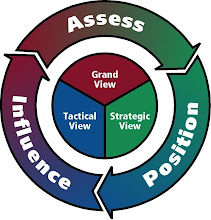
Showing posts with label The Dao of Strategic Assessment (S3). Show all posts

Sunday, July 26, 2009

The Dao of Strategic Assessment (30): Assess and Predict


The C360 group wrote about the possible recovery on the 19th of April 2009.

"In Jan. 2009, some associates told us that the U.S. economy will recover sometimes late this year. That the upper tier banks have slowly begun to release money to the upper middle tier of our society. It will slowly trickle down to other parts of the economic value chain."


We immediately assessed the source of their information and believed the validity of their view.

Our assessment told us that the overall growth of the job market will be slow. We believe that the fore-coming economic upswing will positively benefit the professionals with ultra-class expertise. We advised those with average
work skills to master an arcane high valued trade that has a minimum chance of being obsolete.

Those who thrive in this challenging economy, usually have
ultra class expertise in one or two "hot" areas. They also have a few "above average" general skills.

Someone asked us the question of what to assess.

Following was (the abridgment) of our response:

"Assess your grand settings cautiously and carefully focus on the following three points:
  • the disposition of the (entire field) of competitors;
  • the economic influences; and
  • the market influences.
... Failure to stay focused on the objective while minding their grand settings usually create a position of failure. This frequently occurs all of time. Do not be a victim of repeated negative habits. "

Our globally connected society allows the many global forces to shift and sway the economic foundation of the United States and the rest of the world each and every month.

Conclusively, we do live in interesting times.


#

July 25, 2009
Off the Charts

Leading Indicators Are Signaling the Recession’s End
By FLOYD NORRIS

THE American recession appears to be nearing an end, but only after it has become the deepest downturn in more than half a century.

The index of leading indicators, which signals turning points in the economy, is rising at a rate that has accurately indicated the end of every recession since the index began to be compiled in 1959.

The index was reported this week to have risen for the third consecutive month in June, and to have risen at a 12.8 percent annual rate over those three months. Such a rise, pointed out Harm Bandholz, an economist with UniCredit Group, “has always marked the end of the contraction.”

Mr. Bandholz said he expected that the National Bureau of Economic Research, the official arbiter of American economic cycles, would eventually conclude that the recession bottomed out in August or September of this year.

If that proves to be accurate, the recession that began in December 2007 will have lasted 21 or 22 months, making it the longest downturn since the Great Depression.

There are caveats to the forecast, of course. Somewhat illogically, the index of leading indicators is subject to revision in coming months, which could make the recent gain seem smaller and not necessarily indicative of an approaching recovery.

Only seven of the 1o leading indicators for June have been reported by the government, while the other three were estimated by the Conference Board, an independent research group that compiles the indicators. Some of the seven indicators that have been reported may be revised.

As can be seen in the accompanying charts, six of the seven recessions since 1960 either ended in the month the indicator first showed a 12 percent annualized gain, or had ended a month or two before the index did so.

The exception was the 1990-’91 recession, which was followed by one of the slowest recoveries ever. The official end of the recession was in March 1991, but the recovery was so tepid that it was not until December 1992 that the economic research bureau made that call. As it happened, December was the same month the indicator first showed such a strong three-month rise.

An end to recession is not, of course, the same thing as the beginning of a boom. The indicator “has an unblemished record on calling the turning point,” said another economist, Robert J. Barbera of ITG, “but it is not a particularly good guide to the power of the upturn.”

Indeed, one of the strongest moves in the leading indicators came at the end of the brief 1980 recession, as credit controls were removed. But the economy soon fell into another, longer recession.

Mr. Bandholz thinks we may get a “W” recovery, in which early gains are followed by weaker figures. “We do not expect this recovery to be strong and self-sustaining,” he said. “What is lacking is support from consumer spending.”

During the most recent three months, the strongest indicators have been the financial ones. The Standard & Poor’s 500-stock index has risen while the gap has widened between long-term and short-term interest rates. The indicators index was also helped by an increase in consumer expectations and a slowing in deliveries by suppliers. (Slower deliveries are assumed to be caused by rising orders, although such a change could indicate the suppliers simply laid off too many workers.)

Two of the 10 indicators — the money supply and new orders for consumer goods — have shown declines.

Another measure compiled by the Conference Board, the index of coincident indicators, has fallen for eight consecutive months, and dropped in 17 of the last 19 months. That indicator is often used by the economic research bureau in dating decisions, and its failure to stabilize is a reason that Mr. Bandholz says he thinks the downturn is not yet over.

The index of coincident indicators has fallen 6.4 percent from the peak it reached in November 2007, making this the deepest recession since 1960. Before this cycle, its steepest decline was a 5.6 percent slide during the 1973-’75 downturn.

Floyd Norris’s blog on finance and economics is at nytimes.com/norris.
http://www.nytimes.com/2009/07/25/business/economy/25charts.html

Wednesday, July 15, 2009

The Dao of Strategic Assessment (29): Assess with the Right Data


What is your approach for gathering intelligence?

What is your approach to determine if the data is correct?

If you don't know the answers, what will you do when you chasing the hindquarters of your competition?

One always need the correct data before assessing the big picture. How do you know if you have it?

Many C-level officers assume that they have the latest data. The question is whether due diligence has been performed!?

In the global economy, it is not that difficult to deceive the competition with bells, whistles, smoke and mirrors. In future posts, we will touch on that topic.


#

Wednesday, July 08, 2009 11:19 AM/EST

Law of Averages Overturned

by Tony Kontzer

All those business school lessons about using historical averages to predict probable outcomes? Apparently, that may have been precisely the wrong approach.

In his new book, The Flaw of Averages (2009, John Wiley & Sons, Inc.), Sam Savage, a consulting professor of management science and engineering at Stanford University, posits the theory that averages are a hopelessly useless statistic for determining risk, and that it's time for business decisions to be made using more accurate predictors.

One possible answer, Savage claims, is the emerging field of "probability management," which draws upon a type of data Savage has helped define known as "distribution strings." Unlike numbers, distribution strings are based on the unknown, making it possible to take the uncertain into account when determining a probability. So instead of a spreadsheet cell containing one number, it contains a distribution string of thousands of numbers--called Monte Carlo trials--that constantly are updated any time another cell in the spreadsheet is changed. The idea is that risk isn't a fixed number--it's an ever-changing collection of averages that are inter-related.

"The flaw of averages happens when people plug a single number into a cell to represent a probability," Savage said during a recent interview. "Think of taking a spreadsheet and adding a third dimension to it. Any cell in your spreadsheet should be able to provide you with an average."

It's a big concept to get one's brain around, so to illustrate the problem consider this crude example of how Savage believes averages doom many IT projects: Take a software development project in which 10 separate teams are each working on a particular sub-routine, with no interdependence between them at all. The project manager isn't sure how long each sub-routine will take, but he knows the average will be 3 months, so he relays that to the boss when pressed.

Unfortunately, according to Savage, there is only one chance in a thousand that the project will be done in 3 months--the same odds as flipping a quarter and have it come up heads 10 straight times. In the end, the boss is unhappy, the project manager is held responsible, and stress levels for the next development project rise. Ultimately, companies find themselves resigned to accept that most software projects will take longer than expected, when in fact the problem is that the practice of using historical averages to compute probable completion dates is fundamentally flawed.

The way Savage see it, this dependence on averages has had some pretty grave consequences, which the recession highlights. "We ignored this, and we flew into the side of a cliff," says Savage. He expects that risk analysis will be handled quite differently going forward. "There will be a tremendous move, after this recent meltdown, of people trying to understand risk and uncertainty better."

For IT, in addition to rethinking how project timelines are estimated, this is likely to mean the need to deploy and support tools that can handle this ramped up focus on risk and uncertainty. New applications will be needed for processing distribution string data, and then for analyzing that data to determine probabilities.

In the meantime, if you want to give probability management a test drive, you have two options. You can purchase Frontline Systems' RiskSolver application, which is the brainchild of company President Dan Fylstra, who was the original distributor of VisiCalc back when the Apple II made its debut in 1979. Or, you can try downloading Savage's less powerful--and less expensive--XLSim.

And you may want to brush up on your knowledge of probability management, distribution strings and Monte Carlo trials--something tells me your ability to sufficiently analyze risk and uncertainty will soon depend on it.

Related: Scott Rosenberg on the difficulties of software development.

http://blogs.cioinsight.com/knowitall/content001/software/law_of_averages_overtuned.html

Sunday, July 12, 2009

The Dao of Strategic Assessment (28): Assess and Predict


The first step to predicting the future is to assess the data source and its reliability. The next step is to assess the data through regressive means. Understanding the data from an active view, a functional view and a grand picture view enables one to see the trends. In future posts, we will touch on each view.

#

July 8, 2009
Seeking a Way to Predict Baseball Injuries
By MICHAEL S. SCHMIDT

LOS ANGELES — Beyond the massage tables and stacks of athletic tape in the Dodgers’ cramped training room stands a dry-erase board with scribbled questions like “Fat? Skinny?” and “Country of origin? Region of the country they grew up in?”

Stan Conte, the team’s director of medical services and head athletic trainer, expects the answers to help him resolve a problem plaguing professional sports teams: injuries.

In Major League Baseball, where players are breaking down in record numbers, teams paid about a half-billion dollars last season to players on the disabled list.

The ability to predict how players’ bodies will fare is a holy grail. With an actuarial approach, Conte seems to have a head start in the pursuit. He is trying to build a formula that would give teams a competitive advantage and help them avoid players who spend their days in the training room and not on the field.

“The insurance industry has made millions of dollars off figuring out how, when, where and why people are going to die, and we are trying to figure those things out about injuries,” Conte said.

Every major league team and scores of independent analysts are trying to understand why injuries strike certain players. But Conte said his effort is more advanced because his data has been compiled over 15 years as a trainer for the San Francisco Giants and now the Dodgers. He has had hands-on interaction with hundreds of players before and after their injuries, and his observations and medical records inform his hypotheses.

Conte also draws on the analytical prowess of David Zes and Adam Sugano, statisticians who teach at U.C.L.A., and Matt Marks, an employee in the Dodgers’ baseball operations department. They are building mathematical formulas that they hope will show the chances a player will be injured within the next season.

“This project couldn’t have been done 5 to 10 years ago,” Sugano said. “There weren’t enough numbers, and there wasn’t access to lots of the numbers. The numbers weren’t being collected, and those that were weren’t the cleanest. And 20 years ago, there wasn’t the computational power. It didn’t exist.”

Billy Beane, the general manager for the Oakland Athletics, called it “the natural progression of statistical analysis.”

Beane was at the forefront of baseball’s first surge in statistical analysis, as detailed in the 2003 book “Moneyball,” when he embraced new ways of evaluating players’ talents. Now Conte is applying similar methods to injury research.

“Injuries are a huge part of the game and it makes sense that they are doing it,” he said. “I just don’t have the money to let someone spend all year looking into this.”

Conte considers many of his findings proprietary, but in a recent interview at Dodgers Stadium he provided a glimpse of his project.

About once a week for the past six months, Conte has sent an e-mail message with lists of players’ identifying characteristics to Sugano and Zes. They build logarithmic formulas and computer codes that test Conte’s hypotheses, such as Dominican players being more durable than Americans and whether high pitch counts lead to injuries.

“He has been working and seeing things over his career that he thinks are trends, and he needs someone to execute them,” Sugano said. “We are the executors.”

Marks helps Zes and Sugano by scouring the Internet and baseball databases for statistics on players’ performance and injuries.

Although Conte said the project is far from finished, he has begun to apply some of his analysis to advise the Dodgers’ front office on personnel decisions, including free agents.

When the team’s contract with relief pitcher Scott Proctor was due to expire last year, Conte said he and his assistants conducted a risk assessment that considered Proctor’s medical history, the number of pitches he had thrown and his frequent appearances two seasons in a row.

“We did a risk analysis — I can’t tell you what it was, but we saw him go 83, 83 in appearances two years in a row and had some concerns,” Conte said. “Without getting into specifics, we ended up not tendering him a contract.”

Proctor signed with the Florida Marlins. He sustained an elbow injury in spring training and needed major surgery. He may miss the entire season.

Conte’s injury analysis has evolved. He said it is more sophisticated and, he hopes, more accurate. Three years ago, he advised the Dodgers that signing pitcher Jason Schmidt to a three-year, $47 million contract was not a high risk. Since then, Schmidt has had two shoulder operations and pitched in only six games.

“Everyone asked me two, three times a day, ‘If you had to do it all over again, how would you analyze Schmidt?’ ” Conte said. “I didn’t have all the answers with Jason Schmidt, which has pushed me to get better knowledge.”

A nagging challenge is the absence of a centralized database of injuries. All Conte’s team has to work with is Major League Baseball’s disabled list, a relic that includes errors and misinformation.

“People in M.L.B. don’t believe it, and we still don’t,” Conte said, adding that teams sometimes manipulate roster moves by putting players on the list who may not be injured. “But it is the closest thing we have to anything.”

Unlike the N.F.L. and the N.H.L., baseball does not have a central database of league-wide injury data. The commissioner’s office has begun trying to help teams track injuries reliably and consistently. But that project may take several years.

“Stan has been all over us with this trying to get all the data into one place,” said Chris Marinak, Major League Baseball’s director of labor economics. “The difference between Stan and other trainers is that he has taken a real vested interest in this.”

Conte said he was conducting his research on his own time, not as part of his job with the Dodgers. Considering all the money teams have invested in injured players, the formulas could become lucrative if successful. Conte said he has no agreement with the three others on sharing any potential profits.

“For now, we are having fun and that’s enough,” Sugano said. “It’s something we have talked about, but we will be careful. We will let them taste the sauce. And it’s something that won’t work if they don’t have our algorithms; we have the recipe and it won’t work without it.”

It is not clear whether other teams are attempting similar research because they are not inclined to discuss something that may provide a competitive advantage.

Lonnie Soloff, the head trainer for the Cleveland Indians, a team considered to have a progressive medical staff, said he used a mathematical formula to assess injuries but admitted, “it is not an exact science and I am not sure it will become an exact science anytime soon.”

The Boston Red Sox, another team with a progressive medical staff, declined to let their trainer be interviewed.

Conte believes the long-prevailing belief in baseball that injuries are a matter of chance is misguided.

“I refuse to think we are doing all these things to get them healthy, and it’s a matter of luck whether lightning hits or doesn’t hit,” he said.

Copyright 2009 The New York Times Company
http://www.nytimes.com/2009/07/08/sports/baseball/08injuries.html

Thursday, June 18, 2009

The Dao of Strategic Assessment (27): Assessing One's Grand Settings


Assessing the potential alliances and the opposition through the use of Sunzi principles is quite simple.

Gathering "complete" intelligence on the contenders (not the pretenders) is the first step.

The next step is assessing the intelligence in terms of the "Public View", "The Functional View", The Field View", The Organizational View" and the "Definite View

While analyzing their past history and current actions from those different views can be quite taxing,
transforming the intelligence into a top-down plan is the greater challenge.


If you like to know how to transform assessed data into a top down strategic view, please contact us at service [att] collaboration360 [dott] com.

#

Everyone's on hand

It was pretty stuffy at Wednesday's news conference introducing incoming Police Chief George Gascon -- maybe it was all the egos in the room.


Apparently no one wanted to be left out: City officials nearly outnumbered members of the media at the packed event in the mayor's office. And we couldn't help but notice that most of those elected officials -- some of whom have traded harsh words lately -- have their sights set on higher office.

Of course, Mayor Gavin Newsom is looking to move to Sacramento, and numerous people in attendance are thought to be angling to replace him: Supervisors Ross Mirkarimi and Bevan Dufty, City Attorney Dennis Herrera and Assessor Recorder Phil Ting (who shares a political consultant with Newsom and got a special shout-out towards the end from the mayor).

Incoming Police Chief George Gascon gets a warm welcome from the whole city family Wednesday.
Michael Macor
The Chronicle
Incoming Police Chief George Gascon
gets a warm welcome from the whole city family Wednesday.

But ambition doesn't stop at San Francisco's borders: Attorney General candidate and current District Attorney Kamala Harris was front and center. And her right hand man, Chief Assistant District Attorney Russ Giuntini (who may be looking to become the city's top prosecutor) was also there.

Also in attendance were Board President David Chiu, supervisors Carmen Chu, John Avalos, Eric Mar and David Campos, Public Defender Jeff Adachi (who's gearing up for a budget fight).

Appointed officials were on hand too, including Fire Chief Joanne Hayes-White, Police Commission President Theresa Sparks, Police Commissioner David Onek, Bill Siffermann, San Francisco's juvenile probation chief and Kevin Ryan, director of the Mayor's Office of Criminal Justice.


And, of course, Police Officer's Association president Gary Delagnes, who never fails to give a great quote. Case in point-- when Delagnes was asked what challenges Gascon will face, he had this gem:
"Politics. San Francisco (is) unlike Los Angeles or any other city in America. To learn the players on the police commission, to learn the players on the board of supervisors, the mayors office, the command staff, the media," Delagnes said. "He's got to see where the knives are coming from and the knives are coming from day one. They already started today."

Posted By: Marisa Lagos (Email) | June 17 2009 at 03:30 PM
http://www.sfgate.com/cgi-bin/blogs/cityinsider/detail?blogid=55&entry_id=41905
http://www.sfgate.com/cgi-bin/blogs/cityinsider/detail?entry_id=41905

Tuesday, June 16, 2009

The Dao of Strategic Assessment (26): Assess One's Grand Settings


From the late 60's to the early 80's, the Red Wings went on a losing slump in which they only made the playoffs twice, winning one series.

In 1983, the Red Wings organization changed to a new owner who brought his own management team. Their first set of objective was to assess their global settings and determined what was their overall philosophy in terms of organizational leadership, talent, game style. Once they built and connected to their strategic overview (
Tangible Vision). The Red Wings used their Tangible Vision as their guide and started to search for the best global hockey talent that fit their game philosophy of puck control, speed teamwork and quickness. They immediately began to win. Between 1988 to present, the Red Wings won four Stanley cups, six Conference championships and 14 Division championships

During 2004-2005 season, the economic state of the US professional hockey game changed. The Red Wings and other hockey teams were forced to modify its contracts system and displaced some of its high-priced players. Concurrently, they were also forced to re-think their gameplay approach. In some of their games, they noticed that the stronger opponents were out-muscling them in close games.

The Red Wings management decided to maintain their emphasis on puck control and game speed. However, they adjusted their game by focusing
its European players to play more physically aggressive and go into corners after pucks. It worked quite well that they won the Stanley Cup in 2007-2008 and were playing in the NHL Stanley Cup Finals this past season.


#

In NHL, Detroit Turns to Imports

As Motor City Slumps, Red Wings Thrive With European Players; Swedes Rejoice

By REED ALBERGOTTI

As the ailing Motor City rallies around the Detroit Red Wings, who face the Pittsburgh Penguins on Friday in Game 7 of the Stanley Cup Finals, there is one tiny bit of irony: Michigan’s top team is powered more than ever by European imports.

Less than half the Red Wings’ roster comes from North America. The rest, and most of the team’s top talent, hail from Sweden, the Czech Republic, Russia and Finland. In all, five players are from the U.S. Years ago, when the Big Three auto makers were allowing overseas competitors to pull ahead, the world was getting flat inside Joe Louis Arena. Starting in the 1980s, the Red Wings began building a dynasty by recruiting talent from Russia and adopting a new, European style of hockey.

The Red Wings’ success—they have won four Stanley Cups since 1997–paved the way for the rest of the league to follow. Today 30% of the NHL’s players hail from outside North America. The Red Wings are still the most international team, with 54% of their players hailing from overseas. This season, more than 80% of the Red Wings’ goals were scored by players born outside North America, up from 41.5% in the 1996-1997 season.

At the same time, the pool of available talent at home seems to be thinning. In Michigan, one of the nation’s top junior-hockey states, the struggling economy—and the high cost of junior hockey—is taking a toll on participation. USA Hockey says youth participation in the state has fallen 14% in the past three seasons.

In many ways, the Red Wings are a case study in harnessing globalization. Team scouts travel the world in search of new talent and new ideas. Instead of an employee-training program, the team uses its farm team, the Grand Rapids Griffins of the American Hockey League, to develop talent.

“It’s a global sports market now,” says Michael Maroone, the chief operating officer of AutoNation and part owner of the NHL’s Florida Panthers. “Detroit was certainly out in front on the hockey side. It reminds me of Toyota, honestly.”

Giving Away Cars

In the 1980s, Red Wings owner Mike Ilitch had to give away cars at every home game to persuade fans to watch the beleaguered “Dead Things,” which hadn’t won a championship since 1955.

Team officials Jimmy Devellano and Ken Holland set out on a radical mission: to draft and sign European players who played a brand of hockey completely different from what was common in North America. The Wings drafted Russian Sergei Fedorov and Swede Nicklas Lidstrom in 1989 . Players then switched to a cleaner, faster, less pugnacious puck-control style of hockey that eventually led the team to championships in 1997, 1998 and 2002.

After the lockout in 2004-2005, the team found itself in a bind. It had a payroll of $75 million that had to be shrunk to $39 million. To make room for the new salary cap, Detroit chose fast and talented European players and got rid of many of its beloved North American stars.

The team had mild success, but was knocked out of the playoffs in the first round by Edmonton in 2006. Next the team considered trading in some of its European stars for North Americans who could hit and fight and were more popular with the fans. “Maybe a little more North American—away from our philosophy a bit,” says Mr. Holland.

After much discussion, the team decided to stick with its original plan and instead teach its European players to play more physically and go into corners after pucks. It worked. The team won the Stanley Cup by 2008 and is now one game away from winning two years in a row with a team buttressed by Europeans like Sweden’s Johan Franzen and Russia’s Pavel Datsyuk. Together they won the team another championship last season. “You’re not really going to Europe looking for toughness,” says Mr. Holland.

The NHL and the Red Wings say they’re making an effort to boost development programs in the U.S. and North America. This past fall, the NHL upped the money available to USA Hockey, the country’s governing body, to $8 million from $1 million. In part, the money is going to support initiatives like the American Development Model, a national set of standards based on international best practices in developing athletic talent. The program costs about $2 million annually.

No matter how the team is composed, Detroiters show no lack of support for the Red Wings—and have proven especially devoted this season.

“You would think if there was a town that would not grasp on to an international team, it might be Detroit, because of the ‘buy American’ thing and patriotic feelings,” says Michael Robinet, vice president of vehicle forecasts for consulting firm CSM Worldwide. “It shows Detroit is willing to think outside of the box and has embraced this team.”

John Cooney, a stay-at-home dad from Livonia, Mich. Says he’s all for the Red Wings’ foreign roster. “I think that it’s important to search the four corners of the earth for talent,” he said.

Auto-industry experts are quick to note that the auto makers are not by any means unaware of foreign markets, especially Europe. General Motors says it actually has more employees outside the United States than in, and that it sells more vehicles abroad. Many global suppliers have added a presence in Detroit, bringing in workers from all over the world and making the city more global.

The only difference is the level of success they’ve had bringing European ideas to North America.

“Detroit has had to move from its domestic focus of 30 to 40 years ago to one where their survival depends on going global,” says Mr. Robinet of CSM. “That’s how the Red Wings saw things before many, many other teams,” he says.

Bruce Belzowski, assistant research scientist at University of Michigan’s Transportation Research Institute says the auto makers would have certainly taken a page from the Detroit Red Wings, had it been that simple. “I think it’s a lot easier to go out and scout for four or five good players than it is to turn huge companies around.”

Global Auto Makers

Shawn Morgan, spokeswoman for Chrysler Group says that in a global marketplace, the auto industry has been working hard to be prepared, “which is very similar to what the Wings have done,” she says. “Just like the Ilitches have made a great team, I think we’re putting together a great team.” A Ford spokesman says nobody is more supportive of the team than the company’s Swedish employees. “We’re an international auto maker based in Detroit,” he says.

The Red Wings, for their part, say they hope a Stanley Cup would serve as a respite from a wave of terrible news. “Times are difficult in Detroit and the State of Michigan,” a spokesman said. “We’re just trying to do our part to give the fans something to be proud of and to feel good about.”

Michigan governor Jennifer Granholm puts a different spin on the issue. “Having Swedish roots myself, I get a kick out of the Red Wings having Swedes on their roster—nearly a third of their lineup,” she says. “The Wings are a diverse team, and that diversity is reflective of Michigan.”

—Andrew Grossman contributed to this article.

Write to Reed Albergotti at Reed.Albergotti@wsj.com

http://online.wsj.com/article/SB10001424052970204482304574221962202473816.html#

Tuesday, June 9, 2009

Strategic Assessment Exercise


You are the director of strategic marketing for a mid-level software game company. Your goal is to secure a strategic disposition at the show that would make you the "buzz" of the exposition.

q: What are you going to do to gain that "buzz"?

q: What are you going to assess?

q: What is your positional strategy for being "the signal that is above the noise"?


#

June 9, 2009
Video Games
Electronic Fair Returns, Trying to Regain Its Luster
By SETH SCHIESEL

LOS ANGELES E3 is back. After a two-year experiment as a relatively sedate, exclusive conference, the Electronic Entertainment Expo returned to its bombastic glory here last week as video games’ premier global showcase. Attracting more than 41,000 attendees from almost 80 nations, E3 recaptured its buzz of old without degenerating into the sort of over-the-top crush that had prompted the retrenchment in the first place.

Here are eight of the most interesting and exciting games from E3 that are scheduled to be released this year. This list does not include any of the potential blockbusters from E3 scheduled for 2010, a lineup that includes the suspense thriller Alan Wake, God of War III, Mass Effect 2 and Final Fantasy XIII.

BIOSHOCK 2 The sequel to one of the most important games of recent years, BioShock returns players to Rapture, the ruined Art Deco city under the Atlantic Ocean. In the first game players uncovered the story of the twisted civil war in Rapture’s supposedly utopian society. With its pointed, mature critique of the notion of free will, BioShock set a new bar for interactive storytelling. BioShock 2 hopes to continue the adventure. It is to be released by 2K Games on Nov. 3 for the Play Station 3, Xbox 360 and Windows.

NEW SUPER MARIO BROS. For more than two decades, Mario’s side-scrolling, two-dimensional journey to rescue Princess Peach in Super Mario Bros. has stood as one of the seminally entertaining interactive adventures. At E3, Nintendo announced that it was developing the first multiplayer version, allowing as many as four players to jump and bounce over one another at once. It is to be released by Nintendo by year’s end for Wii.

BAYONETTA While the Mario games may epitomize the cute, family-friendly end of the spectrum in Japanese game design, Bayonetta represents the other end: stylized, flashy and spectacularly violent. Bayonetta, a statuesque, impossibly proportioned witch, is capable of wielding an entire arsenal at once, including multiple guns and swords, not to mention magical attacks unleased by her pulsing mane. Both gory and titillating, Bayonetta is to be released by Sega this year for the PS3 and 360.

HALO 3: ODST. While there is plenty of hectic front-line combat in ODST, a stand-alone prequel to Halo 3, much of the new game places the player in the role of a stealthy special-operations trooper picking his way through the vast ruins of New Mombasa. It is to be released by Microsoft on Sept. 22 for 360.

DJ HERO Activision hosted the party of E3, with Jay-Z, Eminem, DJ AM, Travis Barker and Warren G performing for the private crowd at the Wiltern Theater. But DJ Hero would have made this list even without the party (no, really). For all of the millions of copies the Guitar Hero series has sold, there are still millions of people who prefer hip-hop, electronica, trance and dance music to guitar anthems. It is to be released by Activision on Oct. 27 for PlayStation 2, PS3, 360 and Wii.

MAG MAG for massive action game promises to allow 256 players to blast away at one another simultaneously on one uninterrupted, virtually seamless near-future battlefield, a prodigious technical feat. MAG could represent a watershed for online gaming. If it works, that is. It is to be released by Sony this fall for PS3.

MODERN WARFARE 2 No line of games has yet provided a more consistently compelling rendition of the battlefield than the Call of Duty series. Modern Warfare 2 continues the story of the Call of Duty universe, with the player taking the role of various Western commandos on the hunt for international terrorists. Combining stealth sequences, all-out firefights and vehicular combat, Modern Warfare is to be released by Activision on Nov. 10 for the PS3, 360 and Windows.

DRAGON AGE: ORIGINS My sentimental favorite of E3, Dragon Age is a throwback to the old-school single-player fantasy role-playing game. Of course it helps (a lot) that it is being made by the team behind the Baldur’s Gate series some of the best old-school single-player fantasy role-playing games. Like Baldur’s Gate, Dragon Age appears to mix deep story lines and personal interactions, including the inevitable love triangles, with its sword-and-sorcery action. It is to be released by Electronic Arts on Oct. 20 for the PS3, 360 and Windows.

Copyright 2009 The New York Times Company
http://www.nytimes.com/2009/06/09/arts/television/09games.html

Monday, June 8, 2009

The Dao of Strategic Assessment (25): The Dao of the Strategist


The first step of becoming a good strategist is having the urgency to learn. The next step is learning how to assess. How many of you are willing to work diligently to become an "above-average" strategist?


#
Thursday, June 4, 2009
John U. Bacon
Ken Holland: Bad goalie, great general manager

In 1984, Wayne Gretzky was already well on his way to becoming the greatest hockey player the game has ever seen. That same year, a 5-foot-8 goalie named Ken Holland was well on his way to becoming one of the worst goalies the game has ever seen: four games spread out over four years, no wins, 17 goals against. His pink slip was a mercy killing.

But Holland loved the game more than the game loved him, so he took a job as the Red Wings' western scout. This required driving to every frozen bandbox from Chilliwack to Flin Flon, Medicine Hat and Moosejaw -- places where you keep your car running in the parking lot during the game, or else you won't be able to leave the game.

Holland didn't complain. He humbled himself to learn the art of scouting, and worked his way up the ranks until he became Detroit's general manager in 1997.

The Wings won the Stanley Cup that year for the first time since 1955. But a lot of teams win it once -- and only once -- like the Ducks and 'Canes and Lightning -- oh my! Winning it twice, in the era of expansion and salary caps, is positively historic. Detroit now stands alone with four Cups over the last 12 years -- and soon maybe five. No team in the NFL, NBA or Major League Baseball can equal that.

How did Holland do it? By using what he learned scouting in those miserable rinks. He had to. The system is set up to prevent dynasties. The more you win, the lower your draft picks. So, after lesser teams have snapped up their "can't miss kids," Holland and his staff have to find overlooked gems, the guys who will work the hardest to play for a winning team -- not for themselves.

Holland and company not only draft for talent, but temperament. The Red Wings' locker room's is bereft of egos, and drama. You don't hear about these guys spouting off or getting in trouble.

They found their current 29 players in three states, five provinces and eight countries -- from Alaska to Newfoundland, and all over Europe -- even though everyone used to say you couldn't win with Europeans. In the Wings' locker room, you can hear six languages -- all of them spoken by Stanley Cup winners.

These "leftovers" include seventh-round pick Henrik Zetterberg, last year's playoff MVP; sixth rounder Pavel Datsyuk, the league's best defensive forward; and a third-rounder named Nick Lidstrom. He was just 18 when they found him in a tiny Swedish town, where he got so little playing time, the Wings' scout had to go to practice every day just to see him skate. The scout obviously saw something no one else did.

Today, Lidstrom is not only the Wings' captain, but the very best defenseman in the world. Worked out OK.

In all, other teams picked a total of 431 players before the Red Wings signed these three. Most of those 431 players are not only out of the playoffs, they're out of the game.

The Wings treat their players so well, they accept less to play here. Last year, star forward Marian Hossa played for the Penguins. They offered him a seven-year contract. The Red Wings offered one. Hossa took the Wings' offer -- and is about to win his first Cup, over his former team.

Today, Wayne "The Great One" Gretzky runs the Phoenix Coyotes, a team so bad they might move to Hamilton, Ontario -- while Kenny Holland is the mayor of Hockeytown.

So, here's to one of the worst goalies the game has ever seen, and one of the best general managers -- maybe even the Greatest One.

Copyright 2009, Michigan Public Radio

Former Detroit News reporter John U. Bacon is an Ann Arbor-based freelance writer. He is the author of several books, including the best-selling "Bo's Lasting Lessons," co-written with Bo Schembechler. He is the host of three programs on WTKA-AM (1050), and provides weekly commentary for Michigan Public Radio ( www.michiganradio.org). His Web site is www.johnubacon.com.

http://www.detnews.com/article/20090604/OPINION03/906040497/1128/SPORTS0103/Ken-Holland--Bad-goalie--great-general-manager

Sunday, June 7, 2009

The Dao of Strategic Assessment (24): Transforming a Crisis Into an Opportunity


The intelligent strategists do not always look for opportunities. They assess their global settings, pontificate their options and slowly decide.

While the gathering of intelligence on the strategic disposition of their target is still in motion, they are constantly assessing it. The intelligent strategist always waits for that grand advantageous moment when the circumstance favors them. Conclusively, they pursue it without any emotion and maximize their opportunity to the fullest.


#
June 6, 2009
Saturn deal is called a new business model

BY TIM HIGGINS
FREE PRESS BUSINESS WRITER

Detroit businessman Roger Penske's move to acquire General Motors' troubled Saturn brand and dealer network could be pioneering -- the start of a new strategy for selling cars and trucks in the United States, experts said Friday.

On Friday, GM announced a tentative deal for Penske Automotive Group to purchase Saturn, a transaction that the companies said should be finalized this fall.

The Detroit automaker will continue to assemble Saturn vehicles for two years, and Penske is talking with other manufacturers about building vehicles that the dealer network would sell.

Jack Nerad of Kelley Blue Book heralded the Penske-Saturn deal as "one of the most significant developments in a month that has been full of significant developments."

"The proposed acquisition marks the beginning of a new business model in this industry," he wrote, "a model in which the distribution side of the business controls the brand, and manufacturing is conducted by one or more sub-contractors."

Penske Group seeks new vehicles for Saturn dealers

Penske Automotive Group is in talks with several automakers about providing new vehicles to the Saturn dealer network.

Penske's deal with General Motors, which has not yet been finalized, provides him with GM-made vehicles for two years.

"We have been in discussions during this diligence period with a number of manufacturers on a worldwide basis," Penske told reporters Friday. "We would expect to have a lineup going forward, which would be manufactured by a worldwide partner."

He expects that eventually the new vehicles could be built in the United States if sales demand it.

The Penske deal is an incredible cap to a historic week in the domestic auto industry, particularly at GM. The automaker filed for bankruptcy protection Monday and announced a deal to sell its Hummer brand Tuesday. By Thursday, word of an impending Penske-Saturn deal had also leaked.

Saturn dealers said they are excited to work with Penske, whose Penske Automotive Group is the nation's No. 2 auto retailer.

"It's phenomenal. Roger is a great guy. I don't think Roger would have got involved in this if he didn't think it would be successful," said Carl Galeana, whose Galeana Automotive Group owns Saturn of Lakeside and Saturn of Warren dealerships. "He rolls up his sleeves and gets work done."

Saturn dealers will be offered a franchise agreement, Penske said. He called the dealer network "one of the best in the business."

"Saturn has a passionate customer base and outstanding dealer network," Penske, chairman of Penske Automotive Group, said in a statement. "For nearly 20 years Saturn has focused on treating the customer right. We share that philosophy, and we want to build on those strengths."

GM said the deal will save more than 350 Saturn dealerships and 13,000 jobs at Saturn and its retailers.

GM's most recent plan called for shutting down the brand at year's end if a buyer couldn't be found.

On a contract basis, GM is to continue production of the Saturn Aura sedan and the Vue and Outlook crossovers. The deal includes Saturn's parts operation.

"We are bringing together two icons: the Saturn brand and the Penske organization," said Jill Lajdziak, Saturn's general manager.

The gray area of the deal is how much control Penske's Saturn will have over the design of the vehicles it sells, said Jeremy Anwyl, CEO of Edmunds.com.

"It's one thing to scour the globe and make deals ... but you didn't really have that much input in terms of the development, design, features, whatever of the product," Anwyl said. "Ultimately, the retail brand is a very nice feature but people are living every day with the vehicle itself and that vehicle has got to measure up with the brand attributes."

On Friday, Penske indicate a desire to keep the Saturn look with future vehicles.

"There's a brand value today in the way these vehicles look," Penske said. "And I would hope that we would have this icon brand value and face across the product line as we go forward."

http://www.freep.com/article/20090606/BUSINESS01/906060412

Friday, June 5, 2009

The Dao of Strategic Assessment (23): Time to Plan and Act


"In planning, no useless move, In strategy, no step is in vain."- Chen Hao


Delineating the end in mind is the first step to building a complete top down strategy.

After reading the following story, what is the grand goal of Sprint's and Palm?


#

Sprint's Palm Pre 'War Room'
Elizabeth Woyke, 05.29.09, 6:00 PM ET

Sprint is approaching its June 6 launch of the Palm Pre with military strategy.

The introduction of the hotly anticipated handset will be Sprint's biggest product event of the year. As interest in the phone escalates to a frenzy--in part because of rumored shortages--company representatives say Sprint is prepared for the onslaught.

Extra employees will be on hand to manage crowds, says David Owens, Sprint's director of devices. Sprint is also borrowing manpower from partner Palm, which will dispatch representatives to more than 100 Sprint stores across the country. The additional help will stick around for two months, Owens says.

Both companies are also establishing "situation rooms" to quickly address problems that might arise during launch, particularly tech support issues. If store representatives don't know the answer to a question, they can consult people in the "war rooms" via live chat.

The preparations rival those AT&T took when it released the iPhone. In the days prior to the iPhone 3G's debut last July, AT&T staffed up, created an informational Web site and streamlined its user registration process. (See AT&T Is iPhone Ready.)

Sprint says a successful launch centers on three factors: a great store experience, solid network and worry-free service plans.

Pre buyers will get one-on-one consultations with Sprint salespeople as part of the company's "Ready Now" program. First introduced last fall, it is designed so people can walk out of the store with their phones set up and knowledgeable about their features.

Consumers can choose from several service plans as long as they include Sprint's "Everything Data" package. The cheapest individual plan, with 450 "anytime minutes," will cost $69.99 a month. Those who want an unlimited number of voice minutes will have to pay $99.99 a month. There are also a few plans that specifically target families and businesses.

Sprint says its prices undercut comparable personal digital assistant (PDA) plans from Verizon Wireless and AT&T. The plans are one way the carrier aims to win over consumers who balk at the Pre's $199.99 price tag. "You have to look at the total cost of ownership over the two years, not just the device cost," Owens says.

[ Preparation precedes performance. Good planning always sets the pace for preparation. ]

Preparedness, however, doesn't always translate into success. The iPhone 3G launch frustrated many when an unexpected technical glitch forced Apple and AT&T employees to send would-be customers home empty-handed. Fans of the Pre are already wary because Palm and Sprint have said they may not have enough phones to satisfy customer demand, initially.

While Sprint shoulders the Pre's launch, AT&T and Verizon have been cozying up to Palm. Executives from both companies announced this week that they plan to offer the Pre next year, after Sprint's exclusivity period expires.

Full disclosure: Elevation Partners, which holds a 25% stake in Palm, is also a shareholder in our parent company, Forbes Media.

http://www.forbes.com/2009/05/29/pre-palm-sprint-technology-wireless-pre.html

Sunday, May 31, 2009

The Dao of Strategic Assessment (22): Let's Look at the Data


Quality intelligence gathering defines the quality of strategic assessment.


May 29, 2009

Lebron James, and Naked Without Data

In today’s world, companies, entities, people and concepts are naked without data. Making business decisions or predicting trends using data analysis is perhaps the only way to survive the future. However, it is not the raw data, but how you analyze it that matters. In other words, asking the right questions. Like the ones that many Wall Street firms didn’t ask when betting the farm, the house and the cars on mortgage-backed securities.

A good reminder of how to use data smartly came this week, thanks to Lebron James and my beloved Cleveland Cavaliers. As a frame of reference, none of my three professional teams have ever won a championship in their sport in my lifetime. That would be zero wins in approximately 120 attempts. In fact during such time these teams have made it to the finals on just three occasions. Ouch!

Here comes the “naked without data” part:

Moments after the Cavs lost Game 4 in a best-of-seven series, one the “analysts” (not statisticians but rather former NBA stars who likely have not been trained in statistics) “revealed” how stacked the odds were against them coming back to win it. In the history of the NBA playoffs there have been 3-1 series leads exactly 187 times, and only eight times has a team come back to win. So the Cavs odds are only slightly better than 4 percent, right?

Wrong. What Kenny Smith –- one of my favorite entertainers and basketball analysts — forgets when dealing with stats as opposed to offering up his sensational, articulate and simple breakdown of the subtleties of the pro game is that his sample set of 187 prior events had a bias to it that makes it not directly relevant at all in assessing the Cavs odds.

Why? Well, across the 187 instances of 3-1 series leads we would expect that the majority of them were generated by superior teams. For instance if the Lakers, Celtics or Bulls at the height of their respective Magic, Bird and Jordan years held 3-1 leads in the first or second rounds we would EXPECT them to win those series NOT because of the numbers but because of their superiority! In the case of the Cavs and Magic, the Cavs were actually favored to win the series. If the Magic win the series it will be a well-earned upset. Not a shocker, since the Magic won almost as many games as the Cavs during the regular season and we are now in the semi-finals, where only very good teams remain to compete.

So Kenny was starting with a very faulty sample set, which in this case made the Cavs odds look horrendous. What would have been impressive was if Kenny Smith understood his flawed sample set thanks to his statistical and logical training in grade school and provided the number of instances when a favored team was behind 3-1 in the late rounds of the NBA playoffs. THAT would be darn useful. If you threw in home court advantage, since the Cavs would be playing two out of the three remaining games at home, it would be all the better.

Since there are a mere eight instances of teams overcoming those odds, Kenny might be able to do an easy case study to see what happened in those games, to find out if there was a pattern or not and then use his basketball knowledge to tell a truly powerful story. I’m just guessing, but maybe then the odds move to, say, 20 percent from 4 percent. Still far from ideal for Cavs fans, but the Cavs do have the league MVP on their squad in Lebron James. So that should matter. As it did in Game 5.


So how does this relate to the technology industry? Data is a critical weapon and a difference-maker. Real-time analysis of data is one of the reasons why a company like Google has been able to make itself the king of online advertising, because with the ability to quickly, constantly analyze the data, it can then match ads with pretty much any content page across the web.

Of course, no one is giving Kenny Smith a hard time for the statistical irrelevancy of his comment. But we can probably chalk that up to the eternal optimism of true fans.

Copyright 2009 GigaOm. All Rights Reserved.

http://www.nytimes.com/external/gigaom/2009/05/29/29gigaom-lebron-jamesand-naked-without-data-65254.html

Tuesday, May 26, 2009

The Dao of Strategic Assessment (21): Sifting Reality from Illusions


“All things appear and disappear because of the concurrence of causes and conditions. Nothing ever exists entirely alone. Everything is in relation to everything else.”

~ Buddha


Politicians of all sorts will occasionally use generalized phrases to tell their audience that they have a "high impact" solution that is beneficial to the public.

Go to your favorite news sources and examine the speeches (and sound bites) of your local and regional politicians.

Check if they are using some of the following phrases: Back to Basics; Best Use of Available Resources; Community Objectives Coupled With Meaningful Commitment; Empowering Communities; Growth; Maximize Potential; Meeting Challenges; New Sense of Initiative; Positive Outlook; Quality; Reassessment, Rebirth, Renewal, Revitalization, Stability; Task Force; and Team-Oriented Approach.

Also, if their messages do not possess any tangible specifics (i.e., exclusive dates, defined metrics, etc.), it is a "stopgap" illusion.

Following are some of our favorite strategic assessment's rules:
* Look for "intelligence" situations that have high signal and minimum noise; and .
* The number of informational items with "bells, whistles, smoke and mirrors" is inversely propositional to the number of tangible informational items.

Collaboration360 Consultants (C360 Consultants). Copyright:2009 © All rights reserved. Copying, posting and reproduction in any form (without prior consent) is an infringement of copyright.