Friday, May 1, 2009

A History Channel's Documentary on Sun Tzu's The Art of War


This coming Sunday, History Channel's is doing a two hr presentation on Sun Tzu's The Art of War ... Our friend Mark McNeilly of SunTzu1.com will be featured as one of the on-camera experts.

Behind the scenes, we contributed to the content of the show. ... Enjoy the show.


PREMIERE: Sunday, May 3 at 8 p.m. ET on HISTORY CHANNEL

All warfare is based on deception. Therefore, when capable of attacking, feign incapacity; when active in moving troops, feign inactivity. When near the enemy, make it seem that you are far away; when far away, make it seem that you are near. – Sun Tzu.

Sun Tzu was the Nostradamus of warfare, and his book The Art of War, written 2,400 years ago, is still the ultimate how-to book for winning. This two-hour special brings his words to life. Shot like a graphic novel, Art of War weaves together several epic stories, including the story of Sun Tzu himself, and a war soon after his death where a city is saved using his tactics as China takes the first step toward unification.

Art of War also follows other epic battles in history—Roman battles, The American Civil War, World War II, and present day—that illustrate more of Sun Tzu’s lessons and how the people who understand his strategy are the most dangerous weapons of all. While his ideals were originally created for battle, his lessons could be used by anyone who wants to win—whether at sports, business, or life.

Wednesday, April 29, 2009

Connecting with the Tangible Vision


Starting a fight does not focus a team. It merely distracts the team from connecting and leading with their Tangible Vision. A fight does not create any momentum for the underdog who is behind the eightball.

fyi- A Tangible Vision is a strategic overview that emphasizes the specifics in terms of dates, metrics and risks. When a team connects with their Tangible Vision, they understand that completing the goal is everything. Concurrently, there is trust and accountability.

Lets Go Red Wings. Lets Go. ...

#
Ducks oust top-seeded Sharks 4-1 in Game 6
By GREG BEACHAM, AP Sports Writer
(04-27) 23:58 PDT Anaheim, Calif. (AP) --

Right when the opening puck dropped, Ryan Getzlaf and Joe Thornton dropped gloves. The star centers' simmering dislike erupted into a brawl dominated by Thornton, who pummeled Getzlaf with at least two flush blows to the face.

Getzlaf took it and smiled, knowing he still could win the only important fight.

/// In desperate times, desperate teams deploy desperate measures.
Win a fight. Then, lose a game is not the way to go.
The San Jose Sharks is a team with no idea of their priorities. ///

And that's exactly what happened in the waning minutes of Game 6. Getzlaf scored the knockout goal as the eighth-seeded Anaheim Ducks ousted the not-so-mighty San Jose Sharks from the postseason with a 4-1 victory Monday night.

Teemu Selanne and Francois Beauchemin put Anaheim ahead with their first playoff goals on fortunate deflections 83 seconds apart in the second period, and the Ducks coolly finished off the Presidents' Trophy winners in an upset that could resonate for years in this juicy in-state rivalry.

"I think if you ask anyone, we're not an eight seed," defenseman Ryan Whitney said. "Everyone in here knows that, and I think now everyone in hockey pretty much sees it, too."

Jonas Hiller made 36 saves to finish his phenomenal playoff series debut for the Ducks, who won a fight-filled clincher to complete a remarkable playoff upset two years after winning the franchise's only Stanley Cup.

The clubs' final meeting was a slugfest with 60 total penalty minutes and a long series of brawls between Anaheim's goals and Hiller's saves. It all started with the stunning fight between Getzlaf and Thornton, who traded shoves and harsh words two days earlier in San Jose.

"Joe kind of came in and said, 'Do you want to go tonight?'" Getzlaf said. "I had every intention of asking him, so it was a situation that carried over from last game. We kind of knew what we were doing. ... (In Game 5) I didn't want give them any spark. Tonight, I felt, was the opportunity to redeem myself."

Corey Perry also scored as Anaheim advanced to face second-seeded Detroit, which swept Columbus out of the first round. The defending Stanley Cup champions are favorites to defend their title — but few gave the Ducks much chance against the Sharks, either.

With a dynamic offensive effort that negated all the Sharks' physical bluster, Anaheim became the third team to beat the NHL's top regular-season club in the first round since 2000, and just the fifth since 1968. The Ducks are the eighth No. 8 seed to win a playoff series since 1994, largely dominating the league's first all-California postseason series in 40 years.

Evgeni Nabokov made 28 saves and Milan Michalek scored the game's first goal for the Sharks, who completed the biggest playoff collapse in a franchise history full of them. San Jose led the NHL with franchise records for points (117) and wins (53) during the regular season, but the club has been past the second round of the postseason just once, in 2004.

The Ducks were outshot in every game, but Hiller, the Swiss goalie, allowed just 10 goals and posted two shutouts.

"Did we get what we deserved? We could have played better, obviously, in some games," said Sharks rookie coach Todd McLellan, an assistant in Detroit last year. "It took us a while once our character was challenged, and we responded. The lesson has to be learned that we can't give games away."

San Jose has won four Pacific Division titles in the past seven seasons, but has never made it beyond the 2004 Western Conference finals.

Selanne broke a tie during a power play, slipping the puck in front of the net where it apparently glanced off Christian Ehrhoff's stick. A few moments later, Beauchemin launched a shot from the blue line that appeared to ricochet off Dan Boyle's stick and past Nabokov.

"To a man, they were better," Boyle said in the Sharks' somnolent dressing room. "Their goalie was better than ours. Their defense was better, and their forwards were better. We had a great regular season and a disappointing playoff, and for that, you have to give them credit."

The loss might be the final game in the 20-year career of Jeremy Roenick, who postponed retirement to make two more runs at his first Stanley Cup. Rob Blake, the 39-year-old defenseman, also could be gone, as could 43-year-old Claude Lemieux, who made a comeback after a 5 1/2-year NHL absence, but played just once against Anaheim.

Notes:@ Anaheim improved to 9-0 in franchise history when playing at home with a chance to close out a postseason series. ... Two scraps near the second intermission briefly put four Sharks and three Ducks in the penalty boxes. ... San Jose dropped to 2-13 in the sixth games of playoff series.

http://sfgate.com/cgi-bin/article.cgi?f=/n/a/2009/04/27/sports/s221243D34.DTL

Tuesday, April 28, 2009

The Dao of Strategic Assessment (15): Assess Never Assume


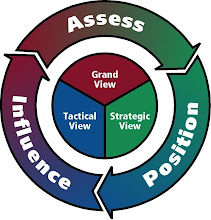
When assessing the grand picture, one must know the grand settings of their terrain and the grand specifications of each competitor.


#
The New York Times April 26, 2009
Does H.P. Need a Dose of Anarchy?
By ASHLEE VANCE
Palo Alto, Calif.

IT all seems obvious when viewed through hindsight’s pristine lens: Hewlett-Packard didn’t need a reinvention. It just needed some fierce fiscal discipline to transform itself from a bumbling, lost soul into a well-oiled profit machine.

At its core, H.P.’s turnaround works against the natural order of things in Silicon Valley, where people talk about technology first and finances a distant second. The frenetic hunt for the next big thing has helped a select few endure decades of busts and booms, and they have always left it to the bean counters to obsess about the bottom line.

So it took a true outsider, in Mark V. Hurd, to engineer H.P.’s resurrection and to create the world’s largest technology company. Mr. Hurd, hired four years ago in the wake of Carleton S. Fiorina’s tumultuous departure as chief executive, forced a steady, boring diet of performance benchmarks, heavy-handed cost-cutting and data-mining down H.P.’s corporate throat.

Silicon Valley is not known for creating lean organizations, and he’s as good as we have ever seen, said Michael S. Malone, a historian who wrote Bill and Dave, a book about the company’s renowned co-founders, William Hewlett and David Packard. He’s taught a lesson in what big-time corporate management looks like.


But with the most brutal cuts behind it, H.P. faces a fresh set of challenges as the second stage of Mr. Hurd’s tenure begins. Most pressing is widespread concern that Mr. Hurd has built an inflexible, solipsistic giant so obsessed with schematics and data-driven fiscal machinations that it has lost the ability to deliver that prized and perennial Silicon Valley trick: to surprise and astound.

Although H.P. is trying to expand its presence in businesses like personal computers and printers, some critics argue that those markets have little left to give. The company could also use more imaginative thinking to bolster its developing line of software products and services.
In short, what may be missing in the formidable intellectual and strategic artillery that Mr. Hurd brings to bear at H.P. is creative inspiration. Or, as Mr. Malone puts it, I am not sure Mark has built an H.P. that can go through the natural changes that accompany the technology industry as the company has in the past. If you posit this idea to any of the company’s top executives, they’ll dismiss it. H.P. has plenty of room to grow, they say in printers, computers, software or services and has a firm grasp of the technology industry’s nature and undulations. If you don’t believe such talk, that’s fine, they say just look at the numbers for any convincing.

When you hear me talk, I have four quadrants in my head simultaneously, Mr. Hurd says, outlining a mental tableau that encompasses H.P.’s operations (Quadrant 1), products (Quadrant 2), business and technology trends (Quadrant 3) and competitors (Quadrant 4). Visions of metrics dance in his mind, and he speaks of them with a passion and devotion that has clearly filtered through the ranks and H.P.’s results. While that approach also offers a contained, orderly way for Mr. Hurd to tackle his challenges, it isn’t necessarily a recipe for the kind of fertile brainstorming that leads to creative breakthroughs in the tech world.


/// As you view the lower left quadrant, do you assess the competitive position of your opposition?


Steven P. Jobs, the co-founder and chief of Apple, has never discussed quadrants when speaking about products like the iPod and the iPhone, and has dismissed the value of using focus groups to inform design projects. Sometimes consumers need to be shown what they want, Mr. Jobs has said.

MR. HURD, 52, often strums a tabletop like a pianist as he delves into business minutiae, his enthusiasm measured by the steady clack-clacking of his gold wedding band. He also enjoys riffling through a flip chart, tracing and disgorging a panoply of figures with the ease of a symphony conductor. Indeed, his flip chart is so precious to him that it accompanies him on the road. He always has that giant white pad and his magic markers, says Jeffrey Katzenberg, the chief executive of DreamWorks Animation, who says he sometimes has trouble parsing Mr. Hurd’s scrawls.

///
A Great Strategic Mind +
A thought-out grand process + Simple tools = Strategic Success
///

But for a numbers guy like Mr. Hurd, H.P. is a fantasy land, and the path for navigating it couldn’t be clearer.
He shows a remarkable familiarity with the balance sheet and amazing depth with numbers, says Matt Lavallee, the director of technology for the MLS Property Information Network, a real estate service, who talked with Mr. Hurd during a recent customer event. He’s the most impressive executive I have ever met.

Thanks to mega-acquisitions and strong growth, H.P. has emerged as the largest buyer of many components that go into computing systems. It buys about one-fifth of Intel’s chips used in PCs and servers, surpassing all rivals. And its purchasing power should increase as the innards of PCs, servers, storage systems and networking gear overlap more and more every year. H.P. has used its heft as a weapon, playing suppliers off one another, especially during lean times like now, to keep costs as low as possible. Ever to the point, Mr. Hurd says that if you don’t have scale, and you don’t have leverage, you won’t be able to give the customer what the customer wants. In recent years, the company has demonstrated an ability to balance chasing growth with its internal cuts. Although industry pundits had derided the PC business as a lost cause, H.P. has expanded its computer division sales by $15.6 billion over the last four years, hitting $42.3 billion in total sales last year.

During a similar period, computer sales at Dell rose to $35.8 billion, from $35.2 billion.
Just as astonishing, H.P. declared in February that it could shoot past Wall Street’s earnings targets for the full year at a time when its sales may come in about $18 billion lower than expected because of frozen consumer and corporate spending. Mr. Hurd attributes this performance to having banged out agreements with suppliers during better days and the company’s ability to turn far-flung corporate dials to fine-tune operations when customers suddenly stop buying.

His own intensity adds to the corporate mojo. Athletic and tightly focused, he comes from a relatively privileged background. His father attended Yale, and his mother, the daughter of a Park Avenue doctor, was introduced to society at a dinner at the Waldorf-Astoria. Growing up in New York and then Miami, he attended college preparatory schools and went to Baylor University in Waco, Tex., on a tennis scholarship.
He had long hair, wore tennis shorts and was a religious devotee of the courts," says Max Sandlin, a former congressman from Texas, who was president of Mr. Hurd’s fraternity.

At the time, most of us would have thought Mark more likely to be the next Jimmy Connors than the C.E.O. of H.P.
After Baylor, Mr. Hurd joined NCR, a quiet maker of cash-register equipment and automated teller machines, based in Dayton, Ohio. While not a self-made man in the classic sense, he is by all accounts a self-made business mind who manufactured his own luck and turned himself into a star at NCR, and over the course of 25 years excelled in a number of jobs, including running NCR’s flashiest division, a database unit called Teradata. Mr. Hurd flourished at Teradata, creating a fast-growing business within NCR that caught executives’ attention and ultimately led to his promotion as chief of the entire company.

More important, he evolved during those years into a manager both feared and admired for his command of numbers.
Mark provided a level of stability and leadership that inspired people, says Jim Murphy, who spent more than a decade at Teradata in sales.

He is the kind of guy you were willing to follow despite the pressure that comes with his constant drive to focus on metrics.


/// If the goal and the objectives have specific (and achievable) metrics, therefore, it is tangible.

That drive played out on the basketball and tennis courts, as well, where Mr. Hurd made it clear that he was always out to win. He is a vicious athlete and competitor, Mr. Murphy says. He would get pretty hot-headed and jaw with people. At H.P., Mr. Hurd’s reputation for having a quick mind and a quick temper has only grown. It’s common for executives to recount stories about his noticing a lowered forecast in a presentation, slamming his briefing materials down and, with an ever-present salty tongue, ordering that the situation be fixed before their next meeting.

For his part, Mr. Hurd is not about to give up his blunt style. I go all over the place, he says. I do like the ability to go around the company at different levels to find the people that have the actual answers to the question.
MR. HURD’S zeal has had a controversial reception at one of his company’s most admired divisions, H.P. Labs. Historically, the unit has been the most freewheeling part of the company, charged with creating new businesses out of thin air. Over the years, the products coming out of the labs have revitalized the company’s business during lulls.

Since Mr. Hurd arrived, H.P. Labs has whittled down the number of projects it tackles at any given time to 30, from about 150.

/// The 80/20 rule is in play. Focus 80% effort on the top 20%
of the listed objectives that generate tangible revenue.

Prith Banerjee, the director of H.P. Labs, has dismissed the castoffs as interesting science projects and championed the survivors as big bets with the most commercial potential.
Yet the often idiosyncratic researchers now find themselves writing up business plans and dealing directly with customers rather than funneling their ideas out to people more experienced in such matters.

For example, Carl Taussig, who runs H.P.’s Information Surfaces Lab, a part of H.P. Labs, has teamed with the Army, Arizona State University, DuPont Teijin Films and E Ink to produce flexible display technology that might be used like electronic paper or to create cheaper screens in mobile devices. H.P. Labs has a bigger burden now in creating a path toward commercialization, Mr. Taussig said. It’s more work, and it’s different work. But H.P.’s businesslike approach to research and curtailed money for the labs have former employees concerned about the company’s future.

I think they are seriously underspending on research and development, says Charles H. House, who worked at H.P. for 29 years, overseeing the creation of 12 product lines. It seems to me that betting on new areas is a struggle for them.
Shane Robison, the company’s chief strategy and technology officer, argues that few companies can match the breadth of its research, in areas as varied as printing systems and data mining. Some of the most impressive work has been in nanotechnology and optics, where engineers do nothing less than manipulate light to move data around computers at ground-breaking speeds. This is fundamental, breakthrough stuff, Mr. Robison says. He later added, It’s just goofy to get into a debate about whether you’re spending enough money.

A believer in long-term planning, Mr. Hurd says the company still has plenty to show the world. You would not want to short H.P. on its ability to innovate, he says.
Its biggest bets surround the plain-vanilla business of providing technology infrastructure to clients. H.P. believes that customers want to buy as much of those products and services from one company as possible a move that is, yes, data-driven.

H.P. expects the amount of information produced by companies to keep rising along with their desire to analyze that data. More data means more servers, storage and networking gear and, for as long as companies print paper records of their computing results plenty of purchases of H.P.’s expensive printer ink. At the heart of the company’s infrastructure play is Electronic Data Systems, the technology services company it acquired last year that manages customers’ data center operations. H.P. is laying off tens of thousands of employees as it tries to revivify the company and make it an integral part of its offerings to corporate customers.

But critics, most notably I.B.M., castigate H.P. as more or less the dull grunt of the tech world that has doubled down on humdrum, low-profit businesses.

If years of price wars for parts and infrastructure services ensue, H.P. will face serious pressure on the cost structure it has worked so hard to achieve.
There are still lots of opportunities for H.P. to cut costs out, but at some point its ability to do that at the rate of the last few years certainly diminishes, said A. M. Sacconaghi, a technology analyst at Sanford C. Bernstein & Company.

Because Mr. Hurd has so ably rationalized the company’s cost structure, he now has to prove that he can foster a culture capable of building a second wave of growth which zeroes back in on the creativity question.

In that regard, the future looks murky. Current and former employees complain that Mr. Hurd has put so much pressure on the organization that the willingness to take risks has faded. Quarterly business unit reviews with Mr. Hurd are known to be intense and probing and to inspire plenty of worry. Adding to this is a fear that morale has declined because of benefits cuts and a pay-for-performance rewards structure that creates deep fissures between the haves and the have-nots.

/// With our Compass AE process, a project team of implementers gain the strategic skills to see the technical connections within their big picture. They also get an overview that enables them to understand the balance of being efficient and being innovative.

Mr. Hurd faced similar criticisms at NCR.
I am not here trying to tell you it’s perfect, he says, adding that workers complain about bureaucracy and the process-driven practices creeping into their jobs. I think at the end of the day all these things come with a price.

/// To some people, a process has a tendency of slowing down innovation and growth. With the Compass AE process, the implementers gain the ability to increase their strategic valuation while minimizing values and mitigating risks.

Mr. Hurd, however, contends that internal surveys provide a more accurate view of the company than scattered anecdotes and reveal a satisfied work force. The company’s strong, consistent financial performance has restored its luster as a Silicon Valley icon and imbued employees with pride, he says. There is a tremendous attraction for the people to the scale, the opportunity, the entrepreneurship, he says. For us, it is a big deal to attract talent that can flourish in an environment like this and take advantage of our scale without it becoming an issue for them.

A COMPANY of 321,000 people can move only so nimbly, and H.P. has fallen behind in some of the most promising parts of the market. It arrived late with a line of netbooks, the low-cost, compact laptops that have taken the world by storm, opening doors for its rival Acer.

/// Sometimes, long term strategic thinkers will misunderstand the "
short-term" behavior of the masses.

And, over the last few years, a wide variety of online services has captured the attention of consumers and businesses, but H.P. has struggled to make its name synonymous with so-called cloud computing.


Despite talking so much about data and the powers of information analysis, the company trails rivals like I.B.M. and Oracle when it comes to building the most sophisticated business software. Another glaring weakness resides on the gadget front, where the company concedes an innovation lapse and continues to sell a relatively unpopular smartphone. (H.P. promises that better phones are in the pipeline.) With its software gurus, its newfound penchant for design and its deep ties to retailers, H.P. might have been expected to disrupt the cellphone market with new devices or even to concoct an electronic book reader that would complement its printer business.

Instead, it’s Apple and Amazon that built vibrant new businesses around such products.
In spite of the fact that there are things we could always do a better job on, innovating and so forth, I don’t think we have ever felt stronger about our portfolio of products and services and our opportunity to serve the market, Mr. Hurd says. I don’t think we think we’re confused about what the market wants.

To H.P.’s credit, it read the PC market just right in recent years, capitalizing on a surge in laptops and retail sales. It revamped the look of its products, developed a distinctive ad campaign and began to assert more independence.


For example, the company built a fanciful laptop in tandem with the fashion designer Vivienne Tam; it looks as much like a purse as a computer. And H.P.’s most daring move may have come with its TouchSmart software that lets people manipulate items on their computer screens with their fingers, while also adding a distinct look and feel to the company’s gear.

On the printing side, the company feels poised to capitalize on another megatrend: a shift to digital presses for industrial jobs like making magazines and labels. Every percentage point of additional share in this market translates into immense profits for H.P., which pours research and development dollars into proprietary ink. Mr. Hurd points again and again to the company’s scale and diversity as its major advantages.

Companies like I.B.M. and Dell have also emerged as the largest buyers of components during different eras, says Intel’s chief executive, Paul S. Otellini. Typically, the companies have started to struggle just as their buying heft approaches that of H.P., when gains prove tougher to come by and unexpected, nimble competitors emerge. That said, the tech industry has never encountered a giant the size of H.P. I do think Mark has carved out a unique opportunity that comes from selling everything from servers to phones, Mr. Otellini says.

In the end, Mr. Hurd says he’s not worried about his image as a numbers mercenary and refuses to fret about how others view his approach as H.P. tries to innovate its way toward growth. When I was at Teradata, I got called a growth guy. And then when I became C.E.O. of the whole company, I got called a cost-cutter, Mr. Hurd says. Then, I came to H.P. and became an operations guy. To be very blunt, I am not really that concerned with what labels get associated with somebody. I know we have a whole bunch of things to get done.

Copyright 2009 The New York Times Company

http://www.nytimes.com/2009/04/26/technology/companies/26hp.html?_r=1&hpw

Sunday, April 26, 2009

The Dao of Strategic Assessment (14): Assess Never Assume


Some newspaper columnists are not experts. They have a tendency to broadcast a mixture of generalized information with their opinion, not ever knowing the specifics of that topic. Without knowing the tangibility of that subject, these columnists presume that their reputation is a trademark of their know-how.

Sometimes, accepting the assumption as the truth can create a loss of time and money, especially if one is going to use it.


Cardinal Rule: Always assess before assuming.
Cardinal Rule: Never confuse some people's opinion as the truth.
Cardinal Rule: There is a distinction between one's expertise and one's opinion..

#

Another Reason Friedman's Wrong: Most Startups Bomb
Joe Weisenthal| Feb. 23, 2009, 1:23 PM|

Earlier, John Carney pointed out a major flaw in Tom Friedman's plan to subsidize the VC industry and startups. Top investors aren't wanting for cash, so any government money would flow towards lower tier investors, and lower tier companies, likely leading to a big mis-allocation of wealth.

Here's another big problem. Innovative startups aren't the cure-all they're made out to be.

Sure, it'd be great to plant the seeds of another 100 Googles, but alas, most startups aren't Google. Actually, most startups crash and burn. Just look over the last few years. Even in the absence of extra government money -- just a normal market scenario -- investors seeded way too many trash companies. Companies got funding despite ideas that were so half-baked you knew they were DOA the moment you heard of them. They still are, even today. And the data bears this out.

The American magazine looked at the 'startup myth' in a piece from January: To get more economic growth by having more start-ups, new companies would need to be more productive than existing companies. But they’re not.

A study by economists John Haltiwanger, Julia Lane, and James Spletzer, published in the American Economic Review Papers and Proceedings, combined data from the U.S. Census and other sources to look at the relationship between firm productivity and firm age. The results showed that firm productivity increases with firm age. This means that the average new firm makes worse use of resources than the average existing firm, which is not what you would expect if economic growth benefits more from the creation of new firms than from the expansion of existing ones. And you shouldn’t think that the typical start-up makes up for its poor productivity when it gets older, because the typical start-up is dead in five years.

This is not to say that we don't need startups. Obviously we do, and some of our most significant quality-of-life enhancements come from innovative startups. But we suffer from mental selection bias, because we think of startups as though they're all potential Googles (a rare startup winner), rather than their most likely outcome, which is a total time and capital sink that should never have gotten off the napkin.

http://www.businessinsider.com/another-reason-friedmans-wrong-startups-suck-2009-2

Here is the link to Thomas Friedman's article on startups.


Wednesday, April 22, 2009

The Dao of Strategic Assessment (13): Assess, Gather Intel and Re-assess


If one wants to connect with the masses, always focus on the needs and the wants of the majority.

Always assess, never assume. Then develop your gameplan by building your strategic overview (Tangible Vision) and your operational plan. Perform proper market research on the audience. Learn about your audience, your competition and yourself.


... I believe in the message of selling values that make sense to them. Talk to them. Learn about their values. Focus on the common values that make sense to them. Respect your audience by relating to their needs and wants. Be honest and pragmatic in your message. Sell them on new dreams and inspiring hope. Gain their trust. Connect to their soul.

In terms of strategy, assess the grand picture. Gather intelligence. Reassess the intelligence and then build your Tangible Vision. Constantly gather new intelligence and know when to adjust your Tangible Vision.

If one can do that, their candidate can win. This is the Dao of the Pragmatic Strategist.

To those who have never read the Art of War, we recommend the following translations: Ames, Griffith, Mair, Minford and Sawyer,

#

Advice for California's GOP candidates for governor

The ghost of Reagan can be useful, but only to a point. Tell your own engaging stories.
By Bill Whalen

April 6, 2009

Meg Whitman struck it rich last month when she appeared on the cover of Fortune magazine, with a headline that asked if the Republican gubernatorial hopeful can "save California." It was a flattering profile, with friends and business associates attesting to her leadership skills as the former chief executive of EBay.

Less fortunate was Fortune's choice of a cover shot, which had Whitman next to a horse, holding the reins. It was similar to a photo taken years ago of a certain former California governor -- prompting Fortune editor at large Patricia Sellers to comment on CNNMoney.com that Whitman is "vying for her next big gig ... Reagan style."

Personally, I don't think Whitman was deliberately trying to tap into the GOP's subconscious by playing the Gipper card. But even if she was, if someone is willing to wear jodhpurs, clear brush and snack on jelly beans, well, that person must really want the job.

Still, the fact that a candidate would be perceived, fairly or unfairly, as mimicking Ronald Reagan a quarter of a century after he last ran for office underscores at least two problems facing California Republicans going into the 2010 gubernatorial election.

First, there's the matter of generational appeal.

The youngest Californian to have voted for Reagan in 1980 -- his first presidential landslide -- is now in his or her mid-40s, close in age to President Obama. As for Generations X and Y, its members have trouble relating to the Reagan revolution, much less to the man himself. Ask young voters who waged the Cold War and they'll likely say NyQuil and Alka-Seltzer. For the same reason that the Dodgers showcase Manny Ramirez and not Kirk Gibson, California Republicans have to resist the urge to revisit the greatest hits of the 1980s and making the election a history lesson on "Morning in America." Save it for Lincoln Day dinners, not the campaign trail.

The second problem: authenticity.

For all its foibles, the electorate has a good truth detector. Hillary Rodham Clinton ran for president and handled the Iraq war issue as her husband would: triangulation and double-talk. Enough Democratic primary voters saw through it to deny her the nomination. Ditto Mitt Romney, who couldn't sell Republicans beyond the Iowa caucuses on a centrist record in Massachusetts and an overly simplistic conservative agenda. Here in California, Arnold Schwarzenegger played the role of the "next Hiram Johnson" and the "next Pat Brown" before the current star-turn as a "post-partisan" governor. Republicans don't know which if any of the many Arnolds to believe, so now they'll attempt to punish him in next month's special election.

For Whitman and Steve Poizner, the state insurance commissioner and her principal rival in the GOP primary, authenticity is key to replacing an actor-turned-governor. Both candidates are relative newcomers to politics (it's Whitman's first campaign; Poizner's third in six years). They will have to answer to accusations that their candidacies are fueled more by opportunism and voter restlessness than core convictions.

But there is one area where they would do well to shamelessly imitate Reagan -- his path to office. As with Whitman's campaign today, the first Reagan run for governor began to take shape soon after the Democrats' winning presidential election in 1964 and a coast-to-coast Republican meltdown. But, although the Reagan campaign was born of the moment, the candidate had been rethinking his progressive roots for the better part of 15 years, ultimately rejecting President Franklin D. Roosevelt's New Deal and the Democratic Party.

Perhaps Whitman and Poizner can't claim the same ideological evolution or the same prolonged path to the state stage. But, at a minimum, they can tell us how they got to where they are today and what seminal moments shaped -- or reshaped -- their thinking. For Whitman, was it cracking the glass ceiling in the corporate world? For Poizner, was it teaching low-income kids?

Using candor and insightfulness to weave an engaging narrative worked for Reagan four decades ago in explaining how he came to distrust government. More recently, it worked for Schwarzenegger in the 2003 recall election in convincing voters that the tough guy on screen had an open heart and an open mind.

As individuals whose run for office is financed by personal fortunes born of ingenuity rather than the GOP cliche of trust funds, Whitman and Poizner should leap at the chance to show they are reflective souls, not some manifestation of focus groups and hackneyed rhetoric or the product of political consultants.

To borrow very loosely from Reagan, taking such an approach might go a long way in tearing down the wall that keeps Republicans out of higher office in California.

Bill Whalen, a research fellow at Stanford University's Hoover Institution, was chief speechwriter for former California Gov. Pete Wilson.

http://www.latimes.com/news/opinion/commentary/la-oe-whalen6-2009apr06,0,6427311.story