Friday, January 11, 2008

Thursday, January 10, 2008
Competing in the Global Economy: A Grand Vision with No Tangibility

Intel exiting from the "One Laptop Per Child" (OLPC) project should not be a surprise. Bad events happen to those who possess a grand vision that lacks tangibility and detailed specifics. Am sure they developed a plan that didn't take account of negative circumstances.
"One Laptop Per Child" people did not plan that there will be competition with grander resources. who will surpass them within a short time period.
Negroponte should have known that his technological edge was minimal at best. The competition should be able to duplicate and improve on their design within a short timeline.
/// Sidebar: Defining and preparing for negative circumstances is considered to be a turnoff for some people. As one Silicon Valley person told me,"... Don't talk negative. It is bad vibe for the team. ... Got to be positive. " ///
Seen this storyline with many global startups who are "social cause-driven" with no concept of the bigger picture, winded up as road kills.
###
Nonprofit slips in race for cheap laptop for world's poor kids
Problems at One Laptop Per Child show how social entrepreneurs can blaze trails but miss the payoff.
By Ben Arnoldy | Staff writer of The Christian Science Monitor
Oakland, Calif.
The vision was grand: Develop a cheap laptop and get it into the hands of 150 million school children in the developing world.
Making the computer turned out to be the easy part. On Wednesday at the Consumer Electronics Show in Las Vegas, Nicholas Negroponte, founder of One Laptop Per Child, showed off the $200 XO. The innovative computer sports a bright screen readable in sunshine and a highly efficient battery that can be recharged by cranking it.
But One Laptop has run into controversy – a corporate partner and the group's chief technology officer pulled out in recent weeks – which has experts noting perils for the broader social entrepreneur movement.
Social entrepreneurs, who aim to solve social problems using business-world principles, have tackled everything from expanding rural credit to marketing indigenous crafts in recent years. But experts say the problems at One Laptop point to a challenge for these emerging entrepreneurs. They often excel at trailblazing new markets among the world's poor but struggle to achieve large-scale sales and distribution.
"In many respects, these social entrepreneurs are pathfinders, they are like the research and development for bigger players that have otherwise ignored the bottom of the pyramid market," says James Koch, a professor at Santa Clara University in California.
For example, One Laptop's XO has proven the concept of cheap laptops. Companies like Lenovo and Intel, sensing the market potential, are now working on their own models. This isn't necessarily bad for One Laptop's ultimate goal.
"Part of our model of success is to have competition, to have other people in this space," says Walter Bender, president of software and content at One Laptop. "We don't need to be the monopoly or biggest player in the market."
/// What we have here is an intangible view of a global economy. MY question is: If you are not going to be big, what are you going to be?
The world is filled with predators waiting for smart but naive people to make the grand mistake.
Dragons create opportunities. Tigers find opportunities. Wolves wait for opportunities. In a life and death struggle, a hungry wolfpack usually prevails over a smaller prey.
But the competitors' products aren't helping One Laptop's efforts to secure big orders. So far, it has orders for 500,000 laptops, with more than 100,000 already en route to places such as Afghanistan and Haiti. But it's far behind its goal to sell 150 million units by the end of 2008.
One reason for the shortfall, One Laptop alleges, is that a former partner – Intel – was disparaging the XO as it developed its own ultra-cheap laptop, the Classmate.
"Their sales people were saying, 'Because we're on the board, we have inside info and we know that everything is broken and it doesn't work,' " says Mr. Bender.
Intel has told a different story, saying that Mr. Negroponte was unreasonably demanding that the company stop marketing the Classmate in regions targeted by One Laptop. Intel didn't respond to an interview request.
/// Inviting current competition to join your group was not a smart idea.
"Do not loan sharp weapons to other men. If you loan sharp weapons to other men, you will be hurt by them and will not live out your allotted span of years." --- Jiang Tai Gong Six Secret Teachings (Sawyer X'lation) ///
Partnerships with multinational corporations can be double-edged swords for nonprofit startups. On the one hand, they're one of the quickest ways for startups to ramp up delivery of a product. On the other hand, nonprofits and corporations have different bottom lines, which means that such partnerships need to develop slowly and carefully, says Nora Silver, director of the Center for Nonprofit and Public Leadership at the University of California, Berkeley.
A successful partnership between clothing-manufacturer Timberland and CityYear, a nationwide volunteer corps, took years to forge. The Intel partnership, however, seemed hasty and didn't integrate the sales force into the effort, Dr. Silver says.
"Did these folks have a clear contract?" she asks. "You have to be very clear about such basic agreements."
One Laptop was acting as if they had a contract with exclusivity and noncompete clauses, she adds. Bender says there was only a nondisparage agreement.
The difficulty of scaling up a business isn't limited to social entrepreneurs. For-profit startups struggle with it, too. But entrepreneurs have a bigger challenge when they target poor people, especially those who are uneducated and live in remote areas.
Traditional marketing campaigns on TV and billboards may miss these customers entirely. And putting the product on shelves may not be enough. The entrepreneurs may have to find ways to advance small loans to would-be buyers. They may have to find indigenous nonprofit groups that could open markets that a corporation would never devote the time or have the credibility to crack.
One Laptop decided to target ministries of education to get bulk orders for schools. Working with those agencies, even in the developed world, requires a lot of effort and patience, notes John Quelch, a professor at the Harvard Business School.
"One of the knocks against [One Laptop] could be that they focused very much at achieving a price point for the product, but didn't necessarily focus as much on developing a solution for the ministry of education for country X," says Dr. Quelch, adding that this can be a common pitfall.
/// Our Compass AE process focuses on the team collaboratively defining clear specifications from goal to objectives. If the specifics do not connect from milestone to milestone, the Tangible Vision does not work. ///
"Initially, we had three or four people doing that around the globe, which is a stretch," says Bender. One Laptop is now working closely with Brightstar, the world's largest cellphone distributor, to help with global logistics.
from the January 11, 2008 edition - http://www.csmonitor.com/2008/0111/p03s04-stct.html
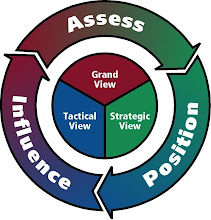
/// When building a Tangible Vision, it is important to focus on creating strategic positioning from top to bottom.
In the case of OLPC, their product does not offer any long term tangible "strategic positioning" leverage. The building of their marketing plan should have been focused on creating "strategic positioning".
Remember, Strategic Positioning = Strategic Advantage. ///
Sunday, January 6, 2008
Competing in the Global Economy ( The Dao of Strategy)

Regardless of the sports and the event, mindless jocks and reporters give the same reasoning why a certain team will win the big game- emotion, individual speed, athleticism and the attitude. Rarely do they say anything that is significantly relevant regarding to the coming "big"game.
There are other important factors that also play a major role in the outcome of the game like talent, injuries, home-field advantage and big game experience.
To compete in the global economy, contemplate like a strategist, not a mindless, hooded jock-warrior dressed in a new suit. This is why ultra professionals like Phil Jackson and Belichek wins most of the time.
Conclusion: Good strategic thinking and implementation is like money in the bank.
#
During the early phase of our Compass AE development, we learned a great deal about how people devise their strategy. We concluded that their professional experience and skill set plays a grand role in viewing strategic situations and the big picture.
While most tacticians cannot perform the role of the grand strategist, many grand strategists cannot operate as a tactician.
Will touch on this topic later.
Copyright:2008 © Collaboration360 Consultants (C360).
Saturday, January 5, 2008
The Strategist as a Fisherman (2)

Most fishermen knows that there are no big fishes in little ponds or small guppies in oceans of sharks and whales?
Before choosing "The Gold Standard" option for their Tangible Vision, one assesses their grand settings and themselves.
--- More to come. ---
Thursday, January 3, 2008
A New Year and A Revised Tangible Vision

Happy New Year to one and all
This past year has been an interesting year for Collaboration360. After four yrs of researching, developing and experimenting, we introduced our concept of top-down project planning to potential clients.
The concept of our Compass AE process was new to many people. Gaining access to them was a challenge. Once it was presented to potential clients, they became interested in implementing our process.
This past year, we have guided and mentored startups from different industrial niches and assisted them in the following:
- strategic marketing;
- marketing development;
- product development; and
- operations management
Establish "The Gold Standard"
During their initial Build and Connect stage of their training, we suggested that they should establish a goal that gives them a position of strategic advantage. It forces their competitors to be the pursuer not the leader. (This particular view is called "Establishing the Gold Standard").
The "Gold Standard" is a standard of quality and excellence that gives the implementors a strategic lead over their competitors
The Importance of Defining a "Gold Standard" within a Tangible Vision?
Being seasoned professionals, we believe in establishing a strategic lead with innovation and quality. Our Compass AE training enabled the client to decide whether to plan for a strategic lead.
Establishing a strategic lead might not always be a good idea. This move depends greatly on the constraints embedded in the client's grand settings.
Achieving Strategic Lead
Achieving this level of strategy positioning requires the team to have strategic insights and experience in their area of expertise and the overall marketplace.
While there were clients who believed in this view of strategic positioning. There were others who prefer a less risky and reactive strategic approach. This choice usually lead to a state of being stressed and grinded by their competitors.
Choosing "The Gold Standard" option is up to the client . As long as the benefits of defining and pursuing "The Gold Standard" is understood, they had the right to build, connect and implement their Tangible Vision within their own comfort level.
The Benefits of Creating a Strategic Position
The client's project team who boldly established a "Gold Standard" in their Tangible Vision, were able to do the following:
- Secured positional advantage in their competitive arena;
- Performed long advanced planning and strategic matters while minding the "big picture";
- Influenced the opposition to grind
Revised Our Own Tangible Vision
While our message of "collaboration without borders" is still relevant, we decided to focus on how project teams can accelerate their workflow through the use of Compass AE.
When a team properly built and connected with their Tangible Vision, they were able to do the following:
- Understand the critical path;
- Avoid negatives, focus on positives;
- Anticipate opportunities;
- Adjust strategically;
- Shape the Tangible Vision; and
- Lead by strategic collaboration
Outcome from Build, Connect and Lead with the Tangible Vision
During our review of the client use of Compass AE, we discovered that the team achieved the following:
- accelerated workflow
- positive team collaboration and
- effective meetings.
Final Thoughts
In future entries, we will cover the following topics:
- Apply Compass AE in a corporate bureaucratic setting;
- Apply Compass AE in a chaotic, fast-moving setting; and
- Apply Compass AE regardless of the distance, the technology and the project culture
If you have any questions or comments, drop us a line. We wish everyone a prosperous 2008.
With Best Regards,
C360 Chief Architect

Copyright:2008 © Collaboration360 Consultants (C360).
All Collaboration360-related materials contained on this site are protected by United States copyright law and may not be reproduced, distributed, transmitted, displayed, published or broadcast without the prior written permission of Collaboration360 Consultants or in the case of third party materials, the owner of that content. You may not alter or remove any trademark, copyright or other notice from copies of the content.
However, you may download material from Collaboration360.blogspot.com (Collaboration360.com) (one machine readable copy and one print copy per page) for your personal, noncommercial use only.
Links to Web sites are offered as a service to readers. Collaboration360.com was not involved in their production and is not responsible for their content.
Subscribe to:
Posts (Atom)