Sunday, November 11, 2007

A Tangible View That is Determined by One's Position On the Value Chain


The tangibility of Mr. Ferris view is depended on one's position on the value chain. The higher his/her position in the value chain of their profession, the greater the emphasis is on completing the outcome with less importance on the process.

###

November 11, 2007
Too Much Information? Ignore It
By ALEX WILLIAMS

AS one of Silicon Valley’s most respected entrepreneurs, Marc Andreessen is something of a connoisseur of what he calls productivity porn, or techniques to maximize personal productivity.

But in recent months, Mr. Andreessen a founder of Netscape Communications and more recently Ning, which allows users to create their own social networks has become enthralled with an unlikely purveyor: Timothy Ferriss, a boyish first-time motivational author from Long Island whose curriculum vitae includes stints as a competitive kickboxer and tango champion.

Mr. Ferriss’s business lessons, focused on cutting out useless information, have been culled from his six years running a modest sports nutrition company that sells, mostly over the Internet, supplements used by athletes to increase reaction speed and muscle power. Mr. Andreessen, a luminary in technology circles, does not seem to care.

Tim basically takes all of the time management and personal productivity theories of the last 20 to 30 years and pushes them to 11, to paraphrase ‘Spinal Tap,’ Mr. Andreessen explained in an e-mail message. In Silicon Valley, Mr. Andreessen is not alone in his enthusiasm for Mr. Ferriss.

After reading Mr. Ferriss’s recent best seller, The 4-Hour Workweek (Crown), Jason Hoffman, a founder of Joyent, which designs Web-based software for small businesses, urged his employees to cut out the instant-messaging and swear off multitasking. From now on, he told them, severely restrict e-mail use and conduct business the old-fashioned way, by telephone.

/// It depends a lot on your business, your role, your responsibilities and the prioritization of your boss,

All of a sudden, Mr. Hoffman said of the results, their evenings are free. All of a sudden Monday doesn’t feel so overwhelming.

Last spring, Jason DeFillippo, a founder of Metroblogging Global Blog Network a company that oversees more than 700 city-specific blogs heard Mr. Ferriss extol his low information diet to a crowd of high-tech devotees at a tech conference this spring. Before the speech was finished, Mr. DeFillippo, who lives in San Francisco, had ordered his book on Amazon. Soon after reading it, he embarked on a crash diet of his own. His nasty addiction to RSS feeds is now a thing of the past, he said.

It’s hard to describe, said Mr. DeFillippo, 36, but life was suddenly just more peaceful.

/// To simplify, minimize, and optimize one's life, start by building and connecting with a Tangible Vision that delineate a big picture with specifics. It must includes the prioritization of values and specific objectives.

Mr. Ferriss, 30, has never run a technology company. He never made millions on an initial public offering. Rather, Mr. Ferriss, who now lives in San Jose, Calif., comes off more like a half-pipe snowboarder than a traditional lacquer-haired motivational guru.

Nevertheless, without appearing on Oprah Winfrey’s show or doing a book tour, Mr. Ferriss has seen his book quickly become a best seller, largely on the strength of blog chatter in the tech community. Subsequently, he has become a pet guru of Silicon Valley, precisely by preaching apostasy in the land of shiny gadgets: just pull the plug. Crawl out from beneath the reams of data. Stand firm against the torrent of information.

HIS methods include practicing selective ignorance tuning out pointless communiqués, random Twitters, and even world affairs (Mr. Ferriss says he gets most of his news by asking waiters). Work crisis? Pay someone else to worry about it ideally in Bangalore. On a bet, Mr. Ferriss even hired low-paid, high-skilled workers abroad to find him dates online. (It worked.)

Once the e-clutter is cleared away, he argues, there will be plenty of time to scuba dive the Blue Hole in Belize, just as he does.

Or at least fantasize about it.

The technology community, after all, shares a great desire for escapism, said Fabio Rosati, the chief executive of Elance in Mountain View, Calif., which provides outsourcing for professionals and small businesses and now features Mr. Ferriss giving an unpaid video testimonial on the company’s Web site. This is why everyone is working 14-hour days in the first place: to strike it rich and cash out.

But Mr. Ferriss is selling the alluring promise that you don’t have to wait for the monster, and perhaps mythical, initial public offering.

As Mr. Rosati said: Silicon Valley is unique in that there is a deep entrepreneurial spirit and a highly ambitious workforce, but they’re always thinking, ‘Gee, if I could only squeeze an extra hour out of the day, I could actually go on that bike ride, I could actually go surfing.’ Tim is evangelizing that lifestyle.

Not that everyone in the Bay Area is sold. Po Bronson, author of The Nudist on the Late Shift: And Other True Tales of Silicon Valley (Random House, 1999), agreed that Mr. Ferriss’s book had made a mark in the tech world. You can’t seem to go two hours without someone mentioning it, he said.

Still, Mr. Bronson said he didn’t know anyone who had actually read it, much less abandoned a cubicle to study yabusame (horseback archery) in Japan, as Mr. Ferriss did last month. What has really turned heads is not the specific ideas, Mr. Bronson speculated, but its provocative title. In Silicon Valley, the promise of a lifestyle revolution or hyperbole to that effect will always find an audience.

It’s not saying the ‘20-Hour Workweek,’ Mr. Bronson explained. That would be something that lots of people can live. It’s 40 hours a week versus four. It’s very important in the tech world that consequences are exponential, not geometrical.

Like most motivational gurus, Mr. Ferriss gives readers a dramatic back-story filled with recollections of the grim days in which he was lost in the wilderness or at least the Internet cafes of Florence, Italy, working 10-hour days on his supplements company in 2003 instead of enjoying what was supposed to be a vacation. Following the predictable arc, he then offers his road-to-Damascus story of enlightenment, wherein he rebounds out of a work-induced nervous breakdown with a vow to eliminate everything that was standing in the way of happiness starting with his Treo.

BlackBerrys and e-mail aren’t inherently bad, he said. It’s just like medicine: it’s the dose that makes the poison.

Putting his beliefs into action, he said, he set about dumping all the clients who involved more work than they were worth. He reduced and outsourced his staff, from 250 eventually down to fewer than 15, and instructed underlings to deal with all but the biggest emergencies themselves.

Most fundamentally, Mr. Ferriss turned ruthless against e-mail. He hired personal assistants in India and the Philippines to sort through and respond to most of it, and ignore the rest. Even today, he said, he typically checks e-mail messages only once a day, at 2 p.m., and only sees those few urgent ones his outsourced assistants forward to him. (He is, however, very quick to respond to media requests, in this reporter’s experience.)

With all the time left over, he said, he has lived the life that most postpone until retirement. In the last two months alone, he said, he has traveled to Scotland, Sardinia, Vienna and Bratislava, as well as Japan, all while technically running a company that he claims kicks off a high five-figure personal income every month.

It’s this have-your-cake-and-eat-it-too tale that has made even the jaded tech establishment take notice.

Robert Scoble, who writes the influential tech blog Scobleizer, praised Tim Ferriss’s approach, as just another techie trying to dig out from under the information rubble.

Our lives are just getting busier, the world is starting to throw more stuff at us, he said. Five years ago it was still pretty rare to have relatives sending you IMs. No one had Flickr feeds or Twitter. YouTube, Facebook and MySpace didn’t exist.

Unsurprisingly, some Tim Ferriss acolytes found that sticking to his information crash diet brought a shock to the system.

/// Your grand goal, your profession, your position and the market change determines your informational intake.

Ryan Carson, 30, who runs technology conferences around the world from his headquarters in Bath, England, said that since reading The 4-Hour Workweek, it can take me two or three days to get back to people on e-mail.

People will get a little angry, he admitted.

More strikingly, Mr. Carson shifted his company, Carsonified, to a four-day workweek after hearing Mr. Ferriss speak at the South by Southwest media and technology conference in Austin, Tex., in March.

I just thought, who made these rules you have to work five days a week? Mr. Carson said. His employees now churn out five days’ worth of work in four, in part because of reduced distractions. (You can believe that they are now Ferriss fans, too, he said.)

Critics might argue that Mr. Ferriss is hardly the first self-improvement guru to preach the clutter-free life. Indeed, it’s possibly the most overused self-help trope.

Even his admirers, like Mr. Andreessen, scoff at the idea that anyone in Silicon Valley least of all the busy Mr. Ferriss could ever realistically slash office face time by a factor of 10 or more.

Indeed, Mr. Ferriss makes little pretense of practicing what he preaches, at least if you count self-promotion as work.

LAST Monday alone, Mr. Ferriss who has served as a guest lecturer on high-tech entrepreneurship at his alma mater, Princeton, for several years spoke at Harvard Business School, followed by an afternoon doing an interview about his book, then finally another talk in front of 130 students at M.I.T. Mr. Ferriss, ever stimulated by yerba mate tea, was still there, hashing out personal-productivity theories over beers with Sloan School of Management graduate students at 11 p.m. on Monday night. All this, while recovering from jet lag after a flight from Japan, where he had taped a pilot for a television show part self-help, part adventure travel developed for the History Channel.

If your definition of work is something primarily financially driven that you would like to do less of, like with my company, I spend far less than four hours a week on it, he said.

All that other stuff lecturing at the corporate campuses of Google and PayPal, blogging incessantly on his www.fourhourworkweek.com that’s, well, evangelizing, he said.

Which is not to say he plans to become an Anthony Robbins for the geek set, touring relentlessly and hawking DVDs on late-night infomercials.

I’d be much better off putting my time into three or four really good blog posts, he said.

But, of course. That would take much less work.
Copyright 2007 The New York Times Company

http://www.nytimes.com/2007/11/11/fashion/11guru.html

Saturday, November 10, 2007

The Dao of Compass AE Leadership


The Chinese classics emphasize that the grand settings and the planned outcome usually decides the leadership type for a specific endeavor.

If the senior leadership decides not to adjust to the changes, they will fall. The top tier leadership survives (and sometimes thrives) by hiring the right people that can make the transition of achieving the planned outcome for that grand settings.

This is the Dao of Leadership. ... Compass AE Leadership


Point #1: Define one's grand vision.
Point #2: Hire ultra professionals.
Point #3: Hire Collaboration360 to teach them how to build, connect and lead with their Tangible Vision as a team.
Point #4: Have Collaboration360 monitor the team progress with their Tangible Vision
Point #5: Team completes their Tangible Vision as a team.

--- More to Come ---

###

November 10, 2007
C.E.O. Evolution Phase 3
By NELSON D. SCHWARTZ

Has the time come for C.E.O. Version 3.0?

The first iteration made its mark in the 1990s, as chief executives like Sanford I. Weill, Gerald M. Levin, John F. Welch Jr. and Michael Eisner built empires, not to mention their profiles, at the companies they ran: Citigroup, Time Warner, GE and Disney.

When the shares deflated earlier this decade after the burst of the tech bubble and various corporate scandals, a new cadre moved in: the Fix-it Men. They were lower-key leaders like Charles O. Prince III of Citigroup and Richard D. Parsons of Time Warner, whose job it was to repair the excesses and mistakes of their predecessors.

Now, management experts and longtime watchers of corporate America say the current environment demands, and is attracting, yet another kind of chief executive: the team builder.

It’s someone who can assemble a team that functions as smoothly as a jazz sextet, said Warren Bennis, a professor of management at the University of Southern California and author of many books on leadership.

In the last week, Mr. Prince and Mr. Parsons both announced they would be stepping aside. Mr. Prince’s abrupt exit followed huge losses that dragged down Citigroup’s long-stagnant stock, while Mr. Parsons is retiring at the end of 2007 after a five-year tenure, during which he stabilized the company but failed to move Time Warner shares higher.

A third chief executive, E. Stanley O’Neal of Merrill Lynch, was forced out late last month after his firm announced an $8.4 billion write-down.

Mr. O’Neal substantially increased Merrill’s revenue and profit during his tenure but has been criticized for forcing out subordinates he perceived as rivals, while several top executives left Citigroup during Mr. Prince’s reign. Now both companies find themselves searching for permanent replacements.

They’ve got to have not just the cognitive ability to run a major firm, which Stan O’Neal definitely had, but the ability to make people feel like they’re working together, Mr. Bennis said.

Merrill and Citi might consider looking at chief executives like A.G. Lafley of Procter & Gamble or W. James McNerney Jr. of Boeing as archetypes of the new model, according to Mr. Bennis.

Both felt the need to make sure the top hundred people know that they’re in this together, that their fates are correlated, Mr. Bennis says. That’s what it will take to succeed in this century.

Mr. Lafley and Mr. McNerney have won plaudits not merely for their personal style, but also for their bottom-line performance, with shares of Procter & Gamble and Boeing easily outpacing the likes of Citigroup and Time Warner, as well as the benchmark Standard & Poor’s 500-stock index, over the last two years.

That’s no coincidence, according to Michael Useem, a professor of management at the Wharton School of the University of Pennsylvania and director of the Center for Leadership and Change Management there. The academic research says if you want to predict what the future financial performance over the next one to three years will be, you need to know the top team, he said.

Jeffrey A. Sonnenfeld, senior associate dean for executive programs at the School of Management at Yale, says the style of today’s best chief executives differs from both the empire builders and the cleanup specialists.

The former were known for public swagger and boardroom-size egos, while the latter often excelled at a narrow set of skills, Mr. Sonnenfeld said. He cited Mr. Prince’s skills as a lawyer who was able to get his company back into the good graces of regulators after Mr. Weill’s departure. Others say Mr. Parsons was a strong administrator, but failed to offer a strategy that satisfied Wall Street.

Mr. Sonnenfeld says Mr. Lafley and Mr. McNerney, along with Anne Mulcahy, chief executive of Xerox, possess the vision of the empire builders without their overpowering egos, while also bringing more personal warmth to the corner office

Ms. Mulcahy, for example, was able to cut jobs and restore Xerox’s profitability without coming across as mean-spirited, Mr. Sonnenfeld said. Mr. Lafley is disarmingly unpretentious, he added. He never comes to my summits and I’ve never been a consultant for him, but he towers over other C.E.O.’s when it comes to putting in people stronger than himself or his ability to talk about setbacks.

Mr. Lafley has spent his entire career at Procter & Gamble, while Mr. McNerney arrived at Boeing after decades at General Electric, long regarded as something of a management boot camp, and after a successful stint as chief executive of 3M. Although clearly an outsider at Boeing, Mr. Sonnenfeld said, he learned to listen to the culture there.

This approach, he said, means these leaders were able to introduce change but people don’t hate them for it; the team comes to them.

Mr. O’Neal, on the other hand, fired people who shouldn’t have been fired, Mr. Bennis said. Mr. Prince, he added, was always in the shadow of Mr. Weill; he never was able to build his own team.

And when disaster struck in the form of billions in losses from the subprime meltdown, these weaknesses came back to haunt Citigroup and Merrill Lynch.

Whenever you have such a stunning decline, errors become much more visible, Mr. Bennis said.

Of course, just as chief executives shape the times, so do the times shape them. There’s a theory that the people who get to the top at big companies should be best at solving the problems of their era, Mr. Useem said.

In fact, Mr. Sonnenfeld said, the original archetype was what he called the custodian, leaders who came of age during the Organization Man era of the 1950s, but were overwhelmed by the rapidly shifting economic landscape of the 1970s and 1980s.

They were followed by the empire builders who focused on mega-mergers and financial management in the 1990s to deliver the growth Wall Street demanded while getting big enough to achieve economies of scale and beat back foreign competitors.

The cleanup artists arrived on the scene in the wake of the collapse of Enron and WorldCom and the passage of Sarbanes-Oxley legislation, which tightened government oversight of public companies.

At the same time, investors were demanding quick fixes. In Time Warner’s case, Carl C. Icahn, the billionaire activist investor, pressed for a quick breakup of the company, something Mr. Parsons was able to stave off.

Business schools are also opting for the 3.0 approach. At the Yale School of Management last year, Mr. Sonnenfeld said, the dean and faculty threw out the old first-year curriculum that emphasized individual disciplines like finance and marketing and replaced it with a team-oriented approach, with professors teaching these subjects jointly. In addition, he said, We have students, faculty and staff assemble their own teams as part of their training to be future execs.

What will be the main challenge in the next 5 to 10 years? Mr. Useem predicted it would be achieving double-digit growth internally, without the benefit of huge deals or accounting sleight-of-hand. That’s why I think the baton will go to the manager who will stimulate a division and will be creative and innovative, he said.

Copyright 2007 The New York Times Company
http://www.nytimes.com/2007/11/10/business/10leaders.html

Friday, November 9, 2007

Does your Project Team Anticipate or React?


One who excels at warfare, seeks victory through the strategic configuration of power, not from reliance on men. Thus he is able to select men and employ strategic power.
- Sunzi Art of War, Chapter 5: Strategic Power

###

Ever work on projects where people are reacting not anticipating? They work from a ground up perspective that prevents them to connect to the specific objectives and the grand goal.

In some cases, people say that is ok.

Some of the news media and business leaders propagates the message of immediate results and instant gratification without any regard to long-range objectives. It also propels the concept of grinding it out is acceptable because it is so romantically adventurous.

From our view, the grinders are those who possess no tangible vision and relies on a tactical checklist to complete their objectives. They waste time and money by replicating tasks while squandering away important resources that can be used for something else.

When smart people are collaborating, they need to view the big picture while deciding on their objectives and task lists. Then determining how everything connects as one unit.

With Compass AE, smart people can do that.

The Compass project team is usually strategically positioned to stay ahead of the change curve instead of grinding it out step by step. There is no guessing or paralysis in analysis in understanding the goal and objectives during the Compass Cycle, They are always two steps ahead of the game. With their Tangible Vision, the Compass team anticipates the opportunities while prepared for negative circumstances.

When the the change curve is steep and deep, the Compass AE team looks for the critical path of least resistance.

The bottom line is that the Compass team is strategically positioned for all general and specific situations. Remember, being
ahead of the curve is always more fun than grinding step by step.

###

Monday, November 5, 2007

Different Applications of the Tangible Vision (2)


It does not matter whether the company is in midst of an economic shift. With a properly-built Tangible Vision, their "Compass" project team always know the proper approach for whatever the circumstance is.

@ the end, making proper adjustments at the right time means great profit.

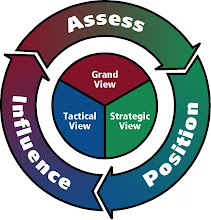
fyi- Included with our Compass AE process is a specialized template that is based on the ancient Chinese strategists viewpoint of strategic circumstances. This process enables the team to strategically position ahead of the competition.

###

With Growth Slowing, eBay Gets Innovative

By Julie Sloane Email 11.05.07 | 12:00 AM


CEO Meg Whitman told the Web 2.0 Summit in San Francisco in October that eBay is making lots of changes.

How does a billion-dollar company with sagging growth get its mojo back? If it's eBay, it throws dozens of new features at the wall to see what sticks.

When Meg Whitman took the stage at the Web 2.0 Summit in mid-October, she announced that eBay had made more changes in the previous months than in the last three years combined. She wasn't kidding. The 11-year-old auction site's interface had long been a confusing morass of links and menus. No longer. Now the focus is on making the site more appealing to buyers through easier navigation, new ways to browse and more reasons to hang around. The strategy seems to be working: There's a feeling of freshness and fun the site hasn't had in years.

The changes were propelled by a kick in the pants: The growth of eBay's core auction business is slowing. For the first nine months of 2007, the number of listings on eBay was down 3 percent from the same period in 2006. Amazon is making a play for eBay sellers -- with some success, observers say. Despite eBay's diversification through purchasing Skype (for which the company recently took a $1.4 billion write-down), PayPal, StubHub and smaller ventures like StumbleUpon and Kijiji, it's important to note that 70 percent to 80 percent of eBay's revenue still comes from its online auctions.

Cantor Fitzgerald analyst Derek Brown says the biggest concern for eBay sellers is that buyer demand seems to be on the decline. "If, as eBay says, conversion rates and average selling prices have increased, why are sellers not responding through more listings?" he asks.

Corporate spokesman Usher Lieberman says eBay's management acknowledges that growth has decelerated. "About a year ago, the leadership of the marketplace business got together and took a hard look at what had been a successful business for 11 years," says Lieberman. "The (buying) experience hadn't kept up with what people expect when they go online."

To that end, the number of new buyer tools introduced in the last several months is staggering:

* A downloadable eBay Desktop application allows users to bid and get streaming price updates without opening a web browser.
* Three new widgets can be used on blogs and social networks outside eBay's walls: eBay To Go, GiftBay and eBay Marketplace for Facebook.
* Bid Assistant automatically places bids for a buyer.
* eBay Countdown is an easier (read: more in-your-face) way to keep track of auctions that are just about to close.
* eBay Deal Finder helps you seek out items that will close soon but have no bids entered yet.

This fall, eBay also unveiled a site redesign with sleeker, simplified graphical interfaces and new pathways to search for items. On eBay Playground (a version of the site where eBay tests new features), for example, the "snapshot view" of items displays search returns as a tiled wall of photos. Mouse over them, and pricing info pops up.

Other discovery features hop on the social-network bandwagon. Neighborhoods, a forum for like-minded collectors to network, got buzz when it launched in early October, and the still-unpublicized EKG allows users to curate their favorite items and share them with others, a concept similar to craft-commerce site Etsy's Treasury.

Rolf Skyberg, whose title at eBay is "disruptive innovator," frames the new social features using the "hierarchy of needs" theory proposed by psychologist Abraham Maslow in 1945. Retail stores, he points out, frequently sell hot dogs. Why? Because they meet shoppers' basic need for food, thereby enabling them to shop longer. If eBay can meet a shopper's social needs, perhaps she will spend more time on the site. (Skyberg recently gave an amusing presentation on the subject.)

The company is also stoking the marketplace fires for sellers. Between Oct. 18 and Nov. 5, eBay is discounting insertion fees by one-third, presumably to encourage more listings. In an Oct. 26 webcast, eBay hinted for the first time that it was considering volume discounts on fees for top sellers.

"That is so contrary to eBay's philosophy since it started," says Ina Steiner, editor of AuctionBytes, a trade publication for online merchants. "High-volume sellers have been demanding volume discounts for years. It wasn't until Amazon increasingly moved in on eBay's territory that eBay reacted to the demand."

Hani Durzy, eBay's director of corporate communications, responds that the company has always run experiments with its pricing structure and this move is "absolutely not" a reaction to Amazon's competition. "We expect that our sellers, even our biggest sellers, are multi-channel," says Durzy. He does add that eBay will be considering more pricing options in 2008 than it has in the past.

In putting forth all of these changes, eBay's whole corporate persona seems softer, less arrogant. It's clear the last year has brought a self-examination process, the fruits of which are now being humbly offered to the public. It's not a bad lesson to remember: Even the market leader needs to keep its customers happy.

http://www.wired.com/techbiz/it/news/2007/11/ebay2

###

Friday, November 2, 2007

Tools for the Global Strategist (aka Road Warrior) @ Large and On Tour


Some basic tools for the global (traveling) strategist.

As a reminder. always think of security. Be hyper-aware.


###

The New Road Warrior

Ten apps for your cell phone that let you finally leave your laptop at home.
From: Issue 120 | November 2007 | Page 67 | By: Robert Scoble

If you're like me, you're on the road a lot. From February to September this year, I put 13,000 miles on my car driving around Silicon Valley, plus I'm regularly on a plane headed to conferences.

Of course, I need to stay in touch with people back home and get work done even when I'm running around.

In the past year, a series of new services for road warriors have hit the market, and they go way beyond email and calendaring. It's now much more possible to live away from your computer and stay fully connected. You do need a smartphone--such as an iPhone, Nokia N95, or
a newer BlackBerry--to use most of these apps, but if you're hard core, you've probably already got one. Spend a few minutes at home outfitting your phone, and you're all set. Oh, yeah: All the services are free, unless otherwise noted.

The basics
Microsoft, Yahoo, and Google all offer mobile versions of their online portals. If you do nothing else, you'll want to use at least one of them. They each provide dozens of features, including search, weather, and stock widgets. Whether you choose Google or not, get Google Maps
for travel directions. In some areas, it'll even show you traffic conditions--a major time-saver.

Phone number for life
Grand Central helpfully lets you control multiple phone lines, send calls to any phone, and then listen to messages from any Web browser.

Smart voice mail
When I worked at Microsoft, my calls were redirected automatically to my cell (à la Grand Central), and if someone left a voice mail, I got it as an email attachment, so I could listen to it even if I was using a friend's laptop in a foreign country. Today, because I don't have a
big IT department behind me, I use Callwave to manage office voice mails. It goes beyond the iPhone's visual voice mail, giving you lots of ways to manage calls. Its latest service converts voice mail to a text message (free during beta).

Voice notes
You can now capture ideas while driving 70 miles per hour. Just call Jott and leave a message. Within a few minutes, Jott will send back an email with both the audio message and text. Jott also now lets you use your voice to blog or send messages to Twitter.

Instant messaging
Using IM is a great way to communicate quickly, let someone know where you are, or save minutes and still talk using your all-you-can-eat data plan. Fring lets you use instant messengers such as Gtalk, Skype, ICQ, and others via mobile. I just made a Skype voice call over my phone's data pipe to Munich from my home in Half Moon Bay, California, and it worked great.

Photo and video sharing
By using ShoZu, you can automatically upload images to a variety of photo-sharing Web sites. During my son's birth, I used ShoZu to post pics to Flickr from the hospital. You can also use it to upload video to sites like YouTube.

Spreadsheets
It's not as sexy as some of the other apps, but if you do a lot of work in Excel, that's often the one program that forces you to lug along your notebook. EditGrid (free for personal use; corporate
account prices vary) is a really cool online spreadsheet program; its new iPhone version gives you full-featured spreadsheets in 4.8 ounces, not pounds. Next time you see me in the airport, feel free to thank me.

Robert Scoble is an influential video podcast pioneer and blogger. Watch him at Podtech.net and read him at Scobleizer.com. Road warriors: Pay it forward and send him your favorite mobile apps. For exclusive video podcasts and daily "Best of the Tech Web," go to
fastcompany.com/scoble.

Feedback: scoble@fastcompany
Copyright (c) 2007 Mansueto Ventures LLC. All rights reserved.
Fast Company, 7 World Trade Center, New York, NY 10007-2195

http://www.fastcompany.com/magazine/120/the-new-road-warrior.html