Wednesday, October 3, 2007

Upcoming Event for the C360 Chief Architect


This coming December, the C360 Chief Architect of Collaboration360 Consultants will be speaking at a local businessman club in Oakland, California.

The topic is
"Sun Zi's the Art of War: Applying Ancient Chinese Strategy to the Global Economy"

# # #

Following is the preliminary draft of his speech:.

Objective:
* Introduce to the audience the basics of Sun Zi Art of War
* Discuss the current role of Sun Zi in the global economy

Introduction
* Introduction of myself
* Who is Sun Zi
* Who has been using it
* Mentioned in the news media
* Number of books published

What is the "Ancient Chinese Strategy Mindset"
* Complete the grand goal by determining the critical path.
* Avoid the negatives and focus on the positives
* Formlessness and Foreknowledge
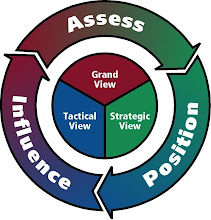
* Prepare by Positioning Strategically
* Shape the Goal
* Lead by Character.

Recommended Translations

Questions and Answers

Summary

- More to come -

# # #

Sunday, September 30, 2007

The Myth of Product Completion (The Unsung Heroes Who Move Products Forward [from NYT])


Behind every hero is a support team that collaboratively supports him or her.

If you are running a small-medium sized company, how do you get your company competitively ready to contend with your larger competitors? Quietly, you hope that your team are collaborating well as a team.

Behind every hero is a support team that collaboratively supports
him or her.

If you are running a small-medium sized company, how do you get your company competitively ready to contend with your larger competitors? Quietly, you hope that your team are collaborating
well as a team.

My questions to you are:
Does your company possess the same resource capacity and manpower as your competitors?

If your team fails as a team, can you survive the failure like a larger company would?

Is your company using the same team collaborative process as your competitor?

What team collaborative advantage does your company have?

Is your project team collaboratively moving as a team?

When they collaborate, do they see the big picture of how everything connects?

Is your company moving as one single entity?

If not, ask yourself the question "Will your company survive in the next three years?"

Does your project team hold the key to the success of your company?

Does your project team need a Compass to collaboratively understand what direction they are focusing on?

# # #

September 30, 2007
Ping
The Unsung Heroes Who Move Products Forward
By G. PASCAL ZACHARY

AT first blush, the iPhone from Apple, the new microprocessor family from Intel and the ubiquitous Google search engine have nothing in common. One is a gadget, one is an electronic part and one is a service.

Yet all of these products much acclaimed for their creativity depend on obscure process innovations that, while highly complex and lacking glamour, are an essential part of establishing a winning edge in commercial electronics. Indeed, the success of Apple, Intel, Google and scores of other technology companies has as much or more to do with their process innovations as the products that inspire loyalty among fans and admiration from foes.

First, a definitional detour. Processes are the stuff in the proverbial black box, the alchemy unseen by consumers or the inelegantly termed end users who buy computers, cellphones, cameras and all manner of digital devices and services.

Snazzy products are the stuff of legends, romanticized by early adopters and skewered by neo-Luddites. Yet while these products bring glory to companies, novel processes are often more important in keeping the cash registers ringing.

The proof of this proposition is that while companies often spend millions to advertise and market new product designs and innovations, they guard intensely the details of their process innovations.

Consider the question of Google’s greatest business secret. Is it the algorithms behind its search tools? Or is it the way it organizes vast clusters of computers around the globe to answer queries so quickly? Perhaps predictably, Google won’t disclose the number of computers deployed in its vast information network (though outsiders speculate that the network has at least 450,000 computers).

I believe that the physical network is Google’s secret sauce, its premier competitive advantage. While a brilliant lone wolf can conceive of a dazzling algorithm, only a superwealthy and well-managed organization can run what is arguably the most valuable computer network on the planet. Without the computer network, Google is nothing.

Eric E. Schmidt, Google’s chief executive, appears to agree. Last year he declared, We believe we get tremendous competitive advantage by essentially building our own infrastructures.

Process innovations like Google’s computer network are often invisible to the public, and impossible to duplicate by rivals. Yet successful companies realize that maintaining competitive advantage depends heavily on sustaining process innovations. Great process innovators often support basic research in relevant fields, maintain complete control over the creation of every aspect of a product and refuse to rely on outside suppliers for important components. Certainly, there are exceptions to these patterns, but even companies like Apple that buy essential processes on the open market nevertheless invest in gaining a working knowledge of the technologies and an understanding of their future arc.

Intel treats its process innovations as a competitive weapon, striving to create a new generation every two years. That enables the company’s chips, even if there were no changes in their design, to perform better and cost less to make.

Consumers are usually blind to the importance of novel processes. Even when they learn about these innovations, they tend to think only of the product itself.

The average consumer doesn’t care what processes are used, says Mark T. Bohr, an Intel physicist who oversaw what is arguably the most important advance in decades in the technology for making microprocessors, the brains inside computers and other digital devices.

Faced with ever-faster chips that threatened to explode into flames, Intel searched desperately for new processes to make microprocessors. Enter hafnium, a rare metal. Designers led by Mr. Bohr in Hillsboro, Ore., chose hafnium to replace silicon oxide, the venerable insulator in chips and a material used in making glass. Mr. Bohr also helped to identify new materials, whose identity Intel is keeping secret, for the crucial transistor gates that sit atop a chip’s insulators.

On Nov. 12, Intel will begin shipping its first chips using the new processes. Gordon E. Moore, Intel’s co-founder, recently declared that the hafnium-and-gate process innovations should allow his so-called Moore’s Law, whereby chips grow ever faster and less expensive, to hold true for some time.

Despite the enormity of the achievement, Mr. Bohr is relatively anonymous, even within Intel. The work of process development comes second to creating new designs for chips, he says. Not surprisingly, when Intel starts shipping the new chips, neither the hafnium nor the gates innovations will be trumpeted as selling points. Rather, Intel will emphasize how customers can benefit from using the chips.

If process innovations are unheralded, consumers may misunderstand the nature of technological change.

Process innovation tends to receive less attention from the informed public for the same reason that incremental innovation tends to receive too little attention: it is more difficult to encapsulate in a press release or photo opportunity, says David C. Mowery, a business professor at the University of California, Berkeley, and a scholar of technological change.

Process innovation, even more than most product innovations, also tends to realize its economic potential through a lengthy process of incremental improvement based on learning by doing and other types of learning, he added. So ‘breakthroughs’ in process engineering are, if anything, even rarer than in product innovation.

As a result, process gurus are resigned to playing in the shadows, leaving fame, if not fortune, to others. John Feland, human interface architect at Synaptics Inc. in Santa Clara, Calif., knows this enduring truth of invention. He helps design arrays of sensors that drive the touch screens in the newest cellphones like the Prada from LG. Such touch screens are earning raves from consumers, yet Mr. Feland is essentially an invisible man.

My job is to make our customers look like heroes, he says philosophically. Then he sums up the special role played by fellow members of the process tribe: We are like Q to James Bond.

G. Pascal Zachary teaches journalism at Stanford and writes about technology and economic development. E-mail: gzach@nytimes.com.

Copyright 2007 The New York Times Company

http://www.nytimes.com/2007/09/30/technology/30ping.html
# # #

Wednesday, September 26, 2007

The Importance of Connecting with a Tangible Vision


A team that connects and leads with the Tangible Vision means that they are committed
to complete the goal with a specific team approach.

Connecting with the Tangible Vision also brings cohesion to the team.

If you want to know how to build, connect and lead with the Tangible Vision, please contact us at service [att] collaboration360 [dott] com

# # #

September 25, 2007
Jets’ Line Brings Offense Together
By NATHANIEL VINTON

HEMPSTEAD, N.Y., Sept. 24 With an average height around 6 feet 5 inches, the Jets’ offensive line could walk even a little taller Monday, knowing it contributed greatly to a 31-28 victory over the Miami Dolphins on Sunday. The line neutralized Jason Taylor, one of the N.F.L.’s top pass rushers, and allowed running back Thomas Jones, an off-season acquisition from the Chicago Bears, to meet expectations.

The offensive line wore them down and gave me some creases to run through, said Jones, who gained 92 of his 110 yards in the second half.

The Jets’ line also shielded quarterback Chad Pennington, who returned from a high ankle sprain and was sacked only once. Credit for that goes largely to the second-year left tackle D’Brickashaw Ferguson, who made Taylor look like something other than the Pro Bowl defensive end that he is. Taylor was limited to two tackles and no sacks.

It definitely was a team effort, Ferguson said. There’s so many different guys that step up at critical times, so it’s hard to pinpoint, but it’s just a great unit.

The Jets’ offensive line strives for cohesion, meeting up for weekly dinners and off-season cookouts.

Whatever it is, communication can solve any problem that you face, Coach Eric Mangini said. And it’s better that you’re all wrong together than half right or half wrong.

/// This is what connecting with the Tangible Vision is all about. When a team connect with their Tangible Vision, they connect to collaborate.

One concern for Mangini, though, was how his defense allowed Miami to rally for 15 points in the fourth quarter. For the game, running back Ronnie Brown gained 99 yards receiving primarily on screens and 112 yards rushing.

Mangini said he would not be surprised if the Buffalo Bills (0-3) tried to exploit that apparent weakness in the teams’ matchup Sunday.

Some people are true copycat coordinators where if you get beat on a play they’re going to run exactly that same play to see whether you got the problem fixed, Mangini said.

Copyright 2007 The New York Times Company

http://www.nytimes.com/2007/09/25/sports/football/25jets.html
# # #

Tuesday, September 25, 2007

Anthr Day in the Global Economy (India Outsources)


Is this the new trend of the 21st century? India companies becoming the global IT middlemen.

Presuming you are a project implementer. You are located in London. Your marketing guy is in San Francisco. Your ad agency is located in NY City. The outsourced techies are either in
Mumbai, India
or Shanghai, China.

The technology, the project culture and the time zones are the collaborative challenges.
How do you get your team and the outsourced expediters to collaborate as a team?

# # #

September 25, 2007
Outsourcing Works, So India Is Exporting Jobs
By ANAND GIRIDHARADAS

MYSORE, India Thousands of Indians report to Infosys Technologies’ campus here to learn the finer points of programming. Lately, though, packs of foreigners have been roaming the manicured lawns, too.

Many of them are recent American college graduates, and some have even turned down job offers from coveted employers like Google. Instead, they accepted a novel assignment from Infosys, the Indian technology giant: fly here for six months of training, then return home to work in the company’s American back offices.

India is outsourcing outsourcing.

One of the constants of the global economy has been companies moving their tasks and jobs to India. But rising wages and a stronger currency here, demands for workers who speak languages other than English, and competition from countries looking to emulate India’s success as a back office including China, Morocco and Mexico are challenging that model.

Many executives here acknowledge that outsourcing, having rained most heavily on India, will increasingly sprinkle tasks around the globe. Or, as Ashok Vemuri, an Infosys senior vice president, put it, the future of outsourcing is to take the work from any part of the world and do it in any part of the world.

To fight on the shifting terrain, and to beat back emerging rivals, Indian companies are hiring workers and opening offices in developing countries themselves, before their clients do.

In May, Tata Consultancy Service, Infosys’s Indian rival, announced a new back office in Guadalajara, Mexico; Tata already has 5,000 workers in Brazil, Chile and Uruguay. Cognizant Technology Solutions, with most of its operations in India, has now opened back offices in Phoenix and Shanghai.

Wipro, another Indian technology services company, has outsourcing offices in Canada, China, Portugal, Romania and Saudi Arabia, among other locations.

And last month, Wipro said it was opening a software development center in Atlanta that would hire 500 programmers in three years.

In a poetic reflection of outsourcing’s new face, Wipro’s chairman, Azim Premji, told Wall Street analysts this year that he was considering hubs in Idaho and Virginia, in addition to Georgia, to take advantage of American states which are less developed. (India’s per capita income is less than $1,000 a year.)

For its part, Infosys is building a whole archipelago of back offices in Mexico, the Czech Republic, Thailand and China, as well as low-cost regions of the United States.

The company seeks to become a global matchmaker for outsourcing: any time a company wants work done somewhere else, even just down the street, Infosys wants to get the call.

It is a peculiar ambition for a company that symbolizes the flow of tasks from the West to India.

Most of Infosys’s 75,000 employees are Indians, in India. They account for most of the company’s $3.1 billion in sales in the year that ended March 31, from work for clients like Bank of America and Goldman Sachs.

India continues to be the No. 1 location for outsourcing, S. Gopalakrishnan, the company’s chief executive, said in a telephone interview.

And yet the company opened a Philippines office in August and, a month earlier, bought back offices in Thailand and Poland from Royal Philips Electronics, the Dutch company. In each outsourcing hub, local employees work with little help from Indian managers.

Infosys says its outsourcing experience in India has taught it to carve up a project, apportion each slice to suitable workers, double-check quality and then export a final, reassembled product to clients. The company argues it can clone its Indian back offices in other nations and groom Chinese, Mexican or Czech employees to be more productive than local outsourcing companies could make them.

We have pioneered this movement of work, Mr. Gopalakrishnan said. These new countries don’t have experience and maturity in doing that, and that’s what we’re taking to these countries.

Some analysts compare the strategy to Japanese penetration of auto manufacturing in the United States in the 1970s. Just as the Japanese learned to make cars in America without Japanese workers, Indian vendors are learning to outsource without Indians, said Dennis McGuire, chairman of TPI, a Texas-based outsourcing consultancy.

Though work that bypasses India remains a small part of the Infosys business, it is growing. The company can be highly secretive, but executives agreed to describe some of the new projects on the condition that clients not be identified.

In one project, an American bank wanted a computer system to handle a loan program for Hispanic customers. The system had to work in Spanish. It also had to take into account variables particular to Hispanic clients: many, for instance, remit money to families abroad, which can affect their bank balances. The bank thought a Mexican team would have the right language skills and grasp of cultural nuances.

But instead of going to a Mexican vendor, or to an American vendor with Mexican operations, the bank retained three dozen engineers at Infosys, which had recently opened shop in Monterrey, Mexico.

Such is the new outsourcing: A company in the United States pays an Indian vendor 7,000 miles away to supply it with Mexican engineers working 150 miles south of the United States border.

In Europe, too, companies now hire Infosys to manage back offices in their own backyards. When an American manufacturer, for instance, needed a system to handle bills from multiple vendors supplying its factories in different European countries, it turned to the Indian company. The manufacturer’s different locations scan the invoices and send them to an office of Infosys, where each bill is passed to the right language team. The teams verify the orders and send the payment to the suppliers while logged in to the client’s computer system.

More than a dozen languages are spoken at the Infosys office, which is in Brno, Czech Republic.

The American program here in Mysore is meant to keep open that pipeline of diversity.

Most trainees here have no software knowledge. By teaching novices, Infosys saves money and hopes to attract workers who will turn down better-known companies for the chance to learn a new skill.

It’s the equivalent of a bachelor’s in computer science in six months, said Melissa Adams, a 22-year-old trainee. Ms. Adams graduated last spring from the University of Washington with a business degree, and rejected Google for Infosys.

And yet, even as outsourcing takes on new directions, old perceptions linger.

For instance, when Jeff Rand, a 23-year-old American trainee, told his grandmother he was moving to India to work as a software engineer for six months, she said, ‘Maybe I’ll get to talk to you when I have a problem with my credit card.’

Said Mr. Rand with a rueful chuckle, It took me about two or three weeks to explain to my grandma that I was not going to be working in a call center.

Copyright 2007 The New York Times Company

http://www.nytimes.com/2007/09/25/business/worldbusiness/25outsource.html
# # #

Wednesday, September 19, 2007

Competing in the Global Economy: “Is Your Team Connected To Its Vision?”


Does your project team go through this situation? If you do, you need Compass AE.

###
Project Gold Rush

It was a long 31 weeks. Members of Team Alpha were relieved that they had completed the implementation of "Project Gold Rush". It was Apex systems’ latest marketing campaign that would give them the lead in a new marketplace. The product was now in the hands of their international users. nothing to do but wait for their feedback.

Mr. Green, the director in charge, sat alone in the semi-dark conference room. He sipped cold coffee and scrounged a box for doughnut halves leftover from a meeting the day before. He was rightfully proud of his team’s achievement in this grand endeavor. But there was no smile on his face. "Pride cometh before the fall", he heard his inner voice say. Damn proverbs. what should have been cause for celebration was in reality a potential backbreaker. How was he going to explain to senior management why he requested another $250,000 Po?

As Green pondered, he rose from his chair and paced toward the wall of white boards that faced him. someone had scrawled an anonymous message The Longest 31 Weeks of My Life. A cold sweat dripped down his forehead. The project was three weeks past the expected launch date and a quarter million over budget. senior management decided to continue with the project only because of the great profit potential.

When the project started, two of Apex’s larger competitors were one month behind in their entry to this marketplace. now they were breathing down his company’s neck.

Green muttered, "This is my second global project. I should‘ve learned from the mistakes of the first fiasco. How’d this happen again? we had our best international project talent implementing this project. we used the best web-conferencing technology and we still made mistakes! we had a plan, and it fell apart. Then the team stopped working together. what did we do wrong? we can’t continue operating like this. How will I know when they’re collaborating as a team? what’s the solution to this problem? "

The secretary walked into the meeting room. "Mr. Green, the CEO and the Vice President wish to speak with you, "she barely whispered. where was that pretty smile she always wore?


Copyright: 2007 Collaboration 360 Consultants. All rights reserved. Copying, posting, or reproduction in any form (without prior consent) is an infringement of copyright.

# # #