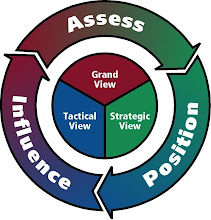
A standard that states "Good enough", would last for a limited time line. To compete properly in an information-driven economy where the copycats outnumbered the innovators (many millions to one), the innovator must develop patentable stuff that forces the opposition to spend a great deal of time and resources to duplicate the same features. The economic settings sometime determines the importance of quality. (Another two strategic options are: the establishment of alliances with trusted competitors and having a good team of intellectual property lawyers watching the possibility of patents.)Concurrently, the innovators must understand the risk/benefits of going beyond the "Good Enough" standard. This requires one to have a grand picture of their marketing terrain.
A grand picture that enables you to maximize profits, minimize costs and exploit opportunities. Do you assess the grand picture, before building a plan?
Without a complete understanding what is the grand picture, how does one make a right strategic move.
Sidebar: While the masses would rather have their stuff with a "good enough" standard, are you one of the few people who prefer excellence?#
The Good Enough Revolution: When Cheap and Simple Is Just FineIn 2001, Jonathan Kaplan and Ariel Braunstein noticed a quirk in the camera market. All the growth was in expensive digital cameras, but the best-selling units by far were still cheap, disposable film models. That year, a whopping 181 million disposables were sold in the US, compared with around 7 million digital cameras. Spotting an opportunity, Kaplan and Braunstein formed a company called Pure Digital Technologies and set out to see if they could mix the rich chocolate of digital imaging with the mass-market peanut butter of throwaway point-and-shoots. They called their brainchild the Single Use Digital Camera and cobranded it with retailers, mostly pharmacies like CVS.The concept looked promising, but it turned out to be fatally flawed. The problem, says Simon Fleming-Wood, a member of Pure Digital's founding management team, was that the business model relied on people returning the $20 cameras to stores in order to get prints and a CD. The retailers were supposed to send the used boxes back to Pure Digital, which would refurbish them, reducing the number of new units it had to manufacture. But customers didn't return the cameras fast enough. Some were content to view their pictures on the tiny 1.4-inch LCD and held on to the device, thinking they'd take it in later to get prints. Others figured out how to hack the camera so it would download to a PC, eliminating the need to return the thing altogether.Brisk sales combined with a lack of speedy returns destroyed the company's thin margins, and the camera failed. But the experience taught Kaplan and Braunstein a lesson: Customers would sacrifice lots of quality for a cheap, convenient device. To keep the price down, Pure Digital had made significant trade-offs. It used inexpensive lenses and other components and limited the number of image-processing chips. The pictures were OK but not great. Yet Pure Digital sold 3 million cameras anyway.Kaplan and Braunstein also learned something important about camera retailing in general. The market had long been split into two main segments: point-and-shoots (including disposables) and single-lens reflex cameras, which use interchangeable lenses and other high-end accessories. Not surprisingly, the vast majority of cameras sold then—as now—were the handy point-and-shoots; SLRs tended to attract only serious hobbyists and professionals.Oddly, though, there was no point-and-shoot analogue in video cameras—and that's where the pair saw their next opportunity. Home videocams were almost without exception expensive, complicated devices loaded with features like image stabilization, night-vision mode, and onboard color correction. And even with tools like Apple's iMovie, it was a hassle to get footage off the cameras and onto a computer for editing and sharing. In terms of complexity and price, the camcorder market resembled the SLR market, but with no low-end alternative. Kaplan and Braunstein suspected that there might be a place for a much cheaper, simpler video camera. So they decided to make one.After some trial and error, Pure Digital released what it called the Flip Ultra in 2007. The stripped-down camcorder—like the Single Use Digital Camera—had lots of downsides. It captured relatively low-quality 640 x 480 footage at a time when Sony, Panasonic, and Canon were launching camcorders capable of recording in 1080 hi-def. It had a minuscule viewing screen, no color-adjustment features, and only the most rudimentary controls. It didn't even have an optical zoom. But it was small (slightly bigger than a pack of smokes), inexpensive ($150, compared with $800 for a midpriced Sony), and so simple to operate—from recording to uploading—that pretty much anyone could figure it out in roughly 6.7 seconds.Within a few months, Pure Digital could barely keep up with orders. Customers found that the Flip was the perfect way to get homebrew videos onto the suddenly flourishing YouTube, and the camera became a megahit, selling more than 1 million units in its first year. Today—just two years later—the Flip Ultra and its subsequent revisions are the best-selling video cameras in the US, commanding 17 percent of the camcorder market. Sony and Canon are now scrambling to catch up.The Flip's success stunned the industry, but it shouldn't have. It's just the latest triumph of what might be called Good Enough tech. Cheap, fast, simple tools are suddenly everywhere. We get our breaking news from blogs, we make spotty long-distance calls on Skype, we watch video on small computer screens rather than TVs, and more and more of us are carrying around dinky, low-power netbook computers that are just good enough to meet our surfing and emailing needs. The low end has never been riding higher.So what happened? Well, in short, technology happened. The world has sped up, become more connected and a whole lot busier. As a result, what consumers want from the products and services they buy is fundamentally changing. We now favor flexibility over high fidelity, convenience over features, quick and dirty over slow and polished. Having it here and now is more important than having it perfect. These changes run so deep and wide, they're actually altering what we mean when we describe a product as "high-quality."And it's happening everywhere. As more sectors connect to the digital world, from medicine to the military, they too are seeing the rise of Good Enough tools like the Flip. Suddenly what seemed perfect is anything but, and products that appear mediocre at first glance are often the perfect fit.The good news is that this trend is ideally suited to the times. As the worst recession in 75 years rolls on, it's the light and nimble products that are having all the impact—exactly the type of thing that lean startups and small-scale enterprises are best at. And from impact can come big sales. "When the economy went south before Christmas last year, we worried that sales would be affected," says Pure Digital's Fleming-Wood. "But we sold a ton of cameras. In fact, we exceeded the goals we had set before the economy soured." And this year? Sales, he says, are up 200 percent. (Another payoff: In May, networking giant Cisco acquired Pure Digital for $590 million.)To some, it looks like the crapification of everything. But it's really an improvement. And businesses need to get used to it, because the Good Enough revolution has only just begun.Speaking at an Online publishers conference in London last October, New York University new-media studies professor Clay Shirky had a mantra to offer the assembled producers and editors: "Don't believe the myth of quality." When it comes to the future of media on the Web, Shirky sternly warned, resist the reflex to focus on high production values. "We're getting to the point where the Internet can support high-quality content, and it's as if what we've had so far has all been nice—a kind of placeholder—but now the professionals are coming," Shirky said. "That's not true." To reinforce his point, he pointed to the MP3. The music industry initially laughed off the format, he explained, because compared with the CD it sounded terrible. What record labels and retailers failed to recognize was that although MP3 provided relatively low audio quality, it had a number of offsetting positive qualities.Shirky's point is crucial. By reducing the size of audio files, MP3s allowed us to get music into our computers—and, more important, onto the Internet—at a manageable size. This in turn let us listen to, manage, and manipulate tracks on our PCs, carry thousands of songs in our pockets, purchase songs from our living rooms, and share tracks with friends and even strangers. And as it turned out, those benefits actually mattered a lot more to music lovers than the single measure of quality we had previously applied to recorded music—fidelity. It wasn't long before record labels were wringing their hands over declining CD sales."There comes a point at which improving upon the thing that was important in the past is a bad move," Shirky said in a recent interview. "It's actually feeding competitive advantage to outsiders by not recognizing the value of other qualities." In other words, companies that focus on traditional measures of quality—fidelity, resolution, features—can become myopic and fail to address other, now essential attributes like convenience and shareability. And that means someone else can come along and drink their milk shake.To a degree, the MP3 follows the classic pattern of a disruptive technology, as outlined by Clayton Christensen in his 1997 book The Innovator's Dilemma. Disruptive technologies, Christensen explains, often enter at the bottom of the market, where they are ignored by established players. These technologies then grow in power and sophistication to the point where they eclipse the old systems.That is certainly part of what happens with Good Enough tech: MP3s entered at the bottom of the market, were ignored, and then turned the music business upside down. But oddly, audio quality never really readjusted upward. Sure, software engineers have cooked up new encoding algorithms that produce fuller sound without drastically increasing file sizes. And with recent increases in bandwidth and the advent of giant hard drives, it's now even possible to maintain, share, and carry vast libraries of uncompressed files. But better-sounding options have hardly gained any ground on the lo-fi MP3. The big advance—the one that had all the impact—was the move to easier-to-manage bits. Compared with that, improved sound quality just doesn't move the needle.#Of course, there are those who appreciate the richer sound of uncompressed files, CDs, or even vinyl records (regarded by some audiophiles as the highest-fi format available). But most of us don't give it a second thought. In fact, there's evidence that consumers are simply adapting to the MP3's thin sound. Jonathan Berger, a professor of music at Stanford University, recently completed a six-year study of his students. Every year he asked new arrivals in his class to listen to the same musical excerpts played in a variety of digital formats—from standard MP3s to high-fidelity uncompressed files—and rate their preferences. Every year, he reports, more and more students preferred the sound of MP3s, particularly for rock music. They've grown accustomed to what Berger calls the percussive sizzle—aka distortion—found in compressed music. To them, that's what music is supposed to sound like.What has happened with the MP3 format and other Good Enough technologies is that the qualities we value have simply changed. And the change is so profound that the old measures have almost lost their meaning. Call it the MP3 effect.We've seen it again and again. Consider, for example, the rise of cloud computing. For years, software was something you bought and installed on your hard drive. A lot of it was made by Microsoft, which solidified its dominance by releasing ever more powerful, feature-laden updates. But with the advent of services like Gmail and Zoho Writer, many users are now turning to the Web for basic tasks like word processing, spreadsheets, and email. These cloud apps have inherent limits: They run through a browser window and can't directly access your local hard drive or processor. They lack features. Their performance depends on the strength of your Internet connection. Nevertheless, tens of millions of people use Gmail, while Zoho Writer boasts 1.8 million users and is growing at a rate of 100,000 subscribers a month. Microsoft, of course, is now jumping into the cloud as fast as it can. Redmond says that Office 2010 will be largely cloud-based. Not to be outdone, Google recently announced a mostly cloud-based operating system that will work in tandem with the company's Chrome browser.Web tools are succeeding because they're Good Enough. They do most of what we need from a word processor or a spreadsheet or an email program or even an OS. But, like the MP3, they also offer other advantages. You can access them from any computer. If your hard drive crashes, you don't lose your work. And they are incredibly cheap—free in the case of simple tools or just a few dollars a month per user in the case of business apps.Compare these qualities with those of the MP3 and the Flip, and a clear pattern emerges. The attributes that now matter most all fall under the rubric of accessibility. Thanks to the speed and connectivity of the digital age, we've stopped fussing over pixel counts, sample rates, and feature lists. Instead, we're now focused on three things: ease of use, continuous availability, and low price. Is it simple to get what we want out of the technology? Is it available everywhere, all the time—or as close to that ideal as possible? And is it so cheap that we don't have to think about price? Products that benefit from the MP3 effect capitalize on one or more of these qualities. And they'll happily sacrifice power and features to do so.#By traditional military standards, the MQ-1 Predator isn't much of a plane. Its top speed is a mere 135 miles per hour. It has an altitude ceiling of 25,000 feet. It carries only two 100-pound Hellfire missiles. It has a propeller. By comparison, an A-10 can travel 420 mph, cruise at 45,000 feet, and carry up to 16,000 pounds of bombs—not to mention a 30-mm gatling gun. An F-16 can reach a blistering 1,500 mph (Mach 2), climb to more than 50,000 feet, and back up its 20-mm multibarrel canon with six missiles.All three of these aircraft are used for surveillance and close air support. But more and more, the military is relying on the unmanned Predator. In the past two years, it has logged more than 250,000 flight hours, nearly all of them in combat. It has been deployed to the Balkans, Pakistan, Afghanistan, and Iraq.Why, if manned planes are so superior, is the Predator saturating the combat market? Because military aircraft are experiencing their own version of the MP3 effect.Over the past few decades, the armed services—like many industries—have been radically changed by the Internet and other modern communications technologies. Now that the military can digitize and share information quickly, engagements are conducted differently: Greater emphasis is being put on "situational awareness," the ability of remote commanders to know what's happening on a battlefield at all times. This in turn has altered what the military looks for in a plane, much the same way small digital files changed what music fans value in a recording.There is at least one measure by which the Predator has piloted aircraft handily beat: the ability to maintain a constant presence in the air. That's because the drones are relatively cheap to build, can fly for more than 20 hours straight, and don't require pilots who need sleep, food, and bathroom breaks (and who might die if the plane is shot down). In Afghanistan and Iraq, a Predator is available pretty much anytime the military needs one. Accessibility, in other words, has become a dominant aircraft value—prized as much as, and sometimes more than, speed, altitude, and armament."Sustaining the sorts of operations we conduct with the Predator used to be virtually impossible," says Eric Mathewson, director of the Air Force Unmanned Aircraft Systems Task Force. "The idea of putting an aircraft over an area of interest 24 hours a day, 365 days a year, was simply unsustainable."Piloted aircraft are still valuable, he's quick to add, but because the Predator can linger, it has enabled a new type of strategy—remotely guided surgical strikes with fewer troops and armaments. It's a lesson that surprised the Air Force and other services, Mathewson says, but one that has been learned definitively. "We're now looking at aircraft capabilities for the future that are even more persistent," he says. "We're exploring airships again, which could stay airborne for up to five years."The impact of the Predator illustrates the potential of the MP3 effect to transform almost any market. In fact, Good Enough tech is already gaining a foothold in two other huge industries: the legal profession and health care.Richard Granat is a pioneer in a field called elawyering. It shouldn't be confused with Web sites that merely offer legal documents for downloading, Granat explains. Elawyering involves actual lawyers, and clients who use these services get help sorting through legal issues.Granat, who runs his own law firm and cochairs the American Bar Association's task force on elawyering, has designed and marketed a number of Web tools that walk people through common legal procedures. He created a child-support calculator, for example, which assists couples going through relatively amicable divorces. There's also a tool to help people decide whether they need Chapter 7 or Chapter 13 bankruptcy. These widgets then generate legal forms, which may be reviewed by a licensed attorney who can make suggestions or offer advice over the phone.It turns out to be a remarkably efficient way of offering what Granat calls legal transaction services—tasks that are document intensive. For everything from wills to adoptions to shareholder agreements, elawyering has numerous advantages. It's cheaper, for example; a no-fault divorce, Granat says, might run a fifth of what seeing an attorney would cost. It's also faster—customers can access the tools anytime and never have to interrupt their day to meet with someone in a distant office. Simply put, elawyering makes certain legal services more accessible.There are trade-offs, of course. "The relationship has less richness than what you'd get from sitting in a lawyer's office," Granat says. "And if you have an issue that's more complex, then you still need to see a lawyer face-to-face." In other words, it's a lower-fidelity experience.But for most simple legal interactions, elawyering is, well, Good Enough. It gets the job done, even if it doesn't let you ask every question or address every contingency. And not surprisingly, it's on the rise. "Elawyering will be mainstream in three years," Granat says. "I predict that in five years, if you're a small firm and don't offer this kind of Web service, you're not going to make it."#In the case of health care, the Good Enough mindset can be seen in a new initiative by Kaiser Permanente. The largest not-for-profit medical organization in the country, Kaiser has long relied on a simple strategy of building complete, self-sustaining hospitals—employing 50 doctors or more—in each region it serves. "It's an efficient model," says Michele Flanagin, Kaiser's vice president of delivery systems strategy. "It offers one-stop shopping: pharmacy and radiology and everything you want from health care in one building." But that approach forces patients who don't live near a hospital to drive a long way for even the most routine doctor's appointment.As it happens, though, Kaiser has become one of the most technologically advanced health care providers in the country, digitizing everything from patient records and doctors' notes to lab data and prescriptions and putting it all online. The system is networked, so patients can email their doctor, check lab results, and make appointments from their PC or mobile Web device. Getting a referral doesn't mean carrying medical records from one doctor to another, as it does at many hospitals.In 2007, Flanagin and her colleagues wondered what would happen if, instead of building a hospital in a new area, Kaiser just leased space in a strip mall, set up a high tech office, and hired two doctors to staff it. Thanks to the digitization of records, patients could go to this "microclinic" for most of their needs and seamlessly transition to a hospital farther away when necessary. So Flanagin and her team began a series of trials to see what such an office could do. They cut everything they could out of the clinics: no pharmacy, no radiology. They even explored cutting the receptionist in favor of an ATM-like kiosk where patients would check in with their Kaiser card.What they found is that the system performed very well. Two doctors working out of a microclinic could meet 80 percent of a typical patient's needs. With a hi-def video conferencing add-on, members could even link to a nearby hospital for a quick consult with a specialist. Patients would still need to travel to a full-size facility for major trauma, surgery, or access to expensive diagnostic equipment, but those are situations that arise infrequently.If that 80 percent number rings a bell, it's because of the famous Pareto principle, also known as the 80/20 rule. And it happens to be a recurring theme in Good Enough products. You can think of it this way: 20 percent of the effort, features, or investment often delivers 80 percent of the value to consumers. That means you can drastically simplify a product or service in order to make it more accessible and still keep 80 percent of what users want—making it Good Enough—which is exactly what Kaiser did.Flanagin believes these clinics will enable Kaiser to add thousands of new members. And they'll do it for less. The per-member cost at a microclinic is roughly half that of a full Kaiser hospital. The first microclinic is set to open in Hawaii early next year. Medical care is now poised for its own manifestation of the MP3 effect.The phenomenon certainly won't stop with hospitals, lawyers, and military campaigns. As more and more industries move their business online, they too will find success in Good Enough tools that focus on maximizing accessibility. It's a reflection of our new value system. We've changed. To benefit from the MP3 effect, companies will have to change as well.No one understands this better than the folks at Pure Digital Technologies. Two years ago, the Flip Ultra nailed all three of those accessibility traits: It was significantly less expensive than other digital video cameras—so much so, it almost seemed an impulse buy in comparison. It was much easier to use, not only for shooting video but also for uploading clips to the Internet. And its pocketable size and Web-sharing abilities made video available anytime, anywhere. The Flip hit the Good Enough trifecta.When asked why he thinks the Flip has succeeded where more powerful videocams—and even new Flip knockoffs from the likes of Sony—have failed, Pure Digital's Fleming-Wood has an interesting answer: "I think it's because we have a better product." What's odd is that executives at Sony and Canon would likely say the same thing—after all, their models have far more features and often produce sharper images. But Fleming-Wood is using a different definition of "better." He now defines quality entirely in terms of ease of use—how easy it is to shoot and share the video. "The one thing everyone wants to do with their footage is show it to someone else," he says.Even so, it's easy to imagine that feature creep will one day seep into the Flip. After all, the company recently released models that record in HD, so why not image stabilization or a bigger LCD—or hey, how about a touchscreen! "We will always prioritize accessibility over features," Fleming-Wood insists. The increase in pixel count, he says, is simply the result of Moore's law advances in chip speed and storage capacity, not a signal that Pure Digital is changing its focus. Once HD components became available that would not drastically raise the price of the camera or make it harder to use, "it made no sense not to go HD," Fleming-Wood says. He points out that Pure Digital has yet to include other features like an optical zoom or image stabilization, adding that he knows people love the Flip because of how simple it makes recording and sharing video. "We will never sacrifice that."When he thinks about how the Flip line will improve in the future, Fleming-Wood envisions adding features that will make the video even easier to share. "Well, we could add Wi-Fi or cell connectivity, so if you were filming your kid's soccer game, you could be uploading the footage to the Web in real time so Grandma could watch from home," he says with a daydreamer's enthusiasm. To do something that ambitious, of course, might require sacrificing some of that HD image quality. No problem, as long as it's Good Enough.Senior editor Robert Capps (rcapps@wired.com) wrote about Judd Apatow in issue 15.06.
http://www.wired.com/gadgets/miscellaneous/magazine/17-09/ff_goodenough?currentPage=all