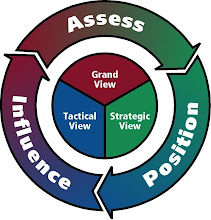
A team that implements technology with a direction is like a compass with a needle.
Strategic classics emphasize that "an organization (or a team) with a strategic foundation is a house with a cornerstone. "
#
July 22, 2008As Travel Costs Rise, More Meetings Go VirtualBy STEVE LOHRJill Smart, an Accenture executive, was skeptical the first time she stepped into her firm’s new videoconferencing room in Chicago for a meeting with a group of colleagues in London. But the videoconferencing technology, known as telepresence, delivered an experience so lifelike, Ms. Smart recalled, that “10 minutes into it, you forget you are not in the room with them.”Accenture, a technology consulting firm, has installed 13 of the videoconferencing rooms at its offices around the world and plans to have an additional 22 operating before the end of the year.Accenture figures its consultants used virtual meetings to avoid 240 international trips and 120 domestic flights in May alone, for an annual saving of millions of dollars and countless hours of wearying travel for its workers.As travel costs rise and airlines cut service, companies large and small are rethinking the face-to-face meeting — and business travel as well. At the same time, the technology has matured to the point where it is often practical, affordable and more productive to move digital bits instead of bodies.The emerging trend, analysts say, goes well beyond a reaction to rising travel costs and a weakening economy. “These technology tools are going to change the way corporations think about travel and work in the long run,” an analyst at Forrester Research, Claire Schooley, said.Past predictions that technology could replace travel have been frequent and premature. The main difference today, analysts say, is that the technology is finally catching up to its promise. No single breakthrough explains the progress, but rather a series of step-by-step advances — and steady investment — in telecommunications networks, software and computer processing.The results can be seen not only in the expensive new telepresence systems like those from Cisco Systems or Hewlett-Packard, but also in more mainstream collaboration technologies — Web conferencing, online document sharing, wikis and Internet telephony. The audio and desktop presentations in Web-based meetings, for example, are now more likely to be in sync and interactive.Companies of all sizes are beginning to shift to Web-based meetings for training and sales presentations. “Only in the last two years has the technology gotten to point where it really makes sense to use it,” said Alan Minton, vice president for marketing at Cornerstone Information Systems, a 60-person business software company in Bloomington, Ind.With his sales force doing many product demonstrations online, Mr. Minton estimates the group’s travel costs of have been cut by 60 percent and the average time to close a new sale has been reduced by 30 percent.No one suggests that the face-to-face meeting is becoming obsolete, or that it is time for a requiem for the road warrior. Companies talk about using digital tools mainly as a way of making business travel more selective and more productive.Still, the potential for digital displacement of business travel is substantial. A report last month by the Global e-Sustainability Initiative, a group of technology companies, and the Climate Group, an environmental organization, estimated that up to 20 percent of business travel worldwide could be replaced by Web-based and conventional videoconferencing technology.The most dedicated business travelers tend to be management consultants, investment bankers, accountants, lawyers and technology services consultants. Much of their work has to be done in person with clients. But these professionals are increasingly using online collaboration tools for work within their firms.At I.B.M., Michael Littlejohn, a work force and technology expert in the company’s global services unit, said two years ago, he was on the road 13 to 15 days a month. These days, he says, he travels 8 or 10 days a month. “But my time spent with clients is not less,” he said. “To really understand a client’s problems or to close a deal, you need face to face.”/// On an one on one basis, he is correct.Corporate training and education is a field many companies are moving online, in part to trim travel costs. Darryl Draper, the national manager of customer service training for Subaru of America, used to travel four days a week, nine months of the year, presenting educational programs at dealers nationwide. Today, Ms. Draper rarely travels and nearly all of her training is done online.Previously, Ms. Draper estimated, in six months she would reach about 220 people at a cost of $300 a person. She said she now reaches 2,500 people every six months at a cost of 75 cents a person.A range of companies offer the mainstream online communications and collaboration tools, including WebEx, Citrix, Microsoft, I.B.M. and others. The most rarefied offering, though, is telepresence videoconferencing. Today, it is an elite product supplied by a few companies, including Cisco, H.P. and Polycom.Completed telepresence rooms, typically with three huge curved screens (and a fourth screen above for shared work), custom lighting and acoustics, cost up to $350,000 — though that is down from $500,000, when H.P. sold its first system in early 2006.The resolution on telepresence screens is even sharper than on high-definition televisions, and images can be magnified to inspect products. Engineers at the far-flung labs of Advanced Micro Devices, for example, scrutinize the microcircuitry on new chip designs using the company’s telepresence systems. And the images of people on screen are life-size.Cisco, which has more than 200 telepresence rooms, figures it is avoiding $100 million in yearly travel costs, and reducing its greenhouse gas emissions from air travel by 10 percent. H.P. says air travel among its offices with telepresence rooms is down 25 percent.When used regularly, the rooms pay for themselves within a year, analysts estimate. Sales of telepresence systems will more than double this year to 627, estimates the market research firm IDC, and reach more than 8,000 by 2012.There is a certain paradox in telepresence, in that it is all to simulate the richest form of human interaction: people talking to each other, face to face.And it is not a perfect substitute. Ms. Smart, the chief of human resources for Accenture, still travels about 10 days a month. “You don’t learn about other cultures in telepresence,” she said. You get things from being there, over breakfast and dinner, building relationships face to face.”Copyright 2008 The New York Times Companyhttp://www.nytimes.com/2008/07/22/technology/22meet.html###
 Regardless of the distance and the project culture, the process precedes the technology.
To thrive in the global economy, the virtual project team needs a strategic foundation and direction. They must collaborate as a team.
.jpg) Most people know how to perform and produce as an individual. Not many knows how to collaborate as a team.
Most people know how to perform and produce as an individual. Not many knows how to collaborate as a team.
If you are interested in knowing about how to collaborate anywhere as a team regardless of the distance, the technology and the project culture. Please contact us at service [at] collaboration360 [dot] com. We have a white paper ready for your reading..


.jpg)