Sunday, June 21, 2009

Risk Management: A View from The Seven Strategy Classics of Ancient China


During the act of assessing or planning, he or she must always consider the risk factor.


"One who abandons what is nearby to plan for what is distant will labor without success. One who abandons the distant to plan for the nearby will be at ease and attain lasting results." - Huang Shek Gong, 9


#
June 16, 2009
Settling for Par: Pros More Likely to Play It Safe

By ALAN SCHWARZ

When PGA Tour golfers from Tiger Woods down to the greenest rookie draw back their putters this week at the United States Open, their scorecards will be sabotaged by a force as human as it is irrational: risk intolerance.


Even the world’s best pros are so consumed with avoiding bogeys that they make putts for birdie discernibly less often than identical-length putts for par, according to a coming paper by two professors at the University of Pennsylvania’s Wharton School. After analyzing laser-precise data on more than 1.6 million Tour putts, they estimated that this preference for avoiding a negative (bogey) more than gaining an equal positive (birdie) known in economics as loss aversion costs the average pro about one stroke per 72-hole tournament, and the top 20 golfers about $1.2 million in prize money a year.


Contrary to most academic studies involving sports, at which athletes typically scoff, a handful of the tour’s top putters did not dispute this finding. Simply put if not putt they admitted to being spooked enough by bogeys that they will ultimately cost themselves strokes to avoid them. Call it the bogeyman.

Par putts just seem to be more critical because if you miss you drop a shot if you miss a birdie putt, it doesn’t seem to have the same effect, said Jim Furyk, one of the tour’s best putters.
Added Justin Leonard: When putting for birdie, you realize that, most of the time, it’s acceptable to make par. When you’re putting for par, there’s probably a greater sense of urgency, so therefore you’re willing to be more aggressive in order not to drop a shot. It makes sense.

Of course, it makes no sense at all: each stroke counts as one on a scorecard, whether for eagle or triple-bogey on any particular hole. The goal is to finish with the fewest strokes, regardless of what each might be artificially termed. All else being equal distance from the cup, one’s proximity to the lead or cut, the course difficulty and so on putts should be handled the same way.


But they are not, according to the study of almost 200 tour professionals from 2004 through 2008. Using data the tour regularly records on every ball’s green location accurate to the nearest inch, the professors found that birdie putts were made about 3 percent less often than otherwise identical putts for par. (In effect, players tell themselves before birdie attempts, Let’s just get close, rather than, I have to make this.) Given that players typically attempt nine birdie putts per round, this cost each golfer about one stroke per tournament which can translate to hundreds of thousands of dollars in prize money.


The professors, Devin Pope and Maurice Schweitzer, seemingly anticipated every But what about? reflex from golf experts. The tendency to miss birdie putts more often existed regardless of the player’s general putting or overall skill; round or hole number; putt length; position with respect to the lead or cut; and more.


As would be expected, the difference decreased on routine short putts and also decreased very far from the hole, where the chance of making the putt is small to begin with. It peaked on putts from about 6 to 12 feet. Even Woods, roundly considered the best putter ever, exhibited the trait at roughly the tour average.


The finding may become significant among behavioral economists, many of whom have suspected that the loss aversion found through contrived experiments might not be demonstrated by actual, expert competitors vying for high stakes. The paper is being submitted this week for publication in an economic journal.


Even experienced professionals playing for high stakes are not rational, Pope said. Tiger Woods, the model of perfection and what an economist would think of as a rational agent, even he exhibits these biases. And if he exhibits these biases, why not business leaders? There are a lot of applications.
Rather than resist any insight from ivory tower academics, several golfers admitted to handling identical birdie and par putts differently and appeared somewhat amused at being found out. Geoff Ogilvy, who made par putts 4.1 percent more often than birdie putts from the same distance, said: A par putt seems more final. It shouldn’t make any difference, should it? And Paul Goydos, who showed the effect at 4.4 percent, said it probably affected him even more on putts for eagle.

If I’ve got a 25-footer for eagle, it seems like I’m more conservative than with a 25-footer for either birdie or par for whatever reason, Goydos said. I think the worst thing you can do is three-putt for par on a par 5. That’s one that drives me more crazy than anything else. Maybe that’s why I’m at the very bottom of the tour in eagles made.

But just as quickly as pro golfers admitted to their costly habit, they dismissed the idea of being able to do much about it. Stewart Cink, who showed a 3.3 percent effect, said that try as he might, he would never be able to convince himself that every putt is the same.

You can’t fool yourself, Cink said. But this is one of the reasons why we use sports psychology, and we try to have a preshot routine so we do the same thing, approach every putt the same way. It’s not always glamorous, and it’s not always possible in reality.
The psychological preference to avoid a perceived penalty (losing a stroke relative to par) rather than go for a perceived gain (gaining a stroke) has some benefit.

Golfers tended to leave their conservatively stroked birdie putts slightly closer to the cup than more aggressively missed pars leading to their making their follow-up shot more often. But that temporary gain was far outweighed by the overall cost in strokes.
The birdie-versus-par effect varies in ways that many golfers would instinctually predict. The tendency to make similar birdie putts less often than pars becomes less prevalent with each tournament round as players are judged more against one another than against par.

The elite tour players generally show less of the trait than marginal ones. And the difference decreases as a player sees himself or his partners handle a particular green.
But the effect is always there, even if a good reason for it is not. A 10-footer for par feels more important than one for birdie, said Goydos, a two-time winner on the tour. The reality is, that’s ridiculous. I can’t explain it in any way other than that it’s subconscious. And pars are O.K. bogeys aren’t.

Larry Dorman contributed reporting.

Copyright 2009 The New York Times Company

http://www.nytimes.com/2009/06/16/sports/golf/16study.html?em


Those who are positionally competing in an intensive competition, should remember the following quote from Questions and Replies between T'ang T'ai-tsung and Li Wei-kung.

"According to Fan Li's book, 'If you're last use yin tactics, if you're first then use yang tactics. When you have exhausted the enemy's yang tactics. When you have exhausted the enemy's tactics. When you have exhausted the enemy measures, then expand your yin to the full and seize them.' This then is the subtle mysteriousness of yin and yang according to the strategists."


Thursday, June 18, 2009

The Dao of Strategic Assessment (27): Assessing One's Grand Settings


Assessing the potential alliances and the opposition through the use of Sunzi principles is quite simple.

Gathering "complete" intelligence on the contenders (not the pretenders) is the first step.

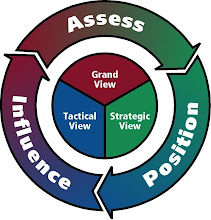
The next step is assessing the intelligence in terms of the "Public View", "The Functional View", The Field View", The Organizational View" and the "Definite View

While analyzing their past history and current actions from those different views can be quite taxing,
transforming the intelligence into a top-down plan is the greater challenge.


If you like to know how to transform assessed data into a top down strategic view, please contact us at service [att] collaboration360 [dott] com.

#

Everyone's on hand

It was pretty stuffy at Wednesday's news conference introducing incoming Police Chief George Gascon -- maybe it was all the egos in the room.


Apparently no one wanted to be left out: City officials nearly outnumbered members of the media at the packed event in the mayor's office. And we couldn't help but notice that most of those elected officials -- some of whom have traded harsh words lately -- have their sights set on higher office.

Of course, Mayor Gavin Newsom is looking to move to Sacramento, and numerous people in attendance are thought to be angling to replace him: Supervisors Ross Mirkarimi and Bevan Dufty, City Attorney Dennis Herrera and Assessor Recorder Phil Ting (who shares a political consultant with Newsom and got a special shout-out towards the end from the mayor).

Incoming Police Chief George Gascon gets a warm welcome from the whole city family Wednesday.
Michael Macor
The Chronicle
Incoming Police Chief George Gascon
gets a warm welcome from the whole city family Wednesday.

But ambition doesn't stop at San Francisco's borders: Attorney General candidate and current District Attorney Kamala Harris was front and center. And her right hand man, Chief Assistant District Attorney Russ Giuntini (who may be looking to become the city's top prosecutor) was also there.

Also in attendance were Board President David Chiu, supervisors Carmen Chu, John Avalos, Eric Mar and David Campos, Public Defender Jeff Adachi (who's gearing up for a budget fight).

Appointed officials were on hand too, including Fire Chief Joanne Hayes-White, Police Commission President Theresa Sparks, Police Commissioner David Onek, Bill Siffermann, San Francisco's juvenile probation chief and Kevin Ryan, director of the Mayor's Office of Criminal Justice.


And, of course, Police Officer's Association president Gary Delagnes, who never fails to give a great quote. Case in point-- when Delagnes was asked what challenges Gascon will face, he had this gem:
"Politics. San Francisco (is) unlike Los Angeles or any other city in America. To learn the players on the police commission, to learn the players on the board of supervisors, the mayors office, the command staff, the media," Delagnes said. "He's got to see where the knives are coming from and the knives are coming from day one. They already started today."

Posted By: Marisa Lagos (Email) | June 17 2009 at 03:30 PM
http://www.sfgate.com/cgi-bin/blogs/cityinsider/detail?blogid=55&entry_id=41905
http://www.sfgate.com/cgi-bin/blogs/cityinsider/detail?entry_id=41905

Tuesday, June 16, 2009

The Dao of Strategic Assessment (26): Assess One's Grand Settings


From the late 60's to the early 80's, the Red Wings went on a losing slump in which they only made the playoffs twice, winning one series.

In 1983, the Red Wings organization changed to a new owner who brought his own management team. Their first set of objective was to assess their global settings and determined what was their overall philosophy in terms of organizational leadership, talent, game style. Once they built and connected to their strategic overview (
Tangible Vision). The Red Wings used their Tangible Vision as their guide and started to search for the best global hockey talent that fit their game philosophy of puck control, speed teamwork and quickness. They immediately began to win. Between 1988 to present, the Red Wings won four Stanley cups, six Conference championships and 14 Division championships

During 2004-2005 season, the economic state of the US professional hockey game changed. The Red Wings and other hockey teams were forced to modify its contracts system and displaced some of its high-priced players. Concurrently, they were also forced to re-think their gameplay approach. In some of their games, they noticed that the stronger opponents were out-muscling them in close games.

The Red Wings management decided to maintain their emphasis on puck control and game speed. However, they adjusted their game by focusing
its European players to play more physically aggressive and go into corners after pucks. It worked quite well that they won the Stanley Cup in 2007-2008 and were playing in the NHL Stanley Cup Finals this past season.


#

In NHL, Detroit Turns to Imports

As Motor City Slumps, Red Wings Thrive With European Players; Swedes Rejoice

By REED ALBERGOTTI

As the ailing Motor City rallies around the Detroit Red Wings, who face the Pittsburgh Penguins on Friday in Game 7 of the Stanley Cup Finals, there is one tiny bit of irony: Michigan’s top team is powered more than ever by European imports.

Less than half the Red Wings’ roster comes from North America. The rest, and most of the team’s top talent, hail from Sweden, the Czech Republic, Russia and Finland. In all, five players are from the U.S. Years ago, when the Big Three auto makers were allowing overseas competitors to pull ahead, the world was getting flat inside Joe Louis Arena. Starting in the 1980s, the Red Wings began building a dynasty by recruiting talent from Russia and adopting a new, European style of hockey.

The Red Wings’ success—they have won four Stanley Cups since 1997–paved the way for the rest of the league to follow. Today 30% of the NHL’s players hail from outside North America. The Red Wings are still the most international team, with 54% of their players hailing from overseas. This season, more than 80% of the Red Wings’ goals were scored by players born outside North America, up from 41.5% in the 1996-1997 season.

At the same time, the pool of available talent at home seems to be thinning. In Michigan, one of the nation’s top junior-hockey states, the struggling economy—and the high cost of junior hockey—is taking a toll on participation. USA Hockey says youth participation in the state has fallen 14% in the past three seasons.

In many ways, the Red Wings are a case study in harnessing globalization. Team scouts travel the world in search of new talent and new ideas. Instead of an employee-training program, the team uses its farm team, the Grand Rapids Griffins of the American Hockey League, to develop talent.

“It’s a global sports market now,” says Michael Maroone, the chief operating officer of AutoNation and part owner of the NHL’s Florida Panthers. “Detroit was certainly out in front on the hockey side. It reminds me of Toyota, honestly.”

Giving Away Cars

In the 1980s, Red Wings owner Mike Ilitch had to give away cars at every home game to persuade fans to watch the beleaguered “Dead Things,” which hadn’t won a championship since 1955.

Team officials Jimmy Devellano and Ken Holland set out on a radical mission: to draft and sign European players who played a brand of hockey completely different from what was common in North America. The Wings drafted Russian Sergei Fedorov and Swede Nicklas Lidstrom in 1989 . Players then switched to a cleaner, faster, less pugnacious puck-control style of hockey that eventually led the team to championships in 1997, 1998 and 2002.

After the lockout in 2004-2005, the team found itself in a bind. It had a payroll of $75 million that had to be shrunk to $39 million. To make room for the new salary cap, Detroit chose fast and talented European players and got rid of many of its beloved North American stars.

The team had mild success, but was knocked out of the playoffs in the first round by Edmonton in 2006. Next the team considered trading in some of its European stars for North Americans who could hit and fight and were more popular with the fans. “Maybe a little more North American—away from our philosophy a bit,” says Mr. Holland.

After much discussion, the team decided to stick with its original plan and instead teach its European players to play more physically and go into corners after pucks. It worked. The team won the Stanley Cup by 2008 and is now one game away from winning two years in a row with a team buttressed by Europeans like Sweden’s Johan Franzen and Russia’s Pavel Datsyuk. Together they won the team another championship last season. “You’re not really going to Europe looking for toughness,” says Mr. Holland.

The NHL and the Red Wings say they’re making an effort to boost development programs in the U.S. and North America. This past fall, the NHL upped the money available to USA Hockey, the country’s governing body, to $8 million from $1 million. In part, the money is going to support initiatives like the American Development Model, a national set of standards based on international best practices in developing athletic talent. The program costs about $2 million annually.

No matter how the team is composed, Detroiters show no lack of support for the Red Wings—and have proven especially devoted this season.

“You would think if there was a town that would not grasp on to an international team, it might be Detroit, because of the ‘buy American’ thing and patriotic feelings,” says Michael Robinet, vice president of vehicle forecasts for consulting firm CSM Worldwide. “It shows Detroit is willing to think outside of the box and has embraced this team.”

John Cooney, a stay-at-home dad from Livonia, Mich. Says he’s all for the Red Wings’ foreign roster. “I think that it’s important to search the four corners of the earth for talent,” he said.

Auto-industry experts are quick to note that the auto makers are not by any means unaware of foreign markets, especially Europe. General Motors says it actually has more employees outside the United States than in, and that it sells more vehicles abroad. Many global suppliers have added a presence in Detroit, bringing in workers from all over the world and making the city more global.

The only difference is the level of success they’ve had bringing European ideas to North America.

“Detroit has had to move from its domestic focus of 30 to 40 years ago to one where their survival depends on going global,” says Mr. Robinet of CSM. “That’s how the Red Wings saw things before many, many other teams,” he says.

Bruce Belzowski, assistant research scientist at University of Michigan’s Transportation Research Institute says the auto makers would have certainly taken a page from the Detroit Red Wings, had it been that simple. “I think it’s a lot easier to go out and scout for four or five good players than it is to turn huge companies around.”

Global Auto Makers

Shawn Morgan, spokeswoman for Chrysler Group says that in a global marketplace, the auto industry has been working hard to be prepared, “which is very similar to what the Wings have done,” she says. “Just like the Ilitches have made a great team, I think we’re putting together a great team.” A Ford spokesman says nobody is more supportive of the team than the company’s Swedish employees. “We’re an international auto maker based in Detroit,” he says.

The Red Wings, for their part, say they hope a Stanley Cup would serve as a respite from a wave of terrible news. “Times are difficult in Detroit and the State of Michigan,” a spokesman said. “We’re just trying to do our part to give the fans something to be proud of and to feel good about.”

Michigan governor Jennifer Granholm puts a different spin on the issue. “Having Swedish roots myself, I get a kick out of the Red Wings having Swedes on their roster—nearly a third of their lineup,” she says. “The Wings are a diverse team, and that diversity is reflective of Michigan.”

—Andrew Grossman contributed to this article.

Write to Reed Albergotti at Reed.Albergotti@wsj.com

http://online.wsj.com/article/SB10001424052970204482304574221962202473816.html#

Tuesday, June 9, 2009

Strategic Assessment Exercise


You are the director of strategic marketing for a mid-level software game company. Your goal is to secure a strategic disposition at the show that would make you the "buzz" of the exposition.

q: What are you going to do to gain that "buzz"?

q: What are you going to assess?

q: What is your positional strategy for being "the signal that is above the noise"?


#

June 9, 2009
Video Games
Electronic Fair Returns, Trying to Regain Its Luster
By SETH SCHIESEL

LOS ANGELES E3 is back. After a two-year experiment as a relatively sedate, exclusive conference, the Electronic Entertainment Expo returned to its bombastic glory here last week as video games’ premier global showcase. Attracting more than 41,000 attendees from almost 80 nations, E3 recaptured its buzz of old without degenerating into the sort of over-the-top crush that had prompted the retrenchment in the first place.

Here are eight of the most interesting and exciting games from E3 that are scheduled to be released this year. This list does not include any of the potential blockbusters from E3 scheduled for 2010, a lineup that includes the suspense thriller Alan Wake, God of War III, Mass Effect 2 and Final Fantasy XIII.

BIOSHOCK 2 The sequel to one of the most important games of recent years, BioShock returns players to Rapture, the ruined Art Deco city under the Atlantic Ocean. In the first game players uncovered the story of the twisted civil war in Rapture’s supposedly utopian society. With its pointed, mature critique of the notion of free will, BioShock set a new bar for interactive storytelling. BioShock 2 hopes to continue the adventure. It is to be released by 2K Games on Nov. 3 for the Play Station 3, Xbox 360 and Windows.

NEW SUPER MARIO BROS. For more than two decades, Mario’s side-scrolling, two-dimensional journey to rescue Princess Peach in Super Mario Bros. has stood as one of the seminally entertaining interactive adventures. At E3, Nintendo announced that it was developing the first multiplayer version, allowing as many as four players to jump and bounce over one another at once. It is to be released by Nintendo by year’s end for Wii.

BAYONETTA While the Mario games may epitomize the cute, family-friendly end of the spectrum in Japanese game design, Bayonetta represents the other end: stylized, flashy and spectacularly violent. Bayonetta, a statuesque, impossibly proportioned witch, is capable of wielding an entire arsenal at once, including multiple guns and swords, not to mention magical attacks unleased by her pulsing mane. Both gory and titillating, Bayonetta is to be released by Sega this year for the PS3 and 360.

HALO 3: ODST. While there is plenty of hectic front-line combat in ODST, a stand-alone prequel to Halo 3, much of the new game places the player in the role of a stealthy special-operations trooper picking his way through the vast ruins of New Mombasa. It is to be released by Microsoft on Sept. 22 for 360.

DJ HERO Activision hosted the party of E3, with Jay-Z, Eminem, DJ AM, Travis Barker and Warren G performing for the private crowd at the Wiltern Theater. But DJ Hero would have made this list even without the party (no, really). For all of the millions of copies the Guitar Hero series has sold, there are still millions of people who prefer hip-hop, electronica, trance and dance music to guitar anthems. It is to be released by Activision on Oct. 27 for PlayStation 2, PS3, 360 and Wii.

MAG MAG for massive action game promises to allow 256 players to blast away at one another simultaneously on one uninterrupted, virtually seamless near-future battlefield, a prodigious technical feat. MAG could represent a watershed for online gaming. If it works, that is. It is to be released by Sony this fall for PS3.

MODERN WARFARE 2 No line of games has yet provided a more consistently compelling rendition of the battlefield than the Call of Duty series. Modern Warfare 2 continues the story of the Call of Duty universe, with the player taking the role of various Western commandos on the hunt for international terrorists. Combining stealth sequences, all-out firefights and vehicular combat, Modern Warfare is to be released by Activision on Nov. 10 for the PS3, 360 and Windows.

DRAGON AGE: ORIGINS My sentimental favorite of E3, Dragon Age is a throwback to the old-school single-player fantasy role-playing game. Of course it helps (a lot) that it is being made by the team behind the Baldur’s Gate series some of the best old-school single-player fantasy role-playing games. Like Baldur’s Gate, Dragon Age appears to mix deep story lines and personal interactions, including the inevitable love triangles, with its sword-and-sorcery action. It is to be released by Electronic Arts on Oct. 20 for the PS3, 360 and Windows.

Copyright 2009 The New York Times Company
http://www.nytimes.com/2009/06/09/arts/television/09games.html

Monday, June 8, 2009

The Dao of Strategic Assessment (25): The Dao of the Strategist


The first step of becoming a good strategist is having the urgency to learn. The next step is learning how to assess. How many of you are willing to work diligently to become an "above-average" strategist?


#
Thursday, June 4, 2009
John U. Bacon
Ken Holland: Bad goalie, great general manager

In 1984, Wayne Gretzky was already well on his way to becoming the greatest hockey player the game has ever seen. That same year, a 5-foot-8 goalie named Ken Holland was well on his way to becoming one of the worst goalies the game has ever seen: four games spread out over four years, no wins, 17 goals against. His pink slip was a mercy killing.

But Holland loved the game more than the game loved him, so he took a job as the Red Wings' western scout. This required driving to every frozen bandbox from Chilliwack to Flin Flon, Medicine Hat and Moosejaw -- places where you keep your car running in the parking lot during the game, or else you won't be able to leave the game.

Holland didn't complain. He humbled himself to learn the art of scouting, and worked his way up the ranks until he became Detroit's general manager in 1997.

The Wings won the Stanley Cup that year for the first time since 1955. But a lot of teams win it once -- and only once -- like the Ducks and 'Canes and Lightning -- oh my! Winning it twice, in the era of expansion and salary caps, is positively historic. Detroit now stands alone with four Cups over the last 12 years -- and soon maybe five. No team in the NFL, NBA or Major League Baseball can equal that.

How did Holland do it? By using what he learned scouting in those miserable rinks. He had to. The system is set up to prevent dynasties. The more you win, the lower your draft picks. So, after lesser teams have snapped up their "can't miss kids," Holland and his staff have to find overlooked gems, the guys who will work the hardest to play for a winning team -- not for themselves.

Holland and company not only draft for talent, but temperament. The Red Wings' locker room's is bereft of egos, and drama. You don't hear about these guys spouting off or getting in trouble.

They found their current 29 players in three states, five provinces and eight countries -- from Alaska to Newfoundland, and all over Europe -- even though everyone used to say you couldn't win with Europeans. In the Wings' locker room, you can hear six languages -- all of them spoken by Stanley Cup winners.

These "leftovers" include seventh-round pick Henrik Zetterberg, last year's playoff MVP; sixth rounder Pavel Datsyuk, the league's best defensive forward; and a third-rounder named Nick Lidstrom. He was just 18 when they found him in a tiny Swedish town, where he got so little playing time, the Wings' scout had to go to practice every day just to see him skate. The scout obviously saw something no one else did.

Today, Lidstrom is not only the Wings' captain, but the very best defenseman in the world. Worked out OK.

In all, other teams picked a total of 431 players before the Red Wings signed these three. Most of those 431 players are not only out of the playoffs, they're out of the game.

The Wings treat their players so well, they accept less to play here. Last year, star forward Marian Hossa played for the Penguins. They offered him a seven-year contract. The Red Wings offered one. Hossa took the Wings' offer -- and is about to win his first Cup, over his former team.

Today, Wayne "The Great One" Gretzky runs the Phoenix Coyotes, a team so bad they might move to Hamilton, Ontario -- while Kenny Holland is the mayor of Hockeytown.

So, here's to one of the worst goalies the game has ever seen, and one of the best general managers -- maybe even the Greatest One.

Copyright 2009, Michigan Public Radio

Former Detroit News reporter John U. Bacon is an Ann Arbor-based freelance writer. He is the author of several books, including the best-selling "Bo's Lasting Lessons," co-written with Bo Schembechler. He is the host of three programs on WTKA-AM (1050), and provides weekly commentary for Michigan Public Radio ( www.michiganradio.org). His Web site is www.johnubacon.com.

http://www.detnews.com/article/20090604/OPINION03/906040497/1128/SPORTS0103/Ken-Holland--Bad-goalie--great-general-manager