Tuesday, May 26, 2009

The Dao of Strategic Assessment (21): Sifting Reality from Illusions


“All things appear and disappear because of the concurrence of causes and conditions. Nothing ever exists entirely alone. Everything is in relation to everything else.”

~ Buddha


Politicians of all sorts will occasionally use generalized phrases to tell their audience that they have a "high impact" solution that is beneficial to the public.

Go to your favorite news sources and examine the speeches (and sound bites) of your local and regional politicians.

Check if they are using some of the following phrases: Back to Basics; Best Use of Available Resources; Community Objectives Coupled With Meaningful Commitment; Empowering Communities; Growth; Maximize Potential; Meeting Challenges; New Sense of Initiative; Positive Outlook; Quality; Reassessment, Rebirth, Renewal, Revitalization, Stability; Task Force; and Team-Oriented Approach.

Also, if their messages do not possess any tangible specifics (i.e., exclusive dates, defined metrics, etc.), it is a "stopgap" illusion.

Following are some of our favorite strategic assessment's rules:
* Look for "intelligence" situations that have high signal and minimum noise; and .
* The number of informational items with "bells, whistles, smoke and mirrors" is inversely propositional to the number of tangible informational items.

Collaboration360 Consultants (C360 Consultants). Copyright:2009 © All rights reserved. Copying, posting and reproduction in any form (without prior consent) is an infringement of copyright.

Saturday, May 23, 2009

Best Practices of Desktop Strategists (6)


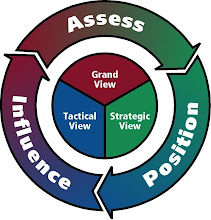
From our experience, we have seen a few people who can think, strategize and implement regardless of the technology, the distance and the grand settings. We referred to them as world class strategists.

These people can also stay focused on the current objective while minding the grand picture.
It is a rare skill. Does your team possess this set of skills?

Following are some of the other questions that we usually ask our clients:
  • How does your team look at your projects and plans?
  • Do they know what is the grand picture for your plan?
  • Can your team view your entire plan from a top down view?
  • Do they understand your plan from a "bottom up" perspective?
  • Can your team see the tactical specifics for each milestone?
  • Can your team see what is ahead after each completed milestone?
  • If a strategic change in one milestone occurs, can they also see the consequential strategic change from one milestone to the following milestones?
  • Regardless of the amount of critical information at your team's fingertips, do you sometimes feel that your team feel overwhelmed by an information overload that they are caught in a phase of paralysis by analysis?
  • Do you feel that your team is not receiving the quality information, that they cannot make a good decision?
Poor quality of information usually prevents one from gaining the strategic insight of the current situation.
  • How many times in your professional career, has your team been able to instinctively perform your projects without fear and uncertainty?
  • Has your team ever automatically connect the dots and reap the rewards?
Technology comes. Technology goes. It is just a tool that does specialized tasks. Nothing more. Nothing less.

To prevail in the global economy, one needs the dual skills of analyzing the information and connecting the dots.
  • Does your team possess that set of skills?
  • If they cannot effectively connect the dots, will they reap the rewards?
  • Is your team still able to effectively compete in spite of the situation?
If not, it is time for you and your team to reconsider the strategic process of seeing the grand picture.

Conclusively, it should always be the plan that runs the technology, not the other way around.
Do you have a process to build that specific plan?

If not, you should contact us at service[@tt]collaboration360[dott].com.

Collaboration360 Consultants (C360 Consultants). Copyright:2009 © All rights reserved. Copying, posting and reproduction in any form (without prior consent) is an infringement of copyright.

#


Beyond BlackBerry, high-tech execs shun gadgets
Fri May 22, 2009 4:13pm EDT

By Franklin Paul

NEW YORK (Reuters) - You'd think the leaders of the world's biggest and coolest tech companies would be total gadget freaks, 'tricorder'-carrying whiz kids sporting the latest doodads months before the masses.

Think again.

Top brass and chief thinkers from companies from Web upstart Twitter to "Big Blue" IBM told the Reuters Global Technology Summit that, when not developing "the next big thing," they turn to hobbies similar to that of non-geeks.

They read books and go fishing. Very un-Star Trek, eh?

"I'm not actually a gadget freak. And I'm not a computer freak. I'm a physicist," said Eli Harari, chief executive of SanDisk Inc, which makes those ubiquitous fingernail-sized digital memory cards and USB thumb drives.

"I love technology. But I don't like gadgets. I rarely use my notebook PC -- and I type with two fingers," he said.

Popular folklore and network TV, fuel a belief in a high-tech world of anti-social genius's like Sheldon from "The Big Bang Theory" or Jack Bauer of Fox's hit show "24", who have critical data at their fingertips via powerful gadgets.

But most of the summit guests admitted that the only super device they wield is a mobile phone -- Research in Motion's Blackberry or Apple Inc's iPhone -- with most saying they would suffer without them. ...

BOOKS OR KINDLES?
Technology executives said their busy lifestyles don't leave much time for dabbling with sophisticated devices that do not pertain to building their own businesses.

"I like to get away from electronics," said John Chen, CEO of business software provider of Sybase. "I have found that very constantly grinding (is) quite stressful."

Like many of his peers, Chen seeks respite in the printed word. But two camps are evolving, now that Amazon.com Inc's Kindle digital reader has captured the fancy of executives bored with sitting around airports.

"This morning I got on a plane to come down here," Corning Inc Chief Financial Officer Jim Flaws said. "I had checked to make sure it downloads the Wall Street Journal and The New York Times. I can read both of them on my BlackBerry, but it's a little easier to read on your Kindle, which is...bigger."

Venture capitalist Tim Draper, a man accustomed to writing million-dollar checks, said he was itching to buy a Kindle, but was too frugal to do it yet.

"I have a little bit of Kindle envy," he said. "I have a Sony Reader, and I have a whole bunch of books on it. I'm so cheap, I want to be sure I've read all of those books before I buy a Kindle."

Sybase's Chen, a self-described old-fashioned guy, says he will pass on Kindle. "If I get on a plane for a long ride, I read a book. I can't stand Kindle. It's not an Amazon issue -- I like the feel of a book."

The aversion to toting gadgets doesn't mean that tech leaders aren't wowed by their electronic abilities. Take, for example, one new take on an activity thousands of years old.

"The last thing I bought was a fish finder -- it's amazing technology," Ralph de la Vega, AT&T Inc's mobile chief, said of a device made by satellite navigation tool maker Garmin Ltd . "I don't know how people used to fish before -- you had to have a lot of stored knowledge."

"You can go to a place, scout it out and say 'I think there's fish over there!' Its such a better thing to do than just casting a fly, and you don't know where the fish are."

He pulls out his other favorite device -- an iPhone -- to show off a snapshot of his prized catch, a Bass. ...

(Reporting by Franklin Paul, editing by Tiffany Wu, Leslie Gevirtz)

http://www.reuters.com/article/GlobalTechnology09/idUSTRE54L63T20090522

Tuesday, May 19, 2009

The Dao of Strategic Assessment (20): Assessing a World Class Implementer


"When torrential water tosses boulders, it is because of momentum; When the strike of a hawk breaks the body of its prey, it is because of timing.Thus the momentum of one skilled in war is overwhelming, and his attack precisely regulated. His potential is that of a fully drawn crossbow; his timing, the release of the trigger. In the tumult and uproar the battle seems chaotic, but there is no disorder; the troops appear to be milling about in circles but cannot be defeated. An apparent confusion is a product of good order; apparent cowardice, of courage; apparent weakness, of strength. ..." - Sunzi 5


#
Learning from Sun Tzu's 'The Art of War'
Saturday, May 9, 2009
The China post news staff

Last Friday marked the latest in a string of naval confrontations between China and the U.S., when, according to the Pentagon, two ships from China's Bureau of Fisheries Patrol came "dangerously close" (within 27 meters) to the surveillance ship USNS Victorious operating in the Yellow Sea.

The patrol vessels used high-intensity spotlights on the Victorious multiple times. The crew on the Victorious responded by sounding its alarm and shooting water from fire hoses at the vessels. The hour-long standoff ended only after the Victorious radioed Chinese military vessels for help.

China holds the U.S. responsible for unauthorized entering of its exclusive economic zone (EEZ). Foreign Ministry spokesman Ma Zhaoxu characterized the incidence as a violation of international and Chinese laws by the U.S. and required the U.S. to take effective measures to prevent a similar incident from happening again.

The U.S., on the other hand, was silent on the confrontation, which is the fourth in the past month alone. The standoff was missing in a White House statement on the conversation between U.S. President Barack Obama and Chinese President Hu Jintao.

The recent showdowns between the so-called G-2 nations are seen as indicators of China's increasing confidence in its naval might and Washington's reluctance to escalate situations in a time when it needs Beijing on broad to tackle issues such as the financial crisis, global warming, and North Korea's arms race.

The unprecedented display of maritime armory on the 60th anniversary of the People's Liberation Army Navy (PLAN) on April 23 was a far cry from the celebration a decade ago, which was, as the Economist put it, "a little more than a few commemorative stamps and plenty of bunting."

Not so this year. In a bit of chest pounding, China showcased two nuclear-powered submarines for the first time.

While China's naval power is still far behind that of the U.S., China's recent clashes with the U.S. are more than simple calls for attention, and should be regarded with caution.

Since the humiliation of seeing the U.S. aircraft carrier Nimitz enter the Taiwan Strait following the 1995-6 missile crisis, China has been eager to deny the U.S. unrestricted access to where it considers its own backyard.

Andrew F. Krepinevich, a military consultant and an expert future strategist, argued that China is not looking for a head-on ocean head bunt with the U.S., but to develop a military strategy that enables the weak to defeat the strong. He called the strategy "shashoujian" (the assassin's mace), a combination of Western technology and Eastern wisdom to create surprise, break the U.S. military's communication network, and launch preemptive attacks "to the point where such attacks, or even the threat of such attacks, would raise the costs of U.S. action to prohibitive levels."

In other words, Beijing opted not to overpower the U.S. Navy, but to obtain the capability of area denial. By showcasing its nuclear submarines and its growing confidence in the seas, Beijing had averted the U.S.' attention out of East Asia, which is in line with the oldest of Chinese military wisdoms, Sun Tzu's Art of War: "When your opponent is in superior strength, evade it."

Other shashoujians such as China's ability to smash orbiting satellites and its cyber-warfare capability (though Beijing denies its development of such technologies) are all aimed at disrupting U.S. military communications and making it difficult to coordinate an operation in East Asia.


/// A good strategist always out-positions his competitor’s advantage through the use of solid planning and preparation. Once a leverage was gained, he has the option of eradicating the competition.

For now, China's strategy seems to be working. Facing a global financial crisis and two ongoing wars in Iraq and Afghanistan, the U.S. is inclined to see China more as a partner than a competitor. Such a situation could post a great challenge for Taiwan.

/// When the resources of the favored is spread thinly, their best survival option is to establish alliances not opposition.

While Beijing and Taipei seem to be on their way to diplomatic detente, the option of attacking the island by force has never left the table. Even best friends fight sometimes, so while the people of Taiwan should hope for improving relations, they should not leave their fate to the mercy of a heavily-armed big brother.

The long term survival of the ROC should not be assumed, but earned. Taiwan's military should learn from China and develop its own area-denial capabilities to prepare for the unthinkable.

These include capabilities to create surprise and opportunities, such as better intelligences and cyber-warfare. After all, one of the best ways to maintain peace and promote camaraderie among friends, ironically, is to make dispute an ugly option.

Copyright © 1999 2009 The China Post.


http://www.chinapost.com.tw/editorial/world-issues/2009/05/09/207390/Learning-from.htm

Friday, May 15, 2009

The Dao of Strategic Assessment (19): Assess, Position and Profit


"The Book of Military Administration says: 'As the voice cannot be heard in battle, drums and bells are used. As troops cannot see each other clearly in battle, flags and banners are used. ... Now gongs and drums, banners and flags are used to focus the attention of the troops. When the troops can be thus united, the brave cannot advance alone, nor can the cowardly withdraw. This is the art of employing a host. ... In night fighting use many torches and drums, in day fighting many banners and flags in order to influence the sight and hearing of our troops. ..." - Sunzi Chapter Seven: Maneuver (Griffith translation)

The Ownthezonesports.com guys are quite brilliant. They saw the possible market need, conceived a very simple concept, used Window Excel as their platform and wrote some VBA code. Bang! They became a niche marketing success. Conclusively, necessity is the mother of invention.

#
Baseball
Signs of the times

A growing number of college, high school teams are switching the way they signal their plays

Tom FitzGerald, Chronicle Staff Writer Friday, May 15, 2009 (05-14) 21:34 PDT --

It's as much a part of baseball as razzing the umpire. The third base coach conveys a play to the hitter and base-runner by touching something - his nose, his cap, his left arm, his right arm, his chest, his buckle, anything you can touch without, well, being obscene. To the uninitiated, it looks like a series of tics in search of medication.

Yet, somewhere in that sequence, there's a sign that the steal is on, or the bunt, or the hit-and-run, or most likely nothing at all. One of the gestures is usually the "indicator," and the next sign is the one that means something.

Newspaper accounts trace the origin of hand signals to one of big-league baseball's only deaf superstars, outfielder William Ellsworth "Dummy" Hoy, in the 1880s. Ever since then, signs have been given, and signs have been stolen. That's a part of baseball tradition too. Cal is among a growing number of college teams that have switched to a different system that uses numbers rather than hand gestures. If you go to a baseball game in Berkeley, a bingo game might break out.

Head coach David Esquer, in the first-base box, is giving the signs with his fingers after looking at his master chart. Three-one-fist (for zero) before one pitch. Three-two-one on the next. The batter and runner each check the numbers on a chart wedged in their plastic wrist band. Don't bother trying to decipher the code. All the numbers come out of a computer program, and there may be 25 three-digit combinations (out of 200) that mean steal.

Unless you have a telephoto lens like a newspaper photographer to give you a close-up look at a wristband, the system is pick-proof. "You see quarterbacks in the NFL having to go to their wrist bands, and they're running multimillion-dollar offenses,"

Esquer said. "I figure we can run some baseball plays on the wrist as well." Is there any downside to the numbers system? "The cards slide in and out a little, so you have to adjust them now and then," said first baseman Mark Canha, Cal's leading hitter at .356. "That's about as bad as it gets. It's a system where you can't miss any signs really." "You don't have to worry about picking up certain indicators, so it's pretty simple," said second baseman Jeff Kobernus, a .351 hitter. "It slows down the game a little bit because (Esquer) has to give it to both the runner and the batter. Sometimes people in the stands will (mockingly) ask, 'What was that number again?' " Nearly 100 college teams are using the system, and many high school teams are jumping on board, too.

Some teams use it just for conveying pitch signals to their catchers, who consult their wristbands and then use traditional finger signals to the pitchers. Pitchers are prohibited from using wristbands because they could be distracting to batters.

The system was dreamed up at the College of Southern Idaho in 2004 by coach Boomer Walker and pitching coach David Carter, who wanted a foolproof system of pitch signals. The coach would call out the numbers or flash them with his fingers. The catcher would find the first two digits on the top of his chart and go down to the intersecting point with the third digit. The sign might be for a changeup outside, or a curve inside, or a fastball in the dirt. The system turned out to be easily adaptable to other aspects of the game.

Teams that use both offensive and defensive cards simply flip them over each half inning.Some coaches made up their own spreadsheet files.

A couple of former Western Oregon University players, Liam Woodard, 30, and Bryce Gardinier, 28, have turned the system into a cottage industry, tailoring the system to specific teams and even specific pitchers. Gardinier wrote a computer program, and Woodard set up a Web site, ownthezonesports.com. They peddle the system for $249.99. If you want 25 wristbands, it's $400. A coach can shuffle the numbers before every game. "It's been fun for us to have our own piece of baseball," Woodard said.

Cal's Esquer was one of their first customers, and he has passed it on to local high school coaches, like Max Luckhurst of Campolindo-Moraga and Chris Declercq of San Ramon Valley-Danville. Both of them swear by it. "I've made one mistake, and (the players) have made one mistake," Luckhurst said. "It's pick-proof but not fool-proof. There's room to read the chart incorrectly. But it speeds things up. It's a lot faster than going through a full sign sequence."

His players had to pass a classroom test on using the chart before they could get their uniforms. Nothing less than a perfect score would do.

According to Declercq, "If they're using it at the Division I level, with guys so crazy about stealing signs, it will work for us." He said his players missed an average of two signs a game last year under the old system.

In planning, no useless move. In strategy, no step is in vain. - Chen Hao

With the new system, he said, they haven't missed any. How vulnerable is the traditional system? "I've got a kid who's smart," Declercq said, "and the other day he had the other team's pitch signals by the second inning." Not everybody is convinced the numbers system speeds up the game. City College of San Francisco and San Francisco State use it only for pitch signals.

On offense, CCSF coach John Vanoncini said, "I think it slows the play down, and umpires now are concerned about the pace of play." SF State coach Tony Dress said, "I'm old school. My signs are not scientific, but they're not easy to pick." The most hide-bound traditionalists aren't about to jump on the numbers bandwagon.

"One of the problems in college baseball is there's too many signs being given," said a pro scout who asked not to be identified. "This system makes it easier to give signs all the time. You see a coach giving signs when it's 0-and-2 and nobody on. There is much more pressure on these college coaches to win now that they feel they have to take control of everything."

The scout doubts you'll ever see the numbers system in the major leagues. "A big leaguer wouldn't wear the wristband," he said. Cal's Esquer admits the numbers aren't for everyone. "I'm the first to admit it," he said. "It's not traditional baseball. It was hard for me. But I hate missing signs more than I have to look traditional."

E-mail Tom FitzGerald at tfitzgerald@sfchronicle.com.

This article appeared on page D - 1 of the San Francisco Chronicle

http://www.sfgate.com/cgi-bin/article.cgi?f=/c/a/2009/05/14/SPPI17KL7Q.DTL

Wednesday, May 13, 2009

The Dao of Strategic Assessment (18): Assessing from the Field Level


Regardless of the situation, always maintain a state of assessment. Ms. Rousso's process of assessing the competitor is simple but efficient for the Poker game.

#

Vanessa Rousso Teaches the Art of Poker

LP: Whose idea was it to incorporate the principles from Sun Tzu’s book “The Art of War” into the curriculum?

VR: Oh yeah, that’s me; that’s typical me. I’m obsessed with the Art of War and Sun Tzu. It goes along with the whole idea of game theory and all that. I’m a big strategy buff. I’ve always loved riddles and puzzles and anything where you use logic and figure out the optimal play. The strategies that Sun Tzu espouses I find it to be so amazing because although it was written so long ago, his advice is really timeless and boundless. It’s extended for hundreds of years in truthfulness and beyond just war obviously. All of his points can be analogized to business and obviously to poker. It was a way to make the content a little more unique from other boot camps that are out there. So I wrote the curriculum based on that and based on the many times that I’ve read Sun Tzu, and I hope people like it. The game theory stuff I’ve taught a lot over the last few years and I just added the Art of War stuff to it. So it will be the first time I teach it on April 5th.

LP: I think people are going to love it. Which bit of the Art of War do you think best applies to the game of poker?

VR: There is none that is “best”. There are a couple tenants that I have centered my presentation around that I find are really germane to poker. Those are probably the parts where he talks about, and I’m not sure if I’m getting the quote exactly right, but something to the extent of “he who makes no calculation will never be victorious; he who sometimes makes calculations will sometimes find victory, and only those that make many calculations will find victory often.”

Then he goes on to break down the factors that are involved in calculations, such as measurement, calculations, quantity, comparison, and then victory. Those all analogize to poker really well.

First you need to measure and figure out what’s my chip stack? What are the blinds? How much does it cost a round? How many chips do my opponents have at the table? You need to measure and size up your opponent.

Then you, of course, calculate. You calculate your pot odds, you calculate your average chip stack and how you are, relative to that. You calculate your average chip stack at the next level; calculate how much time is left in the level, and what sort of shape you will be in at the next level, and then so on and so forth.

Then you compare your different alternatives and choose the best one. If you do analysis like that, you will be victorious far more often than if you ignore the calculations that are necessary in poker.

That’s pretty much what forms the framework of how I use the Art of War in my presentation. Also there is a big chunk of it on “know thyself” and also “know thy opponent.” I tie that into my game theory information acquisition chapter, which I have taught at a ton of boot camps before. So Sun Tzu ties in well there as well.

http://www.launchpoker.com/wsop/vanessa-rousso-teaches-the-art-of-poker/