Monday, March 2, 2009

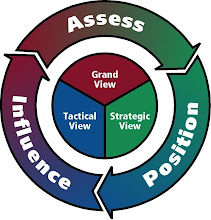
The Dao of Strategic Assessment (5): Same Information, Different Assessment, Different Outcome


PepsiCo Americas Beverages division failed to assessed their competitive positioning before releasing their new packaging. Think of the time and money wasted in the planning and preparation.

During the assessment, their marketing ppl compared and contrast the data but failed to ask the right questions. They became too focused on the positives and not on the negatives.

This limited way of assessing happens all the time. It helps to have the right strategic assessment process.

#
February 23, 2009 Advertising
Tropicana Discovers Some Buyers Are Passionate About Packaging
By STUART ELLIOTT
IT took 24 years, but PepsiCo now has its own version of New Coke. The PepsiCo Americas Beverages division of PepsiCo is bowing to public demand and scrapping the changes made to a flagship product, Tropicana Pure Premium orange juice.

Redesigned packaging that was introduced in early January is being discontinued, executives plan to announce on Monday, and the previous version will be brought back in the next month.

Also returning will be the longtime Tropicana brand symbol, an orange from which a straw protrudes. The symbol, meant to evoke fresh taste, had been supplanted on the new packages by a glass of orange juice. The about-face comes after consumers complained about the makeover in letters, e-mail messages and telephone calls and clamored for a return of the original look.


Some of those commenting described the new packaging as ugly or stupid, and resembling a generic bargain brand or a store brand. Do any of these package-design people actually shop for orange juice? the writer of one e-mail message asked rhetorically. Because I do, and the new cartons stink. Others described the redesign as making it more difficult to distinguish among the varieties of Tropicana or differentiate Tropicana from other orange juices. Such attention is becoming increasingly common as interactive technologies enable consumers to rapidly convey opinions to marketers.

You used to wait to go to the water cooler or a cocktail party to talk over something, said Richard Laermer, chief executive at RLM Public Relations in New York. Now, every minute is a cocktail party, he added. You write an e-mail and in an hour, you’ve got a fan base agreeing with you.

That ability to share brickbats or bouquets with other consumers is important because it facilitates the formation of ad hoc groups, more likely to be listened to than individuals.


There will always be people complaining, and always be people complaining about the complainers, said Peter Shankman, a public relations executive who specializes in social media. But this makes it easier to put us together.


The phenomenon was on display last week when users of Facebook complained about changes to the Web site’s terms of service using methods that included, yes, groups on facebook.com. Facebook yielded to the protests and reverted to its original contract with users.
And in November, many consumers who used Twitter to criticize an ad for Motrin pain reliever received responses within 48 hours from the brand’s maker, a unit of Johnson & Johnson, which apologized for the ad and told them it had been withdrawn.

Twitter is the ultimate focus group, Mr. Shankman said. I can post something and in a minute get feedback from 700 people around the world, giving me their real opinions. Neil Campbell, president at Tropicana North America in Chicago, part of PepsiCo Americas Beverages, acknowledged that consumers can communicate with marketers more readily and more quickly than ever.

For companies that put consumers at the center of what they do, he said, it’s a good thing.
It was not the volume of the outcries that led to the corporate change of heart, Mr. Campbell said, because it was a fraction of a percent of the people who buy the product. Rather, the criticism is being heeded because it came, Mr. Campbell said in a telephone interview on Friday, from some of our most loyal consumers.

We underestimated the deep emotional bond they had with the original packaging, he added. Those consumers are very important to us, so we responded. Among those who underestimated that bond was Mr. Campbell himself. In an interview last month to discuss the new packaging, he said, The straw and orange have been there for a long time, but people have not necessarily had a huge connection to them.

Reminded of that on Friday, Mr. Campbell said: What we didn’t get was the passion this very loyal small group of consumers have. That wasn’t something that came out in the research. That echoed an explanation offered in 1985 by executives of the Coca-Cola Company in response to the avalanche of complaints when they replaced the original version of Coca-Cola with New Coke: Consumers in focus groups liked the taste of New Coke, but were not told old Coke would disappear. The original version was hastily brought back as Coca-Cola Classic and New Coke eventually fizzed out. (There are, it should be noted, significant differences between the two corporate flip-flops.

For instance, the Tropicana changes involved only packaging, not the formula for or taste of the beverage.)
An ad campaign for Tropicana that helped herald the redesigned cartons, also introduced last month, will continue to run, Mr. Campbell said. Print and outdoor ads that have already appeared will not be changed, he added, but future elements of the campaign — like commercials, due in March — would be updated. Unlike the packaging, the campaign has drawn praise, particularly for including in its family imagery several photographs of fathers and children hugging. Such dad-centric images are rare in food ads.

The campaign, which carries the theme Squeeze it’s a natural, was created by Arnell in New York, part of the Omnicom Group. Arnell also created the new version of the Tropicana packaging.


Tropicana is doing exactly what they should be doing, Peter Arnell, chairman and chief creative officer at Arnell, said in a separate telephone interview on Friday. I’m incredibly surprised by the reaction, he added, referring to the complaints about his agency’s design work, but I’m glad Tropicana is getting this kind of attention. In fact, Tropicana plans to contact everyone who called or wrote us to express opinions, Mr. Campbell said, and explain to them we’re making the change.

Tropicana is among several PepsiCo brands whose packaging and logos have been recently redesigned by Arnell. The new logo the agency produced for Pepsi-Cola has been the subject of comments by ad bloggers who perceive a resemblance to the logo for the Barack Obama presidential campaign.
The bloggers have also buzzed about a document outlining the creation of the Pepsi-Cola logo, which appears to have been written by Arnell for PepsiCo executives; Mr. Arnell has declined to comment on the authenticity of the document, which is titled Breathtaking Design Strategy and is written in grandiose language.

One aspect of the new Tropicana packaging is being salvaged: plastic caps for the cartons, also designed by Arnell, that are shaped and colored like oranges. Those caps will be used, Mr. Campbell said, for cartons of Trop 50, a variety of Tropicana with less sugar and calories that is to be introduced soon. During the interview last month, Mr. Campbell said that Tropicana would spend more than $35 million on the Squeeze campaign. Although he declined on Friday to discuss how much it would cost to scrap the new packaging and bring back the previous design, he said the amount isn’t significant.

Asked if he was chagrined that consumers rejected the changes he believed they wanted, Mr. Campbell replied: I feel it’s the right thing to do, to innovate as a company. I wouldn’t want to stop innovating as a result of this. At the same time, if consumers are speaking, you have to listen.


Copyright 2009 The New York Times Company

http://www.nytimes.com/2009/02/23/business/media/23adcol.html

Sunday, March 1, 2009

Protect Your Competitive Advantage!


To thrive in this global economy, one focuses on maintaining and enhancing their "competitive advantage incrementally."

Following are the two questions that you should ask yourself:
  • "What is your competitive advantage!?"
  • "How are you protecting it?"

Jiang Tai Gong book "Six Secret Teachings" emphasizes "the importance of protecting one's advantage."

King Wen asked Tai Gong:"How does one preserve the state's territory?"

Tai Gong said: "Do not estrange your relatives. Do not neglect the masses. Be concillatory and solicitous towards nearby states and control all that is under you. Do not loan the authority of state to other men. If you loan the authority of state to other men, then you will lose your authority. Do not hurt those of lower position to benefit those of higher position. Do not abandon the fundamental to save those that are inconsequential.

When the sun is at midday, you should dry things. If you grasp a knife, you must cut. If you hold an axe, you must attack."


"If at the height of the day, you do not dry things in the sun, this is termed losing the opportunity.

If you grasp a knife but do not cut anything, you will lose the moment for profits. If you hold an axe and do not attack, enemies will attack instead."

"If trickling streams are not blocked, they will become great rivers. If you do not extinguish the smallest flames, there is nothing much you can do when it turns into great flames.

If you do not eliminate the two-leaf sapling, you might have to use the axe to remove it in future."
"For this reason, the ruler must focus on developing wealth within his state. Without material wealth, he has nothing with which to spread beneficence or to bring his relatives together.

If he estranges his relatives it will be harmful. If he loses the common people, he will be defeated. "

"Do not loan sharp weapons to other men. If you loan sharp weapons to other men, you will be hurt by them and will not live out your allotted span of years."

King Wen said:"What do you mean by benevolence and righteousness?"

Tai Gong replied: "Respect the common people, unite your relatives. If you respect the common people, they will be in harmony. And if you unite your relatives, they will be happy.

This is the way to implement the essential cords of benevolence and righteousness."
"Do not allow other men to snatch away your awesomeness.

Rely on your wisdom, follow the norm. Those that submit and accord with you, treat them generously and virtuously. Those that oppose you, break with force. If you respect the people and trust, the state will be peaceful and populace submissive."

- T’ai Kung Liu-t’ao (Six Secret Teachings)

More on this topic can be found in Dr. Ralph Sawyer's Seven Military Classics of Ancient China.

#

When a business component is no longer cost effective and significant to the greater part of the system, there is a strong possibility that it will be outsourced.


August 12, 2008
Cost-Cutting in New York and London, a Boom in India
By HEATHER TIMMONS

GURGAON, India On the top floor of a seven-story building in this dusty aspiring metropolis, Copal Partners churns out equity, fixed income and trading research for big name analysts and banks. It is a long way from the well-cooled corridors of Wall Street, and quarters are tight; business is up about 40 percent this year alone.

"This is one bulge-bracket bank," said Joel Perlman, president of Copal, pointing toward a team behind an opaque glass wall. "And this," he said, motioning across a narrow corridor "is another."

The banks edit and add to what they get from Copal, a research provider, then repackage the information under their own names as research reports, pitch books and trading recommendations.

Wall Street's losses are fast becoming India's gain. After outsourcing much of their back-office work to India, banks are now exporting data-intensive jobs from higher up the food chain to cities that cost less than New York, London and Hong Kong, either at their own offices or to third parties.

Bank executives call this shift "knowledge process outsourcing," "off-shoring" or "high-value outsourcing." It is affecting just about everyone, including Goldman Sachs, Morgan Stanley, JPMorgan, Credit Suisse and Citibank to name a few.

The jobs most affected so far are those with grueling hours, traditionally done by fresh-faced business school graduates research associates and junior bankers on deal-making teams paid in the low to mid six figures.

Cost-cutting in New York and London has already been brutal thus far this year, and there is more to come in the next few months. New York City financial firms expect to hand out some $18 billion less in pay and benefits this year than 2007, the largest one-year drop ever. Overall, United States banks will cut a total of 200,000 employees by 2009, the banking consultancy Celent said in April.

The work these bankers were doing is not necessarily going away, though. Instead, jobs are popping up in places like India and Eastern Europe, often where healthier local markets exist.

In addition to moving some lower-level banking and research positions to support bankers and analysts in New York and London, firms are shipping some of their top bankers from those cities to faster-growing developing markets to handle clients there.

Owing in part to credit weaknesses and billion-dollar charges from the subprime crisis, "people who were off-shoring high value jobs are increasing the intensity of that, and people who were not are now in the planning stage," said Andrew Power, a financial services partner at Deloitte Consulting.

Wall Street banks started cautiously sending research jobs to India a few years ago, hiring employees by the handful and running pilot programs with firms like Copal, Office Tiger, Pipal Research and Tata Consultancy Services.

In 2003, JPMorgan and Morgan Stanley said they planned to move a few dozen research jobs to Mumbai, Lehman Brothers was working on a pilot program to create research presentations in India and both Merrill Lynch and Goldman Sachs said they had not moved any research to the country.

Five years later, the trickle is a flood. Third-party firms say they are seeing a 20 to 40 percent upswing in business this year alone.

Morgan Stanley has about 500 people employed in India doing research and statistical analysis. About 100 of Goldman Sachs' 3,000 employees in Bangalore are working on investment research.

JPMorgan has 200 analysts in Mumbai working for its investment banking operations around the world, doing industry analysis, and compiling data and charts for marketing materials. It has an additional 125 analysts in Mumbai supporting the bank's global research division.

Citigroup employs about 22,000 people in India, several hundred of whom work in investment research. Deutsche Bank has 6,000 employees in India, according to the bank's Web site. Deutsche started a pilot program to outsource some research in 2003, and would not provide any update.

Theoretically, as much as 40 percent of the research-related jobs on Wall Street, tens of thousands of jobs, could be sent off-shore, said Deloitte's Mr. Power, though the reality will be less than that.

The jobs off-shore are more likely to come from the investment bank and trading divisions of Wall Street firms, rather than the sales side, which produces analyst reports about companies and industries, said Andy Kessler, a former analyst who has written several books about Wall Street.

"There's a huge amount of grunt work that has been done by $250,000-a-year Wharton M.B.A.'s," Mr. Kessler said. "Some of that stuff, it's natural to outsource it."

He added, "These are middle of the office jobs, not back office, but they're not the people on the front line."

After research, the next wave may include more sophisticated jobs like the creation of derivative products, quantitative trading models and even sales jobs from the trading floors.

Proponents of the change say Wall Street's wary embrace of the activity may signal the beginning of a profound shift in the way investment banks are structured, with everyone but the top deal makers, client representatives and the bank management permanently relocated to cheaper locales like India, the Philippines and Eastern Europe.

In the future, executives in India like to joke, the only function for highly paid bankers in New York or London will be to greet clients and shake hands when the deals close.

"Wall Street has to look at the world differently," said Manoj Jain, the chairman of Pipal Research, a 400-person firm with offices in Chicago, Delhi and Gurgaon. Moving high-value jobs out of high-cost cities is "no longer a hypothesis," he said.

Pipal has "more work than it can take" right now, he said, and is seeing new clients beyond United States banks, like investment management companies and European financial firms. Like analysts at most offshore research operations, Pipal's number crunchers do not make recommendations, or generally put their name to the research they write. Instead, they work with the big-name bank or fund analyst to create the research that they want.

Permanently moving banking jobs out of New York or London is a touchy subject on Wall Street. Many investment banks, including Morgan Stanley, Goldman Sachs, Merrill Lynch and Citigroup, would not make executives available to discuss the topic.

Press officers for most banks asked not to be quoted or argued over semantics. For example, one spokesman said his bank's fast-growing India support operations are not an outsourcing facility, but a "center of excellence"; another argued that large cost cuts at his bank's New York and London headquarters were really "re-engineering" so the bank should not be included in such an article.

"Some of that is self-serving," Octavio Marenzi, chief executive of Celent, said of the impulse to keep quiet. "If I admit that research analysts can be off-shored to India, that means that I could too."

He said the "more advanced firms" will be able to use the cost differences and talent pools in India, and in the future in China, to their advantage.

A few banks have openly embraced off-shoring. Credit Suisse has 6,500 employees around the world working in lower-cost locations in India, Poland and Singapore. Of these about 500 are doing high-value jobs.

"We have people helping the execution of deals, data gathering, helping to build financial models, writing research, and doing scenario analysis," said Vineet Nagrani, head of knowledge process outsourcing at the bank.

The bank has small teams working on fixed-income research, credit research and foreign exchange research, "all of which are going to grow" Mr. Nagrani said. Credit Suisse is also doubling the number of investment bankers and private bankers in India who deal with local clients in the next 12 months.

The bank's clients, so far, seem happy. "As long as clients get a good quality product and can talk to their favorite research analyst" they do not care if the grunt work is done in New York or India, Mr. Power said.

Third-party outsourcing firms face two hurdles when winning this business, N. Chandrasekaran, chief operating officer of Tata Consultancy Services, said. First, banks need to be confident that third parties are capable of doing the work. Second, they need to decide whether they want to move the work out of the bank at all.

To address the first issue, Tata sets up pilot programs with clients. A new Tata office in Cincinnati, which will employ 1,000 people in three years, is intended to give the company a United States presence.

In addition to growth outside India, these outsourcing experts are bringing in Chinese nationals, Arabic speakers and even the very people they are replacing: business school graduates from America.

Daniel Peng, who will be a senior at Dartmouth next year, is working in the equity research department of Copal Partners as a summer intern. "I thought it would be a good emerging markets experience," he said.

Tellingly, Mr. Peng still hopes for an old-fashioned Wall Street job when he graduates. New York would be "ideal," he said.

Copyright 2008 The New York Times Company

http://www.nytimes.com/2008/08/12/business/worldbusiness/12indiawall.html?

Saturday, February 28, 2009

Transforming Crisis Into Opportunities (2)

A continuation of an earlier thread (Assess, Position and Implement).


The key to transforming crisis (or chaos) into opportunity is to have the advantage of time and resources. Focus on detailed assessment, specific planning and solid preparation. The key is to maximize one's opportunities by establishing a Compass strategy (a Tangible Vision) that delineates your strategic overview. The strategic overview should be an organized set of priorities, approaches and circumstance that you can operate from.

When negotiating with an opposing party, assess the competitive position of each side. Then, determine who has the advantage of time and resources. Do not rush into the situation. Properly build a detailed plan based on assessed data. The greater your advantage of time and resources is, the greater your leverage becomes. Always assess the targeted party with a prepared strategic plan.

From the framework of 36 Stratagems

Loot a burning house ( 趁火打劫; Chèn huǒ dǎ jié)

When an organization is affected by an incremental streak of internal conflicts, then it will be unable to deal with an outside threat. This is the time to seize the opportunity to reap the rewards. Maintain the gathering of internal information about the strategic position of the opposing party. If he/she is currently in its weakest state ever, pursue it without any emotion. Maximize the opportunity to the fullest.

Watch the fires burning across the river ( 隔岸觀火; Gé àn guān huǒ)

Maintain the gathering of internal information on the position of the competitor. When the competitor is at its weakest, seize the opportunity without any emotions.

Delay the entering of the competition arena until all the other players are exhausted from their own internal conflict. Then go in at full strength and pick up the pieces.

Implement this "Opportunistic Stratagem" in situations where vulnerabilities can be exploited. As one capitalizes on all opportunities, the advantage continuously grow.

Collaboration360 Consultants (C360). Copyright:2009 © All rights reserved
Copying, posting and reproduction in any form (without prior consent) is an infringement of copyright.

#

Moneyed Chinese come house hunting
Andrew S. Ross Tuesday, February 24, 2009

Cash-rich Chinese coming to do some house hunting

Call it a bailout from the East. Approximately 40 Chinese real estate investors are winging their way from Beijing today looking to snap up foreclosed and otherwise "distressed" properties in the Bay Area and California. The trip, put together by Beijing real estate portal SouFun Holdings Ltd. and Fortune Group Realty Co. in Pittsburgh, is one of several such Chinese house hunting groups to visit the U.S. periodically. But the timing of this one appears to be particularly fortuitous, on both sides of the Pacific. "It's good for Chinese investors who see lots of opportunities," said Fortune Group vice-president Andrew Hang Chen. "It's also good for the American economy, at least on a small scale."

Homes, apartment buildings and other commercial property in the region are on the shopping list. First stop on the 10-day trip is Los Angeles, followed by the Bay Area, then to Las Vegas. Apparently, the group won't have to worry about mortgages and such. "They have cash, believe me," said Chen.

http://www.sfgate.com/cgi-bin/article.cgi?f=/c/a/2009/02/24/BUUE1631TP.DTL&type=realestate

Wednesday, February 25, 2009

The Dao of Strategic Assessment (4)


Modern football is a competitive area where information on each competitor is available. Having the skill to assess the reality from the deception is the key.

Below this note is an article that displays a different way of assessing a strategic transition game that is limited by time.


[ "I get paid to get into a rhythm with the guy calling the defense" on the other side. When a coach achieves the right "rhythm," he can sense what his opponent is thinking—and for Reid, grasping the "rhythm" of the classic game was fairly easy. "I can see what the offense is doing," he said. "You can almost call it offensively and defensively." ]

#

October 2008

How the greatest game in football history looks 50 years later, through the eyes of a modern NFL head coach

by Mark Bowden

Distant Replay

Illustration by Sean McCabe

Watching game film with Andy Reid, head coach of the Philadelphia Eagles, can make you woozy. He lounges behind the wide desk in his office, feet up, using a wireless control to freeze the image of a play on a screen at the opposite end of the room, and then starts rolling it forward and backward, forward and back, first the whole play and then only portions of it, forward and back, forward and back, until he has pieced all the moving parts together.

Also see:

Interviews: Football's Founding Fathers

(September 19, 2008)
Mark Bowden discusses the legendary Giants-Colts game of 1958 and reflects on how the sport and its players have changed in the past half century.

Reid is a very big man, a former collegiate offensive lineman, and when I met him last spring, he was in full off-season mode: tan, relaxed, and draped in a colorful Hawaiian silk shirt large enough to display the entire Amazon rain forest. Reid was coming off another winning year—the Eagles had made it to the second round of the postseason playoffs just months earlier—and he was already well into his preparations for the next season. Pro football is a year-round occupation these days, so he was doing me a favor by agreeing to help me with research for my book, The Best Game Ever, an account of the celebrated 1958 NFL championship game between the Baltimore Colts and the New York Giants.

I've written about football in the past, but I am by no means an expert, so I had gone looking for a pro coach to help me break down film of the famous game. I live just outside Philadelphia and once covered the Eagles for the local newspaper, so I phoned Derek Boyko, the team's affable public-relations director. Boyko warned me that the club's assistant coaches were probably too busy, but he nevertheless agreed to ask around. He called back to say that all of the coaches, curious about the way the game was played before most of them were born, had expressed an interest. "But they need permission from Andy," he said. "I'll ask him when he comes back from leave in a few weeks."

Boyko called me weeks later to say, "Andy wants to do it."

It seemed odd at first for a pro coach to have never seen film of this historic game—a little like finding a doctor of English literature who had never read Macbeth. But success in pro football, as in any intensely competitive, constantly evolving arena, depends primarily on current intelligence: What did my opponent last do against me? What did he do last week? A pro coach is not inclined to search for what he needs in old black-and-white film. History is … well, history.

But no craftsman or professional can be completely uninterested in seeing how he measures up against past standards of excellence. How good was the game then? How capable were the players? How clever were the coaches and schemes?

The game in question defined excellence for an era. It pitted the best defense in the NFL, the Giants, against the best offense, the Colts, playing for all the marbles. It featured 17 future NFL Hall of Fame players, coaches, and owners. On the field were great athletes like Johnny Unitas, Raymond Berry, Lenny Moore, Gino Marchetti, Frank Gifford, Andy Robustelli, Emlen Tunnell, Rosey Grier, and Sam Huff. Coaching on the sidelines were Vince Lombardi and Tom Landry for the Giants, and for the Colts, Weeb Ewbank, the only pro coach who ever took teams from two different leagues (the NFL and the AFL) to national championships.

Reid was born in the year this game was played, and one reason he had never seen it is that the TV broadcast has been lost. But for serious study, I had wrested something even better from the archives of NFL Films: the grainy, monochrome "coaches' film" of the game, soundless footage shot from the sidelines high over midfield, with all the time-outs, huddles, and game breaks edited out.

Instant analysis envelops pro football like a cloud, but with most plays there is no way to tell what really happened and why without a careful, slow-motion dissection of the film. Reid is one of this craft's most successful practitioners. Even among pro coaches, he is notable for toting thick binders filled with notes and plans, and for fielding highly complex systems on both sides of the ball. Earlier in his career, he was quarterbacks coach for the Green Bay Packers, grooming Brett Favre and helping that team to a Super Bowl championship in 1997. His tenure in Philadelphia has been the most successful of any coach's in the team's long history: starting in 2001, he led the Eagles to four consecutive National Football Conference championship games and a Super Bowl—although, much to the consternation of long-suffering Eagles fans, he has yet to bring the Lombardi Trophy home to Philadelphia.

We watched the game in his office in the Eagles' training complex, just a few blocks from Lincoln Financial Field, where they play. When I covered the team in the early 1990s, the Eagles' offices, locker room, and workout facilities were housed in a few cramped, dark, damp rooms in the basement of the now-demolished Veterans Stadium. Today the team, whose worth is estimated at more than $1 billion, is housed at a state-of-the-art facility that sprawls over an area as large as a college campus.

"Okay," he'd say, when he had examined a play from snap to tackle, "here's what happened." Then out would pour a detailed explication: what the offense was trying to do, how the defense was trying to stop it, the techniques (good and bad) of the various key players, the historical roots of the formations and the play's design, and ultimately why it worked or failed, and who was responsible, either way. The wealth of information Reid gleaned from a single play reminded me of the way Patrick O'Brian's 19th-century naval hero, Jack Aubrey, eyeballing an enemy ship during a sea chase, could read from the play of its sails and the disposition of its crew the experience, intentions, strengths, and weaknesses of his opponent.

Reid's insight told on the first offensive play of the game. Colts coach Weeb Ewbank had designed a trick play, so secret that in his pregame meeting with his team in the visiting locker room at Yankee Stadium, he had mouthed the play call to them, fearful that the room was bugged. Observing the opening formation, Reid noted with surprise that all but one of the Colts linemen were positioned to the left of center Buzz Nutter. "This is a completely unbalanced formation," he told me. "You can't even do that today." The rules would no longer permit it: "You have to have some guys on the line of scrimmage." In the backfield, fullback Alan "The Horse" Ameche, a Heisman Trophy winner at the University of Wisconsin, was lined up behind quarterback Johnny Unitas; right halfback Lenny Moore was three steps to Ameche's right; and left halfback L. G. Dupre was split far out to the left side of the backfield.

Unitas didn't give the Giants a chance to set up in a recognizable defensive formation, even if they had one for such a bizarre look. He bent over, and Nutter immediately snapped the ball. Moore took the handoff—and was tackled for a loss.

"So they came out with a trick play in mind, and it really wasn't all that good," Reid said, chuckling. The main reason the play failed, he pointed out, was a missed block by Dupre, a speedy back whose initials, which stood for Louis George, had earned him the nickname "Long Gone." While Moore took the handoff from Unitas and followed Ameche around the left side of the Colts line, Dupre's job was to race forward and hit Harland Svare, the Giants' right-side linebacker, taking him out of the play. But the film tells the tale: "He didn't get the crack [block] right here," said Reid, using a red laser to point at Svare dodging Dupre, "and he kind of screws the play up." Svare races into the backfield, forcing Moore to step in front of Ameche, his blocker; the two briefly collide, and then as Moore tries to recover and race to the outside, he is pulled down for the loss.

"And then, the fullback forgot the snap count," Reid said, rolling the play back to the beginning again. Sure enough, on the snap of the ball, Ameche remains in a set position until Moore actually takes the ball from Unitas. "He forgot that it was a quick count … That's that Wisconsin education right there."

I told Reid that I had listened to the NBC radio broadcast, and had been struck by how much more quickly the game moved then than it does today. Breaks between plays and possessions are longer and more frequent now, to allow for more commercials, and the use of video replay to reexamine contested calls by the referees causes still more delays. Modern coaches use these gaps in the action for analysis, for sideline conferences and hand signals, or, in the case of the quarterback, for giving instructions over a direct radio link to his helmet. In 1958, the game, once started, was primarily in the hands of the players. Unitas called his own plays. Defensive field captains like the Giants' Sam Huff were on-field tacticians. The game was faster and simpler.

[ Whenever professional football teams are running a no huddle offense, the play calling is simple. While most coaches focuses on creating technical mismatches through motion and shifts, experienced quarterbacks made the adjustments within the play calling process. ]

It also lacked many of the refined mechanical and tactical innovations that are commonplace in modern football. For instance, Reid was surprised to note that wide receivers assumed a three-point stance before the snap of the ball—today they stand upright, which allows them a broader view of the defensive backfield. The pass defenders, meanwhile, stood upright on the old film, with one foot forward, one back, and then just backpedaled to stay with the receivers. In the modern NFL, backfield defenders poise in a forward crouch with their weight evenly balanced on both legs, and retreat by taking short stutter-steps backward, ready to bolt in either direction and avoiding the crossover step, a potentially costly mistake that can offer a receiver the split-second advantage he needs to break away.

Basic positioning along the line of scrimmage has changed as well. A few plays in, Reid noted that the Giants defensive tackles, Dick Modzelewski and Rosey Grier, were "flexed back off the ball"—that is, set up more than a yard away from the Colts linemen. "That's probably for the run game," Reid said, explaining that by hanging back from the line of scrimmage, the defenders could get a better look at the direction of the play before attacking.

I asked, "Why wouldn't you do that today?"

"Well, you give those big guys a head start on you," Reid said. "At that time I would imagine that the linemen were fairly equal athletically, and now the offensive linemen are so big and the defensive linemen are relatively smaller." If you're a defender today, he went on, and you spot a 300-plus-pound blocker a two-step running start, he'll knock you "right on your ass."

Reid surmised correctly. I checked the average weight of the starting offensive and defensive linemen in the '58 game: the Colts' offensive front five weighed an average of 243 pounds, and the Giants' defensive front five weighed an average of 244 pounds. Today, offensive lines on average weigh nearly 25 pounds more than defensive fronts.

Not everything has changed as much. Reid recognized one Colts offensive formation as "the one we run the most—two receivers, two backs, and a tight end." And he even noticed some of his own plays in the mix. "Look, this is a rattler route," he said, watching Raymond Berry twist his way into the backfield, turning the Giants cornerback completely around and gaining a step. "This is the one we ran in the Super Bowl that got picked by stinkin' Rodney Harrison." (Harrison's interception in the closing minutes of Super Bowl XXXIX clinched the New England Patriots' 24–21 win over the Eagles.)

After the Colts' opening boondoggle, the Giants settled into a 4–3 defense, which remains the pro standard. What we were watching on film was the original 4–3, contrived by New York defensive coach Tom Landry, years before he helped create a dynasty as head coach of the Dallas Cowboys. It features four players on the line of scrimmage backed by three linebackers; four pass defenders back up this formation: two cornerbacks split wide on either side, and two deep defenders, or safeties. The 4–3 was designed to counter the growing sophistication of passing offenses. Before the 1950s, football had primarily been a ground game, but after the invention of the wide receiver in 1949, defenses struggled to cover pass catchers without becoming too vulnerable to the run.

But while the 4–3 has survived to the present day, the simplicity of the old game often amazed Reid to the point of disbelief. The offensive formations were so basic that many of them are no longer even used in the pro game. The Giants frequently lined up in the T-formation—the quarterback behind the center, and the three running backs lined up horizontally about three yards behind him—and both teams employed the antiquated "single wing," where one halfback and the fullback line up beside each other, behind the quarterback, while the other halfback splits wide, sometimes all the way out to the flanker position.

The game as it was played in 1958 "is still an entertaining sport to watch, but it's just not near as complicated," Reid said. "If I'm calling the plays" on offense, he went on, "I get paid to get into a rhythm with the guy calling the defense" on the other side. When a coach achieves the right "rhythm," he can sense what his opponent is thinking—and for Reid, grasping the "rhythm" of the classic game was fairly easy. "I can see what the offense is doing," he said. "You can almost call it offensively and defensively."

For instance, he was struck, early in the game, by how close behind the line of scrimmage the Giants safeties, Emlen Tunnell and Jimmy Patton, were setting up. Safeties ordinarily play five to 10 yards back. Tunnell and Patton were just three or four yards back. "First time I saw those safeties that tight," said Reid, "I'd take the tight end up the seam," referring to the hash marks that line the field to the right and left of the center.

As if hearing Reid's advice, that's what Unitas did two plays later. First, he felt out the defense: facing second down and long, the quarterback handed the ball to Dupre, who plunged into the left side of the Giants' defense, where he was hit by Tunnell.

"'Okay,' the Colts are saying, 'this guy, number 45 [Tunnell], is getting tight, and he was very aggressive on the last play, so we'll sell a hard fake,'" Reid speculated. The Colts would set up as if they were going with another running play, he predicted, with the tight end, Jim Mutscheller, "coming up and out like he is going to crack" Tunnell with a block, but instead going past him up the field. "Then they should try and get [a pass] over the top to Mutscheller."

On third down, Mutscheller moved just as Reid had suggested, faking a block on Tunnell and racing up the hash marks. Unitas faked the handoff and dropped back, looking downfield toward his tight end.

"But this guy [Tunnell] sniffs it out!" Reid said, impressed, watching as the safety turned and matched the tight end stride for stride. Unitas, harried suddenly by the Giants' blitzing right cornerback, instead hurried a throw to Moore—"his safety valve," said Reid—that was almost intercepted.

Because the ploy failed, most spectators, myself included, would not have recognized Baltimore's intent, or understood why it failed. Reid saw the reason. He froze the play and noted the fullback, Ameche, missing his block on the Giants cornerback, forcing the quarterback to hurry his throw. Players are forever screwing up the coach's perfect plans.

The Eagles coach saw another opportunity later in the game, when the Giants safeties opted to line up farther downfield in a "cover four" defense, with the four players in the backfield—Patton, Tunnell, Carl Karilivacz, and Lindon Crow—divvying up the defensive secondary into four lanes, each covering one.

"The thing you'd tell Johnny [Unitas] right here," Reid said, "is to take your best mismatch. You put T.O. [former Eagle, now Cowboys receiver, Terrell Owens, a noted deep threat] here and just picture him running a post over the top of that guy [Crow]." Sure enough, several plays later, the Colts exploited the formation, zeroing in on the most obvious mismatch by sending the speedy Moore racing down the right side of the field one-on-one with Crow. Unitas heaved the ball for a 60-yard gain.

Reid was impressed with Moore's speed and hands; less so with his blocking. On a later play, when Moore lined up in the backfield, Reid laughed and rolled the film back. "Watch this," he said. The ball is snapped and Unitas is eventually brought down by the Giants' defense, while Moore simply stays put in the same stance he was in before the snap of the ball. In slow motion, his statue-like pose is comical.

On a later play where Unitas was sacked, Reid again laughed and pointed to Moore missing an assignment. "Lenny didn't help, picking his nose right there, man. That's pissing me off." Then, on another play, "Lenny needs his ass whipped a little bit right here."

(In the Hall of Famer's defense, his back was injured early in the game when Huff picked him up and slammed him into the ground. Moore nearly came out after that, but Ewbank urged him to continue playing, if only as a decoy, because the Giants' defense was keying on him.)

Time after time, watching the vaunted Giants defense in action, Reid remarked how much he wished he could play against it. Landry's squad lined up in the same formation, with the same personnel, on almost every down.

"Very seldom do you see the same formation in a game anymore," he said. "That's just the way it is today. But this was just a part-time job for these guys. They didn't have the time to be in the building [for classroom study] all day."

/// New England Patriots Coach emphasized this same approach in terms of playing defense. During any game, his defensive team rarely ever shows the same defensive formation twice. ...

Again, Reid was right. Most pro players in the 1950s held down full-time jobs off the field. Huff was a salesman for the textile company J. P. Stevens. Unitas and many of his teammates worked at Bethlehem Steel. Art Donovan, the Colts' hilarious defensive tackle known as Fatso, was a liquor salesman. Most of the men earned less than $10,000 a year playing football. The highest-paid stars made between $15,000 and $20,000—enough to support a middle-class lifestyle in 1958, but nothing like today's hefty paychecks. Players who took off from their full-time jobs to play were often expected to make up the time by working long hours in the off-season. This made them better prepared for life after football than many of their modern counterparts are, but it also meant that they were less prepared for Sunday's action.

Still, even if players had been able to devote time to perfecting more-complex schemes, Reid noted, there simply wouldn't have been enough time to implement them, because of the quicker, pretelevision speed of the game. In today's NFL, coaches will often alter both the personnel and the formation of their teams between downs.

The biggest difference between the two eras—literally—is the size and speed of modern athletes. The average player on the 1958 Colts starting team weighed 222 pounds. The average weight of a 2007 Indianapolis Colts starter was 243 pounds. And there is ample reason to believe that today's pros are not just bigger, but faster. For one thing, the league draws on a talent pool far broader and deeper than in the past. It was widely believed (and the evidence on the field suggested) that in the 1950s the league limited the number of African American players, with an unwritten agreement restricting each team to seven. Today, merit is the only criterion, and in some parts of the country, prospects for the pro game are selected and groomed when they are still in grade school. Training methods, dietary habits, coaching, and the quality of competition at all levels have vastly improved. In most cases, the modern pro football player has been preparing to play the game for most of his young life.

Even the kickers have evolved. Few modern teams lack field-goal kickers who can readily boot the ball through the uprights from 40 yards out, while the old toe-kickers, like Steve Myhra for the Colts and even Pat Summerall for the Giants, were shaky beyond 20. The consistency of modern kickers has transformed offensive strategy. In the overtime period of the classic game, for instance, the Colts elected to run five plays from inside the Giants' 20-yard line, because Ewbank did not trust Myhra enough to wager the game on his leg.

I asked Reid whether any of the legends on the field in 1958 might be able to keep up in today's game.

"I was looking to try to see players that I thought could play today," he said. "I think Moore probably could, and Raymond Berry would probably find a way to play. Gifford. Andy Nelson, he looked pretty good on that one run. I don't know what kind of all-out speed he had, but it looked like he moved around pretty good. And Unitas. Unitas could play."

Reid noticed a similarity between the old Colts superstar and the future Hall of Fame quarterback he had coached in Green Bay.

"There are only two quarterbacks that finish their throw," he said. "You always teach chin-to-shoulder follow-through. Your head follows through to your chin when you throw … The ball is going to go where your head goes, and if you are consistent with your head placement … normally good things will happen. There are only two quarterbacks who do it. Unitas and Brett Favre. Watch: every time, they follow through. It's chin to shoulder. You won't find any other quarterbacks that do it, but both those guys do it naturally."

We were watching Unitas at his finest. With less than two minutes on the clock, down by three points and 86 yards from the goal line, he orchestrated a brilliant seven-play passing drive. Three completions in the middle of this march, all of them to Berry, set up a game-tying field goal. (Sam Huff says that he is still haunted, a half century later, by the Yankee Stadium loudspeaker barking "Unitas to Berry, Unitas to Berry.") With just seven seconds on the clock, Ewbank had no choice but to send in Myhra, who booted the game-tying 19-yard field goal to set up the first overtime in pro history. It remains the only overtime ever in an NFL championship game.

At this point, Reid had become a rapt spectator.

"This is just simple football right now, man," he said.

The Giants won the toss and got the ball first in overtime, but they failed to make a first down. They punted, and Unitas did it again, this time without pressure from the clock, mixing runs and passes to move his team 80 yards in 13 plays. Berry caught two more passes for 21 and 12 yards, and then Unitas, spotting Huff cheating to his right in an effort to stop Berry, sent Ameche up the center on a perfectly executed trap play. The Colts' right tackle, George Preas, raced across the defensive backfield to flatten the middle linebacker and clear a path for the fullback, who sprinted 22 yards up the middle of the field to the Giants' 20-yard line.

It ended five plays later, when Ameche plunged over the goal line for the winning touchdown—with Moore, still playing hurt, throwing a perfect block to clear the way. Reid said, simply, "Awesome."

The URL for this page is
http://www.theatlantic.com/doc/200810/nfl-eagles

--

Tuesday, February 24, 2009

Competitive Positioning: Succeeding in Chaotic Times

P&G markets consumer products ( i.e., Bounty paper towels, Dawn dish liquid, Tide laundry detergent, etc.) that possess more value than their cheaper rivals,

No matter how much one cuts back, the smart consumers will always buy "quality" necessities. ... Investing in the stocks of high-valued consumer companies is not the "coolest" investment. However, it is quite steady regardless of the seasons.

Because of their historical branding and quality products, the P&G value will "rarely ever go down.

Cardinal Rule: Quality is value

#

Thursday, February 19, 2009 (AP)
P&G Chief Executive: We'll win on value
By DAN SEWELL, AP Business Writer

(02-19) 13:33 PST CINCINNATI (AP) --
Procter & Gamble Co.'s chief executive said Thursday the consumer products maker's emphasis on value will carry it through the recession.

P&G executives told analysts that they don't expect any major price rollbacks in the near future. However, they are telling consumers, in some 100 current promotions, that their products offer more for the dollar than competitors'.

"Right now, it's a consumer value play," said A.G. Lafley, P&G's chairman and CEO. "A big part of consumer value is trusted brands and products that deliver better value. ... P&G is winning the consumer value equation every day."

Products such as Tide laundry detergent, Dawn dish liquid and Bounty paper towels get more done than cheaper rivals, he said. Lafley also said P&G is increasing productivity and becoming more efficient, seeking out cost savings everywhere from energy to packaging.

"We are leaving no stone unturned," Lafley told analysts at the Consumer Analyst Group of New York conference in Boca Raton, Fla. "P&G is becoming more productive and we're making how we work much simpler."

Consumer goods and food makers are battling household belt-tightening and private-label competition. P&G recently lowered its earnings outlook for the year and forecast lower total sales for this quarter and possibly for its full year.

Companies are dropping some products. P&G last year sold its Folgers coffee business and Noxzema skin care brand and is moving away from pharmaceuticals.

"The garden's going to get weeded," Lafley said. "We're weeding our own garden, but our garden's pretty strong ... I think we're going to come through this in pretty good shape."

P&G stock rose 18 cents to end at $51.13. It had fallen to a 52-week low of $49.28 earlier this week and has traded as high as $73.57 in the past year.
----------------------------------------------------------------------
Copyright 2009 AP
----------------------------------------------------------------------
http://www.sfgate.com/cgi-bin/article.cgi?file=/n/a/2009/02/19/financial/f065858S09.DTL
---------------------------------------------------------------------