Showing posts with label Tst Cs(s). Show all posts

Thursday, March 5, 2009

Competing with Strategy


One cannot change the ground rules of a marketing arena if he or she does not know the rules of the game. One can fight on their own terms if he or she does know the limitations of each competitor.

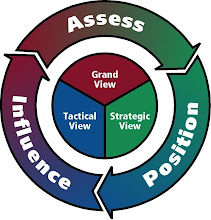
With our Compass AE process, you will assess your grand settings. You will know more than the basics of yourself, your competition, your strengths, your weaknesses, the opportunities and the threats. You will also understand how each competitor operates in terms of the competitive terrains, the campaign logistics, and their true intent.

If you want to know more about our Compass AE process, please contact us at service@collaboration360.com


# # #

Change the ground rules

Fight competitive sales on your terms

Published January 23, 2009

How often do you have sheer dominance over your competition? Unless your solution is three times as compelling as the competitor’s, the answer is just about never!

Let’s face it: few companies are lucky enough to command such superiority. That’s why most sales campaigns end up as price battles.

If we don’t dominate the competition, then we have to change the ground rules of the sale to work in our favor.


You say you want a revolution

The soldiers who fought in the American Revolution did just that. Rather than march down the middle of the street wearing their uniforms, the revolutionaries dressed in their everyday clothes and hid behind rocks, trees and piles of hay to fight the British troops. They didn’t fight the way the British wanted them to fight.

Or recall a famous scene from the film “Raiders of the Lost Ark.” Indiana Jones has just used a whip with considerable skill to fend off a few villains when he comes face to face with a man equally skilled but with a three-foot sword, which he twirls in front of Jones.

The audience watches in eager anticipation of an interesting but apparently fair battle: sword against whip. Instead, Jones suddenly pulls out his revolver and shoots his opponent. Jones changed the ground rules.

Avoid the feature trap

Mel, a salesperson for a client of mine, was selling inventory control software to a large feed mill company. Mel’s competitor’s product was clearly superior to his on a feature-by-feature comparison. They – not Mel – had sheer dominance.

But Mel’s company had one feed mill installation already under its belt; his competitor had none. So Mel changed the ground rules of the sale from technical features to feed mill expertise.

Mel never let his competitor suck him into a feature battle – which would have killed his chances. By staying “on message,” Mel won the deal.

Fight the battle on your terms

Here’s a superb illustration of a change-the-ground-rules strategy from the world of management consulting. Several years ago, the then consulting firm Coopers & Lybrand placed a series of print ads that showed a large picture of an ancient Chinese sword.

The ad’s caption read, “Does your consultant quote ‘The Art of War’ but shy away from battle?” (“The Art of War” is a popular ancient book about warfare that is commonly referenced, even today, in business settings).

Coopers & Lybrand was attempting to change the ground rules for the purchase of management consulting services from “providing theoretical strategic advice” (this is the quote “The Art of War” reference) to “facilitating the implementation of strategy” (the “shy away from battle” reference), something its competitors are not particularly strong at doing.

Take the RFP...please!

One can even change the ground rules when responding to a request for proposal (RFP). Another client salesperson did just that.

Julie had received a highly structured “sealed bid” RFP from a very large industrial company soliciting proposals for its natural gas supply. As is true with most such RFPs, the requesting company in this case planned to compare proposals from multiple gas suppliers and select the lowest price offering.

But Julie had different plans for her response to the RFP. She changed the ground rules from quoting the “lowest wellhead price” – the commodity measure typically used to compare natural gas prices that the request for proposal contained – to quoting “total energy cost,” more of a total cost of ownership kind of approach, and she won the deal. Julie’s last-minute timing was essential to prevent her competitors from attempting the same approach.

[ "If you're last, then use yin (soft) tactics, if you are first, then use yang (hard) tactics. When you have exhausted the enemy's yang measures, then expand yin to the full and seize them. ... This is then the subtle mysterious of yin and yang according to the strategists.
- Questions and Replies, 2
(from Seven Military Classics of Ancient China) ]

"Changing the ground rules that favors you" is a yin approach to playing any game,

Don’t let yourself get sucked into head-to-head engagements unless you have that elusive dominance. As you size up your own selling situation, ask yourself how you can lead with a perceived strength of your own against a perceived weakness of your competition.

Occasionally, that difference will be obvious, as in the examples above. Most other times, it’ll take some work, but it is well worth the effort.

http://www.biztimes.com/news/2009/1/23/change-the-ground-rules

Monday, March 2, 2009

The Dao of Strategic Assessment (5): Same Information, Different Assessment, Different Outcome


PepsiCo Americas Beverages division failed to assessed their competitive positioning before releasing their new packaging. Think of the time and money wasted in the planning and preparation.

During the assessment, their marketing ppl compared and contrast the data but failed to ask the right questions. They became too focused on the positives and not on the negatives.

This limited way of assessing happens all the time. It helps to have the right strategic assessment process.

#
February 23, 2009 Advertising
Tropicana Discovers Some Buyers Are Passionate About Packaging
By STUART ELLIOTT
IT took 24 years, but PepsiCo now has its own version of New Coke. The PepsiCo Americas Beverages division of PepsiCo is bowing to public demand and scrapping the changes made to a flagship product, Tropicana Pure Premium orange juice.

Redesigned packaging that was introduced in early January is being discontinued, executives plan to announce on Monday, and the previous version will be brought back in the next month.

Also returning will be the longtime Tropicana brand symbol, an orange from which a straw protrudes. The symbol, meant to evoke fresh taste, had been supplanted on the new packages by a glass of orange juice. The about-face comes after consumers complained about the makeover in letters, e-mail messages and telephone calls and clamored for a return of the original look.


Some of those commenting described the new packaging as ugly or stupid, and resembling a generic bargain brand or a store brand. Do any of these package-design people actually shop for orange juice? the writer of one e-mail message asked rhetorically. Because I do, and the new cartons stink. Others described the redesign as making it more difficult to distinguish among the varieties of Tropicana or differentiate Tropicana from other orange juices. Such attention is becoming increasingly common as interactive technologies enable consumers to rapidly convey opinions to marketers.

You used to wait to go to the water cooler or a cocktail party to talk over something, said Richard Laermer, chief executive at RLM Public Relations in New York. Now, every minute is a cocktail party, he added. You write an e-mail and in an hour, you’ve got a fan base agreeing with you.

That ability to share brickbats or bouquets with other consumers is important because it facilitates the formation of ad hoc groups, more likely to be listened to than individuals.


There will always be people complaining, and always be people complaining about the complainers, said Peter Shankman, a public relations executive who specializes in social media. But this makes it easier to put us together.


The phenomenon was on display last week when users of Facebook complained about changes to the Web site’s terms of service using methods that included, yes, groups on facebook.com. Facebook yielded to the protests and reverted to its original contract with users.
And in November, many consumers who used Twitter to criticize an ad for Motrin pain reliever received responses within 48 hours from the brand’s maker, a unit of Johnson & Johnson, which apologized for the ad and told them it had been withdrawn.

Twitter is the ultimate focus group, Mr. Shankman said. I can post something and in a minute get feedback from 700 people around the world, giving me their real opinions. Neil Campbell, president at Tropicana North America in Chicago, part of PepsiCo Americas Beverages, acknowledged that consumers can communicate with marketers more readily and more quickly than ever.

For companies that put consumers at the center of what they do, he said, it’s a good thing.
It was not the volume of the outcries that led to the corporate change of heart, Mr. Campbell said, because it was a fraction of a percent of the people who buy the product. Rather, the criticism is being heeded because it came, Mr. Campbell said in a telephone interview on Friday, from some of our most loyal consumers.

We underestimated the deep emotional bond they had with the original packaging, he added. Those consumers are very important to us, so we responded. Among those who underestimated that bond was Mr. Campbell himself. In an interview last month to discuss the new packaging, he said, The straw and orange have been there for a long time, but people have not necessarily had a huge connection to them.

Reminded of that on Friday, Mr. Campbell said: What we didn’t get was the passion this very loyal small group of consumers have. That wasn’t something that came out in the research. That echoed an explanation offered in 1985 by executives of the Coca-Cola Company in response to the avalanche of complaints when they replaced the original version of Coca-Cola with New Coke: Consumers in focus groups liked the taste of New Coke, but were not told old Coke would disappear. The original version was hastily brought back as Coca-Cola Classic and New Coke eventually fizzed out. (There are, it should be noted, significant differences between the two corporate flip-flops.

For instance, the Tropicana changes involved only packaging, not the formula for or taste of the beverage.)
An ad campaign for Tropicana that helped herald the redesigned cartons, also introduced last month, will continue to run, Mr. Campbell said. Print and outdoor ads that have already appeared will not be changed, he added, but future elements of the campaign — like commercials, due in March — would be updated. Unlike the packaging, the campaign has drawn praise, particularly for including in its family imagery several photographs of fathers and children hugging. Such dad-centric images are rare in food ads.

The campaign, which carries the theme Squeeze it’s a natural, was created by Arnell in New York, part of the Omnicom Group. Arnell also created the new version of the Tropicana packaging.


Tropicana is doing exactly what they should be doing, Peter Arnell, chairman and chief creative officer at Arnell, said in a separate telephone interview on Friday. I’m incredibly surprised by the reaction, he added, referring to the complaints about his agency’s design work, but I’m glad Tropicana is getting this kind of attention. In fact, Tropicana plans to contact everyone who called or wrote us to express opinions, Mr. Campbell said, and explain to them we’re making the change.

Tropicana is among several PepsiCo brands whose packaging and logos have been recently redesigned by Arnell. The new logo the agency produced for Pepsi-Cola has been the subject of comments by ad bloggers who perceive a resemblance to the logo for the Barack Obama presidential campaign.
The bloggers have also buzzed about a document outlining the creation of the Pepsi-Cola logo, which appears to have been written by Arnell for PepsiCo executives; Mr. Arnell has declined to comment on the authenticity of the document, which is titled Breathtaking Design Strategy and is written in grandiose language.

One aspect of the new Tropicana packaging is being salvaged: plastic caps for the cartons, also designed by Arnell, that are shaped and colored like oranges. Those caps will be used, Mr. Campbell said, for cartons of Trop 50, a variety of Tropicana with less sugar and calories that is to be introduced soon. During the interview last month, Mr. Campbell said that Tropicana would spend more than $35 million on the Squeeze campaign. Although he declined on Friday to discuss how much it would cost to scrap the new packaging and bring back the previous design, he said the amount isn’t significant.

Asked if he was chagrined that consumers rejected the changes he believed they wanted, Mr. Campbell replied: I feel it’s the right thing to do, to innovate as a company. I wouldn’t want to stop innovating as a result of this. At the same time, if consumers are speaking, you have to listen.


Copyright 2009 The New York Times Company

http://www.nytimes.com/2009/02/23/business/media/23adcol.html