skip to main |
skip to sidebar

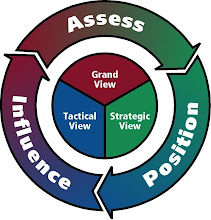
As mentioned before, the first step is to assess. The next step is to position strategically through planning and preparation.
Good planning and preparation requires a good top to bottom planning process and a strong understanding of fundamentals.
When planning your strategy, always walk through the steps. Review with thoroughness.
If you want to know about how to build a good plan, please contact us at service[@t]collaboration360[doott].com
Replace @t with "@" and doott with "." .
Collaboration360 Consultants (C360). Copyright:2006-2009 © All rights reserved
Copying, posting and reproduction in any form (without prior consent) is an infringement of copyright.

Before you enter into a new competitive arena, you should always assess the strategic position of each competitors (including yourself).
 Also know the history and the rules of that particular arena.
Finally, compare, contrast and calculate the actions of each competitor and its relationship to the grand settings.
If you believe you have a "superior" strategic advantage over your future competitors, then it is time for you to build your Tangible Vision (your grand mission with detailed specifics).#
Rethink your business strategy
Perfect your products before you succumb to the "expand or die" philosophy of business in uncertain times
By Ephraim Schwartz
January 6, 2009
I can't speak for the rest of the world, but in the U.S., the overriding business philosophy of companies both large and small is expand or wither away and die.
For retail outlets, this means building more and more stores until, like Starbucks in Seattle, there are two across the street from each other. For high-tech companies, it takes the form of reaching beyond one's area of expertise. Anyone still own a Dell TV or a Toshiba server?
How about driving around town in a car made by TaTa? I would buy an HP printer in a heartbeat but not an HP camera.
Another classic example was Heinz, which spent millions in advertising to get into the soup business. The result of all that advertising? Sales of Campbell's soup increased dramatically.
Companies never seem to learn their lesson. Perhaps it is hubris. Knowing others failed before them doesn't phase some companies in the least, because they believe they know better.
By the way, the opposite of this expand-or-die philosophy is to improve, perfect, and capture your market. In other words, offer products far superior to anyone else's and you will own the market. Unfortunately, many companies learn too late that respect for products in one field does not extend to another. The latest to succumb may be Cisco, which this week announced it will enter the consumer-electronics business, specifically digital stereo systems. Wi-Fi is one thing; stereo systems quite another. And then there's HP, which wants to be your data warehouse provider.
More of the same sad news. Granted, HP in data warehousing is less of a stretch than Cisco stereos. HP has the iron to do it. But if the folks at HP think the backbone of the data warehousing business is hardware, they are already on the wrong track. HP did, however, buy strategic business expertise when it acquired EDS. And this is what is really needed to sell data warehousing, which is much more about strategy than operations. What HP has to do is learn to turn hunks of metal and pieces of crystal into a services rather than a hardware sale. After that, they will still have to convince cash-strapped enterprises to invest millions of dollars in products and services from the new kid on the block in an uncertain economic climate. HP's competition -- Teradata, Oracle, IBM, and Microsoft -- is already stiff. And if it isn't careful, HP's hard-sell pitch to its largest hardware customers might just convince them that they need data warehousing -- a need they may wish to fulfill by buying a data warehousing solution from Teradata, Oracle, IBM, or Microsoft. Yes, HP, the mistake Heinz made has legs, and like it or not, you may not be any smarter than Heinz was. As for Cisco's New Year's resolution to build your digital entertainment system, my suggestion for Cisco is to stick to its plumbing. As I've often said, I don't have an MBA -- I don't even have an MA, having failed the French exam to prove proficiency in a second language, a long, sad story -- but I have watched the consumer market for 25 years, and I know that in consumer electronics, brand is everything.
Like the old real-estate axiom "location, location, location," in consumer electronics, it is "brand name, brand name, brand name." Yes, we have a more sophisticated audience than we did even five years ago. But most non-techies who are familiar with Cisco are so because somebody told them to buy Cisco stock. "What do they do?" a prospective buyer might ask the savvy friend advising them. "Oh, they make all the stuff for the Internet and for networking. You can't miss."
And for the most part, you couldn't. But nobody has to ask, What does Sony do? I would guess nine out of 10 people on the street, even Jay Leno's Jay Walkers, could answer that one. I wouldn't try the name Cisco on Jay Walkers, that's for sure. Whatever Cisco spends on advertising dollars now, it would probably have to increase tenfold, or twentyfold even, to become a blip on the list of names recognized in most households. Even more to become a household name consumers would feel comfortable buying stereos from. Far be it from me to offer advice to HP and Cisco.
Rather, I offer advice to other companies with similar strategies in mind. Markets are global, and once the current economic climate settles, there will be an even larger demand for the product lines you already offer, from India, China, and Indonesia, as well as the nations of Africa and the Middle East.
If you can polish your reputation in the areas where you are currently strongest, you should have enough business to keep your company growing for at least another generation or two. Not only will you be successful, but your business customers will have better, more reliable products with which to work.http://weblog.infoworld.com/realitycheck/archives/2009/01/rethink_your_bu.html
 Regardless of having passion in one's endeavor, one must have a plan.
There are good plans and bad plans.
The challenge is building a plan that enables you to do the following:1. Focus on your objective while mind the Tangible Vision;2. Avoid negative circumstances, while focusing on positive situations;3. Maximize opportunities;4. Adjust strategically;5. Shape the Tangible Vision; and6. Lead with strategic leadership .
When you can do that with your plan, you can make better decisions. You will stay on course and complete your goal regardless of the circumstances.
Does your current plan do that?
What is the Tangible Vision?
The Tangible Vision is a goal, a plan that you work with. It also emphasizes a clearly-defined vision or mission statement that you believe in.
The first step is establishing your desired "end-in-mind" with specific details. The ideal outcome must have the value points and a tangible model that you can relate to. It also encompasses the contra-position of the desired outcome.
The next step is building the specific guidelines for each milestone. Those guidelines are based on the priorities, the approach and various circumstances for that phase.
The final step is outlining the operational steps that match the specific guidelines for each milestone.
The guidelines stated in the Tangible Vision become the strategic standard for the implementer to make decisions with. They know the positives and the negatives based on anticipated situations.
The Tangible Vision also guides the implementer on when and how to adapt the changes, what are the contingencies, etc.
In a future post, we will talk more about the basics of the Tangible Vision.
If you want to know about how to build a good plan, please contact us at service[@t]collaboration360[doott].com
Replace @t with "@" and doott with "." .
Collaboration360 Consultants (C360). Copyright:2006-2009 © All rights reserved
Copying, posting and reproduction in any form (without prior consent) is an infringement of copyright.
 Assessing the grand situation allows one to see the order within the disorder. It also enables one to minimize the chaos while focusing on maintaining stability. One starts by defining the specifics and then developing the connections between the specifics.
 The skill of assessing the grand situation while mastering the basics of one's specialty takes some time. With each execution, experience is gained.
At the end, there is no substitute for hard work and experience. The question is: are you willing to take time to assess the grand situation?
#
November 23, 2008Love, Jobs & 401(k)sBy RUTH LA FERLAON a good day last summer, Thomas Taccetta, a stock trader, might have checked his financial charts before plotting the day’s investments. Today he is likely to check in with his psychic as well. I’ll play the broadest index, the S.&P. 500, Mr. Taccetta said, and if she tells me she is getting a negative view, I will sell.Since September, when the Dow collapsed, Mr. Taccetta, who trades for his own portfolio in Boca Raton, Fla., has talked with his psychic about once a month, roughly twice as often as a year ago. There is no rhyme or reason to the way the market is trading, he said. When conditions are this volatile, consulting a psychic can be as good a strategy as any other.In an era when even Henry M. Paulson Jr., the Treasury secretary, changes his mind weekly about how to rescue the United States economy, Mr. Taccetta’s decision to seek the advice of a psychic may not seem all that irrational. With Washington flinging pieces of the $700 billion bailout package around, dithering about whom to rescue homeowners? automakers? cousin Fred? a good set of tarot cards might come in handy.Your mortgage agents, your realtors, your bankers, you can’t go to these people anymore, said Tori Hartman, a psychic in Los Angeles. They’re just reading a script at least that’s how my clients feel. People are sensing that the traditional avenues have not worked, that all of a sudden this so-called security that they’ve built up isn’t there anymore. They come to a psychic for a different perspective.Psychics say their business is robust, as do astrologers and people who channel spirits, read palms and otherwise predict the future (albeit not the winning lottery numbers). Their clients, who include a growing number of men, are often professional advice-givers themselves, in fields like real estate and investments, and they typically hand over anywhere from $75 to $1,000 an hour for this form of insight.My Web traffic is up and up and up, said Aurora Tower, a New Yorker who constructs spidery star charts for her growing clientele. People will entertain the irrational when what they consider rational collapses.Quackery? Whatever. But after all, the nation’s supposed experts on the economy, from pundits on the networks to billionaire investment bankers, have not been exactly reliable. And spiritual readings, as they are known, appear to be one of the few growth sectors in a contracting economy.My phone is ringing off the hook, said Roxanne Usleman, a psychic in Manhattan.Ms. Usleman, who says she channels angels to advise her clients on interpersonal and financial matters, reported both a spike in traffic on her Web site and a significant surge in private consultations. She used to see comfortably 15 to 20 clients a week, she said. Now she meets with more than twice that number. I’m having trouble squeezing in appointments, she said.Dawn Carr, a psychic in Boston, said her holiday bookings jumped as much as 70 percent this year over last, fueled in part by corporate bookings for holiday parties. These people are looking for someone not just to entertain them, but to enlighten them, she said.Although most of us would settle for just enough telepathy to read our spouse’s mind, some people crave more.When you don’t know what to expect of a job interview or a business partnership, said Gita V. Johar, a professor of at the Columbia University Business School, that is when you’re most likely to turn to a psychic.Professor Johar, whose specialty is studying the effects of superstition on consumer behavior, suggested that when your portfolio is shrinking or your business is tanking, talking to a soothsayer may be one way of feeling in control. She needed no crystal ball herself to predict that given the uncertainty of the economy, psychics are going to see an increase in business.The steep prices charged by practitioners of divination do not seem to have deterred many of the financially fretful. Ms. Hartman, the Los Angeles psychic, said her Internet traffic has picked up substantially, from about 30 visitors a day to more than 200. She charges from $150 for a 30-minute telephone reading to $500 for 90 minutes of intuitive counseling. In what is perhaps a sign of the times, the $70 moss-scented prosperity candle offered on her Web site has become her best seller, she said.Many more men have joined the ranks of seekers. In the old days men would turn to their wives and ask, ‘What did that goofball say, honey?’ said Michael Lutins, a New York writer and astrologer. Now they are raising their heads, interested in matters that were once considered women’s stuff. Mr. Lutin has lectured about astrology at such male-dominated institutions as the Harvard Business School Club of New York.Ms. Usleman said that her once predominantly female clientele has also expanded. Men among them lawyers, doctors, chief executives and insurance brokers now make up about 50 percent of her business. They approach her, she said, with highly targeted questions, as if they were grilling an investment counselor. Before agreeing to a reading, they will ask: ‘What is your accuracy rate? Can you guarantee your readings? How do you get your information and can I depend on it?’ Aside from storefront readers, psychics rarely hang out a shingle, making their earnings hard to track. But one person who has attempted to quantify the rising popularity of psychics is Robert LoCasio, the chief executive of LivePerson.com, a site offering telephone consultations with experts in fields from finance to fly fishing.When he bought his company a year ago, Mr. LoCasio checked the Consumer Sentiment Index, which is published by the University of Michigan and charts consumer confidence, from 2005 through September of this year. He then compared the data with records from his own company, and drew the conclusion that when the economy is down, consultations with psychics spike noticeably.Live Person earned revenues of $30 million this year, about 70 percent derived from spiritual readers, Mr. LoCasio said. In this day and age, a spiritual guide is an everyday therapist that’s what the business has become, he said.In more ordinary economic cycles, psychics tend to offer guidance on romance and relationships. These days, they are besieged with questions about whether a pink slip is in the cards, whether a condo will sell, or whether a company will continue to prosper.Alicia Bowling, who runs a sports bar in Manhattan, consulted a psychic when friction with a business partner seemed about to imperil her livelihood. I used to go to my psychic about twice a year, but in the past year, yikes, I may have talked to her a dozen times, said Ms. Bowling, 49. I used to ask more about love, or will I ever be married, but with all these hard times, I wonder, ‘What’s going to happen to my bar and will I survive?’ Sergei Pamukh, a New York stock trader, considers himself a skeptic about supernatural matters, but softened his stance after consulting Ms. Usleman, the Manhattan psychic. When his business was flailing earlier this fall, she suggested that he travel to Moscow to meet with a billionaire mogul. In two or three weeks I am going, he said.Ms. Usleman said she typically fields questions these days like, Should I go back and live with my parents? and Is it O.K. to take my children out of private school? In the past, she added, they would ask, ‘Should I have a baby?’ But now they have put that on hold.Basically, what people want to know in a troubled economy, she said, is what can they do to reinvent themselves.Fahrusha, a Madame Blavatsky from Manhattan, said that clients have been pressing her with highly focused queries. They might want to know about investing in a particular security, or ask how the euro will fare against the dollar, she said. In flusher times, they might have consulted a financial expert, she said, but some of these people are experts themselves.Maria Napoli, a Manhattan astrologer whose clientele includes a growing circle of the rich and famous in the worlds of fashion, art and finance, observed that many of her clients were fretting about a global picture, not just their careers. They are asking: ‘Where are we headed as a country? Are we entering a depression?’ I get a lot of Republicans wondering where their party is going.Mostly they are after a little peace of mind.It pays to cover all your bets, said Stuart McFaul, who runs a marketing and public relations company in San Francisco.Mr. McFaul checks in with his psychic when he is stumped for answers about where his business, and his competition, might be headed. I’m a big believer that you really don’t dismiss any opinion, he said.Ms. Bowling, the bar owner, is grateful for the slightest shred of insight. In times that are this nerve-racking, all it takes is one word that kind of helps you get through your day, she said.Copyright 2008 The New York Times Companyhttp://www.nytimes.com/2008/11/23/fashion/23psychic.html
If these psychics knew the future, would he/she be focused on investing their money in the market. In unpredictable times, the best strategist quietly does the following:
- Gather the best information;
- Assess it properly;
- Decide on his or her priorities and approaches;
- Build a top-down plan (with a solid understanding of the fundamentals and the ground level circumstances); and
- Execute.
"Even in the good times, one needs to be conservative, totally focused and not expand beyond their means. The good times or bad times can never last forever. Things come in cycles always. "
- Chinese strategy classics:
Understand cycles was not Marinelli's strength.
The best strategist always think in terms of seasonal cycles.
Cardinal Rule: It is better to release the aging player one season sooner than one season later.#
Lions fire Marinelli after record-breaking season BY LARRY LAGE Dec 30, 2008AP Sports Writer | 12/30/08 12:36 AMRod Marinelli might be a good head coach. He just isn't going to find out for sure in Detroit.Marinelli inherited a Matt Millen-created mess and compounded his problems by reuniting with some former Tampa Bay Buccaneers whose best years were in the past. The result was the NFL's first 0-16 team and a three-year record of 10-38 for Marinelli, who was fired Monday by the Lions.Instead of making excuses or explaining why it didn't work out, Marinelli took the high road."If I'd have done better and won more games, then we'd have been fine," he said.The peak of the Marinelli era was midway through last season when the Lions were 6-2.Since then, they're 1-23."If you would've told me about a year and a half ago that we would be in this situation, I would've told you, `No way,'" quarterback Dan Orlovsky said. "I honestly thought Rod was the guy."He came in with the old-school, hard-nose mentality to break the mold and change the culture."Marinelli got a taste of how difficult his job would be during his first minicamp."Some of the work ethic kind of surprised me when I got here," he said. "That's why I kind of dug in on that."I didn't think it was that tough, but I got turned in and that surprised me."At least one player filed a grievance because of the intensity of minicamp. The team was punished by banning players from the practice facility for a couple of days.Marinelli eventually raved about how hard his players practiced for him, insisting he could envision the results showing up on Sundays, but it just didn't happen.Especially, this year."You can't go 0-16 and expect to keep your job," Marinelli said.The leaders of Detroit's front office, though, did just that.Lions owner William Clay Ford elevated Tom Lewand to team president and Martin Mayhew to general manager, announcing the moves in the same news release that included the decision to fire Marinelli. ...The Lions completed their winless season with a loss to Green Bay on Sunday, pushing aside Tampa Bay's 1976 season of 0-14 as the league's worst. Marinelli, though, said the team was not the worst ever in his opinion because the players didn't quit, pout or point fingers.He won only one of his last 24 games and 10 of 48 in three years after Millen gave the former Bucs assistant his first head coaching job. ... Millen was fired as team president three months ago, but the players he left behind, coupled with the former Tampa Bay players Marinelli wanted, created the perfect storm for a historic season of futility.Marinelli acknowledged he misjudged what some of those former Bucs had left in their playing careers. He also, in a rare second-guessing moment, wondered if he raised the bar too quickly after Detroit started 6-2 last season. ..."I can't say he's a bad coach," Orlovsky said. "I just think he was put in a really difficult situation."http://www.sfexaminer.com/ap/?c=y&id=1352062