Tuesday, July 8, 2008

Our "Strategic Assessment" Chart

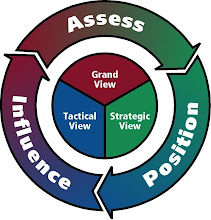
Following is our strategic assessment chart that we have developed and implemented for competitive analysis:


This chart is based on our understanding of Sun Tzu's The Art of War (90%) and other strategy classics (10%).

Our strategic assessment process will work with any industry.
In a later entry, we will explain the concept behind the chart.

In the next few months, a business magazine will be publishing our article titled "Strategic Assessment: Insights from the Art of War."

More to come.

Sunday, July 6, 2008

Competing in the Global Economy: Why Honda Prevails.

Following is a list of why Honda dominates in the automotive industry:
1. Everyone in their "assembly" team can do everyone's else job.

2. Honda has a technological system that adapts to any car model.
3. Honda spends a great deal of time on the ground.
/// They always knowing what are the current and future intents of the vendors. Honda's intelligence gathering and strategic assessments protocols enable their implementers to strategize ahead.

4. They adjust strategically as a team.

/// Honda has a strategic project management process that enables the team to collaborate anywhere as a team,

Regardless of the times, Honda has a grand strategic process (a Tangible Vision) that enables them to adjust strategically. Currently, they are #1 in car manufacturing in the United States.

#

July 3, 2008

The Struggles of Detroit Ensnare Its Workers

By BILL VLASIC and NICK BUNKLEY

DETROIT Their pickups and sport utility vehicles are not selling, and now General Motors, Ford Motor and Chrysler have to pay thousands of auto workers not to make them.

With more than 15 of their assembly plants across the country set to be idled or slowed because of shift cutbacks, the Detroit automakers will temporarily lay off upward of 25,000 auto workers this summer and fall.

Because of their union contracts, G.M., Ford and Chrysler are obligated to pay workers more than half of their regular take-home wages, plus health benefits, with state unemployment benefits picking up a portion of the rest.

Despite cutting more than 100,000 jobs since 2006 through buyouts and special retirement programs, the Detroit companies still cannot match their production capacity with their steadily declining market share.

Consumers are shifting to more fuel-efficient vehicles, if they are stepping into a showroom at all. New vehicle sales plummeted 18 percent in June, and Detroit's share of the declining market fell to a combined 46 percent.

Moreover, all three companies are losing money in North America and burning through cash reserves. On Wednesday, G.M.'s stock fell 15 percent after a Merrill Lynch analyst issued a report saying that "bankruptcy is not impossible" if the overall market continues to deteriorate.

Unlike many factories operated by Japanese manufacturers in the United States, Detroit's plants are not flexible enough to switch their production to better-selling models.

So while some G.M. and Ford factories are scrambling to build more cars, even paying workers overtime to meet demand, other assembly lines are shutting down.

"It's an unprecedented situation," said Harley Shaiken, a labor professor at the University of California, Berkeley. "Despite enormous reductions in total employment, the market is forcing massive temporary layoffs."

Detroit's Big Three, it appears, can't escape their past.

Since the 1980s, the companies by dint of their contracts with the United Automobile Workers union have parked idled workers in so-called "jobs banks" where they received full pay while doing community service or simply clocking in.

New contracts with the U.A.W. signed last year were supposed to pave the way for elimination of the jobs banks and make the companies more competitive on health care and wages for new hires.

In addition, the historic buyout and early-retirement programs were meant to better align, at enormous expense, the automakers' workforce with demand for its vehicles. Even before this year, the companies had announced plans to close several plants.

But the restructuring plans did not account for the huge drop in sales and the shift by consumers to smaller vehicles that have resulted from soaring gas prices and the weak economy.

"You have the demand for large vehicles dropping, combined with growing demand but limited supply of smaller vehicles," said Jesse Toprak, executive director of industry analysis for Edmunds.com, an automotive-research Web site. "What you end up with is miserable sales numbers."

Rather than flood the market with unwanted trucks and S.U.V.'s, the Detroit automakers have announced broad, temporary layoffs on a scale unseen since the early 1990s.

"Instead of building vehicles and selling them at deep discounts, the companies are shutting the plants," said Ron Harbour, managing partner of the consulting firm Oliver Wyman, which issues a widely followed annual report on auto manufacturing trends. "It's painful, but it's smarter than the alternative."

G.M. plans to send about 11,000 United States workers home on layoffs the rest of the year, some for weeks and others for months. It also has about 1,000 workers still on the rolls of jobs banks from plants long since closed.

Ford is idling about 5,000 of its hourly employees, in addition to the estimated 500 workers it has in the jobs bank. Chrysler, which has 300 people in the jobs bank, will lay off about 9,500 workers.

There are also layoffs scheduled at plants in Canada and Mexico.

Virtually all of the laid-off workers are at plants building slow-selling pickups like the Ford F-Series or big S.U.V.'s such as G.M.'s Chevrolet Suburban and Chrysler's Dodge Durango.

Some of those workers will, over time, be moved to car plants that are adding shifts or otherwise increasing production.

But the vast majority of the laid-off workers in the United States will stay at home and collect 95 percent of their average after-tax, take-home pay about $816 a week, according to U.A.W. documents posted on the union's Website.

Of that $816, the automaker pays about 55 percent and state unemployment covers the remainder. In G.M.'s case, the cost of supporting 11,000 laid-off workers averages about $1 million a day.

"It is a very expensive issue, but it's not the critical one for Detroit," said Mr. Shaiken. "The reason these plants are going down is that some catastrophic decisions were made in the past to continue building so many trucks."

The companies are trying to mitigate the impact of the production changes. Ford, for example, will cut a shift at its Missouri truck plant and almost immediately move the workers to a nearby factory making small S.U.V.'s.

At a Kentucky plant that makes Explorer sport utility vehicles, Ford will slash production from two shifts to one. But rather than lay off workers, the shifts will start to alternate work weeks.

Still, the Detroit automakers are hamstrung by the inability of their factories to shift production from slow-selling vehicles to hotter models. Rivals such as Honda can quickly move from making an S.U.V. such as the Element in its Ohio plant to Civic sedans.

"The key is they are able to change the mix of products to what is selling right now," said Mr. Harbour.

While plants operated by G.M., Ford and Chrysler have markedly improved their productivity and lowered their worker rolls in recent years, they generally are confined to making variations on a single truck or car platform.

The stunning drop in truck sales has forced the Detroit companies to make some hard decisions. Chrysler this week said it will close a minivan plant in Fenton, Mo., near St. Louis, and cut a shift at a neighboring factory that makes Ram pickups.

The double blow stunned workers. About 1,500 workers at the minivan plant will go on indefinite layoff in October, while 900 workers at the Ram factory will be idled in September.

"It's very scary," said Joe Wilson, a 40-year-old worker at the minivan plant. "We'd been led to believe we'd have a future. Now they pull the rug out from under us."

Mr. Wilson said that getting a paycheck for not working is hardly a relief when his job is disappearing. He was already cutting back on expenses, and had bought an old Ford Escort to save money on gas for his commute.

"It takes three weeks to get that first check and by then we owe everybody and their uncle," he said.

A worker at the Ram pickup plant, Dave Jacobs, said the plant's long-term prospects have been clouded by the reduction to one shift.

"They can't afford to run this place with one shift," he said. "One shift pays the bills and the others are for profits."

Laid-off workers can receive their unemployment pay for up to 48 weeks. At that time, workers can shift into the jobs bank for another two years.

But one Chrysler worker, Andy Marlow, said the cutbacks are coming so fast that employees fear the worst.

"You can sit and try to ride it out and hope the plant comes back up," said Mr. Marlow. "But then if that pay runs out, you're unemployed."

Bill Vlasic reported from Detroit, and Nick Bunkley from Fenton, Mo.
http://www.nytimes.com/2008/07/03/business/03auto.html

--- eof


If your company needs a strategic collaborative management process that enables your team to collaborate anywhere as a team regardless of the distance, the technology and the project culture.

Please contact us at service [aatt] collaboration360 [dottt] com. We have a white paper ready for your reading.

Tuesday, July 1, 2008

A Lesson on the Importance of Strategic Assessment


An interesting news item on how Will Smith became a mega-superstar.

Will Smith wondered what did it take to be a mega star. He strategically assessed the state of the movie industry ... and the rest is history.


#
Will Smith: My Work Ethic Is "Sickening"
PHILADELPHIA, Dec. 2, 2007(CBS) Of all the stories in Hollywood, there is not another one like Will Smith's. At age 39, he has already had three successful careers: Grammy award winning rapper, sitcom sensation, and finally one of the biggest movie stars on the planet.

With two Oscar nominations and almost four and a half billion dollars in box office receipts to his credit, a movie starring Will Smith is about as close as you get to having a sure thing, whether it's science fiction, romantic comedy, or a summer blockbuster.

As correspondent Steve Kroft found out, there is an ease and enthusiasm about him that transcends race and cultural boundaries, and it is one of the reasons so many people like him.

Asked what he thinks his appeal is, Smith tells Kroft, "I love living, I think that's infectious. It's somethin' that you can't fake."

"And I think that the camera can feel that I'm happy doin' what I do. And it's somethin' that gets inside of people," he adds.

It is swagger with a smile, confidence with cool, and wit grounded in wisdom -- someone who knows who he is, and where he is going. And it has made him one of the most popular and powerful actors in Hollywood.

Why does he think he has been so successful?

"I've never really viewed myself as particularly talented. I've viewed myself as slightly above average in talent. And where I excel is ridiculous, sickening, work ethic. You know, while the other guy's sleeping? I'm working. While the other guy's eatin'? I'm working. While the other guy's making love, I mean, I'm making love, too. But I'm working really hard at it," he tells Kroft, laughing.

That he makes it look just the opposite is testament to his personality and his skill as an actor. He likes the fact that you never see him sweat unless you are supposed to, or notice the emotional capital expended as a homeless father with a hungry son, or the commitment it took to become Muhammad Ali.


... Instead of falling on his face, the performance was hailed as extraordinary and one of the year's best. And the critical acclaim was soon followed by box office success by stealing the largest grossing film of 1996, as Captain Steven Hiller in "Independence Day."

"It was one of those moments where I just realized my life was changed forever," Smith recalls.

How did it change?

"You know, it was so bizarre. So bizarre, 'cause the Fresh Prince of Bel-Air is on, and people scream, 'Will! Will! Will!' And on Monday morning, when the box office receipts for 'Independence Day' came out, I was Mr. Smith. 'Good morning, Mr. Smith. Congratulations.' Who the hell's Mr. Smith?" Smith explains, laughing.

A year later, he brought the same sense of style to "Men In Black. It was another huge blockbuster, and as it turned out, all part of Will Smith's plan.

He's been in a lot of movies with special effects and Smith says that's calculated. When he came to Los Angeles to become an actor, he and his manager did some simple research about the movie business.

"And we got the top ten movies of all time, and we realized that ten out of ten were special effects movies," Smith explains. "Nine out of ten were special effects movies with creatures. And eight out of ten were special effects movies with creatures and a love story. So 'Independence Day' and 'Men In Black' were really no-brainers."

There have been a few turkeys along the way, like "Wild Wild West," which was universally panned and still grossed $250 million.


It's placed him in the elite company of a handful of actors who can command over $20 million a picture. He lives in a spectacular 200-acre compound outside Los Angeles, far away from the paparazzi, with his wife and two children; daughter Willow is in his new movie, and son Jayden was in his last.

His wife is actress Jada Pinkett-Smith, who was a good friend until they became romantically involved.

Produced By John Hamlin and Albert Kahwaty
© MMVII, CBS Interactive Inc. All Rights Reserved.

http://www.cbsnews.com/stories/2007...in3558937.shtml


The key phrase is: "... did some simple research..." It propelled Will Smith ahead of the competition.

#


"Before the engagement, one who determines in the ancestral temple that he will be victorious has found that the majority of factors are in his favor. Before the engagement one who determines in the ancestral temple that he will not be victorious has found few factors are in his favor.

If one who who finds that the majority of factors favor him will be victorious while one has found a few factors favor him will be defeated, what about someone who finds no factors in his favor?

If I observe it from this perspective, victory and defeat will be apparent." - Art of War, 1

Monday, June 30, 2008

Process Precedes Technology (2)


@ Collaboration360, we rarely get a clutter of e-mail. We devised a specific Tangible Vision that prioritized our e-mails we get.

If you are interested in knowing about what is a Tangible Vision. Click on the "Tangible Vision" tag.


#

June 29, 2008
Preoccupations
I Freed Myself From E-Mail’s Grip

EARLIER this year, I became tired of my usual morning ritual of spending hours catching up on e-mail. So I did something drastic to take back control of my productivity.

I stopped using e-mail most of the time. I quickly realized that the more messages you answer, the more messages you generate in return. It becomes a vicious cycle. By trying hard to stop the cycle, I cut the number of e-mails that I receive by 80 percent in a single week.

It’s not that I stopped communicating; I just communicated in different and more productive ways. Instead of responding individually to messages that arrived in my in-box, I started to use more social networking tools, like instant messaging, blogs and wikis, among many others. I also started to use the telephone much more than I did before, which has the added advantage of being a more personal form of interaction.

I never gave up my work e-mail address, because I still need it for some work-related activities — for example, for one-on-one discussions that are too private and confidential to discuss publicly.

I was in a good position to give up most of my other e-mail because I’m a “social computing evangelist” for I.B.M. and have used social software tools for years to collaborate on projects and to share knowledge. I live in the Canary Islands off the coast of Spain and report to managers in the United States and the Netherlands. Between time differences and participation in various projects, it’s important that I spend my time efficiently.

I have had continuing support from my management in this effort, because I’ve been able to prove how much more I can accomplish by answering a question, and posting it on a blog, for example, than I can by answering the same question over and over. I still help people, but in a more open and collaborative fashion. Other people can join in the discussions — maybe they will have a better idea than mine.

I started this experiment by announcing my intention on a couple of blogs, like my personal one and blogs inside I.B.M.’s firewall. The postings in response were overwhelmingly positive — but I also encountered some skepticism. Many people wondered how I would manage to communicate and collaborate with my peers without using e-mail.

The first step was to decide which social software tools were available for me to use much more extensively. The second was to encourage people to stop using e-mail themselves and to start using some of these same social software tools as well, to share their knowledge and collaborate with one another.

Most social networking tools I use are pretty standard. Instant messaging is my preferred method of collaboration and knowledge sharing while at work because it allows real-time interaction. If an instant-message exchange lasts more than three minutes, I usually move the discussion to the telephone.

Other software used at I.B.M. helps me collaborate in various areas: blogs, social bookmarking and tagging, participation in online communities to which I belong, and an alert system for to-do items.

I.B.M. uses a Facebook-like site called Beehive and a personalized internal directory called Profiles. These help build trust levels with peers in order to get a job done much faster, and they easily locate experts in a particular subject. I share and update big files with a file sharing system that cuts down on the back-and-forth of sending big presentations and video files.

Say someone asks to view a presentation you have done recently, and you decide to share it via an open “file sharing” space. Then, before you know it, strangers thank you for sharing that presentation, which they will be reusing themselves within their own projects. That kind of immediate impact would be unlikely through e-mail.

I use a couple of R.S.S./Atom feed readers, which have become not just another in-box, but my primary method of receiving notifications of content relevant to my work. They give me control of what I receive and when, something I couldn’t say when I was relying much more heavily on e-mail.

I am lucky to have the chance to be exposed to such a wide range of social software and collaborative tools at work. But what if your business does not have blogs or wikis or whatever else? What can you do to help repurpose the way you process your e-mail?

You can do something as simple as calling people instead of e-mailing them. If you work on the same floor, you can even walk over to their desks and talk to them!

You may have some other tools that could host some of those conversations. Mainly, it is about a change of habits, about finding new ways to be much more productive with less effort, so that we can focus on more complex tasks.

Anyone can create a blog or a wiki, or a Twitter account. Almost everyone can use instant-messaging tools at work to get things going. So why not start exploring the possibilities and figure out which conversations you can move out of your e-mail system?

THINK about whether my experience could work for you. Think about how to use social networking tools to eliminate spam and to avoid repeatedly answering the same question from many different people. These tools can also save you from an accumulation of online newsletters that never get read, and from those incessant project status reports that clutter many in-boxes.

E-mail can become extinct, if not repurposed altogether, even at big

companies like I.B.M. An e-mail in-box no longer needs to be like Pandora’s box.

Copyright 2008 The New York Times Company http://www.nytimes.com/2008/06/29/jobs/29pre.html

###


Most people know how to perform and produce as an individual. Not many knows how to collaborate as a team.

If you are interested in knowing about how to collaborate anywhere as a team regardless of the distance, the technology and the project culture. Please contact us at service [at] collaboration360 [dot] com. We have a white paper ready for your reading.

Tuesday, June 24, 2008

Compass AE as an Collaborative Enabler


The great enabler

By Rod Newing

Published: June 29 2007 17:38 | Last updated: June 29 2007 17:38

No single technology can accommodate the complex processes and cultural ramifications of collaborative interactions. Successful collaboration results from using the right balance of face-to-face meetings and technology. Furthermore the technology, or combination of technologies, must be appropriate to each kind of interaction.

/// Conceptually, collaboration results from proper teamwork first.

But trying to work together remotely goes against our natural human instincts. "We are optimally evolved to talk at a range of about 5 feet in groups of no more than 90 people," says Ceri Roderick, a partner in Pearn Kandola, an occupational psychologist practice. "We respond to a rich stream of information and judge nuances, such as pronunciation or slight facial expressions." This enables us to assess people's motives, trustworthiness and reliability.

Take all that away and the bald words on the page can be over-interpreted or misunderstood. "As organisations become larger, more global and more dispersed," Mr Roderick warns, "we stretch the parameters and make life difficult for ourselves." The objective of technology is to replicate that rich stream of information when the communication is particularly important – for example, when building relationships and trust, solving problems or reviewing progress. This means operating in real-time and combining as many forms of communication as possible, such as images, voice and text. This process is called "unified communications" and it is made possible by the latest internet-based technologies. These combine to give much more information to provide more context to the exchange.

"Successful collaboration starts with the people," says Graham Oakes, a technology consultant. "They need to establish contact with each other and agree lines of communication, which is a lot easier to do face to face."

Mr Roderick recommends that people working in virtual teams should make time to meet occasionally. This allows them to understand more about the personal and cultural context of other individuals, which helps when they subsequently telephone or e-mail each other.

/// The team starts by building the Tangible Vision as a team. When they builds their Tangible Vision, they begin to learn something about their counterpart. ... For example, how does he/she think? How does he/she expresses their ideas? etc.

The need to get the balance right is shown by "Congested Lives", a research study of over 1,200 UK businesses employees carried out by YouGov for Polycom, a collaborative communications vendor. This showed that unnecessary face-to-face meetings cost businesses £17bn each year and 82 per cent of respondents who had travelled to meetings in the last year believed many of them were unnecessary.

If people want to build trust and relationships without the time and cost of travel, then video conferencing is the most effective tool. "The purpose of many video conferences is not necessarily to get things done but to build trust and contacts in the relationship," says Jeffrey Mann, vice-president of research at Gartner, the technology analyst. "Video and web conferencing are really relationship building, and not necessarily information passing or for agenda point processing, because people want to know who they are dealing with."

Growth in video conferencing has been forecast for many years, but so far it has failed to materialise. Professor Peter Cochrane, a futurologist and founder of ConceptLabs, puts its failure to date down to poor video and sound quality, no eye contact, no gaze awareness, no body language, small people images and no depth of field.

"Most of this can now be fixed," he says, "notably by Cisco Telepresence, which uses life-size high definition screens, audio straight out of the speaker's mouth from the right direction, eye contact and all in good quality. Hollywood discovered the value of emotions, for which good audio and video are the essential."

Asynchronous communication, where people interact over a period of time, is also a valuable tool. "If you are dealing with someone in another part of the world in another language, it gives them more time to think and react," says Mr Mann. "It is a real disadvantage if they have to think in real-time."

But there is a danger of sharing too much information. Microsoft's Enterprise IQ Survey 2007, in partnership with Henley Management College, found that an average workgroup of 25 people shares information 1,500 times a week and intensive information users share over 5,000 times a week. Even then, 22 per cent of documents are considered to be out of date.

"People are drowning in data and feel overwhelmed by information," says Jean-Anne Stewart, director of corporate programmes at Henley Management College. "There are issues of reliability and accuracy, which may be contributing to calling meetings to gather and share information."

/// When a Compass team leads with their Tangible Vision, they focus on the standards that are listed in their Tangible Vision. The Tangible Vision gives the Compass team a strategic overview of direction, connections and anticipation.

Although a wide range of corporate technologies exists to overcome some of the cultural issues surrounding collaborative working, a new range of consumer-based technologies is beginning to establish itself in the enterprise. Often referred to collectively as "Web 2.0", the technologies include social networks, wikis and blogs.

"The teenagers of today are using technology to communicate and collaborate like never before but the business world is struggling to figure out how to use them," says Neil Sutton, general manager for information technology services at BT.

When today's teenagers start their careers in the commercial world, it will have an impact on the way we communicate. They will prefer different ways of communicating, and this will affect collaboration within, and between businesses – but the business world is not ready for it."

Stewart Mader, wiki evangelist at Atlassian, a software systems company, points out that the generation now entering the workforce are experts in social media and are already collaborating with each other. One of the reasons for the success of Web 2.0 tools is that they blur the line between pure business productivity and the building of an emotional connection, a sense of ownership and involvement, which allows people to interact directly with other people to build their knowledge.

"They approach knowledge as the product of that organic, non-linear human connection and collaboration," he says. "Imagine unleashing that potential in the professional world."

People's individual web profiles are the foundation of social networks, allowing them to connect to each other and to information. These profiles add the necessary "context" to the collaboration.

IBM has been using the same approach for eight years with its 475,000 "Blue Pages" employee and partner profiles. These include an individual's experience, skills, projects they have worked on, their patents and publications, the content they have created, the activities they are involved in and the communities in which they participate.

"They are accessed 6m times a day to find more about the people you know and to find the people you don't know," says Jeff Schick, worldwide vice-president for social software at the company. "You really get a better understanding of who the individual is, what they do and what they know."

The CIX electronic conferencing system has been using the personal information of its users to make connections since before the internet became pervasive. "They are essential for building a mental picture of your remote colleagues," says Graham Davies, the company's managing director. "It helps us to predict how a person will interpret and react to our ideas and suggestions, in the same way their facial emotions and body language would in a face-to-face situation."

Clearly, technology can help to address a number of cultural problems associated with collaboration – but not if they are used exclusively. As Prof Cochrane concludes: "Collaboration still works best if it is supported by human contact that cements trust and familiarity on a regular basis."

Copyright The Financial Times Limited 2008

http://www.ft.com/cms/s/2/a68a825e-265d-11dc-8e18-000b5df10621.html

#

When the Compass team collaboratively builds and connects with their Tangible Vision, they become familiarized with the priorities and the approaches to completing their goal and the circumstances that can occur. ... They know their role and responsibilities in certain situations while learning something about each other. ... The members of the team collaboratively trust each other and know that everyone is accountable. The team is always decisive in their actions as a team and continually trusts their Tangible Vision.

#

"One who excels at warfare will await events in the situation without making any movements. When he sees he can be victorious he will arise; if he see he cannot be victorious he will desist. Thus it is said he doesn’t have any fear, he doesn’t vacillate. Of many harms that can beset any army, vacillations is the greatest. Of disasters that can befall an army, none surpasses doubt.”
– Six Secret Teachings, 26


By connecting with their Tangible Vision, a Compass team always know what are their priorities and the approaches regardless of the circumstances. There is no doubt in the mind of the Compass Implementors.

If you are interested in knowing more about how Compass AE works, please contact us at service [at] collaboration360 [dot] com. We have a white paper ready for your reading.


Copyright © 2008 Collaboration360 Consultants (and Collaboration360.com) All rights reserved. Copying, posting and reproduction in any form (without prior consent) is an infringement of copyright

#