Saturday, March 15, 2008

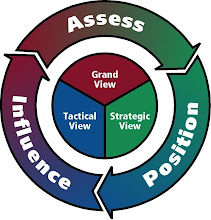
Compass AE principle: Process Precedes Technology


Many companies and governments believes in planning and operating from ground up. These groups rarely implement any advanced thinking and strategic foresight in their plans. If there is a problem, they utilize a "find a technological-driven solution and everything would be solved" type of approach. It usually cost the company more money after the damage is done.


Proper Preparation Prevents Pissed, Poor Performance
Compass AE is a team collaborative process that.emphasizes on advanced planning.

With their Tangible Vision, the Compass team is always prepared for all situations. They understood the specific priorities, the particular approaches and the different circumstances that could occur.

A properly-built process enables the project implementors to effectively utilize the technology in specific situations. Without a process, technology is only effective in limited situations,

If you are interested in knowing more about Compass AE as a strategic collaborative tool. please e-mail us at Service[aatt]collaboration360[ddott]com

###

February 4, 2008

SHANGHAI — For two weeks running, much of this country, long known for its capacity for mass mobilization, has been tied in knots by a series of major snowstorms.

Although the snowfall has been described as the worst here in 50 years, it has been nothing like the deep cover that blankets parts of New England or the upper Midwest in many winters.

But its crippling effect seems to have been mostly because of surprise. The storm knocked out electricity and water supplies, threatened the coal supply that fuels the country’s power plants and stranded millions of Chinese on the eve of the year’s most important holiday.

Many of the worst effects have been in parts of east-central and southern China, which are largely unaccustomed to serious snowfall.

Many victims, however — as many as 100 million people were directly affected — equate surprise on such a huge scale with lack of preparation.

For migrant workers unable to take their annual leave for the Lunar New Year, or for others stuck at home without electricity, water, regular supplies of food or even reliable news, the government, instead of an unpredictable weather system, increasingly appears to be the culprit.

In the last week the Chinese government has worked as hard at public relations over the crisis as it has over crisis management itself.

Prime Minister Wen Jiabao, who has traveled around affected areas almost nonstop, went early in the week to the southern city of Guangzhou, where as many as 800,000 people had gathered at the train station at one point seeking to begin their annual vacations.

President Hu Jintao went to a coal mine in northern Shaanxi Province to encourage miners to redouble their efforts, including forgoing New Year celebrations, to spare the country’s power grid from further brownouts. Mr. Hu, who is known for his circumspection in public, was quoted as saying he was unable to sleep because of the scale of the emergency.

But in many badly affected areas the government seems to have almost disappeared, so overwhelmed it has been by the demand for emergency services. In other areas poor coordination between levels of government and among various agencies has seriously complicated matters.

“The main problem is lack of preparedness,” said Luo Shihong, a relief volunteer in Guiyang, in Guizhou Province. “By late January both the government and people thought the sky would clear up in a couple of days and it would be over. The officials had a lot of confidence initially, then a day or two later they discovered how unprepared they were mentally, physically and in terms of manpower.”

Xie Yonggang, a crisis management expert in northeastern Heilongjiang Province, had a similar explanation: “Despite the weather forecasts, the transportation department didn’t realize how serious this was until all the roads were already blocked.”

In Guangzhou, the capital of southeastern Guangdong Province, which has the largest concentration of migrant labor, these crossed signals may have narrowly missed causing disaster among the desperate crowds stranded at the train station.

Provincial authorities have worked hard for days to convince would-be travelers to abandon their plans to spend the holidays with family in faraway provinces, arranging ticket refunds, setting up shelters and offering nonstop propaganda about the money-saving virtues of staying put. Several hundred thousand people were gradually persuaded to leave the area of the train station.

On Thursday, though, a spokesman for the Railway Ministry said anyone wishing to travel home by train from Guangdong Province would be able to do so within five days. That brought a new surge of passengers, worsening the potentially explosive scene at the station.

Two people reportedly died at the station on Sunday, one crushed in a stampede and the other electrocuted as he tried to jump aboard a train.

“The Railway Ministry has a tone that is different from that of Guangdong, whose attitude had been clear,” said Wen Yunchao, a freelance Internet journalist. It would have been better to hold back as many people as possible so that some could go, instead of telling everyone they could go, he said.

The crisis in Guangdong has been made worse by other contradictions, as well. Although the provincial government has tried to encourage workers to remain at their dormitories, nobody seems to have coordinated with the factories.

“Many factories in the Pearl Delta are already closed or have laid off workers,” said Mr. Wen, the journalist. “The workers at those places have to go home, and they have brought all of their belongings and a few days’ cash out with them. They don’t plan to return to Guangzhou and don’t have a way back home, and we’ve seen no government arrangements directed at this group.”

Transportation is far from the only problem. China’s entire power system, from its extensive reliance on coal to its use of a high-tension power grid spanning the country, has proven surprisingly vulnerable. Agriculture, too, has suffered.

With train service badly affected, the authorities have faced the awkward choice of ferrying passengers or ferrying coal to power plants with the locomotives still in service. By some estimates, China’s coal reserves at power plants had dwindled to a historic low, with only a two-day supply remaining in many places.

Liu Xinfang, a spokesman for the national grid, said that as of Saturday 2,000 transmission towers and about 24,000 miles of transmission cables were still down in central and eastern China. “The wires have been frozen into huge ice sticks,” he said. “Some towers are bearing four times their weight.”

Others said the high number of collapsed transmission towers was a result of the fact that in southern China they are spaced far apart, largely as an economy measure.

One of the worst-hit areas for power has been Chenzhou, a city of four million in Hunan Province, where many have lacked water, electricity, heating or commercial food supplies for 10 days.

“Our power grid system was seriously damaged, in fact torn to pieces, and it is very hard to repair,” said Li Yufang, chief of the city’s emergency operations center. “When one part of the grid is fixed, another suddenly collapses, so power can only be transmitted intermittently.”

In southeastern Guizhou, another hard-hit area, officials said there had been extensive loss of winter crops, like wheat. Power has been out there for weeks.

“In towns and villages life now depends on primitive means,” said Lu Jiang, a spokesman for Southeast Qian Prefecture. “We get light from burning pine, and families grind grains with stone mortars. It’s not difficult to survive, but to live the way we did before the snow began, we will have to wait until the next season.”


Copyright 2008 The New York Times Company

http://www.nytimes.com/2008/02/04/world/asia/04snow.html

Wednesday, March 12, 2008

A List of Current Project Management Trends


1 "Within three years, about two-thirds of U.S. professionals will be mobile workers. ..." - International Data Corporation 2002.
/// It is only a matter of time that most project teams will be operating from a virtual office. The question is ... how will these teams stay connected as a team? In terms of communications, tools connect them. Does it connects the team as a collaborative team?

2 "... In a recent survey of 124 financial executives, only 21% said they encouraged value-creating behaviors. ..."- Deloitte Dbriefs Webcast, Driving Enterprise Value, October 14, 2004
/// When building a Tangible Vision, the project team is encouraged to define the specific values.

3 "50% of all projects fail and a staggering 31.1% of projects will be canceled before they ever get completed. ..." - The Standish Group
/// This outcome happens when the teams lack a team collaborative process to connect with.

4 "Only 59% of all projects reach the market. In Europe only a meager 45% get shipped. ..." - Embedded Systems 07/2006.
/// From the Standish group report, 30% of all projects was completed on time, on-budget and on target

5. "The average cost of a Fortune 500 project range between $6-10 million before it goes over budget and over schedule. ..."- Baseline Magazine

6. "1 out of every 4 projects never get out of the starting line. ..." - Meta group
/// One in four implemented projects failed due to poor planning and an unwillingness to modify existing business practice.

7. "60% of all requirements for most projects are re-written. ..."- Construx
/// More than 60% of software projects in the U.S. failed, and poor requirements is one of the top 5 reasons.

8 "More than 50% of the project failures are due to reasons outside of the project. ..."
-
Anonymous
/// The project implementors are so focused on daily tasks and activities, that they lose track of their strategic matters and long range goals.

Sunday, March 9, 2008

Cooperation Creates Collaboration


Our Compass AE team collaborative process enables your project team to be strategically positioned ahead of the competition.

The following actions occurs:
  • The team knows the critical path toward completing the goal
  • The team focuses on their strengths while avoiding their weaknesses
  • The team always anticipate or seize opportunities
  • The team always know how to strategically adjust to changes
  • The team knows how to properly shape the path that leads to the completion of the project.
  • The team know how to strategically collaborate.
Our Compass AE process enables your project team to collaborate anywhere regardless of the distance, the technology and the project culture. With a compass direction, they collaborate without borders.

If you are interested in knowing more about Compass AE as a strategic collaborative tool. please e-mail us at Service[aatt]collaboration360[ddott]com


#

Following is an Interesting article on cooperation and gaming collaboration.

Cooperative games get casual players involved

Thursday, March 6, 2008

"... developers create more games that invite people to play collaboratively. Army of Two is the first next-generation title to be built from the ground up with cooperative play in mind, which runs through the bloody story line.

Much like Facebook and MySpace have rocketed in popularity through their focus on community and collaboration, a new generation of console games is offering more opportunities to create social modes of interaction. Unlike the solitary experience of playing a game by yourself or the high-stress environment of playing competitively with other players online, co-op offers an easier way to get into video gaming because you're among friends.

"Competition is fun, but it's just as fun to do teamwork," said Nick Puleo, founder of Co-Optimus, a Web site devoted to cooperative gaming. "Co-op is more of a positive thing than going around and killing the other team. It's built around a story or an objective that you can accomplish together."

Video gaming has had elements of co-op play for years. Two decades ago, arcade rats were playing Double Dragon and Contra side by side. With earlier consoles, gamers played on split screens on their televisions. More recently, hardcore PC gamers have banded together in online games like World of Warcraft to create epic battles and embark on various missions.

But in the past couple of years, there has been a co-op renaissance as developers started building the feature into their games, this time with online play so friends can team up remotely. Gears of War, Rainbow Six: Las Vegas and NHL 08 have utilized co-op to good effect. Upcoming titles like Resistance 2, Fable 2 and Haze are all building in more dynamic co-op features that allow up to eight players to work together.

One of the best-known titles in this new crop of co-op games is Rock Band, a four-player music game in which people play as members of the band. Greg LoPiccolo, vice president of product development at Harmonix Music, the developer of Rock Band, said the style of the game and its cooperative play have helped the company not only sell 1.5 million copies in the past few months but also reach out to a broader audience.

"There is a whole vast audience, specifically women, for whom competition is not their main desire for entertainment," LoPiccolo said. "Rock Band has been a good fit for them. From the outset, we hoped we would pull in a new set of customers who don't think of themselves as gamers."

Building co-op features into games isn't as simple as just adding a character. In Army of Two, the developers went to great lengths to ensure that both players can roam separately but
also work well in concert.
That can be harder in story-based games, where one player's progress will set off events in the game. In Army of Two, designers had to be mindful of tracking two players, ensuring their independent movements still work within a linear story line.


/// With Compass AE, each team member always knows what the entire team is focused on. When a Compass team that builds, connect and lead with their Tangible Vision, they will always succeed.


The game also forces players to revive each other, work in tandem to move around, and cover each other during firefights. When done well, the game can be rewarding for friends who are playing only recreationally, said Reid Schneider, senior producer for Army of Two at Electronic Arts.

"It's almost like watching a football game with a buddy as opposed to trying to compete with other," Schneider said. "It's a different experience with different expectations. This is more about the core enjoyment of playing together."

In Rock Band, designers allowed players of different skill levels to play with each other. But if one player falls behind and is on the verge of ending the band's collective round, a star player can save a bandmate through the use of stored "overdrive power."

"That can be really rewarding, if you're struggling and then you have a bandmate rescue you," LoPiccolo said.

Ted Price, president and CEO of Insomniac Games, which is releasing Resistance 2 this fall, said co-op can bring new gamers further into the gaming world. He said games like Resistance 2, which will feature eight-person co-op play, can prepare people for more intense multiplayer battles online.

"We think co-op can serve as a bridge between single player and multiplayer," Price said. "It's not about getting your butt kicked in multiplayer (games). We're introducing multiplayer concepts in a more safe way."

Peter Moore, president of the EA Sports label, said he believes co-op can draw players into games they might have thought were too daunting, such as shooters or sports games like NHL 08 or FIFA 08. By teaming with stronger players, new players can not only have fun but gain confidence, he said.

He said the co-op play was one of the nice features of Gears of War, a title published by Microsoft when he was vice president of Microsoft's gaming business.

"In Gears, you had each other's back and you took care of each other," Moore said. "Even if you were weaker, you could last longer and have more fun."

E-mail Ryan Kim at rkim@sfchronicle.com.

http://www.sfgate.com/cgi-bin/article.cgi?f=/c/a/2008/03/06/BU24VEBTK.DTL

This article appeared on page C - 1 of the San Francisco Chronicle

###

Monday, March 3, 2008

The Growing Trend of the Virtual Office


There is a slow inclining trend of virtual offices and large empty office buildings. ...
Our research tells us that the era of working in one central office is on a decline. The era of the virtual office began in the early 1990's and will continue to grow exponentially.

The question is how do you get your team to strategically collaborate as a team?


#

March 2, 2008
The Office as Architectural Touchstone

By DAVID W. DUNLAP

IT will be either one of the most challenging fixer-uppers in the history of modern architecture or one of the most significant tear-downs.
In any case, Alcatel-Lucent Bell Labs in Holmdel, N.J., is for sale.

A decade ago, as many as 6,500 people worked in the low-slung complex, whose pioneering mirrored-glass facade reflects a gleaming three-legged water tower that looks like a giant Bell Laboratories transistor and pond-speckled landscapes where waterfowl outnumber humans.
Today, it is empty but for a few caretakers.

On a winter day, its vast atriums shudder with the sound of wind buffeting the sawtooth skylights. The only things moving along the miles of corridors are shadows.
And a prospective owner — probably more attracted by a contiguous 473-acre parcel near the Garden State Parkway in Monmouth County than by a vast, unwieldy monument — could demolish every bit of it. Designed in 1957 for Bell Laboratories, part of the former Bell System, by the architectural giant Eero Saarinen and the landscape firm Sasaki, Walker & Associates, the complex no longer suits today’s much smaller Bell Labs or its corporate parent, Alcatel-Lucent.

The property is on the market, but it is hard to imagine finding a new occupant for a structure custom-built two generations ago for physical lab work by a giant monopoly that no longer exists. The main building, with 1.675 million square feet of space, is organized into four pavilions set among atriums and linked by sky bridges. The perimeter circulation pattern leaves few offices with their own windows. Concrete walls divide many spaces.
While the fate of the Holmdel building is the most compelling preservation drama of the moment, it is not the only suburban corporate campus confronting 21st-century realities.

Mr. Saarinen’s research center for I.B.M. in Yorktown Heights, and Edward Durell Stone’s PepsiCo World Headquarters in Purchase, both in Westchester County, are among those that have been immaculately kept by their corporate occupants. But Union Carbide’s former headquarters in Danbury, Conn., has been in a state of flux almost since it opened. Others, like the General Foods headquarters in White Plains, have shed their original use and identity. I.B.M. kept its headquarters in Armonk, but in a newer and much smaller building.

“The less-centralized business model that I.B.M. has moved to can be done without the massive physical headquarters of past business eras,”
said Fred P. McNeese, director of I.B.M.’s corporate media relations. “There is also a different way of working, caused by advances in technology, that provides persons the ability to work remotely, doing the things that would have required them to come into a headquarters building in the past.”

/// Project implementors operate remotely is the growing trend.

How much longer can any of these postwar corporate centers — perfect embodiments of a moment in history when cities began to feel pestilential, when suburban flight grew easier on the interstates and when faith in America’s corporate power was unshakable — maintain the architecture and landscaping that made them such landmarks?

...
... Precisely because of those changes, solitary corporate campuses are regarded as “an evolutionary dead end” by Robert D. Yaro, president of the Regional Plan Association, a nonprofit planning group concerned with New Jersey, New York and Connecticut. “They don’t provide the adaptable, flexible space that companies need,” he said. “They’re great architecture, but they act as a kind of straitjacket.”

... “Driving a long distance to a sylvan location is less appealing than it used to be,” Mr. Yaro said. In the tumultuous wake of World War II, the stand-alone corporate center in a verdant setting seemed like the wave of the future. The prospect of World War III loomed large enough that when the General Foods Corporation announced it was trading Park Avenue for Westchester Avenue in 1951, it took pains to say that “the possibility of an atomic attack on New York was not a factor.”

/// The emergence of the global economy and information technology has changed the rules of the global marketplace. ... The ease of communications and absolute privacy are essential to the remote project team. It is also important to collaborate as a team. Does your team know how to collaborate anywhere as a team?

Copyright 2008 The New York Times Company
http://www.nytimes.com/2008/03/02/nyregion/nyregionspecial2/02Rlandmark.html?

Sunday, March 2, 2008

The Wisdom of the Masses


The question is: how do you get a crowd to work as a team?

###

March 3, 2008
E-Commerce Report
Putting Innovation in the Hands of a Crowd
By BOB TEDESCHI

IF executives are going to rely on the wisdom of the masses for business help, it’s probably time the masses get a little compensation for it.

That’s the theory behind Kluster, the newest in a lineup of companies using the Web to channel the collective wisdom of strangers into meaningful business strategies. With a cash reward system for contributors and a big beginning at the TED conference last week in Monterey, Calif., Kluster hopes to attract just enough visitors with just enough business smarts to gain early momentum.

Along with members of the public, the 1,000 attendees of TED, a conference named for technology, entertainment and design that attracts leaders from many industries, used Kluster to generate ideas for a new product, then chose the most promising one and collaborated on the design. The result was Over There, an educational board game intended to promote cultural awareness, with questions like, What percentage of the world’s population lives further than one mile from their nearest pure water source?

According to Ben Kaufman, Kluster’s 21-year-old founder, there were a few parameters, including provisions that the product could not be wider or longer than eight inches and only specific materials, like single-injection plastic, could be used. Going into the process, Mr. Kaufman said he hoped the product would be something that doesn’t just serve an uninteresting consumer need, but a humanitarian product that can be used by everyone.

Mr. Kaufman said that would actually be a departure for him. As a founder of Mophie, a manufacturer of iPod accessories, Mr. Kaufman last year held a product design contest at the Macworld conference, with attendees submitting ideas and using a company Web site to refine designs and vote on the winner.

Out of that came the Bevy a key chain and bottle opener built into the case for an iPod Shuffle which Mophie sold by the thousands to retailers around the world. On the heels of that success, Mr. Kaufman in August sold Mophie for an undisclosed sum, then set out to build a business out of the process he used at Macworld.

Kluster includes a number of refinements to that process. Those who join are given 1,000 units of Kluster scrip, called watts, and they may earn more by telling the site more about themselves, like their area of expertise, age and income. Meanwhile, businesses are invited to post specific tasks to be addressed, like creating a new product, logo or corporate event.

Participants browsing the ideas offered by Kluster members can bet some or all of their watts on the ideas they most believe in, or post ideas of their own. Those who had winning ideas earn at least 20 percent of the bounty offered by the company that sought the idea, as well as more watts, while those who bet on the winning idea earn watts. Those who bet wrong lose what they wagered.


Mr. Kaufman said several well-known manufacturers would offer projects on the site after the TED contest. He would not disclose the identities of those businesses, but some, he said, would offer $50,000 or more for winning ideas, while others expect to give far less and hope that they have enough good will among their customers to spur ideas.

Kluster will make money, he said, by taking 15 percent of any rewards offered to projects and by charging fees for prominent placement of projects on the site, among other things.

Don Tapscott, the business strategy consultant and co-author of the book Wikinomics, said executives were quickly warming to the strategic value of P.F.E. ideas, or those proudly found elsewhere.

Throughout the 20th century, we’ve had this view that talent is inside the company, Mr. Tapscott said. But with the Web, collaboration costs are dropping outside the boundaries of companies, so the world can become your talent.

Mr. Tapscott, who credited Procter & Gamble with the P.F.E. concept, said executives can go overboard with the idea of outsourcing innovation if, in seeking such help, they expose too much of a company’s trade secrets. But so far, he knows of no business that has done so.

They always err on the other side, he said. They don’t do enough.

Among the obstacles in Kluster’s path are sites like InnoCentive and Cambrian House, which operate similarly. InnoCentive, based in Waltham, Mass., was until late last year a forum for solving science-related problems, typically for cash rewards. In September, it expanded into business, engineering and computer science, among other things. Since then it has grown by 15,000 participants, to 140,000, the company said.

Cambrian House, which is based in Calgary, Alberta, and has 64,000 participants, will also expand its Web site this year to accommodate projects across a broader range of industries. Until now, said Jasmine Antonick, a Cambrian House founder, the site has attracted mostly software and Web entrepreneurs.

Ms. Antonick expects the site to be profitable later this year, when it receives a share of payments made by businesses to several of Cambrian House’s participants, like two men who created Gwabs, an online video game that is to be distributed by an undisclosed company this summer.

Next month, it will introduce VenCorps, a site on which venture capitalists and other investors will review business ideas from the public and, after about 30 days, reward the best idea with $50,000 in exchange for a share of ownership.

VenCorps is a partnership between Cambrian House and Spencer Trask Collaborative Venture Partners, a division of the New York venture firm Spencer Trask. Sean Wise, a Collaborative Venture Partners founder, says he has high hopes for the site.

No matter how good a V.C. I could be, he said, I could never be smarter than the wisdom of a collective community.

Josh Bernoff, an analyst with Forrester Research, said that Kluster had commercial potential. Asking communities for help with solving problems is certainly going to help businesses, he said. It’s just not something you can count on delivering business value yet.

Copyright 2008 The New York Times Company

http://www.nytimes.com/2008/03/03/technology/03ecom.html

# # #