Saturday, February 16, 2008

A Company That Grinds, Will Falter


Yahoo's problem is similar to that of many Silicon Valley companies. They have a difficult time determining what are their key priorities. Concurrently, they do not know how to rank what ideas matches the goal of their company.

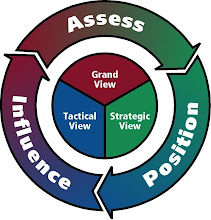
We believed that these companies lacked the strategic overview from top to bottom.

Without a strategic overview, these companies are grinding step by step, never knowing what is the road ahead. T
hey never realized the Compass of their Tangible Vision.

With our Compass AE process as a decision-making tool, the decision makers determines what are their key priorities by studying their planned outcome, their priority ranking of value points and other strategic specifics of their Tangible Vision.

By gaining an strategic overview, Compass AE enables the decision makers to position themselves ahead of the competition.

Does your strategic process enables you to position ahead or does it place you into a situation of grinding behind your competition?


# # #

February 8, 2008
Is It Too Late for Yahoo?
By MIGUEL HELFT and BRAD STONE

SAN FRANCISCO One of the first questions that Jerry Yang and his top lieutenants pondered after he became chief executive of Yahoo last summer was whether the company could remain independent. They quickly answered yes.

But Mr. Yang, who founded Yahoo along with David Filo in 1995, had a harder time coming up with convincing answers for many of the more complex questions facing the company. How exactly would an independent Yahoo sharpen its focus, shed marginal projects and become a stronger competitor to Google, the runaway leader in online search and advertising?

Mr. Yang, a cerebral, highly analytic executive who, by all accounts, cares deeply about the company he helped build and its workers, appears to have run out of time to answer those questions. A $44.6 billion bid from Microsoft is once again forcing Mr. Yang and his board to consider the viability of Yahoo as an independent company.

This time, Mr. Yang, 39, faces enormous pressure as he decides whether to try to rescue the company from the clutches of Microsoft, or accept the bid and watch Yahoo become part of Microsoft’s arsenal in its no-holds-barred brawl with Google.

Some analysts and several current and former Yahoo executives are, meanwhile, wondering whether things would be different had Mr. Yang been quicker at making some of the tough choices that Yahoo faced.

He came on board, announced a 100-day strategic review and promised there would be no sacred cows, said Mark Mahaney, an analyst with Citigroup. One hundred days went by, and no cows were slaughtered.

It took until last week, more than six months into Mr. Yang’s tenure, for him to announce that Yahoo would cut 1,000 employees. At the same time, however, Mr. Yang warned investors that he had decided to make larger-than-expected investments in the business. The announcement sent the company’s shares down to their lowest level in more than three years, precipitating Microsoft’s bid.

Why couldn’t those things be hashed out in the first 100 days? Mr. Mahaney asked.

Yahoo declined to make Mr. Yang available for an interview. But other Yahoo executives strongly defended his short tenure, saying Mr. Yang had quickly set priorities and laid out a precise strategy for making Yahoo more competitive.

We have moved quickly and aggressively to implement our strategy, said Hilary Schneider, an executive vice president in charge of Yahoo’s network of advertisers and publishers.

By most measures, Mr. Yang is one of the most successful entrepreneurs in Silicon Valley history. He helped build Yahoo from an early directory of Web sites into a sprawling Internet giant that offers services from online dating to e-mail that are used by nearly 500 million people around the globe. His wealth is estimated to top $2 billion.

Early on, as Yahoo’s business grew, Mr. Yang and Mr. Filo recognized that they did not have the experience to run the company. They called themselves Chief Yahoos and hired others to fill the chief executive post: Tim Koogle and then Terry S. Semel. Mr. Filo worked as an architect of Yahoo’s computer systems. Mr. Yang played the role of strategic adviser and represented Yahoo in front of investors and business partners.

Last June, Yahoo investors became increasingly disenchanted with Mr. Semel, as Yahoo struggled to compete with Google in the online search business and faced growing threats from successful social networks like MySpace and Facebook.

Mr. Semel resigned and Mr. Yang was unexpectedly thrust into the chief executive job. He inherited a long list of problems, including a demoralized work force and a company that had grown bureaucratic and cluttered with too many projects.

At the time, Mr. Yang said his years as a Yahoo strategist had prepared him well for the job. And he dismissed speculation that his tenure would be short-lived.

But many Yahoo executives, as well as some of Mr. Yang’s friends, say he accepted the job only reluctantly, out of a sense of responsibility and care for his company.

Mr. Yang himself, at times, suggested that some of the burdens of his new role weighed heavily on him. Speaking to Yahoo advertisers at a conference in October, he described the chief executive job as lonely.

As a founder everybody loves you, he said. When you become C.E.O., you can tell somewhat the behaviors change. He later added: You have to make tough calls.

Mr. Yang is generally well liked by Yahoo’s workers, and his appointment helped improve employee morale. He took steps to restore aspects of the company’s start-up culture, for example, by being more open about the challenges facing it. He held some meetings with executives in the middle of the cafeteria.

Mr. Yang and Yahoo’s president, Susan L. Decker, also moved quickly to hash out a strategy. The two thought that Yahoo’s business plan was basically sound but that the company needed to be better managed and had to get out of some businesses that were not vital to its future. They reorganized to make business units more accountable, and they made some acquisitions to build Yahoo’s advertising and e-mail technology.

They have moved faster than they have in the past and focused on increasing the value they provide to the advertiser, said David W. Kenny, chief executive of Digitas, an interactive marketing agency that is part of the Publicis Groupe.

Mr. Yang and Ms. Decker also began meeting regularly with an expanding group of top executives in the offices of Stone Yamashita Partners, a consulting firm in San Francisco. According to executives who attended those meetings, Mr. Yang and Ms. Decker were quick to outline Yahoo’s top priorities: becoming a starting point for consumers on the Web, developing technology and relationships to sell ads on Yahoo and other Web sites, and opening up Yahoo to outside programmers and publishers.

But to achieve those, Yahoo also had to cut some things. In particular, it had to prune its sprawling Internet portal so that employees could be reassigned to crucial projects.

You can’t place your chips on every spot and every color and every number, said Dan Finnigan, an executive vice president who ran Yahoo’s HotJobs site and left last year. Businesses like travel, shopping, music and even HotJobs were all great products, but none were going to make a huge difference in the fight with Google unless we used them to drive the main search business.

Many other executives agreed that Yahoo had to focus on fewer things. To stress the point, Mr. Yang invited Steven P. Jobs, Apple’s chief executive, to give a pep talk to some 300 Yahoo vice presidents. Mr. Jobs told them that years earlier many Apple insiders wanted the company to compete with Palm’s personal digital assistants. Mr. Jobs said he decided against it, and noted that had Apple gone after Palm, it might not have been able to develop the iPod.

But cutting was not easy for Mr. Yang, who choked up in front of employees years ago when Yahoo made its first significant layoffs after the dot-com crash. When a group of executives presented options, he stalled.

Instead of saying yes or no, there were no decisions, said a person who attended many of the meetings. These decisions are agonizing for him. It’s his caring about the people and the company that make him both great for this job and difficult for the job.

One top executive countered that Mr. Yang had already shuttered some projects and turned Yahoo into a more efficient company, without jeopardizing profitable businesses.

Some analysts said the only move that could have averted Microsoft’s bid was for Yahoo to outsource its search advertising business to Google something the company is now considering.

Jordan Rohan, an analyst with RBC Capital Markets, noted that this decision would have required Mr. Yang to admit defeat in a critical area. It would also have required a sense of urgency that Jerry has not necessarily shown, he said.

On Wall Street, patience was running thin. Yahoo shares kept declining, from a high of more than $34 in October to about $24 at the end of the year and a low of $18.58 last week.

We are still trying to do too many things, and fund them in a way that we need to in order to win, said a senior executive who has grown disillusioned with Mr. Yang. With the stock at $24 or $25, we’d be having a very different conversation now. But there were decisions made that were naïve that have left us in a position where we can’t control our destiny.

Copyright 2008 The New York Times Company

http://www.nytimes.com/2008/02/08/technology/08yahoo.html
# # #

Monday, February 11, 2008

Does Your Team Have a Compass of their Tangible Vision?


You and your team are starting a new project. They need to brainstorm.

Following are some of the brainstorm-related questions that we ask the team of our clients:
  • Do you focus on knowing the planned outcome?
  • Do you prioritizes what are your core values into your brainstorm session?
  • Does the specifics of the objectives connect to each other and the goal?
  • Do you know what are the guidelines that your team abides by?
  • Does you and your team connect to Collaborate?
If you cannot answer these questions, you need a strategic collaborative process.

You need Compass AE.

###

February 10, 2008
Slipstream
Mashups Are Breaking the Mold at Microsoft
By JOHN MARKOFF

REDMOND, Wash. TUCKED away in a building on this forested corporate campus, John Montgomery and his team of 17 programmers might be more at home in Silicon Valley than at Microsoft.

Compared with its tenacious Internet competitors like Google and Yahoo, Microsoft is generally still viewed as being more of the shrink-wrapped software generation than the Web 2.0 world.

In Silicon Valley today, software is increasingly delivered as a Web service, it is often put together by teams of programmers who might be scattered on three continents, it’s often free to users, and Web surfers usually do the testing soon after the first prototype is complete.

By contrast, Microsoft has long been a software engineering culture in which huge projects like Windows Vista are developed and tested by teams of hundreds, and whose completion time is measured in a large fraction of decades.

Although it is not yet widely visible to the outside world, some people inside Microsoft are beginning to break that mold.

Mr. Montgomery, a veteran product manager who has also worked as a computer industry writer and editor, is an example of how it just might be possible to teach dinosaurs to dance.

Last fall, his team introduced an intriguing software Web service called Popfly that is intended to make it possible for nonprogrammers to plug together Web components and data sources quickly to create useful new Web services. For example, news feeds could be added to digital images, or data lists to maps.

Introduced at the Web 2.0 conference last year by Steven A. Ballmer, Microsoft’s chief executive, Popfly was picked by PC World magazine as one of the most innovative computing and consumer electronics products of 2007. It has garnered more than 100,000 users the company says the exact number is confidential and now has a library of more than 50,000 mashups: new components or Web pages that have been created in a visual snap-together fashion, like Lego blocks.

The mashup is at the heart of a generation of Lego-style software that is emblematic of the second generation of the Internet. Both Google and Yahoo have developed tools to help Web users display apartment rentals on maps, or build complicated Web sites like

TripTouch.com, which is intended to offer diverse local information for travelers.

The Popfly programmers, however, have gone a step further in an effort to design a tool that is intended for a generation of Web users who are familiar with the Internet but are not skilled programmers.

A user might take Popfly and mash up his list of Amazon book recommendations with the Seattle Library book catalog on the Web, he said, and receive a notification when the waiting list for a particular book was down to zero.

This is not just a passive experience, Mr. Montgomery said. You can take this stuff and use it in new ways.

He now sees his target audience as people who are not professional developers, but who work with information.

Popfly, he said, is for the 21- to 27-year-old crowd who grew up on the Web.

They have never known a world without eBay, Amazon, or Google, he added. They assume that when you create a piece of software it will be Internet-connected and it will have an innate sense of who your friends are.

Microsoft is certainly not alone in seeing this kind of an opportunity. Yahoo offers a widely used tool call Yahoo Pipes that offers some of the same capabilities as Popfly, and Google has designed a mashup editor for more skilled programmers.

But Mr. Montgomery sees Popfly as a more ambitious and comprehensive effort. He also thinks that it could turn into a general educational tool for nonprogrammers.

That is what prompted him to visit an introductory computing course in December at Bentley College in Waltham, Mass., where the computer scientist Mark Frydenberg is using Popfly to teach his students how to interact with digital data in new ways.

So far, students’ projects have run the gamut from simple calculators or clocks that can be displayed on a Web page, to World of Warcraft blocks that make it possible to connect the multiplayer fantasy game to other Web services like Facebook.

Mr. Frydenberg said he believed that Popfly would be a perfect educational tool for the Bentley students, because the college has a general business focus.

This will help the students think about merging data from two different sources, he said. That’s a problem that happens in business all the time.

IF Popfly can become that kind of a tool widely used on the Web, it will be an important quiver in the strategy that was started in 2005 by Ray Ozzie, who is now Microsoft’s chief software architect.

His message was that the only interesting software is going to be software that is connected to the Web and we have to work on that, Mr. Montgomery said.

At the time, Mr. Montgomery was the product manager of the company’s .Net software business, which had been the focus of Microsoft’s previous Internet strategy. But he quickly realized that Microsoft had to reach a much broader audience than its core base of professional software developers.

Mr. Montgomery was intrigued by the phenomenon of 13-year-olds who were tricking out their MySpace pages with digital bling. They didn’t realize it, but by cutting and pasting snippets of code together, they were programming, he said.

The largest challenge facing the Microsoft team of Popfly developers will be to gain the acceptance of the broader Web world. Because the company chose to design Popfly using a Microsoft Web graphics and animation technology called Silverlight, it will be treated with suspicion by an Internet universe that is increasingly committed to open standards.

Silverlight is an alternative developed by Microsoft to compete against Adobe’s Flash and, more recently, Flex systems, that are now used ubiquitously by Web developers.

Mr. Montgomery will also have to overcome the skepticism with which many Internet veterans now view Microsoft.

Popfly shows me that Microsoft still thinks this is all about software, rather than about accumulating data via network effects, which to me is the core of Web 2.0, said Tim O’Reilly, the founder and chief executive of O’Reilly Media, a print and online publisher. They are using Popfly to push Silverlight, rather than really trying to get into the mashup game.

For his part, Mr. Montgomery believes that Popfly does have some very big ideas to offer the Web world. He is following in an important tradition that began in the 1960s with computer languages like Logo and Smalltalk, which were aimed at unlocking the power of computing for nontechnical users. Today he is betting that Popfly will offer a simple way to give the power of programming to the rest of us.

Copyright 2008 The New York Times Company

http://www.nytimes.com/2008/02/10/business/10slipstream.html

Friday, February 8, 2008

Competing in the Global Economy (Using Compass AE to Create Innovation)


"Genius is one percent inspiration and ninety-nine percent perspiration." --- Thomas Alva Edison

"If Edison had a needle to find in a haystack, he would proceed at once with the diligence of the bee to examine straw after straw until he found the object of his search. I was a sorry witness of such doings, knowing that a little theory and calculation would have saved him ninety per cent of his labour." --- Nikola Tesla, New York Times, October 19, 1931

With the Compass AE process, the project team understands the big picture. They understand the connections between the incremental chain of objectives to the goal . Instead of grinding, the team is strategically positioned to complete their goal.

A Compass team that build, connect and lead with a Tangible Vision is a team with positional advantage. We have a specific template that enables product development teams to stay focused on their objectives while minding the big picture.

When a Compass team achieves the gold standard of innovation, they have a good chance of becoming a successful trendsetter.


If you are interested in learning more about Compass AE, please e-mail us at contactus [tat]collaboration360[dott] com. [ Replace [tat] with "@" and [dot] with "." ]

###

Copyright:2008 © Collaboration360 Consultants (C360).
Copying, posting and reproduction in any form (without prior consent) is an infringement of copyright.

###

February 3, 2008
Unboxed
Eureka! It Really Takes Years of Hard Work

WE’VE all heard the tales of the apple falling on Newton’s head and Archimedes leaping naked from his bath shrieking “Eureka!” Many of us have even heard that eBay was created by a guy who realized that he could help his fiancée sell Pez dispensers online.

The fact that all three of these epiphany stories are pure fiction stops us short. As humans, we want to believe that creativity and innovation come in flashes of pure brilliance, with great thunderclaps and echoing ahas. Innovators and other creative types, we believe, stand apart from the crowd, wielding secrets and magical talents beyond the rest of us.

Balderdash. Epiphany has little to do with either creativity or innovation. Instead, innovation is a slow process of accretion, building small insight upon interesting fact upon tried-and-true process. Just as an oyster wraps layer upon layer of nacre atop an offending piece of sand, ultimately yielding a pearl, innovation percolates within hard work over time.

“The most useful way to think of epiphany is as an occasional bonus of working on tough problems,” explains Scott Berkun in his 2007 book, “The Myths of Innovation.” “Most innovations come without epiphanies, and when powerful moments do happen, little knowledge is granted for how to find the next one. To focus on the magic moments is to miss the point. The goal isn’t the magic moment: it’s the end result of a useful innovation.”

Everything results from accretion, Mr. Berkun says: “I didn’t invent the English language. I have to use a language that someone else created in order to talk to you. So the process by which something is created is always incremental. It always involves using stuff that other people have made.”

The innovator Jim Marggraff, creator of an interactive world globe called the Odyssey Atlasphere, the LeapPad reading platform for children and LeapFrog’s Fly talking pen, explains that each creation built on the work that went into making the previous one. That same process of accretion holds true for the Pulse Smartpen, introduced last week by his new company, Livescribe; he hopes that the product, which records audio while it tracks what the pen writes, will bring back computing to its pen-and-paper roots.

“The aha moments grow out of hours of thought and study,” he says. “If you look at my innovations, there’s a common theme. I take something familiar, intuitive and ubiquitous and recast it in a manner that will redefine its use to drive profound change.”

The Atlasphere grew from his dismay that one in seven American adults could not find the United States on an unmarked world map, and that one in four couldn’t find the Pacific Ocean. He sees geographic illiteracy as a big obstacle to world peace, so he packed his interactive globe with games and tens of thousands of geographic and cultural facts, all available at the touch of a stylus.

The “near touch” technology that went into the Atlasphere might have other educational benefits, Mr. Marggraff realized. A self-described “student of learning and learning systems,” he had been puzzling over how to help his 4-year-old son understand reading.

“I was pointing to the words on the page and trying to explain what a word was, but I’d watch him and realize that he didn’t have any idea what I was talking about,” he says. “This black-ink thing here is called a letter — I realized this was all very abstract.”

Mr. Marggraff likes to go to bed with one or more problems on his mind. “Typically, I’ll fall asleep chewing on it and then I’ll wake up at 4 in the morning with some sort of solution,” he says.

That’s a common theme in innovation, according to Mihaly Csikszentmihalyi, a psychologist at the Claremont Graduate University in California. “Cognitive accounts of what happens during incubation assume that some kind of information processing keeps going on even when we are not aware of it, even while we are asleep,” he writes in “Creativity: Flow and the Psychology of Discovery and Invention.”

This time, Mr. Marggraff awoke at 4 in the morning determined to “flatten out” the globe so he could use the Atlasphere’s near-touch technology on a single page and, ultimately, within a specially designed book to help children learn how to read. Though some would call this an epiphany, it took years of trial and error to make the LeapPad a reality.

“There’s an aha moment followed by a ton of work to figure out what it is that’s actually going to work,” agrees Douglas K. van Duyne, co-founder of Naviscent, a Web usability consulting firm. “It goes back to that old saw that invention is 1 percent inspiration and 99 percent perspiration. The idea of epiphany is a dreamer’s paradise where people want to believe that things are easier than they are. It takes a huge amount of determination and effort to follow through.”

Businesses want to believe that a brilliant mind or a brilliant idea can make or break their innovation efforts, Mr. Berkun says. The myth of epiphany has a long history because it’s appealing to believe that there is a short, simple reason that things happen. The myth has staying power because there is a tiny core of truth within it.

“But as soon as you dig into what happened five minutes before that magic moment, or a day, or a week, or a month,” he says, “you realize that there is a much more complicated story in the background."

THAT more complicated story most often begins and ends with a determined, hard-working and open-minded person trying, and failing, to find a solution to a given problem.

“Successful entrepreneurs do not wait until ‘the Muse kisses them’ and gives them a ‘bright idea’: they go to work," Peter F. Drucker says in “Innovation and Entrepreneurship.” “Altogether they do not look for the ‘biggie,’ the innovation that will ‘revolutionize the industry,’ create a ‘billion-dollar business’ or ‘make one rich overnight.’ Those entrepreneurs who start out with the idea that they’ll make it big — and in a hurry — can be guaranteed failure.”

It’s not that these magical moments of epiphany don’t happen. In small ways, they happen all the time. But they’re not nearly as important as what the innovator did before — or ultimately does after — the magic light bulb goes on. As the French scientist Louis Pasteur once said, “Chance favors the prepared mind.”

Janet Rae-Dupree writes about science and emerging technology in Silicon Valley.

Copyright 2008 The New York Times Company

http://www.nytimes.com/2008/02/03/business/03unbox.html

Thursday, February 7, 2008

Saturday, February 2, 2008

Is Compass AE the Answer for the Productivity Paradox?


Many people believe that being more knowledgeable means that they are more productive in their work. Without a strategic process, these people spend their time grinding at the current task, . . .
barely understanding what is in front of them.

Cardinal Rule: Process Precedes Technology
Some people prefer using technology as the complete solution for everything. Realistically, technology is a narrow short cut that completes the objective. It rarely solves the long term problem. A good general strategy process is usually the answer. Where it specifically starts by understanding the goal and the objectives.

In most cases, most people work from ground up. Focusing on one task at a time without ever acknowledging what is ahead of them. They grind away their resources and time.


With the Compass AE process, the project implementers are able to collaboratively see the full Compass of their plan (Tangible Vision) regardless of their project culture, technology and distance.

Specifically, they are able to focus on completing their objectives while minding the goal. This feature positions the implementors in a strategic advantage.

Does your planning process allows your team to perform the above standards? If not, you need Compass AE.

If you are interested in learning more about Compass AE, please e-mail us at contactus [tat]collaboration360[dott] com. [ Replace [tat] with "@" and [dot] with "." ]

#

The productivity paradox
By Brent Frei and Mark Mader, News.com

Published on ZDNet News: Jan 29, 2008 4:00:00 AM
If there were a Productivity Hall of Fame, John Deere would definitely occupy a place of prominence.

The 19th century inventor introduced his cutting-edge steel plow with a polished and curved blade in 1837. In the process, he revolutionized agriculture. Tilling an acre of land with a spade required 96 hours and plowing an acre with a yoke of oxen and a crude wooden plow took 24 hours. Deere's steel plow reduced the time to five to eight hours.

Fred Smith would also be inducted into the Productivity Hall of Fame. On the night of April 17, 1973, the Yale-educated logistics master sent the first FedEx narrow-body Dassault Falcon jet roaring down the runway at the Memphis airport. From that moment on, packages were delivered more rapidly--absolutely, positively overnight.

Another sure-fire member of our pantheon of productivity would be Andy Grove, the co-founder and former CEO of Intel. Under Grove's leadership, Intel brought out a new generation of microchips that powered the first wave of PCs in the 1980s. Those PCs with Intel inside spelled the demise of typewriters and paper account ledgers, and set the stage for digital time-saving tools like e-mail.

Even though we now have the technological ability to do faster work, we may not be doing better work.

Deere, Smith, and Grove each made it possible--and easier--for us to do more work faster.

That's the nature of productivity. And productivity is the lifeblood of a nation's economy. America's efficient assembly line culture, spurred by Henry Ford and General Motors' Alfred Sloan, certainly proved this in the 20th century.

Once the Model-Ts started rolling, America's labor productivity growth started surging, averaging about 2 percent each year. That growth rate helped double the U.S. standard of living every 35 years.

As the hyper-prosperous high-tech 1990s unfolded, Americans were living better than at any time in our history. Indeed, the Internet accelerated the U.S. productivity revolution, pushing annual labor productivity growth up to 2.5 percent between 1995 and 2000, and 2.8 percent between 2000 and 2004.

Productivity growth has slowed since 2004, however, and nobody is sure why.

Certainly, technology has done its job. In the wake of downsizing, budget cuts, re-engineering, and outsourcing, it has filled in the gaps at company after company. As a result, supply chains are efficient and lean, the financial services industry is automated, and manufacturing processes are flexible. Indeed, the average company in America now spends between $5,000 and $10,000 per knowledge worker on hardware and software designed to boost productivity.

One theory that may explain declining productivity growth has been advanced by McKinsey consultants, who believe that companies have finally cut the non-complex transactional positions that benefit from productivity-stimulating technology. All that's left are complicated and nuanced jobs requiring experience, expertise, judgment, interaction, and collaboration--or tacit knowledge. Increasing productivity for these employees, whose jobs can't be automated, has thus far proven to be a challenge for software developers.

Another way of explaining the decrease in productivity is to admit that much of the productivity-enhancing technology now in use hasn't made us more productive. According to Basex, a research firm focusing on the knowledge economy, interruptions from e-mail, cell phones, instant messaging, text messaging, and blogs eat up nearly 30 percent of each day; on an annualized basis, this represents a loss of 28 billion hours for the entire U.S. workforce, or a $588 billion cost to the American economy.

An equally sad truth is that even though we now have the technological ability to do faster work, we may not be doing better work. More problematic is the fact that we're generally not working easily or happily--in groups or on our own.

A 2006 research study conducted among sales and marketing teams at Intel indicated that 54 percent of those surveyed believed e-mail had a negative impact on their stress levels. And a number of other studies show that productivity-enhancing hardware and software has helped heighten distraction and discontinuity in the workplace at the expense of critical and creative thinking--as well as constructive collaboration.

This is a large and looming problem because, as McKinsey says, we are entering an interaction revolution that will require employees to truly and sensitively come together to achieve top- and bottom-line goals in a hyper-competitive global marketplace.

Automating the knowledge economy is essential to our nation's health. And when this technological turn of the wheel takes place it will almost certainly drive productivity growth back up--but in the right way that makes sense for well-meaning companies and the hard-working people within them.

©2007 CNET Networks, Inc. All rights reserved.

http://news.zdnet.com/2010-9595_22-6228144.html

# # #