Tuesday, August 21, 2007

An Example of Chinese Strategy of Indirectness


Someone recently asked me to enter some interesting examples of the Chinese strategy mindset. The following example is a demostration of indirectness, a favorite approach from the Chinese strategy classics.

The recent alliance of Japan and India is an example of indirectness and collaboration. Both countries understands the notion of competing against China by themselves is suicide.

The objective of Japan is to assist India in building an infrastructure that would benefit the economic state of India and later assist Japan in their manufacturing competition against China.

This grand strategic move by Japan reminded me of a pair of strategem from a book titled "The 36 Strategems" (
Strategem #2 and Strategem #23).

Besiege Wèi to rescue Zhào
(Traditional Chinese:
圍魏救趙; Simplified Chinese: 围魏救赵; Pinyin: Wéi Wèi jiù Zhào)
  1. When the enemy is too strong to be attacked directly, then attack something he holds dear. Know that in all things he cannot be superior. Somewhere there is a gap in the armour, a weakness that can be attacked instead.

    The origins of this proverb is from the Warring States Period. The state of Wèi attacked Zhao and laid siege to its capital Handan. Zhào turned to Qí for help, but the Qí general Sun Bin determined it would be unwise to meet the army of Wèi head on, so he instead attacked their capital at Daliang. The army of Wèi retreated in haste, and they were ambushed and defeated at the Battle of Guiling, with the Wèi general Pang Juan slain on the field.

    In the Second Punic War at the Battle of Zama Scipio Africanus was able to defeat Hannibal's army in Italy not by facing him in the field but by destroying his power base in Spain and menacing his home city of Carthage


Befriend a distant state while attacking a neighbour
(Traditional Chinese: 遠交近攻; Simplified Chinese: 远交近攻; Pinyin: Yuǎn jiāo jìn gōng)
  1. It is known that nations that border each other become enemies while nations separated by distance and obstacles make better allies. When you are the strongest in one field, your greatest threat is from the second strongest in your field, not the strongest from another field.

Source: http://en.wikipedia.org/wiki/Thirty-Six_Strategies

###

The question is "does Japan and India have a Tangible Vision to collaborate with?"

- More to come -


###
August 21, 2007
As Japan and India Forge Economic Ties, a Counterweight to China Is Seen
By HEATHER TIMMONS

NEW DELHI, Aug. 20 When Prime Minister Shinzo Abe of Japan touches down in India this week, it will be the highest-level step yet in what analysts say is a long-term effort to balance, if not contain, China’s growing economic and political might.

As Beijing’s influence in Asia and around the world has grown, their common interests have forced Tokyo and New Delhi to begin warming their historically chilly relationship and to start forging closer economic ties. The key issue facing the whole region is how to accommodate the rise of China, said Suman Bery, the director general of the National Council of Applied Economic Research, a New Delhi research group. Indian economists estimate that Japanese investment in India will reach $5.5 billion by 2011, compared with just $515 million in the 2006 fiscal year.

Mr. Abe is on his first trip to India. He and his Indian counterpart, Manmohan Singh, are expected to unveil public-private partnerships and new business initiatives. Leading the agenda will be a $100 billion infrastructure project to create a high-tech manufacturing and freight corridor between New Delhi, India’s capital, and Mumbai, its port and financial center. It would be the most expensive development project in India, and a third of the bill would be paid by Japanese public and private money. Mr. Abe and Mr. Singh are expected to announce that the two governments have reached formal agreement on the deal.

Japanese business leaders traveling with Mr. Abe will disclose similar deals this week on natural gas, transportation, currency swaps and Japanese investment in Indian educational projects, Indian officials said. Chief executives from Toyota, Mitsubishi, Canon, Hitachi and others have joined a new India-Japan business leader forum, which will meet for the first time on Wednesday in New Delhi.

Consultants are trying, so far in vain, to coin the catchphrase, like the Samurai and the Swami, that will sum up the nascent strategic economic relationship between the countries.

/// Catchphrases do not make a collaborative relationship work

Courting India has come slowly for the Japanese, who were highly critical of India’s surprise nuclear weapons test in 1998. While Japan is a large lender to India, until now it has not been a major investor or business partner. Instead, Japan has virtually sat on the sidelines while countries from Switzerland to Brazil cemented business alliances in India, where economic growth is about 9 percent a year.

Japan’s trade with India was about $6.5 billion in 2006, according to the Indian government about 4 percent of Japan’s trade with China. Whatever doubts Japan had for so long, now India is smelling like roses, said Jagdish N. Bhagwati, an economist and a professor at Columbia University and a fellow at the Council on Foreign Relations. They want to get in before it is too late.

For Japan, India is an attractive market, both for its growing consumer spending and cheap labor. Tokyo also has an interest in diversifying its Asian trading partners and reducing its dependence on China. As an increasingly confident China has flexed its muscle regionally and globally, anti-Chinese sentiment has been rising in Japan, as has anti-Japanese sentiment in China.

India is a much safer bet, in business terms, because it lacks the historical baggage, said Richard Tanter, professor of international relations at the Royal Melbourne Institute of Technology in Australia.

Then there is the straightforward economics. Japanese and other automakers, for instance, view India as a potential manufacturing center that could offer lower labor costs than China. But India’s manufacturing and export potential are still crippled by an inability to move goods in and around the country.

The proposed New Delhi-Mumbai industrial corridor could address that problem. The nearly 1,500-kilometer corridor would include a high-speed freight line and nine 200-square-kilometer investment regions dedicated to industries like chemicals and engineering, as well as three ports and six airports.

Infrastructure projects like the industrial corridor are the kind of thing Japanese companies are particularly good at roads and harbors and ways to get into developing countries, Mr. Bhagwati said. Japanese companies were heavily involved in the construction of New Delhi’s clean, efficient subway system.

India, which desperately needs more power generation, could be a particularly fertile market for Toshiba, which bought the nuclear power plant manufacturer Westinghouse last year.

Any deals between India and Toshiba would be far in the future, though. India’s government is still deeply divided over a deal with the United States that allows India access to civilian nuclear technology, and Japan may not support the United States-India nuclear deal, given Tokyo’s aversion to nuclear proliferation.

Still, on Monday, Mr. Singh stressed India’s commitment to nuclear energy during the opening of a new research center in New Delhi, calling oil imports an unbearable burden.

The most successful India-Japan business partnership to date is a venture by the automakers Suzuki and Maruti, which has become one of India’s leading carmakers after a troubled start in the early 1980s. Sales of its reliable, zippy and cheap Marutis were up 17 percent in the quarter that ended in July from a year ago, to 1.6 million units.

Toyota’s India partnership, Toyota Kirloskar Motors, which dates back to 1999, makes about 60,000 units a year. But, last month Toyota executives said they expected the unit to produce 10 times its current capacity by 2015.

Culturally and economically, Japan and India remain far apart, a fact that government officials and economists said could complicate building a stronger relationship. Speaking Monday during a meeting in a New Delhi hotel to discuss the Japanese prime minister’s visit, Mr. Bery, the director of the New Delhi research group, said Japan’s manufacturing is state of the art, which has not been our strong suit.

Minutes later, the five-star hotel fell victim to one of New Delhi’s frequent power disruptions, the lights flickered out and the meeting carried on in the dark.

Copyright 2007 The New York Times Company

http://www.nytimes.com/2007/08/21/business/worldbusiness/21rupee.html

###

fyi- Since the 1960's, Sun Zi Art of War and other Chinese strategy classics became quite "popular read" for Japanese businessmen.

I always found it to be fun and
interesting to use the strategic approach (and/or intellectual property) of your competitor against the originator.


Connect to Collaborate (Working with Your Rival)


To connect to collaborate, both sides need to define their Tangible Vision first.
Collaboration is about everyone cooperating for the greater purpose.

Here is a story on the alliance of Cisco and Microsoft. Whether they can collaborate as one entity would be an interesting story.

Monday, August 20, 2007

Collaborate Anywhere


To collaborate anywhere with great efficiency, it helps to have good tools

###
August 20, 2007
Hewlett Introduces a Web Feature to Make Document Printing Mobile
By JOHN MARKOFF

PALO ALTO, Calif., Aug. 18 Hoping to alleviate a frustration of mobile computing, Hewlett-Packard has quietly introduced a free service designed to make it possible to print documents on any printer almost anywhere in the world. Cloudprint, which was developed over a period of several months by a small group of H.P. Labs researchers, makes it possible to share, store and print documents using a mobile phone.

The service emerged as the result of a conversation begun at the laboratory this year over how the computer and printing company might benefit from the introduction of the Apple iPhone, according to Patrick Scaglia, H.P.’s director for Internet and computing platforms technologies at the research lab.

The world is going to flip, Mr. Scaglia said. We want to ride the wave of the Web.

The underlying idea is to unhook physical documents from a user’s computer and printer and make it simple for travelers to take their documents with them and use them with no more than a cellphone and access to a local printer.

The service requires users to first print their documents to H.P. servers connected to the Internet. The system then assigns them a document code, and transmits that code to a cellphone, making it possible to retrieve and print the documents from any location.

Later, using the SMS message the service has sent to the user’s cellphone, it is possible to retrieve the documents by entering the user’s phone number and a document code on the Cloudprint Web site. The documents can then be retrieved as a PDF, ready to be printed at a nearby printer.

The service will include a directory service that will show the location of publicly available printers on Google Maps. The system currently works with any Windows-connected printer. A Macintosh version is also planned.

The strategy is an extension of a broader, and all-important, H.P. strategy of indirectly creating a business that will foster the sale of Hewlett-Packard ink and supplies. The strategy has been working well. On Thursday, the company said operating profits from its printing division, most of it from ink and supplies, rose 11 percent in its third quarter from a year earlier.

The service is the first of a series of initiatives the company will take in the coming months to increasingly unhook printing from desktop computers, Mr. Scaglia said. Later this month H.P. plans to announce a partnership with a major retailer that will offer a variety of Internet-connected printing services at hundreds of locations around the country.

Copyright 2007 The New York Times Company

###

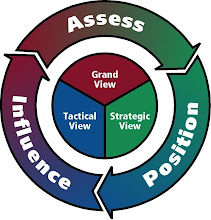
The Technical Vantage Behind the Tangible Vision


With the Tangible Vision, a project team sees the big picture.

Our big picture process gives them the capability to implement the following:

1. Complete the goal by determining the critical path;
2. Avoid obstacles and focus on positive circumstances;
3. Anticipate opportunities;
4. Perform proper pre-stage preparation;
5. Shape the target; and

6. Lead by strategic collaboration.


Does your company possess a grand process that gives your team this type of technical vantage?


Collaboration360 Consultants (C360). Copyright:2006-2007 © All rights reserved
Copying, posting and reproduction in any form (without prior consent) is an infringement of copyright.

If you are interested in more information on how Compass AE works, please contact us at service [at] collaboration360 [dot] com. We have a white paper ready for your reading.


Sunday, August 19, 2007

A Model of Collaborative Teamwork


"... It's a lot about coaching, doing things on the sidelines, making adjustments, getting our quarterbacks to play really well. ..." - Lane Kiffin, Raiders Head Coach

With the Compass AE methodology, a project team uses the Tangible Vision to understand the goal, and the specific objectives. They also use it to adjust to various circumstances.

A team that connects to collaborate is a team that will complete their Tangible Vision.

###

New coaching technique in RaiderLand
Nancy Gay

Sunday, August 19, 2007

The familiar white Raiders visor was gone Saturday night and so was Lane Kiffin's high-decibel coaching voice. Doctor's orders.

His Raiders were marching up and down Bill Walsh Field at Candlestick, shredding the 49ers' high-priced remodeled defense, yet Kiffin quietly wore his headset and low-keyed it all night. He appeared to let his coordinators - two of the best in the business - do all the hollering, play-calling and directing in a 26-21 49ers' victory.

"Coaching isn't always about yelling. It's a lot about coaching, doing things on the sidelines, making adjustments, getting our quarterbacks to play really well," said Kiffin, who didn't believe he was coaching any differently in his second NFL game.

Kiffin, to his credit, already has shown us he can take charge. And we learned he can delegate when he has to, a pretty admirable trait for a 32-year-old rookie NFL head coach who desperately wants to prove he belongs where he is.

If the Raiders exceed expectations in 2007 and perform a hammer throw to last season's 2-14 record by winning half a dozen games or more, Kiffin will get credit for a lot of things.

Among them: He should be lauded for assembling a hell of a coaching staff.

Defensive coordinator Rob Ryan, architect of the NFL's third-ranked defense in 2006, could have bolted Oakland in revolt when he didn't get the head-coaching job. But Al Davis, Kiffin and his loyal players convinced him to stay.

Hiring Greg Knapp, whose experience running the West Coast offense and tutoring quarterbacks - we'll give him a pass on Michael Vick - also smacked of genius. So was the addition of offensive line coach Tom Cable, he of the zone-blocking technique that allowed one sack and opened up monster rushing lanes and clear passing outlets.

This much was evident Saturday night, when Ryan and Knapp maintained most of the sideline authority. Kiffin nodded, watched and oozed ultimate authority. This has been the arrangement all along, really. Kiffin makes decisions and is the in-your-face voice, as long as the doc says it's OK.

Ryan and Knapp, who ooze experience and credibility, do a lot of the dirty work.

The players know it. They look to those coordinators. The Raiders did last week, when Kiffin was mysteriously laid up with an infection. They also looked to themselves.

"I think it says a lot about the staff, but it also says a lot about us as players," Pro Bowl defensive end Derrick Burgess said. "Hey, this is business and we're professionals out there. We knew we had take care of our business when coach was gone."


The teamwork and mutual respect on the Raiders' coaching staff is 180 degrees from the anarchy that ruled under Art Shell's watch, and you better believe the players are responding.

///
The best leaders are those the people hardly know exist.
The next best is a leader who is loved and praised.
Next comes the one who is feared.
The worst one is the leader that is despised.
If you don't trust the people, they will become untrustworthy.
The best leaders value their words, and use them sparingly.
When the leader has accomplished their task, the people say, "Amazing: we did it, all by ourselves!"
--- Dao De Jing, Chapter 17
///

Kiffin is not the reinvention of Jon Gruden. The age bracket is about the same, the boyish good looks are vaguely familiar. The energy level - a hell-fire, spittle-spewing, red-faced furor achieved through healthy doses of 30-something adrenaline and, in all likelihood, a case of Red Bull - has been pretty darn close.

But the budding legend of Kiffin, the youngest man ever hired to run an NFL team, took a bizarre twist last week when he, well, sort of disappeared from sight.

Within hours of coaching the Raiders to a 27-23 victory Aug. 11 over the Cardinals in the exhibition opener, Kiffin was flattened by a temperature of nearly 104 degrees.

Eventually, we learned he was hospitalized. For two days. Tests were run. Or were they? For several uncertain days, chaos momentarily returned to the super secret world of RaiderLand.

Players - who had grown accustomed to Kiffin's boisterous manner and presence - had no idea where their coach was when they returned to the practice field Monday. Except that he wasn't there.

Curious reporters finally discovered Kiffin was admitted to a Napa hospital. The Raiders' public-relations machine, which under the best of circumstances, operates with the openness and efficiency of the old TASS news agency, hoped that Kiffin's absence wouldn't be noticed.

Then the Raiders argued semantics: "Hospitalized? Well, he was at a hospital ..."

Across the chatty NFL, Blackberrys and e-mail inboxes began exploding.

When a 32-year-old NFL head coach is in the hospital for two days, you bet there is talk. "What's he got?" one NFL general manager demanded of a reporter via e-mail last week.

"A virus," was the reply.

"Out two days with a virus? Unheard of," the GM wrote back.

There isn't a lot of sympathy in the brutish NFL for head coaches who are felled for two days in training camp by anything short of an anvil on the skull.

In a sense, Kiffin's illness was unique. How many NFL head coaches have been downed by mononucleosis, one of the nastiest viral infections you can catch? High fever, swollen glands, sore throat that feels like you're swallowing broken glass. Would the Type A Gruden have handed off the megaphone to his assistants, even in an exhibition game? Probably not.

But Kiffin, who was a model patient Saturday night despite the urge to dial his vocal cords to "11," became an even better NFL head coach as a result of Saturday's pastoral sideline demeanor.

"I felt fine," Kiffin said, "and I know it's your job (to ask), but I kind of feel it has become a distraction to what we're trying to get done."

Not really. Kiffin kept it from becoming one by trusting his coaches to coach, and his players to play. Change has come RaiderLand. And that can be only good.

E-mail Nancy Gay at ngay@sfchronicle.com.

http://sfgate.com/cgi-bin/article.cgi?f=/c/a/2007/08/19/SP9IRLHSF.DTL

This article appeared on page C - 1 of the San Francisco Chronicle