Showing posts with label Collaboration for Quality. Show all posts

Tuesday, April 22, 2008

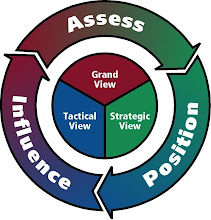
Compass AE: A Well-Defined Aspiration Motivates People


Metaphor-driven inspiration and motivation can only go so far. ... A team needs a Tangible Vision.

Compass AE Collaborative principle: A project team collaborates well when they build, connect and lead with a well-defined Tangible Vision. During the building of their Tangible Vision, the team determines who can they trust to complete their objective and who will collaborate as a team player. If the team connects with their well-defined Tangible Vision and each other. It means they believe in the plan and themselves. They are motivated as a team. Good things originate from within.

Inspiration can only go so far. The team has to believe in the aspiration (the goal of the Tangible Vision) before they are inspired to do more. The bottom line is that the team will collaborate well as a team. This is the essence of the Compass AE process.

This concept originates from our understanding of Chinese strategy classics. The well defined goal and plan determines the leadership, not the other way around. If the team believes in it, there is a good chance that they will do their best to complete the goal as a team.

# # #

Climbing Other Mountains

Why one woman's adventure feats inspire corporate workers to do their best at their desks

Dorsey Kindler

Sunday, April 20, 2008

In the months leading up to her recent expedition, Alison Levine received a visit from CNN's senior business correspondent, Ali Velshi. This was not unusual. Levine had gotten plenty of press since she began mountaineering and trekking in the late 1990s. The camera crew shot her training on Ocean Beach while Velshi asked about her upcoming trip to Antarctica.

"What I'm going to be doing is crossing the continent," Levine said in her exuberant way, "from the Ronne Ice Shelf to the South Pole. So it's about 550 miles of Antarctic ice and it's the coldest, windiest place on Earth!"

Velshi asked about her company, Daredevil Strategies, and the heart condition she had corrected through surgery, and called it a wrap. The segment aired Oct. 12. Pretty standard fare. But something about the interview struck Levine. Velshi had asked why she had given up a career on Wall Street. Why she turned her back on a five-figure income, with the potential for six in the not-so-distant future.

Even now, months later, Levine laughs at the recollection. If he only knew.

Scaling heights

Levine is probably best known for her outdoor adventures. During the past decade she has climbed - at least partway - the highest peaks on all seven continents, and has traveled under her own power to the North and South poles.

Her windburned countenance has graced the pages of Outside, National Geographic Adventure and O. And she's been featured on NBC's "Today" show, CNBC's "Power Lunch" and "ABC World News Tonight." While much is made of her accomplishments on the heights, little is said about the other nine months of the year when she works as a motivational speaker. At 41, Levine travels from her Cow Hollow apartment to cities across the country, imploring workers to make their numbers next quarter.

For this she charges $15,000 per hour onstage.

"The route to the top is different for every peak," says her Web site, "just as it is for every individual and every company. Each Daredevil Strategies presentation is customized for your event based on your goals and objectives."


/// Collaboration360 trains project teams to collaborate effectively with their team vision in mind by using our Compass AE methodology. Our process also enables project implementers to collaborate anywhere as a team regardless of distance, technology and project culture.training teams to collaborate as a team, not as a team of individuals.

Compass AE is a grand strategic process that works for all businesses. We can customize it for your Alpha projects based on your goals and objectives.


In February I traveled to Sacramento to witness the conversion of mountaineering anecdotes into parables about business competence and office productivity.

Some 900 members of the Coalition for Adequate School Housing had gathered at the Hyatt Regency ballroom. All were involved with the building and renovation of California's public schools. And all were facing a difficult year with state funding cuts and skyrocketing construction costs.

Taking a seat at a table designated for first-timers, I noticed Levine amid a cluster of handlers. Petite (5'4" in flats), she wore a dark pantsuit with a white V-necked blouse. Her dark, shoulder-length hair was glossy and expertly cut. Her cheeks glowed; though she did look a little tense.

Nonprofit association meetings like this one always take more effort than the standard company meeting. The attendees have less in common, making it difficult to craft an entertaining presentation while staying on message. (She can't manipulate the CEO's head onto her climbing photos, for example.)

The proposition

Levine was 31 before she strapped on her first pair of crampons. That expedition to Mount Kilimanjaro was a celebration. Born with a heart condition called Wolff-Parkinson-White syndrome, as a child she was scarcely able to climb a flight of stairs. She'd had the defective valve surgically corrected the year before, and was eager to test her endurance on Africa's highest peak.

Plus she wanted to do some traveling before she got her master's in business administration. After graduating from the University of Arizona in 1987 (she grew up in Phoenix), Levine worked for a pharmaceutical company where she focused on business development in Southeast Asia. Then she worked for a Silicon Valley startup that produced medical lasers. But she felt as though she hadn't seen much of the world.

Levine enrolled at Duke University in the fall of 1998, and spent every break traveling to mountains around the world, gaining confidence and technical expertise. Within months of her 2001 graduation, she had bagged six of the fabled Seven Summits. Only the highest peak in Asia eluded her. Before long she would have her chance. ...

Dorsey Kindler last wrote for the Magazine on William Langeweische. E-mail magazine@sfchronicle.com.

http://sfgate.com/cgi-bin/article.cgi?f=/c/a/2008/04/20/CMK1VLV88.DTL

This article appeared on page P - 9 of the San Francisco Chronicle

#

Sunday, April 1, 2007

Thrive on Quality (NY Times: Honda Wants to Be Known for Safety)


Quality.

People talk about it. People want it. But no one wants to pay for it. . . . There is no time to create it. ... But there is always time to remedy the mistakes. ... What is the problem with this mindset of doing it fast and unprepared? Is it an endless loop of insanity?

Most Japanese companies have always focused on quality. Quality is instilled into their culture.

Look at their culture, their architecture, their products and their mindset. They do not take much risk. They take what has been developed and re-innovate it to an article of quality. Their principal focus is on simplicity,
elegance, and quality. Quality is Job 1.

My viewpoint is the same with classic German and Swiss products. They succeed because of their emphasis on quality.

Quality is simple. Quality is complete. Quality is easy to adjust. Quality creates long-term stability.

Does your plan and action include quality?


# # #

March 30, 2007
Honda Wants to Be Known for Safety
By MICHELINE MAYNARD

MARYSVILLE, Ohio From the time it started selling cars in the United States 35 years ago, Honda has fostered a reputation for building fuel-efficient vehicles.

Now it is taking a new tack: it wants to join Volvo as an automaker best known for safety.

To get there, Honda is promoting safety as an essential part of its public image. It is offering front and side-curtain air bags and antilock brakes on most of its offerings, from the smallest cars to trucks, emphasizing that buyers need not pay top dollar for such protection.

It has also redesigned the frames of its vehicles to better spread out the impact of a crash. That redesign process, begun this decade in Japan, will be mostly complete this fall across its lineup, when the newest version of its flagship Accord sedan reaches showrooms.

Honda’s campaign, known internally as Safety for Everyone, is showing results, with some of the auto industry’s best scores on government and insurance industry crash tests.

Eight of its vehicles, from the small CR-V sport utility to the Odyssey minivan, can claim to be among the safest cars on the road, with five-star ratings from the National Highway Traffic Safety Administration in front and side crash tests, as well as the top rankings from the Insurance Institute for Highway Safety on a variety of crash tests.

Those results exceed the ratings for General Motors, Chrysler, Toyota and even Volvo, the company whose image Honda is striving to emulate. The Ford Motor Company and the Korean automaker Hyundai have a similar number of vehicles that receive those best-in-class scores, though they are not emphasizing safety as much as Honda does in its marketing, including its Web site.

We want to get the confidence of consumers, said Tomiji Sugimoto, vice president of Honda Research and Development.

And the company is winning over some buyers. Before he bought his Honda Fit in 2006, Steve Armistead, a database administrator from Vancouver, Wash., said he checked out the company’s results from the traffic safety administration and looked at crash test photos on other Web sites.

He was particularly concerned since his two teenage sons would be driving the Fit, the smallest vehicle Honda sells in the United States.

Because of the boys, safety is a top consideration for me, Mr. Armistead, 52, said. All the crash test ratings I read indicated that this was a very stable, solid car, and considering its size, a relatively safe car.

Volvo, which has been stressing safety since it began building cars in 1927, is not overly concerned about competition from Honda.

We have no plans to give up safety to Honda or anyone we have an 80-year jump on them, said Dan Johnston, a spokesman for Volvo Cars, who said Volvo was flattered by Honda’s efforts.

He and industry analysts note that crash test results are constantly evolving. The Insurance Institute for Highway Safety publishes new ratings every few weeks, as it tests more cars. And regulators are looking for ways to make safety tests more challenging, given that dozens of vehicles have scored the highest marks.

As the manufacturers have improved their vehicles, the ratings are less relevant, because they all crunch up there in the four and five stars, said Joan Claybrook, president of Public Citizen, a consumer advocacy group, and a former administrator at the traffic safety agency.

She wants additional testing to focus on pedestrian safety, rear-end crashes and roof sturdiness in case of a rollover all things that Honda, Volvo and other companies are addressing.

Philip Reed, consumer advice editor at Edmunds.com, which offers car-buying information, said Honda’s focus on becoming known as a maker of safe as well as fuel-sipping cars was a canny way to set itself apart.

If they can become Volvo, look what it did for Volvo, he said. There’s something similar between a focus on the environment and a focus on safety.

None of Honda’s cars, minivans, sport utilities or pickups are offered with anything bigger than a V-6. It beat Toyota to the hybrid-electric market in the United States, where its Insight, recently retired, went on sale a year before the Prius. (The Prius predates the Insight in Japan, however.)

There are two important issues in the automobile business: one is the environment; the other is safety, said Koichi Kondo, a senior managing director at Honda and chief operating officer for North America.

When gas prices jumped over the last few years, many buyers turned to Honda, and its American sales climbed 3.5 percent in 2006, to 1.5 million vehicles. That growth, however, was overshadowed by the 12.5 percent increase at Toyota, which passed Chrysler in 2006 to rank as the country’s third-biggest automaker.

Like Toyota, Honda is poised to grow more. On March 19, it broke ground in Greensburg, Ind., for its fourth American assembly plant, which will build 200,000 compact Civics a year beginning in 2008.

The new factory is about a three-hour drive from Honda’s research and development center in central Ohio, near its manufacturing plants in Marysville and East Liberty.

Honda’s crash test lab here opened in 2003, coinciding with its Safety for Everyone approach. It is the company’s second indoor crash test lab and acts as a backup to its primary test center in Tochigi, Japan, the world’s first company-owned indoor crash test site when it opened in 2000. (Volvo has since opened its own indoor lab.)

Measuring a million square feet, the Marysville lab is downstairs from its vast research center.

When tests occur, which is about once a week, these guys get treated to a little mini-earthquake, said Frank Paluch, the vice president for engineering.

Honda generally uses this center to test cars primarily sold in the United States, like the white Acura TL sedan it crashed recently. That analysis was meant to measure a crucial feature of the TL called the ACE body structure, which is appearing on all of Honda’s vehicles except the S2000 sports car.

ACE, which stands for advanced compatibility engineering, is meant to spread the force of a head-on crash as widely as possible to give passengers more protection, even when a smaller car hits a bigger car or an S.U.V.

The design distributes the energy from a crash throughout the entire frame of the front end, not just across the bumpers and side panels. In a collision, the ACE body crumples upward, stopping a larger vehicle from crushing it.

Inherently, when a small car and a large car collide, they’re mismatched, said Chuck Thomas, manager of Honda’s automotive safety department. We want the small car and the large car to both deform, not have the large car drive over the small car.

A crash test shows the theory in practice. An Acura, with two dummies belted into the driver and front passenger seats, was towed by an underground cable along a track, accelerating to 35 miles per hour before it crashed with a loud bang into a specially designed barrier.

The crash was photographed by high-speed cameras and charted by electronic measuring devices that fed pictures and data to engineers sitting in a control room above.

As Mr. Thomas expected, the front end of the Acura was folded upward like a tilted accordion, its headlights broken, its tires badly scuffed.

But the rest of the car was basically intact. The doors remained shut, and the dummies stayed in place, a sign that humans would fare just as well. It would be very expected that the occupants would open the doors and get out of the car, Mr. Thomas said.

Mr. Thomas admits there is only so much Honda or any manufacturer can do, short of building tanks, to keep drivers and passengers safe. It’s hard to design something that will protect you if you hit a tractor-trailer, he said.

But in the most common crashes, like those that take place on city streets, There’s no reason you can’t design a car to survive it, he said.

Mr. Reed at Edmunds said Honda’s safety-focused approach could help dispel Americans’ long-held belief that only big vehicles were safe in crashes.

Philosophically, Honda’s timing could not be better, he said, given that consumers like Mr. Armistead, who could easily justify owning something roomier, are turning to fuel-efficient vehicles as much to save money as to make statements about their personal beliefs.

I can’t get all those big vehicles off the road, Mr. Armistead said, but I cannot join the crowd. Nick Bunkley contributed reporting from Detroit.

Copyright 2007 The New York Times Company

http://www.nytimes.com/2007/03/30/business/30honda.html?