Tuesday, June 16, 2009

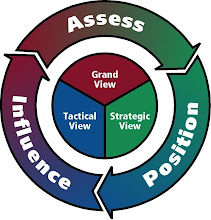
The Dao of Strategic Assessment (26): Assess One's Grand Settings


From the late 60's to the early 80's, the Red Wings went on a losing slump in which they only made the playoffs twice, winning one series.

In 1983, the Red Wings organization changed to a new owner who brought his own management team. Their first set of objective was to assess their global settings and determined what was their overall philosophy in terms of organizational leadership, talent, game style. Once they built and connected to their strategic overview (
Tangible Vision). The Red Wings used their Tangible Vision as their guide and started to search for the best global hockey talent that fit their game philosophy of puck control, speed teamwork and quickness. They immediately began to win. Between 1988 to present, the Red Wings won four Stanley cups, six Conference championships and 14 Division championships

During 2004-2005 season, the economic state of the US professional hockey game changed. The Red Wings and other hockey teams were forced to modify its contracts system and displaced some of its high-priced players. Concurrently, they were also forced to re-think their gameplay approach. In some of their games, they noticed that the stronger opponents were out-muscling them in close games.

The Red Wings management decided to maintain their emphasis on puck control and game speed. However, they adjusted their game by focusing
its European players to play more physically aggressive and go into corners after pucks. It worked quite well that they won the Stanley Cup in 2007-2008 and were playing in the NHL Stanley Cup Finals this past season.


#

In NHL, Detroit Turns to Imports

As Motor City Slumps, Red Wings Thrive With European Players; Swedes Rejoice

By REED ALBERGOTTI

As the ailing Motor City rallies around the Detroit Red Wings, who face the Pittsburgh Penguins on Friday in Game 7 of the Stanley Cup Finals, there is one tiny bit of irony: Michigan’s top team is powered more than ever by European imports.

Less than half the Red Wings’ roster comes from North America. The rest, and most of the team’s top talent, hail from Sweden, the Czech Republic, Russia and Finland. In all, five players are from the U.S. Years ago, when the Big Three auto makers were allowing overseas competitors to pull ahead, the world was getting flat inside Joe Louis Arena. Starting in the 1980s, the Red Wings began building a dynasty by recruiting talent from Russia and adopting a new, European style of hockey.

The Red Wings’ success—they have won four Stanley Cups since 1997–paved the way for the rest of the league to follow. Today 30% of the NHL’s players hail from outside North America. The Red Wings are still the most international team, with 54% of their players hailing from overseas. This season, more than 80% of the Red Wings’ goals were scored by players born outside North America, up from 41.5% in the 1996-1997 season.

At the same time, the pool of available talent at home seems to be thinning. In Michigan, one of the nation’s top junior-hockey states, the struggling economy—and the high cost of junior hockey—is taking a toll on participation. USA Hockey says youth participation in the state has fallen 14% in the past three seasons.

In many ways, the Red Wings are a case study in harnessing globalization. Team scouts travel the world in search of new talent and new ideas. Instead of an employee-training program, the team uses its farm team, the Grand Rapids Griffins of the American Hockey League, to develop talent.

“It’s a global sports market now,” says Michael Maroone, the chief operating officer of AutoNation and part owner of the NHL’s Florida Panthers. “Detroit was certainly out in front on the hockey side. It reminds me of Toyota, honestly.”

Giving Away Cars

In the 1980s, Red Wings owner Mike Ilitch had to give away cars at every home game to persuade fans to watch the beleaguered “Dead Things,” which hadn’t won a championship since 1955.

Team officials Jimmy Devellano and Ken Holland set out on a radical mission: to draft and sign European players who played a brand of hockey completely different from what was common in North America. The Wings drafted Russian Sergei Fedorov and Swede Nicklas Lidstrom in 1989 . Players then switched to a cleaner, faster, less pugnacious puck-control style of hockey that eventually led the team to championships in 1997, 1998 and 2002.

After the lockout in 2004-2005, the team found itself in a bind. It had a payroll of $75 million that had to be shrunk to $39 million. To make room for the new salary cap, Detroit chose fast and talented European players and got rid of many of its beloved North American stars.

The team had mild success, but was knocked out of the playoffs in the first round by Edmonton in 2006. Next the team considered trading in some of its European stars for North Americans who could hit and fight and were more popular with the fans. “Maybe a little more North American—away from our philosophy a bit,” says Mr. Holland.

After much discussion, the team decided to stick with its original plan and instead teach its European players to play more physically and go into corners after pucks. It worked. The team won the Stanley Cup by 2008 and is now one game away from winning two years in a row with a team buttressed by Europeans like Sweden’s Johan Franzen and Russia’s Pavel Datsyuk. Together they won the team another championship last season. “You’re not really going to Europe looking for toughness,” says Mr. Holland.

The NHL and the Red Wings say they’re making an effort to boost development programs in the U.S. and North America. This past fall, the NHL upped the money available to USA Hockey, the country’s governing body, to $8 million from $1 million. In part, the money is going to support initiatives like the American Development Model, a national set of standards based on international best practices in developing athletic talent. The program costs about $2 million annually.

No matter how the team is composed, Detroiters show no lack of support for the Red Wings—and have proven especially devoted this season.

“You would think if there was a town that would not grasp on to an international team, it might be Detroit, because of the ‘buy American’ thing and patriotic feelings,” says Michael Robinet, vice president of vehicle forecasts for consulting firm CSM Worldwide. “It shows Detroit is willing to think outside of the box and has embraced this team.”

John Cooney, a stay-at-home dad from Livonia, Mich. Says he’s all for the Red Wings’ foreign roster. “I think that it’s important to search the four corners of the earth for talent,” he said.

Auto-industry experts are quick to note that the auto makers are not by any means unaware of foreign markets, especially Europe. General Motors says it actually has more employees outside the United States than in, and that it sells more vehicles abroad. Many global suppliers have added a presence in Detroit, bringing in workers from all over the world and making the city more global.

The only difference is the level of success they’ve had bringing European ideas to North America.

“Detroit has had to move from its domestic focus of 30 to 40 years ago to one where their survival depends on going global,” says Mr. Robinet of CSM. “That’s how the Red Wings saw things before many, many other teams,” he says.

Bruce Belzowski, assistant research scientist at University of Michigan’s Transportation Research Institute says the auto makers would have certainly taken a page from the Detroit Red Wings, had it been that simple. “I think it’s a lot easier to go out and scout for four or five good players than it is to turn huge companies around.”

Global Auto Makers

Shawn Morgan, spokeswoman for Chrysler Group says that in a global marketplace, the auto industry has been working hard to be prepared, “which is very similar to what the Wings have done,” she says. “Just like the Ilitches have made a great team, I think we’re putting together a great team.” A Ford spokesman says nobody is more supportive of the team than the company’s Swedish employees. “We’re an international auto maker based in Detroit,” he says.

The Red Wings, for their part, say they hope a Stanley Cup would serve as a respite from a wave of terrible news. “Times are difficult in Detroit and the State of Michigan,” a spokesman said. “We’re just trying to do our part to give the fans something to be proud of and to feel good about.”

Michigan governor Jennifer Granholm puts a different spin on the issue. “Having Swedish roots myself, I get a kick out of the Red Wings having Swedes on their roster—nearly a third of their lineup,” she says. “The Wings are a diverse team, and that diversity is reflective of Michigan.”

—Andrew Grossman contributed to this article.

Write to Reed Albergotti at Reed.Albergotti@wsj.com

http://online.wsj.com/article/SB10001424052970204482304574221962202473816.html#

Tuesday, June 9, 2009

Strategic Assessment Exercise


You are the director of strategic marketing for a mid-level software game company. Your goal is to secure a strategic disposition at the show that would make you the "buzz" of the exposition.

q: What are you going to do to gain that "buzz"?

q: What are you going to assess?

q: What is your positional strategy for being "the signal that is above the noise"?


#

June 9, 2009
Video Games
Electronic Fair Returns, Trying to Regain Its Luster
By SETH SCHIESEL

LOS ANGELES E3 is back. After a two-year experiment as a relatively sedate, exclusive conference, the Electronic Entertainment Expo returned to its bombastic glory here last week as video games’ premier global showcase. Attracting more than 41,000 attendees from almost 80 nations, E3 recaptured its buzz of old without degenerating into the sort of over-the-top crush that had prompted the retrenchment in the first place.

Here are eight of the most interesting and exciting games from E3 that are scheduled to be released this year. This list does not include any of the potential blockbusters from E3 scheduled for 2010, a lineup that includes the suspense thriller Alan Wake, God of War III, Mass Effect 2 and Final Fantasy XIII.

BIOSHOCK 2 The sequel to one of the most important games of recent years, BioShock returns players to Rapture, the ruined Art Deco city under the Atlantic Ocean. In the first game players uncovered the story of the twisted civil war in Rapture’s supposedly utopian society. With its pointed, mature critique of the notion of free will, BioShock set a new bar for interactive storytelling. BioShock 2 hopes to continue the adventure. It is to be released by 2K Games on Nov. 3 for the Play Station 3, Xbox 360 and Windows.

NEW SUPER MARIO BROS. For more than two decades, Mario’s side-scrolling, two-dimensional journey to rescue Princess Peach in Super Mario Bros. has stood as one of the seminally entertaining interactive adventures. At E3, Nintendo announced that it was developing the first multiplayer version, allowing as many as four players to jump and bounce over one another at once. It is to be released by Nintendo by year’s end for Wii.

BAYONETTA While the Mario games may epitomize the cute, family-friendly end of the spectrum in Japanese game design, Bayonetta represents the other end: stylized, flashy and spectacularly violent. Bayonetta, a statuesque, impossibly proportioned witch, is capable of wielding an entire arsenal at once, including multiple guns and swords, not to mention magical attacks unleased by her pulsing mane. Both gory and titillating, Bayonetta is to be released by Sega this year for the PS3 and 360.

HALO 3: ODST. While there is plenty of hectic front-line combat in ODST, a stand-alone prequel to Halo 3, much of the new game places the player in the role of a stealthy special-operations trooper picking his way through the vast ruins of New Mombasa. It is to be released by Microsoft on Sept. 22 for 360.

DJ HERO Activision hosted the party of E3, with Jay-Z, Eminem, DJ AM, Travis Barker and Warren G performing for the private crowd at the Wiltern Theater. But DJ Hero would have made this list even without the party (no, really). For all of the millions of copies the Guitar Hero series has sold, there are still millions of people who prefer hip-hop, electronica, trance and dance music to guitar anthems. It is to be released by Activision on Oct. 27 for PlayStation 2, PS3, 360 and Wii.

MAG MAG for massive action game promises to allow 256 players to blast away at one another simultaneously on one uninterrupted, virtually seamless near-future battlefield, a prodigious technical feat. MAG could represent a watershed for online gaming. If it works, that is. It is to be released by Sony this fall for PS3.

MODERN WARFARE 2 No line of games has yet provided a more consistently compelling rendition of the battlefield than the Call of Duty series. Modern Warfare 2 continues the story of the Call of Duty universe, with the player taking the role of various Western commandos on the hunt for international terrorists. Combining stealth sequences, all-out firefights and vehicular combat, Modern Warfare is to be released by Activision on Nov. 10 for the PS3, 360 and Windows.

DRAGON AGE: ORIGINS My sentimental favorite of E3, Dragon Age is a throwback to the old-school single-player fantasy role-playing game. Of course it helps (a lot) that it is being made by the team behind the Baldur’s Gate series some of the best old-school single-player fantasy role-playing games. Like Baldur’s Gate, Dragon Age appears to mix deep story lines and personal interactions, including the inevitable love triangles, with its sword-and-sorcery action. It is to be released by Electronic Arts on Oct. 20 for the PS3, 360 and Windows.

Copyright 2009 The New York Times Company
http://www.nytimes.com/2009/06/09/arts/television/09games.html

Monday, June 8, 2009

The Dao of Strategic Assessment (25): The Dao of the Strategist


The first step of becoming a good strategist is having the urgency to learn. The next step is learning how to assess. How many of you are willing to work diligently to become an "above-average" strategist?


#
Thursday, June 4, 2009
John U. Bacon
Ken Holland: Bad goalie, great general manager

In 1984, Wayne Gretzky was already well on his way to becoming the greatest hockey player the game has ever seen. That same year, a 5-foot-8 goalie named Ken Holland was well on his way to becoming one of the worst goalies the game has ever seen: four games spread out over four years, no wins, 17 goals against. His pink slip was a mercy killing.

But Holland loved the game more than the game loved him, so he took a job as the Red Wings' western scout. This required driving to every frozen bandbox from Chilliwack to Flin Flon, Medicine Hat and Moosejaw -- places where you keep your car running in the parking lot during the game, or else you won't be able to leave the game.

Holland didn't complain. He humbled himself to learn the art of scouting, and worked his way up the ranks until he became Detroit's general manager in 1997.

The Wings won the Stanley Cup that year for the first time since 1955. But a lot of teams win it once -- and only once -- like the Ducks and 'Canes and Lightning -- oh my! Winning it twice, in the era of expansion and salary caps, is positively historic. Detroit now stands alone with four Cups over the last 12 years -- and soon maybe five. No team in the NFL, NBA or Major League Baseball can equal that.

How did Holland do it? By using what he learned scouting in those miserable rinks. He had to. The system is set up to prevent dynasties. The more you win, the lower your draft picks. So, after lesser teams have snapped up their "can't miss kids," Holland and his staff have to find overlooked gems, the guys who will work the hardest to play for a winning team -- not for themselves.

Holland and company not only draft for talent, but temperament. The Red Wings' locker room's is bereft of egos, and drama. You don't hear about these guys spouting off or getting in trouble.

They found their current 29 players in three states, five provinces and eight countries -- from Alaska to Newfoundland, and all over Europe -- even though everyone used to say you couldn't win with Europeans. In the Wings' locker room, you can hear six languages -- all of them spoken by Stanley Cup winners.

These "leftovers" include seventh-round pick Henrik Zetterberg, last year's playoff MVP; sixth rounder Pavel Datsyuk, the league's best defensive forward; and a third-rounder named Nick Lidstrom. He was just 18 when they found him in a tiny Swedish town, where he got so little playing time, the Wings' scout had to go to practice every day just to see him skate. The scout obviously saw something no one else did.

Today, Lidstrom is not only the Wings' captain, but the very best defenseman in the world. Worked out OK.

In all, other teams picked a total of 431 players before the Red Wings signed these three. Most of those 431 players are not only out of the playoffs, they're out of the game.

The Wings treat their players so well, they accept less to play here. Last year, star forward Marian Hossa played for the Penguins. They offered him a seven-year contract. The Red Wings offered one. Hossa took the Wings' offer -- and is about to win his first Cup, over his former team.

Today, Wayne "The Great One" Gretzky runs the Phoenix Coyotes, a team so bad they might move to Hamilton, Ontario -- while Kenny Holland is the mayor of Hockeytown.

So, here's to one of the worst goalies the game has ever seen, and one of the best general managers -- maybe even the Greatest One.

Copyright 2009, Michigan Public Radio

Former Detroit News reporter John U. Bacon is an Ann Arbor-based freelance writer. He is the author of several books, including the best-selling "Bo's Lasting Lessons," co-written with Bo Schembechler. He is the host of three programs on WTKA-AM (1050), and provides weekly commentary for Michigan Public Radio ( www.michiganradio.org). His Web site is www.johnubacon.com.

http://www.detnews.com/article/20090604/OPINION03/906040497/1128/SPORTS0103/Ken-Holland--Bad-goalie--great-general-manager

Sunday, June 7, 2009

The Dao of Strategic Assessment (24): Transforming a Crisis Into an Opportunity


The intelligent strategists do not always look for opportunities. They assess their global settings, pontificate their options and slowly decide.

While the gathering of intelligence on the strategic disposition of their target is still in motion, they are constantly assessing it. The intelligent strategist always waits for that grand advantageous moment when the circumstance favors them. Conclusively, they pursue it without any emotion and maximize their opportunity to the fullest.


#
June 6, 2009
Saturn deal is called a new business model

BY TIM HIGGINS
FREE PRESS BUSINESS WRITER

Detroit businessman Roger Penske's move to acquire General Motors' troubled Saturn brand and dealer network could be pioneering -- the start of a new strategy for selling cars and trucks in the United States, experts said Friday.

On Friday, GM announced a tentative deal for Penske Automotive Group to purchase Saturn, a transaction that the companies said should be finalized this fall.

The Detroit automaker will continue to assemble Saturn vehicles for two years, and Penske is talking with other manufacturers about building vehicles that the dealer network would sell.

Jack Nerad of Kelley Blue Book heralded the Penske-Saturn deal as "one of the most significant developments in a month that has been full of significant developments."

"The proposed acquisition marks the beginning of a new business model in this industry," he wrote, "a model in which the distribution side of the business controls the brand, and manufacturing is conducted by one or more sub-contractors."

Penske Group seeks new vehicles for Saturn dealers

Penske Automotive Group is in talks with several automakers about providing new vehicles to the Saturn dealer network.

Penske's deal with General Motors, which has not yet been finalized, provides him with GM-made vehicles for two years.

"We have been in discussions during this diligence period with a number of manufacturers on a worldwide basis," Penske told reporters Friday. "We would expect to have a lineup going forward, which would be manufactured by a worldwide partner."

He expects that eventually the new vehicles could be built in the United States if sales demand it.

The Penske deal is an incredible cap to a historic week in the domestic auto industry, particularly at GM. The automaker filed for bankruptcy protection Monday and announced a deal to sell its Hummer brand Tuesday. By Thursday, word of an impending Penske-Saturn deal had also leaked.

Saturn dealers said they are excited to work with Penske, whose Penske Automotive Group is the nation's No. 2 auto retailer.

"It's phenomenal. Roger is a great guy. I don't think Roger would have got involved in this if he didn't think it would be successful," said Carl Galeana, whose Galeana Automotive Group owns Saturn of Lakeside and Saturn of Warren dealerships. "He rolls up his sleeves and gets work done."

Saturn dealers will be offered a franchise agreement, Penske said. He called the dealer network "one of the best in the business."

"Saturn has a passionate customer base and outstanding dealer network," Penske, chairman of Penske Automotive Group, said in a statement. "For nearly 20 years Saturn has focused on treating the customer right. We share that philosophy, and we want to build on those strengths."

GM said the deal will save more than 350 Saturn dealerships and 13,000 jobs at Saturn and its retailers.

GM's most recent plan called for shutting down the brand at year's end if a buyer couldn't be found.

On a contract basis, GM is to continue production of the Saturn Aura sedan and the Vue and Outlook crossovers. The deal includes Saturn's parts operation.

"We are bringing together two icons: the Saturn brand and the Penske organization," said Jill Lajdziak, Saturn's general manager.

The gray area of the deal is how much control Penske's Saturn will have over the design of the vehicles it sells, said Jeremy Anwyl, CEO of Edmunds.com.

"It's one thing to scour the globe and make deals ... but you didn't really have that much input in terms of the development, design, features, whatever of the product," Anwyl said. "Ultimately, the retail brand is a very nice feature but people are living every day with the vehicle itself and that vehicle has got to measure up with the brand attributes."

On Friday, Penske indicate a desire to keep the Saturn look with future vehicles.

"There's a brand value today in the way these vehicles look," Penske said. "And I would hope that we would have this icon brand value and face across the product line as we go forward."

http://www.freep.com/article/20090606/BUSINESS01/906060412

Friday, June 5, 2009

The Dao of Strategic Assessment (23): Time to Plan and Act


"In planning, no useless move, In strategy, no step is in vain."- Chen Hao


Delineating the end in mind is the first step to building a complete top down strategy.

After reading the following story, what is the grand goal of Sprint's and Palm?


#

Sprint's Palm Pre 'War Room'
Elizabeth Woyke, 05.29.09, 6:00 PM ET

Sprint is approaching its June 6 launch of the Palm Pre with military strategy.

The introduction of the hotly anticipated handset will be Sprint's biggest product event of the year. As interest in the phone escalates to a frenzy--in part because of rumored shortages--company representatives say Sprint is prepared for the onslaught.

Extra employees will be on hand to manage crowds, says David Owens, Sprint's director of devices. Sprint is also borrowing manpower from partner Palm, which will dispatch representatives to more than 100 Sprint stores across the country. The additional help will stick around for two months, Owens says.

Both companies are also establishing "situation rooms" to quickly address problems that might arise during launch, particularly tech support issues. If store representatives don't know the answer to a question, they can consult people in the "war rooms" via live chat.

The preparations rival those AT&T took when it released the iPhone. In the days prior to the iPhone 3G's debut last July, AT&T staffed up, created an informational Web site and streamlined its user registration process. (See AT&T Is iPhone Ready.)

Sprint says a successful launch centers on three factors: a great store experience, solid network and worry-free service plans.

Pre buyers will get one-on-one consultations with Sprint salespeople as part of the company's "Ready Now" program. First introduced last fall, it is designed so people can walk out of the store with their phones set up and knowledgeable about their features.

Consumers can choose from several service plans as long as they include Sprint's "Everything Data" package. The cheapest individual plan, with 450 "anytime minutes," will cost $69.99 a month. Those who want an unlimited number of voice minutes will have to pay $99.99 a month. There are also a few plans that specifically target families and businesses.

Sprint says its prices undercut comparable personal digital assistant (PDA) plans from Verizon Wireless and AT&T. The plans are one way the carrier aims to win over consumers who balk at the Pre's $199.99 price tag. "You have to look at the total cost of ownership over the two years, not just the device cost," Owens says.

[ Preparation precedes performance. Good planning always sets the pace for preparation. ]

Preparedness, however, doesn't always translate into success. The iPhone 3G launch frustrated many when an unexpected technical glitch forced Apple and AT&T employees to send would-be customers home empty-handed. Fans of the Pre are already wary because Palm and Sprint have said they may not have enough phones to satisfy customer demand, initially.

While Sprint shoulders the Pre's launch, AT&T and Verizon have been cozying up to Palm. Executives from both companies announced this week that they plan to offer the Pre next year, after Sprint's exclusivity period expires.

Full disclosure: Elevation Partners, which holds a 25% stake in Palm, is also a shareholder in our parent company, Forbes Media.

http://www.forbes.com/2009/05/29/pre-palm-sprint-technology-wireless-pre.html