Sunday, April 5, 2009

The Dao of Strategic Assessment (10): Assess, Never Assume

Never assume. Always assess first.

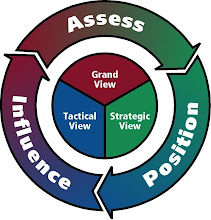
While assessing the goal, always check the grand settings. Understand the direction of the momentum, the scope, the time line, the metrics and the risks.

Our Compass AE process is based on defining the outcome first. Once it is delineated, one understands the direction of the project. Then it becomes easier for the project strategist to establish the operational specifics of the project.

We will touch on the topic of top-down thinking in later posts.


When You Assume
Andy Clark

April 1, 2009

The plan looks good on paper. Competent professionals are executing it. But unexpected delays and costs still crop up. It could be the one area of project management where your years of experience can actually hurt you: assumptions. So how do you weed them out of your plan? Here are some unassuming ideas.

It happened to me again last week in the initiation phase of an Archiving Implementation project. We completed a successful proof of concept and were moving ahead with the implementation, which required a refreshed database. I had asked the database administrators (DBAs) how long it would take to build the refresh and they answered “4 hours.” I assumed this was a full estimate of the time required for the refresh, based on my experience working with DBAs on similar activities. What I didn’t realize is that changes in storage technology had changed our refresh procedures and this was now a System Administrator operation as much as a DBA operation. Consequently the estimate did not include either the System Administrator work or the coordination work.


I hadn’t waited until the last minute to get started, so this false assumption didn’t cause a delay in the project’s critical path, but it did cost some of my time and caused work to be done on a quasi-emergency basis rather than as a planned activity.


Every time I turn around, I run into an assumption. I’ve seen system tests delayed because lab configuration wasn’t complete; rollouts delayed because user documentation wasn’t in a usable format; and meetings delayed because key participants were on vacation.

Many times I’ve seen a plan that looks good on paper, executed by qualified professionals, get hammered with delays caused by assumptions. It’s easy to do, and it’s the one area of project management where your own experience can actually betray you. You evaluate and estimate an activity based on previous experiences, but don’t realize that there have been changes in the business environment that render these estimates invalid.

How do you avoid falling victim to assumptions? Here are some techniques that can help:
· Review your requirements and deliverables
· Question estimates
· Know the project team
· Consider stakeholders
· Pay attention to risk management
· Don’t be afraid to ask the obvious question
· Document (!!)

Carefully reviewing a project’s requirements and deliverables can identify many assumptions as you build the WBS, schedule and the other planning documents.


For example if a project requires status reports, who will draft them? How will the information be gathered and distributed, and in what format? Where will they be retained? Is there any special content that the sponsor or other stakeholders are looking for? Is there a specific time they want to see them and what time period do they want covered? Is there a part of the project they (or you) are particularly interested in tracking? Are there any accessibility or language considerations? Many of these questions have simple answers that will be right 99 percent of the time. However, notice how many questions come up for building status reports, and this is usually a very straightforward deliverable. By the time you finish walking through a moderately complex project there will be hundreds of these questions and your chances of missing one of those “99 percent certainty” questions is quite high.

You should always examine any estimates closely, even those you make yourself.How confident is the estimator? What resources is he or she depending on? Which of these resources do you not have firm control over? How much coordination and communications are required for the task? How recently has the estimator done this type of work? Generating an estimate that states, “We’ll need a developer to spend 16 hours developing a login page” is not enough. It is crucial to identify all of the resources and coordination required for each task. Otherwise there is a good chance that something will come up — for example, the coder will not have access to your directory services system for user authentication and you’ll lose a week waiting for that to happen.


Now you are ready to take a close look at the project team. Are there tasks that require a specific skill-set that is not on your team? For example, does your project require DBAs, or some other specialty, for several key tasks? If so, you should look to add or reserve someone with the right skills on at least a part time basis. In a similar vein, you also need to be careful when project staff has other commitments. When you have project members on multiple projects you need to be sure you know where your project falls “in the stack.” When your project members also support operational systems this can take them completely off your project at any time. Be prepared.


Always consider the stakeholders. Some project managers fall into the trap of paying so much attention to the project team’s requirements, that they ignore the stakeholders requirements. Many projects depend heavily on stakeholders for training, testing and documentation activities. Virtually all projects depend on stakeholders to verify and accept deliverables. Give careful thought to what stakeholders will need to perform their duties. If you are relying on stakeholders for testing or verification, they will likely need help in defining test plans and test cases. Consider what type of training, access and reports your stakeholders will need. Investing time in helping your stakeholders be effective participants is time well spent.


You may have noticed that the type of work you do in identifying assumptions bears a strong resemblance to Risk Identification. The two efforts really do work hand in hand. Any assumption is a risk, so doing due diligence in risk management will help you identify assumptions and vice versa. In addition, you should be alert for new assumptions when you are working your way through Risk Analysis and especially Risk Response Planning. If your contingency plan for losing your database server is to move your database to another server, then you are assuming that both servers will not be simultaneously offline for an extended period of time. Hopefully, these two servers are not on two virtual machines located on the same physical server.


Good project managers ask questions even when the answer seems obvious. Questions, even seemingly easy questions, make people think. When you ask the system engineer whether a 50-teraflop graphics processor can handle the forms processing video, he may realize that, while processor power is not a problem, memory and storage could be. The obvious question often is not as obvious as you think, and sometimes it leads others to spot problems that you might overlook. These types of questions will help you get the best from your team.

Finally, make sure that your assumptions are documented in appropriate places — the Project Charter, Risk Management Plan and Project Requirements Document, for starters. This needs to be done for all of the usual political reasons, but it also helps identify new assumptions. Writing documents and asking questions are the best ways to nudge team members into identifying new risks.

These best practices can help, but in all probability you will not identify all assumptions. It’s easy to overlook the possibility that a team member will be sick at a crucial point, a virus will infect your workstation, or that your sponsor will be transferred to a different position. In fact, it’s probably not worthwhile to try to find everything, but you need to do what you can.

In the case of my archiving project, the problem with the refresh did not delay the project because the refresh was not started at the end of its slack period. Slack time is a gift on a busy project. Typically that gift is spent working on other activities, but whenever possible, start tasks as early as possible, lest you discover that your project has a new critical path.

These concepts, like much of project management, are mostly common sense. However, if you believe that common sense is the same as common practice, then you are making a really bad assumption.


Andy Clark is a Lead for the Virginia Community College System, one of the largest integrated higher education systems in the world. In this capacity, he routinely leads projects with dozens of engaged stakeholders. His 25 years of project management experience encompasses projects of all sizes in both the public and private sector.

Copyright © 2009 projects@work All rights reserved.
The URL for this article is:
http://www.projectsatwork.com/article.cfm?ID=248406


http://www.projectsatwork.com/content/Articles/248406.cfm

Sunday, March 29, 2009

The Dao of Strategic Maneuverability


Speed is the essence of war. - Sunzi

In combat, there is always a trade-off between speed, maneuverability, carrying personnel ability, high impact firepower and armor.

Sometimes there are those who consciously believe that they are in midst of a video game and are moving at mind-breaking speed. Their perception is that they are invincible

When negative consequences strike, injuries occur, they realized that they are not playing in a video game and their reality is painful and harsh.

Sidebar: When building a Tangible Vision of this magnitude, one must properly decide on the ranking of the technical values. It should be based on time, resources and tangibility.


An Intangible Vision is Always Unrealistic
Paraphrasing from the essays of Master Ghost Valley, "Perception is not always reality."

To achieve the essence of "perception is reality", the task-objectives of competitive intelligence and strategic assessment must be consummate and continuous.

Sidebar: Other people have believe that their state of conscious awareness can be heightened through the various practice of yoga and internal martial arts.


#

March 10, 2009
Too Much Armor Robbing Marines of Speed in Combat

By THE ASSOCIATED PRESS

Filed at 1:23 p.m. ET

WASHINGTON (AP) -- Using heavy layers of armor to keep troops safe from bullets and bombs is making the Marine Corps too slow on a battlefield where speed and mobility are critical, a senior military leader said Tuesday.

With 8,000 Marines about to be sent to Afghanistan to quell rising violence, Lt. Gen. George Flynn cautioned members of Congress against wrapping them in so much protective gear they can't hunt down more agile insurgents who use the country's rugged peaks and valleys to their advantage.

''The bottom line is that the focus on armor as the principal means of protecting our force is making us too heavy,'' said Flynn, deputy commandant of the Marine Corps for combat development and integration, during a hearing held by the House Appropriations defense subcommittee.

The weight of personal body armor and steel-encased vehicles limits the speed and maneuverability that make the Marine Corps ''more effective and deadly to the enemy,'' he said.

Body armor has been a proven lifesaver of U.S.. troops. But the vests weigh as much as 34 pounds each. When body armor is added to the assault rifles, ammunition, water and other essential gear troops are required to carry, they can be lugging as much as 80 pounds into combat. Besides moving more slowly, overburdened troops tire more quickly and are prone to orthopedic injuries that can take them out of action, officials say.

Convincing a war-weary public of a less-is-more approach won't be easy, they say. If a commander decides the gear shouldn't be used for a particular mission and a service member is killed, there could be a backlash, said Jean Malone, deputy director of experiment plans at the Marine Corps Warfighting Lab in Quantico, Va.

''We've got to have the internal fortitude to come back and say: 'We have the data. We made the right decision. We can't guarantee you that nobody will die in this war,''' he said.

Paring down the amount of armor could actually make troops safer on the battlefield, officials say. Speed and maneuverability give them the best chance of killing or capturing the Taliban and other militants before they can set roadside bombs or get in position for an ambush.

''Being able to maneuver and fight and chase down a fleeing enemy; that's actually where your protection is (versus) armoring up and being more static,'' said Brig. Gen. Tim Hanifen, deputy commanding general of the Marine Corps Combat Development Command at Quantico.

The loads carried by modern American troops are equivalent to those ''the medieval knight wore into and out of battle back in the year 1000 until about the 16th century,'' he said.

Bomb-resistant vehicles that are light and nimble enough to handle Afghanistan's primitive roads are also needed, Flynn told the defense subcommittee. He outlined plans to buy an all-terrain vehicle strong enough to blunt improvised explosive devices and still have the mobility of a Humvee.

The defense subcommittee is holding oversight hearings Wednesday and Thursday on force-protection programs, readiness levels, and ergonomic injuries. Senior Marine Corps and Army leaders are scheduled to testify.

As troop levels are surging in Afghanistan, so are roadside bomb attacks, according to the Pentagon's Joint Improvised Explosive Device Defeat Organization.

In January and February, 52 IED attacks in Afghanistan killed 32 coalition troops and wounded 96 more, according to preliminary figures from the organization. During the same two months in 2008, 21 IED attacks killed 10 troops and wounded 39.

Body armor has become a focus of Marine Corps efforts to lighten troop loads because it weighs so much more than the other gear. The standard kit consists of hardened composite plates inserted into a ballistic vest. The vest and plates protect the upper body from armor-piercing bullets and shrapnel.

Personal armor made of substantially lighter composite materials that are more effective than current models won't be available for several years. So the Marine Corps is looking for near-term solutions.

The Marine Corps is buying 65,000 vests called ''scalable plate carriers'' that weigh under 20 pounds. The carrier, which uses the same plates as the standard vest, doesn't cover as much of the torso. About 14,000 of the plate carriers have been fielded and the feedback has been positive, according to Marine Corps officials.

http://www.nytimes.com/aponline/2009/03/10/washington/AP-Marines-Lighter-Loads.html?

Thursday, March 26, 2009

Compass AE: A Strategic Decision Guide for All Seasons


Someone recently asked us, " What can our Compass AE process do for their company?"

Compass AE is a strategic decision guide that enables a project team to do the following:
  • minimize costs;
  • mitigate risks;
  • maximize opportunities;
  • accelerate delivery; and
  • ensure quality.

By looking at their project from a top down view of their goal and their objectives, t
hey are able to see the technical connections between the milestones in terms of costs, risks, opportunities, accelerated dates and ensured quality.

If the team makes a strategic decision regarding to the above points, they would know which of the five values would be directly affected.

Our strategic process is not dependent
on the technology, the project management process, the project culture and the distance.

In a future post, we will talk more about the basics of the Compass AE.

If you are interested in knowing more about our Compass AE process, please contact us at service[aatt] collaboration360[ddott]com

#

Collaboration360 Consultants (C360 Consultants). Copyright:2009 © All rights reserved
Copying, posting and reproduction in any form (without prior consent) is an infringement of copyright.

Monday, March 23, 2009

Transforming Chaos Into Opportunities (3)


The intelligent ones do not only look at opportunity first. They assess their global settings, pontificate their options and slowly decide.

Not only do they maintain the gathering of internal information about the strategic disposition of their targeted party, they constantly assess it. Waiting for that grand advantageous moment when the target is at its weakest state ever. They pursue it without any emotion. Conclusively, they maximize their opportunity to the fullest.


In California and other parts of the world, it is hunting season for the bargain hunters. .


#
US buying trip just hype?
By Hu Yuanyuan and Wu Chong (China Daily)
Updated: 2009-03-16 08:01

Yin Guohua heaved a sigh of relief last week as his plane touched down in Beijing after an 11-day tour of the US.

As a member of China's first-ever delegation to shop for American real estate, Yin was prepared for hectic travel, endless showings, and pushy salesmen.

He was not prepared for the reporters.

"Everywhere we went, there were cameras chasing us," Yin said ruefully.

The novelty of Chinese shopping for American property guaranteed publicity for the 21-man delegation, which visited Los Angeles, San Francisco, Las Vegas, New York, and Boston. Another 19 delegates, most of them 35-50 years old, missed the trip because of visa problems.

Soufun.com, the real estate portal, organized the trip but did not announce the results.

Yin, a lawyer who had said he intended to buy a $1 million apartment in either Los Angeles or New York, also declined to say whether he had made a deal, but said the trip met his expectations.

"In fact, we had a wider range of choices than we expected," he said.

Industry experts said the trip did not appear to be a serious attempt to buy property.

Howard Rosen, a senior manager at Grubb & Ellis, a New York-based property agency, said he does not think most Chinese individuals are qualified to purchase real property in the US "unless the money is here."

Investors with deposits in Hong Kong may qualify, he said, but assets on the Chinese mainland will not satisfy US sellers, Rosen said.

In addition, foreign investment in US property requires a lengthy process, according to Rosen. Without "certainty of disclosure," Chinese investors will not be taken seriously, he said.

Rosen also questioned Chinese investors' interest in the US real property market, as the Chinese stock markets begin to rebound.

Even if they are interested, he said, there are still many questions investors must answer before they make such an investment, such as "what kind of investment returns they'd expect" and "how long will they expect to invest."

Chen Yunfeng, secretary general of the China Real Estate Managers Association, said he also doubts that the time is right for Chinese to buy US investment property.

"Given the current US economy, there is no sign that the price of property will appreciate strongly in the short term," said Chen. The price may even continue to slide if the crisis worsens, he said.

More buying trips are likely, however, as China's new millionaires look for places to invest their wealth.

According to a report by the Boston Consulting Group, China had the world's fifth-largest population of millionaires in 2008 with 391,000, up 20 percent from the previous year.

The growing interest among Chinese in buying overseas properties is not focused solely on the US.

"There are more people coming to us, asking about the process of buying an overseas property," said Rainer Schleif, a manager of Aimeilan Consulting (Beijing) Co Ltd, a company that deals mainly with Australian and Singaporean real estate.

Desire to emigrate and the sharp depreciation of the Australian dollar have piqued investors' interest, Schleif said.

(China Daily 03/16/2009 page7)
http://www2.chinadaily.com.cn/bw/2009-03/16/content_7580709.htm


#
Chinese 'Buying' Tour May Have Been a Bust

You probably read -- or saw something on TV -- about a group of Chinese investors who toured the U.S. shopping for bargain basement real estate in San Francisco, Las Vegas, New York, Boston and Los Angeles.

One man's foreclosure is another man's profit.

While the tour made headlines -- most of which were fairly alarmist -- the trip seems to have amounted to naught, according to a China Daily report.

Turns out, unless Chinese investors have their cash in Hong Kong or U.S.-based accounts, they probably won't qualify to buy U.S. property. And there were other reasons why industry insiders were skeptical of the trip: For one thing, of the 40 people who were supposed to come, only 21 investors made it, and it's not clear how many of those who attended actually placed offers on properties. (The 19 investors that didn't come reportedly had visa problems.)

Still, that's not to say Chinese buying tours won't eventually become commonplace, but probably not until the U.S. market delivers more predictable short-term returns.


http://www.sfgate.com/cgi-bin/blogs/ontheblock/detail?entry_id=37187

Saturday, March 21, 2009

The Dao of Strategy: Integrating Strategic Rules of Go with The Strategic Principles of Art of War's


Go is one of the most popular board strategy game in Asia. While this game takes less than one hour to learn and a lifetime to master, it has more technical complexity than Chess.

Unlike the game of Chess, the top masters of this game have not been defeated by a computer. This game was developed in ancient China and refined in Japan. It is called WeiQi in Chinese or more popularly known by the Japanese word Go. The literal meaning is to surround. (As a side note, Go is called Baduk in Korea.) For this post, the term Go will be used to describe this mysterious but ancient Asian board strategy game.

Historically, Go was considered one of the four great accomplishments of ancient China, one of the worthy pursuits of a lifetime, along with poetry, archery, and calligraphy. It is both an art and a mental exercise - ingeniously disguised as a game. People of all ages can play and enjoy Go, from children of five or six to people in their nineties. Not only was Go popular with royalty, it was also a favorite exercise for warriors, scholars and philosophers.

The object of this game is simple: control the greatest quantity of territory by surrounding your opponent's stones in a 19 x 19 gridded board with the minimal amount of pieces. Stones are placed on any of the three hundred sixty-one intersections. To some enthusiasts of Go, there is a philosophical bent to it. As in martial arts, a player's Go game is an extension of their view of life.

History

Go originated in China about 4000 years ago. Japan imported the game of Go around the eighth century. Players in eastern Asia have excelled at this game throughout modern times. Go reached the western hemisphere in the late 1800s. Completely logical in design, the game of Go has withstood the test of time. Today Go survives in its original form as the oldest game in the world. It has been said that there are over 100 million devotees of this game.

Asian Go masters considered the Go board to be a microcosm of the universe - an extremely complex and chaotic universe. In their eyes, an empty game board is a visual paradigm of simplicity and order.

In fact, the possibilities of game play are endless. The ancient Go masters has said that Go games are just like snowflakes – no two games are alike.

Playing the Game

A typical game of Go starts with two players and an empty game board. Players would alternate putting black and white stones on the board to surround an area or territory. Whoever has more territory at the end of the game is the winner. There are nineteen horizontal and nineteen vertical game lines on the standard board,which forms a grid of 361 intersections or "points."

During a typical game of Go, the four major goals of each player are the following:

  • Surround territory.
  • Reduce their opponent's territory.
  • Capture enemy stones.
  • Protect their own stones.

The winner is always the player who has accomplished these goals more efficiently.

The goal is to make the opponent to say, "‘I pass," meaning there is no way of achieving any of the above goals. The game is then over.

Passing presumes that all claimed territories are completely surrounded (all fence sections are in place) and no stones are in atari (a position to be captured) along the borders between opposing live groups.

To win in Go, all you have do to control a minimum of 181 points of the board. Sound simple?

Learning Curve

It has been said that Go is a game that takes a minimum of nine minutes to learn and nine years to win. In reality, it usually takes a lifetime to master.

After hundred of games, one gains the experience that spending too much time looking at the small-scale tactical side of a confrontation can cause one to miss the large picture and as a consequence, lose badly. On the other hand, if one sets up patterns of safety or executes attacks without caring to examine and adapt to the changing situation, the other player can prevail. In both cases it becomes difficult to win.

The consummate Go players are those who don't waste a move or a resource. Every move that is executed should serve a small but continuous move toward the long-term objective of the player. It has been said that the three attributes of a consummate Go player are patience, persistence and the ability to adapt to any game situations.


Playing Against Go Computer Software

While Go is a simple game to learn, with its endless permutations it is almost impossible to master. Currently, the brute force of computers like Deep Blue, which can rapidly explore the possible outcomes of a game and choose the best course of action, is overwhelming chess masters. This "brute force" approach is not applicable to Go. For one thing, brute force depends on the ability to perform a quick, accurate positional analysis, but it is qualitatively more difficult to evaluate a "Go" position than a "Chess" position. To succeed in the game of Go, deep analysis is often required just to decide which strategic position favors one side or the other. A single mistake in this analysis could fatally throw off a computer evaluation.

As a result, Go is a much more interesting computing problem than Chess. Go programmers must try to replace exhaustive search with expert knowledge, as human players do. They must approximate human perception judgment and reasoning. So far there has been little success: the best Go computers today play at the level of an experienced beginner.

Comparing the Game of Go to the Game of Chess

Before a Go game starts, the board is empty, whereas in Chess the game board is full of pieces. In a game of Chess, from the start to finish pieces are usually exchanged and positions are minimized to an empty board with a few men left standing. The winner is when one of the player's kings is captured.

Compared to Chess, Go is a total technical paradox. A typical Go game starts with an empty board and usually ends with a full board with the occupation of pieces by both sides with some exchanges of pieces for the control of selective territory. What makes Go more distinguishable from Chess is that all of the pieces possess equal importance.

Someone told me that comparing the technicalities of Go to that of Chess is like comparing philosophies of two different cultures - Asian and Western. This quote from Descartes describes an aspect of the Western culture and the game of Chess: "I think, therefore I am." Where the quote "We think therefore I am…" illustrates a basic of Asian culture and the game of Go.

The success of a winning Go game is when all of the pieces can work together, whereas in the game of Chess an uncertain number of pieces are usually sacrificed for the single aim of victory.

A quote from Trevanian's book, Shibumi, is a good representation of the metaphorical difference between Go and Chess: "Go appeals to the philosopher in any man and Chess to the merchant in him."

Conclusion

What the game of Go has taught a budding player is to think from a grand view. Do not take anything only at face value: Examine the possibilities. Test them if possible. Anything you do (practice, perform, and produce) is only as good as you are. To succeed in life as in the game of Go, one must start by occupying a strategic corner, then develop a strategic sphere of influence by focusing on continuous progress toward long-term strategic supremacy.

If you want to learn a discipline that focuses on developing a strategic sphere of influence by forsaking short-term territorial gains and concentrating only on continuous progress toward long-term dominance, the game of Go may be the answer that you are seeking. It only takes less than an hour (nine minutes if you were a genius) to learn Go, but do you have a lifetime to master this game?


Following is our example of combining the Ten Golden Rules of Go (围棋十决) with some of the principles from the Art of War:

1. Tan Bu De Sheng (贪不得胜)- The greedy does not succeed.
"And for this reason, the wise general in his deliberations must consider both favourable and unfavourable factors. By taking into account the favourable factors, he makes his plan feasible; by taking into account the unfavourable, he may resolve the difficulties." - The Art of War, 8


2. Ru Jie Yi Huan (入界宜缓)- Be unhurried to enter opponent´s territory
"In level ground occupy a position which facilitates your action. With heights to your rear and right, the field of battle is to the front and the rear is safe." - The Art of War, 7


3. Gong Bi Gu Wo (攻彼顾我)- Take care of oneself when attacking the other
Anciently the skillful warriors first made themselves invincible and awaited the enemy's moments of vulnerability. Invincibility depends on one's self; the enemy's vulnerability on him. It follows that those skilled in war can make themselves invincible but cannot cause an enemy to be certainly vulnerable.
...
Therefore it is said that one may know how to win, but cannot necessarily do so. Invincibility lies in the defense; the possibility of victory in the attack. One defends when his strength is inadequate; he attacks when it is abundant. The experts in defense conceal themselves as under the ninefold earth; those skilled in attack move as from above the ninefold heavens. Thus they are capable both of protecting themselves and of gaining complete victory. - The Art of War, 4

Generally, he who occupies the field of battle first and awaits his enemy is at ease; he who comes later to the scene and rushes into the fight is weary. And therefore those skilled in war bring the enemy to the field of battle and are not brought there by him. One able to make the enemy come to his own accord does so by offering him some advantage. And one able to prevent him from coming does so by hurting him. - The Art of War, 6

4. Qi Zi Zheng Xian (弃子争先)- Discard a stone to gain sente

"When torrential water tosses boulders, it is because of momentum; When the strike of a hawk breaks the body of its prey, it is because of timing. Thus the momentum of one skilled in war is overwhelming, and his attack precisely regulated. His potential is that of a fully drawn crossbow; his timing, the release of the trigger. - The Art of War, 5

"When campaigning, be swift as the wind; in leisurely march, majestic as the forest; in raiding and plundering, like fire; in standing, firm as the mountains. As unfathomable as the clouds, move like a thunderbolt." - The Art of War, 7

/// note: The proverb is about sacrificing time, space and resources to continue one's momentum.


5. She Xiao Jiu Da (舍小就大)- Abandon small to save big
Ground in which the army survives only if it fights with the courage of desperation is called 'death'. And therefore, do not fight in dispersive ground; do not stop in frontier borderlands.
Do not attack an enemy who occupies key ground; in communicating ground do not allow your formations to become separated.
- The Art of War, 11

6. Feng Wei Xu Qi ((逢危须弃)- When in danger, sacrifice
In enclosed ground, resourcefulness is required. In death ground, fight. - The Art of War, 8


7. Shen Wu Qing Su (慎勿轻速) - Make thick shape, avoid hasty moves
"When you plunder the countryside, divide your forces. When you conquer territory, divide the profits. Weigh the situation, then move. ..." - The Art of War, 7

8. Dong Xu Xiang Ying (动须相应) - A move must respond to the opponent's
"In planning no useless move. In strategy, no step is vain." - Chen Hao


9. Bi Qiang Zi Bao (彼强自保) - Against strong positions, play safely
When the army traverses mountains, forests, precipitous country, or marches through defiles, marshlands, or swamps, or any place where the going is hard, it is difficult ground.
- The Art of War, 11


10. Shi Gu Qu He (势孤取和) - Look for peace, avoid fighting in an isolated or weak situation
You should not encamp in low-lying land. In communicating ground, unite with your allies. You should not linger in desolate ground. - The Art of War, 8