Wednesday, February 18, 2009

Assessing the Global Economy (2)


How would you assess the economic grand picture for Japan? What specific data set do you look for?


How would you would use the Sun zi strategic principles to assess the economic grand picture? .
..


The clues are in this blog and some parts of it can be found in Sunzi Art of War. ...


#

Japan's economy slumps as global gloom spreads

Mon Feb 16, 2009 3:45pm EST

By Yuzo Saeki

TOKYO (Reuters) - Japan sank deeper into recession with its worst quarterly contraction since the oil crisis in the 1970s, its reliance on exports and soft domestic demand dragging down the world's second-largest economy.

Hillary Clinton, in Tokyo on her first trip abroad as U.S. secretary of state, said Asia and the United States must fight the global crisis together.

The U.S.-Japanese relationship was founded on a "commitment to our shared security and prosperity, but we also know that we have to work together to address the global financial crisis," she said.

The grim Japanese figures, coupled with disappointment over the lack of coordinated action from the G7 and worries about bank rescue plans, pushed down European shares by 1.4 percent in thin trade, with U.S. markets closed and lighter UK volumes due to holidays. [nLG79960]

U.S. oil prices dipped below $37 a barrel as the raft of gloomy economic data underscored falling oil demand worldwide. Oil prices have dropped by more than 70 percent from their peak at almost $150 per barrel last year.

The pessimism extended to Latin America. At midday, Mexico's peso weakened 0.65 percent as appetite for riskier emerging market assets waned. Brazilian stocks and currency declined in thin trade as investors awaited details on a U.S. government economic plan.

In Canada, factory shipments sank a record 8 percent in December from a month earlier, far steeper than analysts had projected, boosting predictions that the central bank would once again trim interest rates.

In Rome, G7 financial leaders, fearing a 1930s-style resurgence in protectionism, pledged at the weekend to do all they could to fight recession.

"The outlook for the global and euro area economy in 2009 appears dismal," said European Central Bank Governing Council member George Provopoulos. "The current crisis is the biggest since the 1930s and exiting from it will not be easy or quick."

At the Italian parliament, U.S. House Speaker Nancy Pelosi defended the United States against accusations of protectionism, following concerns about a "Buy American" provision in the U.S. economic stimulus plan.

"Somewhere in the mix of things, someone has decided that America has become, is becoming, more protectionist. I don't think that is the case," she said.

In the United States, President Barack Obama will sign on Tuesday the $787 billion stimulus package which is hoped will save or create 3.5 million jobs.

FURTHER ACTION

The Bank of England said it would probably have to take further action to boost Britain's waning economy but recovery could start later in the year.

"A sharp contraction in activity, both here and abroad, is already baked into the cake for the first half of this year," Deputy Governor Charles Bean said.

Falling demand forced German car maker BMW to announce it was shedding 850 jobs and cutting back production of the Mini at its factory near Oxford.

European Central Bank President Jean-Claude Trichet warned policymakers they must avoid sowing the seeds of future crises in their efforts to revive economies.

Decisions made today should "not lay the ground for similar disorder in the future," he told European parliamentarians.

In India, the government said spending may have to rise sharply this year to shield the economy from the global credit crunch. The announcement in an interim budget worried investors, and credit rating agency Standard & Poor's said it planned to review the country's domestic debt rating.

Singapore Airlines said it planned to cut capacity by 11 percent in the year from April amid waning travel and cargo demand.

The German government is considering emergency measures to rescue the stricken bank Hypo Real Estate, whose shares have fallen by 97 percent over the last 18 months.

In Europe, the Czech Republic approved an economic stimulus package, Hungary announced plans to reform its tax code to help boost the economy, and Bulgaria said its economic growth nearly halved in last year's fourth quarter.

The widening economic crisis in Russia has sparked a wave of violent crime in Moscow that started last month, said the city's chief prosecutor.

GLOBAL CRISIS

Even though Japan has been relatively insulated from the collapse of the U.S. credit and housing markets that precipitated the global downturn, Economics Minister Kaoru Yosano said his country faced its worst economic crisis since World War Two.

With demand for its cars and electronics waning, an unprecedented slump in exports saw Japan's economy shrink by 3.3 percent in the fourth quarter of 2008, or an annual rate of 12.7 percent, marking three straight quarters of contraction and its worst result since the first oil crisis in 1974.

Japanese investors had largely factored in a big fall in GDP, limiting losses after the data was released.

The Nikkei share average fell 0.4 percent. But the yen rose against other major currencies after the G7 financial chiefs made no specific mention of the strength of the Japanese currency.

Adding to the Japanese government's woes, Finance Minister Shoichi Nakagawa faced calls for his resignation after denying he was drunk at a G7 news conference. He said he had taken too much cough medicine.

In the United States, administration officials said President Obama would form a task force to oversee the restructuring of the ailing U.S. auto industry.

General Motors Corp and Chrysler LLC are due to submit new turnaround plans by Tuesday showing they can be made viable again after receiving $13.4 billion in emergency aid last year.

Negotiators for GM and the United Auto Workers union were making progress in talks aimed at trimming the automaker's costs and debt, a person familiar with the matter told Reuters. GM wants concessions from the union and debt holders as required under the terms of the government aid package.

(Additional reporting by Sumeet Desai in Rome, Elaine Lees in Tokyo, Martha Graybow in New York, Kevin Krolicki in Detroit, and Reuters bureau around the world; Writing by Giles Elgood; Editing by Jon Boyle and Matthew Lewis)

© Thomson Reuters 2008. All rights reserved.

http://www.reuters.com/article/topNews/idUSTRE5180XK20090216

Tuesday, February 17, 2009

Assessing the Global Economy


How would you assess the economic grand picture for the United States? What specific data set do you look at?


How would you would use the Sunzi's strategic principles to assess the economic grand picture? .
..

The clues are in this blog. ...


#
Wall St. looking for clues, inspiration
Tim Paradis, Associated Press Monday, February 16, 2009
(02-16) 04:00 PST New York
--

The stock market doesn't have much to hang its hat on.

With the stream of corporate earnings reports waning and President Obama preparing to sign the $787 billion stimulus package, investors this week will be looking for fresh clues about the economy.

Wall Street has been busy focusing on companies' quarterly numbers and the developments in Washington. Now, investors are faced with finding less obvious answers to the question, "What's next?"

Any jitters about what might be the next major bit of news to drive the market could extend the back-and-forth trading seen in the nearly three months since the Standard & Poor's 500 index finished at an 11-year low on Nov. 20.

Stocks fell sharply last week to end at their lowest levels since November, as investors factored in the stimulus bill and looked to other uncertainties about the economy. The benchmark S&P 500 ended down 4.8 percent for the week, while the Dow Jones industrial average lost 5.2 percent.

"This whole process has been a market-bottoming process. It takes time," said Harry Clark, president and chief executive at Clark Capital Management in Philadelphia.

Clark and other market experts say it remains unclear whether the late-November levels will hold as the bottom of the market's pullback from its October 2007 highs.

U.S. markets are closed today for Presidents Day. On Tuesday, Obama plans to sign the stimulus bill in Denver. He is then scheduled to outline his mortgage-rescue proposal on Wednesday.

Also this week, General Motors Corp. and Chrysler LLC are expected to submit plans to the government to meet a Tuesday deadline for showing how they can repay billions in loans and become viable, even as automobile sales are falling.

GM already has borrowed $9.4 billion and would receive another $4 billion if the Treasury Department signs off on its viability plan. Chrysler has borrowed $4 billion and is seeking another $3 billion.

Investors are worried one or more of the companies could have to declare bankruptcy if they don't win additional financing. Ford Motor Co. is the only one of the Detroit automakers not taking government loans.

Wall Street also will be looking at a few quarterly reports from retailers and other companies. Wal-Mart Stores Inc. is due to report results on Tuesday before the market opens. Investors have relied on the world's largest retailer as a safe bet in a weak economy because it can attract customers looking for discounts on necessities.

Earnings are also due this week from cable TV operator Comcast Corp., farm equipment-maker Deere & Co., Goodyear Tire & Rubber Co., Hewlett-Packard Co., J.C. Penney Co. and Sprint Nextel Corp.

Most earnings reports from the final quarter of 2008 have been weak, but that shouldn't come as surprise given the difficult recession, analysts say. They contend the markets eventually will look beyond the bad news to a recovery.

http://sfgate.com/cgi-bin/article.cgi?f=/c/a/2009/02/16/MNG315UN5H.DTL

This article appeared on page C - 3 of the San Francisco Chronicle

--- e o f

Monday, February 16, 2009

The Dao of Strategic Assessment (2)


"A desk (or a conference room) is a dangerous place to view
(or manage) the world." - Our version of a John Le Carre phrase.

With statistics, the consummate strategist understands the competitive positioning of each competitor. The quality of statistics determines whether he can pinpoint the tendencies of the competitors. and distinguish the reality from the illusions.

In a transitional game like basketball, the amateurs assess the obvious factors that produces the offensive outcome. There are currently no tangible category for the "team playing" factors. Only, competent coaches and players could appreciate certain players who play the team game.

Their superb strategic assessment process enables the Houston Rockets to succeed . They understands what the opposition does. Then, they choose a skilled player who is willing to sacrifice his statistics for the good of the team.


#
February 15, 2009
The No-Stats All-Star

By MICHAEL LEWIS


Out of Duke University. . . . A 6-foot-8-inch forward. . . . He had more or less admitted to me that this part of his job left him cold. ‘It’s the same thing every day,’ he said, as he struggled to explain how a man on the receiving end of the raging love of 18,557 people in a darkened arena could feel nothing. If you had filet mignon every single night, you’d stop tasting it.

To him the only pleasure in these sounds the name of his beloved alma mater, the roar of the crowd was that they marked the end of the worst part of his game day: the 11 minutes between the end of warm-ups and the introductions. Eleven minutes of horsing around and making small talk with players on the other team. All those players making exaggerated gestures of affection toward one another before the game, who don’t actually know one another, or even want to. I hate being out on the floor wasting that time, he said. I used to try to talk to people, but then I figured out no one actually liked me very much. Instead of engaging in the pretense that these other professional basketball players actually know and like him, he slips away into the locker room.
Shane Battier! And up Shane Battier popped, to the howl of the largest crowd ever to watch a basketball game at the Toyota Center in Houston, and jumped playfully into Yao Ming (the center out of China). Now, finally, came the best part of his day, when he would be, oddly, most scrutinized and least understood. Seldom are regular-season games in the N.B.A. easy to get worked up for. Yesterday Battier couldn’t tell me whom the team played three days before. (The Knicks! he exclaimed a minute later. We played the Knicks!) Tonight, though it was a midweek game in the middle of January, was different. Tonight the Rockets were playing the Los Angeles Lakers, and so Battier would guard Kobe Bryant, the player he says is the most capable of humiliating him. Both Battier and the Rockets’ front office were familiar with the story line. I’m certain that Kobe is ready to just destroy Shane, Daryl Morey, the Rockets’ general manager, told me. Because there’s been story after story about how Shane shut Kobe down the last time.

Last time was March 16, 2008, when the Houston Rockets beat the Lakers to win their 22nd game in a row the second-longest streak in N.B.A. history. The game drew a huge national television audience, which followed Bryant for his 47 miserable minutes: he shot 11 of 33 from the field and scored 24 points. A lot of people watched, Morey said. Everyone ­watches Kobe when the Lakers play. And so everyone saw Kobe struggling. And so for the first time they saw what we’d been seeing. Battier has routinely ­guarded the league’s most dangerous offensive players LeBron James, Chris Paul, Paul Pierce and has usually managed to render them, if not entirely ineffectual, then a lot less effectual than they normally are. He has done it so quietly that no one really notices what exactly he is up to.


Last season, in a bid to draw some attention to Battier’s defense, the Rockets’ public-relations department would send a staff member to the opponent’s locker room to ask leading questions of whichever superstar Battier had just hamstrung: Why did you have so much trouble tonight? Did he do something to disrupt your game?

According to Battier: They usually say they had an off night. They think of me as some chump. He senses that some players actually look forward to being guarded by him. No one dreads being guarded by me, he said. Morey confirmed as much: That’s actually true. But for two reasons: (a) They don’t think anyone can guard them and (b) they really scoff at the notion Shane Battier could guard them. They all think his reputation exceeds his ability. Even as Battier was being introduced in the arena, Ahmad Rashad was wrapping up his pregame report on NBA TV and saying, Shane Battier will try to stop Kobe Bryant. This caused the co-host Gary Payton to laugh and reply, Ain’t gonna happen, and the other co-host, Chris Webber, to add, I think Kobe will score 50, and they’ll win by 19 going away.


[ Some of these former players based their views on their own experience, the visual proof (and other players views) not on statistical proof. ... Without the foundation of facts, their opinions are fluff. ... At this ultra level of competition, one should never underestimate the competitors. ]

Early on, Hoop Scoop magazine named Shane Battier the fourth-best seventh grader in the United States. When he graduated from Detroit Country Day School in 1997, he received the Naismith Award as the best high-school basketball player in the nation. When he graduated from Duke in 2001, where he won a record-tying 131 college-basketball games, including that year’s N.C.A.A. championship, he received another Naismith Award as the best college basketball player in the nation. He was drafted in the first round by the woeful Memphis Grizzlies, not just a bad basketball team but the one with the worst winning percentage in N.B.A. history whereupon he was almost instantly dismissed, even by his own franchise, as a lesser talent.

The year after Battier joined the Grizzlies, the team’s general manager was fired and the N.B.A. legend Jerry West, a k a the Logo because his silhouette is the official emblem of the N.B.A., took over the team. From the minute Jerry West got there he was trying to trade me, Battier says. If West didn’t have any takers, it was in part because Battier seemed limited: most of the other players on the court, and some of the players on the bench, too, were more obviously gifted than he is. He’s, at best, a marginal N.B.A. athlete, Morey says.


The Grizzlies went from 23-59 in Battier’s rookie year to 50-32 in his third year, when they made the N.B.A. playoffs, as they did in each of his final three seasons with the team. Before the 2006-7 season, Battier was traded to the Houston Rockets, who had just finished 34-48. In his first season with the Rockets, they finished 52-30, and then, last year, went 55-27 including one stretch of 22 wins in a row. Only the 1971-2 Los Angeles Lakers have won more games consecutively in the N.B.A. And because of injuries, the Rockets played 11 of those 22 games without their two acknowledged stars, Tracy McGrady and Yao Ming, on the court at the same time; the Rockets player who spent the most time actually playing for the Rockets during the streak was Shane Battier.

This year Battier, recovering from off-season surgery to remove bone spurs from an ankle, has played in just over half of the Rockets’ games. That has only highlighted his importance. This year, Morey says, we have been a championship team with him and a bubble playoff team without him.
Here we have a basketball mystery: a player is widely regarded inside the N.B.A. as, at best, a replaceable cog in a machine driven by superstars. And yet every team he has ever played on has acquired some magical ability to win.

[ In any competitive team game, the superstars excite the crowd. However, the well-coached experienced team of a few superstars and team players who play the team game, will usually win the championship. Statistically, a team of superstars rarely win the championship. ]

Solving the mystery is somewhere near the heart of Daryl Morey’s job. In 2005, the Houston Rockets’ owner, Leslie Alexander, decided to hire new management for his losing team and went looking specifically for someone willing to rethink the game. We now have all this data, Alexander told me. And we have computers that can analyze that data. And I wanted to use that data in a progressive way. When I hired Daryl, it was because I wanted somebody that was doing more than just looking at players in the normal way. I mean, I’m not even sure we’re playing the game the right way.
The virus that infected professional baseball in the 1990s, the use of statistics to find new and better ways to value players and strategies, has found its way into every major sport. Not just basketball and football, but also soccer and cricket and rugby and, for all I know, snooker and darts each one now supports a subculture of smart people who view it not just as a game to be played but as a problem to be solved.

Outcomes that seem, after the fact, all but inevitable of course LeBron James hit that buzzer beater, of course the Pittsburgh Steelers won the Super Bowl are instead treated as a set of probabilities, even after the fact. The games are games of odds. Like professional card counters, the modern thinkers want to play the odds as efficiently as they can; but of course to play the odds efficiently they must first know the odds. Hence the new statistics, and the quest to acquire new data, and the intense interest in measuring the impact of every little thing a player does on his team’s chances of winning. In its spirit of inquiry, this subculture inside professional basketball is no different from the subculture inside baseball or football or darts. The difference in basketball is that it happens to be the sport that is most like life.


When Alexander, a Wall Street investor, bought the Rockets in 1993, the notion that basketball was awaiting some statistical reformation hadn’t occurred to anyone. At the time, Daryl Morey was at Northwestern University, trying to figure out how to get a job in professional sports and thinking about applying to business schools. He was tall and had played high-school basketball, but otherwise he gave off a quizzical, geeky aura. A lot of people who are into the new try to hide it, he says. With me there was no point. In the third grade he stumbled upon the work of the baseball writer Bill James the figure most responsible for the current upheaval in professional sports and decided that what he really wanted to do with his life was put Jamesian principles into practice. He nursed this ambition through a fairly conventional academic career, which eventually took him to M.I.T.’s Sloan School of Management. There he opted for the entrepreneurial track, not because he actually wanted to be an entrepreneur but because he figured that the only way he would ever be allowed to run a pro-sports franchise was to own one, and the only way he could imagine having enough money to buy one was to create some huge business.

This is the 1990s there’s no Theo, Morey says, referring to Theo Epstein, the statistics-minded general manager of the Boston Red Sox. Sandy Alderson is progressive, but nobody knows it. Sandy Alderson, then the general manager of the Oakland Athletics, had also read Bill James and begun to usher in the new age of statistical analysis in baseball. So, Morey continues, I just assumed that getting rich was the only way in. Apart from using it to acquire a pro-sports team, Morey had no exceptional interest in money.
He didn’t need great wealth, as it turned out. After graduating from business school, he went to work for a consulting firm in Boston called Parthenon, where he was tapped in 2001 to advise a group trying to buy the Red Sox. The bid failed, but a related group went and bought the Celtics and hired Morey to help reorganize the business. In addition to figuring out where to set ticket prices, Morey helped to find a new general manager and new people looking for better ways to value basketball players. The Celtics improved. Leslie Alexander heard whispers that Morey, who was 33, was out in front of those trying to rethink the game, so he hired him to remake the Houston Rockets.

When Morey came to the Rockets, a huge chunk of the team’s allotted payroll the N.B.A. caps payrolls and taxes teams that exceed them was committed, for many years to come, to two superstars: Tracy ­McGrady and Yao Ming. Morey had to find ways to improve the Rockets without spending money. We couldn’t afford another superstar, he says, so we went looking for nonsuperstars that we thought were undervalued. He went looking, essentially, for underpaid players. That’s the scarce resource in the N.B.A., he says. Not the superstar but the undervalued player. Sifting the population of midlevel N.B.A. players, he came up with a list of 15, near the top of which was the Memphis Grizzlies’ forward Shane Battier. This perplexed even the man who hired Morey to rethink basketball.

All I knew was Shane’s stats, Alexander says, and obviously they weren’t great. He had to sell me. It was hard for me to see it.
Alexander wasn’t alone. It was, and is, far easier to spot what Battier doesn’t do than what he does. His conventional statistics are unremarkable: he doesn’t score many points, snag many rebounds, block many shots, steal many balls or dish out many assists. On top of that, it is easy to see what he can never do: what points he scores tend to come from jump shots taken immediately after receiving a pass. That’s the telltale sign of someone who can’t ramp up his offense, Morey says. Because you can guard that shot with one player. And until you can’t guard someone with one player, you really haven’t created an offensive situation. Shane can’t create an offensive situation. He needs to be open. For fun, Morey shows me video of a few rare instances of Battier scoring when he hasn’t ­exactly been open. Some large percentage of them came when he was being guarded by an inferior defender whereupon Battier backed him down and tossed in a left jump-hook. This is probably, to be honest with you, his only offensive move, Morey says. But look, see how he pump fakes. Battier indeed pump faked, several times, before he shot over a defender. He does that because he’s worried about his shot being blocked. Battier’s weaknesses arise from physical limitations. Or, as Morey puts it, He can’t dribble, he’s slow and hasn’t got much body control. Battier’s game is a weird combination of obvious weaknesses and nearly invisible strengths.

When he is on the court, his teammates get better, often a lot better, and his opponents get worse often a lot worse. He may not grab huge numbers of rebounds, but he has an uncanny ability to improve his teammates’ rebounding. He doesn’t shoot much, but when he does, he takes only the most efficient shots. He also has a knack for getting the ball to teammates who are in a position to do the same, and he commits few turnovers.

On defense, although he routinely guards the N.B.A.’s most prolific scorers, he significantly ­reduces their shooting percentages. At the same time he somehow improves the defensive efficiency of his teammates probably,
Morey surmises, by helping them out in all sorts of subtle ways. I call him Lego, Morey says. When he’s on the court, all the pieces start to fit together. And everything that leads to winning that you can get to through intellect instead of innate ability, Shane excels in. I’ll bet he’s in the hundredth percentile of every category.
There are other things Morey has noticed too, but declines to discuss as there is right now in pro basketball real value to new information, and the Rockets feel they have some. What he will say, however, is that the big challenge on any basketball court is to measure the right things. The five players on any basketball team are far more than the sum of their parts; the Rockets devote a lot of energy to untangling subtle interactions among the team’s elements. To get at this they need something that basketball hasn’t historically supplied: meaningful statistics.

For most of its history basketball has measured not so much what is important as what is easy to measure points, rebounds, assists, steals, blocked shots and these measurements have warped perceptions of the game. (Someone created the box score, Morey says, and he should be shot.) How many points a player scores, for example, is no true indication of how much he has helped his team. Another example: if you want to know a player’s value as a ­rebounder, you need to know not whether he got a rebound but the likelihood of the team getting the rebound when a missed shot enters that player’s zone.
There is a tension, peculiar to basketball, between the interests of the team and the interests of the individual. The game continually tempts the people who play it to do things that are not in the interest of the group. On the baseball field, it would be hard for a player to sacrifice his team’s interest for his own. Baseball is an individual sport masquerading as a team one: by doing what’s best for himself, the player nearly always also does what is best for his team. There is no way to selfishly get across home plate, as Morey puts it. If instead of there being a lineup, I could muscle my way to the plate and hit every single time and damage the efficiency of the team that would be the analogy. Manny Ramirez can’t take at-bats away from David Ortiz.

We had a point guard in Boston who refused to pass the ball to a certain guy. In football the coach has so much control over who gets the ball that selfishness winds up being self-defeating. The players most famous for being selfish the Dallas Cowboys’ wide receiver Terrell Owens, for instance are usually not so much selfish as attention seeking. Their sins tend to occur off the field.


It is in basketball where the problems are most likely to be in the game where the player, in his play, faces choices between maximizing his own perceived self-interest and winning. The choices are sufficiently complex that there is a fair chance he doesn’t fully grasp that he is making them.
Taking a bad shot when you don’t need to is only the most obvious example. A point guard might selfishly give up an open shot for an assist. You can see it happen every night, when he’s racing down court for an open layup, and instead of taking it, he passes it back to a trailing teammate. The teammate usually finishes with some sensational dunk, but the likelihood of scoring nevertheless declined. The marginal assist is worth more money to the point guard than the marginal point, Morey says. Blocked shots they look great, but unless you secure the ball afterward, you haven’t helped your team all that much. Players love the spectacle of a ball being swatted into the fifth row, and it becomes a matter of personal indifference that the other team still gets the ball back. Dikembe Mutombo, Houston’s 42-year-old backup center, famous for blocking shots, has always been the best in the league in the recovery of the ball after his block, says Morey, as he begins to make a case for Mutombo’s unselfishness before he stops and laughs. But even to Dikembe there’s a selfish component. He made his name by doing the finger wag. The finger wag: Mutombo swats the ball, grabs it, holds it against his hip and wags his finger at the opponent. Not in my house! And if he doesn’t catch the ball, Morey says, he can’t do the finger wag. And he loves the finger wag. His team of course would be better off if Mutombo didn’t hold onto the ball long enough to do his finger wag. We’ve had to yell at him: start the break, start the break then do your finger wag! When I ask Morey if he can think of any basketball statistic that can’t benefit a player at the expense of his team, he has to think hard. Offensive rebounding, he says, then reverses himself. But even that can be counterproductive to the team if your job is to get back on defense. It turns out there is no statistic that a basketball player accumulates that cannot be amassed selfishly. We think about this deeply whenever we’re talking about contractual incentives, he says. We don’t want to incent a guy to do things that hurt the team and the amazing thing about basketball is how easy this is to do. They all maximize what they think they’re being paid for, he says. He laughs. It’s a tough environment for a player now because you have a lot of teams starting to think differently. They’ve got to rethink how they’re getting paid. Having watched Battier play for the past two and a half years, Morey has come to think of him as an exception: the most abnormally unselfish basketball player he has ever seen. Or rather, the player who seems one step ahead of the analysts, helping the team in all sorts of subtle, hard-to-measure ways that appear to violate his own personal interests. Our last coach dragged him into a meeting and told him he needed to shoot more, Morey says. I’m not sure that that ever happened. Last season when the Rockets played the San Antonio Spurs Battier was assigned to guard their most dangerous scorer, Manu Ginóbili. Ginóbili comes off the bench, however, and his minutes are not in sync with the minutes of a starter like Battier. Battier privately went to Coach Rick Adelman and told him to bench him and bring him in when Ginóbili entered the game. No one in the N.B.A. does that, Morey says. No one says put me on the bench so I can guard their best scorer all the time.

One well-known statistic the Rockets’ front office pays attention to is plus-minus, which simply measures what happens to the score when any given player is on the court. In its crude form, plus-minus is hardly perfect: a player who finds himself on the same team with the world’s four best basketball players, and who plays only when they do, will have a plus-minus that looks pretty good, even if it says little about his play.
Morey says that he and his staff can adjust for these potential distortions though he is coy about how they do it and render plus-minus a useful measure of a player’s effect on a basketball game. A good player might be a plus 3 that is, his team averages 3 points more per game than its opponent when he is on the floor. In his best season, the superstar point guard Steve Nash was a plus 14.5. At the time of the Lakers game, Battier was a plus 10, which put him in the company of Dwight Howard and Kevin Garnett, both perennial All-Stars. For his career he’s a plus 6. Plus 6 is enormous, Morey says. It’s the difference between 41 wins and 60 wins. He names a few other players who were a plus 6 last season: Vince Carter, Carmelo Anthony, Tracy McGrady.
As the game against the Lakers started, Morey took his seat, on the aisle, nine rows behind the Rockets’ bench. The odds, on this night, were not good. Houston was playing without its injured superstar, McGrady (who was in the clubhouse watching TV), and its injured best supporting actor, Ron Artest (cheering in street clothes from the bench). The Lakers were staffed by household names.

The only Rockets player on the floor with a conspicuous shoe contract was the center Yao Ming who opened the game by tipping the ball backward. Shane Battier began his game by grabbing it.
Before the Rockets traded for Battier, the front-office analysts obviously studied his value. They knew all sorts of details about his efficiency and his ability to reduce the efficiency of his opponents. They knew, for example, that stars guarded by Battier suddenly lose their shooting touch. What they didn’t know was why. Morey recognized Battier’s effects, but he didn’t know how he achieved them. Two hundred or so basketball games later, he’s the world’s expert on the subject which he was studying all over again tonight. He pointed out how, instead of grabbing uncertainly for a rebound, for instance, Battier would tip the ball more certainly to a teammate.

Guarding a lesser rebounder, Battier would, when the ball was in the air, leave his own man and block out the other team’s best rebounder.

[ That action should be recorded in a category of "Star Neutralization". ]

Watch him, a Houston front-office analyst told me before the game. When the shot goes up, he’ll go sit on Gasol’s knee. (Pau Gasol often plays center for the Lakers.) On defense, it was as if Battier had set out to maximize the misery Bryant experiences shooting a basketball, without having his presence recorded in any box score. He blocked the ball when Bryant was taking it from his waist to his chin, for instance, rather than when it was far higher and Bryant was in the act of shooting. When you watch him, Morey says, you see that his whole thing is to stay in front of guys and try to block the player’s vision when he shoots. We didn’t even notice what he was doing until he got here. I wish we could say we did, but we didn’t.
People often say that Kobe Bryant has no weaknesses to his game, but that’s not really true. Before the game, Battier was given his special package of information. He’s the only player we give it to, Morey says. We can give him this fire hose of data and let him sift. Most players are like golfers. You don’t want them swinging while they’re thinking. The data essentially broke down the floor into many discrete zones and calculated the odds of Bryant making shots from different places on the court, under different degrees of defensive pressure, in different relationships to other players how well he scored off screens, off pick-and-rolls, off catch-and-shoots and so on. Battier learns a lot from studying the data on the superstars he is usually assigned to guard.

[ The professionals always assess their opposition thoroughly. ]

For instance, the numbers show him that Allen Iverson is one of the most efficient scorers in the N.B.A. when he goes to his right; when he goes to his left he kills his team. The Golden State Warriors forward Stephen Jackson is an even stranger case. Steve Jackson, Battier says, is statistically better going to his right, but he loves to go to his left and goes to his left almost twice as often. The San Antonio Spurs’ Manu Ginóbili is a statistical freak: he has no imbalance whatsoever in his game there is no one way to play him that is better than another. He is equally efficient both off the dribble and off the pass, going left and right and from any spot on the floor.
Bryant isn’t like that. He is better at pretty much everything than everyone else, but there are places on the court, and starting points for his shot, that render him less likely to help his team. When he drives to the basket, he is exactly as likely to go to his left as to his right, but when he goes to his left, he is less effective. When he shoots directly after receiving a pass, he is more efficient than when he shoots after dribbling. He’s deadly if he gets into the lane and also if he gets to the baseline; between the two, less so. The absolute worst thing to do, Battier says, is to foul him. It isn’t that Bryant is an especially good free-throw shooter but that, as Morey puts it, the foul is the worst result of a defensive play. One way the Rockets can see which teams think about the game as they do is by identifying those that try dramatically not to foul. The ideal outcome, from the Rockets’ statistical point of view, is for Bryant to dribble left and pull up for an 18-foot jump shot; force that to happen often enough and you have to be satisfied with your night. If he has 40 points on 40 shots, I can live with that, Battier says. My job is not to keep him from scoring points but to make him as inefficient as possible. The court doesn’t have little squares all over it to tell him what percentage Bryant is likely to shoot from any given spot, but it might as well. The reason the Rockets insist that Battier guard Bryant is his gift for encouraging him into his zones of lowest efficiency. The effect of doing this is astonishing: Bryant doesn’t merely help his team less when Battier guards him than when someone else does. When Bryant is in the game and Battier is on him, the Lakers’ offense is worse than if the N.B.A.’s best player had taken the night off. The Lakers’ offense should obviously be better with Kobe in, Morey says. But if Shane is on him, it isn’t. A player whom Morey describes as a marginal N.B.A. athlete not only guards one of the greatest and smartest offensive threats ever to play the game. He renders him a detriment to his team. And if you knew none of this, you would never guess any of it from watching the game. Bryant was quicker than Battier, so the latter spent much of his time chasing around after him, Keystone Cops-like. Bryant shot early and often, but he looked pretty good from everywhere. On defense, Battier talked to his teammates a lot more than anyone else on the court, but from the stands it was hard to see any point to this. And yet, he swears, there’s a reason to almost all of it: when he decides where to be on the court and what angles to take, he is constantly reminding himself of the odds on the stack of papers he read through an hour earlier as his feet soaked in the whirlpool. The numbers either refute my thinking or support my thinking, he says, and when there’s any question, I trust the numbers. The numbers don’t lie. Even when the numbers agree with his intuitions, they have an effect. It’s a subtle difference, Morey says, but it has big implications. If you have an intuition of something but no hard evidence to back it up, you might kind of sort of go about putting that intuition into practice, because there’s still some uncertainty if it’s right or wrong. Knowing the odds, Battier can pursue an inherently uncertain strategy with total certainty. He can devote himself to a process and disregard the outcome of any given encounter. This is critical because in basketball, as in everything else, luck plays a role, and Battier cannot afford to let it distract him. Only once during the Lakers game did we glimpse a clean, satisfying comparison of the efficient strategy and the inefficient one that is, an outcome that reflected the odds. Ten feet from the hoop, Bryant got the ball with his back to the basket; with Battier pressing against him, he fell back and missed a 12-foot shot off the front of the rim. Moments earlier, with Battier reclining in the deep soft chair that masquerades as an N.B.A. bench, his teammate Brent Barry found himself in an analogous position. Bryant leaned into Barry, hit a six-foot shot and drew a foul. But this was the exception; normally you don’t get perfect comparisons. You couldn’t see the odds shifting subtly away from the Lakers and toward the Rockets as Bryant was forced from 6 feet out to 12 feet from the basket, or when he had Battier’s hand in his eyes. All you saw were the statistics on the board, and as the seconds ticked off to halftime, the game tied 54-54, Bryant led all scorers with 16 points. But he required 20 possessions to get them. And he had started moaning to the referees. Bryant is one of the great jawboners in the history of the N.B.A. A major-league baseball player once showed me a slow-motion replay of the Yankees’ third baseman Alex Rodriguez in the batter’s box. Glancing back to see where the catcher has set up is not strictly against baseball’s rules, but it violates the code. A hitter who does it is likely to find the next pitch aimed in the general direction of his eyes. A-Rod, the best hitter in baseball, mastered the art of glancing back by moving not his head, but his eyes, at just the right time. It was like watching a billionaire find some trivial and dubious deduction to take on his tax returns. Why bother? I thought, and then realized: this is the instinct that separates A-Rod from mere stars. Kobe Bryant has the same instinct. Tonight Bryant complained that Battier was grabbing his jersey, Battier was pushing when no one was looking, Battier was committing crimes against humanity. Just before the half ended, Battier took a referee aside and said: You and I both know Kobe does this all the time. I’m playing him honest. Don’t fall for his stuff. Moments later, after failing to get a call, Bryant hurled the ball, screamed at the ref and was whistled for a technical foul. Just after that, the half ended, but not before Battier was tempted by a tiny act of basketball selfishness.

The Rockets’ front office has picked up a glitch in Battier’s philanthropic approach to the game: in the final second of any quarter, finding himself with the ball and on the wrong side of the half-court line, Battier refuses to heave it honestly at the basket, in an improbable but not impossible attempt to score. He heaves it disingenuously, and a millisecond after the buzzer sounds. Daryl Morey could think of only one explanation: a miss lowers Battier’s shooting percentage. I tell him we don’t count heaves in our stats, Morey says, but Shane’s smart enough to know that his next team might not be smart enough to take the heaves out.


Tonight, the ball landed in Battier’s hands milliseconds before the half finished. He moved just slowly enough for the buzzer to sound, heaved the ball the length of the floor and then sprinted to the locker room having not taken a single shot.

In 1996 a young writer for The Basketball Times named Dan Wetzel thought it might be neat to move into the life of a star high-school basketball ­player and watch up close as big-time basketball colleges recruited him. He picked Shane Battier, and then spent five months trailing him, with growing incredulity. I’d covered high-school basketball for eight years and talked to hundreds and hundreds and hundreds of kids really every single prominent high-school basketball player in the country, Wetzel says. There’s this public perception that they’re all thugs. But they aren’t. A lot of them are really good guys, and some of them are very, very bright. Kobe’s very bright. LeBron’s very bright. But there’s absolutely never been anything like Shane Battier.
Wetzel watched this kid, inundated with offers of every kind, take charge of an unprincipled process. Battier narrowed his choices to six schools Kentucky, Kansas, North Carolina, Duke, Michigan and Michigan State and told everyone else, politely, to leave him be. He then set out to minimize the degree to which the chosen schools could interfere with his studies; he had a 3.96 G.P.A. and was poised to claim Detroit Country Day School’s headmaster’s cup for best all-around student. He granted each head coach a weekly 15-minute window in which to phone him. These men happened to be among the most famous basketball coaches in the world and the most persistent recruiters, but Battier granted no exceptions. When the Kentucky coach Rick Pitino, who had just won a national championship, tried to call Battier outside his assigned time, Battier simply removed Kentucky from his list. What 17-year-old has the stones to do that? Wetzel asks. To just cut off Rick Pitino because he calls outside his window? Wetzel answers his own question: It wasn’t like, ‘This is a really interesting 17-year-old.’ It was like, ‘This isn’t real.’

Battier, even as a teenager, was as shrewd as he was disciplined. The minute he figured out where he was headed, he called a sensational high-school power forward in Peekskill, N.Y., named Elton Brand and talked him into joining him at Duke. (Brand now plays for the Philadelphia 76ers.) I thought he’d be the first black president, Wetzel says. He was Barack Obama before Barack Obama.

Last July, as we sat in the library of the Detroit Country Day School, watching, or trying to watch, his March 2008 performance against Kobe Bryant, Battier was much happier instead talking about Obama, both of whose books he had read. (The first was better than the second, he said.) He said he hated watching himself play, then proved it by refusing to watch himself play. My every attempt to draw his attention to the action on the video monitor was met by some distraction. I pointed to his footwork; he pointed to a gorgeous young woman in the stands wearing a ­Battier jersey. (You don’t see too many good-looking girls with Battier jerseys on, he said. It’s usually 12 and under or 60 and over. That’s my demographic.) I noted the uncanny way in which he got his hand right in front of Bryant’s eyes before a shot; he motioned to his old high school library (I came in here every day before classes). He took my excessive interest in this one game as proof of a certain lack of imagination, I’m pretty sure. I’ve been doing the same thing for seven years, he said, and this is the only game anyone wants to talk about. It’s like, Oh, you can play defense? It grew clear that one reason he didn’t particularly care to watch himself play, apart from the tedium of it, was that he plays the game so self-consciously. Unable to count on the game to properly measure his performance, he learned to do so himself. He had, in some sense, already seen the video. When I finally compelled him to watch, he was knocking the ball out of Bryant’s hands as Bryant raised it from his waist to his chin. If I get to be commissioner, that will count as a blocked shot, Battier said. But it’s nothing. They don’t count it as a blocked shot. I do that at least 30 times a season. In the statistically insignificant sample of professional athletes I’ve come to know a bit, two patterns have emerged. The first is, they tell you meaningful things only when you talk to them in places other than where they have been trained to answer questions. It’s pointless, for instance, to ask a basketball player about himself inside his locker room. For a start, he is naked; for another, he’s surrounded by the people he has learned to mistrust, his own teammates. The second pattern is the fact that seemingly trivial events in their childhoods have had huge influence on their careers.

A cleanup hitter lives and dies by a swing he perfected when he was 7; a quarterback has a hitch in his throwing motion because he imitated his father. Here, in the Detroit Country Day School library, a few yards from the gym, Battier was back where he became a basketball player. And he was far less interested in what happened between him and Kobe Bryant four months ago than what happened when he was 12.
When he entered Detroit Country Day in seventh grade, he was already conspicuous at 6-foot-4, and a year later he would be 6-foot-7. Growing up tall was something I got used to, he said. I was the kid about whom they always said, ‘Check his birth certificate.’ He was also the only kid in school with a black father and a white mother. Oddly enough, the school had just graduated a famous black basketball player, Chris Webber. Webber won three state championships and was named national high-school player of the year. Chris was a man-child, says his high school basketball coach, Kurt Keener. Everyone wanted Shane to be the next Chris Webber, but Shane wasn’t like that. Battier had never heard of Webber and didn’t understand why, when he took to the Amateur Athletic Union circuit and played with black inner-city kids, he found himself compared unfavorably with Webber: I kept hearing ‘He’s too soft’ or ‘He’s not an athlete.’

[ Most stars are athletes first. The team player have the "above average" skills and the "team" attitude to play the team game. ]

His high-school coach was aware of the problems he had when he moved from white high-school games to the black A.A.U. circuit. I remember trying to add some flair to his game, Keener says, but it was like teaching a classical dancer to do hip-hop. I came to the conclusion he didn’t have the ego for it.
Battier was half-white and half-black, but basketball, it seemed, was either black or white. A small library of Ph.D. theses might usefully be devoted to the reasons for this. For instance, is it a coincidence that many of the things a player does in white basketball to prove his character take a charge, scramble for a loose ball are more pleasantly done on a polished wooden floor than they are on inner-city asphalt? Is it easier to play for the team when that team is part of some larger institution?

At any rate, the inner-city kids with whom he played on the A.A.U. circuit treated Battier like a suburban kid with a white game, and the suburban kids he played with during the regular season treated him like a visitor from the planet where they kept the black people. On Martin Luther King Day, everyone in class would look at me like I was supposed to know who he was and why he was important, Battier said. When we had an official school picture, every other kid was given a comb. I was the only one given a pick. He was awkward and shy, or as he put it: I didn’t present well. But I’m in the eighth grade! I’m just trying to fit in! And yet here he was shuttling between a black world that treated him as white and a white world that treated him as black. ‘‘Everything I’ve done since then is because of what I went through with this, he said. What I did is alienate myself from everybody. I’d eat lunch by myself. I’d study by myself. And I sort of lost myself in the game.
Losing himself in the game meant fitting into the game, and fitting into the game meant meshing so well that he became hard to see.

In high school he was almost always the best player on the court, but even then he didn’t embrace the starring role. He had a tendency to defer, Keener says. He had this incredible ability to make everyone around him better. But I had to tell him to be more assertive. The one game we lost his freshman year, it was because he deferred to the seniors.

Even when he was clearly the best player and could have shot the ball at will, he was more interested in his role in the larger unit. But it is a mistake to see in his detachment from self an absence of ego, or ambition, or even desire for attention. When Battier finished telling me the story of this unpleasant period in his life, he said: Chris Webber won three state championships, the Mr. Basketball Award and the Naismith Award. I won three state championships, Mr. Basketball and the Naismith Awards. All the things they said I wasn’t able to do, when I was in the eighth grade.
Who’s they? I asked. Pretty much everyone, he said. White people? No, he said. The street. As the third quarter began, Battier’s face appeared overhead, on the Jumbotron, where he hammed it up and exhorted the crowd.

Throughout the game he was up on the thing more than any other player: plugging teeth-whitening formulas, praising local jewelers, making public-service announcements, telling the fans to make noise. When I mentioned to a Rockets’ staff member that Battier seemed to have far more than his fair share of big-screen appearances, he said, Probably because he’s the only one who’ll do them.
I spent the second half with Sam Hinkie, the vice president of basketball operations and the head of basketball analytics in the Rockets’ front office. The game went back and forth. Bryant kept missing more shots than he made. Neither team got much of a lead. More remarkable than the game were Hinkie’s reactions and it soon became clear that while he obviously wanted the Rockets to win, he was responding to different events on the court than the typical Rockets (or N.B.A.) fan was. I care a lot more about what ought to have happened than what actually happens, said Hinkie, who has an M.B.A. from Stanford.

The routine N.B.A. game, he explained, is decided by a tiny percentage of the total points scored. A team scores on average about 100 points a game, but two out of three N.B.A. games are decided by fewer than 6 points two or three possessions.

The effect of this, in his mind, was to raise significantly the importance of every little thing that happened. The Lakers’ Trevor Ariza, who makes 29 percent of his 3-point shots, hit a crazy 3-pointer, and as the crowd moaned, Hinkie was almost distraught. That Ariza shot, that is really painful, he said. Because it’s a near-random event. And it’s a 3-point swing. When Bryant drove to the basket, instead of being forced to take a jump shot, he said: That’s three-eighths of a point. These things accumulate.
In this probabilistic spirit we watched the battle between Battier and Bryant.

From Hinkie’s standpoint, it was going extremely well: With most guys, Shane can kick them from their good zone to bad zone, but with Kobe you’re just picking your poison. It’s the epitome of, Which way do you want to die? Only the Rockets weren’t dying. Battier had once again turned Bryant into a less-efficient machine of death. Even when the shots dropped, they came from the places on the court where the Rockets’ front office didn’t mind seeing them drop. That’s all you can do, Hinkie said, after Bryant sank an 18-footer. Get him to an inefficient spot and contest. And then all of a sudden it was 97-95, Lakers, with a bit more than three minutes to play, and someone called timeout. We’re in it, Hinkie said, happily. And some of what happens from here on will be randomness.
The team with the N.B.A.’s best record was being taken to the wire by Yao Ming and a collection of widely unesteemed players. Moments later, I looked up at the scoreboard: Bryant: 30. Battier: 0. Hinkie followed my gaze and smiled. I know that doesn’t look good, he said, referring to the players’ respective point totals. But if Battier wasn’t in there, he went on to say: we lose by 12. No matter what happens now, none of our coaches will say, ‘If only we could have gotten a little more out of Battier.’

One statistical rule of thumb in basketball is that a team leading by more points than there are minutes left near the end of the game has an 80 percent chance of winning. If your team is down by more than 6 points halfway through the final quarter, and you’re anxious to beat the traffic, you can leave knowing that there is slightly less than a 20 percent chance you’ll miss a victory; on the other hand, if you miss a victory, it will have been an improbable and therefore sensational one.

At no point on this night has either team had enough of a lead to set fans, or even Rockets management, to calculating their confidence intervals but then, with 2:27 to play, the Lakers went up by 4: 99-95. Then they got the ball back. The ball went to Bryant, and Battier shaded him left into Yao Ming. Bryant dribbled and took the best shot he could, from Battier’s perspective: a long 2-point jump shot, off the dribble, while moving left. He missed, the Rockets ran back the other way, Rafer Alston drove the lane and hit a floater: 99-97, and 1:13 on the clock. The Lakers missed another shot. Alston grabbed the rebound and called timeout with 59 seconds left.
Whatever the Rockets planned went ­instantly wrong, when the inbound pass, as soon as it was caught by the Rockets’ Carl Landry, was swatted away by the Lakers. The ball was loose, bodies flew everywhere. 55 . . . 54 . . . 53 . . . On the side of the court opposite the melee, Battier froze. The moment he saw that the loose ball was likely to be secured by a teammate but before it was secured he sprinted to the corner. 50 . . . 49 . . . 48 . . .

The 3-point shot from the corner is the single most efficient shot in the N.B.A. One way the Rockets can tell if their opponents have taken to analyzing basketball in similar ways as they do is their attitude to the corner 3: the smart teams take a lot of them and seek to prevent their opponents from taking them. In basketball there is only so much you can plan, however, especially at a street-ball moment like this. As it happened, Houston’s Rafer Alston was among the most legendary street-ball players of all time known as Skip 2 My Lou, a nickname he received after a single spectacular move at Rucker Park, in Harlem. Shane wouldn’t last in street ball because in street ball no one wants to see his game, Alston told me earlier. You better give us something to ooh and ahh about. No one cares about someone who took a charge. The Rockets’ offense had broken down, and there was no usual place for Alston, still back near the half-court line, to go with the ball. The Lakers’ defense had also broken down; no player was where he was meant to be. The only person exactly where he should have been wide open, standing at the most efficient spot on the floor from which to shoot was Shane Battier. When Daryl Morey spoke of basketball intelligence, a phrase slipped out: the I.Q. of where to be.

Fitting in on a basketball court, in the way Battier fits in, requires the I.Q. of where to be. Bang: Alston hit Battier with a long pass. Bang: Battier shot the 3, guiltlessly. Nothing but net.


Rockets 100, Lakers 99.

43 . . . 42 . . . 41 . . .

At this moment, the Rockets’ front office would later calculate, the team’s chances of winning rose from 19.2 percent to 72.6 percent. One day some smart person will study the correlation between shifts in probabilities and levels of noise, but for now the crowd was ignorantly berserk: it sounded indeed like the largest crowd in the history of Houston’s Toyota Center. Bryant got the ball at half-court and dribbled idly, searching for his opening.

This was his moment, the one great players are said to live for, when everyone knows he’s going to take the shot, and he takes it anyway.

On the other end of the floor it wasn’t the shooter who mattered but the shot. Now the shot was nothing, the shooter everything.
33 . . . 32 . . . 31 . . . Bryant 12 for 31 on the night took off and drove to the right, his strength, in the middle of the lane. Battier cut him off. Bryant tossed the ball back out to Derek Fisher, out of shooting range.

30 . . . 29 . . .
Like everyone else in the place, Battier assumed that the game was still in Bryant’s hands. If he gave the ball up, it was only so that he might get it back. Bryant popped out. He was now a good four feet beyond the 3-point line, or nearly 30 feet from the basket. 28 . . .

Bryant caught the ball and, 27.4 feet from the basket, the Rockets’ front office would later determine, leapt. Instantly his view of that basket was blocked by Battier’s hand. This was not an original situation.

Since the 2002-3 season, Bryant had taken 51 3-pointers at the very end of close games from farther than 26.75 feet from the basket. He had missed 86.3 percent of them.

A little over a year ago the Lakers lost to the Cleveland Cavaliers after Bryant missed a 3 from 28.4 feet. Three nights from now the Lakers would lose to the Orlando Magic after Bryant missed a shot from 27.5 feet that would have tied the game. It was a shot Battier could live with, even if it turned out to be good.


Battier looked back to see the ball drop through the basket and hit the floor. In that brief moment he was the picture of detachment, less a party to a traffic accident than a curious passer-by. And then he laughed. The process had gone just as he hoped. The outcome he never could control.

Michael Lewis is the author of Moneyball and a contributing editor for Vanity Fair. His next book, Home Game, a memoir about fatherhood, will be published in June.

Copyright 2009 The New York Times Company
http://www.nytimes.com/2009/02/15/magazine/15Battier-t.html


Statistics should always be one of the many foundation pieces for any strategic assessment projects. ... In some cases, we focus on both micro and macro statistics on why things work from a grand picture.

As a reminder, statistical analysis should only be used to inform the implementer before each and every strategic decision.

#
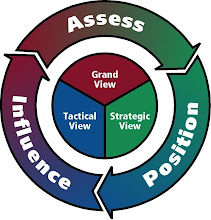
Just remember that the first step is to assess strategically. The next step is to position strategically through planning and preparation. Good planning and preparation requires a good top to bottom planning process and a strong understanding of the fundamentals.

When planning your strategy, always walk through the steps. Review with thoroughness.

If you want to know about how to assess, position and influence strategically, please contact us at service[@t]collaboration360[doott].com

Replace @t with "@" and doott with "." .

More to come.

Collaboration360 Consultants (C360). Copyright:2009 © All rights reserved
Copying, posting and reproduction in any form (without prior consent) is an infringement of copyright.

Sunday, February 15, 2009

Cardinal Rule for the Global Economy (2)


Good ideas are like coals. Properly-implemented ideas are like gold.

Cardinal Rule: If you are a high-end strategic thinker-implementer, always protect your ideas.

"Do not loan the handles of state- the power to grant rewards and inflict punishments- to other men. If you loan the handles of state to other men then you will lose your authority.

Do not loan sharp weapons to other men. If you loan sharp weapons to other men, you will be hurt by them and will not live out your allotted span of years.

Do not allow other men to snatch away your awesomeness. Rely on your wisdom. Follow the constant. Those who submit and accord with you treat generously with Virtue. Those that oppose you break with force. If you respect the people and are decisive, then All under heaven will be peaceful and submissive.
--- Jiang Tai Gong Six Secret Teachings (Sawyer X'lation) ///


#
Copyright battle over iconic Obama image

Joe Garofoli, Chronicle Staff Writer
Thursday, February 12, 2009
(02-12) 18:45 PST --

Artist Shepard Fairey says that he has distributed more than 300,000 copies of his iconic poster of President Obama with the word "Hope" written underneath and that it has inspired countless other versions. Now, the 38-year-old Los Angeles street artist, who says he used an Associated Press photograph as a "visual reference" for his piece, is in the middle of a copyright battle that goes to the heart of how media is made, remixed and mashed up.


Given the notoriety of Fairey's iconic poster, "it is kind of the perfect storm," said Michael Kwun, a senior staff attorney at the Electronic Frontier Foundation, a San Francisco digital advocacy organization. "It raises questions about what we as a culture and a legal society feels is proper."


The question is "how much leeway do we give a second-comer when they want to use someone else's original creation," said Michael Kahn, who teaches a course on censorship and free expression at Washington University School of Law and has represented both artists and Fortune 500 companies in copyright disputes. "This would make a terrific question on a law school exam."

The fear among artists and advocates is that too tight an interpretation of copyright law would stifle creativity and expressions of political dissent. But courts have long tried to balance that approach with the need to protect the value of the original work.


New technology that makes it increasingly easy to combine different types of media is putting more people in legal limbo. Ask Stephanie Lenz, the Pennsylvanian woman who posted to YouTube a 29-second video of her toddler dancing to Prince's song "Let's Go Crazy" in 2007. When Universal Music Publishing Group demanded that YouTube take down the video, San Francisco's Electronic Frontier Foundation filed suit, claiming that it was a fair use of the song. The case is still ongoing.

Or ask the owners of CommonWealth Press in Pittsburgh. After the Pittsburgh Steelers won their sixth Super Bowl this month, owner Dan Rugh started selling a shirt with the outline of the Lombardi Trophy, the word "Sixburgh" and the phrase "Yes, We Did" in the team's black-and-gold colors. Rugh stopped selling them after receiving a letter from the National Football League telling him that using the Lombardi Trophy image violates the league's registered trademark and the trophy's copyrighted design.

Fairey's fair-use journey started in January 2008, when he created the poster by taking a 2006 Associated Press photo of Obama at a press conference with actor George Clooney and tightly cropping the image around the then-candidate's face.

Last fall, Fairey told The Chronicle that "the illustration does have roots in propaganda art. I also want it to seem like a patriotic image, but not be seen as too countercultural. ... It needed just enough mainstream ingredients to transcend."

Interest in Fairey's resulting image caught fire contiguously with Obama's campaign, and Fairey - an Obama supporter - began plowing the money he made from poster sales into producing more of them - eventually giving away tens of thousands of "Hope" posters in battleground states, according to court documents and past interviews he's done with The Chronicle.

Last month, an attorney for the Associated Press contacted Fairey, according to court documents, and said the use of the image required permission and credit.

This week, Fairey's attorneys - including Stanford University Law School lecturer Anthony Falzone - responded by suing in U.S. District Court in New York, asking the court to rule that the artist's work was protected by the Fair Use Doctrine of copyright law.

Courts determine if a new work is fair use by asking the following questions: Is the new work transformative - does it add new meaning - and not just replicate the original? What is the nature of the work? (Creative or fictional works generally get more protection than purely factual ones, legal scholars say.) How much of the original work is used? Does the new creation use the "heart" of the original? And how would the new work affect the market for the original?

Fairey's attorneys say he used the photograph taken by Mannie Garcia as a "visual reference for a highly transformative purpose." Fairey's use hasn't affected the AP's ability to take photographs and sell and distribute them. Rather, "Fairey has enhanced the value of the Garcia photograph beyond measure," according to the complaint filed by Fairey's attorneys.

Fairey told The Chronicle last fall that originally, "my goal was to sell 350 prints and print 1,000 to mail out." Signed copies of the poster have sold for several thousand dollars on eBay.

The wire service argues he should have licensed the photo - much as rappers license a sliver of music they want to sample on a recording.

"I would like to ask Mr. Fairey why he didn't just ask to license it," said Patrick Ross, executive director of the Copyright Alliance, a Washington trade group whose supporters include movie studios, television networks and artists interested in preserving copyright protection.

Fairey's attorney Falzone, executive director of the Fair Use Project at the Center for the Internet and Society at Stanford, declined to comment.

While several legal scholars predicted the case will be settled before it gets to court, some said they would like to see a legal ruling.

Ross said several visual artists have told him that while "what Fairey did was very cool, it was a rather pedestrian thing in the art world. I would love to see a court decide this. It would give everybody a little more guidance."

E-mail Joe Garofoli at jgarofoli@sfchronicle.com.

http://sfgate.com/cgi-bin/article.cgi?f=/c/a/2009/02/12/MN2715SEPA.DTL

#


Think, reflect, contemplate.


Always protect your ideas.

Friday, February 13, 2009

The Dao of Strategic Assessment


Bilateral trust can only go so far.

Always perform due diligence. Assess the other party before and during the dealing process.

What is the strategic process?
Assess him or her in terms of the
competitive positioning of both parties, the competitive advantage of both parties, the weaknesses and strengths of the parties, etc.


Compare and contrast each parties with the rest of the competition.

Those who do not assess properly, might face the consequences of failure.


After the assessment is completed, he/she asks the following question, "What is my competitive position now?"

#
February 8, 2009

For Bank of America and Merrill, Love Was Blind
By LOUISE STORY and JULIE CRESWELL IN mid-September, as Wall Street unwound and venerable financial institutions were brought to their knees, the mood inside the Manhattan law offices of Wachtell, Lipton, Rosen & Katz was decidedly celebratory.

After a weekend of whirlwind deal-making and emergency meetings at the Federal Reserve Bank of New York, John A. Thain and his team at Merrill Lynch had sold their troubled brokerage firm to the Bank of America Corporation, dodging the financial sinkhole that was swallowing Lehman Brothers.


But before Wachtell lawyers, who were representing Bank of America, signed off on the deal, they told Merrill’s lawyers that they wanted to be sure about just one more thing: the size of the bonuses that Mr. Thain and his colleagues would snare at the end of the year. A page was ripped from a notebook, and someone on Merrill’s team scribbled eight-digit figures for each of Merrill’s top five executives, including $40 million for Mr. Thain alone.

Although Merrill had been bleeding money all year and would continue to do so the bonuses weren’t, as Merrill executives later explained to colleagues, about that performance. Rather, they were fees for getting the merger done, akin to what investment bankers receive for blockbuster deals.

Mr. Thain in particular felt he deserved a hefty payout for his deal-making heroics, according to five individuals with detailed knowledge of the situation who requested anonymity because of their personal and business relationships with those involved.


A few weeks later, Merrill’s human resources director visited John D. Finnegan, the head of the compensation committee on Merrill’s board, and told him about the bonuses, according to four people briefed on the conversation. “That’s ludicrous,” said Mr. Finnegan, the chief executive of the Chubb Group of Insurance Companies. He thought that the lush bonus requests came across as greedy and insensitive particularly because Wall Street was in such dire straits that it was likely taxpayer support would be needed to survive.

An internal debate with Mr. Thain over his bonus ensued; a person familiar with Mr. Thain’s thinking said that a $40 million bonus was “never a subject of serious discussion.”

Even so, others at Merrill were put off by his bonus negotiations, which helped splinter the carefully tended image of Merrill’s chief executive, a man perceived during most of his career to be a robotic and circumspect number-cruncher.


More important, the episode revealed the rampant hubris and sense of entitlement embedded on Wall Street, foreshadowing the myriad problems that would eventually threaten the merger of the two beleaguered financial giants. Hailed as the path forward for a Wall Street in disarray, the merger offered Merrill a chance to rebound from billions of dollars in mortgage-related mistakes and gave Bank of America access to Merrill’s well-known brand and its vast network of brokers, known as the thundering herd.

But the merger, in which Bank of America agreed to pay about $50 billion in stock for Merrill, soured at light speed. Back then, the combined companies would have been valued by the stock market at about $176 billion.

Today, the combination has a market capitalization of only $39 billion.
Interviews with almost 30 current and former Bank of America and Merrill executives and employees convey just how messy the merger has been. All of them asked not to be identified because they either did not have permission from the banks to speak or because they had signed confidentiality agreements with their former employers.

On one side is Mr. Thain, who was viewed as someone who promised far more to Merrill than he delivered. Although he has repeatedly said that he helped heal the firm’s financial wounds and its battered morale, he wound up insulating himself from most top Merrill executives and failed to protect the firm from a stunning $15.3 billion loss in the fourth quarter of last year, according to several current and former senior Merrill insiders.

On the other side of the deal is Kenneth D. Lewis, a pragmatic, no-nonsense banker who, as Bank of America’s chief executive, monitored the Merrill takeover from a remote base in his Charlotte, N.C., headquarters and who, according to people at his bank, was perhaps blinded to Merrill’s risks by his own ambitions and penchant for empire building.


While Mr. Lewis has maintained in calls with analysts that his team dug deep into Merrill’s books in mid-September, analysts have repeatedly questioned whether the reviews were thorough. Although Mr. Lewis contends that he was surprised by the magnitude of Merrill’s losses, his financial team on the ground in New York had daily access to Merrill’s trading books, which would have allowed them to detect the mounting exposures. Spokesmen for Mr. Thain and Mr. Lewis declined to comment for this article.

Now, after dismissing Mr. Thain amid public criticism about his bonus negotiations and the huge losses, Mr. Lewis faces an uphill battle as he struggles to make the marriage of two financial giants work.
Taxpayers are furious that Bank of America hit up the government for a second round of bailout funds in order to close the Merrill deal earlier this year, bringing its tab at the federal trough to $45 billion and potentially exposing taxpayers to further losses.

Shareholders were shocked to see the stock of what was a solid retail banking operation recently trade below $5 a share. And Bank of America employees are angry that their own bonuses have all but evaporated because of what they see as Mr. Lewis’s mistakes.
While Bank of America’s board has affirmed its support for Mr. Lewis, 61, many analysts believe that his job and his own legacy is in jeopardy if the ambitious bet he placed on Merrill plays out poorly.

Mr. Lewis is now scrambling to shore up his bank and its image by conserving cash and selling corporate jets. The bank, meanwhile, is providing reams of documents to the New York attorney general, who is investigating whether all aspects of the Merrill merger were handled legitimately.

Above all, individuals inside the bank say, Mr. Lewis is desperate to avoid greater government intervention and maintain control over his wobbling financial empire.
“When you go into a deal, you hope for the best but expect the worst,” says Nancy Bush, a banking analyst. “I think Bank of America did plenty of due diligence; they just ignored what they found. They knew it was there. They just didn’t completely grapple with the fact that it could get uglier. And it did.”

ON Jan. 22, only shortly after the Merrill takeover was formally complete, breaking news drew Bank of America’s traders away from their blinking computer screens in New York to nearby televisions: John Thain was out. Spontaneous applause broke out across the trading floor and bets were placed on which one of Mr. Thain’s highly paid lieutenants would be next.
That reaction was hardly a surprise.

In the eyes of Bank of America employees, Mr. Thain sold them a lemon of a company that put their own company and their jobs at risk. The animosity was fueled by reports of Mr. Thain’s lavish $1.2 million office renovation and last-minute bonuses that he paid out to Merrill employees days before the deal closed. A manager at Bank of America said that he and others were ordered to cut already-low bonuses by 20 percent the day after Merrill’s loss became public. A Bank of America spokesman said the bank did not tie its bonuses to Merrill’s results.


What is a surprise, however, is just how disliked Mr. Thain, 53, had become inside Merrill. When he arrived at Merrill in late 2007, he was given a hero’s welcome.

Mr. Thain, lanky and square-jawed at 53, was brought in to fix the wayward firm battered by losses and the ouster of its controversial leader, E. Stanley O’Neal.
Merrill’s board thought Mr. Thain perfect for the job. He had traded mortgage securities at Goldman Sachs in the 1980s and rose quickly through that investment bank’s ranks to become one of the youngest chief financial officers on Wall Street. He left Goldman in 2003 to lead the New York Stock Exchange, in part because Goldman had passed him over for the top job there.

Ultimately, Mr. Thain’s tenure at Merrill would generate distinctly different internal assessments of his character within the firm. Initially, people considered him aloof but hard-working and well intentioned. After he helped engineer the sale to Bank of America at a moment when Lehman was collapsing, he was regarded as a savvy deal maker who saved the firm.

But after publicity about his lavish office redecoration and his bonus negotiations was coupled with the firm’s huge losses, people came to resent what they considered to be his feckless and self-aggrandizing behavior.


When he was first ensconced at Merrill, he brought over his closest associates from the Big Board, including Margaret D. Tutwiler to run communications. A seasoned political operator who spent most of her career working for Republican administrations in Washington, Ms. Tutwiler largely spent her time cultivating Mr. Thain’s image. Ms. Tutwiler quickly scheduled a series of interviews for Mr. Thain from Merrill’s trading floor.

As the cameras flashed, he shook hands with the troops. When the cameras left, so did Mr. Thain.
“He went on a series of speeches all over the world. He was being called a hero. The press was incredible,” remarked one Merrill Lynch executive. “What was not happening was that he was not meeting with Merrill people.”

Mr. Thain, who always carefully parses his public comments and is a well-known micromanager, seemed to insulate himself from longtime Merrill executives and didn’t take time to familiarize them with his plans for reviving the firm.
Instead, he surrounded himself with former colleagues. In addition to luring his N.Y.S.E. deputies, he showered cash on former Goldman executives to bring them to Merrill. He paid $25 million to Peter S. Kraus, who ran Goldman’s investment management unit, to oversee business strategy at Merrill. He shelled out $39 million to Thomas K. Montag, who was co-head of Goldman’s global securities unit, to run Merrill’s trading operations.

Mr. Kraus and Mr. Montag have already received all of that money, some in cash and some in stock and options.

Mr. Kraus, who was not offered a job at Bank of America, left Merrill weeks later to become C.E.O. of AllianceBernstein. Mr. Montag, who is still at Merrill, declined to comment on his compensation, as did Mr. Kraus.
Mr. Thain took control of Merrill’s gigantic trading and risk-management operations, saying that his mortgage expertise would help him solve the firm’s problems. He also quickly raised capital $12.8 billion by early 2008. Enough, he repeatedly told Wall Street analysts, to cover the firm for the year. Along the way, Ms. Tutwiler helped get out the message:

Mr. Thain was cleaning house and getting rid of Mr. O’Neal’s problems.
But on the ground at Merrill, gridlock ensued. For months, there were inquiries from hedge funds and other buyers about a range of mortgage assets and securities, but Merrill’s mortgage desk was blocked from distributing price lists because Merrill’s management refused to agree on market estimates, according to Merrill insiders.

By last summer, these people say, Mr. Thain began to realize that he, in fact, didn’t have a handle on Merrill’s mortgage mess. When he learned the firm’s second-quarter earnings were devastated by mortgage losses, he picked up a chair and threw it against a wall, according to two people who were briefed on the incident.

On a conference call shortly after that, he was testy with an analyst who asked about Merrill’s toxic portfolio of securities known as collateralized debt obligations, or C.D.O.’s: “I did not create these C.D.O.’s,” he said.


After Mr. Thain decided to sell a batch of Merrill’s C.D.O.’s at a cut-rate price, he had to raise more capital. That incurred a fee with certain Merrill investors, forcing the firm to pay them $4.6 billion.
On top of that, Mr. Thain’s point man for the C.D.O. sales alienated a potential buyer, Guggenheim Partners, that had been willing to pay north of $2 billion more in cash than Merrill received, driving yet more cash out the door just when investor confidence in Wall Street was about to nose-dive all of which eventually pushed Mr. Thain into Bank of America’s arms.

IN New York on Monday, Sept. 15, after that weekend of meetings at the New York Fed, Mr. Thain and Mr. Lewis shook hands for photographers as they announced the merger. Mr. Thain emphasized his successes at Merrill, saying that “we have been consistently cleaning up the balance sheet, repairing the damage that was done over the last few years.” Mr. Lewis had built Bank of America into one of the nation’s largest and most powerful banks through numerous mergers. Some acquisitions like Merrill and, earlier, Countrywide Financial were riskier than others. He felt strongly that Merrill’s brokers, tied to his bank’s retail branches, would increase his bank’s ability to sell its products. That included his firm’s own stock.

When Bank of America raised $10 billion in new capital just a few weeks after announcing the merger with Merrill, Mr. Lewis got on a conference call with Merrill’s financial advisers and encouraged them to sell his bank’s stock to their clients. It wasn’t the most propitious time to be pushing a bank stock: a week later, the government pumped $125 billion into nine large banks, including Bank of America.
Mr. Thain, meanwhile, was already in the running for other jobs. He was rumored to be Senator John McCain’s choice for Treasury secretary. When Senator McCain lost the presidential election, Mr. Thain still had a nice option: possibly taking the reins at Bank of America when Mr. Lewis retired. New trouble, however, was brewing on Merrill’s trading floor. Under Mr. Montag’s direction, Merrill’s traders were far more active than they had been since Mr. Thain’s arrival. Said by Merrill insiders to be an unpopular figure, Mr. Montag further alienated many people already stunned by the $39 million package Mr. Thain gave him when he insisted on a holiday before starting at Merrill. His late arrival, many individuals at Merrill say, left traders navigating troubled markets on their own and uncertain about when their boss would arrive to guide them. Mr. Montag has little interaction with traders on the floor, largely communicating through short, sometimes castigating, e-mail bursts, according to Merrill insiders. Others say that when a Merrill trader or colleague disagrees with him,

Mr. Montag like Mr. Thain often points out that he didn’t create the financial mess at Merrill.
Last October, Mr. Montag’s traders dove into higher-quality, though risky, mortgage assets known as alt-A loans, according to people familiar with Merrill’s trading books. The fate of those maneuvers is now hotly disputed inside and outside of Merrill. Several individuals familiar with the alt-A trades, as well as others involving bets on such things as interest rates and equity derivatives, say that these gambits contributed about a third of the firm’s $15.3 billion fourth-quarter loss. But a senior Merrill trader and a former senior Merrill executive contend that there were no “significant” trading losses taken in the quarter. The former executive said that any investigation of the firm’s trading would support that fact. Whatever transpired on the trading desk, Merrill was still contending with withering assets that predated Mr. Thain’s arrival. Despite the fact that Mr. Thain inherited these assets, Merrill insiders say they could have been hedged moves well within Mr. Thain’s purview as head of risk management at the firm. Yet he never did so, according to three people who worked closely with him. An individual familiar with Mr. Thain’s thinking said that Mr. Thain didn’t believe hedges would have been effective. Losses in those so-called legacy assets would reach $10 billion in the quarter. By most accounts, few at Merrill knew how much the fourth-quarter losses would be. Many chalk that up to the fact that Mr. Montag reported directly to Mr. Thain, bypassing other Merrill executives. Still, other individuals inside Merrill note that Bank of America, shortly after the deal was announced, quickly put 200 people at the investment bank, including a large financial team. A Bank of America executive was sent to New York from Charlotte to act as an interim chief financial officer and had daily access to Merrill’s profit-and-loss statements.

Likewise, Bank of America was well aware of the $3.2 billion in bonuses that Merrill paid to its rank and file in late December. The two companies had agreed in September that Merrill might pay up to $5.8 billion, according to a private agreement reviewed by The New York Times. Several weeks after that agreement was struck, a top deputy to Mr. Lewis met with Mr. Thain and asked him to lower the bonus pool below $3.5 billion and to increase the portion paid in cash. Mr. Thain agreed to do so, according to two people familiar with the meeting.

Mr. Thain, meanwhile, lobbied for a bonus of his own until December, according to people familiar with his board discussions. The initial $40 million suggestion floated on his behalf was no longer viable and Mr. Thain himself suggested a figure of $5 million to $10 million. After that number was pilloried in public, he formally asked the board to award him nothing. On Dec. 9, Mr. Thain flew to Charlotte to attend Bank of America’s board meeting, where Merrill’s financial results through November were presented. Already 60 percent of Merrill’s losses were visible, but neither Mr. Lewis nor his board questioned Mr. Thain about the losses, according to a person close to Mr. Thain. Mr. Lewis did not immediately disclose the losses to his shareholders, who had voted to approve the merger just days before. Mr. Lewis later said that the losses greatly accelerated in mid-December, which caught him off guard.

On Friday, James Mahoney, a Bank of America spokesman said that “we have not disputed that we were kept informed about the financial condition of the company.”
During the last two weeks of December, while Mr. Thain was skiing in Vail, Mr. Lewis told federal regulators that he was thinking of backing out of the deal because of the losses. Government officials, according to Mr. Lewis, told him he had to complete the deal in order to keep markets calm. But Mr. Lewis did not tell Mr. Thain about his talks with the government until Jan. 5, according to a person close to Mr. Thain.

AS the merger closed, and a new year began, Mr. Thain was prepared to take on a leadership role at Bank of America, even though several of his top deputies, longtime Merrill leaders, began leaving the bank themselves. Mr. Lewis, battered by analyst questions about the wisdom of the Merrill takeover, became disenchanted with Mr. Thain. In mid-January, he met with Mr. Thain at Merrill’s downtown headquarters. After a five-minute meeting, Mr. Thain was out. Furious, Mr. Thain paced the halls of Merrill, venting his frustration to at least two people. “I don’t know how these people can run this company without me,” he told them.

Copyright 2009 The New York Times Company

http://www.nytimes.com/2009/02/08/business/08split.html