Sunday, February 1, 2009

Applying SunZi Principles in a Competitive Arena


A drafted post that was lost in the archives.

When a visiting team enters the home territory of their opposition, they must remember the following: "... In dispersive ground the opposition must unify the determination of the army. ... Ground equally accessible to both the enemy and me is communicating. ... Do not attack an enemy who occupies key ground; in communicating ground do not allow your formations to become separated. ... In difficult ground, press on; in encircled ground, devise stratagems; in death (desperate) ground, fight. ... " --- Sun Zi AoW, Chapter 11 Nine Grounds


Notes:
Dispersive ground
is a competing situation where a competitor attempts to challenge you before your preparation is completed .

Key ground is a competing situation where one secures great advantage by having the expediency of utilizing the resources at hand.

Communicating ground
is a competing situation where you and your competitor(s) are able to advance and retreat easily. The challenge is to secure the space of one's terrain with maximum efficiency, speed and the least amount of resources, without exposing one's weakness.

Difficult ground is a competing situation where you or your competitor encounter major barriers. The challenging part of this situation is deciding whether to advance or retreat.

Serious ground
is a competing situation where you or your competitor have gain significant ground in the terrain of their competing arena. The two challenging points of this situation is: (1) the risk of running out of resources and provisions; and (2) determining how to secure more resources as one progress along .

Encircled ground
is a competitive situation where you or your competitor are almost out of resources. The recommended protocol is to study the strategic positioning of the "encircling" player, pinpoint weaknesses and devise stratagems to avoid the state of desperation.

Death ground is a competitive situation where the encircled competitor is at a desperate situation. In order to gain new momentum and life, he or she focuses on fast wins through direct confrontation. Any delayed strategic action would guarantee the end of their endeavor.

#

Following are the steps that we recommend to the advantageous competitor:
  • Force the Dispersive circumstance into the heart of the opposition by commanding the Key ground and controlling the Communicating ground;
  • Move intensively fast; and
  • Secure the Serious ground while understanding that the grand settings behind the goal must not be destroyed.
This is the essence of Sunzi strategic concepts.

# # #

NFL says Patriots claim of extra crowd noise unsubstantiated
ESPN.com news services

Updated: November 5, 2007, 3:21 PM ET


The NFL says no artificial crowd noise was pumped into the RCA Dome on Sunday during the New England-Indianapolis game, despite claims otherwise by Patriots team president Jonathan Kraft.

"CBS has informed us that the unusual audio moment heard by fans during the Patriots-Colts telecast was the result of tape feedback in the CBS production truck and was isolated to the CBS broadcast," NFL spokesman Greg Aiello said Monday. "It was in no way related to any sound within the stadium and could not be heard in the stadium." Yahoo! Sports reported earlier that the NFL was looking into charges Kraft made after Sunday's 24-20 New England win. Kraft told NFL vice president of security Milt Ahlerich -- the same man involved in confiscating the Patriots' videotape made in a Week 2 game against the New York Jets that cost Belichick $500,000, the Patriots $250,000 and a first-round draft pick -- that he felt there was extra noise in the stadium. Aiello said, according to Yahoo!: "We're aware of it and we're looking into it. It may just be the TV feed from CBS, but we're checking it out." Monday, he said that was indeed the case. Kraft is the latest in a line of people who have accused the Colts of enhancing crowd noise in their domed stadium. It has never been proven.
http://sports.espn.go.com/nfl/news/story?id=3095903

###

q: How do you stop the opposition from utilizing this advantage?
a: From another Chinese strategy classic, "one uses 'Yin' (soft) methods to counter the opponent's 'Yang' (hard) methods."

q: What soft method could the Patriots have used to shut down the channeled loud noise?
De-accelerate the pace of the game by implementing a "long and tedious no-huddle run first" attack. The slower the game gets, the more bored the crowd becomes. Once one gets two long consecutive scoring drives and if the opposition fails in their scoring. Most likely, the crowd will no longer be involved in the game.


Water (soft methods) can isolate an enemy but cannot destroy his supplies or equipment (team unity or fan support). ... Those who use fire (hard methods) to assist their attacks are intelligent; those who use inundations (a combination of soft and hard methods) are powerful.
- Sun Tzu's The Art of War: Chapter 12 Attack by Fire (Use of Influence)


More examples on the maneuvering of Yin and Yang tactics will be covered in our Strategic Assessment book.

# # #

Collaboration360 Consultants (C360 Consultants). Copyright:2009 © All rights reserved
Copying, posting and reproduction in any form (without prior consent) is an infringement of copyright.

Tuesday, January 27, 2009

Cardinal Rule for the Global Economy


Cardinal Rule: If you are a high-end product thinker (or strategic implementer), always protect your ideas.


"Do not loan the handles of state- the power to grant rewards and inflict punishments- to other men. If you loan the handles of state to other men then you will lose your authority.

Do not loan sharp weapons to other men. If you loan sharp weapons to other men, you will be hurt by them and will not live out your allotted span of years.

Do not allow other men to snatch away your awesomeness. Rely on your wisdom. Follow the constant. Those who submit and accord with you treat generously with Virtue. Those that oppose you break with force. If you respect the people and are decisive, then All under heaven will be peaceful and submissive.
--- Jiang Tai Gong Six Secret Teachings (Sawyer X'lation) ///


Think, reflect, contemplate

/// note: Both pictures are from theAtlantic.com/thinkagain

Sunday, January 25, 2009

Random Notes on Strategic Assessment and Strategy Development


One major reason why projects fail is poor intelligence gathering. If the intelligence gathering process is wrong, then the gathered intelligence is incorrect. Therefore, the strategic assessment of the intelligence could be invalid. Now that the strategic assessment is invalid, what makes he or she think that their plan of action is going to be correct!?

In this global economy, do you have the inclination to waste time and resources?

#

Our Compass AE strategic assessment module is superior to the basic SWOT analysis
in terms of presenting a grand picture with strategic specifics and connecting the tactical specifics to the grand picture. Our process of assessing the competition is more than understanding their strengths and their weaknesses of the opposition and the possible opportunities and the threats of the grand situation. It is about understanding their strategic intent.

In our up and coming book, we will briefly touch on the differences
between our Compass AE's strategic assessment module and the SWOT process.


#

In future posts, we will explain how to integrate Colonel's Boyd OODA approach with our Compass AE methodology.

#

From our observations, some professionals do not have the tangible experience to defining or identifying a "tangible"grand picture. They would rather operate from the ground up. ... While not knowing what lies the road ahead, they are making new changes every 2-5 days. Time and resources are being wasted again.

Observe what they do and hear what they say. They always talk about objectives. Rarely do they know the actual approach. Sometimes they have a tendency to use general strategy principles in specific situations and
use specific strategy principles in general situations. In most cases, they have no awareness of what is the grand situation and how to connect their plan to it. Most of the time, they rarely deliver promptly, precisively and properly.

In a chaotic global economy, delivering your projects on time, on budget and on target is the key to success. With our Compass process, you can do it.


#

Building the Grand Picture

Once we has assessed the grand picture, we begin to build the Tangible Vision. The first step is to focus on understanding the end in mind. With our Compass AE process, the implementers focus on the end in mind by delineating the goal and then the operational objectives.

Side note: The Tangible Vision is a strategic overview model that enable you to focus on “the end in mind”. It is the bridge between the strategic assessment process and the operational planning stage of the project.

#

If the gathered intelligence and the strategic assessment process are correct, then the strategic assessment of the intelligence is valid. If the strategic assessment is valid, the project team's plan of action (based on the strategic assessment) is going to be correct.

Following are the steps to Compass AE process:
1. Perform proper intelligence gathering;
2. Validate the data;
3. Assess strategically
4. Validate the assessment of the data;
5. Build and Connect with the Tangible Vision; and
6. Lead with the Tangible Vision.

When a team properly defines the tactical objectives, the grand goal and the connections between it (the Tangible Vision), one can define the tactical requirements and the steps to completing the project

Don’t be a grand architect who focus on abstract dreams. Be a pragmatic architect-implementer who understands tangibility of the grand picture and how the operations connect to your goal.

With our Compass AE methodology, your project team will always hit their target, on time and on budget. :)


Collaboration360 Consultants
(C360). Copyright:2009 © All rights reserved
Copying, posting and reproduction in any form (without prior consent) is an infringement of copyright.

Monday, January 19, 2009

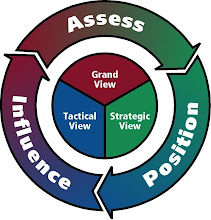
Assess, Position and Implement


Currently our global economy is overwhelmed with random chaos. Some people look at divine inspiration as an alternative.

The key to adjusting to this state of random chaos is to have a process that allows one to stay on the tangible course while minding the grand picture.


Our solution is based on these three steps:
  • Assessing the grand picture;
  • Positioning by planning and preparing a master plan with detailed specifics; and
  • Implementing by utilizing the strategic overview as a standard in completing your goal.
Assess the grand picture means understanding the grand settings through proper information gathering steps. Then, evaluating the information with a proper set of strategic assessment protocols.

If one does not know their grand settings, there is no way he or she will be able to anticipate what is ahead.

--- More to come.

If you want to know about how to build a good plan, please contact us at service[@t]collaboration360[doott].com

Replace @t with "@" and doott with "." .

Collaboration360 Consultants (C360). Copyright:2006-2009 © All rights reserved
Copying, posting and reproduction in any form (without prior consent) is an infringement of copyright.

#
Faith and Finances
Rob Baedeker, Special to SF Gate
Monday, January 19, 2009

Try a Google search for "lost faith" and you'll get plenty of stories about crises of religious belief. But these days you're also likely to see headlines like this one about lost faith in Wall Street and the economy in general.

The road to the free-market promised land may indeed have been paved with a confidence bordering on religious conviction. But now that financial markets have faltered, are believers turning to old-fashioned religious faith for solace and direction?

When I spoke with Bay Area clergy to see if they'd noticed an increase in the number of congregants coming to them for guidance due to financial distress, most echoed Kalid Siddiqi, the imam for Friday prayer at the Masjid Darussalam in San Francisco. "All kinds of people have approached me for counseling," Saddiqi told me. "I have been in this country 24 years, and I have never seen this kind of uneasiness, financially and economically, among the community."

Others, like Diane Rizzetto, abbess and teacher at the Bay Zen Center in Oakland, said that while the numbers of community members seeking her counsel for money-related issues haven't changed substantially, "There is definitely a sense of uncertainty. There's a tension sort of in the air."


... Across faiths, these clergy see this kind of material assistance as rooted in deeper spiritual convictions.

Friedman explained Judaism's response to people in need. The first, she said, is to mobilize people who have resources to support others. "A mitzvah is a commandment and a good deed all wrapped up in one, and there are two sides: one is giving, but receiving is also a mitzvah."

Friedman and others relayed the embarrassment that many in their congregations have felt about asking for help. "There's so much shame around not only asking for help but even people who can't ask for help," she said. There's shame in being poor, in losing your job or home and not being able to provide for your family. I try to help people to see that by coming to ask for help, or allowing themselves to open up and say, 'I need something,' they're enabling other people to give to them, and they're doing a mitzvah -- enabling other people to be holy and act in holy ways."

Siddiqi, a professor of Islamic Studies and Arabic language at several Bay Area colleges and institutions, cited one of the five pillars of Islam, zakah (the directive for the rich to share their wealth with the poor), but he added a caveat about receiving.

"Asking for help if you have all the doors closed is OK," he said. "But asking for help when you are able to do something for yourself is not a very good idea. It is a great honor to work -- it is dishonoring yourself when go and ask for help while you are able to do something."

His advice to those with money worries often includes updating their professional skills or perhaps widening their job search -- and changing their expectations.


... Saddiqi said economic calamity can also be understood, in Islam, as a test from God. He quoted passages from the Koran about Allah testing humans with "fear and hunger, or some loss in goods or lives" and how he will reward "glad tidings to those who patiently persevere."

But Howell had a different take. "Sometimes people think that they're supposed to suffer and that's something that God wants or that's demanded of their faith. That's not what I believe in. I think sometimes we put ourselves in situations where we make ourselves miserable because we have such a small idea of where we can go and what we can be."

In difficult times like these, Rizzetto reminds people that "uncertainty is what lies at the basis of Buddhist thinking." Economic upheaval is "also a very dramatic reminder of our basic human condition of clinging to things É of our wanting things to be permanent, and that's the basis of our suffering. Because they just aren't permanent: as much as we want it, the universe just doesn't run that way."

"But something really good can come of it," she added. "We just don't know. We have a choice: we can look at it as doom and gloom and this is terrible and the end of the world, or if we remember that change brings with it many different possibilities."

Here again the theme of opportunity-in-crisis carried across religious lines.

"It's not always about money or having a great job," said Glabach. "It's also that maybe in situations of crisis, new things can become better or maybe a lot of things can become restructured or redefined."

"This has been an opportunity," Rabbi Friedman said, "to really appreciate the things in life that money doesn't buy, the things that are really enduring, and for all of us to pull back financially and realize that so many of us have not only been living beyond means and our needs, but confusing needs with wants."

After hearing some perspectives from the faithful, I was curious how the God-less were dealing with -- and making sense of -- the recession, so I called David Fitzgerald, action coordinator for the San Francisco Atheists.

"We've had lots of people in our community who have been impacted," he said, explaining the case of a member who recently lost his home.

Aside from the lack of belief in a higher power, Fitzgerald's description of the atheists' response to its members' needs sounded much like the community efforts of the faithful I spoke with. "We say, 'Hands that help are better than hands that pray,'" he explained. "When things like this happen, we come together and we know there's not going to be anybody in the sky looking out for us. If we don't do it, no one else will. That gives us a lot of impetus to take direct action and help people out, and give them support É I have a lot of respect for [religious] charities that do go out there and do the work, but like we say, 'Nothing fails like prayer.' It's literally the least you can do."

Prayer was indeed part of the prescription of many of the faithful I spoke with. But some, like the Zen Center's Rizzetto, had different methods of assuaging their adherents' anxiety.

"There are little specific practices that sometimes I'll give someone," she said. "One is to carry a notebook around and make a list of 10 things a day that they're thankful for. I'm talking about things that are not general, just little things like being able to smell coffee. Not even to have the cup of coffee but just to smell coffee. It helps turn the mind toward the abundance. There is a great abundance, but the mind will turn toward that which isn't. Sometimes we need to put a gentle hand on the shoulder say turn, look in that direction."

Surveying how different faiths make sense of financial disaster, it's tempting to generalize about how all religions are the same, in the end -- that the minister, the imam, the Buddhist and the rabbi are all telling similar stories, albeit with different terms.

It's a comforting notion, but not completely true, I think. What I was reminded of over the course of even these brief conversations is the sometimes radically different ways that religions contextualize catastrophe: for one faith, the recession is a dramatization of uncertainty; for another it's the confirmation of God's certain plan. For one man, the stock market crash is a test from God; for another it's a reminder that there is no God.

If there is a point these religious thinkers have in common, though, it may be optimism. All of them, even the atheist, talked about opportunities revealed by the economic crisis. And universally, they spoke about mobilizing their communities to help others in need.

It's hard to tell which one -- optimism or the exercise of charity -- is the cause and which is the effect. Either way, it's nice to hear.

Do you have a person or topic you'd like to see covered in Money Tales? Let us know. E-mail Rob at rbaedeker@sfgate.com
#