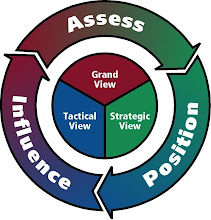
Understand cycles was not Marinelli's strength.
The best strategist always think in terms of seasonal cycles.
Cardinal Rule: It is better to release the aging player one season sooner than one season later.
#
Lions fire Marinelli after record-breaking season
BY LARRY LAGE Dec 30, 2008
AP Sports Writer | 12/30/08 12:36 AM
Rod Marinelli might be a good head coach. He just isn't going to find out for sure in Detroit.
Marinelli inherited a Matt Millen-created mess and compounded his problems by reuniting with some former Tampa Bay Buccaneers whose best years were in the past. The result was the NFL's first 0-16 team and a three-year record of 10-38 for Marinelli, who was fired Monday by the Lions.
Instead of making excuses or explaining why it didn't work out, Marinelli took the high road.
"If I'd have done better and won more games, then we'd have been fine," he said.
The peak of the Marinelli era was midway through last season when the Lions were 6-2.
Since then, they're 1-23.
"If you would've told me about a year and a half ago that we would be in this situation, I would've told you, `No way,'" quarterback Dan Orlovsky said. "I honestly thought Rod was the guy.
"He came in with the old-school, hard-nose mentality to break the mold and change the culture."
Marinelli got a taste of how difficult his job would be during his first minicamp.
"Some of the work ethic kind of surprised me when I got here," he said. "That's why I kind of dug in on that.
"I didn't think it was that tough, but I got turned in and that surprised me."
At least one player filed a grievance because of the intensity of minicamp. The team was punished by banning players from the practice facility for a couple of days.
Marinelli eventually raved about how hard his players practiced for him, insisting he could envision the results showing up on Sundays, but it just didn't happen.
Especially, this year.
"You can't go 0-16 and expect to keep your job," Marinelli said.
The leaders of Detroit's front office, though, did just that.
Lions owner William Clay Ford elevated Tom Lewand to team president and Martin Mayhew to general manager, announcing the moves in the same news release that included the decision to fire Marinelli. ...
The Lions completed their winless season with a loss to Green Bay on Sunday, pushing aside Tampa Bay's 1976 season of 0-14 as the league's worst. Marinelli, though, said the team was not the worst ever in his opinion because the players didn't quit, pout or point fingers.
He won only one of his last 24 games and 10 of 48 in three years after Millen gave the former Bucs assistant his first head coaching job. ... Millen was fired as team president three months ago, but the players he left behind, coupled with the former Tampa Bay players Marinelli wanted, created the perfect storm for a historic season of futility.
Marinelli acknowledged he misjudged what some of those former Bucs had left in their playing careers. He also, in a rare second-guessing moment, wondered if he raised the bar too quickly after Detroit started 6-2 last season. ...
"I can't say he's a bad coach," Orlovsky said. "I just think he was put in a really difficult situation."
http://www.sfexaminer.com/ap/?c=y&id=1352062
Thursday, January 1, 2009

Wednesday, December 31, 2008
Happy New Year!

Assess your grand settings carefully. Plan and Position yourself with an advantage.
Implement your plan for 2009. Good luck!
Sunday, December 28, 2008
Pragmatic Strategic Guidelines in Unpredictable Times

Lately, there have been some chaotic situations that gotten us to reread our situational guidelines list
Following are some of our strategic guidelines for the traveling strategists:
- Plan and prepare early
- Focus on the safety of you (and your entire team)
- Leave early. Carry lightly. Travel fast and quietly.
- Use a transportation service that is trustworthy and reliable
- Leave for the airport before dawn breaks
- Arrive promptly and quietly
- Take rooms between 3rd floor and the 9th floor
- Never take rooms near elevators and exits
- Always have a min. of two escape routes
- Always have a lightweight "Go" bag of essentials available
- Carry a paper map just in case your PDA is not available
- Store your corporate data in a separate portable digital storage device
- Always carry a paper list of contact phone numbers (include fax #'s) and a calling card.
- Always have some "all-climate" clothes available in your clothing pack
- When traveling alone, keep one hand free and always be aware of your grand settings.
Why Plan?
"In planning, no useless move. In strategy, no useless move in vain." - Chen Hao
It has been said that a bad plan is always better than no plan. Why? One can always adjust a bad plan. The question is, how can one adjust their strategic focus when they have no plan?
Tactical Deployment
"In the field of observation, fortune favors the prepared mind." - Louis Pasteur
- Stay centered, relaxed, ground, calm and consciously aware
- Always play it safe
- Never make decisions based on emotions
- Never take large risk for a small gain
- Focus on executing a purposeful move that propels a gain of strategic value.
Copyright: 2008 © Collaboration360 Consultants (C360 Consultants).
Copying, posting and reproduction in any form (without prior consent) is an infringement of copyright
Friday, December 26, 2008
Competing in the Global Economy: Creating a Fast Start (1)

Regardless of the various crises', there are opportunities. How are you find it?
Anyone can claim that they know how to assess strategically. Whether they can do it, that would be a miracle.
We have two questions to our readers, "Do you know what is the supposed outcome after you have assessed the big picture? ..." The answer should be in terms of the context of Sunzi's The Art of War.
The second one is "What is your next step after you answered the 1st question?"
We are offering a copy of a Chinese strategy book to anyone who can give us the answer. Any takers!?
Sunday, December 21, 2008
The Outcome from Poor Assessment

Regardless of the arena, strategic assessment is a necessity.
Following is our C360 process:
- Collect your data with a good intelligence gathering process.
- Assess your data.
- Verify and validate
- Re-assess one more time.
###
Sunday, December 21, 2008 (SF Chronicle)
What investors can learn from Madoff scandal
Kathleen Pender
What can investors learn from the Bernie Madoff scandal?
It's not clear exactly how Madoff allegedly bilked wealthy and supposedly sophisticated investors out of $50 billion in a Ponzi scheme.
Unlike hedge funds, which are essentially unregulated, Madoff registered as an investment adviser with the Securities and Exchange Commission, but not until the SEC forced him to do so in 2006. For decades before that, he operated solely as a broker-dealer, which is also subject to scrutiny by the SEC and Financial Industry Regulatory Authority, the securities industry's self-regulator.
It will be awhile before we understand how the SEC failed to detect the fraud until Madoff's sons, who worked with him, turned him in this month.
But based on what we know so far, here are 10 lessons for investors who work with registered investment advisers.
1. Don't buy what you don't understand. Madoff reportedly told clients he invested in blue-chip stocks and then hedged his positions by trading put and call options on the Standard & Poor's 100 stock index. Although this is a fairly common strategy, it's hard for people who are not financial wizards to comprehend. "If you can't understand the strategy, you have no business investing," says Jay Gould, an attorney with the law firm Pillsbury Winthrop Shaw Pittman.
/// *** Don't build a plan if you do not understand what you are assessing
2. If it sounds too good to be true, it is. Madoff claimed to earn 10 to 12 percent, year after year, with nary a down month. In the real world, such consistent returns are as improbable as doubling or tripling your money in a year.
/// Perception is reality. Always look at the grand picture. Ask yourself does it make sense?
Other firms using a strategy like Madoff's could not figure out how he made such returns in up and down years. Some brought their concerns to the SEC.
"Real put-option strategies can and do provide fairly consistent income, but not in all markets," Gould says.
3. Know where your money is and who is watching over it. Registered investment advisers must place client assets with a qualified custodian, usually a bank or brokerage firm. Advisers can use an independent custodian, which provides an extra layer of security, or an affiliated custodian, which apparently is what Madoff did. The custodian must provide quarterly statements, either directly to the investor or to the adviser to give to the client. "If the statement is delivered by the adviser, that is where there is the potential for the adviser to manufacture the statement," says Clifford Kirsch, a partner at the Sutherland law firm in New York. Madoff allegedly faked statements to make it look like his clients owned securities when in fact their money was being used to pay off other investors. If your money is with an adviser, find out where it is held, whether the custodian is affiliated with the adviser and what safeguards are in place to make sure the adviser can't swipe your money. If you give your adviser discretion to make trades in your account, do not give him or her permission to withdraw funds. And make sure statements are sent directly to you. "Nowhere is (Ronald) Reagan's old adage more applicable than in this case: Trust but verify," says Mercer Bullard of Fund Democracy, an investor advocacy organization.
4. Audit the auditor. If the client receives statements from the adviser (instead of the custodian), the adviser must submit to an annual surprise audit by an outside firm.
Madoff's sole auditor reportedly operated out of a tiny office in suburban New York. A legitimate firm of Madoff's size would have employed at least one brand-name auditor. If your adviser has an auditor, be sure it's reputable.
5. Are your assets insured? Most brokerage accounts are insured against fraud or embezzlement (but not against market losses) for up to $500,000 per account by the Securities Industry Protection Corp., a private, nonprofit entity.
Many brokerage firms purchase insurance that covers additional losses. Find out what insurance your account has and who provides it. (For more, see www.sipc.org.)
6. Diversify. Some Madoff victims had virtually all their assets with his firm, which violates the first rule of investing: Don't put all your eggs in one basket.
"One would never want to have all their assets with any one manager, no matter how brilliant or safe they are," says Joyce Linker, a principal with ThinkEquity who helps clients of the San Francisco bank evaluate money managers.
7. Beware of affinity groups. Many scam artists recruit clients through religious, ethnic or work groups whose members know and trust each other.
Madoff's clients included many wealthy Jewish people and nonprofits in New York and Florida who found him through word of mouth. "We've seen more people steal money in the name of God than any other mechanism," says Wisconsin securities regulator Patty Struck.
8. Understand fees. Sheryl Garrett, head of the Garrett Planning Network, an association of fee-only financial planners, says investors should fully understand how their advisers are compensated.
"Strongly consider not giving anyone trading authority or the ability to withdraw their fee from your account. You can write a check for the fee," says Garrett.
9. Stick with funds. If all of the above seems like too much work, stick with mutual funds, which are much more closely supervised.
10. Don't assume the SEC will protect you. "It's unacceptable that the SEC is not providing the basic level of protection that investors ought to be able to rely on," says Barbara Roper, director of investor protection for the nonprofit Consumer Federation of America. "They ought to be able to assume that the SEC is weeding out those kind of obvious con artists for them."
Unless things change at the SEC, Roper says, "Good luck. You're on your own. Cross your fingers. And hope for the best."
Net Worth runs Tuesdays, Thursdays and Sundays.
E-mail Kathleen Pender at kpender@sfchronicle.com.
----------------------------------------------------------------------
Copyright 2008 SF Chronicle
----------------------------------------------------------------------
http://www.sfgate.com/cgi-bin/article.cgi?file=/c/a/2008/12/21/BUD014RBOF.DTL
---------------------------------------------------------------------
Subscribe to:
Posts (Atom)