Sunday, August 3, 2008

Collaboration 360's Latest Compass AE Success


/// A few months ago, we mentioned that we were working with an organization on a remote collaboration project. The project is over. It was a success

For the last few months, we worked with Lois Gomes, the Chairperson of the Oakland Youth Games committee in organizing their Youth Games. It was our first real test for Compass AE.

[side bar: Compass AE is our strategic collaborative management process (SCMP) that enables teams of implementers to collaborate anywhere as a team regardless of the technology, the distance and the project culture.]

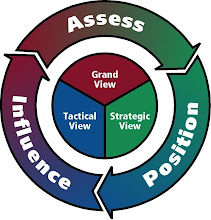
We instructed Ms. Gomes on the fundamentals of Compass AE by guiding her in the building of her Tangible Vision. It began by defining the specifics for her grand picture and her operational objectives.

By understanding the completeness (wholeness) of her project, she became aware of the grand picture of her project. Ms. Gomes also understood the connection
between each milestone together from a strategic viewpoint.

Once the Youth Games began, the operational side (of this event) went off without a major glitch.

Our Compass AE process enabled Ms. Gomes (and her team) to do the following:
  • understanding the critical path;
  • avoiding negative situations while focusing on positive situations;
  • anticipating opportunities;
  • adjusting strategically;
  • shaping the Tangible Vision; and
  • leading by strategic collaboration.
Ms. Gomes comprehension of how the objectives of her current milestone were connected with the grand picture, allowed her to make quality strategy decisions. (We referred this action as "Leading with the Tangible Vision.").

The Collaboration360 team is happy to say that it was a success for the Youth Games organizers and our distance collaboration process. ...

This is a small victory for us. There are many, more miles for us to walk before we sleep.


In a future entry or our next white paper, we will explain the specifics on how our collaborative process was successfully used.

The Importance of Strategic Assessment: (The Origin of Moneyball.)


While the amateurs regard the act of gathering the data and implementing the plan as the monumental keys to project success, the professionals believes that the act of gathering intelligence and assessing it strategically are the keys to quality strategy development and implementation. A team that performs quality strategy development and implementation will succeed.


Compass AE Implementers use the assessed data as the foundation for building their Tangible Vision.

Those who properly build, connect and lead with their Tangible Vision, will prevail.
Just remember that "intelligence is assessed as information with value ."

#

The Red Sox' Stat Man And The Numbers Game
March 30, 2008
(CBS) At last the summer game is back, hope once again rears its pretty head, and the sound of "Play Ball!" is heard in the land. Baseball is a game like no other and despite the obscene salaries and even more obscene steroid cheating scandals, it remains rich in tradition - a favorite of poets and dreamers - and most of all of statistical wonks who believe that enlightenment lies in the correct reading of the numbers. This brings us to Bill James, the wizard hired by the Boston Red Sox five years ago. Since then the team - that was a congenital loser for 86 years - has won two World Series. James invented something called "sabermetrics," loosely defined as the analysis of baseball through objective evidence. Whether it actually works or not is open to debate, but baseball, with its unshakeable reliance on superstition, believes the Red Sox have found themselves one extremely lucky charm.
60 Minutes correspondent Morley Safer found Bill James at spring training in Fort Myers, Fla., a shambling giant who strolls unnoticed among the stars and the star-struck fans, about as athletic as a night watchman at a pork and beans factory, which is exactly what he was. Asked if he tried playing baseball, James admits, "I did play baseball but I have no athletic ability whatsoever." "What position did you play?" Safer asks. "I played where anybody else wasn't playing," James says. He still does. The Red Sox created a new position, Senior Adviser for Baseball Operations. He's an unlikely guru, who for 30 years had been declaring that many of baseball’s hallowed beliefs were "ridiculous hokum." "I remember by the time I was 14 or 15 I'd begun to realize that a lot of baseball's traditional wisdom didn't actually make sense," James says. He says he realized that baseball was going to be his life when he "failed at everything else."

Growing up in Mayetta, Kan., rooting for the old Kansas City A's, James, consumed by baseball, couldn't help but adapt college courses to his first love. "I went to a state university in the Midwest and they tried to teach me economics. And I took everything that they tried to teach me and applied it to baseball," he explains.
He tried a variety of jobs, finally ending up as the night watchman at the Stokely Van Camp Pork and Beans plant in Lawrence, Kan.

To pass the time while watching the beans simmer, he brought a stack of box scores to work. Thus began the theory of sabermetrics.
"There were certain things that Major League Baseball traditionally believed that I argued were nonsense. One, that you could evaluate a pitcher by his won-loss record. Two, that I -- serious disagreement on what drove an offense," he says. Like batting averages: the oldest way to measure a hitter, James believed that players who got a lot of walks and wore down pitchers were overlooked. So he embraced a new statistic, "on-base percentage," which has become part of baseball's Bible. As for pitching, he has said that won-loss records do not tell how good or how bad a pitcher is. "The most accurate thing is to focus on the strikeouts, the walks, the home runs allowed. And to evaluate the pitcher on that level," James explains. So James stresses another statistic: the strike-out to walk ratio. He says for decades managers used outdated formulas or intuition in making decisions. So night after night, he crunched numbers until he came up with new statistics based on facts that would either support or debunk tradition. In 1977, the night watchman became so confident of his theories that he published them. The "Bill James Baseball Abstract" was born; it was 68 pages, mimeographed and stapled, and there was even an advertising campaign.

"Did you have a hard time convincing people of what is the basic truth of baseball?" Safer asks.

"I was a night watchman. I was working in a factory in Kansas. I didn't have a prayer of convincing people who had been in baseball for 40 years that I understood something that they didn't. Nor reasonably should I. I mean, it wouldn't have made sense for them to listen to me and they didn't," James says.

But James did gain a following that kept growing, and by 1982 a major publisher had signed him up.

"He's actually the pioneer of a whole school of thought," says NBC commentator Bob Costas, who is a true believer.

"It changed the way I looked at baseball. The idea that the most important hitting statistics are on base percentage or slugging percentage…it seems simple. But, basic baseball statistics hadn't taken that into account," Costas says.

Costas says James debunked of many of baseball’s myths, like the old belief that pitchers prevented stolen bases. James proved it was the catcher who made the difference.

Some other theories seemed unsupportable, like James' dictum that there is no such thing as a clutch hitter, or that batting order has no significance. But his numbers did show that the sacrifice bunt is rarely worth the out, and that the use of the so-called "closer" is a wasted pitching resource.

"Why does your closer only have to pitch the ninth inning?" Costas asks. "Bill has said for a long time, 'Why wouldn’t you bring in your best reliever with the tying or go ahead runs in scoring position and the best hitter for the other club coming up in the sixth inning or the seventh inning?' Maybe the game turns right there."

Costas says the key to Bill James' success is his simply expressed logic. "He writes very well. And, he’s funny," Costas says. "Bill James is a very, very smart guy. Who doesn’t just understand information, but, he’s shown people a different way of interpreting that information."

Though James' abstracts became bestsellers, and he became the "voice of God" to baseball geeks everywhere, Major League Baseball was slow to appreciate him. When James claimed that legendary manager Sparky Anderson was more lucky than talented, Sparky shot back that James was "a fat little bearded man who knows nothing about nothing."

His ideas were finally put into practice in 1997, when Billy Beane of the hapless Oakland A's used sabermetrics to fill his roster with young, underrated, cheaper players. It made the A's competitive.

In 2002, the new management of the Boston Red Sox came calling on Bill James, ready to try anything to break the 86-year-old curse. Two of the partners, Tom Werner and Larry Lucchino, proclaimed James was part of a grand design-that the team would not be "your father's Red Sox."

"His reputation had preceded him so we knew we were getting a guy who was unusual. And I thought it was a giant step forward," Lucchino says.

"The truth is, Morley, this is a very sophisticated business these days. And it's very competitive. And I think when Larry and I first came into the business, the general manager relied fairly much on gut instincts. And I think that what we've done is we've taken a much more systematic approach, which really comes from Bill," Werner adds.

James sees his job as being the voice of cold reason based on hard evidence.

Example: Fenway Park and its infamous left field wall, the "Green Monster." Fenway was legendary as a right-handed hitters' park. But analysis showed it actually favored left-handed hitters, and the Sox line-up has been lefty-heavy ever since.

Red Sox General Manager Theo Epstein says Bill James is the staff contrarian. "I know with Bill that I'm always gonna get a unique perspective. 'Cause he I think he does see the game from a different vantage point than most anyone else," Epstein says. "His basic questions about the game, I think, have allowed us to think more critically about the best way to develop players. Even if he doesn't have the answers, he always has the questions."

Neither the Red Sox nor James will reveal specific decisions based on James' input, but it is widely accepted that it was James who urged them to sign a jolly giant named David Ortiz.

But James refuses to take full credit for hiring Ortiz, nicknamed "Big Papi."

"Everybody was in favor of signing David Ortiz. I liked him because of his numbers. The scouts liked him because of his swing. Some people liked him because they knew he was a positive guy in the clubhouse," James says.

"Were there any people who said no?" Safer asks.

"Yes, there was. There was a guy. Yeah," James says.

Asked if that guy is still with the club, James says, "I think he is. But I haven't seen him around the office lately."

And what does the guru think about baseball generally? Best player of all? St. Louis Cardinal’s first baseman Albert Pujols. Most underrated? Philadelphia Phillies second baseman Chase Utley.

And if he could have anyone on his team?

"David Wright," James says.

Asked why, James tells Safer, "Because he does everything I like and he's very young."

And age is just about the most important number of all to Bill James. "A player's best years are 25 to 29. That was true when I was a kid, and it's still true now," he says.

Many believe that James-ian theory was behind the Red Sox decision to not re-sign hugely popular but aging stars Johnny Damon and Pedro Martinez, a decision that seems to have paid off for the Red Sox.

But while Red Sox manager Terry Francona says James is an integral part of the Red Sox, you can’t always play strictly by the numbers. "This game's played by people. And, you know, I mean, certainly knowing the numbers, and I care about 'em, and it's important. But people play the game, and I never try to lose sight of that," Francona says.

"Of course in any given day any professional baseball player can defy all the numbers in his record," Safer remarks.

"Yep," Francona agrees. "And the only reason they're ever gonna be any good is if they believe in that. I would never wanna say, 'Hey, you're 0-for-20 against this guy. You can't play.' We don't share that with the players a lot. We want 'em to feel indestructible."

"He's made some what sound like pretty dogmatic statements like, 'There's no such thing as a clutch hitter,'" Safer points out.

"I've heard him say that. But then I would want him to be introduced to David Ortiz…You get my point? We feel pretty good when David Ortiz is hittin' in the clutch," Francona says.

James is rethinking that one. But the players, like Red Sox third baseman Mike Lowell, say theories are for the front office-not the playing field.

"I don't think we come into spring training and say, 'Man, hopefully we have a .960 fielding percentage.' I don't think it gets that detailed," Lowell says. "But I think more teams are realizing that when you use these numbers you’re gonna win more games."

"In the final analysis, it's one guy with a piece of wood, hitting a ball that's moving at 90 miles an hour," Safer remarks.

"Absolutely. You can't put a number on that," Lowell says,

But one number, the number two, as in two World Series, still resonates.

"Whatever effect that Bill James has in the Red Sox, he’s certainly been a good luck charm. I mean, in four years, they’ve won two World Series after an 86-year drought," Safer tells Bob Costas.

"You certainly can't say that Bill James has had a negative effect on the Red Sox fortunes. And, that's bought a tremendous amount of good will, as well in Boston. I mean, 2004 changed everything," Costas says.

One thing 2004 did not change is the hatred for the New York Yankees, who are now playing the numbers game as well.

"Are you concerned that the 'evil empire,' I think, as he - otherwise known as the New York Yankees, are doing the same thing?" Safer asks Larry Luccino.

"Yes," he replies. "They are, but, there are several teams in baseball that are doing it. But, the Yankees always tend to spend a little more money at whatever it is they're doing."

James says he’s always looking for new numbers to help the Red Sox. But even he admits the numbers will never say it all.

"There's something in baseball that you really can't quantify. And that is, the mix of guys at a given moment, there's some magic or whatever, that goes on. That all the James-ian theory in the world will never find the answer to," Safer says.

"It's mostly intangible," James says. "I mean, I don't understand most of it. I don't think that anybody in the Red Sox would tell you that we have that magic stuff figured out. But there are people here who understand that part of the equation a lot better than I do."

Produced by Deirdre Naphin © MMVIII, CBS Interactive Inc. All Rights Reserved. http://www.cbsnews.com/stories/2008/03/27/60minutes/main3974752.shtml

Saturday, July 26, 2008

Strategic Assessment: The Book


After a few weeks of contemplation, we at the Collaboration360 decided to write a book on how to apply our Strategical Assessment process to the global marketplace.

As mentioned before, our process is based on the principles from the Art of War and the rest of the eight Chinese strategy classics.

We have already done the table of contents. Have not figured out the book title. It will have
detailed examples for different competing arena.

It will be a long and slow process. But we will get it done.

More to come

Wednesday, July 23, 2008

Thriving in the Global Economy by Collaborating Without Borders


A
team that implements technology with a direction is like a compass with a needle.

Strategic classics emphasize that "
an organization (or a team) with a strategic foundation is a house with a cornerstone. "

#

July 22, 2008
As Travel Costs Rise, More Meetings Go Virtual
By STEVE LOHR

Jill Smart, an Accenture executive, was skeptical the first time she stepped into her firm’s new videoconferencing room in Chicago for a meeting with a group of colleagues in London. But the videoconferencing technology, known as telepresence, delivered an experience so lifelike, Ms. Smart recalled, that “10 minutes into it, you forget you are not in the room with them.”

Accenture, a technology consulting firm, has installed 13 of the videoconferencing rooms at its offices around the world and plans to have an additional 22 operating before the end of the year.

Accenture figures its consultants used virtual meetings to avoid 240 international trips and 120 domestic flights in May alone, for an annual saving of millions of dollars and countless hours of wearying travel for its workers.

As travel costs rise and airlines cut service, companies large and small are rethinking the face-to-face meeting — and business travel as well. At the same time, the technology has matured to the point where it is often practical, affordable and more productive to move digital bits instead of bodies.

The emerging trend, analysts say, goes well beyond a reaction to rising travel costs and a weakening economy. “These technology tools are going to change the way corporations think about travel and work in the long run,” an analyst at Forrester Research, Claire Schooley, said.

Past predictions that technology could replace travel have been frequent and premature. The main difference today, analysts say, is that the technology is finally catching up to its promise. No single breakthrough explains the progress, but rather a series of step-by-step advances — and steady investment — in telecommunications networks, software and computer processing.

The results can be seen not only in the expensive new telepresence systems like those from Cisco Systems or Hewlett-Packard, but also in more mainstream collaboration technologies — Web conferencing, online document sharing, wikis and Internet telephony. The audio and desktop presentations in Web-based meetings, for example, are now more likely to be in sync and interactive.

Companies of all sizes are beginning to shift to Web-based meetings for training and sales presentations. “Only in the last two years has the technology gotten to point where it really makes sense to use it,” said Alan Minton, vice president for marketing at Cornerstone Information Systems, a 60-person business software company in Bloomington, Ind.

With his sales force doing many product demonstrations online, Mr. Minton estimates the group’s travel costs of have been cut by 60 percent and the average time to close a new sale has been reduced by 30 percent.

No one suggests that the face-to-face meeting is becoming obsolete, or that it is time for a requiem for the road warrior. Companies talk about using digital tools mainly as a way of making business travel more selective and more productive.

Still, the potential for digital displacement of business travel is substantial. A report last month by the Global e-Sustainability Initiative, a group of technology companies, and the Climate Group, an environmental organization, estimated that up to 20 percent of business travel worldwide could be replaced by Web-based and conventional videoconferencing technology.

The most dedicated business travelers tend to be management consultants, investment bankers, accountants, lawyers and technology services consultants. Much of their work has to be done in person with clients. But these professionals are increasingly using online collaboration tools for work within their firms.

At I.B.M., Michael Littlejohn, a work force and technology expert in the company’s global services unit, said two years ago, he was on the road 13 to 15 days a month. These days, he says, he travels 8 or 10 days a month. “But my time spent with clients is not less,” he said. “To really understand a client’s problems or to close a deal, you need face to face.”

/// On an one on one basis, he is correct.

Corporate training and education is a field many companies are moving online, in part to trim travel costs. Darryl Draper, the national manager of customer service training for Subaru of America, used to travel four days a week, nine months of the year, presenting educational programs at dealers nationwide. Today, Ms. Draper rarely travels and nearly all of her training is done online.

Previously, Ms. Draper estimated, in six months she would reach about 220 people at a cost of $300 a person. She said she now reaches 2,500 people every six months at a cost of 75 cents a person.

A range of companies offer the mainstream online communications and collaboration tools, including WebEx, Citrix, Microsoft, I.B.M. and others. The most rarefied offering, though, is telepresence videoconferencing. Today, it is an elite product supplied by a few companies, including Cisco, H.P. and Polycom.

Completed telepresence rooms, typically with three huge curved screens (and a fourth screen above for shared work), custom lighting and acoustics, cost up to $350,000 — though that is down from $500,000, when H.P. sold its first system in early 2006.

The resolution on telepresence screens is even sharper than on high-definition televisions, and images can be magnified to inspect products. Engineers at the far-flung labs of Advanced Micro Devices, for example, scrutinize the microcircuitry on new chip designs using the company’s telepresence systems. And the images of people on screen are life-size.

Cisco, which has more than 200 telepresence rooms, figures it is avoiding $100 million in yearly travel costs, and reducing its greenhouse gas emissions from air travel by 10 percent. H.P. says air travel among its offices with telepresence rooms is down 25 percent.

When used regularly, the rooms pay for themselves within a year, analysts estimate. Sales of telepresence systems will more than double this year to 627, estimates the market research firm IDC, and reach more than 8,000 by 2012.

There is a certain paradox in telepresence, in that it is all to simulate the richest form of human interaction: people talking to each other, face to face.

And it is not a perfect substitute. Ms. Smart, the chief of human resources for Accenture, still travels about 10 days a month. “You don’t learn about other cultures in telepresence,” she said. You get things from being there, over breakfast and dinner, building relationships face to face.”

Copyright 2008 The New York Times Company
http://www.nytimes.com/2008/07/22/technology/22meet.html


###
Regardless of the distance and the project culture, the process precedes the technology.

To thrive in the global economy, the virtual project team needs a strategic foundation and direction. They must collaborate as a team.


Most people know how to perform and produce as an individual. Not many knows how to collaborate as a team.

If you are interested in knowing about how to collaborate anywhere as a team regardless of the distance, the technology and the project culture. Please contact us at service [at] collaboration360 [dot] com. We have a white paper ready for your reading..


Implementing the C360's Strategic Assessment Process


We are currently talking to a high-tech media personality to implement our Strategic Assessment process as the format for a "new" high-tech market research report. Both sides are still playing with the idea.

Our strategic assessment process is designed to be implemented to all competitive arenas.

More to come