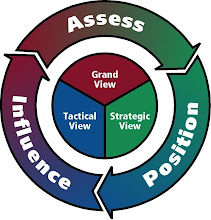
Strategy fails for many reasons. A lack of leadership. ... Bad strategy. ... Poor execution. ... Sometimes it is two out of those three reasons.
# # #
Three Reasons Why Good Strategies Fail: Execution, Execution...
Published: August 10, 2005 in Knowledge@Wharton 
From Vivendi to Webvan, the shortcomings of a bad strategy are usually painfully obvious -- at least in retrospect. But good strategies fail too, and when that happens, it's often harder to pinpoint the reasons. Yet despite the obvious importance of good planning and execution, relatively few management thinkers have focused on what kinds of processes and leadership are best for turning a strategy into results.
/// Chinese strategic classics emphasized that individual team leadership is overrated. Mission definition (and presentation) is what counts. This view is found in chapter 1 and 2 of Jiang Tai Gong's Six Strategies essay.
As a result, says Wharton management professor Lawrence G. Hrebiniak, MBA-trained managers know a lot about how to decide a plan and very little about how to carry it out. " Making Strategy Work: Leading Effective Execution and Change (Wharton School Publishing). "Even though they are good managers, over time they really have to learn through the school of hard knocks, through experience, which means they make a lot of mistakes."
This lack of expertise in execution can have serious consequences. In a recent survey of senior executives at 197 companies conducted by management consulting firm Marakon Associates and the Economist Intelligence Unit, respondents said their firms achieved only 63% of the expected results of their strategic plans. Michael Mankins, a managing partner in Marakon's San Francisco office, says he believes much of that gap between expectation and performance is a failure to execute the company's strategy effectively.
But can better execution be taught? "I think you can at least make people aware of the key variables," says Hrebiniak. "You can develop a model.... If people know what the key variables are, they know what to look for and what questions to ask."
/// *** Our C360 research told us that most uncompleted goals were rarely tangible. Without detailed specifics, the chances of a project being completed "on time, on budget and on target" are rare.The Pitfalls of Poor Synchronization
While execution can go wrong for a variety of reasons, one of the most basic may be allowing the focus of the strategy to shift over time. The attempt by Hewlett-Packard, after it acquired Compaq, to compete with Dell in PCs through scale is a classic example of goal-shifting -- competing on price one week, service the next, while trying to sell through often conflicting, high-cost channels. The result: CEO Carly Fiorina lost her job and HP still must resolve some key strategic issues.
/// *** The specific connections from the initial milestone to the final milestone is one of the many keys to a successful Tangible Vision. This "top view connection" characteristic of the Tangible Vision enables the team to adjust strategically while maintaining the focus toward the goal.
The first step is to define the challenge. Ultimately, argues Richard Steele, a partner in Marakon's New York office, the challenge of execution is mostly a matter of synchronization -- getting the right product to the right customer at the right time. Synchronization is hard for a variety of reasons, including the fact that "any large company these days sells multiple products to multiple customers in multiple geographies. In order to pursue the scale benefits of size -- those benefits of scale through consolidation -- you now have more and more complexity across the matrix." For example, Steele says, a regional manufacturing initiative in Europe may involve reconfiguring 15 different supply chains and understanding the markets of 15 different countries. "It's really tough to do."
///*** The building of the Tangible Vision starts with the understanding of the outcome.
Another classic example of mis-synchronization: United Air Lines' TED, which attempted to set up a competitive subsidiary to compete against upstarts such as Southwest. This was a good idea as far as it went, but United tried to compete using its same old cost structure -- the main reason it was losing markets to the low-cost airlines in the first place.
/// The Compass AE process emphasizes that each stage of the tangible vision must be connected from top down, start to finish.
At other times, plans fail simply because they don't get communicated to all the people involved. "I've done consulting where a major strategic thrust has been developed, and a month or two later I go down four or five levels and ask people how they're doing. They haven't even heard of the program," Hrebiniak says.
/// The Compass stakeholders who build and connect with their Tangible Vision, are accountable to communicate the detailed specifics of their milestone to the expediters.
Strategies also flop because individuals resist the change. For example, headquarters might want more standardization in a product, but a local marketing executive disagrees with the idea. "He might say, 'I need more nuts in my chocolate bar' or 'I need a different pack size,'" Steele says. "You can only get the cost benefit and you can only consolidate if everybody agrees that we are actually going to execute the strategy."
/// Compass AE emphasizes that each stage of the tangible vision must have standards relating to dates and metrics. It contains a criteria that enables them to adjust strategically.
Many times, there can be sound reasons for resistance. Sometimes a strategy might make sense at the highest level, but its full impact on the whole organization has not been fully considered, according to Steele. For example, imagine that the general strategy calls for promoting one brand throughout the company while taking resources away from another brand. That might make sense in one market, yet be completely counterproductive elsewhere. Faced with the choice to promote a product that's considered an advantaged brand in one market but lags in his own, a country manager is likely to try to fight or circumvent the strategy. "Human nature will say, 'I'm not going to synchronize with you. I'm not going to spend the money where you want me to spend it. And I'm going to fight it,'" Steele says. "And that's what he does."
/// The Compass AE process emphasizes that each stage of the tangible vision is connected from start to finish.
Cultural factors can also hinder execution. Companies sometimes try to apply a tried-and-true strategy without realizing that they are operating in markets that require a different approach. Even such a world-beater at execution as Wal-Mart, for instance, has sometimes made some missteps because of culture. One example: When Wal-Mart first moved in to Brazil, it tried to lay down terms with suppliers in the same way it does in the U.S., where it carries huge weight in the market. Suppliers simply refused to play, and the company was forced to reevaluate its strategy.
/// The Compass AE process emphasizes the collaborative building of the goals and the objectives. This point enables the team to learn something about each other.
Internal cultural factors may also present problems. Steele points out that marketers typically move from brand to brand over two-year cycles. At the same time, operations executives advance at a slower, steadier five-year pace, which gives each of them very different perspectives both about the organization's past and its future. Employee incentives may create friction as well. "We hope for A but reward B. We say, 'Do this under the strategy,' but the incentives have been around for 25 years and they reward something else totally," Hrebiniak says.
/// Will comment on this point of "time-lining" later.
Yet the biggest factor of all may be executive inattention. Once a plan is decided upon, there is often surprisingly little follow-through to ensure that it is executed, the experts at Wharton and Marakon note.
One culprit: "Less than 15% of companies routinely track how they perform over how they thought they were going to perform," says Mankins. Instead, only the first year's goals are measured -- and executives often set first-year goals deliberately low in order to meet a threshold for a bonus. He argues that this lack of introspection makes it easier for companies to ignore failed plans. And ignoring failure makes it that much harder to identify execution bottlenecks and take corrective action.
According to Mike Perigo, a partner in Marakon's San Francisco office, frequent communication is essential if plans are to be executed well. "We have found that very effective companies have regular dialogues between the leadership team and unit managers," he says.
People versus Process
What should be done? Mankins says that there are two schools of thought about the best way to improve execution.
One school emphasizes people: Just put the right people in place and the right things will get done. However, within the people school, there are also divisions. Some experts insist that the right people are hired, not made. "The idea is you get A players, you pay them a lot of money, and you pay them for the performance they generate -- irrespective of what may be happening in some other business or region," Mankins says. Others within the people camp think that the key is to improve executive performance through training, and improve the average employee's performance through the creation of a culture of accountability. For example, W. James McNerney, Jr., the chairman and CEO of 3M, argues that by improving the average performance of every individual by 15%, irrespective of what his or her role is, a company can achieve and sustain consistently superior performance.
/// Some ppl believes that having the right people in place is the key to winning. It does not always means that they will collaborate as a team . A collaborative team usually succeeds over a uncompetitive team.
In professional sports, having a team of superstars doesn't always mean a championship team.
A second school emphasizes process rather than people, Mankins says. Larry Bossidy, the CEO of Honeywell and co-author of Execution: The Discipline of Getting Things Done, is one of the leading proponents of this school. Hrebiniak is also a firm advocate of better processes. "If you have bad people, sure, you're not going to do anything well. But how many organizations go out and hire bad people? They all hire good people. So something else must get in the way," he argues. Mankins, however, believes both propositions have merit. "I don't believe those two schools of thought are competing. I think they're just two sides of the same coin," he says.
/// Process works when there is a set of standards that everyone collaboratively connects to it
Marakon's research suggests that companies that have delivered the best results to shareholders combine both approaches. Looking at stock performance going back to 1990, Mankins says, they found that the majority of companies in the top quartile of performance combine attention to process with attention to executive development. Cisco, 3M, and GE are all companies that have emphasized both. Bossidy's Honeywell, on the other hand, has focused principally on process -- and has achieved only average performance.
/// Compass AE process emphasizes that each stage of the tangible vision is connected from start to finish.
Five Keys to Getting the Job Done
Whatever perspective is ultimately seen as the most helpful, there seem to be some tangible things companies can do to improve the chances of success. Experts at Wharton and Marakon agree that, like everything else in business management, improving execution is an ongoing process. However, they say there are steps any company can take that should provide some incremental gains. For example:
Develop a model for execution.
Strategic yardsticks are plentiful. Michael Porter's theory of comparative advantage, for instance, gives strategists a way to conceptualize market leadership goals. In the evaluation of narrower plans, William Sharpe's capital asset pricing model, or more recent schema such as real options theory, can play a similar role. But when it comes to managing change, there are few such guidelines.
Hrebiniak, who offers such guidelines in his book, notes that it's important for managers to "have a model [identifying] the critical variables that define -- at least for the manager -- the things they have to worry about when they put together an implementation plan. Without that, managers will say something like, 'We just hand the ball off to someone and let them run with it,' and that's the execution plan. That isn't going to go anywhere."
/// Will comment on this point of identifying the critical variables later.
Choose the right metrics.
While sales and market share are always going to be the dominant metrics of business, Mankins says that more and more of the best companies are choosing metrics that help them evaluate not only their financial performance, but whether a plan is succeeding. For example, when a large cable company realized that the speed at which it penetrated a new market correlated directly with the number of service representatives it had in the field, executives began tracking the progress of how quickly representatives were being added in particular territories.
/// Each Tangible Vision includes detailed metrics at each milestone.
But Hrebiniak warns that it's important to choose metrics in a package so that they can change if market conditions change. For example, sales of cars might be a good metric for a car manufacturer, but if interest rates rise, sales will likely suffer. A good set of metrics takes that into account.
What should business units that don't touch customers use as a metric? Hrebiniak says he is often told by lawyers, human resource officers or information officers that the success of what they do can't be measured in numbers. His advice: Ask internal clients what would change for them if your department were good or bad -- or didn't exist? Sometimes questions like that can lead to good ideas for performance metrics.
/// To build and connect with the Tangible Vision, qualified stakeholders must be involved.
Don't forget the plan.
As noted above, plans are often simply agreed to and then forgotten. One way advocated by Mankins to keep the plan on center stage is to separate executive meetings about operations from those focused on strategy. While Hrebiniak holds that strategy only succeeds when it is integrated into operations, Mankins and his colleagues argue that day-to-day concerns often so overwhelm the executive team that such an agenda management process is the only way to keep executive attention focused on the organization's progress.
/// Will comment on the topic of connecting the Tangible Vision to a plan later.
Assess performance frequently.
Performance monitoring is still an annual affair at most companies. However, according to Mankins, plan assessments at many of the leading companies happen at much more frequent intervals than they did in the past. "The reason why Wal-Mart is so good at execution is it knows daily if what it is doing in each of its stores gets results or not," Mankins says. For example, when Wal-Mart learned this year that its Christmas sales strategy hadn't worked just eight days after the close of the season, it was able to mitigate the damage in a way it wouldn't have if results had been slower in coming. By shortening the performance monitoring cycle -- from quarter-by-quarter to month-by-month or week-by-week -- top management can get more "real-time" feedback on the quality of execution down the line.
/// Will comment on this point of "performance monitoring" later.
Communicate.
Hrebiniak says that companies often go wrong by creating a cultural distinction between the executives who design a strategy and people lower down in the corporate hierarchy who carry it out. Asking ongoing questions about the status of a plan is a good way to ensure that it will continue to be a priority.
Meetings between the executive team and unit managers should be regular and ongoing, advises Perigo. It's that kind of "direct, demonstrated leadership," he says, that convinces an organization that commitment to a plan is real and that there will be consequences if the plan is not followed through. "It's a signal of commitment from the top that there's an expectation of commitment from below."/// Will comment on this point later.http://knowledge.wharton.upenn.edu/article.cfm?articleid=1252 By using our strategic collaboration process, you will be able to out-do your competition in terms of faster execution, minimize costs, mitigate risks, etc.
If you are interested in learning more about our Compass AE process, please e-mail us at contactus(aatt)collaboration360(ddott)com.