"... It's a lot about coaching, doing things on the sidelines, making adjustments, getting our quarterbacks to play really well. ..." - Lane Kiffin, Raiders Head Coach
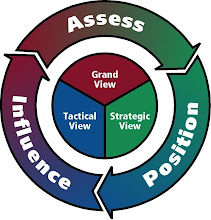
With the Compass AE methodology, a project team uses the Tangible Vision to understand the goal, and the specific objectives. They also use it to adjust to various circumstances.
A team that connects to collaborate is a team that will complete their Tangible Vision.
###
New coaching technique in RaiderLandNancy Gay
Sunday, August 19, 2007
The familiar white Raiders visor was gone Saturday night and so was Lane Kiffin's high-decibel coaching voice. Doctor's orders.
His Raiders were marching up and down Bill Walsh Field at Candlestick, shredding the 49ers' high-priced remodeled defense, yet Kiffin quietly wore his headset and low-keyed it all night. He appeared to let his coordinators - two of the best in the business -
do all the hollering, play-calling and directing in a 26-21 49ers' victory.
"Coaching isn't always about yelling. It's a lot about coaching, doing things on the sidelines, making adjustments, getting our quarterbacks to play really well," said Kiffin, who didn't believe he was coaching any differently in his second NFL game.
Kiffin, to his credit, already has shown us he can take charge. And we learned he can
delegate when he has to, a pretty admirable trait for a 32-year-old rookie NFL head coach who desperately wants to prove he belongs where he is.
If the Raiders exceed expectations in 2007 and perform a hammer throw to last season's 2-14 record by winning half a dozen games or more, Kiffin will get credit for a lot of things.
Among them: He should be lauded for assembling a hell of a coaching staff.
Defensive coordinator Rob Ryan, architect of the NFL's third-ranked defense in 2006, could have bolted Oakland in revolt when he didn't get the head-coaching job. But Al Davis, Kiffin and his loyal players convinced him to stay.
Hiring Greg Knapp, whose experience running the West Coast offense and tutoring quarterbacks - we'll give him a pass on Michael Vick - also smacked of genius. So was the addition of offensive line coach Tom Cable, he of the zone-blocking technique that allowed one sack and opened up monster rushing lanes and clear passing outlets.
This much was evident Saturday night, when Ryan and Knapp maintained most of the sideline authority. Kiffin nodded, watched and oozed ultimate authority. This has been the arrangement all along, really. Kiffin makes decisions and is the in-your-face voice, as long as the doc says it's OK.
Ryan and Knapp, who ooze experience and credibility, do a lot of the dirty work.
The players know it. They look to those coordinators. The Raiders did last week, when Kiffin was mysteriously laid up with an infection. They also looked to themselves.
"I think it says a lot about the staff, but it also says a lot about us as players," Pro Bowl defensive end Derrick Burgess said. "Hey, this is business and we're professionals out there. We knew we had take care of our business when coach was gone."
The teamwork and mutual respect on the Raiders' coaching staff is 180 degrees from the anarchy that ruled under Art Shell's watch, and you better believe the players are responding.
/// The best leaders are those the people hardly know exist.
The next best is a leader who is loved and praised.
Next comes the one who is feared.
The worst one is the leader that is despised.
If you don't trust the people, they will become untrustworthy.
The best leaders value their words, and use them sparingly.
When the leader has accomplished their task, the people say, "Amazing: we did it, all by ourselves!"
--- Dao De Jing, Chapter 17 ///
Kiffin is not the reinvention of Jon Gruden. The age bracket is about the same, the boyish good looks are vaguely familiar. The energy level - a hell-fire, spittle-spewing, red-faced furor achieved through healthy doses of 30-something adrenaline and, in all likelihood, a case of Red Bull - has been pretty darn close.
But the budding legend of Kiffin, the youngest man ever hired to run an NFL team, took a bizarre twist last week when he, well, sort of disappeared from sight.
Within hours of coaching the Raiders to a 27-23 victory Aug. 11 over the Cardinals in the exhibition opener, Kiffin was flattened by a temperature of nearly 104 degrees.
Eventually, we learned he was hospitalized. For two days. Tests were run. Or were they? For several uncertain days, chaos momentarily returned to the super secret world of RaiderLand.
Players - who had grown accustomed to Kiffin's boisterous manner and presence - had no idea where their coach was when they returned to the practice field Monday. Except that he wasn't there.
Curious reporters finally discovered Kiffin was admitted to a Napa hospital. The Raiders' public-relations machine, which under the best of circumstances, operates with the openness and efficiency of the old TASS news agency, hoped that Kiffin's absence wouldn't be noticed.
Then the Raiders argued semantics: "Hospitalized? Well, he was at a hospital ..."
Across the chatty NFL, Blackberrys and e-mail inboxes began exploding.
When a 32-year-old NFL head coach is in the hospital for two days, you bet there is talk. "What's he got?" one NFL general manager demanded of a reporter via e-mail last week.
"A virus," was the reply.
"Out two days with a virus? Unheard of," the GM wrote back.
There isn't a lot of sympathy in the brutish NFL for head coaches who are felled for two days in training camp by anything short of an anvil on the skull.
In a sense, Kiffin's illness was unique. How many NFL head coaches have been downed by mononucleosis, one of the nastiest viral infections you can catch? High fever, swollen glands, sore throat that feels like you're swallowing broken glass. Would the Type A Gruden have handed off the megaphone to his assistants, even in an exhibition game? Probably not.
But Kiffin, who was a model patient Saturday night despite the urge to dial his vocal cords to "11," became an even better NFL head coach as a result of Saturday's pastoral sideline demeanor.
"I felt fine," Kiffin said, "and I know it's your job (to ask), but I kind of feel it has become a distraction to what we're trying to get done."
Not really. Kiffin kept it from becoming one by trusting his coaches to coach, and his players to play. Change has come RaiderLand. And that can be only good.
E-mail Nancy Gay at ngay@sfchronicle.com.
http://sfgate.com/cgi-bin/article.cgi?f=/c/a/2007/08/19/SP9IRLHSF.DTLThis article appeared on page C - 1 of the San Francisco Chronicle