Most startups will never have the resources and the timeline to make the same recovery moves as NBC.
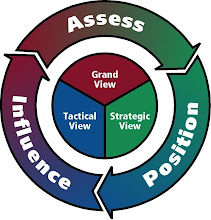
With the Tangible Vision, the project team is compelled to think "big picture". They understand the standards of date and value, the cycles of various components, the processes, etc.
The objective is to avoid being in tactical purgatory. This is where one spends time reacting and living day by day.
The Tangible Vision enables the team to understand the basics of a big picture perspective, a grand strategy, a "Tangible Vision". They receive a perspective that is above the day to day grind. This enables them to plot their moves. Most ppl do not ever get to this stage of thinking and implementation. But it is a goal that is worth aiming for.
People forget that tactics are trendy and limited in terms of specific situations. It comes and go.
Strategically, it is the Tangible Vision that counts. Do you have a Tangible Vision?
In a future article, will have an sample Tangible Vision for the readers to think about
###
August 13, 2007
NBC Making a Clean Start in a House of Mixed MediaBy BROOKS BARNES
After it bought the Web site iVillage.com last year for $600 million, NBC Universal bragged that it had landed a digital darling. The women-focused Internet business was a perfect fit with the Today show, executives said, and would turbo-charge their online efforts.
Few people at NBC Universal are boasting about iVillage now.
Promotions on Today did not spike traffic to the Web site as expected. Veteran Web employees fled after a decision to move iVillage’s offices to New Jersey from Manhattan. Hearst, which had long featured content from Cosmopolitan and Redbook on the site, severed ties so it could bulk up its own Internet business.
Most embarrassing, an effort to increase traffic by introducing a syndicated television program, iVillage Live, resulted in a month-to-month drop in visitors to the iVillage Web site. Introduced last December, iVillage Live, carried on NBC-owned stations in 10 cities, was seen as a failure on its own, suffering from low ratings, poor production quality and a certain nagging cloying quality. It ceased production in June, but is still running in repeats and will return, after a full makeover, next month.
The show’s rebirth is a sign that iVillage’s engines are finally humming. Ad revenue in the second quarter soared 40 percent, and traffic to the Web site is growing. But NBC Universal’s struggles with the online property underscore the snags that can arise when trying to bolt a new media operation onto an old one. The problems also illustrate the growing pains involved in trying to take a mature Internet franchise into the wider world; founded in 1995, iVillage could easily qualify as a rare Dot-Com That Lived.
NBC Universal, which is part of General Electric, is far from alone in grappling with these challenges. Media conglomerates from CBS to Scripps-Howard risk similar integration troubles as they seek growth online by snapping up hot Internet properties, analysts say.
Most recently, Walt Disney paid $300 million for Club Penguin, a subscription Web site aimed at preteenagers, with the goal of melding the site’s penguin characters into the Disney franchise.
The potential potholes, as NBC Universal has discovered, are many. Perhaps the biggest is thinking that the same strategies that yield bountiful results in television will deliver on the Web, said Beth Comstock, NBC Universal’s president of integrated media.
You assume in the beginning that a mention on the ‘Today’ show will drive tremendous traffic, but it’s not that easy, she said. We like where we are now, but boy did we have some tough learning.
Even so, Ms. Comstock said it was unfair to call iVillage Live a failure. The point of the show was to experiment, she said.
/// Experimenting with a purpose means having an "tangible end in mind". Does the "end" justifies the means? This strategist is sure that there are many money-losing projects out there that she can experiment on?NBC Universal is still tinkering with how iVillage fits into its portfolio. One option under consideration is the purchase of Oxygen, the women-focused cable network, according to people familiar with the matter. The low-rated Oxygen, not exactly a trophy in its own right, has been quietly shopped by bankers for months; Kagan Media Research values it at about $1 billion. NBC Universal and Oxygen spokeswomen declined to comment.
/// An overpriced asset!?Back when NBC Universal bought iVillage in March 2006, the chairman at the time, Bob Wright, was hungry to jump-start the company’s online growth. He had watched the News Corporation buy MySpace and Walt Disney negotiate a landmark deal to sell television programs on iTunes from Apple. In many ways, iVillage was one of the only big Web sites left without a dance partner.
/// Failure to prepare (without a tangible objective) is to perform with failure in mind.Candice Carpenter, one of New York’s most prominent Internet executives in the 1990s, was a founder of the Web site and took the company public in 1999. In a sign of the times, shares in an initial public offering sold for $24 and reached more than $100 the next day.
IVillage survived the dot-com collapse partly because of its devoted user base and experienced sales staff. The Web site, known for its Pepto-Bismol pink home page, features a mix of health advice, parenting tips and message boards (Does anyone here regret getting a gastric bypass?). The site logged about 15.9 million unique visitors in July, a 5 percent increase compared with the same month in 2006, according to comScore Media Metrix.
Mr. Wright’s decision to pay $600 million for iVillage at the time, $41 for each unique user stunned some analysts. By comparison, the News Corporation had paid $28 for each unique user for MySpace a few months earlier. Mr. Wright’s boss, the chief executive of G.E., Jeffrey R. Immelt, has since said that the company probably overpaid.
NBC Universal liked iVillage because it was stable, said Peter Naylor, who oversees ad sales for all of NBC Universal’s digital properties. The topics and design were aimed at mature women who would be less likely to abandon the site as soon as a flashier one came along.
But Ms. Comstock, who moved over to NBC Universal from G.E. several months after Mr. Wright first started looking at iVillage, quickly realized that integrating the Web site would be a bigger chore than the company had thought. For instance, the technology that ran iVillage was antiquated and needed a complete overhaul.
We had to decide whether to first launch new products or do the unsexy stuff, like rebuilding the technology, Ms. Comstock said.
She opted for new editorial products, including the ill-fated iVillage Live. As hosts talked about a topic, they encouraged iVillage users to chat about the same thing on the Web site. Some segments, like those discussing hair styling, clicked with both audiences, but most did not.
During that time, a whole new set of Internet competitors popped up. The more stylish Glam.com started courting iVillage’s advertisers. Newer technology allowed upstart competitors like UrbanBaby.com to have sharply lower overhead costs. And media heavyweights like Martha Stewart Living Omnimedia and Lifetime Entertainment started pouring money into the Web.
/// Did their Tangible Vision take account of new marketing adversaries!?
Ms. Comstock and Jeff Zucker, NBC Universal’s chief executive, also confronted a more strategic quandary: which digital horse to back. The company, configured by Mr. Zucker to focus on digital media as a top priority, found itself with three different Internet businesses. There was NBC.com and the array of Web sites dedicated to TV programs; the stand-alone iVillage; and an emerging sector.
We can’t do everything, and you have to spend a lot of time figuring out how to fund these properties properly, Ms. Comstock said.
Ms. Comstock said the retrenchments have helped iVillage. The marketplace wants fast, rapid returns, but I would rather take our steady, long-term growth anytime, she said.
NBC Universal does appear to be making headway. The Web site’s ad sales teams are now fully integrated with the other online properties and the traditional television operation. Ms. Comstock postponed the move to New Jersey.
And Deborah I. Fine, iVillage’s president, has secured new partners to replace Hearst, including theknot.com, a popular wedding planning Web site, and PopSugar, a fast-growing online community aimed at younger women. Meredith Vieira, a Today co-host, has started to blog for the site, and Ms. Fine has created a new weddings section.
I really think we are doing it right, Ms. Fine said.
/// Ms Fine, ... Do you think or do you know?More strategic integration with Today has been crucial to the nascent turnaround, said Phil Griffin, senior vice president of NBC News. For instance, the hosts of the morning program have stopped parroting the line, For more information, go to iVillage.com, he said. Now we try to direct viewers to the site by telling them what specific three related stories they can find if they go there, he said.
The iVillage-related segments typically feature an iVillage expert giving advice or discussing a timely issue. The segments themselves have also become meatier, Mr. Griffin said. We’re trying not to do just female stories that are sweet and nice, he said. Translation: fewer beauty makeovers and more coverage of personal finance.
A revamped iVillage Live will premiere next month with a new title and new hosts. The show, formerly taped in Orlando, Fla., will also move to Chicago, where NBC Universal hopes to attract more celebrity guests.
Although iVillage has failed to sustain a month-to-month rise in visitors, a spokeswoman said that the company is pleased to be delivering steady year-on-year increases. NBC Universal does not publicly report quarterly revenue for iVillage, but analysts estimate the site will generate over $120 million in 2007, a 26 percent increase from last year.
/// To play in the game of "Dealing with the Masses", one must understand what are the current trends and what are the on-coming trends. I wonder if the Tangible Vision of the iVillage cover that?One reason for increases in ad revenue is that iVillage has started working more efficiently with advertisers to weave products deeper into the fabric of the site, said Mr. Naylor, NBC Universal’s senior vice president of digital media sales. For instance, when Schick wanted to advertise razors in the context of things that simplify your life, iVillage pulled related articles from across the site and aggregated them on one page for the company.
They’re protective of their users, but they are very open to working with advertisers, said Shelby Saville, a senior vice president at StarLink, a media buying firm. It seems like they are starting to hit their groove.
Copyright 2007 The New York Times Company
http://www.nytimes.com/2007/08/13/business/media/13ivillage.html
###
If a company does not have a Tangible Vision that people cannot collaborate through, what good is that goal?