Thursday, August 16, 2007

Another Company Lacking the Tangible Vision


Most startups will never have the resources and the timeline to make the same recovery moves as NBC.

With the Tangible Vision, the project team is compelled to think "big picture". They understand the standards of date and value, the cycles of various components, the processes, etc.

The objective is to avoid being in tactical purgatory. This is where one spends time reacting and living day by day.

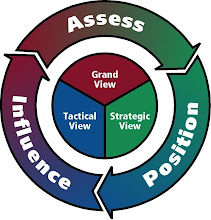
The Tangible Vision enables the team to understand the basics of a big picture perspective, a grand strategy, a "Tangible Vision". They receive a perspective that is above the day to day grind. This enables them to plot their moves. Most ppl do not ever get to this stage of thinking and implementation. But it is a goal that is worth aiming for.

People forget that tactics are trendy and limited in terms of specific situations. It comes and go.

Strategically, it is the Tangible Vision that counts. Do you have a Tangible Vision?

In a future article, will have an sample Tangible Vision for the readers to think about

###

August 13, 2007
NBC Making a Clean Start in a House of Mixed Media
By BROOKS BARNES

After it bought the Web site iVillage.com last year for $600 million, NBC Universal bragged that it had landed a digital darling. The women-focused Internet business was a perfect fit with the Today show, executives said, and would turbo-charge their online efforts.

Few people at NBC Universal are boasting about iVillage now.

Promotions on Today did not spike traffic to the Web site as expected. Veteran Web employees fled after a decision to move iVillage’s offices to New Jersey from Manhattan. Hearst, which had long featured content from Cosmopolitan and Redbook on the site, severed ties so it could bulk up its own Internet business.

Most embarrassing, an effort to increase traffic by introducing a syndicated television program, iVillage Live, resulted in a month-to-month drop in visitors to the iVillage Web site. Introduced last December, iVillage Live, carried on NBC-owned stations in 10 cities, was seen as a failure on its own, suffering from low ratings, poor production quality and a certain nagging cloying quality. It ceased production in June, but is still running in repeats and will return, after a full makeover, next month.

The show’s rebirth is a sign that iVillage’s engines are finally humming. Ad revenue in the second quarter soared 40 percent, and traffic to the Web site is growing. But NBC Universal’s struggles with the online property underscore the snags that can arise when trying to bolt a new media operation onto an old one. The problems also illustrate the growing pains involved in trying to take a mature Internet franchise into the wider world; founded in 1995, iVillage could easily qualify as a rare Dot-Com That Lived.

NBC Universal, which is part of General Electric, is far from alone in grappling with these challenges. Media conglomerates from CBS to Scripps-Howard risk similar integration troubles as they seek growth online by snapping up hot Internet properties, analysts say.

Most recently, Walt Disney paid $300 million for Club Penguin, a subscription Web site aimed at preteenagers, with the goal of melding the site’s penguin characters into the Disney franchise.

The potential potholes, as NBC Universal has discovered, are many. Perhaps the biggest is thinking that the same strategies that yield bountiful results in television will deliver on the Web, said Beth Comstock, NBC Universal’s president of integrated media.

You assume in the beginning that a mention on the ‘Today’ show will drive tremendous traffic, but it’s not that easy, she said. We like where we are now, but boy did we have some tough learning.

Even so, Ms. Comstock said it was unfair to call iVillage Live a failure. The point of the show was to experiment, she said.

/// Experimenting with a purpose means having an "tangible end in mind". Does the "end" justifies the means? This strategist is sure that there are many money-losing projects out there that she can experiment on?

NBC Universal is still tinkering with how iVillage fits into its portfolio. One option under consideration is the purchase of Oxygen, the women-focused cable network, according to people familiar with the matter. The low-rated Oxygen, not exactly a trophy in its own right, has been quietly shopped by bankers for months; Kagan Media Research values it at about $1 billion. NBC Universal and Oxygen spokeswomen declined to comment.

/// An overpriced asset!?

Back when NBC Universal bought iVillage in March 2006, the chairman at the time, Bob Wright, was hungry to jump-start the company’s online growth. He had watched the News Corporation buy MySpace and Walt Disney negotiate a landmark deal to sell television programs on iTunes from Apple. In many ways, iVillage was one of the only big Web sites left without a dance partner.

/// Failure to prepare (without a tangible objective) is to perform with failure in mind.

Candice Carpenter, one of New York’s most prominent Internet executives in the 1990s, was a founder of the Web site and took the company public in 1999. In a sign of the times, shares in an initial public offering sold for $24 and reached more than $100 the next day.

IVillage survived the dot-com collapse partly because of its devoted user base and experienced sales staff. The Web site, known for its Pepto-Bismol pink home page, features a mix of health advice, parenting tips and message boards (Does anyone here regret getting a gastric bypass?). The site logged about 15.9 million unique visitors in July, a 5 percent increase compared with the same month in 2006, according to comScore Media Metrix.

Mr. Wright’s decision to pay $600 million for iVillage at the time, $41 for each unique user stunned some analysts. By comparison, the News Corporation had paid $28 for each unique user for MySpace a few months earlier. Mr. Wright’s boss, the chief executive of G.E., Jeffrey R. Immelt, has since said that the company probably overpaid.

NBC Universal liked iVillage because it was stable, said Peter Naylor, who oversees ad sales for all of NBC Universal’s digital properties. The topics and design were aimed at mature women who would be less likely to abandon the site as soon as a flashier one came along.

But Ms. Comstock, who moved over to NBC Universal from G.E. several months after Mr. Wright first started looking at iVillage, quickly realized that integrating the Web site would be a bigger chore than the company had thought. For instance, the technology that ran iVillage was antiquated and needed a complete overhaul.

We had to decide whether to first launch new products or do the unsexy stuff, like rebuilding the technology, Ms. Comstock said.

She opted for new editorial products, including the ill-fated iVillage Live. As hosts talked about a topic, they encouraged iVillage users to chat about the same thing on the Web site. Some segments, like those discussing hair styling, clicked with both audiences, but most did not.

During that time, a whole new set of Internet competitors popped up. The more stylish Glam.com started courting iVillage’s advertisers. Newer technology allowed upstart competitors like UrbanBaby.com to have sharply lower overhead costs. And media heavyweights like Martha Stewart Living Omnimedia and Lifetime Entertainment started pouring money into the Web.

/// Did their Tangible Vision take account of new marketing adversaries!?

Ms. Comstock and Jeff Zucker, NBC Universal’s chief executive, also confronted a more strategic quandary: which digital horse to back. The company, configured by Mr. Zucker to focus on digital media as a top priority, found itself with three different Internet businesses. There was NBC.com and the array of Web sites dedicated to TV programs; the stand-alone iVillage; and an emerging sector.

We can’t do everything, and you have to spend a lot of time figuring out how to fund these properties properly, Ms. Comstock said.

Ms. Comstock said the retrenchments have helped iVillage. The marketplace wants fast, rapid returns, but I would rather take our steady, long-term growth anytime, she said.

NBC Universal does appear to be making headway. The Web site’s ad sales teams are now fully integrated with the other online properties and the traditional television operation. Ms. Comstock postponed the move to New Jersey.

And Deborah I. Fine, iVillage’s president, has secured new partners to replace Hearst, including theknot.com, a popular wedding planning Web site, and PopSugar, a fast-growing online community aimed at younger women. Meredith Vieira, a Today co-host, has started to blog for the site, and Ms. Fine has created a new weddings section.

I really think we are doing it right, Ms. Fine said.

/// Ms Fine, ... Do you think or do you know?

More strategic integration with Today has been crucial to the nascent turnaround, said Phil Griffin, senior vice president of NBC News. For instance, the hosts of the morning program have stopped parroting the line, For more information, go to iVillage.com, he said. Now we try to direct viewers to the site by telling them what specific three related stories they can find if they go there, he said.

The iVillage-related segments typically feature an iVillage expert giving advice or discussing a timely issue. The segments themselves have also become meatier, Mr. Griffin said. We’re trying not to do just female stories that are sweet and nice, he said. Translation: fewer beauty makeovers and more coverage of personal finance.

A revamped iVillage Live will premiere next month with a new title and new hosts. The show, formerly taped in Orlando, Fla., will also move to Chicago, where NBC Universal hopes to attract more celebrity guests.

Although iVillage has failed to sustain a month-to-month rise in visitors, a spokeswoman said that the company is pleased to be delivering steady year-on-year increases. NBC Universal does not publicly report quarterly revenue for iVillage, but analysts estimate the site will generate over $120 million in 2007, a 26 percent increase from last year.

/// To play in the game of "Dealing with the Masses", one must understand what are the current trends and what are the on-coming trends. I wonder if the Tangible Vision of the iVillage cover that?

One reason for increases in ad revenue is that iVillage has started working more efficiently with advertisers to weave products deeper into the fabric of the site, said Mr. Naylor, NBC Universal’s senior vice president of digital media sales. For instance, when Schick wanted to advertise razors in the context of things that simplify your life, iVillage pulled related articles from across the site and aggregated them on one page for the company.

They’re protective of their users, but they are very open to working with advertisers, said Shelby Saville, a senior vice president at StarLink, a media buying firm. It seems like they are starting to hit their groove.

Copyright 2007 The New York Times Company

http://www.nytimes.com/2007/08/13/business/media/13ivillage.html

###

If a company does not have a Tangible Vision that people cannot collaborate through, what good is that goal?


The Elemental Foundation of the Compass AE


Our Compass AE methodology emphasizes the collaborative Build and Connect and Lead of the Tangible Vision.

The Tangible Vision process (the strategy element of the Compass AE methodology) component highlighted the following:
* The prioritization of objectives, activities and circumstances;
* The top down connection between the goal and the path of specific objectives; and
* The management of the stakeholders regardless of the distance, the technology and the project culture.

If your process does not have this strategic foundation, your company needs Compass AE.

# # #

For more information on Compass AE, please contact us at Service (aatt) Collaboration360 (dottt) com.

Tuesday, August 14, 2007

An Online Slide Show of Compass AE is coming


If you are interested in viewing our online slideshow, please contact us for the link.
Our e-mail address is: Service [/a/tt/]collaboration360[/d/ott/]com

Thanks

Monday, August 6, 2007

Does Yahoo Needs a Tangible Vision?

Seen too many teams without a collaborative process for defining their vision and the direction fail.

With our Compass AE process, the Yahoo team would have a collaborative criteria that they can use to determine their priorities and the processes and how it relates to the grand goal.

By seeing the "grand picture", efficiency improves while unnecesary meeting time and redundancy are eliminated.

A team without a vision and direction is like a car without a steering wheel.

My question is ... "Does Yahoo have the Tangible Vision and the drive to take it to the next level?"

###

Creating a new Yahoo

Verne Kopytoff, Chronicle Staff Writer
Sunday, August 5, 2007

A cavalcade of Yahoo Inc. employees showcased Internet products they had built over the previous 48 hours to hundreds of colleagues crammed into a meeting room during this year's "Hack Day," hoping that their ideas would someday make the big time.

Some gave polished presentations, others were barely intelligible and a couple of the products didn't even work.

Bradley Horowitz, a Yahoo vice president, paid close attention, nodding, clapping and quietly critiquing while sipping a beer. After the event wound down, he walked up to the team that won the "best of" award for an idea related to search and offered to introduce them to a senior executive to "get him enthused and excited."

The internal Yahoo event, where employees whip up products literally overnight, is part of a broader effort by Horowitz to nurture innovation at the Sunnyvale Web portal. After falling behind rival Google Inc. in developing products that win users' hearts and minds, Yahoo is trying to make a comeback based partly on becoming more of an innovator and risk-taker.

Horowitz, 42, who was recently appointed vice president of advanced development, is a prominent part of that effort. Part muse, evangelist and matchmaker, he spends his days trying to help grease the wheels of innovation at the company, which even top executives acknowledge has become too bureaucratic.

Yahoo has suffered a series of disappointing quarters, eliciting Wall Street's ire, a management shakeup and second guessing about the company's direction. Many critics lay the blame on Yahoo's failure to develop a new generation of products so it could more easily chip away at Google and the rising social networking superstars, MySpace and Facebook.

"When you think of innovation and technology companies, Yahoo doesn't necessarily come to mind," said Denise Garcia, an analyst for A.G. Edwards.

For the past few years, Yahoo's new product pipeline has depended largely on buying hot startups, the most prominent of which was Flickr, a photo-sharing Web site. It has blossomed under Yahoo's umbrella by offering users the ability to easily share and comment on photos to the point that executives shuttered the company's internally built photo service earlier this year.

A number of other acquisitions soon followed Flickr: bookmark sharing service, Del.icio.us; event listings service, Upcoming; contest site, Bix; and video editor, Jumpcut.

The obvious question was why couldn't Yahoo have built some of these new technologies in-house? Had the leading Web portal lost its cool quotient?

/* Generating profit is more cooler. */

Subversive style

That's where Horowitz fits in. He sports a perpetual 5 o'clock shadow and black-framed hipster glasses. His management style could be described as subversive, harkening to his days as a guitarist in a punk rock band and promoting punk gigs.

Phrases like "taking power from the man" roll off his tongue with abandon. Music is one of his frequent topics, especially when talking about Hack Day and its ethos of fun.

"It's the difference between practicing piano after school in a regimented way versus smoking pot and jamming with your friends in a garage," Horowitz said.

A longtime devotee of meditation, Horowitz once spent a year in India seeking his inner calm and chopping vegetables. Colleagues say he is relentlessly positive without seeming slick.

"Bradley is a person who is unbounded with his enthusiasm and energy from what he does every day," said Andrew Braccia, a former Yahoo search executive who is now a venture capitalist with Accel Partners. "People feed off of that."

Horowitz grew up in Detroit, where he started using computers in grade school during an era it was for the supernerdy. He later went on to University of Michigan, where he spent time in the artificial intelligence lab, before going to Massachusetts Institute of Technology for graduate school, where he focused on multimedia.

He abandoned his doctoral studies to co-found Virage, an online video company that went though an initial public offering, got sucked into the dot-com downdraft and was acquired by Autonomy in 2003. He joined Yahoo in 2004, thinking that he needed to get a year of corporate experience under his belt before vaulting to another startup.


Changing plans

Those thoughts of leaving quickly evaporated.

"Because I had a bit of a devil-may-care attitude - I didn't come here to climb the corporate ladder - I started in a cavalier way doing what I thought was right for the company," Horowitz said.

In his current role, which he assumed earlier this year, Horowitz oversees dozens of employees in three teams, the most prominent of which is called Brickhouse, which opened for business four months ago. It is based in a renovated warehouse in San Francisco, intentionally distant enough from headquarters in Sunnyvale to feel like a startup.

The facility is intended to be a sort of incubator where products bubble up from the rank and file. Employees submit ideas for projects. A board made up of several Yahoo executives - including Horowitz - screens the proposals. Employees who make the final cut are detailed temporarily to the office until the project is complete.

Horowitz explained that the facility may create 10 products in its first year, some of which may look radically different from Yahoo's traditional mass-market fare. But given the risky nature of innovation, perhaps only two of the ideas will ever premiere publicly, he said.

Yahoo Pipes, a service for techies that helps them use data from different sources, was the first project to be shoved out the door. Although it received rave reviews, it hardly has the killer app that is going to close the gap with Google.

"We would love to have the next big hit," Horowitz said before explaining that some of what Brickhouse creates may be invisible to the average user, such as making Web pages load faster.


Creating the next Flickr


Horowitz played a big role in buying Flickr and several of the other startups over the past few years. Though smaller acquisitions will continue to play an important role at Yahoo, Horowitz emphasized, he wants to spawn more products within Yahoo, in part to save money and to make them easier to integrate throughout the Web portal.

"How can we grow the next Flickr internally?" is the question that he constantly asks himself.

/* You got to have a Tangible Vision */

Analysts want to know, too. Getting the product pipeline on track could help revive Yahoo's stalled growth, largely attributed to a lagging advertising business and the juggernaut that is Google.

"I am keen to see this company rise to the reputation it deserves and I certainly feel like we have a lot of work to do to change the headlines," Horowitz said. "The onus is on us."

As a Web behemoth, Yahoo has been criticized over the years for being conservative, and that it is part of the reason the company is struggling today. Big companies tend to defend the businesses they're in rather than jumping into new ones.

"Innovation involves risk, and that's not in the DNA of a big business that is generating a lot of revenue," said Dan Cohen, a former Yahoo executive who is now chief executive of Pageflakes, a San Francisco company that offers personalized home pages.

Horowitz agreed to a point, saying: "It's not like we were an insurance company. But I think (we) will be open to taking bigger risks."

To catalog all the products presented at Hack Days over the years, Yahoo keeps what is unofficially called a "hack tracker." More than 1,200 ideas, some in the works, others that never got off the ground, are organized by theme and are annotated with comments about their prospects and priority in the product pipeline.

Science fair for adults

Given the number of ideas, saying "no" is a big part of his job. Treading lightly is important.

"If you say no in a way that is shutting people down, it is incredibly damaging," Horowitz said.

For Yahoo's Hack Day last month, employees submitted 120 ideas that they showed off in a black tent set up on the lawn at Yahoo's headquarters. The preliminaries had the air of a science fair, with individual teams made up of everyone from Yahoo attorneys to product managers, touting their ideas and asking that fellow colleagues vote for them so that they would make it to the finals.

/* Ideas are exchanged. Ideas are modified and stolen. */

Because some of the products could ultimately be put into development, Yahoo asked that no specifics about them be publicized. Although some seemed pretty far-flung, or would have only niche appeal, several seemed to have potential, according to Horowitz and several of the day's judges, who included Yahoo co-founder David Filo.

During the finals, held in a vast meeting room, with a 90-second timer ticking down on a whiteboard, one presenter gave an impassioned appeal to elevate his idea to the big time, saying, "If you let me push this tonight, we'd be beating Google tomorrow morning."

/* Does that sound like an impassioned appeal!? Sound like a desperate peal for attention. */

However, nothing is that easy at a big company. Anything released must first be thoroughly vetted for privacy, security, patents, licensing and adequate infrastructure, even when innovation is a priority.

E-mail Verne Kopytoff at vkopytoff@sfchronicle.com.

http://sfgate.com/cgi-bin/article.cgi?f=/c/a/2007/08/05/BU8HRA6SD1.DTL

This article appeared on page D - 1 of the San Francisco Chronicle

# # #

For more information on our team collaborative process, click on the following labels: "Tangible Vision" and the "Compass AE".
You can contact us by going to our
General Information on Collaboration360 Consultants profile page.


Wednesday, August 1, 2007

Notes on Dr. Ralph Sawyer's Translation of the Six Secret Teachings


Someone asked me why we are giving away this strategy classic, not Sun Zi's Art of War. The big picture concept behind our Tangible Vision process is based on our understanding of this specific classic and other essays found in the other ancient Chinese strategic classics.

Some people have considered this classic is considered to be the 1st strategic essay written during Ancient China.
Not to confuse the reader. viewer.

Jiang Tai Gong (姜太公, Chiang Tai Kung's, Wales romanization).the writer of this essay was a predecessor of Sun Zi during the Western Zhou era.

# # #

This book is a great guide for "newbies" who are interested in strategic consulting and advising. It consists of six chapters that guide the readers in the art and science of effective strategy and leadership from a top-down model.

The first two "chapters" deal with the duties of the organization and the natural transition of power to the principal rival if the organization fails. This scenario can be described as a "respective" interplay of "yin and yang."

1. The Civil Strategic Secret: The first chapter underscores the importance of recruiting talent, managing the organization, and valuing developing a proper relationship within your client and your own organization. Once the bond of absolute trust is established, they will do almost anything for you.

2. The Military Strategic Secret: The second chapter highlight the importance of how to prevail over the opposition and how to build a territorial domain by the following actions: Cultivating yourself and organizing your own group in order to govern your external settings and pacify the world. The concept of "conquering without a single tactical battle" is also greatly emphasized. (It is similar to Sunzi's concept of "winning a war without a battle.")


3. The Dragon Strategic Secret: The emphasis is on how to lead wisely through various situations by understanding the development of operational command, order and liaison.

4. The Tiger Strategic Secret: The emphasis is on the tactical essentials, including matters related to proper group-maneuvering procedures for certain scenarios.

5. The Leopard Strategic Secret: This chapter focuses on the tactical specifics for determining the critical path toward completing the objective.

6. The Dog Strategic Secret: This final chapter focuses on the tactical specifics of trapping the target (i.e., encircling and intercepting). There are also good points on selecting and training the desired team professionals and coordinating the personnel's and resources toward the target.

Understanding and mastering the content from Chapter 1 and Chapter 2 (civil secret teachings and martial secret teachings) is an important key to being a good consultant
The first stage of any good consultant is to gain the client's trust by knowing the various ways of "suggesting" ideas and perspectives to the principal client.

The concepts behind Chapter 1 and Chapter 2 are similar to Adam Smith's Wealth of Nations, but with a Dao-conceptualized viewpoint. If one wants to start an uprising in their competitive arena, we recommend the interested person to carefully study those two chapters.


Another lesson that comes from reading Jiang's essay was the importance of "thinking big" in one's own aspiration. It helps to have read the Jiang's biography.


A note from RalphSawyer.com: Although the Art of War remains the only book known in the West, the Wuzi and Six Secret Teachings proved to be highly important sources for military wisdom over the centuries, and the latter continues to be held in higher esteem among contemporary PRC military professionals.

# # #

More information on Jiang Tai Gong can be found here.