Wednesday, August 1, 2007

Notes on Dr. Ralph Sawyer's Translation of the Six Secret Teachings


Someone asked me why we are giving away this strategy classic, not Sun Zi's Art of War. The big picture concept behind our Tangible Vision process is based on our understanding of this specific classic and other essays found in the other ancient Chinese strategic classics.

Some people have considered this classic is considered to be the 1st strategic essay written during Ancient China.
Not to confuse the reader. viewer.

Jiang Tai Gong (姜太公, Chiang Tai Kung's, Wales romanization).the writer of this essay was a predecessor of Sun Zi during the Western Zhou era.

# # #

This book is a great guide for "newbies" who are interested in strategic consulting and advising. It consists of six chapters that guide the readers in the art and science of effective strategy and leadership from a top-down model.

The first two "chapters" deal with the duties of the organization and the natural transition of power to the principal rival if the organization fails. This scenario can be described as a "respective" interplay of "yin and yang."

1. The Civil Strategic Secret: The first chapter underscores the importance of recruiting talent, managing the organization, and valuing developing a proper relationship within your client and your own organization. Once the bond of absolute trust is established, they will do almost anything for you.

2. The Military Strategic Secret: The second chapter highlight the importance of how to prevail over the opposition and how to build a territorial domain by the following actions: Cultivating yourself and organizing your own group in order to govern your external settings and pacify the world. The concept of "conquering without a single tactical battle" is also greatly emphasized. (It is similar to Sunzi's concept of "winning a war without a battle.")


3. The Dragon Strategic Secret: The emphasis is on how to lead wisely through various situations by understanding the development of operational command, order and liaison.

4. The Tiger Strategic Secret: The emphasis is on the tactical essentials, including matters related to proper group-maneuvering procedures for certain scenarios.

5. The Leopard Strategic Secret: This chapter focuses on the tactical specifics for determining the critical path toward completing the objective.

6. The Dog Strategic Secret: This final chapter focuses on the tactical specifics of trapping the target (i.e., encircling and intercepting). There are also good points on selecting and training the desired team professionals and coordinating the personnel's and resources toward the target.

Understanding and mastering the content from Chapter 1 and Chapter 2 (civil secret teachings and martial secret teachings) is an important key to being a good consultant
The first stage of any good consultant is to gain the client's trust by knowing the various ways of "suggesting" ideas and perspectives to the principal client.

The concepts behind Chapter 1 and Chapter 2 are similar to Adam Smith's Wealth of Nations, but with a Dao-conceptualized viewpoint. If one wants to start an uprising in their competitive arena, we recommend the interested person to carefully study those two chapters.


Another lesson that comes from reading Jiang's essay was the importance of "thinking big" in one's own aspiration. It helps to have read the Jiang's biography.


A note from RalphSawyer.com: Although the Art of War remains the only book known in the West, the Wuzi and Six Secret Teachings proved to be highly important sources for military wisdom over the centuries, and the latter continues to be held in higher esteem among contemporary PRC military professionals.

# # #

More information on Jiang Tai Gong can be found here.

Tuesday, July 31, 2007

Free Copy of Six Secret Teachings book to the First Two Participants of the Informative Interview


Collaboration360 Consultants is offering a free copy of Dr. Ralph Sawyer's Six Secret Teachings to the first two people who participates in our informational interview. This 30 minute interview focuses on the participant's personal experience of distance collaboration.

This limited offer is extended to two different participants; other restrictions apply.

Interested candidates may contact us at service [ aat ] collaboration360 [dott] com. After the candidate is chosen, we will provide further information. We reserve the right to modify or rescind this offer at any time.

Copyright: 2007 © Collaboration360 Consultants (C360).
Copying, posting and reproduction in any form (without prior consent) is an infridgement of copyright.

Monday, July 23, 2007

A Positive Referral from Another Client


"... Your Compass AE methodology is an awesome pathway to success! From the international conglomerate to the lemonade stand down the road, I can't think of any organization that wouldn’t benefit from putting together a Tangible Vision. It's helped us create an award-winning website and build strong relationships based on trust with our overseas partners. ...
Enable the right professionals with Compass AE—it will be hard NOT to excel in whatever your endeavor might be! Thanks C360! ..." - Of Course Lion Source

Tuesday, July 17, 2007

Different Applications of the Tangible Vision


Recently, we have worked with different groups of people in applying the Tangible Vision to their endeavors.

In one case, we guided the founders of an Asian wireless startup in understanding their goal, their direction and the circumstances that comes with it. . By enabling them to collaboratively built three "connective" Tangible Visions (from a top down viewpoint), they
were able to see the entire directional path toward their goal.

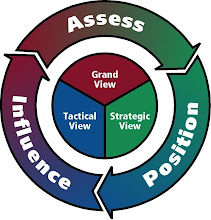
The first one is the "Grand" Tangible Vision that focused on the grand goal and the direction of their company. It also delineates the values of their mission and the
identity of the senior management.

The second Tangible Vision is the "Marketing" Tangible Vision that complements the first one in how the marketing team is going to complete their goal.

The third Tangible Vision
complements the second one. It is the product development team's big picture on how to complete their goal. The completion of this stage enables the marketing team to complete their Tangible Vision.

In future entries, we will include a diagram that displays how the Tangible Vision works from the top level of senior management to the level of implementers.

- More to come -

Sunday, July 8, 2007

Competing in the Global Marketplace: Challenges of Remote Collaboration

In the international marketplace, Global-bounded companies are faced with the dilemma of synchronizing the work of their remote collaboration teams. Working interdependently, unifying teams under one direction and having efficient meetings are the major challenges for these teams.

The challenge of working interdependently
Our research shows that people involved in remote collaboration struggle to work interdependently as a team. The lack of day-to-day interactions prevents the team from being connected and unified. The problem of making decisions without input from other team members is pertinent.

The challenge of unifying teams under one direction
When there is uncertainty in the goal and specifics connected to it, unifying remote teams under one direction becomes difficult. A non-unified team does not collaborate and is usually ineffective.

The challenge of efficient meetings
Efficient meetings are difficult in remote collaboration situations when team members are not unified in one absolute direction. There is a tendency to be distracted by local issues that divert the focus toward the strategic matters of the current project. The effects of inefficient meetings are poor decision-making and poor managerial control.

In summary, the negative effects of these challenges have a tendency to create vicious cycles. Time and money are wasted and team morale suffers. Progress towards the grand goal is impeded or never advances.

If project managers and their team members cannot resolve these basic collaborative challenges, how can they function when distance and culture become relevant?


--- More to come ---

Copyright: 2006-2007 © Collaboration360 Consultants
(C360).
Copying, posting and reproduction in any form (without prior consent) is an infridgement of copyright.