Sunday, May 10, 2009

The Dao of Strategic Assessment (17): The Dilemma of Assessing


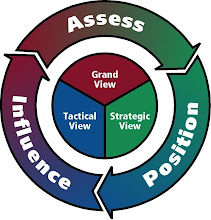
When assessing one's marketplace, focus on understanding what are the current and future economic influences and the current state of the marketplace.

At this moment, businesses of all sizes must decide
what is the next big trend for their marketplace. They are in process of assessing their grand picture, searching for the grand variable that indicates the economy is turning around.

Historically, the smaller companies usually pursue the "high risk, high reward" ventures while the larger companies sit and wait for the smaller companies to validate the new marketplace and create internal mistakes at the same time .

Conclusively, the process of strategic assessment always plays the important role in understanding what are the current and the future opportunities, especially for those who are willing to pursue the apex position of their marketplace.

So,
what is the dilemma? Deciding on when to stop assessing and start the planning and preparation process. We will touch more on this topic later on.

#

No rebound just yet, according to supply-chain survey
By Peter Clarke
EE Times Europe
(05/06/09, 08:33:00 AM EDT)
LONDON — The electronics supply chain remains pessimistic and appears to believe we have not yet seen the bottom of the recession, according to a survey of more than 230 electronics supply chain decision makers.

Respondents gave an average score of 4.2 regarding how the current economic situation is impacting their company on a scale of 1 to 10, 1 being "very negative" and 10 being "very positive."

When asked about the next 6 months, these same respondents answered with an average score of 4.6, a small, but significant increase, pointing to a belief that the business environment in the technology sector will improve. Respondents were also neutral (average score of 4.9) regarding prospects for their company's profits for the next 6 months.

Respondents that identified themselves as electronics manufacturing services (EMS) or original design manufacturing (ODM) companies were generally more optimistic at 5.4. Respondents from semiconductor, distribution and logistics, and components manufacturing firms were more pessimistic, giving average scores of 4.2, 4.0, and 3.4 respectively. The survey was conducted by VentureOutsource.com and sponsored by electronic component distributor Digi-Key.

"VentureOutsource.com's survey is revealing and confirms what we're seeing," said Paul Singh, CEO for privately-held Suntron Corp. a North American EMS provider serving such end-markets as military/aerospace and industrial and medical electronics. "Economic conditions are impacting the industry as a whole, but quality-focused companies not burdened by a lot of debt and with good cash flow should emerge okay once economic conditions improve," added Singh.

"Our findings don't indicate a full recovery in the electronics sector is underway just yet but our survey results do provide some helpful information indicating where we are right now in this downturn," said Mark Zetter, president and founder of VentureOutsource.com.

Related links and articles:

www.ventureoutsource.com

Top 25 distributors of 2009

Intersil and Digi-Key sign distribution agreement

When the going gets tough, the tough get trained

http://www.embedded.com/217300436?cid=NL_embedded

#

If you are interested in understanding the basics of assessing a marketing terrain, please view this past post .

Thursday, May 7, 2009

A History Channel's Documentary on Sun Tzu's The Art of War


This coming Saturday, History Channel's is rebroadcasting a two hr presentation on Sun Tzu's The Art of War ... Our friend Mark McNeilly of SunTzu1.com will be featured as one of the on-camera experts.

Behind the scenes, we contributed to the content of the show. ... Enjoy the show.


Saturday, May 9 at 5 p.m. ET on HISTORY CHANNEL

All warfare is based on deception. Therefore, when capable of attacking, feign incapacity; when active in moving troops, feign inactivity. When near the enemy, make it seem that you are far away; when far away, make it seem that you are near. – Sun Tzu.

Sun Tzu was the Nostradamus of warfare, and his book The Art of War, written 2,400 years ago, is still the ultimate how-to book for winning. This two-hour special brings his words to life. Shot like a graphic novel, Art of War weaves together several epic stories, including the story of Sun Tzu himself, and a war soon after his death where a city is saved using his tactics as China takes the first step toward unification.

Art of War also follows other epic battles in history—Roman battles, The American Civil War, World War II, and present day—that illustrate more of Sun Tzu’s lessons and how the people who understand his strategy are the most dangerous weapons of all. While his ideals were originally created for battle, his lessons could be used by anyone who wants to win—whether at sports, business, or life.

You can also purchase the DVD at the History Channel website store here:
http://shop.history.com/detail.php?p=95924&SESSID=630d44dda567d8680140bb1a78660e29&v=All

Tuesday, May 5, 2009

Best Practices of Desktop Strategists (5)


One cannot assess and strategize if he cannot focus. When one has the "world class" focus, he sees the connections within his grand settings from a top down view. Gaining the view of the entire grand settings enables one to make better decisions.

If one cannot focus, their
ability to make proper decisions will diminish.

It has nothing to do
with the abundant of information that he or she gets.


#
May 5, 2009
Findings
Ear Plugs to Lasers: The Science of Concentration
By JOHN TIERNEY

Imagine that you have ditched your laptop and turned off your smartphone. You are beyond the reach of YouTube, Facebook, e-mail, text messages. You are in a Twitter-free zone, sitting in a taxicab with a copy of “Rapt,” a guide by Winifred Gallagher to the science of paying attention.

The book’s theme, which Ms. Gallagher chose after she learned she had an especially nasty form of cancer, is borrowed from the psychologist William James: “My experience is what I agree to attend to.” You can lead a miserable life by obsessing on problems. You can drive yourself crazy trying to multitask and answer every e-mail message instantly.

Or you can recognize your brain’s finite capacity for processing information, accentuate the positive and achieve the satisfactions of what Ms. Gallagher calls the focused life. It can sound wonderfully appealing, except that as you sit in the cab reading about the science of paying attention, you realize that ... you’re not paying attention to a word on the page.

The taxi’s television, which can’t be turned off, is showing a commercial of a guy in a taxi working on a laptop — and as long as he’s jabbering about how his new wireless card has made him so productive during his cab ride, you can’t do anything productive during yours.

Why can’t you concentrate on anything except your desire to shut him up? And even if you flee the cab, is there any realistic refuge anymore from the Age of Distraction?

I put these questions to Ms. Gallagher and to one of the experts in her book, Robert Desimone, a neuroscientist at M.I.T. who has been doing experiments somewhat similar to my taxicab TV experience. He has been tracking the brain waves of macaque monkeys and humans as they stare at video screens looking for certain flashing patterns.

When something bright or novel flashes, it tends to automatically win the competition for the brain’s attention, but that involuntary bottom-up impulse can be voluntarily overridden through a top-down process that Dr. Desimone calls “biased competition.” He and colleagues have found that neurons in the prefrontal cortex — the brain’s planning center — start oscillating in unison and send signals directing the visual cortex to heed something else.

These oscillations, called gamma waves, are created by neurons’ firing on and off at the same time — a feat of neural coordination a bit like getting strangers in one section of a stadium to start clapping in unison, thereby sending a signal that induces people on the other side of the stadium to clap along. But these signals can have trouble getting through in a noisy environment.

“It takes a lot of your prefrontal brain power to force yourself not to process a strong input like a television commercial,” said Dr. Desimone, the director of the McGovern Institute for Brain Research at M.I.T. “If you’re trying to read a book at the same time, you may not have the resources left to focus on the words.”

Now that neuroscientists have identified the brain’s synchronizing mechanism, they’ve started work on therapies to strengthen attention. In the current issue of Nature, researchers from M.I.T., Penn and Stanford report that they directly induced gamma waves in mice by shining pulses of laser light through tiny optical fibers onto genetically engineered neurons. In the current issue of Neuron, Dr. Desimone and colleagues report progress in using this “optogenetic” technique in monkeys.

Ultimately, Dr. Desimone said, it may be possible to improve your attention by using pulses of light to directly synchronize your neurons, a form of direct therapy that could help people with schizophrenia and attention-deficit problems (and might have fewer side effects than drugs). If it could be done with low-wavelength light that penetrates the skull, you could simply put on (or take off) a tiny wirelessly controlled device that would be a bit like a hearing aid.

In the nearer future, neuroscientists might also help you focus by observing your brain activity and providing biofeedback as you practice strengthening your concentration. Researchers have already observed higher levels of synchrony in the brains of people who regularly meditate.

Ms. Gallagher advocates meditation to increase your focus, but she says there are also simpler ways to put the lessons of attention researchers to use. Once she learned how hard it was for the brain to avoid paying attention to sounds, particularly other people’s voices, she began carrying ear plugs with her. When you’re trapped in a noisy subway car or a taxi with a TV that won’t turn off, she says you have to build your own “stimulus shelter."


She recommends starting your work day concentrating on your most important task for 90 minutes. At that point your prefrontal cortex probably needs a rest, and you can answer e-mail, return phone calls and sip caffeine (which does help attention) before focusing again. But until that first break, don’t get distracted by anything else, because it can take the brain 20 minutes to do the equivalent of rebooting after an interruption. (For more advice, go to nytimes.com/tierneylab.)

Multitasking is a myth, Ms. Gallagher said. You cannot do two things at once. The mechanism of attention is selection: it’s either this or it’s that. She points to calculations that the typical person’s brain can process 173 billion bits of information over the course of a lifetime.

People don’t understand that attention is a finite resource, like money, she said. Do you want to invest your cognitive cash on endless Twittering or Net surfing or couch potatoing? You’re constantly making choices, and your choices determine your experience, just as William James said.

During her cancer treatment several years ago, Ms. Gallagher said, she managed to remain relatively cheerful by keeping in mind James’s mantra as well as a line from Milton: The mind is its own place, and in itself/ Can make a heav'n of hell, a hell of heav'n.

When I woke up in the morning, Ms. Gallagher said, I’d ask myself: Do you want to lie here paying attention to the very good chance you’ll die and leave your children motherless, or do you want to get up and wash your face and pay attention to your work and your family and your friends? Hell or heaven it’s your choice.”

Copyright 2009 The New York Times Company
http://www.nytimes.com/2009/05/05/science/05tier.html


Sunday, May 3, 2009

The Dao of Strategic Assessment (16): Strategic Assessment's Golden Rule


In our future book, we will emphasize on some of the significant assessment points. ...

#
April 29, 2009
Poppies a Target in Fight Against Taliban
By DEXTER FILKINS

ZANGABAD, Afghanistan American commanders are planning to cut off the Taliban’s main source of money, the country’s multimillion-dollar opium crop, by pouring thousands of troops into the three provinces that bankroll much of the group’s operations.

The plan to send 20,000 Marines and soldiers into Helmand, Kandahar and Zabul Provinces this summer promises weeks and perhaps months of heavy fighting, since American officers expect the Taliban to vigorously defend what makes up the economic engine for the insurgency. The additional troops, the centerpiece of President Obama’s effort to reverse the course of the seven-year war, will roughly double the number already in southern Afghanistan. The troops already fighting there are universally seen as overwhelmed. In many cases, the Americans will be pushing into areas where few or no troops have been before.

Through extortion and taxation, the Taliban are believed to reap as much as $300 million a year from Afghanistan’s opium trade, which now makes up 90 percent of the world’s total. That is enough, the Americans say, to sustain all of the Taliban’s military operations in southern Afghanistan for an entire year.

Opium is their financial engine, said Brig. Gen. John Nicholson, the deputy commander of NATO forces in southern Afghanistan. That is why we think he will fight for these areas.

/// By assessing the economic and logistics points of the Taliban, the U.S. Military realized what was their primary source of their strength.

... Among the ways the Taliban are believed to make money from the opium trade is by charging farmers for protection; if the Americans and British attack, the Taliban will be expected to make good on their side of that bargain.

Indeed, Taliban fighters have begun to fight any efforts by the Americans or the British to move into areas where poppy grows and opium is produced.

... To offer an alternative to poppy farming, the American military is setting aside $250 million for agriculture projects like irrigation improvements and wheat cultivation. General Nicholson said that a $200 million plan for infrastructure improvements, much of it for roads to help get crops to market, was also being prepared. The vision, General Nicholson said, is to try to restore the agricultural economy that flourished in Afghanistan in the 1970s. That, more than military force, will defeat the Taliban, he said.

There is a significant portion of the enemy that we believe we can peel off with incentives, the general said. We can hire away many of these young men.

Even if the Americans are able to cut production, shortages could drive up prices and not make a significant dent in the Taliban’s profits.


/// One of the key objectives of the U.S. military is to diminish the momentum of the Taliban's.

To instill chaos into the heart of the opposition, the first step is knowing the mind and the structure of the opposition.

After the Taliban was strategically assessed, the
U.S. military discovered the fuel behind their engine and focused their efforts toward dismantling it.

While politics steer the Taliban cooking pot, the financing of the opium is what fuels the cooking pot.
Eliminate the fuel of Taliban. The idealogy of the Taliban will decline immediately.

This "Remove the Firewood from Under the Cooking Pot" stratagem can be found in the 36 Stratagems essay.

In our soon to be published book on strategic assessment, we will cover more on this point.


The foray into Zangabad suggested the difficulties that lie ahead. The terrain is a guerrilla’s dream. In addition to acres of shoulder-high poppy plants, rows and rows of hard-packed mud walls, used to stand up grape vines, offer ideal places for ambushes and defense.

But the trickiest thing will be winning over the Afghans themselves. The Taliban are entrenched in the villages and river valleys of southern Afghanistan. The locals, caught between the foes, seem, at best, to be waiting to see who prevails. ...

Copyright 2009 The New York Times Company
http://www.nytimes.com/2009/04/29/world/asia/29afghan.html

When attacking a strong force it is difficult to attack it directly as it stands. In these cases, one attacks the corners. In large scale battles, after careful inspection of the enemy's forces, one can gain advantage by attacking the corners of exposed strategic points. When one has eliminated the strength of the corners, the strength of the whole will also be diminished.
---
Miyamoto Musashi

Friday, May 1, 2009

A History Channel's Documentary on Sun Tzu's The Art of War


This coming Sunday, History Channel's is doing a two hr presentation on Sun Tzu's The Art of War ... Our friend Mark McNeilly of SunTzu1.com will be featured as one of the on-camera experts.

Behind the scenes, we contributed to the content of the show. ... Enjoy the show.


PREMIERE: Sunday, May 3 at 8 p.m. ET on HISTORY CHANNEL

All warfare is based on deception. Therefore, when capable of attacking, feign incapacity; when active in moving troops, feign inactivity. When near the enemy, make it seem that you are far away; when far away, make it seem that you are near. – Sun Tzu.

Sun Tzu was the Nostradamus of warfare, and his book The Art of War, written 2,400 years ago, is still the ultimate how-to book for winning. This two-hour special brings his words to life. Shot like a graphic novel, Art of War weaves together several epic stories, including the story of Sun Tzu himself, and a war soon after his death where a city is saved using his tactics as China takes the first step toward unification.

Art of War also follows other epic battles in history—Roman battles, The American Civil War, World War II, and present day—that illustrate more of Sun Tzu’s lessons and how the people who understand his strategy are the most dangerous weapons of all. While his ideals were originally created for battle, his lessons could be used by anyone who wants to win—whether at sports, business, or life.